In the fall of 2000 Gustavus Adolphus was one of twenty colleges to receive from the Lilly Endowment a grant for the “Theological Exploration of Vocation.” A fourteen-month planning process preceded the grant proposal. What follows will reflect some of the thinking that emerged during those fourteen months, as well as some of my own. I intend that what I say speaks to any of you at any of your institutions, with or without a grant.
First, a preliminary clarification of terms. In what follows, the word “vocation” will not refer to a person’s occupation, even though today the words “vocation” and “occupation” are often used interchangeably. I want to use the word differently. What comes to mind immediately is a rabbi I once heard speak. He told about a man who worked for the moving company he had hired. Throughout the move the man was so cheerful and so helpful that the rabbi’s curiosity was aroused, and he asked him about it. The workman replied (in words to this effect), “Moving is a stressful time for any family. I am a Christian, and my vocation is to try to make it easier for them.” His occupation was moving furniture; his vocation was helping people cope with the stress of moving.1 In what follows, the word “vocation” will refer to an overarching self-understanding which (a) sees oneself not as an isolated unit but “nested” into a larger community and (b) gives ethical priority to those behaviors that will benefit the community. Usually this self-understanding is built on a foundation of awe and gratitude. I will return to the concept of vocation later, but for now this preliminary clarification is sufficient.
After that note about terminology, we tum to the central issue. Why should a college related to the Lutheran Church be concerned about vocation? For two interlocking reasons:
The first reason has to do with context. Both in his article “Bowling Alone” and in his book by the same title, Robert Putnam2 has described the remarkable decline of civic engagement in the United States. The participation of Americans in what he calls “secondary communities”—that is, any regular face-to-face meeting—went down significantly in the second half of the twentieth century. The title of his article came from a statistic he happened to notice: between 1980 and 1993 the number of people bowling rose by 10% but those participating in bowling leagues decreased by 40%. So, more people were bowling, but more were bowling alone. That statistic prompted him to look at secondary communities in general. He found that during the previous forty years participation had declined in PTA groups (from 12 million in 1964 down to 7 million), the Boy Scouts (down 26% since 1970), the Red Cross (down 61% since 1970), the League of Women Voters (down 42% since 1969), fraternal organizations (Lions, Elks, Shriners, Jaycees, and Masons all down), labor unions (down more than a half since the 1950s), religious organizations, and other similar secondary communities. And between 1973 and 1993 the number of people who said they had attended any meeting on town or school affairs during the past year fell by more than a third. In fact, decline occurred across the board, except for tertiary groups (such as AARP) with membership lists but no meetings. And with this decline has come a corresponding loss of what Putnam calls “social capital”—that is, that reservoir of trust and community understanding that allows a neighborhood to sort out and implement its response to a problem or a crisis. He cites survey evidence to show that Americans express a correspondingly lower level of trust in other people and in institutions. In 1960 58% of Americans said most people could be trusted; by 1993 only 37% did. Those who report that they “trust the government in Washington” only “some of the time” or “almost never” rose steadily from 30% in 1966 to 75% in 1992. In Putnam’s view, participation in secondary communities and the development of trust and social capital go hand-in-hand.
Putnam does not claim to know the cause of the decline in civic engagement that he describes. The causes are likely complex, but in my judgment mobility is likely one of them. Another is the advent of television, which not only absorbed people’s time and attention but also, perhaps unavoidably, conveyed a distorted view of our society, as more dangerous and dysfunctional than it actually is. Healthy families are not the material out of which drama is made, so dysfunctional families dominate “the tube.” As reported on National Public Radio, an insurance company was surprised recently when a survey it commissioned showed that almost all respondents said they were happy with their own families while simultaneously believing that families are in bad shape in the country—a matter of perception likely influenced by the way other families are portrayed in movies, in newspapers, and on television. A number of years ago a study showed that people who watch television all overestimate the crime in their own communities, but the more they watch the more exaggerated their estimates become. Such perceptions are not neutral; they prompt people to withdraw. The more frightening their neighborhood appears, the less likely a person is to participate in secondary communities and be otherwise involved in neighborhood affairs. Another possible cause for the decline in civic engagement is the separation of people’s workplace from their place of residence. Moreover, the housing pattern of the typical suburb, with its excessive reliance on automobiles rather than pedestrian traffic, also undermines any operative sense of a neighborhood. And closely connected with the separation of residence and workplace is the fragmentation and compartmentalization of people’s lives. They are not “nested” anywhere; they hop from one unconnected perch to another, from their place of residence to a weekend cabin, from their church building to a place of entertainment, from little league practice to the grocery store, from school to music lessons, from day care to their place of business often without any similarity of location or any continuity among persons participating in those various activities.
This context (declining civic engagement) is part of the lived reality of our students. But they are also products of their high schools, and an important feature of today’s secondary students is that they are by and large remarkably separated from the world of adults. To be sure, they see authority figures on a daily basis—teachers, principals, parents, and the like—but they often do not witness those adults (or any other adults, for that matter) interacting with each other. Many seldom listen to adult conversations about the community. They do not see how their parents behave at work. They often do not interact with other adults in their neighborhood. So, not only has American involvement in communities declined, but what involvement there is is often not visible to high school students.
The advice young people typically receive is also not helpful. They are told to “do what makes you happy,” to “express yourself,” to “develop your own talents,” to “work hard so that you succeed,” and so on. In other words, the message is usually couched in individualistic terms. And insofar as others come into the picture at all, the recommended approach is an ethic of mere tolerance, not engagement. The message they receive and internalize goes something like this: “Let your neighbor do his or her own thing, and so long as it is not harming you, it’s okay.” “You are responsible only for your own actions, not for anyone else’s.” And so on.
The net result is that students entering the doors of our colleges often have little experience of vocation, little experience of the dynamics of human community, little experience of community involvement, and little understanding of either vocation or community.
Communities are not led from the outside but from the inside; so a lack of involvement yields an absence of leadership. One type of leader emerges when he/she perceives a problem in the neighborhood that needs to be addressed and goes to work trying to make things better. Another kind of leader wins respect and social influence by his/her consistently wise counsel, his/her understanding of people and sensitivity to the dynamics of a community. In either case, community involvement is essential.
The societal question that needs to be confronted is, once those socialized in a previous era disappear, who will lead our neighborhoods and communities?
The second reason has to do with tradition. The colleges represented at this conference are heirs to a Lutheran tradition. One of its facets is an ethic of community benefit. Although Luther found guidance in the principles he discerned in the Scriptures, his was emphatically not a rule-oriented ethic. It was an ethic of “Christian freedom”—that is, freedom not only from coercion but also freedom for one’s neighbors and one’s community. He kept thrusting his readers out into the community. If it needs mayor, become a mayor. If the community needs a hangman, become a hangman.3 If it needs a school, help build one.4 His primary ethical question was always, what behavior will benefit the community? Or, what course of action will help my neighbor? This made him quite willing to break rules, even to recommend that his cautious colleague Philip Melanchthon “sin boldly,” if the resulting action would benefit one’s neighbor. He saw no problem in allowing one’s own reputation to be tarnished, and abandoning what contemporary Americans call their own “rights,” in order to benefit the community. His is an ethic of seeking justice and enhancing human dignity, not an ethic of “rights”—and the difference is significant, because “rights” language is individualistic and not communal, and it offers no help when the rights of one person come into conflict with those of another. There is a kind of radicality about Luther’s ethic. Non rule-oriented Christian freedom allows one to dig to the root of social problems and propose fresh solutions. Unmerited grace sets a person free for a radically community-oriented life—so radically community-oriented, in fact, that its preoccupation with another may not only be self-forgetful but even, in a sense, God-forgetful. In comparison with Luther’s contemporary, John Calvin, in whose ethic “obedience” plays an important role, Luther directed people’s attention primarily to their neighbors, rather than focusing directly on obeying God.
(Given this ethic of community benefit, it is perhaps no accident that the largest social service network in the nation is the Lutheran service agencies, larger than Red Cross and other similar organizations. Nor is it likely an accident that 25% of the not-for-profit nursing homes in the country are Lutheran. Nor that Lutheran Disaster Relief has the reputation for staying the longest to provide assistance after a flood or a tornado or a hurricane. Others come and leave, but LDR is still there months later. Nor that outside the borders of the U.S. during the last half century Lutheran World Relief has led the way in developing indigenously based relief and small-scale development projects wherever the need is the greatest, regardless of the religious, ethnic, or political background of those helped.)
While I lived in Pennsylvania and came to know the Amish, I gained a deep respect for their community-oriented decision-making. A telephone is okay in the barn, because it doesn’t disrupt the family, but not allowed in the house, where it does. Riding in a car is permitted; owning one is not, because the resulting mobility pulls people apart. For the Amish, any new technology is on probation until its effect on family and community can be discerned. If it undermines either, the technology is “put away” (i.e., disallowed).5 My point, of course, is not that we all follow the Amish pattern, but I do admire the ethical priority that influences their decisions, a priority consistent with Luther’s community-oriented ethic.
The Lutheran ethic of community benefit is nested in several other principles that deserve mention.
One such principle is the graciousness and generosity of God. Luther’s own religious and theological breakthrough involved a recognition of undeserved giftedness from a God who creates righteousness rather than demands it. This biblical insight ended his struggles in the monastery and energized his teaching, preaching, and writing. The ethic of community benefit is an ethic of human generosity, a correlate of divine generosity.
A second principle is Christian freedom. If the fundamental reality is an undeserved giftedness from God, then there is no basis for coercion. Nothing can be required for an undeserved gift, so there is “freedom from.” But, as already mentioned, undeserved giftedness does entail generosity toward others, that is, a “freedom for.”
A third principle is a profound awareness of the centrality of community. Humans are inherently relational beings, shaped and formed by their connectedness, incomplete and impoverished without it. Nothing that Luther says makes sense if this is not so.
A fourth principle is “God active in the world.” God is not portrayed as “above” the world, controlling its outcomes, but deeply involved in a conflicted humanity, seeking to create new possibilities for justice and dignity and peace. The relevant point here is that this God is acting in, with, and under someone who aids us and in, with, and under our own words and deeds when they benefit others. In no way does this principle undermine human agency or freedom; it simply gives ultimate meaning to those behaviors that reflect our connectedness to others.
A fifth principle is “the theology of the cross,” meaning in this instance the surprising character of God’s presence. Paradoxically God’s generosity and our connectedness are often most evident amid pain and suffering. God is, as it were, calling to us to “look over here; this is where I am, here with someone oppressed or in despair.”
The Lutheran idea of vocation is that every human being is invited to an ethic of community benefit. That idea of vocation is nested in these five principles, which give it character and focus.
If one facet of the Lutheran tradition is an ethic of community benefit, another facet, to which our colleges are heirs, is Luther’s support for education. He recommended universal education for both young men and young women in order to equip them for community service and community leadership. Only if they understood human decisions and their consequences, he thought, would they be able to choose wisely for their own communities. With education “they could,” in his words, “gain from history the knowledge of what to seek and to avoid in this outward life, and be able to advise and direct others accordingly.” Without schools, the result, even of a disciplined upbringing, would be “little more than a certain enforced outward respectability.” Underneath, humans would be “nothing but the same old blockheads, unable to converse intelligently on any subject, or to assist or counsel anyone.”6
The colleges represented at this conference were founded at various times and with various motivations, but the common thread throughout all those stories is a concern for community leadership—both in the form of educating clergy and in the form of preparing young men and women for lives of citizenship—of ethical commitment, community involvement, and wise decision-making.7
So, I believe we should care about vocation because (1) our context needs it and (2) our tradition supports it. The confluence is significant—dare I say, compelling?
I turn now to the program at Gustavus. I do so in order to provide some examples of what can be done. The project is just getting started, so it is too soon to assess success or failure. A few things have happened, including two student retreats, a faculty workshop, a series of discussions among the student services staff, selecting a Director for the Center for Vocational Reflection, and influencing the way some staff members deal with students, but most of it will not go into effect until this coming year. Its overall goal is to enhance the possibility that every student will be challenged to define his or her life in terms of vocation. We studiously tried to avoid adding new requirements and the like. We tried instead to infiltrate campus life on a variety of levels so the opportunity would present itself to every student somewhere during his/her years at the College. In the words of the title suggested for this presentation, we tried to create a comprehensive program.
I find it helpful to think about our proposal on three levels.
The first of these levels is the definition of vocation. Those of us who worked on the proposal decided that we needed to define what we meant by vocation. As the planning committee endeavored to do so, one question with which it wrestled was that of religious orientation. If we were trying to enhance the sense of vocation for all students, while not all are Christian or, if Christian, not Lutheran, how should we proceed? (We recognized that Luther and the Lutheran tradition are of little direct help at this point. Because Luther lived in medieval Christendom, religious pluralism was not something to which he gave much attention. However, Luther did insist that one need not be Christian in order to be a good citizen, and that outlook opens the door to a serious engagement with the issues of religious pluralism.) There was agreement at Gustavus about what we wanted to do; we wanted to build on the Lutheran tradition of vocation but try to define our purposes in such a way as to be available to persons of other religious traditions, or even no tradition.
Here’s what we formulated:
We understand vocation to be a sense of responsibility encompassing multiple areas of one’s life (work, family, citizenship, etc.) so that the person lives life in such a way as to benefit the community. For the Lutheran tradition out of which Gustavus comes, the most profound foundation for a sense of vocation is gratitude to God for the free gift of God’s love and for the gifts received through others (teachers, parents, mentors, friends, etc.). That same tradition recognizes that vocation may also be grounded in other religious faiths and on other understandings of self and the world, and that diverse perspectives and traditions enrich each individual’s sense of calling.
Closely associated with the sense of responsibility and integral to our understanding of vocation are the wisdom to understand what benefits the community and the courage to act for justice and defend human dignity even when economic, social, and political pressures make it easier not to do so.
I do not want to argue that this formulation is anything special, but it does reflect a consensus that we were trying to be inclusive but not relativistic. That is, a human being can build one’s own vocation on several different religious and philosophical foundations, but vocation cannot be built on just any foundation. It is not, for example, compatible with individualism—that is, the view that one’s life can be whole and complete without deep, meaningful, ongoing ties with others. It is not compatible with careerism, with complete cynicism, or with an encompassing sense of entitlement. But the concept does seem compatible with the form of Buddhism represented by one member of the planning committee, with the Catholicism of another, and with the agnostic humanism of still another.
The second level is what I will call “middle principles.” In this setting all I mean by that designation is an answer to the question, “what types of experience will enhance a person’s sense of vocation?” If we were to design programs that had that effect, we needed to have some conceptual guidelines; we needed an overall strategy before determining what our tactics would be.
Here we relied heavily on the research done by Sharon Parks and her co-authors (Laurent Parks Daloz and Cheryl and James Keen) in Common Fire: Leading Lives of Commitment in a Complex World.8 They interviewed 100 persons from across the U.S. whose lives exhibited a commitment to the betterment of their communities. A day-long workshop, led by Sharon Parks, provided the planning committee with a thoughtful precis of that research.
My own formulation of our “middle principles” includes the following:
Awareness of the connectedness of one person with another. Any experience which enhances that sense of being “nested” in a larger whole may contribute to a sense of vocation.
A safe place in which to consider alternatives. Many of the people interviewed for Common Fire spoke of their dinner table as a safe place where they explored public policy issues, religious differences, and the like. Others from more dysfunctional nuclear families spoke about a grandfather who offered a safe place for conversation while baking doughnuts every Friday night or a grandmother who would talk with her grandchild while shucking peas. But how does this need for a safe place affect a college campus? When I was at Muhlenberg I discovered that many entering students did not dare discuss controversial topics, for fear of too intense a reaction from others. In the context of a course on “Religion and American Culture,” I asked them to form groups of four that included students whose views on abortion were quite different. After establishing some ground rules and providing some basic information, I asked them to meet for at least two 50-minute periods, during which they would seek “common ground.”9 They were to record those things upon which they agreed and to identify those about which they wished there would have been agreement but there was not. From their written reactions I learned that they were utterly amazed how productive a conversation they had had and amazed they could agree on as much as they did. So we need to be aware that creating in our classrooms and on our campuses a safe space to explore options is a significant challenge and to recognize that some experience of the possibility of common ground is essential for vocation.
Modeling. That is, listening to the concerns and conversations of adults about community matters.
Mentoring. Being asked the right question to prompt thinking about vocation.
“A constructive engagement with otherness.” The emphasis in this middle principle is not so much on “otherness” as on “constructive engagement.” It should not be confused with discussions of “diversity,” where the emphasis falls on the educational value of exposure to different cultures. The formulation suggested here comes from the authors of Common Fire and entails discovering a bond of humanity across some social boundary—a boundary which may have little to do with race or gender or nationality. For one woman in their study, a sense of vocation emerged when she visited a nearby prison and discovered a common bond of humanity with its inmates. She now runs a large program that brings teachers and counselors into the prison to provide opportunities for those inmates. The authors are discussing more than exposure; involvement is required in order to overcome the tendency toward “tribalism”—i.e. clustering together with others who are similar or have similar interests and merely tolerating those who differ.
A sense of agency and influence. That is, an experienced recognition that a person can affect what is happening in his or her community. It is important to recall how significant this factor was in distinguishing the rescuers from the bystanders during the Holocaust. Persons who became rescuers sometimes had as much prejudice as those who did not, but they (a) saw the victims as humans in need and (b) had a greater sense of their own agency. In the words of Samuel and Pearl Oliner, “Rather than regarding themselves as mere pawns, subject to the power of external authorities, they, in significantly larger percentages than the nonrescuers, perceived themselves as actors, capable of making and implementing plans and willing to accept the consequences.” Sometimes leaders and sometimes followers, rescuers felt they could affect events—and they did. To this day they “concentrate less on their own victimization and speak more of others’ pain and others’ losses” and they continue “to be more involved in community activities” than do the bystanders.10 Any experience that enhances a student’s sense of agency contributes to vocation. Certain kinds of service learning may well be helpful here.
Religious reflection on questions of meaning and purpose in life. Involved here are both space for reflection, and reflection of a particular level and scope that I would call “religious.”
These “middle principles” are a mixed bag and not all equally specific or equally relevant, but they provide the guidelines for the programs we envisioned.
The third level therefore involves those programs. Here I will proceed in three steps.
Step one. Programs oriented toward encouraging students to consider church professions—clergy, directors of Christian education, youth workers, church musicians, and the like. For simplicity, let me focus on clergy. Clergy are strategically located to give leadership to neighborhoods and communities, but they no longer have the status that they once did. They have less visibility and less social prestige than four or five decades ago. Therefore community leadership does not automatically come with the office. In many settings today it is perfectly possible for a clergyperson to relate only to the members of his or her congregation. In other words, it is possible to be a pastor or priest or rabbi and not live out vocation, in the sense we are using the term. The number of seminary students who graduate from our church-related colleges has fallen dramatically in the last three decades. This decline is a matter of concern, because graduates of our Lutheran colleges have, in general (please note, I am quite aware that I am painting with large strokes here and that there are many exceptions to this generalization!), been better educated in the liberal arts, better prepared for theological study, and more able to assume leadership among their peers than those trained in technical fields at state colleges and universities. So our program has three aims: (a) to encourage young men and women to consider church professions, (b) to encourage them to see their role in that office in terms of benefit to the larger community, and (c) to increase the numbers of students in seminary who come from church-related colleges.
The programs aimed at accomplishing these goals include the following:
Provide a fall orientation and a spring retreat for students involved in the Chapel apprentice program—a program under the direction of the Chaplain’s office for students both to engage in ministry on campus and to reflect about it.
Provide January-term courses that explore ministry—e.g. one course specifically on church vocations and another on Christian social activists.
Support (in alternate years) “Inside Out,” a summer program for high school students that is led in part by Gustavus students and alumni. The purpose is to give Gustavus students an opportunity to serve as mentors, while also developing the leadership skills of the high school students and encouraging them to attend a church-related college.
Inaugurate (for the intervening summers) a summer high school theological conference on vocation and leadership. The idea here is give selected high school students a taste of serious theology and an opportunity to interact with other young people who have some awareness of a calling into church service.
Provide stipends for summer church camp counselors. Our experience has been that over 60% of the persons who enroll in our pre-theology program cite their experience as a counselor at a church camp as an important part of their journey. The difficulty is that summer earnings from camp counseling are quite meager. The purpose of these stipends is to open the experience of camp counseling to Gustavus students who would otherwise be unable to afford it.
Step two. Programs aimed at all students. What follows is a long list. My purpose is not to recommend the whole list or even to recommend any particular way to implement the middle principles. What I want to demonstrate by going through the list is how multi-faceted and comprehensive our approach intends to be. It is designed to intersect with students in different ways and at different stages during their four years. On the campus of another college, quite a different list of activities might need to be developed, but these are the ones we have identified.
At the beginning of a student’s college experience:
Give attention to vocation during summer registration for first-year students (including a component for their parents!) and during orientation after they arrive on campus in the fall.
Provide a vocation-oriented retreat for first-year students during the spring semester.
Inaugurate small group discussions in faculty and staff homes for first-year students.
Along the way:
Support a January-term wilderness experience for 2nd and 3rd year students, involving reflection on the experience of living in community and on vocation.
Introduce a more intentional reflection component into the existing community service program by training student leaders to model and mentor vocation-oriented reflection. This training would occur via a sequence of three retreats, designed for the first, second, and third years of the student’s involvement.
Provide a program coordinator to work with the Community Service Office and the Chaplain’s Office to organize the training for community service leaders and to enhance service learning among faith-based groups on campus.
As students make career choices:
Bring to campus alumni who exhibit a sense of vocation to meet with students who are considering entering the same profession (e.g. a lawyer to meet with pre-law students).
Provide half-day retreats to consider the vocational implications of post-graduate plans and career choices.
Provide an annual workshop that would address issues faced by persons in the professions, relating to ethics, decision-making, and professional standards of assessment.
For the campus as a whole:
Support interfaith dialogue on campus.
Provide an annual four-day spring conference on vocational reflection that brings to campus a speaker or speakers to make campus-wide presentations, conduct workshops and the like. Topics could include interfaith dialogue, the needs of society, the intersection of theology, stewardship, and the environment, and the like.
For faculty and staff:
Support a mentoring program for new faculty, including a summer workshop for mentors and periodic gatherings of mentors and new faculty.
Provide a half-day orientation on the mission of the College for administrative and support staff.
Support a faculty-staff retreat to explore the Lutheran tradition of the college and its church-relatedness and discern how integral issues of vocation, community service, and social justice are to the identity of the College.
Inaugurate a summer faculty development workshop, oriented toward introducing a component on vocational reflection into a new or existing course. This began in June. Eighteen faculty members wrote proposals. Fifteen were accepted. Those fifteen were involved in a three-day workshop in June. Three times during the summer they will meet together in groups of five. And they will gather for 1½ days in late August.
Support a year-long faculty collaboration seminar on vocation.
It should be emphasized that the programs mentioned above are proposed programs. Each will be evaluated as we go along. There likely will be revisions, additions, and subtractions as we grow into this program.
Step three: The Center for Vocational Reflection. As we surveyed all of these programs, it became clear that coordination was important. There needed to be some central place on campus to serve as a source of support and encouragement for all of those faculty, staff, and students who will be involved in implementing the programs. There also needs to be clearing house to ensure that the programs being supported actually do deal with vocation. We have thus created a Center for Vocational Reflection, with a full-time Director, an administrative assistant, and a ten-member Board whose role is to set policy and oversee its activities. The role of the Director will be to speak to different groups on campus regarding the concept of vocation, to provide opportunities for reflection, to approve retreats and programs and projects which fall under the guidelines of the grant, to encourage new initiatives, and to organize some of the programs already envisioned in the proposal. Much of the actual programming will be done by someone else (staff member, faculty, students), but the Director will be the key link in the network to keep things going and to keep them on track. For the next five years funding for this Center will come from the Lilly grant, but the College has committed itself to raising funds to keep it in operation after that period.
Conclusion. I have mentioned various programs in steps 1–3 as examples of what can be done. They are intended to bring the discussion “down to earth.” As indicated earlier, my central purpose has not been to advocate any particular way to implement the middle principles, but to argue that the contemporary context (with its decline of civic engagement) and the tradition of our Lutheran colleges (with its focus on an ethic of community benefit and its vision regarding the purpose of education) together encourage us to give increased attention to vocation.
A pair of visitors (from Willamette College in Oregon) were on campus July 23rd to examine our project on vocation. They asked what I found most exciting about the program. I responded: the potential to expose students to something that is genuinely counter-cultural, in order to stimulate a different kind of engagement with our society. My hope is that greater attention to vocation will arouse in them a passion for justice and for human dignity and a sense of their own agency. Or, to borrow terminology from holocaust studies, I hope that with a keener sense of vocation graduates will be “resisters” and “rescuers” amid whatever darkness creeps into our future, rather than “bystanders,” or (God-forbid) “perpetrators” of that darkness. From the Nazi era and similar incidents since 1945 we already know how critical for others those different responses of very ordinary citizens can be. My argument is that increasing the number of resisters and rescuers among our graduates is a goal worthy of our attention and of our collective energies.
Endnotes
1. An occupation may be a vocation (in sense I am using the term) if it is an avenue by which a person benefits the larger community, but occupations are not automatically understood this way.
2. Robert Putnam, “Bowling Alone: America’s Declining Social Capital,” Journal of Democracy, VI (January, 1995), pp. 65–78, and Bowling Alone: The Collapse and Revival of American Community (New York: Simon and Schuster, 2000).
3. See, for example, Martin Luther, “Temporal Authority: To What Extent it Should be Obeyed,” Luther’s Works (Philadelphia: Muhlenberg Press, 1962), LXV, 95.
4. See Martin Luther, “To the Councilmen of All Cities in Germany That They Establish and Maintain Christian Schools,” Luther’s Works (Philadelphia: Muhlenberg Press, 1962), LXV, 347–378.
5. For more information, see Donald B. Kraybill, The Riddle of Amish Culture (Baltimore: The Johns Hopkins University Press, 1989).
6. Luther, “To the Councilmen,” pp. 369 and 368. Emphasis added.
7. For a fuller discussion of the topic of the Lutheran underpinnings for liberal arts education, see Darrell Jodock, “The Lutheran Tradition and the Liberal Arts College: How Are They Related?” Called to Serve: St. Olaf and the Vocation of a Church College (Northfield, MN: St. Olaf College, 1999), pp. 13–36, and “Freedom, Humor, and Community: A Lutheran Vision of Higher Education,” Inaugural lecture for the Drell and Adeline Bernhardson Chair in Lutheran Studies, Gustavus Adolphus College, September 21, 1999 (available on the web at www.gustavus.edu/oncampus/academics/religion/jod_inag.html).
8. Boston: Beacon Press, 1996.
9. This term is borrowed from James Davison Hunter, Before the Shooting Begins: Searching for Democracy in America’s Culture War (New York: The Free Press, 1994).
10. Samuel P. Oliner and Pearl M. Oliner, The Altruistic Personality: Rescuers of Jews in Nazi Europe (New York: The Free Press, 1988), pp. 177 and 223. See also Nechama Tec, When Light Pierced the Darkness: Christian Rescue of Jews in Nazi-Occupied Poland (New York: Oxford University Press, 1986), pp. 150–193.
-
 Editorial
From the Publisher
Arne Selbyg
Writing on behalf of the publisher, Sue Edison-Swift names vocation as one of the precious gifts Lutheran theology offers education, reflects on her first ELCA Vocation of a Lutheran College conference, and asks readers to gift future issues of Intersections with feedback—notes on what they read and skipped, and how they ended up with a copy.
-
Editorial
From the Editor
Tom Christenson
Christenson argues that whether or not the conversation is funded by the “Lilly lottery,” vocation should just be part of who we are and what we do at ELCA colleges, and proposes three low-cost conversations—among faculty (twenty dollars of wine, in vino veritas), with students throughout their four years, and with alumni—explaining why this issue is deliberately “fatter” than usual and inviting feedback on other single-topic issues.
-
Article
Renewing a Sense of Vocation at Lutheran Colleges and Universities: Insights from a Project at Valparaiso University
Marcia Bunge
Bunge, director of the process for writing Valparaiso’s nearly two-million-dollar Lilly grant on the Theological Exploration of Vocation, argues that contemporary culture’s reduction of vocation to either paid work or self-fulfillment requires Lutheran institutions to renew attention to a rich theological concept rooted in Luther’s expansion of vocation beyond the priesthood. She outlines eight low-cost “doorways”—caring adults, prayer, worship leadership, music and the arts, service, cross-cultural experience, church camps and wilderness, study and reflection—and describes Valparaiso’s two-program structure: a Campus-Wide Program weaving vocation into Freshman Core Courses and chapel life, and a Church Vocations Program for students considering full-time ministry. She closes with four troubling questions for any institution carrying out such a grant: what faith traditions can learn from one another, how to involve parents, whether faculty and staff have space to reflect on their own vocations, and whether daily institutional practices—family policies, treatment of low-paid staff, environmental responsibility, obligations to the wider community—actually reflect a commitment to love of neighbor.
-
Article
Martin Luther, Vocation, and Church Colleges: Nurturing Future Leaders for Faith and Community
Richard W. Rouse
Rouse, citing Arne Selbyg’s statistic that thirteen of sixteen newly elected ELCA bishops graduated from a Lutheran college (and 49 of 65 in the new Conference of Bishops), argues that ELCA colleges are training grounds for future church and community leaders because of Luther’s doctrine of the priesthood of all believers and his distinction between vocation and station—the basis of PLU’s motto “educating for lives of service, inquiry, leadership, and care.” He describes “Paths Unknown: Where is God Leading Me?” a Western Mission Cluster collaboration of California Lutheran, Luther Seminary, Pacific Lutheran Theological Seminary, PLU, and Trinity Lutheran College that used a dedicated web site (godleading.com), a January-February 2001 online virtual forum reaching over 300 participants in 40 states and Canada and Mexico, and one-day interactive video workshops featuring Trump’s play “Holy Odors,” and reports LECNA’s Reclaiming Lutheran Student Project findings on teaching, community, and faith integration at Lutheran schools.
-
Article
Holy Odors
John P. Trump
A one-act play by John P. Trump, premiered at Pacific Lutheran University, in which Maggie, a senior studying Reformation history in the library stacks, falls asleep over the Apology of Augsburg and dreams a 16th-century pickled-herring merchant—Herr Leonard Kopp, the man who smuggled Katie von Bora and eight other nuns out of the convent—into existence to argue that her call to archaeology (“digging up old bones”) is as holy as ordained ministry, with Luther’s joke that the church burns incense to insulate priests from the “holy odors” (not holy orders) of everyday life.
-
Article
Of Fathers and Feminism: How One Lutheran Woman Came to a Vocation
Karla G. Bohmbach
Bohmbach, a recently tenured Susquehanna University feminist biblical scholar one month shy of forty, traces her vocation back through a Vacation Bible School injury, an LCMS upbringing in which only men could preach or preside, her father’s contradictory message that she could do anything while modeling a church that limited women, St. Olaf’s revelation of a Lutheran female face, and a Duke graduate seminar on the History of Feminist Thought with Carol Meyers. Her published feminist work on biblical daughters and on the concubine of Judges 19 is read alongside Kathleen Norris’s account of word-bombardment in church, Michel Tournier on childhood as “ardent confusion,” and her own recent participation as both student and teacher in an Authorized Lay Worship Leaders Program.
-
Reflection
Discerning Vocation: Personal Recollections
Tom Christenson
Christenson recalls growing up two blocks from Concordia College, Moorhead, where his father—known to students as “Doc”—was the steam engineer, and afternoon wanderings past walrus-moustached biologists, Harpo-Marx-haired theologians, and a math professor who wrote proofs with one hand and erased them with the other. He came to see the campus as “an asylum for child-like minds building towers of intellectual blocks and then knocking them down,” and traces his philosophical bent back to a high school physics teacher who, asked why Bernoulli’s principle was true, finally growled, “Christenson, you’re nothing but a damn philosopher.”
-
Book Review
Alister McGrath: Glimpsing the Divine: The Search for Meaning in the Universe
Don Braxton
Braxton reviews Alister McGrath’s Glimpsing the Divine (Eerdmans, 2002), commending its twelve articulate, lavishly photographed meditations as a fine introduction to Western spirituality but criticizing its conservative neo-Barthian confessionalism, its Eurocentric treatment of non-Western traditions as “taillights” to Christianity’s “headlights,” its one-sided host-guest engagement with the natural sciences, and its metaphysical dualism. In a section added for ministerial readers, he contrasts McGrath’s self-contained confessionalism with H. Richard Niebuhr’s call to respond to all things as if to God’s actions upon us, and argues that in an era of rival fundamentalisms exclusivity must become a thing of the past.
-
 Article
In a Diverse Society, Why Should Lutheran Colleges/Universities Claim their Theological Roots?
Darrell Jodock
No. 49 · Spring 2019
Jodock develops his “third path” account of the Lutheran college — neither sectarian nor non-sectarian but both rooted and open — analogizing the college to a bridge whose deck of daily activities rests on pillars of shared educational priorities, which in turn rest on theological footings; he then answers six common objections to claiming Lutheran roots and explains why those footings still matter.
-
 Article
Religious Diversity and the Vocation of a Lutheran College
Darrell Jodock
No. 44 · Fall 2016
Jodock argues that a college which takes its Lutheran values seriously is well positioned to foster inter-religious relations along a “third path” that is both religiously rooted and inclusive. He traces the relational and communal character of Lutheran theology, develops a Lutheran understanding of deeper freedom, the theology of limits, and human complexity, and shows how a down-to-earth image of God offers theological resources for overcoming the anxiety and fear that block interfaith engagement.
-
 Article
Vocational Leadership
Darrell Jodock
No. 41 · Spring 2015
Jodock proposes “vocational leadership” as a name for a distinctive educational value at the heart of a Lutheran college — one that seeks to benefit the neighbor and the community, inspires and invites others to participate in that service, and is institutionally anchored in the Lutheran concept of vocation. He unpacks twelve facets of vocational leadership and ties them to Luther’s own leadership around indulgences, public schooling, and beggary.
-
 Article
Gift and Calling: A Lutheran Perspective on Higher Education
Darrell Jodock
No. 34 · Fall 2011
Jodock argues that a Lutheran perspective on higher education rests on three underlying ideas—that we are gifted (a giftedness that calls forth wonder, awe, gratitude, a sense of humor, and vocation as response to neighbor); that the Lutheran tradition affirms a particular kind of God who is down-to-earth and at work in the world for justice and human wholeness; and that a Lutheran “third path” can be both rooted in the tradition and inclusive of others. He draws out ten implications for higher education, from wonder as the heart of religion through liberal learning oriented toward the freedom of its members.
-
Reflection
Fumbling Toward Integrity: A Sermon on Mark 8:34-38, Pastor Kaj Munk, and Father Maximilian Kolbe
Darrell Jodock
No. 34 · Fall 2011
Preached at the 2007 ELCA Convocation of Teaching Theologians at Lenoir-Rhyne College, Jodock holds up two World War II martyrs—Polish Franciscan Father Maximilian Kolbe, who took the place of a condemned father in Auschwitz’s starvation bunker, and Danish pastor-playwright Kaj Munk, who was shot by the Nazis after helping save 97 percent of Denmark’s Jews—as mirrors for our own priorities. Drawing on the rescuer characteristics identified by Samuel and Pearl Oliner (agency, moral independence, universalistic caring, a history of care-giving) and on Jesus’s words in Mark 8:34-38, Jodock asks how we who routinely opt out at the first sign of opposition might fumble toward integrity in our own time.
-
 Article
Vocation of the Lutheran College and Religious Diversity
Darrell Jodock
No. 33 · Spring 2011
Jodock describes a “third path” for Lutheran colleges that is both rooted in the Lutheran tradition and inclusive of religious diversity — an alternative to sectarian and non-sectarian default models — and identifies six interlocking features of the Lutheran tradition (giftedness, an engaged God, wisdom, caution about claims to know, community, and an emphasis on service and community leadership) that shape how such a college engages interreligious dialogue and civil discourse.
-
 Editorial
From the Editor
Robert D. Haak
No. 23 · Summer 2006
Haak previews the issue’s four essays by Marcia Bunge, Paul Dovre, Samuel Torvend, and Cheryl Budlong — each engaging the ELCA Task Force on Education’s study document and first draft of the social statement on Lutheran education — and invites readers to bring their distinctive voices as professional educators at Lutheran institutions into the conversation before the October 15 deadline. He also invites submissions to Intersections and directs readers to LauraOMelia@augustana.edu to be added to the direct mailing list.
-
 Editorial
From the Editor
Tom Christenson
No. 16 · Winter 2003
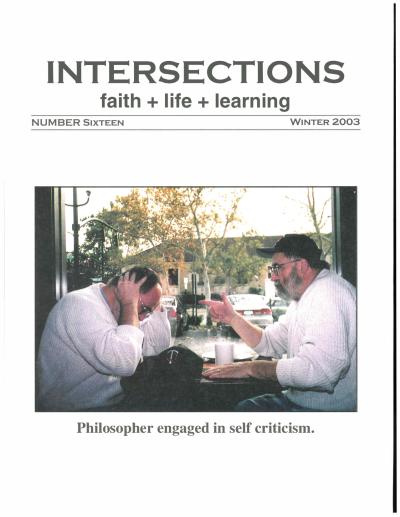
Christenson previews this issue’s papers from the Vocation of a Lutheran College Conference—Curt Thompson on “the Lutheran knot,” Carol Gilbertson on the creative dimensions of language, Bruce Heggen on theological vocabulary in the state university, Susan Poppe on the boundaries of campus freedom, and Sig Royspern’s oracular gems—welcomes Robert Benne’s response to the previous issue as a sign that Intersections is becoming a locus of continuing conversation, and confesses his reluctant consent to appear on the cover.
-
 Article
Leading Students to Distinguish Between Career and Vocation: Reflections from a Lutheran Law School
Steven C. Bahls
No. 20 · Fall 2004
Bahls, writing as former dean of the Capital University Law School, argues that most law students and many legal educators confuse vocation with career—asking “what kind of lawyer do you want to be?” rather than “who do I want to be?” Drawing on John O. Mudd’s five attributes of a well-prepared lawyer and Susan Daicoff’s empirical research on lawyer dissatisfaction and the “amoral professional role,” he turns to Ernest L. Simmons’s and Darrel Jodock’s articulations of Luther’s understanding of vocation and proposes five steps—reflection, assessment, vision, integrative thinking, and reassessment—along with explicit leadership from law school deans, engagement of career services offices, and leadership within the profession (illustrated by Capital’s joint venture with the Columbus Bar Association).
-
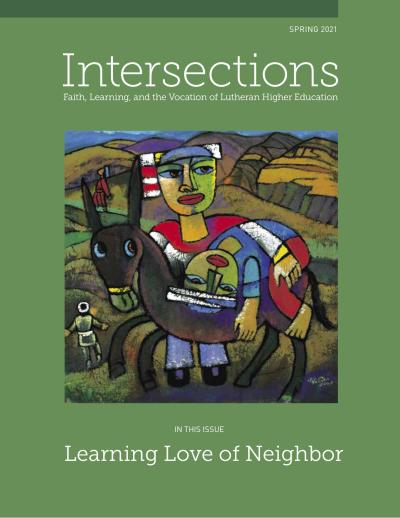 Article
Down and Out: First Year Students Encounter Lutheran Theology
Lindsey Leonard
No. 53 · Spring 2021
Leonard describes how Wartburg’s IS 101 first-year seminar wove the Dalai Lama, Paul Kingsnorth, Chimamanda Ngozi Adichie, and Mary Robinson’s Climate Justice into the Fall 2020 reader so the “COVID class” could encounter Lutheran theology’s call to serve the neighbor across the pandemics of disease, racism, and climate change.
-
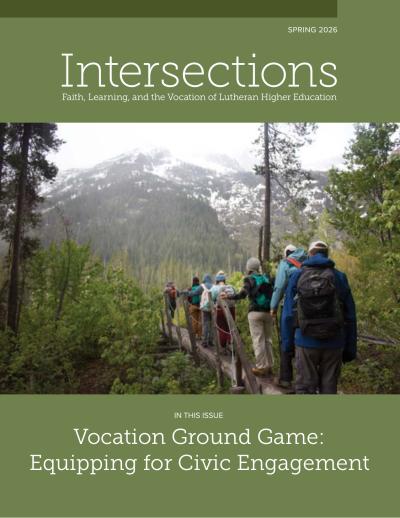 Article
Leaning-In to the Civic Lessons of Our Namesakes
A. Lanethea Mathews-Schultz
No. 63 · Spring 2026
6 min audio
Mathews-Schultz uses the civic legacy of the Muhlenberg family — from General Pete’s Revolutionary call to action to President Muhlenberg’s inaugural address on the “education of conscience” — to invite students at Muhlenberg College into a shared civic inheritance.
-
 Editorial
From the Editor
Robert D. Haak
No. 28 · Fall 2008
Haak frames the issue around “Lutheran conversations,” centered on the exchange between Robert Benne and Tom Christenson at Wartburg College’s ongoing campus conversation about what it means to be a “college of the church,” alongside Mark Wilhelm’s historical and social context, Lake Lambert’s sermon, and Bishop Mark Hanson’s short piece reprinted from The Lutheran—and points readers to the Lutheran Academy of Scholars seminar at Harvard as a place to continue the conversation.