My purpose in this article is to suggest that a college which takes seriously its Lutheran values is well positioned to foster inter-religious relations. I want students and faculty and staff who are Muslim or Jewish or humanist or Buddhist or Hindu to be able to say, “This is a good place for me to study and work because it is built on a Lutheran foundation.”
Just to be clear, I am talking about the Lutheran foundations of higher education. My purpose is to help everyone at a Lutheran college—whatever his or her personal faith—to understand and, I hope, appreciate the nature of the college or university where they work and study. This requires exploring some of the Lutheran theological principles and their implications. In no sense do I see this as disparaging other traditions or ignoring the gifts they have offer, nor am I blind to the mistakes that representatives of this tradition have made over the years. I do not want this discussion to make anyone feel like an outsider; this is about the college of which we are already a part.
To say that a Lutheran college is well positioned to foster inter-religious relations is to argue against a commonly held idea—namely, that it must reduce or renounce its religious commitments in order to treat others with respect and welcome them onto campus. I think a Lutheran college can be both religiously rooted and inclusive. I like to describe this combination as following a third path. This third-path option is in contrast, on the one hand, to those schools who value religious uniformity and require their faculty and staff to sign a statement of belief. These schools are religiously rooted but not inclusive. And, on the other hand, the third-path option is in contrast to those schools that have severed their ties to the faith of their founders and modeled their approach to religion after that followed by American society. These schools are inclusive but no longer religiously rooted.
A college that follows a third path takes seriously both its religious heritage and religious and other forms of inclusiveness. In order to do this, a third-path college distinguishes between its educational values and the Lutheran theological principles that anchor and inform those values. To illustrate this, think of a large bridge. Everything that happens at the college occurs on its expansive deck. The pillars that “hold up” this deck are its educational values—that is, the values that influence decisions about what does and does not happen on the deck. The footings are its theological principles. They anchor, support, and inform the college’s educational values (the pillars).1 A third-path college invites everyone on its campus to endorse its educational values and to appreciate the theological principles that undergird them, even if they do not personally subscribe to the Lutheran faith.
A Relational Theology
So, what is it about the character of this theological foundation that prompts a Lutheran college to continue on a third path? The partial answer is that Lutheran theology is thoroughly relational. Its focus is on the character and quality of relationships. The questions it asks are these: Does the relationship under consideration intimidate, or does it enhance the dignity and freedom and creativity of the other? Does it foster justice, or acquiesce to political or racial or economic injustice? My claim is this: the relational character of Lutheran theology enables it to deepen the educational mission of the college, not stifle or impede it, and inter-religious dialogue and understanding serve this educational mission.
I have to confess that I have difficulty finding short and simple ways to explain a relational theology. So I invite readers to think along with me as I spend some time trying to do just that. Let me begin by asking “What are some indications that Lutheran theology is thoroughly relational?”
“The relational character of Lutheran theology enables it to deepen the educational mission of the college, not stifle or impede it, and inter-religious dialogue and understanding serve this educational mission.”
One indication is its fondness for paradoxes. Again and again, Luther put two seemingly contradictory ideas next to each other and affirmed both. For example, he said that God is both hidden and revealed (to reveal is to uncover, so it would seem to be the opposite of hidden), and then went on to explain why this was so. He also said that believers are simultaneously justified (that is, right with God) and sinners (that is, not right with God). And that they are both free lords of all, subject to none, and dutiful servants of all, subject to all. It took him an entire treatise to explain this last paradox (“Freedom”). What paradoxes do is to invite people to look beyond the contrasting ideas to a deeper truth not fully contained in either—a deeper truth that is relational.
Another indication of what it means for a theology to be relational is that Luther objected to letting rules of behavior stand between one person and another. What takes priority is active love and deeds of service. If a person focuses on the other, listens to other, and uses wisdom to decide what to do, something good and beneficial will happen. Though ethical guidelines can be helpful, trying to follow rules undercuts generous listening and transfers the focus back to oneself rather than the neighbor. There was a time, for example, when I decided to practice the virtue of humility—that is, to follow the rule that it was good to be humble. As I went along, whenever I saw evidence of humility, I was proud of my accomplishment. I was like a dog chasing its tail, and the focus was firmly on me. Eventually I came to see that the best approximation of humility occurred when I forgot all about the rule, when the power of another person’s presence so captured my attention that I forgot about myself. The energy was coming from the other. It is this energy that a relational theology affirms.
Sometimes, love for the neighbor may even require a sacrifice of one’s own virtue. Dietrich Bonhoeffer, for example, sacrificed the ethical virtue of pacifism to participate in a plot to assassinate Hitler, when it became clear to him that this was the only way to end the deaths of thousands of other humans. He did not think this absolved him of responsibility or that murder had somehow become virtuous. He expected to be held accountable for his actions. Assassination was not right, but the effect on others of doing nothing was still worse. In the Lutheran tradition, the quality of relationships and their effects on the other take priority over obedience—even if the two are not always in conflict.
Still another indicator of a relational theology is that Luther’s primary concern was how the teachings of Christianity were applied and understood. On the basis of his own struggles and his own experience with others, he understood that doctrines could be interpreted either as ways to coerce obedience and conformity or as avenues to freedom and wholeness. A relational theology is concerned about the effect of words and ideas and doctrines. The basic principles Luther advanced were not new doctrines to be set aside other doctrines. Rather, his principles affected the way the teachings were interpreted. More important than the teaching itself was understanding its effect on the God-human and human-to-human relationships. In fact, a teaching could only be understood properly if its effect on relationships was taken into account. To wrap it up in a single sentence: in this theology, relationships do not serve beliefs, beliefs serve relationships.
“In this theology, relationships do not serve beliefs, beliefs serve relationships.”
And one final indicator of a relational theology is Luther’s concept of faith. Let me approach this concept a little differently, by asking first what the alternatives are to a relational theology. There are at least two. One is to regard religion as entirely inner, entirely spiritual. This approach seeks inner peace by isolating the self from the storms of life. There is nothing wrong with this as a religious option, but it is not consistent with the biblical image of what it means to be human, so it does not fit well with Christianity. The other option, far more common in American Christianity, is to insist that there is a set of ideas or beliefs to which a person must agree. To have faith is to accept these ideas. Endorsing them then becomes the pre-requisite for inclusion in the faith community. When viewed through such a check-list of required ideas, a person who practices any other religion automatically falls short.
How does relational theology understand faith? Faith is a response to a God who has already taken the initiative and in an act of sheer generosity reached out to be reconciled with human beings. Faith tags along after God’s action. It first of all acknowledges what God has already done and is doing. And then it grows into trust—a trust in God’s promises and a trust in the promiser. Just as a person who falls in love wonders, “How it is possible for my lover to view me as lovable?” so the person of faith wonders how God could possibly love the likes of me. And out of this wonder comes a quest to understand—a quest that is never quite satisfied. While it regards every idea about God and about faith to be incomplete and only partially adequate, it also regards every idea about God to matter, because it either highlights or obscures God’s generosity and its implications for human life.
A Relational Theology and Inter-Religious Relations
What does a relational theology mean for inter-religious relations? It means that the focus in on the other person, on getting to know that person, trying to understand how the world looks from his/her point of view, seeking to assist where help is needed, and joining in cooperation for the benefit of the larger community. The focus is not primarily on convincing the other to agree with my ideas about God and the world, but engaging with and befriending that person and seeking ways to cooperate for the benefit of the larger community.
This is not to say that ideas or beliefs are unimportant, because they can and do influence behavior—sometimes in harmful ways and sometimes in beneficial ways. Those beliefs that harm need to be challenged, and those that benefit need to be affirmed and celebrated—no matter whether they are associated with my religion or the religion of another. There is a time and a place for my dialogue partner to challenge the adequacy of my ideas about God and human life, and there is a time and a place for me to challenge the adequacy of his/her ideas about God and human life, but this is not where the relationship begins. We need to understand the effects of unfamiliar ideas before rejecting or endorsing them. And how we assess the beliefs held by the other person does not need to be decided in advance. Those decisions come later—after we have come to know and understand that person.
A college that expects religious uniformity closes its doors to persons who practice another religion, or it merely tolerates their presence. On the other hand, a college that has severed its religious roots achieves inclusivity by considering religion and religious practice to be entirely a private matter. Religion is not part of the public life of that college community. Its absence has the effect of asking people to check their religious identity at the gate. By contrast, a third-path college welcomes the whole person into its midst, inviting her or him into a conversation that it believes will benefit all parties, of whatever religious background. It does so, because it believes that relationships are themselves valuable.
The ultimate basis for this priority is the biblical image of shalom, which is identified there as the goal of God’s activity, a goal we are called to share. Shalom involves whole, healthy relations between God and humans, among humans, and between humans and nature. In the Bible it is more often pictured than defined—portrayed as a time when the wolf lies down with the lamb, or a time when swords are beaten into plowshares and spears into pruning hooks and no one learns war any more, or a time when persons go the second mile and turn the other cheek, or a time when a city is created here on earth with its gates open for all, with enough food, water, and medicine for all, and no temple because God is so close at hand. Forming a healthy relationship with persons from another religion is itself one step toward shalom. Cooperating in ways that benefit others is itself another step toward shalom. Of course, still more steps are needed, but drawing boundaries and refusing the cross them is not moving in the right direction.
“A third-path college welcomes the whole person into its midst, inviting her or him into a conversation that it believes will benefit all parties, of whatever religious background.”
A Communal Theology
If a theology is relational, it is also communal. In isolation, humans are incomplete. Only as part of a healthy community can they be fully human. When a community of faith functions correctly, it is a place to practice shalom, a place of support and encouragement, a place of instruction and feedback, a place to participate in rituals that celebrate the importance of human community.
Because a relational theology is communal, it understands inter-connectedness and cares about the wellbeing of the entire larger community. One small aspect of such a concern is practicing good citizenship. In America, this means making decisions about the common good. Which candidate holds positions that are most likely to serve that common good? What voluntary organizations should I support because they serve the common good? What advocacy project should I join because it serves the common good? All of these questions and decisions come into play in a Lutheran college because part of its vocation is to educate community-oriented citizens and community-oriented leaders.
This brings us back to inter-religious relations, because as I try to discern and articulate the common good, I need to understand not only how a proposal will affect me and others like me, I also need to know how it will affect those segments of our cities, states, and nation that are unlike me. Developing good relations with people in other religions and listening to what does or does not benefit them is a crucial step in discerning the common good, just as is listening to the poor, listening to those of another race, listening to immigrants and refugees, and listening to the differently abled. As a Lutheran college helps its members develop a healthy vision of the common good, providing access to religious diversity is a valuable asset. It is part of the college’s calling, of its vocation.
“Developing good relations with people in other religions and listening to what does or does not benefit them is a crucial step in discerning the common good, just as is listening to the poor, listening to those of another race, listening to immigrants and refugees, and listening to the differently abled.”
For Luther, the one thing that makes an action good is that it benefits the neighbor. A relational theology finds no reason to exclude the person of another religion from being my neighbor.
A Lutheran Understanding of Freedom, Limits, and Human Nature
“Freedom” is a word that is used frequently in our society. Most often it means doing what I want without anyone else getting in the way, or being allowed to make a choice without any coercion. Given this usage, its implications are often a matter of debate in the political sphere. How much regulation should there be and how much should individuals be able to do whatever they want? Whether we are discussing environmental protection or gun control or health insurance or motorcycle helmets, debates are bound to arise about how much freedom is desirable. Whatever the disagreements about its political implications, no one doubts that in America freedom is valued and politically important.
Deeper Freedom
What I want to suggest is this: when Lutheran theology talks about freedom, it is talking about something deeper. To begin to envision what I mean, ask yourselves the question, when I make a free choice, why am I choosing what I do? Do my choices reflect a deeper slavery? A person can freely decide to buy this kind of car rather than that kind of car and still be enslaved to consumerism, to the notion that my life is enhanced by possessing things. A person can freely decide to vote for this candidate rather than that and still be enslaved to something deeper, to an overly simplistic political ideology that is potentially harmful to other groups in society. A person can freely decide to major in biology rather than music and still be following a deeper script about good jobs and success that the student has been absorbed from peers or parents or other adults. Deeper freedom operates at this level.
Or we can begin to envision what I mean by noting that typical American usage of the word “freedom” is highly individualistic. To be free, according to this view, is to be unencumbered by committed relationships. Hence all the jokes at weddings about the bride and groom losing their freedom when they get married. But, is there not a deeper freedom that can be found within a healthy relationship where partners are committed to each other? When Lutheran theology talks of freedom, it has in mind a relational freedom.
How then can we talk about a freedom that is deeper and is not individualistic? Lutheran theology talks of a “freedom from” and a “freedom for.” Perhaps we can start with an example. In the midst of the Holocaust, there were a few individuals in every Nazi-occupied country who became rescuers. They hid or protected Jews or Gypsies or others targeted by the Nazis—even though, if caught, the punishment was death not only for themselves but also for their families. They exhibited the kind of deeper freedom I have in mind. They were “free from” the onslaught of propaganda to which they had been exposed that labeled the victims as a danger to society and “free from” the threats of the Nazis. They were “free for” counting among their neighbors anyone in need, even wounded enemy soldiers or Jews or Gypsies or targeted peoples of another religion or race. They exhibited a universalistic perception of the needy (Tec 176-80). They were free enough to pay more attention to their neighbor’s problems than to their own. They were free enough to act in unusual and unauthorized ways. They were free enough to come up with highly creative ways to help. They were, in short, both “free from” the fear that came from the polarizing and paralyzing scripts to which they had been exposed and “free for” the neighbor. Such freedom is inherently relational, because it takes the neighbor seriously enough not just to honor his/her humanity but also to act to protect that humanity.
“Lutheran theology talks of a ‘freedom from’ and a ‘freedom for.’”
It is interesting to note that scholars who have studied the rescuers have wondered about the role that religion played. The answer seems to be that it depends on what kind of religion a person espoused. If a person had a narrow concept of religion—where the limits of one’s responsibility ended at the boundary of his or her faith community, this form of religion got in the way of rescuing the victims. And if religion and nationalism were too intertwined, this also got in the way of rescuing the victims. On the other hand, if one had a broader understanding of the two highest commandments (shared by Christianity, Judaism, and Islam), to love God and to love one’s neighbor as oneself, then religion was an aid. Folks with this sort of religious outlook have reported that what went through their mind as they decided how to respond to the victim’s request for help was a story: the parable of the Good Samaritan (Luke 10:25-37), the rich man with the beggar at his gate (Luke 16:19-31), or people gathered before the Son of Man, some of whom are commended for visiting him in prison, feeding him when he was hungry, clothing him when he was naked (Matt 25:31-46). In this case their religious resources and commitments undergirded their freedom.
How does such deeper freedom come about? The experience of generosity is what produces it. In other words, it takes relationships in which I am the recipient of generosity to free me to be able to create a relationship in which I practice this generosity. Lutheran theology affirms that God shows us this kind of undeserved generosity and invites us to pass it along. And, if we are fortunate, other humans do the same and invite us to pass it along. I once heard a story of a young boy who had been bounced from one foster care home to another. Each time the foster parents came back in tears saying, “We’ve tried everything we know, but he continues to be disruptive at school, in the neighborhood, and at home.” After yet another return, someone suggested placing him with an elderly couple who had been asking for a child but did not meet the criteria. The people in charge agreed. A few weeks went by, then a few months, and the couple did not come back. The people in charge went to visit. Things were not perfect, they discovered, but they were working. They asked the parents what they did. They said they didn’t know. They asked the school authorities what had happened. They said they didn’t know. So, with nowhere to turn, they sat down with the couple and asked, “Tell us exactly what you said and did from the very beginning.” The parents answered, “Well, we knew this was our only chance, so the very first thing we told him was ‘So far as we are concerned, you are and will be our son, no matter what.’” On the basis of that relational security, the young man was free to change, free to listen to others, free to think of others. He had been the recipient of generosity—of a commitment to him before he did anything to deserve it. What ended Luther’s religious turmoil was the insight he discovered in the Bible that God is like this couple, saying, in effect, “You are my child, no matter what.”
“What ended Luther’s religious turmoil was the insight he discovered in the Bible that God is like this couple, saying, in effect, ‘You are my child, no matter what.’”
In order to be free from and free for, in order to value others, I need to feel valued. I need to be valued, both by God and by humans. That is why a community is important. And that is why a Lutheran college strives to create the kind of community in which faculty, staff, and fellow students are inspired to treat anyone and everyone with this kind of generosity. My freshman week in college was a complete blur. I was totally unprepared and totally overwhelmed. I knew no one and was 350 miles from home in the days when long distance calls were so expensive they were for emergencies only. But one statement still sticks in my memory. When I wandered in for an audition with the director of the concert band, he must have recognized what was happening and said, “Just remember, Darrell, here you are among friends.” To someone more lonely and confused than he had ever been, this was an experience of generosity. And, I am happy to say, it was only one of several similar experiences of generosity, all of which kept me there. In order to survive and flourish, I needed this generous hospitality. The person in another religion needs it; we all need it.
By now, I hope it is evident how deeper freedom affects inter-religious relations. Those who have experienced generosity are equipped to show generosity to others, no matter what the religious persuasion of those others. Their deeper freedom allows them to see on the other side of any boundary creatures of God also loved by God, whether that boundary is political or social or racial or economic or religious. Their deeper freedom breaks open their own bonds of social prejudices and stereotypes and fears.
I do not want to underestimate the importance of yet another factor—it is education. Education helps us identify and recognize the social prejudices and stereotypes and fears to which we have been exposed. And, when done well, education helps us understand the factors that have led to the boundaries, have made that group’s experience different from ours, and have shaped their religion. Education can enhance our deeper freedom. That is why the Lutheran tradition has valued it so highly!
A Theology of Limits
Alongside of this concern for a deeper freedom, the Lutheran tradition also adds another emphasis. Luther was upset about the theology of his day for claiming to know too much. What it did was to take an idea from the Bible and infer from it answers to questions not addressed in the Bible. It then took all of these answers and organized them into a systematic whole, which obscured the difference between what had been borrowed from the Bible and what had been inferred.
A contemporary version of this kind of approach is any attempt to answer the question—when and how will the world end? It is a question not answered in the Bible, and every attempt to answer it jerry-rigs together assumptions, inferences, and snippets drawn haphazardly from various parts of the Bible, all arranged like one would lay out pieces of a jigsaw puzzle. And it then claims biblical authority for this mixture. Though at first Luther thought the Bible provided all the answers, as he studied and studied he came to recognize that we humans are left with many unanswered questions. What led him to see this was noticing that the Psalmists often voiced questions for which they provided no answer, as did Jesus himself, who said he did not know when the end was coming. To give it a name, what this means is a theology of limits. Some things are known, others are not. As humans, there is no way we can understand God fully or the world fully or even ourselves fully. A theology of limits avoids claims that exaggerate what little we do know, and it raises doubts about the claim to completeness made by any ideology—whether political or scientific or ethical or religious. The security of a divine-human relationship built on generosity is what allows humans to live without pretense and to live within these limits.
Inter-religious relations is one place that a theology of limits comes into play. In his Epistle to the Romans, Paul spends three chapters trying to figure out God’s relationship to the Jews who had not accepted Jesus as the Messiah. After three chapters, he comes to no conclusion. He throws up his hands and ends with a doxology; “O the depth of the riches and wisdom and knowledge of God! How unsearchable are his judgments and how inscrutable his ways! . . . For from him and through him and to him are all things. To him be the glory forever. Amen” (Rom 11:33, 36). If Paul could live without understanding God’s relationship to those on the other side of a religious boundary, then a theology of limits can live without understanding God’s relationship to other religions.
Not only does a theology of limits affect one’s view of the other, it also affects one’s view of oneself. If I do not understand fully, then I always have something more to learn. When I begin talking with a person in another religion, I do not know in advance what I will learn. I do not know how my world will be expanded or how it will be re-shaped by an alternative perspective. A theology of limits means I enter into the relationship expecting to learn something.
“I do not know how my world will be expanded or how it will be re-shaped by an alternative perspective. A theology of limits means I enter into the relationship expecting to learn something.”
I am not saying, however, that expecting to learn something and to have one’s world re-shaped includes expecting to lose one’s own faith. The experience of those engaged in inter-religious dialogue is that this is seldom the result. What is challenged is my understanding of my own faith, not my faith itself. Almost universally, each participant in an inter-religious encounter comes away with a deeper understand of and appreciation for their own religion. They come away seeing in it things that they had never noticed or never appreciated before, while at the same time coming away with a deeper understanding and appreciation for the religion of the dialogue partner. When the Institute for Jewish-Christian Understanding at Muhlenberg College was formed, one of its first steps was to organize living-room dialogues between members of Christian congregations and members of Jewish congregations. Participants soon sensed they needed to know more both about their own religion and about the religion of their conversation partners. They requested that the Institute offer classes to increase their understanding of both religions.
A Complex Anthropology
Let me make one additional observation. The Lutheran tradition has been very clear that humans are a complex mixture of goodness and evil, of love and cruelty, of faith and unfaith. Participation in a community of faith does not magically change that, so a church is also a mixed body, with people of all sorts and degrees of commitment and of freedom in it. If this is true of one religion, it is likely true of others. So, it is important to remember that when we engage with people from another religion, it is persons engaged with persons, not one religion engaged with the other. People on either or both sides might well be uninformed about their own religious tradition. People on either or both sides might be poor embodiments of that to which their religion aspires.
So, inter-religious dialogue may also expose us to the challenges that arise from dealing with flawed human beings. These experiences are disappointing, to be sure, but they should not result in new stereotyping or new disengagement. We would do well to follow Luther’s advice in his explanation to the 8th commandment, to “put the most charitable construction on all our neighbor says and does.” Otherwise inter-religious relations will be counterproductive, producing new enmity and new stereotypes rather than new cooperation, reinforcing boundaries rather than fostering a new harmony and a new understanding.
So, a Lutheran college—or any community—built on the principles of deeper freedom, of limited knowing, and human complexity is well equipped to support and encourage inter-religious relations.
Lutheran Resources for Overcoming Anxiety and Fear
Our project has been to show why the theological foundations of a Lutheran college support inter-religious relations. We have discussed the relational character of Lutheran theology. We have discussed its concern with deeper freedom and its theology of limits. In this third section I want to begin by asking, what gets in the way of inter-religious understanding? Why have there been incidents where places of worship have been vandalized? Why have we been exposed to so much public rhetoric that targets refugees or members of another religion?
Yes, for some, there may be beliefs that get in the way, but the larger answer to what stifles inter-religious understanding is anxiety and fear. Please bear with me as I try to characterize the larger setting, and then I will return to inter-religious relations.
Fear and anxiety are not the same thing. Fear is focused. When I am afraid, I am afraid of something—a speech at a conference, a tornado, a speeding car that may not stop, an angry encounter, or whatever. When the cause of the fear disappears, it comes to an end. By contrast, anxiety is more free-floating. It is pervasive rather than focused. It arises from things that seem out of one’s control. It attaches itself to any fear that comes along and, in so doing, heightens that fear, making it less manageable.
Anxiety
Let’s first consider anxiety. There seems to me to be a high level of anxiety in America. What is fueling it? Many things. Americans are, for example, anxious about our country’s role in the world. Do we dominate or cooperate? Americans seem not to have found a credible story to guide their expectations for the future and their sense of national identity in today’s world. Moreover, our sense of entitlement has been threatened. We are anxious that scarce resources will mean new consumption patterns and such changes will threaten our consumerist expectation that possessions create the good life. Americans are anxious about the even more significant adjustments required to slow down climate change. And those workers left behind after the recession are understandably anxious about wages and employment and changing global economics. Middle-class Americans are anxious about sliding down the economic scale. And, finally, many are anxious about the changing face of America, about losing white privilege and losing Christian privilege. What has been seems threatened, and, without an alternative vision, the result is anxiety. Jim Wallis tells the story of visiting a fifth-grade class in 2013 in Washington, D.C. Here are his words:
They were studying the subject of immigration and invited me to speak about it. First, we went through the long history of immigration in this country. All the children in my son’s class learned that they were part of our national history—of people who had chosen to come to America (or were forced to by the chains of slavery). So they all heard the history of their own ancestries.
Then I told the students about our current problem of 11 million undocumented people living in uncertainty and fear for years and even decades; being unable to safely obtain medical care and police protection; being exploited without protection by unscrupulous employers; and, most painfully, being separated from family members, with fathers and mothers being torn away from their children. Hardworking and law-abiding people were being deported every day—at that time about 1,100 per day.
Looking very surprised, these students asked the obvious question, “Why don’t we fix that? Why doesn’t Congress change the system?”
I answered, “They say they’re afraid.”
The students looked even more confused and asked, “What are they afraid of?”
I paused to consider their honest question and looked around the room— . . . at . . . a group of African American, Latino, Asian American, Native American, and European American children. Then it hit me.
“They are afraid of you,” I replied. [Using my terms, he could have said, “You are the source of their anxiety.”]
“Why would they be afraid of us?” the shocked students asked, totally perplexed. I had to tell them.
“They are afraid you are the future of America. They’re afraid their country will someday look like this class—that you represent what our nation is becoming.”. . . “They are afraid this won’t work,” I said, “Does it work?”
The children looked at one answer, then responded with many voices, saying, “Yeah. . . Sure. . . Of course it works . . . It works great . . . It’s really cool!”
Together we decided that our job was to show the rest of the country that this new America coming into being is, in fact, really cool. (Wallis 187-88)
What anxiety does is to decrease our capacity to learn, replace curiosity with a demand for certainty, stiffen our position, prompt a desire for a quick fix, foster either-or thinking, diminish flexibility, and create imaginative gridlock that prohibits one from being able to think of alternatives, options, or new perspectives (Steinke 8-9). More than anything, anxiety exaggerates fears.
Fear
So, how does fear enter the picture? It assumes that those whose ideas differ from ours are dangerous. They are poised to undermine everything we value. Fear selects a target upon which to focus our anxiety. The unsavory acts of a few are often mistakenly associated with the whole. Our discomfort in unfamiliar settings makes maintaining existing boundaries easier than stepping over them. Crossing over boundaries requires us to revisit the most basic questions of identity and purpose, and this mean confronting our own insecurities. Doing so is never comfortable. Yes, there are credible dangers, but too often some politicians and political pundits cultivate fear to serve their own purposes. In so doing, they enhance the polarization that already paralyzes our public life.
“Fear assumes that those whose ideas differ from ours are dangerous. They are poised to undermine everything we value.”
What fear does is slightly different from anxiety. It transforms social boundaries into barriers and demonizes those on the other side. And very often, religion gets drawn into the fray, as differences and antagonisms that are not fundamentally religious are ascribed religious significance. What all of this suggests is that when we are confronted by public suspicion and misunderstanding of another religion, we are confronted by something deep and complex.
Theological Resources to Combat Anxiety and Fear
So, my question is, what theological resource does a Lutheran college have to address this current, public anxiety and fear with regard to other religions?
My answer is that it offers a down-to-earth image of God, an image of an active God at work behind the scenes to foster shalom. This claim requires some explanation. There are, I think, three common images of God prevalent in our society. One sees God above it all, in control of everything, micromanaging, we could say, so that everything that happens is either specifically willed by God or, if not willed, then specifically allowed. A second image sees God above it all, running an orderly world, but a world that from time to time needs intervention. So God occasionally interrupts the orderly sequence. A third image sees God above it all, setting up the rules but then letting things occur without intervention. God sits back and lets human events unfold until at the end of each person’s life stepping in to restore justice—by means of rewards and punishments in an afterlife. In all three of these views, God is above it all, and the world is fairly well-ordered. Our job is to make sense of it and fit into the established pattern. Luther’s image is different. According to his view, God has given humans a great deal of freedom to influence what happens, and this freedom has led to a confusing, disorderly world. What God does is not to stand above it all, but to enter into the fray. God does this, not by intervening here or there, but by working behind the scenes, working incarnationally—that is, in and through creatures, in and through human beings—to invite and nudge the world into shalom.
This behind-the-scenes activity means at least two things:
First, it means that discerning specifically what God is doing is not easy. Events are not stamped with a sign that says “caused by God” nor are they readily noticeable interruptions of the natural order. The difficulty is heightened because our finitude, our limited perspective, keeps influencing what we think we see. For example, Hal Lindsey’s 1970 book, The Late Great Planet Earth, sold millions and millions of copies, as it predicted the order of events that would end the world. Looking back on the book 46 years later, it is interesting to see that the bad guys are all nations on the other side of the cold war and the good guys are all allies of America. The author’s outlook directly, though likely not consciously, influenced his interpretation of Daniel and Revelation and his perception of what God was up to. So, mindful of our limits, we are left with the task of discerning as best we can what does or does not contribute to wholeness and peace and justice. To guide us we have the many biblical images of shalom that I mentioned in my first presentation.
“Mindful of our limits, we are left with the task of discerning as best we can what does or does not contribute to wholeness and peace and justice.”
Secondly, this view of God means that there is hope, even when the problems loom so very large and so very intractable. God has a way of taking dry bones and making them live, of raising up new leaders in the darkest of times, of inspiring both the old and the young to dream dreams and roll up their sleeves to work for change. Rabbi Irving Greenberg has defined religious hope as “a dream which is committed to the discipline of becoming a fact” (8), and that’s the kind of hope that a down to earth, behind the scenes, active God can inspire. Such hope is the best antidote to anxiety and fear.
So, how does this affect inter-religious relations? It means that a Lutheran college enters into such explorations with hope—the hope that whatever good comes out of our engagement serves to increase shalom, with the confidence that we can count on God’s presence, and with the expectation that, however deep and real the differences between religions, with a dose of generosity, their adherents can find ways to work together for peace and justice in the world.
Fear Not
The louder the rhetoric that vilifies another religion, the higher the barriers become and the more frightening it is to cross them. Time and again (in fact, over 200 times), we find in the Bible the words “fear not” or “do not be afraid” when someone encounters the divine. Often this occurs when a biblical figure is asked to cross a boundary and is called to a new task. We think of Moses at the burning bush, reluctant to go back to Egypt. Or of Jonah, reluctant to go to Nineveh, Israel’s enemy. Or of Joseph, called to become a refugee in Egypt in order to save the life of his son. For all of these figures and many others, the borders seemed so imposing. Yet, such persons hear from God, “Do not be afraid, I will go with you.”
“Time and again (in fact, over 200 times), we find in the Bible the words ‘fear not’ or ‘do not be afraid’ when someone encounters the divine.”
Not only does Lutheran theology count on the gracious presence of God, it also affirms that God is already at work on the other side of the boundary. Despite Luther’s inattention to inter-religious relations and the serious mistakes that he made in this arena, he was very clear that the down-to-earth God in whom he believed was at work in every society. Even though Germany and the Holy Roman Empire were at war with the Turks, and even though the Turks were enjoying successful campaigns that brought them as close as Vienna and inspired widespread fear, he could see God at work in their midst. Through their parents, God was giving Muslim children good gifts, and through those rulers who ruled wisely, God was giving Muslim citizens good gifts. The implication is this: in an inter-religious encounter, a person who acknowledges being gifted by God meets another recipient of God’s gifts. “Do not be afraid,” for God is already at work on the other side of the boundary we are being asked to cross.
My guess is that anxiety and fear will not disappear from our society any time soon. If so, reaching across religious boundaries is not going to be something we do because it is nice or because it is merely interesting. It is going to require some commitment in the face of societal anxiety and societal fear. The theological foundation to support this commitment includes the behind-the-scenes activity of God who is at work to fostering whole, healthy relationships all around, and it includes God’s invitation for humans to serve this same goal. This footing can anchor a Lutheran college’s commitment to inter-religious relations, even in the face of adverse pressures.
When Basic Values Differ
In addition to societal anxiety and fear, there is another problem. Inter-religious understanding and cooperation are not always easy. The planning committee for this conference posed the question, “How do we relate to those whose basic values are fundamentally different from ours?” Sometimes these differences occur within a faith community and at other times they occur between religions. In either case, this question is a difficult one, well worth serious and extended discussion. I do not pretend to have the answer. But I see no alternative other than beginning with a generous hospitality and a generous willingness to listen.
An ecumenical institute2 of which I am a part calls this the first-person method. In an ecumenical consultation, everyone at the table shares his/her own story and then listens to the stories of the others to learn what brought their conversation partners to their present stance. Only after this does the group tackle the topic that divides them. If we think of other settings, it helps if an occasion can be found to surprise the other with an act of love, concern, or assistance. Once some level of personal understanding and trust has been established, then the differences can be explored. A combination of attentive listening and generous action is what forges a connection, on the basis of which the two parties can search for moral common ground. It takes a good amount of the deep freedom that we discussed in section two and the fearlessness we have been discussing in this section to engage in this process without defensiveness. I see no easy shortcut through this hard and challenging work, and I can offer no guarantees that it will always work. But, if we are called to foster shalom and to work for the common good, then we can never escape the assignment of seeking and identifying moral common ground.
But there is another factor. It takes committed leadership on both sides of a basic difference to be able to convince the forces of mistrust in one’s own religion that there is another way. Educating and inspiring such leaders in faith communities—both Christian and non-Christian—is part of the vocation of a Lutheran college.
Wisdom and a Sense of Agency
Let me come back to Lutheran higher education. Lutheran higher education has two very basic educational values—fostering wisdom and fostering a sense of agency guided by wisdom and by vocation. Let us consider first one and then the other.
Wisdom. Anyone who is free from established scripts needs wisdom to guide their behavior. By wisdom, I mean an understanding of humans and of communities, how they react and what they need to be whole and healthy. Good intentions alone are not enough. Wisdom is what can guide those intentions in ways that actually benefit the other. When Luther wrote to the city councils of Germany, urging them to create schools for all young men and young women, he identified wisdom as the goal and suggested that it be found by examining the history of all the peoples of the world—what they did that went well and what they did that got them in trouble (“To the Councilmen” 368-69). The scope of this education encompasses human history, its many religions, and its many cultures. Even the wisdom found in the Old Testament (in Proverbs and Ecclesiastes, for example) is not distinctively Israelite. It was gathered from all the surrounding cultures. Wide-ranging study, including exposure to other religions, is thus an important pathway to wisdom, as long as it involves the kind of engagement that moves beyond knowledge to dialogical understanding. The point is this: when a college facilitates inter-religious understanding, it is embodying one of its core values—that of fostering wisdom.
“Wide-ranging study, including exposure to other religions, is thus an important pathway to wisdom, as long as it involves the kind of engagement that moves beyond knowledge to dialogical understanding.”
A sense of agency. What I mean by agency is a sense that I can do something, however small, to influence and benefit the world around me. To gain the courage to act, I need someone who believes in me, I need a vision of wholeness, I need some experience of getting things accomplished, and I need a support community. These a college can provide—not only for its undergraduates, but, I would advocate, for its alumni and friends. What anchors this empowerment is a sense of vocation built on God’s down-to-earth activity in the world. In addition to extending and deepening a person’s sense of vocation, Inter-religious engagement can develop a person’s sense of agency and thereby advance the educational values of a Lutheran college.
The foundation provided by Lutheran theological principles offers a college hope in the face of both anxiety and fear. The wisdom and the sense of agency it fosters help move the overall project forward so that boundaries do not become barriers and the future can move toward shalom.
Conclusion
My claim has been that Lutheran principles anchor, support, and inform a college’s commitment to inter-religious relations. These principles encourage it to follow a third path—both religiously rooted and inclusive—and to do so both for the sake of educating and equipping students and for the sake of advancing the common good.
Endnotes
1. A religiously uniform college moves directly from its theological principles to decisions about life on the deck; it collapses the footings and the pillars. A college that has severed its ties has no theological footings. Thus, neither makes this distinction.
2. The Collegeville Institute for Ecumenical and Cultural Research, located on the campus of St. John’s Abbey and University, Collegeville, Minnesota.
Works Cited
Greenberg, Rabbi Irving. “Judaism and Christianity: Their Respective Roles in the Strategy of Redemption.” In Visions of the Other: Jewish and Christian Theologians Assess the Dialogue, edited by Eugene Fisher. New York: Paulist Press, 1994.
Lindsey, Hal. The Late Great Planet Earth. Grand Rapids, MI: Zondervan, 1970.
Luther, Martin. “The Freedom of a Christian,” Luther’s Works (American Edition), volume 31. Philadelphia: Muhlenberg, 1957.
———. “To the Councilmen of All Cities in Germany That They Establish and Maintain Christian Schools,” Luther’s Works (American Edition), volume 45. Philadelphia: Muhlenberg, 1962.
Steinke, Peter. Congregational Leadership in Anxious Times. Herndon, VA: Alban Institute, 2006.
Tec, Nechama. When Light Pierced the Darkness: Christian Rescue of Jews in Nazi-Occupied Poland. New York: Oxford University Press, 1986.
Wallis, Jim. America’s Original Sin: Racism, White Privilege, and the Bridge to a New America. Grand Rapids, MI: Brazos, 2016.
-
 Editorial
From the Publisher and Editor
Jason A. Mahn, Mark Wilhelm
Writing weeks after the 2016 presidential election, Wilhelm and Mahn frame interfaith engagement as the urgent and ongoing work of ELCA colleges and universities, recap NECU’s growing commitments to inter-religious leadership, and introduce essays first delivered at the summer 2016 Vocation of a Lutheran College Conference under the theme “Preparing Global Leaders for a Religiously Diverse Society.”
-
Article
Laboratories for Living in a Diverse World
Elizabeth Eaton
Presiding Bishop Elizabeth Eaton argues that ELCA colleges and universities are called to be laboratories for living in a religiously diverse world. Reflecting on the decline of Christian privilege, the ELCA’s ecumenical and inter-religious work, and her own experience addressing the Islamic Society of North America, she offers three questions about partnerships, formation, and institutions as platforms for new collaborations.
-
Article
Why Interfaith Work is Not a Luxury: Lutherans as Neighboring Neighbors
Martha E. Stortz
Stortz argues that interfaith work is not a luxury but a constitutive commitment of Lutheran higher education — institutions she describes as both “faith-based and interfaith-dependent.” Reading the parable of the Good Samaritan as both an intra-faith and inter-faith encounter, she offers a four-fold matrix of theological reflection, spiritual engagement, social action, and everyday experience as portals into the work of being neighbor.
-
Article
The Promise and Peril of the Interfaith Classroom
Matthew Maruggi
Maruggi draws on his years teaching in the Augsburg religion department to identify three pairs of seeming opposites — dialogue and debate, safety and risk, commonality and particularity — that, held in creative tension, nurture a vibrant interfaith classroom where pluralism is actively engaged rather than merely present.
-
Article
Risky Speech–Gifted Friendships
Sonja Hagander
Augsburg College Pastor Sonja Hagander reflects on pastoral care across faith traditions — from a campus chapel service after the 2008 murder of Muslim student Achmednur Ali, to her decade-long friendship with Jewish colleague Barbara Lehmann — and reads the Gospel of John as a roadmap for interfaith friendships marked by love, free speech, public space, and a willingness to risk being changed.
-
Reflection
Mapping Interfaith Encounters
Callista Isabelle
Muhlenberg College Chaplain Callista Isabelle uses a student-designed subway map of religious and spiritual communities as an image for interfaith engagement — one that invites students to leave their “home” stations, encounter common ground and respectful disagreement, and explore the major intersections where religion meets science, environment, and mental health.
-
Article
Negotiating Legitimate and Conflicting Values
Eboo Patel, Katie Bringman Baxter, Mark S. Hanson
In a closing-day conversation at the 2016 Vocation of a Lutheran College Conference, Mark Hanson and Eboo Patel — moderated by Katie Bringman Baxter of Interfaith Youth Core — share case studies in which legitimate religious values come into tension with one another, and make the case that Lutheran colleges should teach interfaith leadership through the hard cases rather than the easy ones.
-
Institutional Focus
Interfaith Campus Organizing at California Lutheran University
Allison Bermann, Mehak Sachdev
California Lutheran University students Allison Bermann and Mehak Sachdev describe how interfaith participation at CLU grew from a grassroots movement into a sustained, integrated part of campus identity — with an intern program, Interfaith Allies, co-curricular events from Diwali dinners to Hunger Banquets, and a classroom practice of storytelling that opens the required Introduction to Christianity course to students of every faith and none.
-
 Article
In a Diverse Society, Why Should Lutheran Colleges/Universities Claim their Theological Roots?
Darrell Jodock
No. 49 · Spring 2019
Jodock develops his “third path” account of the Lutheran college — neither sectarian nor non-sectarian but both rooted and open — analogizing the college to a bridge whose deck of daily activities rests on pillars of shared educational priorities, which in turn rest on theological footings; he then answers six common objections to claiming Lutheran roots and explains why those footings still matter.
-
 Article
Vocational Leadership
Darrell Jodock
No. 41 · Spring 2015
Jodock proposes “vocational leadership” as a name for a distinctive educational value at the heart of a Lutheran college — one that seeks to benefit the neighbor and the community, inspires and invites others to participate in that service, and is institutionally anchored in the Lutheran concept of vocation. He unpacks twelve facets of vocational leadership and ties them to Luther’s own leadership around indulgences, public schooling, and beggary.
-
 Article
Gift and Calling: A Lutheran Perspective on Higher Education
Darrell Jodock
No. 34 · Fall 2011
Jodock argues that a Lutheran perspective on higher education rests on three underlying ideas—that we are gifted (a giftedness that calls forth wonder, awe, gratitude, a sense of humor, and vocation as response to neighbor); that the Lutheran tradition affirms a particular kind of God who is down-to-earth and at work in the world for justice and human wholeness; and that a Lutheran “third path” can be both rooted in the tradition and inclusive of others. He draws out ten implications for higher education, from wonder as the heart of religion through liberal learning oriented toward the freedom of its members.
-
Reflection
Fumbling Toward Integrity: A Sermon on Mark 8:34-38, Pastor Kaj Munk, and Father Maximilian Kolbe
Darrell Jodock
No. 34 · Fall 2011
Preached at the 2007 ELCA Convocation of Teaching Theologians at Lenoir-Rhyne College, Jodock holds up two World War II martyrs—Polish Franciscan Father Maximilian Kolbe, who took the place of a condemned father in Auschwitz’s starvation bunker, and Danish pastor-playwright Kaj Munk, who was shot by the Nazis after helping save 97 percent of Denmark’s Jews—as mirrors for our own priorities. Drawing on the rescuer characteristics identified by Samuel and Pearl Oliner (agency, moral independence, universalistic caring, a history of care-giving) and on Jesus’s words in Mark 8:34-38, Jodock asks how we who routinely opt out at the first sign of opposition might fumble toward integrity in our own time.
-
 Article
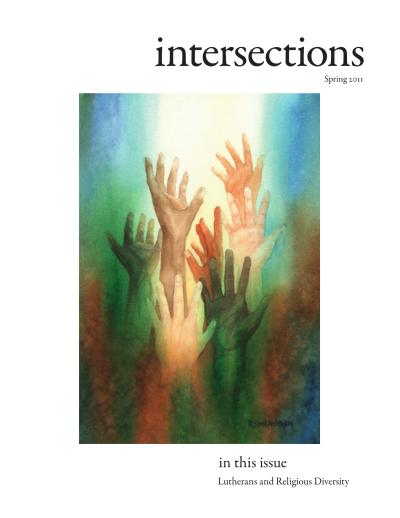
Vocation of the Lutheran College and Religious Diversity
Darrell Jodock
No. 33 · Spring 2011
Jodock describes a “third path” for Lutheran colleges that is both rooted in the Lutheran tradition and inclusive of religious diversity — an alternative to sectarian and non-sectarian default models — and identifies six interlocking features of the Lutheran tradition (giftedness, an engaged God, wisdom, caution about claims to know, community, and an emphasis on service and community leadership) that shape how such a college engages interreligious dialogue and civil discourse.
-
 Article
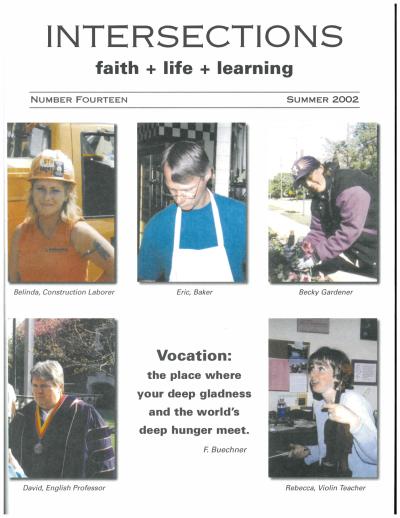
Vocational Discernment: A Comprehensive College Program
Darrell Jodock
No. 14 · Summer 2002
Jodock, whose Gustavus Adolphus was one of twenty colleges to receive a Lilly “Theological Exploration of Vocation” grant in 2000, defines vocation not as occupation but as a self-understanding that nests the self in community. Reading Robert Putnam’s Bowling Alone on the collapse of secondary communities alongside Luther’s ethic of community benefit and five Lutheran principles (graciousness, Christian freedom, community, God active in the world, the theology of the cross), he walks through Gustavus’s three-level design—a definition of vocation open to other faith traditions, “middle principles” drawn from Sharon Parks’s Common Fire, and a long menu of programs coordinated by a new Center for Vocational Reflection—hoping that, in the language of Holocaust studies, graduates will be “resisters” and “rescuers” rather than bystanders.
-
 Article
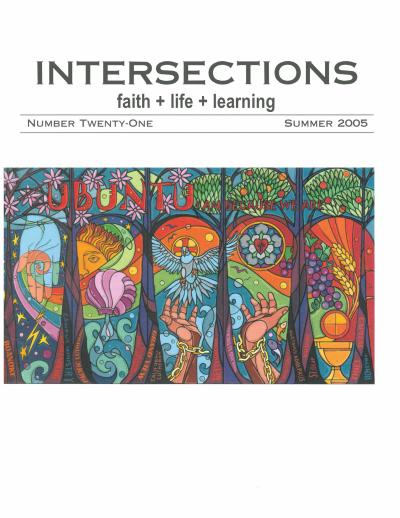
The Church in Education? Education in the Church? Ten Theses on Why These Questions Matter
Leonard G. Schulze
No. 21 · Summer 2005
Writing in the months before the August 2005 Churchwide Assembly that will decommission DHES, Schulze frames his vision for the division as ten Lutheran-style theses, each followed by Luther’s catechetical question “What does this mean?” He argues that critical thinking and moral deliberation are in the Lutheran gene pool; that Luther’s devotion to learning was an expression of Christian vocation; that the rise of the research university and the binary public meaning of “evangelical” have marginalized church-related colleges; that DHES has been wrongly perceived as marginal; and that the reformed concept of vocation must drive the soon-to-be-created program unit for Vocation and Education. An appendix reproduces the 2005 DHES strategic planning overview.
-
 Article
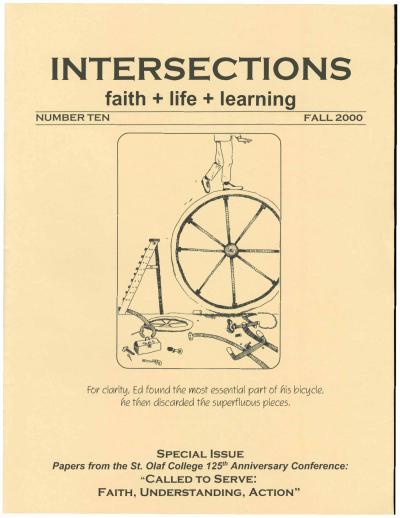
The Literature of Spiritual Reflection and Social Action
Shirley Hershey Showalter
No. 10 · Fall 2000
Showalter, president of Goshen College, opens with Garrison Keillor’s “Singing with the Lutherans” and Walter Sundberg’s account of the Anabaptist “radical reformers” to locate Mennonite identity in a theology of suffering, humility, narrative, and song—tracing it through John S. Coffman’s 1904 “The Spirit of Progress,” Harold S. Bender’s 1944 “Anabaptist Vision,” John Howard Yoder’s The Politics of Jesus, and J. Lawrence Burkholder. She uses her Senior Seminar “Pedagogy of the Holy Spirit” reading of Viktor Frankl’s Man’s Search for Meaning, Madeleine L’Engle’s “Be a namer” and Walter Wink on the angels of institutions, and a Goshen Study-Service Term (SST) journal entry by student David Roth returning from Haiti—closing with two poems by Sarah Klassen—to argue for naming as the redemptive practice of church-related education.
-
Article
Vocational Leadership
Darrell Jodock
No. 41 · Spring 2015
Jodock proposes “vocational leadership” as a name for a distinctive educational value at the heart of a Lutheran college — one that seeks to benefit the neighbor and the community, inspires and invites others to participate in that service, and is institutionally anchored in the Lutheran concept of vocation. He unpacks twelve facets of vocational leadership and ties them to Luther’s own leadership around indulgences, public schooling, and beggary.
-
 Editorial
Guest Editorial
Lynn Hunnicutt
No. 47 · Spring 2018
Hunnicutt traces the etymology of vocation through its cognates — evoke, provoke, convocation — to argue that vocation presumes a relationship between caller and called, that callings are often grounded in ordinary words and humble lives, and that recognizing vocation as plural and lifelong relieves colleges of the pressure to help students find a single calling while on campus.
-
Article
Of Fathers and Feminism: How One Lutheran Woman Came to a Vocation
Karla G. Bohmbach
No. 14 · Summer 2002
Bohmbach, a recently tenured Susquehanna University feminist biblical scholar one month shy of forty, traces her vocation back through a Vacation Bible School injury, an LCMS upbringing in which only men could preach or preside, her father’s contradictory message that she could do anything while modeling a church that limited women, St. Olaf’s revelation of a Lutheran female face, and a Duke graduate seminar on the History of Feminist Thought with Carol Meyers. Her published feminist work on biblical daughters and on the concubine of Judges 19 is read alongside Kathleen Norris’s account of word-bombardment in church, Michel Tournier on childhood as “ardent confusion,” and her own recent participation as both student and teacher in an Authorized Lay Worship Leaders Program.
-
 Article
A Fifth Teat on a Cow: The Irrelevance of the Lutheran Doctrine of the Two Kingdoms for Academic Life
Richard VonDohlen
No. 9 · Summer 2000
VonDohlen, responding to Richard Hughes, Carol LaHurd, David Ratke, Philip Nordquist, and Robert Benne, argues that the Lutheran doctrine of the two kingdoms as commonly deployed in recent discussions of Lutheran higher education rests on a faulty sociology (taking Luther’s sixteenth-century structure for our highly differentiated society) and an epistemological monism (assuming a single neutral reason against the pluralism described by Alasdair MacIntyre and others), making it anti-intellectual, hostile to interdisciplinary dialogue and Christian social ethics, and ultimately as a defense of theology’s relevance about as useful as “a fifth teat on a cow.” Drawing on his experience on the Catawba Valley Hospice Ethics Committee, his Dutch Reformed and dispensationalist background, and the ELCA social statement “Sufficient, Sustainable Livelihood for All,” he calls for an “intellectually ecumenical” dialogue between Lutherans and non-Lutherans willing to take each other’s paradigms seriously.