Preface
When I first delivered a version of this essay at the 2019 Vocation of a Lutheran College conference at Augsburg University in Minneapolis, I started with a “Land Acknowledgement.” The conference was entitled “Beyond Privilege: Engaging Diversity, Inclusion, and Equity.” It was hosted by colleges and universities affiliated with the Evangelical Lutheran Church in America, on lands once occupied exclusively by indigenous peoples. A land acknowledgement is one small way of acknowledging the peoples who originally inhabited lands colonized by Europeans settlers. It also acknowledges the enduring relationship that exists between indigenous peoples and their traditional lands (“Honor Native Land”).
I spoke about how the Minneapolis-Saint Paul metropolitan area is home to one of the largest and most diverse urban indigenous populations. That population is comprised primarily of the Dakhóta (Dakota), and the Anishinaabeg (Ojibwe) (“Dakota People”). The Dakota represent one of three major language divisions among people commonly referred to by European colonizers as the Sioux. The so-called Sioux are a confederacy of several “tribes.” The Eastern Dakota (often referred to as the Santee) reside primarily in Minnesota and Northern Iowa. They were the inhabitants of the land of Augsburg’s campus when European colonizers first arrived.
The proper name for the Sioux is Oceti Sakowin, (Oh–cháy–dee Shah–kóh–wee), which means, “Seven Council Fires.” The original Sioux nation was made up of seven council fires (or “tribes”). Each of these council fires was made up of small kinship “bands” (or “families”) based on dialect and geographic proximity.
Within a context of European conquest and colonialism, a land acknowledgment is not simply a way of giving thanks for Mother Earth, which represents an indigenous practice. It is also a way of honoring the indigenous people who inhabited these lands long before one of the most egregious displays of white privilege—the genocide and near total decimation of this nation’s original inhabitants.
Indeed, it would have been a great display of hypocrisy to have a conference on privilege in America and not acknowledge on whose land we reside. We have retained names like White Bear Lake, Minnesota or Winneshiek County, Iowa (where I live), while giving little (if any) acknowledgment of indigenous peoples. Land acknowledgments represent one small way of foregrounding and understanding the history of land possession and dispossession as well as our place within that history. I hope that raising such awareness will cause us to seriously consider and challenge the unacknowledged privilege underlying much of the immigration debate in the United States today.
Two Uses of Privilege
In this essay, I explore what I call “The Perils and Promise of Privilege,” especially as it relates to diversity, inclusion, and equity within Lutheran higher education.
Privilege has always been used in one of two ways: (1) to preserve privilege by promoting and maintaining inequity, or (2) to challenge privilege by promoting diversity, inclusion, and equity.
Since privilege is relational, it is always possible to find ourselves in relations where we possess more privilege than someone else, even though we may also at times find ourselves in relations where we possess less privilege. The question is how do we use our privilege in those times when we possess more privilege than others? Do we use our privilege to preserve privilege and maintain inequity? Or do we use our privilege to challenge privilege by promoting diversity, inclusion, and equity?
Do we use our privilege to preserve privilege and maintain inequity? Or do we use our privilege to challenge privilege by promoting diversity, inclusion, and equity?
Let me be clear these are the only two options. We are either preserving the privilege that maintains inequity, or we are challenging privilege and promoting diversity, inclusion, and equity. If we are not doing the latter, we are by default doing the former. There is no neutral ground with regards to privilege. To deny that unfair privilege exists or to simply feel guilty and throw up our hands out of frustration, despair, and a sense of hopelessness only results in preserving forms of privilege that maintain inequity.
As a man living in a patriarchal society, I identify with a gender that affords me privilege. Denying the reality of male privilege or becoming defensive or frustrated instead of challenging male privilege only contributes to preserving male privilege and maintaining inequity. Similarly, denying the reality of white privilege or becoming defensive or frustrated instead of challenging white privilege only contributes to preserving white privilege and maintaining racial inequity.
Contemporary and Historical Examples
Recently a private Jesuit high school in Indianapolis had its status as a “Catholic” school revoked by the Catholic Archdiocese of Indianapolis. The decision was made because the school refused to fire a teacher who is in a same-sex marriage. The Archbishop issued a decree in June, 2019 stating that Brebeuf Jesuit Preparatory School “can no longer use the name Catholic and will no longer be identified or recognized as a Catholic institution” (Taylor).
I am familiar with this story because my youngest son attends Brebeuf. The story is a perfect example of the two uses of privilege. While the Archdiocese is using privilege to preserve privilege, Brebeuf is attempting to use privilege in order to challenge privilege.
Days after Brebeuf defied the order of the Indianapolis Archdiocese, the archbishop forced Cathedral High School in Indianapolis to fire a teacher in a civilly sanctioned same-sex marriage. Cathedral is the third Indianapolis Catholic high school to face pressure from Archbishop Charles Thompson over employees in same-sex marriages since Thompson became archbishop in July 2017 (Herron).
One can see the perils of privilege as the Archbishop uses privilege to preserve privilege and promote inequity. We see the promise of privilege, however, as Brebeuf uses its privilege to challenge privilege by promoting diversity, inclusion, and equity.
Let’s turn back 500 years. Many are aware of Martin Luther’s repeated invoking of Christian privilege in order to engage in vitriolic displays of Jewish anti-Semitism. But Luther also used privilege to challenge privilege, as reflected in his early sermon, “Two Kinds of Righteousness”:
For you are powerful, not that you may make the weak weaker by oppression, but that you may make them powerful by raising them up and defending them. You are wise, not in order to laugh at the foolish and thereby make them more foolish, but that you may undertake to teach them as you yourself would wish to be taught. (304)
While the quotation reflects the paternalism of its time, it nevertheless illustrates the idea of using privilege to challenge privilege. As a faculty person teaching at an ELCA college, I often think about the issues of privilege, diversity, inclusion, and equity in light of the Lutheran tradition of vocation and reform.
I often think about the issues of privilege, diversity, inclusion, and equity in light of the Lutheran tradition of vocation and reform.
While I am not a Lutheran, I understand the reform promoted by Martin Luther to include a reformation of the understanding of “vocation.” While vocation during Luther’s time referred primarily (if not exclusively) to those called to religious service—those called “away from the world” to serve God—Luther redefined vocation as those called to the world in order to serve God and God’s world. That service is particularly directed toward those who are in need, those suffering and lacking power (or privilege).
It is within this context of vocation as representing a call to the world in order to serve God and God’s world—especially those suffering and lacking privilege—that I want to explore key words in the theme of this issue of Intersections.
Defining Key Terms
While diversity, inclusion, and equity are often used interchangeably, they are not synonymous. Being able to distinguish meaning is crucial. When we don’t disambiguate the terms and then understand how they interact with one another , we can’t set clear goals and strategies around each. Before defining these terms, however, we should do the same with privilege.
Privilege
I define privilege as a special advantage granted or available to a particular person or group of people that results in an inequitable disadvantage experienced by others. The last part of this definition is crucial because people will often equate measures designed to correct inequities to measures giving “privilege” to those who suffer inequities. For example, some people try to argue that measures designed to correct racial disparities in higher education give “privilege” to those who experience negative racial disparities. This is incorrect because corrective measures designed to eliminate the negative racial disparities experienced by black and brown people do not result in an inequitable disadvantage being experienced by white people. Corrective measures do not award “privilege” that results in an “inequitable disadvantage” for other groups of people. Corrective measures actually seek to eliminate inequitable group disadvantages.
We live in a society where special advantages available to men results in inequitable disadvantages being experienced by women. None of the current corrective measures (including the “Equal Rights Amendment,” which has yet to be ratified even though it was passed by Congress in 1972) will result in an inequitable disadvantage experienced by men. We live in a society where special advantages available to cisgender heteronormative people results in inequitable disadvantages experienced by people who do not conform to binary, cisgender, heteronormative expectations. We live in a society where special advantages available to white people results in inequitable disadvantages experienced by black and brown people. Correcting these disadvantages should not be considered awarding “privilege.” In none of these corrective measures do the dominant groups/populations end up experiencing inequitable disadvantages.
Diversity
Diversity is the presence of “difference” within a given setting. It includes all the ways in which people differ. While it might seem obvious, it is important to understand that diversity is about a collective or a group and can only exist in relationship to others. An individual is not diverse. He or she might be unique, but not diverse. Certain identities may bring diversity to your institution, but they in and of themselves are not diverse. They’re a woman; they’re a person of color; they’re part of the LGBTQIA+ community. They may possess multiple and societally opposing intersectional identities (all which contribute to their uniqueness), but one person by himself or herself does not equal diversity. Equating one person with diversity often results in tokenism. Diversity occurs in a collective that exhibits measurable difference across that collective.
Since diversity refers primarily to “difference” often measured across dimensions of race, ethnicity, gender, sexual orientation, socio-economic status, age, physical abilities, religious affiliation, political beliefs, and other ideologies, many (if not most) of our institutions can in one way or another be considered “diverse.” And yet, we can and should here prioritize racial diversity. I believe when talking about diversity, it is crucial and important to explicitly identity what we mean by diversity. This is because diversity is often used as a euphemism. People will say, “We are working to diversify our campus” instead of, “We are working to ensure we have more faculty, staff, administrators, and students of color.”
Stepping away from euphemisms requires us to be more specific and detailed in our goals, which can lead to more substantive and accurate conversations and strategies.
Stepping away from euphemisms requires us to be more specific and detailed in our goals, which can lead to more substantive and accurate conversations and strategies. One of the reasons I want to focus on racial diversity is to highlight the difference between diversity, inclusion, and equity. An organization or institution can be diverse in one area without being diverse in another. An organization or institution can be diverse without being inclusive. And an organization or institution can be diverse without being equitable.
Inclusion
Inclusion is about people with different identities feeling and/or being valued, welcomed, and empowered to participate fully in the life and decision-making processes within an organization. I once read somewhere that diversity is being asked to the party, while inclusion is being asked to dance.
The mere presence of diversity does not mean everyone (particularly those with marginalized identities ) will feel welcomed or valued. It doesn’t mean everyone will be given opportunities to contribute, grow, develop, and be who they are called to be. Inclusion is not an automatic consequence of diversity. You can spend a significant amount of time and money bringing a diverse collection of people to your campus without ever changing the environment—without creating an ethos where people can be who they truly are.
Campuses that experience negative persistence (or retention) among specific demographics (e.g. racial minorities, or members of the LGBTQIA+ community) are often guilty of improving diversity without improving inclusion. It’s not enough to have explicit strategies for increasing diversity without having specific strategies for increasing inclusion. We have to be willing to address the barriers (whatever they might be) that stand in the way of people with marginalized identities feeling a sense of welcome and belonging, of being empowered to experience full participation.
Equity
Equity represents fair treatment, access, opportunity, and advancement for all people, while at the same time striving to identify and eliminate barriers that prevent the full participation and inclusion of people who are often marginalized. Equity is an approach that ensures everyone has access to the same opportunities. Equity recognizes that advantages and barriers exist, and that, as a result, everyone does not start from the same place. Seeking equity involves developing processes that acknowledge unequal starting places and that seek to correct and address such imbalances by reducing disparate and unbalanced outcomes.
Within higher education, people tend to be more comfortable with the language of diversity than of equity because equity highlights the role of overt and covert oppression embedded within our institutional practices, structures, and policies.
Within higher education, people tend to be more comfortable with the language of diversity than of equity because equity highlights the role of overt and covert oppression embedded within our institutional practices, structures, and policies. Equity emphasizes processes that lead to outcomes of diversity and inclusion. We’re often much more comfortable stressing outcomes than we are with stressing processes. Stressing processes requires us to acknowledge our complicity in the problem. Implementing new processes require us to challenge and change our beliefs and practices in ways that lead to the outcomes we say we want. We say we want diversity and inclusion, but often we want to preserve processes that hinder diversity and inclusion. We clamor for change but we want to continue doing things the way we’ve always done them.
Equity and Racial Justice
I want to emphasize that race and racial justice are the focus of an equity process that leads to outcomes of diversity and inclusion. I believe all conversations regarding diversity, inclusion, and equity—especially within higher education—need to be explicit in foregrounding race and racial justice as part of the conversation. According to the online Racial Equity Tools Glossary, racial justice is “the proactive reinforcement of policies, practices, attitudes and actions that produce equitable power, access, opportunities, treatment, impacts and outcomes for all” (“Racial Equity”).
All conversations regarding diversity, inclusion, and equity—especially within higher education—need to be explicit in foregrounding race and racial justice as part of the conversation.
It is critical within higher education to adopt a racial justice understanding of equity—especially as it relates to outcomes. While I am not suggesting that conversations regarding diversity, inclusion, and equity be limited to issues of racial justice, I do believe such conversations need to be explicit in foregrounding issues of racial justice.
How often do our institutional plans for equity and inclusion explicitly mention race, racism, and racial justice? We know most of our academic institutions were created primarily to serve white students and white faculty. How then could we ever address diversity, inclusion, and equity without explicitly talking about race, racism, and racial justice?
Unfortunately, many of us are often uncomfortable and/or unwilling to explicitly talk about race, racism, and racial justice. As Robin DiAngelo asserts, much of the difficulty white people (and therefore white institutions) have with talking about race, racism, and racial justice is connected to the issue of “white fragility.” According to DiAngelo, white fragility is a discomfort and defensiveness experienced by white people when confronted with information about racial inequities and injustice.
There are essentially two reasons why most white people get uncomfortable talking about racism. One reason is because they don’t know how to talk about these issues and they’re afraid of being criticized for saying something wrong. Yet there is an entire corpus of literature written on how to talk about race. White people who truly want to become better at talking about race need to make the effort to read and learn rather than feeling sorry for themselves when they’re corrected for making inappropriate comments.
The second reason many white people get uncomfortable talking about racism and racial justice is because they’ve bought into the false and naïve notion that they are “colorblind” and that race is a social construct and therefore not real. While race is indeed a social construct for which there is no biological basis, race and racism are social realities.
Anyone who says when they look at me they don’t see a black man, that person is lying. If I went on a shooting rampage and then fled, every white person present would describe me to the police as a black man. No one would tell the police, “Well, officer, you know... I didn’t really see his color.”
People who claim to be colorblind falsely equate seeing blackness with thinking negatively about blackness. Which, when you think about it, shows how deeply ingrained racism and racial bias actually are. Because we’ve been conditioned to think negatively about blackness, the only way to avoid the negative connotations associated with blackness is to convince ourselves we don’t see blackness. If we experienced positive connotations associated with blackness, we’d gladly embrace seeing blackness. When white people look at me, I don’t want them not to see my color, I want them not to have negative connotations associated with my color.
When white people learn to do this, they will be much more comfortable talking about race, racism, and racial justice. They will also be much more capable of developing effective institutional policies and practices that promote diversity, inclusion, and equity.
While I am vehemently opposed to the notion of a color-blind society, I tend to think many people operating with a colorblind approach to life are actually good-intentioned people, who care about issues of equity and inclusion. They’re operating within the ideal that all people are equal and should be treated equally. The problem, however, is that the ideal is not reflective of our social reality. The real life status of people in the world is not one of equality.
Treating people equally, when they do not possess equal status, simply maintains and reproduces existing inequalities. The real-life status of black and brown people in America is not one of equality with white people. So attempts to bring about racial equity cannot treat black and brown people as though their social status is equal to white people.
Advocating for racial equity and racial justice can often be difficult because people fail to recognize the difference between equity and equality. Furthermore, some academics associate the terms racial equity and racial justice with activism and advocacy, and then argue that academic institutions are supposed to be “neutral and objective.”
Treating people equally, when they do not possess equal status, simply maintains and reproduces existing inequalities.
Higher education, however, has never been in the business of neutrality. Institutions have always taken stances. Luther College proudly takes an advocacy stance regarding climate change and environmental sustainability. Martin Luther’s 95 Theses were about taking a stance. The Reformation was about taking a stance. The question is: Are we willing to be explicit regarding where we stand with our commitment to promoting racial equity and racial justice?
As I mentioned previously, we are often much more comfortable talking about diversity and inclusion than we are with talking about equity. When we do talk about equity in the context of racial inequities, we often have varying opinions regarding the underlying causes of racial inequities.
While few Americans actually deny the existence of racial disparities in America, there are often various reason given for the existence of racial disparities. Echoing the sentiment of Ibram X. Kendi, a New York Times bestselling author and the founding director of the Antiracist Research and Policy Center at American University, data show that racial disparities are the direct result of racist practices and policies—especially when we fail to recognize the many ways in which such practices and policies are racist (Kendi).
We tend to focus on ‘helping’ minority students and faculty, as though they are the reason for racial disparities, rather than addressing and changing our racist practices and policies.
Often when addressing racial disparities at our institutions, we tend to focus on racialized minorities rather than on racist practices and policies. We tend to focus on “helping” minority students and faculty, as though they are the reason for racial disparities, rather than addressing and changing our racist practices and policies.
While many people working at predominantly white colleges and universities will make comments like, “We want more racial minority students admitted,” or, “We want more racial minority faculty hired,” very few are willing to acknowledge that their personal and institutional values, preferences, practices, and policies actually reproduce whiteness and are the primary cause of racial inequities.
Too often I hear colleagues say things like minorities don’t apply or they are not interested in relocating to rural Iowa, or minority faculty are so scarce that they are being offered “better jobs” elsewhere. The data, however, do not support such claims (“Race and Ethnicity”). College and university recruitment and hiring committees will frequently make racialized others responsible for the existence of racial disparities on their campuses while rarely considering the racial disparities to be the result of how they go about recruiting and hiring or how their racial beliefs about “quality,” “competence,” and “fit” contribute to the racial disparities on their campuses.
The reduction of racial disparities requires adopting what the Center for Urban Education calls “equity-mindedness.” Equity-mindedness refers to actions that demonstrate individuals’ capacity to recognize and address racialized structures, policies, and practices that produce and sustain racial inequities (“What is Equity-Mindedness?”). While we frequently talk about the lack of racial diversity on our campuses, our actions (or lack thereof) rarely focus on how we are actually responsible for the racial disparities that exist on our campuses.
Equity-mindedness refers to actions that demonstrate individuals’ capacity to recognize and address racialized structures, policies, and practices that produce and sustain racial inequities.
It reminds me of a sculpture by the Danish sculptor and activist, Jens Galschiot. The sculpture, entitled, Survival of the Fattest, is of Lady Justice depicted as an obese woman from the West sitting on the shoulders of a starved African man.1 The sculpture illustrates that when addressing oppression (especially oppression dealing with race, gender, and sexual orientation), we’ll often claim a willingness to do “anything” we can to help, except seriously examining and giving up the oppressive beliefs, practices, and policies that privilege us.
If we are serious about moving beyond privilege by engaging diversity, inclusion, and equity, then we have to be intentional in using whatever privilege we possess in ways that avoid the perils of privilege by challenging privilege and pursuing the promise of privilege.
Endnotes
1. For images and the artist’s reflections, see www.galschiot.com/survival-of-the-fattest.
Works Cited
“Dakota People.” Historic Fort Snelling. Minnesota Historical Society. Accessed 1 Oct. 2019, http://www.mnhs.org/fortsnelling/learn/native-americans/dakota-people.
DiAngelo, Robin. White Fragility: Why It’s So Hard for White People to Talk About Racism. Beacon, 2018.
Herron, Arika. “Unanswered questions about Cathedral, Brebeuf Jesuit and the Indianapolis Archdiocese.” Indianapolis Star. June 25, 2019. Accessed 1 Oct. 2019, https://www.indystar.com/story/news/education/2019/06/25/cathedral-high-school-brebeuf-jesuit-indianapolis-archdiocese-catholic-gay-teacher-questions/1554313001/.
“Honor Native Land: A Guide and Call to Acknowledgment.” U.S. Department of Arts and Culture. Accessed 1 Oct. 2019, https://usdac.us/nativeland
Kendi, Ibram X. How to be an Anti-Racist. One World, 2019.
Luther, Martin. “Two Kinds of Righteousness.” Luther’s Works (American Edition), volume 31. Muhlenberg, 1957.
“Race and Ethnicity in Higher Education: A Status Report.” American Council on Education, 2019. Accessed 1 Oct. 2019, https://www.equityinhighered.org/.
“Racial Equity Tools Glossary.” Racial Equity Tools. Accessed 1 Oct. 2019, http://www.racialequitytools.org/glossary#racial-equity.
Taylor, Derrick Bryson. “Jesuit School, Defying Archdiocese, Refuses to Remove Teacher in Same-Sex Marriage” The New York Times. June 21, 2019. Accessed 1 Oct. 2019, https://www.nytimes.com/2019/06/21/us/fire-gay-teacher-jesuit-school.html.
“What is Equity-Mindedness?” Center for Urban Education, University of Southern California. Accessed 1 Oct. 2019, https://cue.usc.edu/about/equity/equity-mindedness/.
-
 Editorial
From the Publisher
Mark Wilhelm
Wilhelm frames the issue by noting that a federal court’s vindication of Harvard’s race-conscious admissions process is a win for higher education’s commitments to diversity, equity, and inclusion — and argues that for Lutheran higher education, the commitment to diversity is an old and foundational claim, rooted in Christianity’s openness to all and reflected in the four diverse gospels of the New Testament.
-
Editorial
From the Editor
Jason A. Mahn
Mahn opens with Lenny Duncan’s observation that the ELCA is 96 percent white — the whitest denomination in the U.S. — and asks how teachers and administrators at historically, predominantly, and persistently white institutions can turn from white privilege and white supremacy toward spaces where people of color thrive and white people are re-formed into antiracist allies.
-
Article
Making Diversity Matter: Inclusion is the Key
Monica Smith
Smith, Augustana’s inaugural Vice President for Diversity, Equity and Inclusion, frames the work of a Chief Diversity Officer as that of a disrupter and argues that while diversity in higher education is already happening, inclusion is a choice — one requiring a fundamental institutional transformation that diversifies faculty and staff, infuses diversity into the curriculum, invests in professional development, and draws on senior leadership to dismantle barriers.
-
Article
The Vocation of White People in a Racist Society
Caryn Riswold
Riswold proposes that whiteness is a weakness borne of apathy, atrophy, and ignorance — an atrophied muscle of race-consciousness — and offers concrete practices (reading, adjusting one’s gaze, consuming media differently, drawing on ELCA social statements like the repudiation of the Doctrine of Discovery) for exercising that muscle and naming the vocation of white people in a racist and white supremacist culture.
-
Article
Learning the Language of Inclusive Pedagogy
David Thompson
Thompson frames inclusive pedagogy as a foreign language with its own vocabulary, grammar, and cultural values, and reflects on a year of immersing himself in readings, conversations, and workshops — arguing that proficiency grows when instructors study and practice these languages repeatedly and atrophies when ignored.
-
Article
The "V" Word: Different Dimensions of Vocation in a Religiously Diverse Classroom
Martha E. Stortz
Stortz responds to a sea of blank stares when she used the word “vocation” in a religiously diverse required course by offering five metaphors — place, path, relationships, lens, and story — that point to different dimensions of vocation across the world’s religions and help students articulate their callings on their own terms.
-
Book Review
The American Myth of White Supremacy: A Review of Myths America Lives By
Susan VanZanten
VanZanten reviews Richard T. Hughes’s Myths America Lives By: White Supremacy and the Stories that Give Us Meaning, which argues that the United States grounds its identity in five myths — Chosen Nation, Nature’s Nation, Christian Nation, Millennial Nation, and Innocent Nation — all informed by the primal myth of white supremacy, and considers what Lutheran theological values can offer for resisting that myth.
-
Reflection
Seeing in a New Way: A Meditation
Kara Baylor
Baylor, the only Black campus pastor in the NECU, weaves Psalm 25, the parable of the Good Samaritan as re-read through Lenny Duncan, and the “crimson thread of divine justice” from Allen Dwight Callahan into a meditation that closes with the invitation she offered at the 2019 conference — to tie a crimson thread around the wrist as a symbol of collective commitment to moving beyond privilege toward inclusion and equity.
-
Article
Conciliatory and Queer: The Radical Love of Lutheran Higher Education
Kiki Kosnick, Sharon Varallo
Kosnick and Varallo reflect in conversation on how Augustana’s Five Faith Commitments and its conciliatory ecumenical roots in the Augsburg Confession have given them — a non-binary queer first-generation faculty member and a twenty-one-year veteran — the “street cred” to act on radical love, build bridges to imprisoned and non-binary communities, and discover that Augustana is welcoming not despite the fact that it is Lutheran, but because of it.
-
 Article
2024 VHLE Conference: "Rooting Access" Panel Talking Points
Guy Nave
No. 60 · Fall 2024
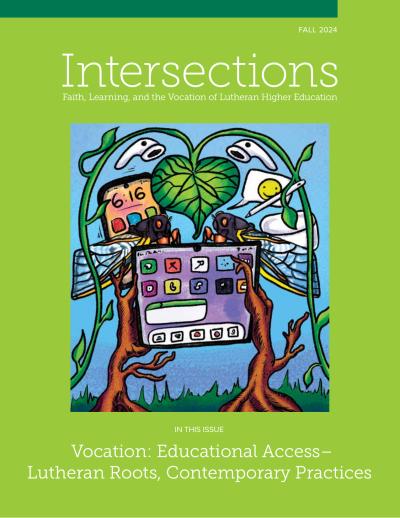
Nave reads “access” across Deuteronomy 23, Ruth, Isaiah 56, Acts 10, and Matthew 15:21-28 as an ongoing biblical conversation that evolves from exclusion to ever-widening welcome — and presses ELCA institutions to shift their focus from “student readiness” to “institutional readiness.”
-
 Article
Polarization, Incivility, and a Need for "Change"
Guy Nave
No. 48 · Fall 2018
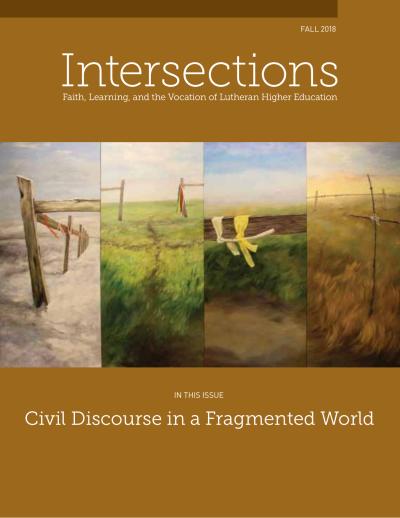
Nave argues that when Americans demand “change,” they usually mean that “others” need to see things their way — and that meaningful transformative change requires acknowledging the provisional nature of our perspectives, seeking to understand as much as to be understood, and bursting the ideological echo chambers of social media through projects like Clamoring for Change.
-
 Article
Freedom, Humor, and Community: A Lutheran Vision for Higher Education
Darrell Jodock
No. 13 · Winter 2002
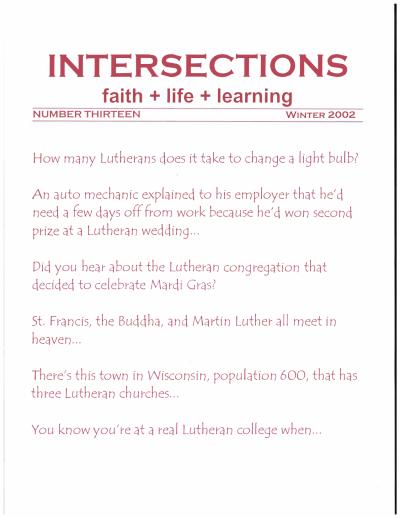
Jodock’s inaugural lecture for the Bernhardson chair at Gustavus Adolphus develops three interlocking themes drawn from the Lutheran tradition as a deeper grounding for the liberal arts college than contemporary American assumptions. A sense of humor rests on Luther’s discovery that God takes the initiative—Luther could call himself a beggar, joke about the epistle of James, and credit Wittenberg beer for the Reformation—and underwrites the freedom of inquiry that John Updike traces to Grace Lutheran Sunday School in Shillington. Community, grounded in Augsburg Confession VII and Luther’s 1524 letter to the German city councils, makes the college a community of discourse pursuing wisdom rather than “the same old blockheads.” Freedom is both “freedom from” and “freedom for,” illustrated by Nechama Tec’s Polish Holocaust rescuers and by Jodock’s Holocaust-class corporate role-play in which students voted to build a factory in a death camp rather than risk losing their board seats—a vivid case for educating toward “a passion for justice.”
-
 Article
Vocational Leadership
Darrell Jodock
No. 41 · Spring 2015
Jodock proposes “vocational leadership” as a name for a distinctive educational value at the heart of a Lutheran college — one that seeks to benefit the neighbor and the community, inspires and invites others to participate in that service, and is institutionally anchored in the Lutheran concept of vocation. He unpacks twelve facets of vocational leadership and ties them to Luther’s own leadership around indulgences, public schooling, and beggary.
-
 Institutional Focus
So That All May Belong: Lutheran Roots for Diversity, Equity, Inclusion, and Justice
Altheia Richardson, Angie Hambrick, Caryn Riswold, Colleen Windham-Hughes, Deanna Thompson, Marcia Bunge, Robert Clay
No. 61 · Spring 2025
22 min audio
The full NECU statement grounds DEIJ work in Luther’s 16th-century reforms and Lutheran theological claims about the image of God, equal dignity, and the limits of human knowing — offering definitions, Lutheran roots, and calls to action for diversity, equity, inclusion, and justice, with belonging as the outcome of DEIJ at work.
-
 Book Review
Types, Methods, and Sagas in Lutheran Higher Education: Learning from Childers
Lake Lambert
No. 39 · Spring 2014
Lambert situates Eric Childers’ College Identity Sagas within the older tradition of the 1977 Association of Lutheran College Faculties volume The Church-Related College in an Age of Pluralism, working through Burton Clark’s “saga” and Robert Benne’s typology of church-related colleges. He commends Childers’ socio-scientific approach while questioning whether a typology can do justice to institutions that resist easy classification.
-
 Editorial
Guest Editorial: Moral Deliberation in NECU Classrooms
Ernest L. Simmons
No. 51 · Spring 2020
Simmons introduces the guiding question of the NECU working group: could the ELCA’s twelve social statements and thirteen social messages — expressions of Lutheran social teaching originally formulated for congregational use — turn campuses into “academic communities of moral deliberation”?
-
 Editorial
From the Editor
Tom Christenson
No. 14 · Summer 2002
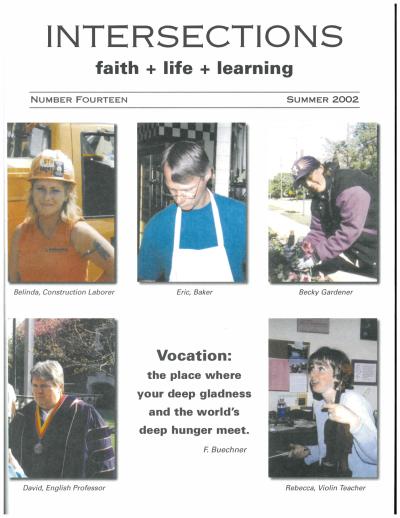
Christenson argues that whether or not the conversation is funded by the “Lilly lottery,” vocation should just be part of who we are and what we do at ELCA colleges, and proposes three low-cost conversations—among faculty (twenty dollars of wine, in vino veritas), with students throughout their four years, and with alumni—explaining why this issue is deliberately “fatter” than usual and inviting feedback on other single-topic issues.