At the beginning of each of my classes at Augsburg College, I ask students to make a name tent. They fold a piece of card stock paper in half and on the outside, in thick marker, write the name they wish to be called for the semester. On the inside of the tent, I ask them to answer a series of questions, which I explain will be for my eyes only. One question I ask is: What is your religious preference, if any? The cultural diversity of the College is reflected in the wide variety of names on these tents: Samira, Blake, Mai, Alejandra, Mohammed, Hannah, and Ramon, to name a few. The rich differences in how students orient around religion is reflected on the inside of the tent: Muslim, Lutheran, Shamanist, atheist, agnostic, Catholic, spiritual, and more.
It is with great excitement that I view this diversity and think about the learning potential in this kind of classroom environment. At the same time, I hear the caution in the words of world religions scholar Diana Eck, when she writes, “Pluralism is not the sheer fact of plurality alone, but its active engagement with plurality” (191). In other words, while there is great promise in the interfaith classroom, just having a group of students who orient differently around religion in the room does not necessarily lead to a pluralistic environment where interfaith dialogue can flourish.
The Power of Pairing Opposites
My years teaching in the religion department at Augsburg College have given me much practice nurturing interfaith conversation in the classroom. While there is always an intangibility as to why a robust interfaith community develops sometimes and at other times does not, I have found that there are certain qualities to consider in creating a vibrant interfaith environment. I find that the best way to think about these qualities is in pairs of seeming opposites: dialogue and debate, safety and risk, commonality and particularity. These qualities play out in the classroom, not in adversarial ways, but in creative tension.
“For me, dialogue is the default position in the interfaith classroom because it fosters the qualities of critical loyalty, deep listening, intellectual empathy, and active respect.”
Dialogue and Debate
Diana Eck traces the origin of the word dialogue to the Greek word meaning “through speech.” She posits that, in an interfaith environment, dialogue involves reciprocal conversation. Mutual witness takes place, where each party bears witness to the truth he or she possesses. At the same time, each participant engages in mutual transformation, which does not imply agreement with the other but rather willingness to question one’s own position and to be changed by the encounter (19). For me, dialogue is the default position in the interfaith classroom because it fosters the qualities of critical loyalty, deep listening, intellectual empathy, and active respect.
Conversely, according to Merriam-Webster’s dictionary, the definition of the verb debate is “to dispute or argue about,” which is certainly how debate is viewed in our political culture. It is a competition in which one side’s arguments win out over the other. When we move to the noun form, debate is defined as “a regulated discussion of a proposition of two matched sides.” This kind of carefully planned discussion can be a useful technique in an interfaith setting in order to discuss not truth claims, but rather particular issues in an interfaith world that can help student clarify their positions.
Safety and Risk
The second set of qualities—safety and risk—can perhaps be seen as even more diametrically opposed to one another. Currently, there is much conversation about safety in the university classroom, much of it stemming from the positive impulse of ensuring that underrepresented voices are valued and heard, without the risk of micro (or macro) aggressions based on race, class, culture, religion, or sexual identity. As stated above, dialogue requires intellectual empathy and active respect which helps to create safe space.
At the same time, safety is not an absolute value and must be balanced against risk taking. Betty Barett suggests that while educators should promise that students will not be subjected to behaviors that threaten the social or physical integrity of the learning environment, they “may not be able to (nor should they) promise students in good faith that the intellectual enterprise and scholarly exchanges are safe and comfortable endeavours” (10). Najeeba Syeed-Miller applies this notion to the interfaith classroom, asserting that “we must disarm the notion of a ‘safe’ classroom and disabuse students of an expectation of a risk-free learning experience” if we seek to prepare students to navigate the complex, rich, and choppy waters of our interfaith world. According to transformational learning theory, it is only through a series of disorienting dilemmas, where one’s taken-for-granted assumptions and perceptions are challenged, that transformation can occur, that the learner may create new, inclusive, and more accurate beliefs to guide his or her actions (Mezirow 17). Disorientation involves sitting with discomfort and risking a change in the way you see the other and the world.
“It is only through a series of disorienting dilemmas, where one’s taken-for-granted assumptions and perceptions are challenged, that transformation can occur.”
Commonality and Particularity
The final set of qualities for consideration when creating a vibrant interfaith environment is commonality and particularity. A laudable goal of the interfaith classroom can be to create a sense of solidarity across religious and nonreligious worldviews—a sense that we are all one human family and perhaps we share some universal values. Karen Armstrong, scholar of world religions, and founder of the Charter for Compassion, believes that compassion is a universal value that “lies at the heart of all religious, ethical, and spiritual traditions, calling us always to treat others as we wish to be treated” (6). Discovering commonality can lay the foundation for lasting interfaith relationships.
At the same time, the interfaith classroom should be a place that affirms the distinctiveness and value of different cultures, religions, and worldviews, recognizing the unique contributions each perspective brings to the world house. The particularities within traditions should be celebrated as well. There are, after all, many Judaisms, Christianities, and secular humanisms. By affirming particularity, students are empowered to bring their unique identities, which are increasingly hybridized, either due to how they were raised or by their own choosing. In the classroom at Augsburg College, I have encountered more than one Christian-Shamanist and Buddhist-Lutheran, not to mention many who identify as “spiritual-but-not-religious.” I have even encountered a “Muslic,” a young woman raised to practice both the Catholic tradition of her mother, and the Muslim tradition of her father. By affirming both particularity and communality, one’s individual and unique story can to be put into conversation with the larger narratives of religious and philosophical traditions, thus further expanding the interfaith conversation in the classroom.
Conclusion
The promise of the interfaith classroom is that it can create a space to fulfill the primary purpose of education. According to Trappist monk and interfaith advocate Thomas Merton, this purpose is “to show a person how to define himself [or herself] authentically and spontaneously in relation to the world—not to impose a prefabricated definition of the world, still less an arbitrary definition of the individual” (3). This environment can nurture self-understanding and an expanded worldview while holding the qualities of dialogue and debate, safety and risk, and communality and particularity in creative and productive tension.
Works Cited
Armstrong, Karen. Twelve Steps to a Compassionate Life. New York, Anchor, 2010.
Barrett, Betty J. “Is ‘Safety’ Dangerous? A Critical Examination of the Classroom as Safe Space.” The Canadian Journal for the Scholarship of Teaching and Learning. No. 1 (2010). Accessed 1 November 2016, http://dx.doi.org/10.5206/cjsotl-rcacea.2010.1.9.
Eck, Diana L. Encountering God: A Spiritual Journey from Bozeman to Banaras. 2nd Edition. Boston: Beacon, 2003.
Merton, Thomas. Love and Living. New York: Farrar, Strauss, Giroux, 1979.
Mezirow, Jack. “Learning to Think Like an Adult: Core Concepts of Transformation Theory.” In Learning as Transformation: Critical Perspectives on a Theory in Progress, edited by Jack Mezirow, 3-34. San Francisco, CA: Jossey-Bass, 2000.
Syeed-Miller, Najeeba. “The Politics of Interreligious Education.” Spotlight on Theological Education. American Academy of Religion. March 2014. Accessed 1 November 2016, https://www.aarweb.org/publications/spotlight-on-theological-education-march-2014-the-politics-of-interreligious-education.
-
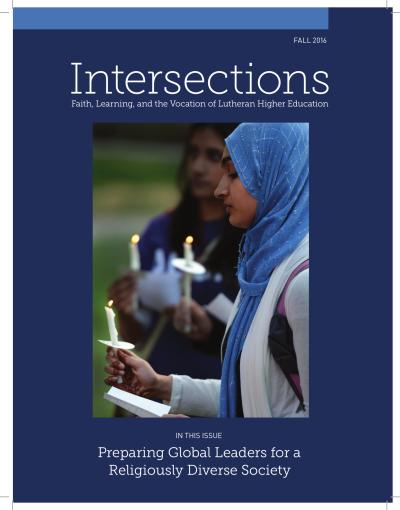 Editorial
From the Publisher and Editor
Jason A. Mahn, Mark Wilhelm
Writing weeks after the 2016 presidential election, Wilhelm and Mahn frame interfaith engagement as the urgent and ongoing work of ELCA colleges and universities, recap NECU’s growing commitments to inter-religious leadership, and introduce essays first delivered at the summer 2016 Vocation of a Lutheran College Conference under the theme “Preparing Global Leaders for a Religiously Diverse Society.”
-
Article
Laboratories for Living in a Diverse World
Elizabeth Eaton
Presiding Bishop Elizabeth Eaton argues that ELCA colleges and universities are called to be laboratories for living in a religiously diverse world. Reflecting on the decline of Christian privilege, the ELCA’s ecumenical and inter-religious work, and her own experience addressing the Islamic Society of North America, she offers three questions about partnerships, formation, and institutions as platforms for new collaborations.
-
Article
Why Interfaith Work is Not a Luxury: Lutherans as Neighboring Neighbors
Martha E. Stortz
Stortz argues that interfaith work is not a luxury but a constitutive commitment of Lutheran higher education — institutions she describes as both “faith-based and interfaith-dependent.” Reading the parable of the Good Samaritan as both an intra-faith and inter-faith encounter, she offers a four-fold matrix of theological reflection, spiritual engagement, social action, and everyday experience as portals into the work of being neighbor.
-
Article
Religious Diversity and the Vocation of a Lutheran College
Darrell Jodock
Jodock argues that a college which takes its Lutheran values seriously is well positioned to foster inter-religious relations along a “third path” that is both religiously rooted and inclusive. He traces the relational and communal character of Lutheran theology, develops a Lutheran understanding of deeper freedom, the theology of limits, and human complexity, and shows how a down-to-earth image of God offers theological resources for overcoming the anxiety and fear that block interfaith engagement.
-
Article
Risky Speech–Gifted Friendships
Sonja Hagander
Augsburg College Pastor Sonja Hagander reflects on pastoral care across faith traditions — from a campus chapel service after the 2008 murder of Muslim student Achmednur Ali, to her decade-long friendship with Jewish colleague Barbara Lehmann — and reads the Gospel of John as a roadmap for interfaith friendships marked by love, free speech, public space, and a willingness to risk being changed.
-
Reflection
Mapping Interfaith Encounters
Callista Isabelle
Muhlenberg College Chaplain Callista Isabelle uses a student-designed subway map of religious and spiritual communities as an image for interfaith engagement — one that invites students to leave their “home” stations, encounter common ground and respectful disagreement, and explore the major intersections where religion meets science, environment, and mental health.
-
Article
Negotiating Legitimate and Conflicting Values
Eboo Patel, Katie Bringman Baxter, Mark S. Hanson
In a closing-day conversation at the 2016 Vocation of a Lutheran College Conference, Mark Hanson and Eboo Patel — moderated by Katie Bringman Baxter of Interfaith Youth Core — share case studies in which legitimate religious values come into tension with one another, and make the case that Lutheran colleges should teach interfaith leadership through the hard cases rather than the easy ones.
-
Institutional Focus
Interfaith Campus Organizing at California Lutheran University
Allison Bermann, Mehak Sachdev
California Lutheran University students Allison Bermann and Mehak Sachdev describe how interfaith participation at CLU grew from a grassroots movement into a sustained, integrated part of campus identity — with an intern program, Interfaith Allies, co-curricular events from Diwali dinners to Hunger Banquets, and a classroom practice of storytelling that opens the required Introduction to Christianity course to students of every faith and none.
-
 Response
A Call for Creative Education
Wendy McCredie
No. 3 · Summer 1997
McCredie of Texas Lutheran responds to Reichenbach by reframing the four ideas embedded in his claim that “the entire college community should be knowledgeably committed to the college’s mission”—community, knowledge, commitment, mission—and argues that the Lutheran tradition’s unwillingness to be separate from the world should lead us to educate the public about the Lutheran tradition rather than interrogate prospective employees about their faith. She questions whether agreement on “Christian values” is possible (or even Lutheran), and reads Reichenbach’s “creative education” as the dialectical tension between gospel and law, God’s love and our human limits, that members of communities related to the Lutheran church are uniquely positioned to inhabit.
-
 Editorial
From the Editor
Robert D. Haak
No. 30 · Fall 2009
Haak frames the issue around the question of Lutheran college identity as formed in distinction from some “other,” introducing essays by Witherup on the Joint Declaration, Reuther on Holden Village, Afzaal on Christian-Muslim dialogue, Dovre on the history of Midwestern Lutheran colleges, Radecke on service-learning, and Ratke on Wilhelm Löhe — each making the claim that the “other” is an essential partner in conversation who helps us know who we are and shape who we will become.
-
 Response
Response to Bishop Olson and President Tipson
Robert Benne
No. 16 · Winter 2003
Benne responds to two articles in the Winter 2002 Intersections: former Bishop Stanley Olson’s “The Marks of an ELCA College,” whose narrow reading of the two kingdoms cedes all epistemological claims to secular knowledge, and President Tipson’s engagement with The Future of Religious Colleges, whose “rather unchastened Enlightenment spirit” underestimates how loaded the social sciences and humanities are with their own philosophical and religious assumptions. Drawing on Reinhold Niebuhr, John Milbank, and William Buckley, Benne defends a “critical mass” of pervasively Lutheran colleges and calls on bishops and pastors to take the schools seriously lest they drift from their religious heritage.
-
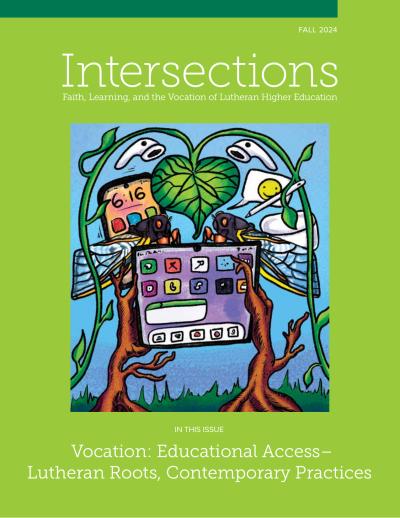 Article
Access, Accessibility, & Change: A Call for Trustworthy Leadership in Higher Education
Emma Jones
No. 60 · Fall 2024
Jones surveys the converging pressures on higher education — cost, the enrollment cliff, shifting demographics, and declining public confidence — and uses Reichheld and Dunlap’s four factors of trust (transparency, capability, reliability, humanity) to call campus leaders to rebuild trustworthy leadership from the inside out.
-
 Article
Lutheran Colleges, the Lutheran Tradition, and the Future of Service-Learning
Joseph McDonald
No. 34 · Fall 2011
McDonald, who has used service-learning since the early 1990s and now directs the Values Based Learning Program at Newberry College, traces the service-learning movement from its 1960s socio-political pioneers (Nadinne Cruz, Ira Harkavy) through its institutionalization as classroom pedagogy and citizenship education (Stanton, Giles, and Cruz; Edward Zlotkowski; Jane Addams’s Hull House and John Dewey). He argues that three strengths of the Lutheran tradition—robust reflection as a community of discourse, Christian vocation as service infused in all roles, and the capacity to negotiate tension and paradox—uniquely equip Lutheran colleges to hold the pedagogical and socio-political dimensions of service-learning together, recovering the energy of the pioneers without sacrificing classroom rigor.
-
 Article
In a Diverse Society, Why Should Lutheran Colleges/Universities Claim their Theological Roots?
Darrell Jodock
No. 49 · Spring 2019
Jodock develops his “third path” account of the Lutheran college — neither sectarian nor non-sectarian but both rooted and open — analogizing the college to a bridge whose deck of daily activities rests on pillars of shared educational priorities, which in turn rest on theological footings; he then answers six common objections to claiming Lutheran roots and explains why those footings still matter.