Over the past few years, interfaith participation at California Lutheran University has grown from a grassroots movement to a sustainable and integral part of our campus identity. We have integrated several aspects of interfaith into our campus and have created a variety of opportunities into which students to immerse themselves.
Interfaith at CLU
During the 2015-2016 academic year, interfaith experiences reached approximately 550 individuals, logged about 28 programming hours, and hosted 15 original programs. The key components of interfaith at California Lutheran University include the following:
Intern Program
Our intern program is integrated into our Student Life Office. Students are able to apply for an on-campus internship through Student Employment. We hire approximately 3-4 interns per semester to work for the Community Service Center. For the first time in 2016-17, we will also hire a Graduate Assistant. Interns are responsible for interfaith programming and logistics. They put together events, manage social media pages, host weekly meetings, and serve as liaisons with other campus groups.
Interfaith Allies
The Interfaith Allies are a group of students, faculty, and staff that promote interfaith cooperation and dialogue between faiths and non-faith groups. Allies focus on fostering a more inclusive campus community by working across all lines of religious difference.
Co-Curricular Programming and Tools
Interfaith at California Lutheran implements a variety of programs and tools on campus. These include the following:
- Weekly Meetings: The Interns host weekly meetings at the coffee shop on campus for the Interfaith Allies. Each week, the group is presented with a discussion topic that can range from current events to dialogue about love.
- Events: We host gatherings with food for all to learn about religious festivals, to partner in serving refugees, and to hear students’ reflections on their research in religious communities. Past events include a Diwali Dinner, Children of Abraham (which was hosted when the Jewish holiday of Yom Kippur coincided with the Muslim holiday of Eid El Adha), and Engaged Buddhism (where students experience a 4 day retreat).
- Alternative Tablings: Tabling events are held once or twice a month. There is usually a monthly theme where we have an open question and answer period with the Interfaith Interns. We give away swag, along with informational postcards about our organization, events, and meetings. We also hold tabling events to promote our larger events.
- Fast-A-Thon/Hunger Banquet: The Interfaith Hunger Banquet was created through our partnership with Oxfam America. We collect food for a local food bank and invite speakers from local hunger agencies. Their insights leave a lasting impact on participants.
- Interfaith Prayer for the World: We host these prayers when tragedies occur around the world. They occur at the main campus flagpole during the ten minute break between classes.
- Come Together Now: Campus Ministry and Interfaith Allies collaborate for Come Together Now dinners. They are casual dinners where we have topics (such as rest, sacrifice, love) and dialogue about how religion and our faith/non-faith traditions tie into the topic. A few speakers are invited to speak on the topic, followed by open discussion for all.
- Resident Assistant/Peer Assistant Training: Non/religious identities and interfaith cooperation are included regularly in diversity training for student leaders on campus.
Additional programs include staff luncheons, interfaith meditation chapel, and other collaborations and cooperation with other departments and existing programs.
Students Teaching through Stories
On our campus, every student is required to take Introduction to Christianity. Some students are uncomfortable or even unwilling to be involved with this subject matter. I (Allison) was definitely one of these students at first, mostly because I was worried that as a non-Lutheran student, my religious traditions would be ignored or even viewed as unacceptable. However, because my professor taught us the importance of interfaith cooperation and made the space an inclusive one, the study of religion has become a big part of my college career. I believe that without a focus on creating a safe and comfortable space for interfaith discussion, no one in our class would have been willing to talk about our personal identities and share our stories. Not every professor that teaches this class puts an emphasis on interfaith, but I believe that made all the difference.
In my sophomore year, students from my interfaith seminar taught a lesson on interfaith for the introductory class in religion. We opened the lesson by telling our personal stories, focusing on why we were involved in interfaith. We talked about our own personal struggles with our religious identity, times where we had a memorable experience with a person of a different faith tradition, and how we want to continue interfaith work in our careers and throughout our lives. By sharing our experiences with fellow Millennials, we were all able to connect and empathize with one another and the new students became less apathetic about the subject matter. Regardless of whatever religious or non-religious tradition they adhered to, they were able to find similarities between our stories and their life experiences, which made all of us more comfortable discussing sometimes difficult subject matters.
Through these and other experiences, students in the Interfaith Seminar have realized how essential and helpful storytelling is when connecting with others. We look forward to making our campus an even stronger community by hearing one another’s stories.
-
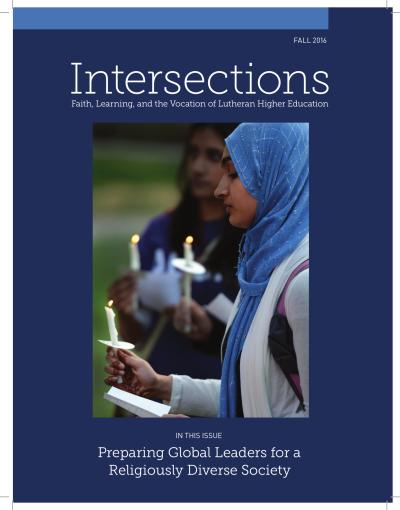 Editorial
From the Publisher and Editor
Jason A. Mahn, Mark Wilhelm
Writing weeks after the 2016 presidential election, Wilhelm and Mahn frame interfaith engagement as the urgent and ongoing work of ELCA colleges and universities, recap NECU’s growing commitments to inter-religious leadership, and introduce essays first delivered at the summer 2016 Vocation of a Lutheran College Conference under the theme “Preparing Global Leaders for a Religiously Diverse Society.”
-
Article
Laboratories for Living in a Diverse World
Elizabeth Eaton
Presiding Bishop Elizabeth Eaton argues that ELCA colleges and universities are called to be laboratories for living in a religiously diverse world. Reflecting on the decline of Christian privilege, the ELCA’s ecumenical and inter-religious work, and her own experience addressing the Islamic Society of North America, she offers three questions about partnerships, formation, and institutions as platforms for new collaborations.
-
Article
Why Interfaith Work is Not a Luxury: Lutherans as Neighboring Neighbors
Martha E. Stortz
Stortz argues that interfaith work is not a luxury but a constitutive commitment of Lutheran higher education — institutions she describes as both “faith-based and interfaith-dependent.” Reading the parable of the Good Samaritan as both an intra-faith and inter-faith encounter, she offers a four-fold matrix of theological reflection, spiritual engagement, social action, and everyday experience as portals into the work of being neighbor.
-
Article
The Promise and Peril of the Interfaith Classroom
Matthew Maruggi
Maruggi draws on his years teaching in the Augsburg religion department to identify three pairs of seeming opposites — dialogue and debate, safety and risk, commonality and particularity — that, held in creative tension, nurture a vibrant interfaith classroom where pluralism is actively engaged rather than merely present.
-
Article
Religious Diversity and the Vocation of a Lutheran College
Darrell Jodock
Jodock argues that a college which takes its Lutheran values seriously is well positioned to foster inter-religious relations along a “third path” that is both religiously rooted and inclusive. He traces the relational and communal character of Lutheran theology, develops a Lutheran understanding of deeper freedom, the theology of limits, and human complexity, and shows how a down-to-earth image of God offers theological resources for overcoming the anxiety and fear that block interfaith engagement.
-
Article
Risky Speech–Gifted Friendships
Sonja Hagander
Augsburg College Pastor Sonja Hagander reflects on pastoral care across faith traditions — from a campus chapel service after the 2008 murder of Muslim student Achmednur Ali, to her decade-long friendship with Jewish colleague Barbara Lehmann — and reads the Gospel of John as a roadmap for interfaith friendships marked by love, free speech, public space, and a willingness to risk being changed.
-
Reflection
Mapping Interfaith Encounters
Callista Isabelle
Muhlenberg College Chaplain Callista Isabelle uses a student-designed subway map of religious and spiritual communities as an image for interfaith engagement — one that invites students to leave their “home” stations, encounter common ground and respectful disagreement, and explore the major intersections where religion meets science, environment, and mental health.
-
Article
Negotiating Legitimate and Conflicting Values
Eboo Patel, Katie Bringman Baxter, Mark S. Hanson
In a closing-day conversation at the 2016 Vocation of a Lutheran College Conference, Mark Hanson and Eboo Patel — moderated by Katie Bringman Baxter of Interfaith Youth Core — share case studies in which legitimate religious values come into tension with one another, and make the case that Lutheran colleges should teach interfaith leadership through the hard cases rather than the easy ones.
-
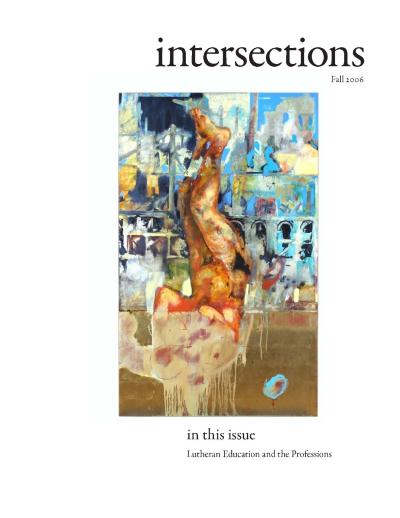 Editorial
From the Publisher
Arne Selbyg
No. 24 · Fall 2006
Selbyg situates this issue in the ongoing ELCA conversation about education that began with the 2005 conference and is feeding into the second draft of the ELCA Social Statement on Education, previews the 2007 conference (“The Vocation of a Lutheran College — Engaging the World”) at Augustana College, Rock Island, and lifts up Luther’s insistence that the church and its members contribute to their wider communities rather than retreat into self-centered enclaves.
-
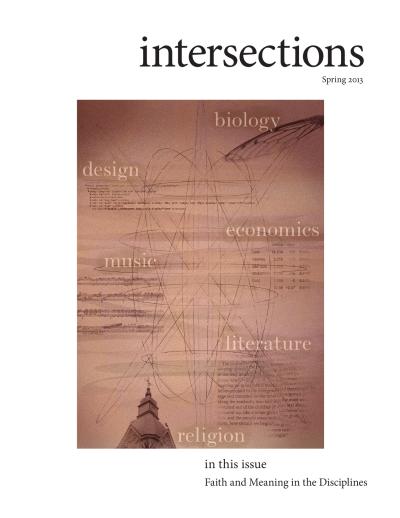 Article
Singing Faith
Adam Luebke
No. 37 · Spring 2013
Luebke describes the Waldorf College Choir as a community of faith whose daily devotions, century-long lineage from F. Melius Christiansen, and disciplined wrestling with sacred repertoire—from Fauré’s Requiem to African-American spirituals to Romans 8 sung backstage—form students spiritually as they form them musically, so that fully grasping what they sing becomes a discovery of why they sing.
-
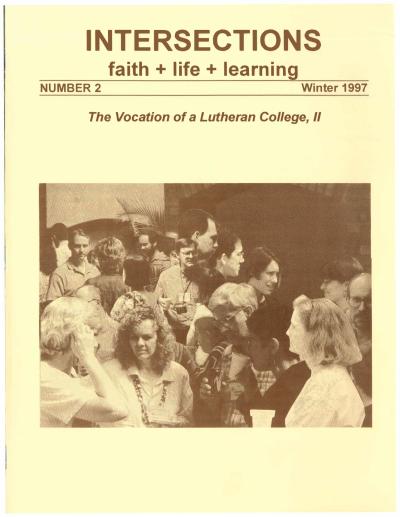 Response
On the Outside Looking Out: A Personal and Social Psychological Response
Chuck Huff
No. 2 · Winter 1997
Huff of St. Olaf—a self-described “Metho-Bap-terian” from the South educated at Bob Jones University—offers a personal response to Bouman’s themes (welcoming the rejection of biblical inerrancy, the distinction between gospel and scripture in the homosexuality debate, the gospel-in-the-creeds reading that releases him from Hellenistic conundrums, and the recasting of justification by faith as meaning rather than insurance policy) and a social-psychological response in which a planned study of campus social networks at St. Olaf was discontinued when preliminary interviews revealed that everyone—storied Lutherans, secular faculty, feminists, fundamentalists—felt like outsiders. Continuing the tradition requires constructing a conversation that is thoughtful, fair, inclusive, charitable, focussed, and still true to the tradition.
-
 Editorial
From the Editor
Robert D. Haak
No. 30 · Fall 2009
Haak frames the issue around the question of Lutheran college identity as formed in distinction from some “other,” introducing essays by Witherup on the Joint Declaration, Reuther on Holden Village, Afzaal on Christian-Muslim dialogue, Dovre on the history of Midwestern Lutheran colleges, Radecke on service-learning, and Ratke on Wilhelm Löhe — each making the claim that the “other” is an essential partner in conversation who helps us know who we are and shape who we will become.
-
 Editorial
From the Editor
Tom Christenson
No. 1 · Summer 1996
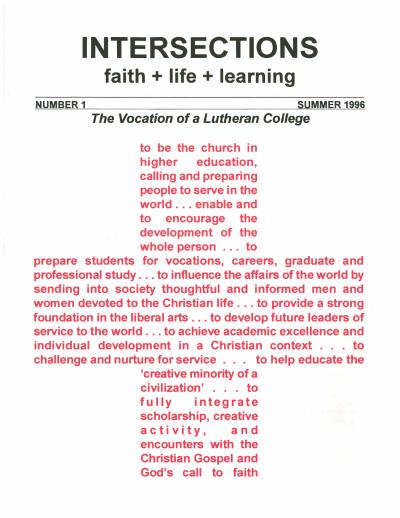
Christenson, feeling like a proud parent, welcomes readers to the inaugural issue and acknowledges three people without whom the publication would still be just an idea: Naomi Linnel of the ELCA office for Higher Education and Schools, publisher Jim Unglaube, and Capital University president Josiah Blackmore. He invites readers’ reactions, suggestions, and active involvement as editors, reviewers, authors, artists, and critics in shaping the dialogue across the ELCA college and university family.
-
 Article
Sexuality over the Lifespan—Social Trends Pose Moral Dilemmas for Communities of Faith
Adina Nack
No. 22 · Spring 2006
Nack, a sociologist who presented to the ELCA Task Force for Studies on Sexuality, surveys empirical research on three life-stages flagged by the Task Force as particularly contested—premarital sexuality among adolescents and young adults, sexuality after divorce and within single parenting, and sexuality in late adulthood. Drawing on the Alan Guttmacher Institute, the Office of the Surgeon General, AARP, National Council on the Aging, and the World Health Organization’s 2002 definition of sexual health, she closes each section with questions about the church’s role in education, blessing of committed nonmarital relationships, and dismantling stereotypes about aging and sexuality.