The Augsburg community was shocked to learn of the brutal murder of one of our students. It was a weekday morning in September 2008 when Achmednur Ali was shot and killed while on his way to volunteer at the nearby Brian Coyle Community Center. It is our practice as a College to gather in the chapel on the news of the death of a student—to pray, support one another, cry, and provide safe space for the entire community. How might we now, as Christian pastors, provide that space for the campus in light of the death of our friend Ali—a practicing Muslim? What would we say? What would we pray? How might we gather with the cross of Christ present in the space, amidst reporters and cameras and, most importantly, a grieving community?
In our brief chapel planning time before the service, my friend Mohamed Sallam, director of Pan-Afrikan Student Services, was gracious enough to join us. We all sat together in the space as colleagues in grief and people of faith, even though our faith traditions were different. I experienced the feeling of “standing on holy ground” as we prayed—Christians and Muslims together—for the day. Mohamed says that “before we gathered as a community, four or five agents of the College gathered to ponder where we thought the conversation should go. What this event provided us with was an opportunity to do what was right. Had we gone about our business without stopping to think, I am not sure that anyone would have made a fuss. However, since as a College we decided to pursue the most appropriate course of action, we not only did the right thing, but we also became friends in the process.”
During the 20 minute service the president gave an overview of what had happened in Ali’s death, we shared a public prayer for comfort, and Mohamed explained part of the Islamic tradition around death and shared some insights into Ali’s life and contribution to Augsburg College as a student. We sang songs from the Taizé community such as “Wait for the Lord,” “Stay with Us,” and “Bless the Lord My Soul.”1 We, as a community—no matter what our individual faiths—shared our grief, our pain at the injustice of such a death, and our concern for Ali’s family.
Mohamed notes that our location in the Augsburg community brings particular gifts and challenges when he says, “It would have been convenient if we were in some other place where Muslims and non-Muslims know one another better. But, I am not interested in convenience. I can say honestly that after that gathering, my coworkers earned my friendship and I hope that I have earned theirs.”
As a pastor I ask myself, “How do I care for members of my community in crisis?” What does it mean for me and others to be actively engaged with populations in whose religions I have little theological expertise?2 How do I give pastoral care to all students (faculty and staff, too), no matter what their beliefs, especially in terms of trauma, rites of passage, familial relationships, personal development, and their pursuit of meaningful lives? I am drawn to these questions because of our students, Augsburg’s unique geographical location, and my own friendships.
“How do I give pastoral care to all students (faculty and staff, too), no matter what their beliefs, especially in terms of trauma, rites of passage, familial relationships, personal development, and their pursuit of meaningful lives?”
The Gift of Interfaith Friendships
I found her or she found me in the library stacks about a decade ago. She, a new faculty member and a Jew—and I, a pastor and a Lutheran Christian. I was pleased to welcome her to campus and be received by her warmth, and Barbara Lehmann was happy to make my acquaintance. The friendship grew over Asian food in Dinkytown, the planning of interfaith services, campus meetings, and the natural inclination to reach out to one another immediately following September 11, 2001. By that time we had developed a deep sense of mutual trust. In my office, she and I and another faculty member, a Muslim, met over a period of time, hoping to model a peace-filled response to the horrible occasion of 9/11. Over the years, she has deeply respected my preaching of Christ crucified and risen and my commitment to the broad themes of new life that arises out of death through baptism.
I have come to her for friendship, and she has celebrated the birth of my two children and advised and lifted me up as a new parent. I have learned from her a deep commitment to ritual and the cycle of life. She has taught me about our shared grief, and her Jewish practice of shivah now informs my own grief practices and pastoral care on campus. We have pondered the book of Job together and wondered about its consequences and God’s actions in our own lives. I have learned about the importance of the specificity of the chosen people and the vitality of the land associated with modern-day Judaism. In her grace she has allowed me to make mistakes about how I understood Judaism. She has gently taught me about how she has interpreted and lived out her faith. We, as friends, have created a safe space in which to learn from each other. We do not avoid religion; instead, it is a core component of our friendship.3
My friend tells me, “I find gifts in interfaith relationships…I can learn about different ways of prayer, thinking about the Bible, interpretation of texts. I find that we have different rituals of celebrating lifecycle events—births, deaths, weddings, or divorces…it helps me deepen my understanding of myself by seeing my culture in relationship with others.”
It is important to note that on the Augsburg campus, Christians are the majority. Even though this essay is about interfaith relationships, it is written within that context. My friend Barbara perceptively notes that her religion suggests that “our purpose is to heal the brokenness of this world,” and that it “obligates us to treat the stranger with kindness and graciousness.” She reminds me that in being a member of a religious minority, one cannot help but interact with people of other faiths. But she believes that mere contact is not enough—that being in this position “compels us to do more.” She actively engages with others, and in so doing she shows them that “stereotypes of Jews may need to be updated (or maybe confirmed) through knowing me.” In other words, friendships take place in public.
“Friendships take place in public.”
As a member of the Augsburg community, I personally have been blessed and enriched by my colleagues and students who come from a variety of faith traditions. For several years the College has made both formal and informal attempts at interfaith dialogue.4 For example, in 2008, Campus Ministry sponsored an interfaith dialogue on “Creation: The Common Story” led by Abrahamic faith leaders.5 Last year we hosted another such dialogue on “Death, Grief, and the End of Life,” attending not only to broad themes but responding to the deaths of six students in 2008-09.
This interfaith commitment has an institutional history. As I understand, Augsburg’s sixth president, Bernhard Christensen, not only valued scholarship, studied scripture at a deep level, and cultivated his interests in critical theory, he also broke new ground by reaching out to other religious groups. It is important to note that while the idea that “interfaith friendships enrich learning” is a part of Christensen’s legacy, this emphasis is more gleaned than a direct gift from him. Christensen was very interested in ecumenical dialogue, which was considered the leading edge of Christian thought during his time.6 For instance, he attended the very first gathering of the World Council of Churches in 1948 (Amsterdam). He also strongly advocated that the Lutheran Free Church (LFC) join the American Lutheran Church (ALC). And though it might not even be considered noteworthy today, Christensen was a radical in that he befriended Catholic and Orthodox Christians. This behavior was especially significant given Christensen’s context—a position of distinction in the LFC, which was a small, pious denomination. And so, we might extrapolate from Christensen’s attitudes toward other Christians that, if he were with us today, he would feel similarly toward persons from other faith traditions.
One may also conclude from Christensen’s work with Hubert H. Humphrey on the Human Rights Commission that he was very much committed to combating discrimination against Jewish-Americans and African-Americans in the Twin Cities during the 1960s. Alongside this, Christensen was a strong supporter of Christian missions to people of other religions. According to Brad Holt, Christensen “had the courage to go beyond what was conventional in exploring the faith of the Other.”
Vital to our interfaith endeavors on campus is that they be both personal and public. The idea that friendships are personal is incontestable, but the idea that friendships are public may be a challenging notion for some. Certainly, people do not always assume that matters of faith are public matters. Yet I would argue they are, and as I understand the Christensen legacy, the public nature of faith was instinctive for him. Paul Sonnack, professor emeritus, explained the connection Christensen drew between personal faith and the community:
There is another important dimension to Dr. Christensen’ understanding of religion as primarily personal. To put it bluntly, he was convinced that the personal is never simply to be equated with the individual. There is a strong inclination, particularly in a society like ours where rampant individualism prevails in both religion and secular arenas, to make that mistaken equation. For Christensen, that which is personal necessarily includes the dimension of community. A person is never only a discrete individual who lives in isolation from other individuals. What is constitutive of personhood is precisely relationship with other persons, and it is that relationship which forms and shapes human community.7
Friendship With and In God
The Gospel of John is a communal gospel. Ever since I entered the ministry, my journey through John has significantly informed my work as a pastor on campus. In June 1995, this passage from John was read at my service of ordination:
I do not call you servants any longer, because the servant does not know what the master is doing; but I have called you friends, because I have made known to you everything that I have heard from my Father. You did not choose me but I chose you. And I appointed you to go and bear fruit, fruit that will last, so that the Father will give you whatever you ask him in my name. I am giving you these commands so that you may love one another. (John 15:15-17)
It seems to me that the Gospel of John has several key themes that may nourish interfaith friendships and enrich learning on campus—love, friendship, free speech, and public space. Because of these elements, I believe this gospel can provide a roadmap (though not necessarily the only roadmap) for further interfaith endeavors at Lutheran colleges and universities.8
The connection between love and friendship portrayed in John has intrigued me because of its implications for interfaith conversation. This Gospel uses the two Greek words agape and filia when referring to love and friendship, respectively, although agape appears more than twice as many times as the other. After the Lazarus story (John 11:1-57), the text gradually blends the two terms, and by the end of John the words become completely transposable. It is in the conversation between Peter and Jesus that both words are used repeatedly and interchangeably. The repetition shouts to the reader to “take notice!” What does this repetition and collapsing of terms mean for us as readers, and moreover, as members of our diverse community?
“One might dare say that to enter into interfaith friendships and commitments is to enter into friendship with God!”
For one, we are encouraged to think about how God’s sending the Son relates to friendship. The death of Jesus seems to make friendship between God and humanity possible. God’s love for the world (agape) is present prior to Jesus’ presence and death and glory; but it seems that through Jesus’ glorification we become friends with God. John broadens the notion of love to include love as friendship. We cannot miss the point that we are friends because we are drawn up into the very life of God. This is not a life of domination, for we are no longer as servants, but a life of freedom and friendship. Glorification is not for the sake of itself, but for the sake of community, and this creates in us a sense of freedom. This has significance in terms of our interfaith setting on campus. One might dare say that to enter into interfaith friendships and commitments is to enter into friendship with God!
Risking Radical Speech
The invitation to friendship in the Gospel of John also challenges one to explore and reflect on the role of conversation and language in the gospel. The gospel writer emphasizes—even delights—in the theme of speaking and speech. We see this in the very first verse: “In the beginning was the Word, and the Word was with God, and the Word was God” (John 1:1). God is not cause; God is speech. The word parresia, which means “plainness of speech, outspokenness, or frankness”9 provides an avenue into this discussion. The word is used nine times in John; the only other time it is used in the four gospels is in Mark—once. This number alone draws our attention. In John’s gospel we find a direct connection between speech and openness.
Significant for John is that God is a speech-bringer. Jesus’ voice, not work, draws people into God. From the mouth of Jesus, the idea of speaking plainly is directly connected to friendship; speech is transparent to thought. This is also a model for the language of interfaith friendship—where one speaks in a free, unguarded manner. John models for us the public nature of conversation, a quality that applies particularly to interfaith conversations and relationships since they not only occur on a personal level but also extend into our public lives on campus. One notices early in the narrative that Jesus’ speaking openly is radical. In fact, it gets him killed. We read, “Is not this the man whom they are trying to kill? And here he is, speaking openly, but they say nothing to him!” (John 7:25-26a). The danger of openness is frequently repeated in John. There is risk in conversation when it takes place in public, even when Jesus is the one who sets the stage.
A variety of voices enter into this conversation space in this gospel. John includes confused disciples, voices from the margins, faithful confessions, and angry crowds—just to name a few. Emphasizing the speakers reveals the power and dialogical nature of the relationships, and this in turn encourages members of a community to enter into space with one another, to create in conversation something new. When we follow the conversation modeled in John, we are able to listen to the many voices of others with confidence, in a space where all voices are free—no shame, no dominance, no muting. As in the text, we become participants in the conversation, not simply spectators.
In John’s gospel, the narrator weaves all these terms together—speech, love as agape, love as filia—to emphasize their interconnectedness and open our minds to imagine God’s presence in the world in a new, radical way. In John, God’s power is channeled into making all things open. The future that arises from the present is not one of dominance, but of communication. Being in conversation means that both God and we risk change. How much are we willing to risk? To receive? No matter the answer, the Gospel of John gives me as a pastor, and all of us as conversation partners, room to breathe. How risky—and yet how freeing.
“Being in conversation means that both God and we risk change. How much are we willing to risk? To receive?”
Friends, colleagues, students, and scripture have all shaped my understanding of how interfaith friendships enrich learning. Over the years, insights from these various sources have organized themselves into themes. I offer them now in the form of resolutions:
- That we allow and nurture a deep love for one another, keeping in mind that interfaith friendships might entail suffering on behalf of one another.
- That we assume the freedom to speak without shame.
- That we speak from our relationships with other human beings, not only from doctrine or a formal set of beliefs. Participation in the conversation is as vital as the end result of the conversation.
- That we hold these friendships to be personal, even though they exist in the public space.
- That we allow ourselves to risk—to make mistakes, to be changed, to challenge, even to offend.
- That we recognize that we are in the presence of God as we participate in interfaith conversations.
May this collective wisdom nourish our efforts—no matter what our individual faiths—to come together in true community.
Endnotes
1. The Taizé Community is an ecumenical Christian monastic community in France. Taizé music emphasizes repetition of short phrases, often taken from scripture, set to simple melodies.
2. Augsburg College sits in the Cedar-Riverside neighborhood, amidst the largest population of Somali Muslims outside Somalia. We have, in our College community, a broad spectrum of faith traditions.
3. In his challenging article “The Impossibility of a Pluralist View of Religions,” Gavin D’Costa cheers on the honoring of particular truth claims. He argues that there is “no high ground in the pluralist position, for in principle its logic is no different from the exclusivist position. The only difference is in terms of truth claims and the criteria for truth employed by the practitioners.” Religious Studies 32 (June 1996): 225.
4. Over the years formal dialogues, events, and worship services have occurred alongside a myriad of friendships, relationships, and even pastoral care across faith traditions on this campus. It goes without saying that one essay barely “scratches the surface” of the depth of friendships shared through the years on this campus.
5. Lectures and interfaith worship took place in the Hoversten Chapel at Augsburg on March 3-4, 2008. The panelists included Dr. Hatem al-Haj, Islamic scholar and pediatrician; Rabbi Lynn Liberman, Beth Jacob Congregation in Mendota Heights, Minnesota; and Mark Throntviet, professor of Old Testament at Luther Seminary, St. Paul, Minnesota.
6. Conversation with Brad Holt, Augsburg College Religion Department, Minneapolis, Minnesota, November 20, 2009.
7. Paul G. Sonnack, “A Perspective on Dr. Bernhard M. Christensen” (address, Augsburg College, Minneapolis, Minnesota, date unknown), 3.
8. It could be fruitful to embed this conversation in overarching qualities like “hospitality” or “justice” found in many of the major religions of the world. And other writings have done this. I wonder, is it possible, for me, as a Christian, to embed these kinds of relationships in even the specificity of a gospel text?
9. Walter Bauer, et al. A Greek-English Lexicon of the New Testament and Other Early Christian Literature, 2nd ed. (Chicago: University of Chicago Press, 1979), 630.
-
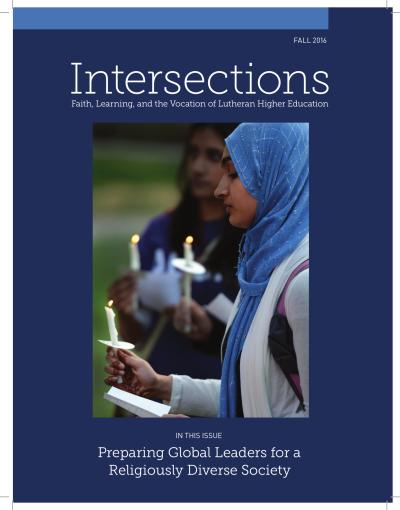 Editorial
From the Publisher and Editor
Jason A. Mahn, Mark Wilhelm
Writing weeks after the 2016 presidential election, Wilhelm and Mahn frame interfaith engagement as the urgent and ongoing work of ELCA colleges and universities, recap NECU’s growing commitments to inter-religious leadership, and introduce essays first delivered at the summer 2016 Vocation of a Lutheran College Conference under the theme “Preparing Global Leaders for a Religiously Diverse Society.”
-
Article
Laboratories for Living in a Diverse World
Elizabeth Eaton
Presiding Bishop Elizabeth Eaton argues that ELCA colleges and universities are called to be laboratories for living in a religiously diverse world. Reflecting on the decline of Christian privilege, the ELCA’s ecumenical and inter-religious work, and her own experience addressing the Islamic Society of North America, she offers three questions about partnerships, formation, and institutions as platforms for new collaborations.
-
Article
Why Interfaith Work is Not a Luxury: Lutherans as Neighboring Neighbors
Martha E. Stortz
Stortz argues that interfaith work is not a luxury but a constitutive commitment of Lutheran higher education — institutions she describes as both “faith-based and interfaith-dependent.” Reading the parable of the Good Samaritan as both an intra-faith and inter-faith encounter, she offers a four-fold matrix of theological reflection, spiritual engagement, social action, and everyday experience as portals into the work of being neighbor.
-
Article
The Promise and Peril of the Interfaith Classroom
Matthew Maruggi
Maruggi draws on his years teaching in the Augsburg religion department to identify three pairs of seeming opposites — dialogue and debate, safety and risk, commonality and particularity — that, held in creative tension, nurture a vibrant interfaith classroom where pluralism is actively engaged rather than merely present.
-
Article
Religious Diversity and the Vocation of a Lutheran College
Darrell Jodock
Jodock argues that a college which takes its Lutheran values seriously is well positioned to foster inter-religious relations along a “third path” that is both religiously rooted and inclusive. He traces the relational and communal character of Lutheran theology, develops a Lutheran understanding of deeper freedom, the theology of limits, and human complexity, and shows how a down-to-earth image of God offers theological resources for overcoming the anxiety and fear that block interfaith engagement.
-
Reflection
Mapping Interfaith Encounters
Callista Isabelle
Muhlenberg College Chaplain Callista Isabelle uses a student-designed subway map of religious and spiritual communities as an image for interfaith engagement — one that invites students to leave their “home” stations, encounter common ground and respectful disagreement, and explore the major intersections where religion meets science, environment, and mental health.
-
Article
Negotiating Legitimate and Conflicting Values
Eboo Patel, Katie Bringman Baxter, Mark S. Hanson
In a closing-day conversation at the 2016 Vocation of a Lutheran College Conference, Mark Hanson and Eboo Patel — moderated by Katie Bringman Baxter of Interfaith Youth Core — share case studies in which legitimate religious values come into tension with one another, and make the case that Lutheran colleges should teach interfaith leadership through the hard cases rather than the easy ones.
-
Institutional Focus
Interfaith Campus Organizing at California Lutheran University
Allison Bermann, Mehak Sachdev
California Lutheran University students Allison Bermann and Mehak Sachdev describe how interfaith participation at CLU grew from a grassroots movement into a sustained, integrated part of campus identity — with an intern program, Interfaith Allies, co-curricular events from Diwali dinners to Hunger Banquets, and a classroom practice of storytelling that opens the required Introduction to Christianity course to students of every faith and none.
-
 Article
Access, Accessibility, & Change: A Call for Trustworthy Leadership in Higher Education
Emma Jones
No. 60 · Fall 2024
Jones surveys the converging pressures on higher education — cost, the enrollment cliff, shifting demographics, and declining public confidence — and uses Reichheld and Dunlap’s four factors of trust (transparency, capability, reliability, humanity) to call campus leaders to rebuild trustworthy leadership from the inside out.
-
 Reflection
Some Personal Reflections on the ELCA Vocation of a Lutheran College Conference, 1998
Jennifer Sacher Wiley
No. 7 · Summer 1999
Sacher Wiley, a Unitarian Universalist with one Jewish parent and a first-year music faculty member at Susquehanna, reflects on common-ness and other-ness at the 1998 conference—Tom Christenson’s weaver’s warp and Charles Ives’s essay on American music—and proposes four markers of group identity. Against the fear of secularization expressed by some attendees, she suggests that “Christian” might be defined less by belief in Christ as Savior than by living a vocation as Jesus lived, with Cheryl Ney offered as an example of a “working prophet,” or “little Christ,” regardless of specific belief in the Trinity.
-
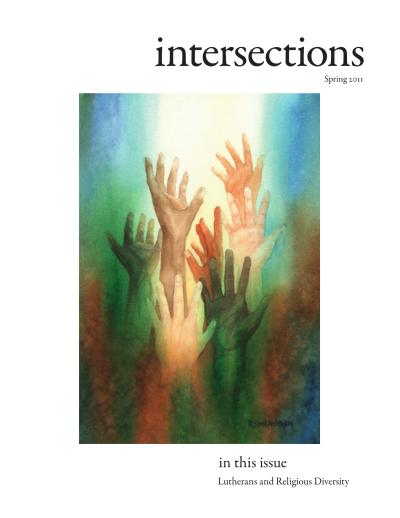 Article
The Breadth and the Depth: Dimensions of Christian-Muslim Relations at Educational Institutions of the ELCA
Mark N. Swanson
No. 33 · Spring 2011
Swanson reflects on the spatial metaphors of depth and breadth that shape Lutheran higher education and argues that the study of Islam and real conversation between Christians and Muslims can contribute to both the broadening of horizons and the deepening of faith, drawing on his experience at the Lutheran School of Theology at Chicago and pointing to hospitality as a Christian practice in which depth and breadth come together.
-
 Article
Civic Engagement, "Baylor In Deeds," and Engaged Learning
Rebecca Flavin
No. 63 · Spring 2026
6 min audio
Flavin describes how Baylor’s strategic plan “Baylor in Deeds” and its Office of Engaged Learning are building civic engagement into the Arts & Sciences core curriculum, with early Global Engagement Survey data showing gains in civic efficacy and global civic responsibility.
-
 Reflection
VLHE—Wednesday Morning Sacred Pause
Ann Rosendale
No. 62 · Fall 2025
8 min audio
Rosendale draws on Esther 4:14 and the Lutheran practice of holding death and resurrection together — with “and” as the hardest word — to argue that the calling of Lutheran higher education for “just such a time as this” requires us to remember and name out loud that ours are places where God is at work.
-
 Book Review
Learning Across Campus: Hearing Bok's Call to Conversation
David Ratke
No. 39 · Spring 2014
Ratke reads Derek Bok’s Our Underachieving Colleges from Lenoir-Rhyne and argues that Bok’s call to think holistically about undergraduate education and to dialogue across disciplinary boundaries names the work already underway at ELCA colleges. He weighs faculty attitudes, the role of skills in the core curriculum and the major, and the importance of the extracurriculum for student formation.