It is remarkable that twenty-two of the twenty-six ELCA colleges and universities have gathered here to explore together what it means to prepare global leaders for a religiously diverse world. This is an indication of the importance of this topic for higher education, and for the church.
I would contend that it is the proper work of Lutheran higher education to be laboratories for people to engage in what it means to be living in a world—not to mention a country and a city like Minneapolis—that is religiously diverse. It is simply no longer an option for people to pretend that there aren’t other traditions surrounding them. There is probably no mono-cultural (mono-ethnic, mono-racial, or mono-religious) community remaining in the United States.
The question is this: How can we in the church and in Lutheran higher education honor and celebrate this diversity without boiling everything down into the mush that sometimes passes as inter-religious relations? How can we stay true to our own traditions, but appreciate and truly understand and encounter the religious traditions of others?
Beyond Christian Privilege
The Lutheran tradition has a lot to offer, and it begins with recognizing the diversity within the Lutheran tradition. There are a lot of young people on our college and seminary campuses who are involved with a movement called “Decolonize Lutheranism” (“Welcome”). These faithful Christians are challenging cultural norms that have been used to define what it means to be Lutheran. Folks in the Decolonize Lutheranism movement and many others are saying that cultural markers actually have little to nothing to do with the Lutheran tradition. Indeed, many in this room have been instrumental in pushing or pulling us into a deeper and more authentic way of understanding and engaging the Lutheran tradition, and from that place of greater diversity, into a deeper and more authentic way of understanding and engaging in inter-religious relations.
“Christianity in the current culture is not in the same position that it used to have, particularly after WWII, when it was in a privileged place.”
Christianity in the current culture is not in the same position that it used to have, particularly after WWII, when it was in a privileged place. Christians have sharply defined the history and identity of this country. Some of us remember firsthand what this means. I grew up when stores were closed on Sundays. Wednesday night was church night, so you didn’t dare have a soccer game or practice then. This Christian culture has radically shifted, of course. According to a recent PEW survey of 35,000 Americans, among people 30 and under, 30 percent now have no religious affiliation whatsoever (“U.S. Public”). Moreover, if we take a look at the whole world, we can see that the center of gravity of a Christian culture—the Christian movement—is no longer in Europe or North America. It’s in the global South. The same is true for the center of gravity of Lutherans. There are now more Lutherans in Indonesia than there are in the Evangelical Lutheran Church in America. There are far more Lutherans in Ethiopia and Tanzania than there are in the United States.
This shift in where the church is growing also brings a host of new practices to us, as Lutheran Christians living in the United States. But here again we need to divorce ourselves from saying that cuisine and culture define Lutheranism; we need to look at the ways that our theology and understandings of God are being lived out by brothers and sisters around the world.
Along with our predecessor churches, the ELCA has been deeply engaged in the modern ecumenical movement, which has been going full speed ahead for the last 50 years. We just recently developed a joint text in cooperation with the U.S. Conference of Catholic Bishops called “Declaration On The Way” (Bishops’ Committee). Bishop Mark Hanson was the ELCA co-chair of that committee. In reviewing 50 years of Lutheran-Catholic dialogue, the task force discovered 32 places where Lutherans and Catholics agree with each other in the areas of church, ministry, and the Eucharist. This is deeply significant as we approach the five hundredth anniversary of the Reformation.
In addition to ecumenical relations, certainly global migration is shaping and reshaping our culture—despite some troubling political rhetoric. For example, the ELCA, together with Missouri Synod Lutherans and others, are committed to helping refugees make a way of life here. When Lutherans help immigrants and refugees resettle in this country, it’s not with any thought that somehow we’re going to fit these people into some kind of generic Christian model—which would have more to do with dominant American culture anyway. We respect the traditions of people who come here and we can learn from them. That’s precisely part of what is reshaping our culture right now.
“Many try to define who ‘real’ Americans are, and this often entails turning against people who are not Christian.”
Pluralization is happening everywhere—in urban areas, of course, but also in suburbs and small towns and communities. Because of this pluralization, the church does not have the privileged position it once had. Some people who are used to Christian privilege of the past are now frightened by the speed and the reality of change. One of the unfortunate consequences is that we can see a rise in fear of and hatred toward others. We see this in the rise of Islamophobia in our country. As I walk around the neighborhood surrounding Augsburg College, I am so pleased to see signs in people’s yards wishing others a blessed Ramadan. But that’s not the case everywhere. Many try to define who “real” Americans are, and this often entails turning against people who are not Christian.
The Church in and for a Diverse World
Given this massive shift of Christianity within American culture, the arrival of people from so many vibrant religious traditions other than Christianity, and the decline of the cultural importance of church, how should churches such as the ELCA respond? Lutheran churches and colleges/universities believe that our role is one of convening and bridge-building. It is important for us to be seen neither as those who shun the other, nor as those who retreat into some sort of guarded religious identity. We are called to build bridges.
In 2011 the ELCA invited Dr. Sayyid Syeed, national director of the Islamic Society of North America’s Office of Interfaith and Community Alliances, to address the our churchwide assembly. This was the first time that a Muslim had addressed the assembly. He and Bishop Hanson had done a lot of work together. When Dr. Syeed spoke, it was the tenth anniversary of 9/11 and he talked about what we needed to do to bring down the mountains of hatred and hostility that had grown up between our traditions. He pleaded that it was our two traditions—Islam and Christianity—who should be leading the way to find common ground. He received a standing ovation.
Later, Dr. Sayeed invited me to address his annual convention, the Islamic Society of North America (ISNA) convention. Kathryn Lohre, the ELCA Executive for Ecumenical and Inter-religious Relations, and I attended and it was simply amazing. If you took out the prayer rugs and changed some of the vendors, it would look exactly like a churchwide assembly. In fact, I was looking through their workshops and among them was a title something to the effect of: “Getting Young Muslims back to the Masjid.” I said that when Muslims work that one out, they should let us know! The ISNA is very intentional about having Shia and Sunni together at the conferences; they use that as a model for the rest of the Muslim world of worshiping together, working together, and fellowshipping together. At this convention, they also had boy scouts—all Muslim kids who also happen to be kids of color—come and pledge allegiance and sing the national anthem. I got tears in my eyes when the little guy in charge of the color guard declared that he “proudly posts the colors of the United States of America.”
Sadly, back in Chicago at the churchwide offices, our call center was at the same time overburdened with people accusing me of agreeing to be a keynote speaker for a fundraiser for Hamas. How dare we be engaged in working with these Muslims? It is not always easy to engage people who are afraid and angry. But we do try to talk with these people; when they can listen, we tell them that it is not a new thing for the ELCA to be engaged with the Muslim communities or to do inter-religious work. In the 1990s, the ELCA made a statement that repudiated and asked for forgiveness for Luther’s anti-Jewish writings (“Declaration”). For about 12 years now, we have also said we should be in dialogue with the Muslim community as well. This was not something new that we’ve done. When we gather with our Jewish colleagues or our Muslim colleagues, we get together on issues of gun violence, women’s rights, or domestic hunger. One of the basics for us in our Christian identity is that we believe that we have been set free in Christ to love and serve the neighbor. We enter into inter-religious relations out of that love for the neighbor, but with clarity about who we are and what we believe. How can you have a conversation with somebody else—how can you really encounter someone else—if you don’t know who you are? At its best, inter-religious dialogue is also a deeper encounter with ourselves.
“One of the basics for us in our Christian identity is that we believe that we have been set free in Christ to love and serve the neighbor. We enter into inter-religious relations out of that love for the neighbor, but with clarity about who we are and what we believe.”
Prospects for Partnership
Lutheran higher education has pointed out the importance and necessity of engaging people in inter-religious dialogue because that’s where the world is. I want you to know that the ELCA is following what you’re doing, and hoping to learn from you. But we also believe that the church has something to share with you, and that together we can do even more.
In the interest of deepening our partnership as we seek to prepare global leaders for a religiously-diverse world, I offer three questions:
First of all, can you find community partners and partners in the church? Augsburg College’s partnership with Trinity Cedar Riverside is an excellent example of a community partnership. Could your synod or the local congregation be a resource as well? Could Lutheran colleges and universities become resources for our synods and our congregations, in turn? We need to work together on this.
“How might your college or university provide opportunities for ecumenical and inter-religious formation for students of all disciplines and years of study?”
Secondly, how might your college or university provide opportunities for ecumenical and inter-religious formation for students of all disciplines and years of study? Engaging religious difference is not just for religion majors. In fact, it probably should be geared more towards people who are not religion majors. They might not otherwise learn to negotiate religious difference, and yet they are sure to be working next to someone from another religious tradition. We know that, when people leave our universities and colleges, they’re going to go into an inter-religious, pluralistic world. So how are we forming people so that they are able to be good citizens and good neighbors to someone who is not from their own religious tradition? We need to form people so that they can be not only ambassadors of their own religious traditions, but also bridge-builders and peacemakers within our communities. Are there opportunities for developing, sharing, and lifting up existing inter-religious resources of the ELCA and of colleges and universities in curricular and co-curricular endeavors? What are the best practices? We can learn from each other here, too.
Finally, how do we see our institutions as platforms—as firm ground—for work that has been going on for a hundred or more years, but also as launch pads for new endeavors and new collaborations? We are called to educate Christians, Jews, Muslims, agnostics, and others to be faithful to their own identities and to collaborate with one another, knowing one another as brothers and sisters, becoming global citizens. That is new work and—in other ways—work as old as the gospel itself.
Works Cited
Bishops’ Committee for Ecumenical and Inter-religious Affairs, United States Conference of Catholic Bishops, and the Evangelical Lutheran Church in America. Declaration on the Way: Church, Ministry and Eucharist. Accessed 1 November 2016, http://www.usccb.org/beliefs-and-teachings/ecumenical-and-interreligious/ecumenical/lutheran/upload/Declaration_on_the_Way-for-Website.pdf
“Declaration of the Evangelical Church in America to the Jewish Community.” Accessed 1 November 2016, http://download.elca.org/ELCA%20Resource%20Repository/Declaration_Of_The_ELCA_To_The_Jewish_Community.pdf?_ga=1.71619091.1292554358.1407466505
“U.S. Public Becoming Less Religious.” Pew Research Center, Religion and Public Life. November 3, 2015. Accessed 1 November 2016, http://www.pewforum.org/2015/11/03/u-s-public-becoming-less-religious
“Welcome to #decolonizeLutheranism.” Accessed 1 November 2016, http://decolonizelutheranism.org
-
 Editorial
From the Publisher and Editor
Jason A. Mahn, Mark Wilhelm
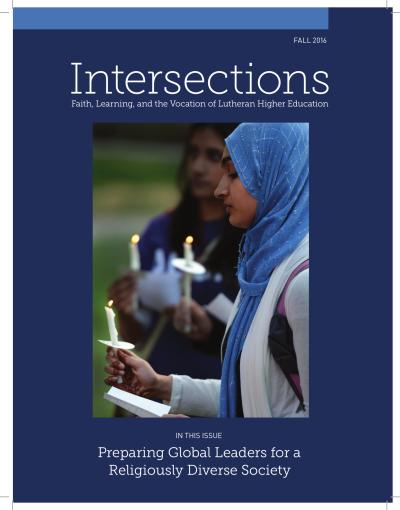
Writing weeks after the 2016 presidential election, Wilhelm and Mahn frame interfaith engagement as the urgent and ongoing work of ELCA colleges and universities, recap NECU’s growing commitments to inter-religious leadership, and introduce essays first delivered at the summer 2016 Vocation of a Lutheran College Conference under the theme “Preparing Global Leaders for a Religiously Diverse Society.”
-
Article
Why Interfaith Work is Not a Luxury: Lutherans as Neighboring Neighbors
Martha E. Stortz
Stortz argues that interfaith work is not a luxury but a constitutive commitment of Lutheran higher education — institutions she describes as both “faith-based and interfaith-dependent.” Reading the parable of the Good Samaritan as both an intra-faith and inter-faith encounter, she offers a four-fold matrix of theological reflection, spiritual engagement, social action, and everyday experience as portals into the work of being neighbor.
-
Article
The Promise and Peril of the Interfaith Classroom
Matthew Maruggi
Maruggi draws on his years teaching in the Augsburg religion department to identify three pairs of seeming opposites — dialogue and debate, safety and risk, commonality and particularity — that, held in creative tension, nurture a vibrant interfaith classroom where pluralism is actively engaged rather than merely present.
-
Article
Religious Diversity and the Vocation of a Lutheran College
Darrell Jodock
Jodock argues that a college which takes its Lutheran values seriously is well positioned to foster inter-religious relations along a “third path” that is both religiously rooted and inclusive. He traces the relational and communal character of Lutheran theology, develops a Lutheran understanding of deeper freedom, the theology of limits, and human complexity, and shows how a down-to-earth image of God offers theological resources for overcoming the anxiety and fear that block interfaith engagement.
-
Article
Risky Speech–Gifted Friendships
Sonja Hagander
Augsburg College Pastor Sonja Hagander reflects on pastoral care across faith traditions — from a campus chapel service after the 2008 murder of Muslim student Achmednur Ali, to her decade-long friendship with Jewish colleague Barbara Lehmann — and reads the Gospel of John as a roadmap for interfaith friendships marked by love, free speech, public space, and a willingness to risk being changed.
-
Reflection
Mapping Interfaith Encounters
Callista Isabelle
Muhlenberg College Chaplain Callista Isabelle uses a student-designed subway map of religious and spiritual communities as an image for interfaith engagement — one that invites students to leave their “home” stations, encounter common ground and respectful disagreement, and explore the major intersections where religion meets science, environment, and mental health.
-
Article
Negotiating Legitimate and Conflicting Values
Eboo Patel, Katie Bringman Baxter, Mark S. Hanson
In a closing-day conversation at the 2016 Vocation of a Lutheran College Conference, Mark Hanson and Eboo Patel — moderated by Katie Bringman Baxter of Interfaith Youth Core — share case studies in which legitimate religious values come into tension with one another, and make the case that Lutheran colleges should teach interfaith leadership through the hard cases rather than the easy ones.
-
Institutional Focus
Interfaith Campus Organizing at California Lutheran University
Allison Bermann, Mehak Sachdev
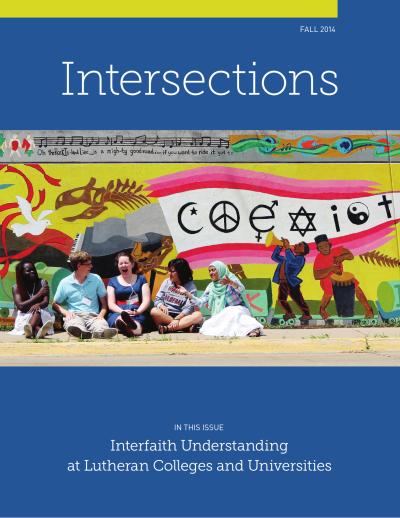
California Lutheran University students Allison Bermann and Mehak Sachdev describe how interfaith participation at CLU grew from a grassroots movement into a sustained, integrated part of campus identity — with an intern program, Interfaith Allies, co-curricular events from Diwali dinners to Hunger Banquets, and a classroom practice of storytelling that opens the required Introduction to Christianity course to students of every faith and none.
-
 Article
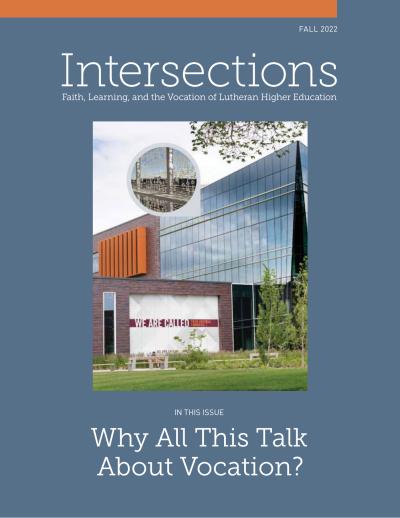
Why All This Talk About Understanding the Mission of NECU Member Institutions as a Vocation?
Mark Wilhelm
No. 56 · Fall 2022
In his valedictory keynote, retiring NECU Executive Director Mark Wilhelm argues that Lutheran higher education is, properly understood, vocation-based education — outlining four core practices recovered over the past fifty years and naming the constructive and corrective work still to be done, including a fuller embrace of DEIJ and of the diverse vocations of NECU’s 27 institutions.
-
 Article
Learning and Teaching as an Exercise in Christian Freedom
Tom Christenson
No. 6 · Winter 1999
Christenson, the 1998 Wittenberg keynote, argues that what makes our institutions Lutheran is not the percentage of Lutherans served or employed, ethnic celebration, or self-conscious difference, but a theologically informed vision of the educational task framed by the linked ideas of gift, freedom, and vocation. Drawing on Joe Sittler, Wendell Berry, David Orr, Harold Kushner, John Updike, Frederick Buechner, and Luther’s On the Freedom of a Christian, he reframes the liberal arts as four “liberating arts”—critical/deconstructive, embodying/connecting, melioristic/creative, and arts of enablement and change—and closes with his mother’s “end-of-the-month soup” as an image of vocation in a particular place.
-
 Article
Called to Serve
Robert D. Haak
No. 31 · Winter 2010
Haak describes Augustana’s Center for Vocational Reflection (CVR) and its threefold framework of skills/gifts/talents, passions/values, and needs of the community. He surveys the CVR’s Working with Faith group, seminary visits, spiritual companioning, Servant Leader Internships, international travel reflection, and the major Senior Inquiry curriculum revision—then reports the lessons learned at Augustana: that multiple exposures matter more than any single program, that the language of vocation works even for non-religious students, that student-initiated ideas (like Erin Blecha’s Athletes Giving Back) often succeed most, and that the CVR will soon merge into a new Community Engagement Center.
-
 Article
Toward an Adequate Theology of Christian Higher Education
Robert Benne
No. 10 · Fall 2000
Drawing on his forthcoming Eerdmans volume Quality With Soul—Thriving Ventures in Christian Higher Education, which studies St. Olaf, Valparaiso, Notre Dame, Baylor, Wheaton, and Calvin, Benne argues that these schools have kept their souls because a critical mass of boards, administrators, faculty, and students treat the Christian account as comprehensive, unsurpassable, and central. He critiques four inadequate theologies of Christian higher education—pietism, liberal theology (Whitehead, Henry Nelson Weiman, the “values” turn, and accommodation to diversity and multiculturalism), “First Article” approaches (including Merrill Cunninggim’s Methodist version and a Lutheran two-kingdoms quietism), and reactionary/triumphalist theology—and contrasts the Catholic (Notre Dame), Reformed (Calvin, Wheaton, Baylor), and Lutheran (St. Olaf, Valpo) ways of relating faith and learning, calling Lutherans to recover “Christ and culture in paradox” as serious extended conversation rather than as a lazy excuse.
-
 Editorial
From the Editor
Robert D. Haak
No. 27 · Spring 2008
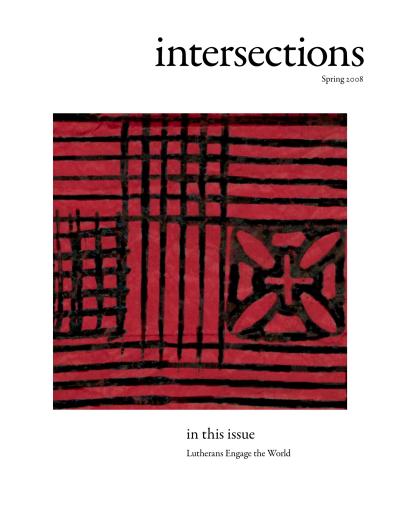
Haak frames the issue around the question of why Lutherans engage the world rather than retreat from it, locating the answer in the doctrines of creation and incarnation, and introduces essays by Erwin on globalism, Carlsen on local community engagement, Marty on multiple callings, and Mattes on the Grundtvigian heritage at Grand View. He also bids farewell to publisher Arne Selbyg, noting the fittingness of the Adinkra (“farewell”) cloth on the cover of this final issue under Selbyg’s leadership.
-
 Article
Academic Vocation: What the Lutheran University has to Offer
Wendy McCredie
No. 19 · Summer 2004
Writing as a practicing Lutheran, a trained literary scholar, and the associate director for interpretation at the ELCA churchwide office, McCredie articulates a vocation for ELCA colleges and universities grounded in the dialogical tension Gilbert Meilaender names between “bonds of particular love” and “a love which is open to every neighbor.” Drawing on Berube and Nelson, Marsden, Pelikan, Schwehn, Toulmin, Simmons, Hughes, MacIntyre, and Wolterstorff, she argues that Lutheran tradition resists both the easy separation and the collapse of sacred and secular, that human reason errs while God’s grace makes action possible, and that listening to the marginalized and to those outside the tradition is itself a theology of the cross enacted in classroom and collegial life.