As someone who grew up on an Iowan farm, I find the idea of travel by subway rather intimidating. Will I get on the right train? Will I be able to navigate the chaos of Grand Central Station? Will I find my way back home?
In reality, subways provide opportunities to (quite literally) bump into people of diverse cultures and beliefs. Travel stretches us out of our comfort zones and connects us with new communities.
Rebecca Diamond, a 2015 graduate of Muhlenberg College and a member of our Interfaith Leadership Council, designed this subway map as an image for interfaith engagement here. To a blank map of the Montreal subway system, she added the various religious and spiritual communities of our student body. The map is a powerful image for interfaith engagement. Students often begin at one point, perhaps identifying strongly as Roman Catholic or atheist. Other students start at one of the unnamed stations, which we could label “questioning” or “exploring.”
While many students feel most at home at one point on the map, diverse college environments invite students to “jump on a train” and learn about another point. Lutherans attend Shabbat dinner with their Jewish friends. Muslims celebrate Holi with Hindu classmates. An atheist talks with a Catholic about social justice. Many travel back to their home base communities, of course, to be nurtured in their religious (or non-religious) practices and beliefs. But once given the opportunity to learn about a peer’s tradition, one’s worldviews has been stretched.
Interfaith encounters enable students to articulate—often for the first time—what they believe and don’t believe. Conversations with new neighbors often lead to a discovery of common ground. But lingering for more than a few minutes at a new subway stop inevitably leads to points of theological disagreement as well. Interfaith dialogue should not only be kumbaya circles of commonality. It should provide sanctuaries for civil discourse and, at times, respectful disagreement.
Consider the major intersections in the subway map. Where are these intersections on your campus? Muhlenberg students are especially eager to explore the intersections of religion and science, spirituality and the environment, faith and mental health. These topics invite students of any or no religious belief to participate in deep conversation. These intersections also invite collaboration between academic departments and co-curricular partners to co-sponsor speakers, panel conversations, film screenings, and art exhibits.
I invite you and your students to draw an interfaith engagement map for your campus. Where do students call “home” on the map? What intersections and partnerships would you like to explore? The train is about to leave the station. Will you get on board?
-
 Editorial
From the Publisher and Editor
Jason A. Mahn, Mark Wilhelm
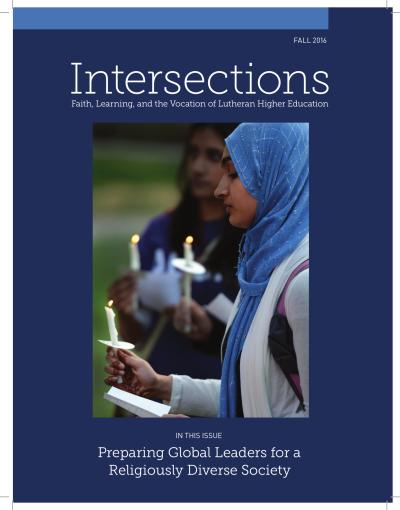
Writing weeks after the 2016 presidential election, Wilhelm and Mahn frame interfaith engagement as the urgent and ongoing work of ELCA colleges and universities, recap NECU’s growing commitments to inter-religious leadership, and introduce essays first delivered at the summer 2016 Vocation of a Lutheran College Conference under the theme “Preparing Global Leaders for a Religiously Diverse Society.”
-
Article
Laboratories for Living in a Diverse World
Elizabeth Eaton
Presiding Bishop Elizabeth Eaton argues that ELCA colleges and universities are called to be laboratories for living in a religiously diverse world. Reflecting on the decline of Christian privilege, the ELCA’s ecumenical and inter-religious work, and her own experience addressing the Islamic Society of North America, she offers three questions about partnerships, formation, and institutions as platforms for new collaborations.
-
Article
Why Interfaith Work is Not a Luxury: Lutherans as Neighboring Neighbors
Martha E. Stortz
Stortz argues that interfaith work is not a luxury but a constitutive commitment of Lutheran higher education — institutions she describes as both “faith-based and interfaith-dependent.” Reading the parable of the Good Samaritan as both an intra-faith and inter-faith encounter, she offers a four-fold matrix of theological reflection, spiritual engagement, social action, and everyday experience as portals into the work of being neighbor.
-
Article
The Promise and Peril of the Interfaith Classroom
Matthew Maruggi
Maruggi draws on his years teaching in the Augsburg religion department to identify three pairs of seeming opposites — dialogue and debate, safety and risk, commonality and particularity — that, held in creative tension, nurture a vibrant interfaith classroom where pluralism is actively engaged rather than merely present.
-
Article
Religious Diversity and the Vocation of a Lutheran College
Darrell Jodock
Jodock argues that a college which takes its Lutheran values seriously is well positioned to foster inter-religious relations along a “third path” that is both religiously rooted and inclusive. He traces the relational and communal character of Lutheran theology, develops a Lutheran understanding of deeper freedom, the theology of limits, and human complexity, and shows how a down-to-earth image of God offers theological resources for overcoming the anxiety and fear that block interfaith engagement.
-
Article
Risky Speech–Gifted Friendships
Sonja Hagander
Augsburg College Pastor Sonja Hagander reflects on pastoral care across faith traditions — from a campus chapel service after the 2008 murder of Muslim student Achmednur Ali, to her decade-long friendship with Jewish colleague Barbara Lehmann — and reads the Gospel of John as a roadmap for interfaith friendships marked by love, free speech, public space, and a willingness to risk being changed.
-
Article
Negotiating Legitimate and Conflicting Values
Eboo Patel, Katie Bringman Baxter, Mark S. Hanson
In a closing-day conversation at the 2016 Vocation of a Lutheran College Conference, Mark Hanson and Eboo Patel — moderated by Katie Bringman Baxter of Interfaith Youth Core — share case studies in which legitimate religious values come into tension with one another, and make the case that Lutheran colleges should teach interfaith leadership through the hard cases rather than the easy ones.
-
Institutional Focus
Interfaith Campus Organizing at California Lutheran University
Allison Bermann, Mehak Sachdev
California Lutheran University students Allison Bermann and Mehak Sachdev describe how interfaith participation at CLU grew from a grassroots movement into a sustained, integrated part of campus identity — with an intern program, Interfaith Allies, co-curricular events from Diwali dinners to Hunger Banquets, and a classroom practice of storytelling that opens the required Introduction to Christianity course to students of every faith and none.
-
 Article
Between Suspicion and Trust
Ahmed Afzaal
No. 30 · Fall 2009
Afzaal argues that scholars and educators have a unique vocation to shift Christian-Muslim relations from suspicion to trust, drawing on the 2007 Muslim open letter “A Common Word,” Robert Shedinger’s Was Jesus a Muslim?, and Muhammad Iqbal’s Reconstruction of Religious Thought in Islam to argue that Christianity and Islam converge in the insight that religion is a spiritual force for social justice and human liberation — an insight obscured by the modern Western discourse of sui generis religion.
-
 Article
Affirming, Entrusting, and Acting: A Baptismal Grounding of Affirmative Action in Lutheran Higher Education
Peter Carlson Schattauer
No. 60 · Fall 2024
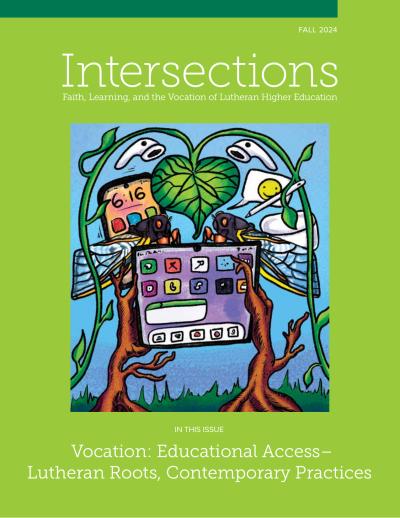
Schattauer draws on the Lutheran baptism liturgy — where the gathered assembly publicly affirms what it is for and is entrusted with responsibilities for justice and peace — to argue that NECU institutions create truly inclusive communities by affirming commitments, naming responsibilities, and acting in ways that embody both.
-
 Article
Sojourners in a Pluralistic Land: The Promise and Peril of Christian Higher Education
Randall Balmer
No. 25 · Spring 2007
Balmer, a Barnard scholar of American evangelicalism reared in evangelical parsonages and formed at Trinity College in the Chicago suburbs, defends public education even as he champions Christian higher education as a “halfway house” for students moving from religious subculture into a pluralistic world. Drawing on his own undergraduate experience, his books Mine Eyes Have Seen the Glory and Thy Kingdom Come, and a chastening visit to Patrick Henry College, he names three perils of Christian higher education—the Scylla of secularism (intellectual arrogance allergic to piety), the Charybdis of sectarianism (intellectual dishonesty as exemplified by intelligent design’s special pleading), and insularity—and prescribes mentors, primary sources, internships outside the subculture, and a broader, intergenerational pluralism on campus.
-
 Response
Response to Mark Wilhelm: DEI, Great; DWS (Dismantling White Supremacy), Even Better
Vic Thasiah
No. 56 · Fall 2022
Thasiah argues that if Lutheran colleges and universities want to live out their commitment to the flourishing of all, DEI is good but DWS — dismantling white supremacy — is even better, and offers three Lutheran sensibilities (suspicion of self-righteousness, the decolonial shockwave of the cross, and critical thinking that can still register awe) that can make DWS a core practice of higher education.
-
 Article
Diversity and Dialogue: Twenty Years and Counting
Florence D. Amamoto
No. 43 · Spring 2016
Twenty years after her essay “Diversity and Dialogue” in the first issue of Intersections, Amamoto returns to Gustavus Adolphus College to reflect on what has changed and what has not: rising numbers of students of color and international students, faculty turnover and increased publication pressures, the disappearance of the Center for Vocational Reflection, and the renewed importance of articulating Gustavus’s Swedish Lutheran heritage and inclusive sense of community in a tuition-dependent, cost-cutting environment.
-
 Article
The Challenge of Inclusion in the Ethics Classroom
Faith Wambura Ngunjiri
No. 51 · Spring 2020
Ngunjiri, the only Black woman tenured faculty member at Concordia College, reflects on her students’ resistant and resonant responses to MLK Day programming on “Not Racist: A White Moderate Myth” — and on what it takes to make the ethics classroom a place where students can “BREW”: Becoming Responsibly Engaged in the World.