in the midst of American Higher Education
My task is to examine the vocation of Lutheran colleges in the midst of American higher education, to consider both the work to which these schools are called and the manner in which that work is carried out in a way that suggests how the schools compare to other American schools and to one another. Behind this descriptive task there lurks, unarticulated, a dual demand for justification. First, show that the designation Lutheran is significant now, not only in the past; and second, show that it matters in ways that make the schools worth maintaining and attending in the future.
Colleges and universities are communities united in their commitment to the life of the mind and to the centrality of ideas within that life; often they are communities characterized also by internal disputes about how best to cultivate that life and about its connection with other aspects of human endeavor. Issues such as the value of experiential learning, the significance of personal identity to scholarship, and the proper role of religious conviction in academic life have focused the discussions in the last decades of the 20th century, but the underlying concerns are perennial.
Here I explore the commitments and practices of Lutheran schools. First I do this by placing them in the context of American higher education. This chronological account suggests both that the 28 colleges and universities now associated with the Evangelical Lutheran Church in America have much in common with other schools and that there are significant variations within the Lutheran set. I then turn to consider the basis upon which these schools might be regarded as Lutheran, in contrast to secular schools or other sorts of religious ones and in view of their differences from one another. Leaving behind nominal, historical, and institutional matters I examine the tradition embodied in characteristic practices that engender specific virtues suggesting that explicitly Lutheran reasons can be given for these.1
Foundings and Foundations
Although I was an undergraduate history major and earned two graduate degrees in historical fields, I began my teaching career knowing woefully little about the history of higher education. Unfortunately few faculty members come out of graduate school informed about these topics. Our ignorance prevents a clear view either of the whole of the enterprise or of the place our schools occupy in it. My plot is not the decline of authentic religious life on campuses under the rubric of either secularization or disengagement nor is it a rebuttal of such a thesis.2 Rather I intend to provide a brief chronological account that draws attention to commonality and difference among Lutheran colleges and between them and other American colleges. I do this because I’m convinced that knowing how our schools and their work fit into this larger scheme will allow us to understand more about our work and to do it better.
The founding of American institutions of higher education is generally told in three phases. The first began, of course, in 1636 with the establishment of Harvard College, a small, religiously affiliated, school on the model of English colleges, a school whose “vocation”, if you will, included that “Every one shall consider the main end of his life and studies to know God and Jesus Christ, which is eternal life … and therefore to lay Christ in the bottom as the only foundation of all sound knowledge and learning.”3 Stated more generally, the purpose of producing “both a learned clergy and an educated gentry”4 was characteristic of all nine colleges founded prior to the American Revolution and of the scores established in the following decades. This remained the primary goal and usual model for American higher education until the mid-19th century. Following the Civil War another model appeared, the model of the modern research university devoted to the production of knowledge and specialized education of advanced students. The third phase, beginning in the 1940s, is characterized by rapid expansion: more students, bigger schools, new schools including many with two-year, non-residential programs. It may be that we are now well into a fourth phase in which the idea that learning occurs in the company of other students and teachers who share a specific place and time is under extreme challenge. Certainly at schools such as these associated with the ELCA we are no longer in a growth mode as is attested by frequent use of phrases such as “belt-tightening”, “down-sizing”, “out-sourcing,” “strategic planning,” “assessment,” and “the culture of evidence.”
The Old Time College
The aims and programs of the nine colonial colleges had much in common with one another and with the English tradition of the liberal arts which, historian Christopher Lucas suggests, included a “combination of literary training, religious piety, and courtly etiquette” that produced “an archetypal conception of the ideally-educated person as a ‘Christian gentleman.’”5 The colleges’ programs consisted almost entirely of rhetoric, grammar, and theology taught by Christian gentlemen whose pedagogical method, most often lectures, was designed to transfer a defined body of knowledge to their students. Students were not taught how to learn, they were given what was then judged to be the treasures of Classical and Christian culture as the foundation for development of Christian character and responsible participation in civic life, often as clergymen. Close supervision of students’ life outside the classroom, or at least efforts to do so, was also intended to prepare students for civic life. The number of students was small; in a peak year (1770) the total number enrolled at Yale was 413.6
While these schools shared goals and methods and were alike in placing Christianity at the center of both, the particular sort of Christianity varied. At the outset Harvard’s supporters were Congregationalists, but by the early 18th century conservatives, suspicious that the school’s orthodoxy had been undermined, established The Collegiate School in Connecticut. (The school was renamed Yale in recognition of a major gift in kind from Elihu Yale.) Similarly, Yale’s second, less enthusiastic thoughts about the Great Awakening contributed to the founding of Princeton by “New Side” (pro-revivalist) Presbyterians. The “sectarian” importance of establishing a college was related to the college’s task in preparing clerical leadership for the sponsoring party. Using the language of a Harvard brochure published in 1643, one may point to the sponsors’ dread “to leave an illiterate Ministry to Churches.”7 Although there were Lutherans in the colonies from the 1620s, and although Henry M. Muhlenberg, the patriarch of American Lutheranism who arrived in the 1740s, was concerned about the education of potential clergy, Lutherans did not found or sponsor a college in this period.
Having pointed to the identification of these schools with particular religious parties, I hasten to offer three cautions. First, I have used the word parties rather than denominations quite deliberately because in this time period nothing so organized or formal as a denomination existed. Second, at this stage identification with a religious party did not render a college ineligible for public financial support. William and Mary’s receipt of duties paid on skins and furs and income generated by a tobacco tax provides a vivid example of the typical blurring of public/private status. This blurring continued even after 1819 when a U.S. Supreme Court decision regarding Dartmouth College began to clarify matters. Third, despite distinctions between the religious character of the colleges—Brown was Baptist, William & Mary was Anglican, Columbia was Dutch Reformed—the student body was sure to be more heterogeneous. There were no official standards of belief for enrollment.
Following the Revolution what we now call the “old time college” model remained the ideal with many—individuals, groups of church folks or official religious groups, and municipal boosters—rushing to found schools as the population expanded in numbers and across the continent. In the two decades between 1782 and 1802 nineteen colleges were founded; by the outbreak of the Civil War the total number reached 250 including Indiana College in Bloomington, Emory in Georgia, Roman Catholic Notre Dame, and several Lutheran colleges.8 The stated purposes of the these schools were consistent with earlier concerns. A board member at the College of California put it this way: “to make men more manly, and humanity more humane; to augment the discourse of reason, intelligence and faith, and to kindle the beacon fires of truth on all the summits of existence.”9 Other leaders were more explicitly Christian in their aims, particularly those persons deeply affected by the Second Great Awakening, those concerned to evangelize on the western frontier, or those Protestants who feared Roman Catholic expansion. Churches with a strong tradition of an educated clergy, such as Presbyterians, Congregationalists, and Lutherans, were eager founders of new institutions; Antebellum Presbyterians had 49 colleges.10 Tory Female Seminary (1821) and Mount Holyoke Seminary (1837) lead the way in providing educational opportunities for young women. Oberlin College, profoundly influenced by revivalism and committed to social reform agendas, begin to admit women and people of color. By the 1850s a small handful of colleges for blacks were in operation.11
Regardless of who founded these schools or who staffed them, they were alike in their programs and in their small size.12 If a calculated average enrollment was about 250, the actual enrollment at many schools was far less.13 Even at the so-called state schools Protestant culture and influence pervaded leadership and community life. There, as at schools which claimed religious identity, the president often was a clergyman and usually he was personally responsible for college governance. In the late 1820s the Yale Report asserted the foundational purposes of collegiate education: “The two great points to be gained in intellectual culture, are the discipline and the furniture of the mind; expanding its powers, and storing it with knowledge.”14 However, this assertion, perhaps better RE-assertion, was not universally supported. Indeed debates about educational objectives and specific curricular reforms preceded the Yale Report. The standard classical course was being supplemented by literary and scientific tracks that took account of appeals for more practical learning and responded to the expectation that education had an economic benefit for the student as well as a civic one for the nation. By the late 19th century students are schools that adopted an elective system were able to select specific classes rather than committing to a prescribed series of courses.
Lutheran Colleges
More than half of the 28 colleges and universities affiliated with the ELCA were founded between 1832 and 1870. Others that no longer exist, either due to merger or to closure, were also begun. All except California Lutheran were established in some form prior to 1900. Here we can not look carefully at each school as Richard Solberg does in his useful volume, Lutheran Higher Education in North America15, or as is done in histories of individual schools. I commend those to you, but here use broader strokes to convey some patterns—ways that these schools were like or unlike other “old time colleges,” like each other, and distinct from each other. The simple assertion that every Lutheran synod founded its own college is not entirely wrong and helpfully points out that the colleges thus established were distinguished by their sponsorship, by the structure of the sponsorship, and by the sorts of religious, ethnic, and geographical factors that bound the sponsoring group together. This observation is not helpful to the degree that it obscures the key role of the colleges in linking together those many 19th and early 20th century church bodies. The graduates of one became faculty members at another; a faculty member from a third became the president of a fourth. The Association of Lutheran College Faculty was one of the first pan-Lutheran organizations.
That said, this seems the time to turn to Philip Schaff, a 19th century church historian, for his categorization of Lutherans in his time.16 Although congregations were linked to one another in dozens of synods, Schaff divided them into three types based upon degree of Americanization and sort of commitment to confessional specificity: the Neo-Lutherans, the moderates, and the Old Lutherans. Neo-Lutherans were those whose longer residence in the United States (some came from pre-Revolutionary families) had yielded sympathy with the generalized Protestantism then called evangelical and manifested in cooperative societies such as the American Bible Society. Within Lutheran circles these people were also known as Americanists or Platformists in reference to the Definite Synodical Platform which offered an “American” revision of that central Lutheran document, the Augsburg Confession. The moderates were a more complex group which included both persons from these same families, quite literally, and more recently arrived immigrants. They too adapted themselves and their churches to the American setting, but were significantly more resistant to ecumenical cooperation and more devoted to confessional adherence. The Old Lutherans, notably but not only, the Saxons who founded the Lutheran Church Missouri Synod were the most sectarian in their corporate life, were committed to preservation of doctrinal purity, and required agreement with the largest number of confessional documents. These three types of Lutherans corresponded roughly with the General Synod, the General Council, and the Synodical Conference though bodies such as the Joint Synod of Ohio and the Augustana Synod and individual members sometimes straddled the boundaries. When these groups, or their members, founded, supported and ran colleges they were alike in having a religious purpose, but the particular nuances of the Lutheran version of Christianity they espoused differed as did their expectation that the college would promote ethnic identity.
Sydney E. Ahlstrom, a 20th century church historian who was himself Lutheran, offered another categorization of Lutherans specifically in reference to higher education.17 He identified three currents of Lutheranism: the scholastic, the pietistic, and the critical. Each current emerged from a particular historical setting, yet all three claim affinities with Luther’s thought and endure beyond that original setting. In the early 17th century the scholastic impulse toward definition and systematization was strong. The pietistic emphasis upon inner spiritual life and participation in evangelism, acts of mercy, and the moral life followed in the late 17th and early 18th centuries. Then in the later 18th and much of the 19th century came the investigative spirit of the critical stream. Ahlstrom observed that all of these currents can flow together within one stream: a church body, an institution, or an individual person. Certainly the three have marked American Lutheranism both by their presence and by their interactions. Among American Lutherans during the colonial era the pietistic emphasis was strongest with leadership from key figures including Muhlenberg. Pietism was also deeply influential for many of the 19th century immigrants. The notable exception was those who formed the Lutheran Church Missouri Synod; they were more sympathetic to scholastic concerns. The relative force of these three impulses among the founders and subsequent leaders of colleges contributed to the particular nuances of Lutheranism found on Lutheran campuses and thus account in part for the differences between the schools as well as for their similarities.
Samuel S. Schmucker was both the first Lutheran clergyman to be formally trained in the United States, at Princeton, and, in 1832, the founder of the first Lutheran college in Gettysburg, Pennsylvania. In keeping with the Lutheran commitment to an educated pastorate, Schmucker first established a seminary. Finding its students frequently ill-prepared to take up theological studies, he opened the college as a remedy. Schmucker was arguably the most influential and well-known Neo-Lutheran, inside Lutheranism and out. Thus it is only to be expected that Gettysburg College, like so many other small schools founded by Protestants in these decades, depended heavily on financial backing from local, non-Lutheran supporters and included non-Lutherans on its board and in its student body. In contrast the faculty members were usually Lutheran clergymen some of whom also taught at the nearby seminary. From the outset Gettysburg was an American college without strong ties to either an ethnic or an immigrant community. Although the Lutherans could trace their origins to Germany, they were not immigrants or the children of immigrants and tended to regard themselves primarily as Americans. Young men enrolled at Gettysburg received an education quite like what they might have gotten at any of the host of similar colleges. Indeed the primary factor that separated Gettysburg from its peers was its association with Lutherans.
For a decade Gettysburg was the single Lutheran college. Then, in the 1840s and 1850s a half dozen additional schools more-or-less replicated its model and its association with the Neo-Lutheran branches of Lutheranism. Wittenberg, in Springfield, Ohio, and Newberry in South Carolina were each located near a seminary with the intention of preparing its future students. From the outset Newberry was more closely affiliated with the South Carolina Synod than Gettysburg had been with the General Synod. As was common, these Lutheran colleges did not restrict their enrollment to those called to the Lutheran pastorate. However, all founded in these decades restricted their enrollment to male students. Young women were offered educational opportunities which I will discuss later.
With the founding of Capital University (1850) in Columbus, Ohio the variety within the set of Lutheran associated colleges increased theologically, ethnically, and programmatically. In comparison to Wittenberg only 50 miles away, the founders of Capital were theological moderates. This confessional position allowed some of the recent German immigrants to lend their support to Capital. Thus the school was also distinguished by its ethnic identification. Rather than the American college, the model for this school was an old style European university with faculties in arts, medicine, law, and theology. Of the projected professional programs only the seminary and law schools became operative. No other 19th century Lutheran school shared this aspiration. Like Capital several were associated with groups defined by moderate or orthodox theology, more-or-less pietist inclinations, and national origins. Muhlenberg College (1867) was founded in direct response to Gettysberg’s more minimalist confessional position and lack of attention to things German.
Other Germans and Scandinavians arriving in the mid-19th century soon followed the lead of their co-religionists in setting up both seminaries and colleges. The combination of theological specificity, style of piety, and ethnic identification contributed to closer ties—whether formal, informal, or symbolic—between these schools and their church bodies than was the case for the Neo-Lutheran schools.18 Augustana College (1860) in Rock Island, Illinois, for example, was founded by direct action of the newly organized Augustana Synod and 49 congregations. However, since the Synod provided no direct financial support the founding was a sort of unfunded mandate.19 Dana and Grand View were both founded by Danish Lutherans distinguished by the first group’s “holy” pietism and the second’s “happy” Grundtvigianism. Insofar as these colleges served as—indeed were founded precisely to—supply the seminaries with students and thus the church with pastors, the colleges enrolled only male students. This was the case at Wartburg (1852), Augustana, Luther (1861), and Augsburg (1869). This purpose was consistent with the long standing Lutheran conviction that education is a necessary qualification for the office of public ministry. A personally apprehended call from God is not enough, as it sometimes was among more revivalist influenced Protestants. While lay Lutherans were capable of leading themselves in worship, and did, because a pastor was required to administer the sacraments the need for qualified candidates was urgent. Among these schools Augsburg was remarkable for its fierce defense of a gymnasium-like program which combined college and seminary training in a nine year sequence quite unlike the usual pattern of a four-year college course followed by a clearly articulated seminary course.20
Beyond their theological and ethnic identifications, Lutheran schools in the late 19th century also differed from one another in ways that mirrored the variety of non-Lutheran schools in the era. There were distinctions based in the audience and in the program determined by school’s stated purpose. Some institutions admitted women, either along with men as at Thiel and St. Olaf or only women as at Elizabeth and Marion Colleges in the south and the Lutheran Ladies’ Seminary in Red Wing, Minnesota.21 By the mid-1960s the last of the Lutheran women’s colleges closed so we tend to forget that there ever were any when in fact there were close to three dozen, many of them established by private initiative.22 Most of these schools were located in the east and the south. Their programs ranged from something resembling a high school to a more rigorous curriculum which offered students a classical course as well as alternatives, for example a practical business course. The co-educational model that is now regarded as the norm, was introduced among Lutherans at Thiel College (1866), founded with leadership from William A. Passavant. Seven years later Susquehanna Female Seminary merged with the Missionary Institute forming the basis of Susquehanna University. St. Olaf and Gustavus Adolphus, founded by Norwegians in 1874 and Swedes in 1876, were co-educational from the outset.
Although some male students at these schools may have been headed for the pastorate, their curricula were not primarily pre-seminary programs. Even more than at the men’s schools, there were always a certain number of students whose contributions to the world would be as teachers, business people, and medical professionals, as well as through their membership in communities, congregations, and families. The founders of co-educational colleges (or academies) recognized what might now be called the need for an informed citizenry. That view is consistent with Martin Luther’s argument urging the German nobility to support schools. There Luther set out three purposes for education: first, it supported faith by enabling the believer to understand the gospel as well as to experience it; second, education prepared the students to employ their talents in service to their neighbors; and third, pastors required sound learning to faithfully fulfill the special responsibilities of their office.23 This view of education reflects Luther’s insistence that God’s grace precedes human action; it is a gift. As in the gift economies considered by Lewis Hyde, this gift evokes a grateful response that transforms and transfers the gift to a third party.24 Here the second act of giving is the believer’s vocation to serve the neighbor. Because such service requires adequate preparation, education should be provided. Because that education undergirds faithful response to the believer’s vocation, it might be termed “vocational education” but in the robust theological sense of the word and not in its narrowly technical meaning.25
Given this understanding of education and vocation, it is not surprising that some Lutheran schools offered occupational training for “jobs” other than that of the pastor. While nursing schools attached to deaconess hospitals might fit this category, the principle example is normal schools, such as those operated by the Lutheran Church Missouri Synod or the Lutheran Normal School in Madison, Minnesota. The purpose of these schools was to train teachers for parochial and public teaching. The close connection between parochial schools and the interests of the sponsoring churches may account for the official and close relationship between the Lutheran Normal School and the United Church which founded it following synodical action. This is in contrast to the looser connection of overlapping “membership” between the Lutheran Ladies’ Seminary and the Norwegian Synod and to the label “College of the Church” (here the United Church) for which Augsburg and St. Olaf were in competition. Even at the colleges the number of occupational offerings during this period would likely surprise us. Of course there were lots of other normal schools, both private and public, in these years and many colleges offered a range of practical courses. Debates about such programs included assertions of educational principles as well as appeals to economic realities. It is impossible to determine merely from lists of courses whether Lutheran involvement was a response to economic pressures, an educational principle, or a manifestation of a Lutheran commitment to the centrality of service to the neighbor.
Changing Contexts
In the decades after the Civil War and into the 20th century the model of the old time college was replaced by that of the modern university that crossed the Atlantic with influential scholars trained in Germany.26 It informed establishment of new private institutions with Johns Hopkins University (1876) as the earliest; development of public institutions such as the University of Wisconsin, many of them supported by the Morrill Acts (1862 & 1890); and the transformation of some old style colleges, Harvard among them. The modern university differed from the old time college on several counts all rooted in its particular purpose. Rather than transmitting a fixed body of knowledge to undergraduates and enabling them to be good citizens, the university was to discover new information and in the case of the “land grant” universities facilitate its application. Some universities that grew from colleges had once been connected to a religious party, but by the late 19th century that connection was usually diluted or gone. Most universities were not associated with religious groups though there are notable exceptions, particularly among the Roman Catholics and Methodists.27
No Lutheran college made the transition nor did Lutherans found a modern university. Nonetheless, like other colleges Lutheran colleges are affected by this powerful ideal and tend to evaluate our programs by its standards even as we assert our differences: we are devoted to the liberal arts, in some form, they are specialized; we are focused on teaching, they are focused on research; they are huge, we are small; we attend the student’s whole person, often in a residential program, they only care about the mind. Of course, these comparisons are overdrawn, on both sides, and yet they suggest the way in which the university has become the standard by which even the most prestigious colleges describe themselves and against which they justify their continuation.28
The challenge was put bluntly over a century ago by a Columbia University professor who declared, “I confess that I am unable to divine what is to be ultimately the position of Colleges which cannot become Universities and will not be Gymnasia. I cannot see what reason they will have to exist. It will be largely a waste of capital to maintain them, and largely a waste of time to attend them.”29
Beginning after World War II and into recent decades American higher education was in an expansionist mode that peaked about the time that those who are now mid-career were in college. The GI Bill provided hosts of veterans with the financial resources to attend college and initiated a series of infusions of government money into higher education. Some of that money supported growth in existing institutions; some of it was used to open new schools including hundreds of non-residential, community colleges with two-year programs; some of it continues to be used to provide members of specific groups with access to college. Here are the staggering numbers. In 1947 there were 2.3 million students enrolled at 1,800 schools; in 1986, 12.3 million students were enrolled in 3,200 schools (about a third of them had 2-year programs).30 That is 10 million more students in almost twice as many schools, not quite forty years later. At the same time the sorts of programs offered also expanded, both to include the occupational tracks at community colleges and in response to innovations in scholarship such as women’s studies and ethnic studies.
ELCA colleges benefited from these changes. Many renovated their facilities or constructed new buildings in mid-century using federal funds. A large percentage of students now have federal or state money in their financial aid packages. Many current faculty began their teaching careers with federally insured loans to pay off. In the 1960s and 70s schools increased enrollment, perhaps by 100%, and added classes, majors, and programs to serve those students. Lutherans even took courage to open two new colleges: the American Lutheran Church and the Lutheran Church in America cooperated at California Lutheran (1959) and the LCMS founded Christ College-Irvine, now part of the Concordia University system. (During the same years, some schools were “lost” by merger or closing.)
Certainly these schools are different today than they were when the class of 1950 was in attendance. Here are some of the ways. The faculty members are less likely to come from the college’s “conventional constituency,” that is to say they may not be Lutherans and they probably aren’t members of the ethnic group that founded the college, if one did. Similarly they are less likely to be alumni or graduates of any liberal arts college. But, they are likely to have better academic credentials. Some took the job hoping it would be the first step in an upward career path and discovered that they liked the place and have stayed on happily; others, however, committed to significant aspects of the school’s mission or continue to be dissatisfied with their academic fate. The composition of the student body has also changed. There is a smaller proportion of Lutherans. Even as colleges are trying desperately to recruit a more diverse group with regard to race and ethnicity they long for higher board scores. As tuition and fees go up there are still efforts to provide access to students who are without the funds to pay the current price. Mission statements suggest these changes by their use of a common vocabulary.31 Whole person, diversity, community, liberal arts, service: these are the words that appear again and again. The statements vary more in the way they signal Lutheran connections. Some state a current formal affiliation with the ELCA or to its regional synods; others point more vaguely to Lutheran heritage or tradition. In the midst of such comparisons to the past, it is salutary to acknowledge that the past was not the same everywhere. From the start the older colleges founded by native-born, more assimilated, Neo-Lutherans have been less distinctly Lutheran than those founded by recent immigrants who were more devoted to the Confessions or more intensely pietistic.
In the meantime the churches to which the colleges are connected have also been changing. In the 1960s and again in 1988 mergers reduced their number and diluted the relationship between the members of a smaller church and “their”—“our”—college. Locally, church-wide, and internationally Lutherans have become more actively ecumenical. While it has never been the case that all Lutherans have gone to Lutheran schools, as potential students from Lutheran congregations have been given more options and expanded their horizons fewer have automatically selected Lutheran schools. There are lots of reasons for that. The much discussed decline in denominational loyalty is certainly one important factor. Being Lutheran in name isn’t enough, especially if the word Lutheran isn’t in the college’s name and when many prospective students, and their parents, and their pastors don’t even know which schools are Lutheran.32
Who Are These Schools Now?
In view of the facts that the name Lutheran seems to matter less to some folks than it once did and to matter not at all to others, including most everyone who is not Lutheran and that the amount of financial support that comes directly from the ELCA church-wide office or from its synods is minimal, for the moment let us leave aside the formal relationship with the ELCA. What characteristics do these schools have in common today? They are small, or smallish; they are residential, more-or-less; they offer a liberal arts program, for the most part. These characteristics place these schools with others that continue the traditions established by the old time colleges, and place them in Carnegie categories: BA I or II or Comprehensive University I. An honest appraisal also suggests that within this larger pool, Lutheran colleges as a group are less expensive, have fewer financial resources, and are less selective. Based on the credentials of our faculty and the attention we give to our students’ “whole lives” we stand by the quality of our programs. Indeed some of our schools are “best buys.”
Now I’m a person from a family that loves to get a good deal, but I’ve also learned that it is not a good deal to buy something I don’t need or won’t use no matter how low the price. I think that the case that these colleges are worth continuing to operate and worth attending must be made on some basis other than their comparatively low price. Moreover I’m convinced that we have something to offer that derives, not from the search for a marginal differentiation in the market but from the Lutheran tradition; here I intend by Lutheran tradition the theological “argument” that has been socially embodied and historically extended in, though not limited to, Lutheran churches.33
This final section points to five practices that are common on Lutheran campuses and for which explicitly Lutheran reasons can be given.34 Before specifying the aims of Lutheran higher education, listing common practices, suggesting how the practices might be grounded in Lutheran teaching, and proposing virtues that they might engender, I make these caveats. My discussion will be suggestive rather than a complete development of my own views and certainly will not include careful engagement with the others who are involved in this conversation. The intention is that readers will test these ideas against the situation at their own schools. I do not make the strong claim that these practices are uniquely Lutheran or even the softer claim that they are distinctly Lutheran. Other schools also engage in these practices, though as part of different narratives. Indeed, it is likely that on our campuses, even among the readers of this essay, there are persons who participate in these practices or affirm them, but whose commitment does not grow out of the Lutheran tradition. Further, I know that the practices have local variations that reflect both past history and present circumstances. Nonetheless, taken together these practices contribute to a recognizable Lutheran identity for institutions and it may be that if none of them are practiced and no explicitly Lutheran reasons can be marshaled to defend their absence, then the time has come to admit that the institutional ties to the ELCA are meaningless even if the school continues to be well worth attending.
What are the aims of Lutheran higher education? What good ends is it meant to accomplish? I follow Luther’s argument to the German princes but I reorder the three “goods” that he offers. Further I distinguish between the overlapping goods for the larger society, for the church, and for students, both those who are Christians and those who are not. Because the Lutheran tradition here intersects and runs together with the tradition of American higher education and because here we are concerned with institutions that are schools I want first to specify the good offered to students regardless of their beliefs. They are equipped to use their gifts—talents, training, opportunities for example—in ways that benefit their communities (defined variously) including their role as members of families, as citizens, and as workers. This is also a good the schools offer to society. Second for students who are believers—I might say who know that God’s gift of grace has made them righteous—we also aim to enhance their righteous living. Third, for the churches, certainly the ELCA, its congregations, and its ministries but also others, we aim to cultivate in their members the skills and virtues that are necessary for faithful participation in congregational life and to provide lay and clerical leadership.
How do we accomplish these good ends for students, society and the churches? I offer a short list of five practices largely directed toward students that can be carried out in various ways as appropriate to local history and current situation:
The school really is a college. The faculty and students along with other staff are drawn into a community by their shared commitment to and engagement in learning. The faculty provides students with an academically solid curriculum that neither excludes a topic or discipline for fear that it might destroy faith nor over-estimates the possibility that human knowledge will ever know all that is God. Thus scientific disciplines and attention to physical well-being, study of many cultures, languages, and religions, and cultivation of critical capacities are all possible though the particular program mix is determined locally. This is education that is both evocative and provocative. By evocative I intend that it draws out the best from students and from our human heritage. This assumes that there is sweet water in these wells to be drawn out, gifts to be received and passed on. By provocative I intend that this education engages and stimulates action. Its reception of gifts from ancestors or contemporaries is not romantic or uncritical. Rather it is a realistic engagement with self and society (and with the natural world) and an engagement that can not remain passive, but must respond. Among the available areas of study, three are given particular importance.
Students study—perhaps are required to study—the Bible and the Christian tradition. This is a cognitive goal, not a covert effort to convert students who are not Lutheran to Lutheranism or who are not Christian to Christianity. This does not, however, exclude the possibility that God will work such a change in any of the multiple arenas of college life. The religion department may have particular responsibility for required courses, but careful, informed consideration of Christianity and its implications for life—intellectual and otherwise—is not limited to courses offered by that department.
Students participate in the arts both as makers of art and as an appreciative audience. This reflects the conviction that God is present in and revealed by finite things such as lines of poetry, oil paint, dance steps or frames of film in a manner not entirely unlike God’s presence in the water, wine and bread of the sacraments. The arts can provide a glimpse of God and they afford us the means to express what is “too deep for words.” Likely music is given a prominent place. Perhaps this is only an accident of history or a continuation of Martin Luther’s high regard for music. I am not a musician, so please don’t disregard this as self-interest or as some St. Olaf College party line. I suspect that music, especially participatory (rather than performed) choral music is prominent also because it brings the intellect and the body into partnership even as it brings the individual into the group.
Students are encouraged to apply what they learn, both in their own lives and in service to others. This takes place in the classroom and outside of it. By encouraging students to apply what they learn in their own lives we demonstrate that learning is not merely a matter of objective acquisition of information; that it includes a subjective element as well. However this subjective application is not merely concerned with the immediate, personal relevance of learning. Application is also an act of service, a sort of action that is provoked by attention to vocation. The gift of learning calls forth from the student (and the teacher) responsible use of this gift for the good of one’s neighbors in this time, in the current or future now.
Christian worship is conducted on campus regularly and frequently. Here individuals are convoked or called into community; here the community invokes God. The ways that we order our time, that most finite and yet most equally distributed resource, is a sign of how we are oriented in the world. To set aside time for worship is an affirmation of the centrality of God’s grace in the midst of ordinary things, and within the finitude of time and space. Such an orientation, toward “true north” if you will, equips us to carry out our work responsibly and faithfully. Also: worship, not the classroom, is the appropriate location for the proclamation of the gospel that allows us to recognize God elsewhere, e.g. in the arts, in our neighbors, or in nature. When we do encounter God in these places or receive divine grace in the minuteness or magnificence of nature, in the beauty of human artifacts, in the depth of social relationships, worship is where we join in expressions of gratitude. So too, when God seems only hidden, nature only dangerous, relationships only broken, or human invention only damaging, this is where we join the psalmist in cries of anger and lament. In the midst of an American society, characterized by Steven Carter as a “culture of disbelief,” this use of time, space, and other resources may seem quite odd. Many Americans regard religion as personal rather than corporate, as private rather than public. That Lutheran colleges do set aside this time and support this activity with institutional resources, but do not require participation, is partially explained by the centrality of Word and sacrament to our understanding of the church. Indeed, explicitly Lutheran arguments can be marshaled for all five of these practices.
What is the explicit Lutheran grounding of these practices? They are informed by specific teachings central to the Lutheran tradition of Christianity. Important among those teachings are:
- The ultimate nature of divine grace which renders all else penultimate;
- An understanding of human beings as made in God’s image, yet fallen; bound in sin, yet freed by God’s grace;
- The expectation that gratitude for God’s gracious gift of justification will issue both in returning thanks to God in worship and in using one’s talents and temporal gifts in service to the neighbor; and
- Recognition that God’s self revelation comes most reliably in the person of Jesus the Christ, in the scriptures, and in the sacraments but also through other “masks” which include human reason, social relationships, and nature.
How these teachings and others support the practices I’ve listed is beyond this essay, though significant and subject to debate.35
What virtues do these practices engender? Gratitude, wisdom, boldness and humility. Because I have used these terms idiosyncratically I must provide some small elaboration. Recalling their variety as individuals and assuming their excellence in their particular work, when I meet graduates of our schools I would like to recognize them by these virtues.36
- By their loving gratitude, that is by their disposition to recognize that all that they are and have is a gift and by their disposition to respond with thankfulness to the divine giver and with generosity and hospitality toward others;
- By their faithful wisdom, that is by their ability to think about matters of faith with rigor and knowledge without excluding the sensual, the natural, and social; and by their ability to think and act faithfully in other arenas of life;
- By their bold freedom, that is by their willingness to speak the truth and act with mercy and justice without undue concern about the effect upon their penultimate situation; and
- By their hopeful humility, that is by their capacity to respond to limitation and failure with good grace knowing that all temporal things are penultimate and that God’s re-creative power is at work both now and in eternity.
I long for our life together to be characterized more by mutual consolation than by recrimination; more by anticipation than by disappointment; more by hope than by discouragement.
If the colleges and universities affiliated with the ELCA are able, by these practices, to engender these virtues in their students (as well as in their staff and faculty) and to accomplish these aims for students, for society, and for the churches then they are faithful to the Lutheran tradition as well as worth being maintained by the ELCA and attended by its members and by other students. If they are able to do these things, then they may also offer an alternative to consumerist views of education, something that is much needed today.
Endnote
1. This essay was first written for oral presentation at the sixth Vocation of a Lutheran College conference, August 2000. My thinking about these matters has been profoundly stimulated and informed by the conversation at those meetings and in their planning; by participation in the Lutheran Academy of Scholars; and by my colleagues and students at St. Olaf College including those involved in drafting the so called “We(e) Document.”
2. The “secularization thesis” has been put forth by George M. Marsden and James T. Burtchaell among others. In The Dying of the Light: The Disengagement of Colleges and Universities from Their Christian Churches (Eerdmans, 1998) Burtchaell includes three Lutheran schools: Gettysburg, St. Olaf, and Concordia, River Forest. Other readings of St. Olaf’s history and current situation are offered by Mark Granquist, in Richard T. Hughes and William B. Adrian, eds., Christian Models of Higher Education: Strategies for Success in the Twenty-first Century (Eerdmans, 1997) and Robert Benne, Quality with Soul: Thriving Ventures in Christian Higher Education (Eerdmans, forthcoming).
3. Quoted by Christopher J. Lucas, American Higher Education: A History (St. Martin’s Griffin, 1994), p. 105, n. 5.
4. F. Michael Perko, “Religion and Collegiate Education,” Encyclopedia of American Religious Experience, 1611.
5. Lucas, p. 313.
6. Lucas, p. 109.
7. “The Harvard Guide,” www.news.harvard.edu/guide
8. Lucas, p. 117.
9. Quoted by Lucas, p. 119, n. 81. The College of California was founded in 1855 by Congregationalists but became the secular University of California in 1868. Perko, p. 1614.
10. Perko, p. 1613.
11. 1849 Avery College; 1851 Miner Academy; 1856 Wilberforce and others, Lucas, p. 122.
12. Here I may seem to suggest that the purposes and program of schools for women or for blacks was no different than at schools for men. That is not the case. Intense debates were carried on about precisely that point. For example, those who asserted that if women were to be allowed advanced education then the education should be of a different sort than the sort offered to men tended to reject co-education. O. M. Norlie, a graduate of co-educational St. Olaf, took this position in the early 20th century as part of his support of the Lutheran Ladies’ Seminary. See L. DeAne Lagerquist, “‘As Sister, Wife, and Mother’: Education for Young Norwegian-American Lutheran Women,” Norwegian-American Studies Vol. 33 (1992): 130–1.
13. Lucas, p. 140, gives an estimate of 62,000 in 1870. If the number of schools held constant at 250, a statistical average would have been 248; however, some schools had less than 100.
14. Quoted by Lucas, p. 133, p. 135.
15. (Augsburg, 1985).
16. Schaff’s 1854 remarks to an audience in Germany are quoted in E. Clifford Nelson, ed., Lutherans in North America (Fortress Press, 1975), pp. 211–13. Burtchaell uses a similar three part division in his treatment of Lutherans. I find his characterizations distorting. This is especially so for the “moderate” group. His term for it—confessing—does not give adequate attention to the role of Lutheran Pietism (in contrast to the evangelical pietism of revivalism) among some of the moderate groups or nor does it acknowledge the on-going role of the Confessions even among the Neo-Lutherans who revised the Augsburg Confession rather than rejecting it out of hand. For further treatment of American Lutheranism see L. DeAne Lagerquist, The Lutherans (Greenwood, 1999).
17. “What’s Lutheran About Higher Education? — A Critique,” Papers and Proceedings of the 60th Annual Convention (Washington, D.C.: Lutheran Educational Conference of North America, 1974), pp. 8–16.
18. Legal ownership, significant financial support, and structures of governance are examples of formal ties; overlapping membership and social interactions are examples of informal ties which contribute to a school’s symbolic role as source of group pride and visibility.
19. Solberg, p. 184.
20. The curricular difference was a component in the two schools’ competition to be designated the official college of the United Church, formed in 1890 by the merger of the three moderate Norwegian-American churches. A brief discussion of the controversy see Solberg, pp. 231–3 or Michael B. Aune, “‘Both Sides of the Hyphen’? The Churchly and Ethnic Heritage of St. Olaf College,” in Pamela Schwandt, ed. Called to Serve: St. Olaf and the Vocation of a Church College (St. Olaf College, 1999), pp. 42–44.
21. See L. DeAne Lagerquist, “As Sister, Wife, and Mother,” pp. 111–18 and “Utile Dulci, The Useful and the Sweet: Women and Lutheran Higher Education,” Shiler Lecture, Luther College, March 1998.
22. Solberg, p. 275. Fourteen were founded prior to 1860; another 20 after. Early in the twentieth century the United Lutheran Church in America Board of Education made plans to found a women’s college with Mary Markely as the president. Funds were raised and property purchased, but in 1934 the project was abandoned and the moneys designated for scholarship aid for female students. p. 299 and Lagerquist, “Utile Dulci”.
23. Martin Luther, “To the Councilmen of all Cities in Germany that they Establish and Maintain Christian Schools,” in Timothy Lull, ed., Martin Luther’s Basic Theological Writings (Fortress Press, 1989), pp. 704–35.
24. Lewis Hyde, The Gift: Imagination and the Erotic Life of Property (Vintage Books, 1983). See in particular “The Circle,” pp. 11–24 and chapter 3, “The Labor of Gratitude,” pp. 40–55.
25. Mark U. Edwards, Jr. has often employed this usage during his tenure as president of St. Olaf College.
26. See Julie A. Reuben, The Making of the Modern University: Intellectual Transformation and Marginalization of Morality (University of Chicago Press, 1996) for a helpful account that considers the consequences for curriculum and student services.
27. The degree to which these schools now retain a vital relationship to their religious bodies is a point of discussion. See George M. Marsden’s The Soul of the American University (Oxford University Press, 1994) for an detailed account which argues the secularization thesis. My point is only that not all such institutions have always been secular.
28. A recent issue of Daedalus: Journal of the American Academy of Arts and Sciences (Winter 1999) was titled “Distinctly American: The Residential Liberal Arts Colleges.” In the Preface Stephen R. Graubard discussed the reasons to devote an issue to this topic and observes “[M]uch that is distinctive to higher education in the United States, those attributes that make the American system very significantly different from any other, are generally lost sight of. The residential liberal arts college of the country, while scarcely invisible, do not today figure in the public prints or in the television commentary as the country’s major private and public research universities do.” vi
29. Lucas, p. 143
30. Lucas, pp. 228–9.
31. Based on ten of the 28 read for the Lutheran Academy of Scholars, 2000.
32. LECNA data
33. After Virtue: A Study in Moral Theory (University of Notre Dame Press, second edition, 1984). I am grateful to Donald Reed and Ronald Thiemann for their generous tutoring as I have begun to understand MacIntyre’s proposal and to explore how it might illuminate our work in Lutheran higher education. MacIntyre’s influential work has informed reconsideration of denominations that attends to matters beyond their institutional forms. This shift is important for efforts to understand colleges’ relationships to those denominations in view of diminished financial support, weakened church participation in governance, and reduced numbers of church members among colleges’ faculty and staff. See Robert Bruce Mullins and Russell E. Richey, eds. Reimagining Denominationalism: Interpretive Essays (Oxford University Press, 1994). Of particular interest for this essay is Christa R. Klein, “Denominational History as Public History: The Lutheran Case,” pp. 307–17. Mark R. Schwehn’s discussion of academic virtues does not rely upon MacIntyre but is consistent with MacIntyre’s proposal. Exiles from Eden: Religion and the Academic Vocation in America (Oxford University Press, 1993), “Spirited Inquiry,” pp. 44–65.
34. An earlier consideration of these matters appears in “What Does It Mean? Lutheran Higher Education,” Lutheran Higher Education, Vol. 135, no. 4 (March/April 2000), pp. 184–198. This article was first presented to faculty at Concordia University, River Forest. I explored these issues in “Incarnating a Tradition: Personal and Institutional Reflections” at Gustavus Adolphus College, September 1998, and in “A Mission of Calling” at Newberry College, February 2000. Those who are familiar with this on-going discussion will note the affinity between the spirit, if not the details, of my proposal and Tom Christenson “Learning and Teaching as an Exercise in Christian Freedom,” Intersections: Faith + Life + Learning No. 6 (Winter 1999): pp. 3–11; Darrell Jodock, “The Lutheran Tradition and the Liberal Arts College: How are They Related,” in Schwandt, pp. 13–36; and Schwehn, Exiles from Eden. I have not addressed here questions about faculty profile or governance, matters Schwehn terms “constitutional requirements” in “The Idea of a Christian University,” in Paul J. Contino and David Morgan, eds. The Lutheran Reader (Valparaiso, 1999), pp. 64–65. His proposals suggest the key issues that need to be resolved on each campus. I am also informed by the work of Ernest Simmons, Lutheran Higher Education: An Introduction (Augsburg, 1998) and Bob Benne. Although we arrived at them independently Marcia Bunge’s list in “Introduction to Valparaiso in the Context of Lutheran Higher Education,” in The Lutheran Reader, pp. 1–9 and my list of practices are quite similar.
35. For an extended discussion see Lagerquist, “What Does This Mean?”
36. I have not developed the specifically intellectual significance of these virtues but have pointed only toward their more general and moral import. In Exiles from Eden Schwehn suggests that humility, faith, self-denial, and charity each have cognitive importance with potential to shape the academic enterprise. I am in sympathy with his general assertion and find much overlap between the content of the virtues he names and those I list here.
-
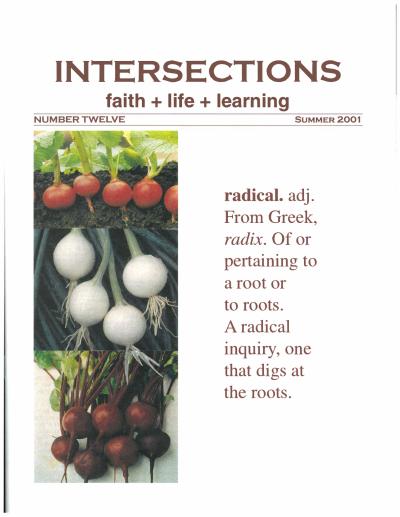 Editorial
From the Publisher
Arne Selbyg
Selbyg reports that the Lutheran Brotherhood Foundation and the Lilly Endowment have funded the Lutheran Academy of Scholars, which since 1999 has gathered ten to twelve Lutheran scholars at Harvard for two-week summer seminars under Ronald Thiemann (themes: “Finding Our Voice—Christian Faith and Critical Vision” in 1999–2000 and “The Lutheran Public Intellectual: Faith, Reason and the Arts” in 2001), and announces that the academy will move to Berkeley in 2002 under Ted Peters to take up the intersection of faith and science.
-
Editorial
From the Editor
Tom Christenson
Christenson introduces three pieces from the summer 2000 Vocation of a Lutheran College Conference at Dana College—noting that Leonard Schulze was asked to keynote before becoming executive director of DHES—and recommends Peter C. Hodgson’s God’s Wisdom: Toward a Theology of Education and Douglas Sloan’s Faith and Knowledge: Mainline Protestantism and American Higher Education for their accounts of how faith and knowledge have been dissociated in modern higher education and what it might take to recover their connection.
-
Article
Teaching as a Form of Servant Leadership
Leonard G. Schulze
Schulze defines teaching as a paradoxical “servant leadership” rooted in the etymology of educare, e-ducere, Erziehung, and Bildung, surveys representative models of the teacher (Plato’s cave, the Theatetus midwife, Socrates of the Apology, and Freire’s Pedagogy of the Oppressed), and proposes a four-fold taxonomy of learning—information, critical thinking, praxis, and teleology—each requiring its own form of teacherly leadership. He closes with ten Wittenberg-style theses for teachers at Lutheran colleges, including that the Gospel liberates us from using knowledge as power, that disputatio is an expression of faith, and that we are called to lead students from the tyrannies of ignorance, rote knowledge, incompetence, and anomy to the freedoms of awareness, critical understanding, skillful action, and purposive lives in community.
-
Article
Perspectives on Institutional Service: All Hands on Deck
Ruth Henricks
Henricks, President and CEO of Lutheran Family Services of Nebraska, uses Annie Dillard’s image of Christians tourist-like on Deck C to call colleges and social ministry organizations to “all hands on deck” in a church standing at a threshold of shifting demographics—a growing rich-poor gap, a coming Hispanic majority, an aging baby-boom, dual-career families, contingency workers, and for-profit Lockheed Martin-style competitors entering human services. Drawing on Foster McCurley, Andrew Grove’s Only the Paranoid Survive, Justo Gonzales’s Manana, Arthur Becker, Bob Bacher, David Tiede, and the ELCA constitution, she argues that SMOs and colleges are the “hands” of the body of Christ and asks whether we have courage to require Spanish, partner ecumenically, cut services to Caucasian clients, and lead the church from the front rather than the rear.
-
Article
A River Runs Through It: CLU as a Church-Related University
A. Joseph Everson
Everson borrows Norman Maclean’s A River Runs Through It and the small creek that flows through California Lutheran University’s Kingsman Park as images for the quiet stream of Christian tradition on campus, describes the dialectic of faith and reason (with a “Lord of Life” student congregation, two required religion courses, and a voluntary Wednesday chapel) as the “theology of paradox” that runs from Luther’s simul justus et peccator through Richard Solberg and Richard Hughes, and names six commitments that constitute the CLU ethos—academic freedom (Jeremiah 29:7 and John 8:32), vocation, service (Amos and Habitat for Humanity), grace and graciousness (Portia’s “quality of mercy” speech from The Merchant of Venice), diversity, and reverence (Proverbs 9 as awe and wonder).
-
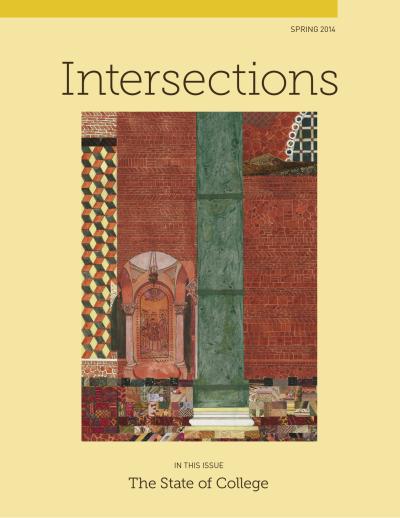 Book Review
Post-Secular Religion on Campus: Conversing with Jacobsen and Jacobsen
L. DeAne Lagerquist
No. 39 · Spring 2014
Lagerquist guides readers through Douglas and Rhonda Hustedt Jacobsen’s No Longer Invisible: Religion in University Education and its companion volumes, unpacking the authors’ three-act story of campus religion (Protestant, Privatized, Pluriform), their three-by-two framework of historic/public/personal religion in belief and behavior, and the six questions they pose for campus conversations. She lifts up interfaith etiquette and vocation as especially fruitful zones for Lutheran campuses.
-
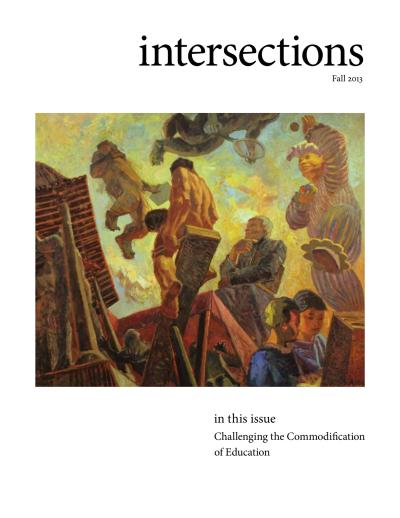 Article
Welfare of the City and Why Lutherans Care about Education
L. DeAne Lagerquist
No. 38 · Fall 2013
Lagerquist takes readers on a historical tour from sixteenth-century Saxony through the founding decades of Lutheran higher education in the United States to the present day, recovering Luther’s “gift economy” alongside Lewis Hyde and Oswald Bayer as a counter to the market logic that increasingly governs American higher education. She offers four propositions on vocation and commodification and proposes that Lutheran institutional vocation is to accept and pass along the gifts that come to our schools for the well-being of students, neighbors, and the world.
-
 Article
You Don't Seem Angry: Methodological Confessions Of A Lutheran Lay-Woman
L. DeAne Lagerquist
No. 5 · Summer 1998
Lagerquist, opening from a colleague’s 1981 observation about her M.A. thesis on four female abolitionists, traces her path from feminist historian and battered women’s shelter advocate through the University of Chicago’s obsession with method to a more self-conscious account of her own. The method grows out of four Lutheran themes—original sin (caution and humility), the eighth commandment against bearing false witness (generosity and forgiveness), the neighbor as “little Christ” (cooperative interpretation), and vocation (interpretation as calling, located alongside feeding the hungry and visiting the lonely)—and shapes her ongoing work on a history of Lutherans in the United States with a plot about learning to live with diversity.
-
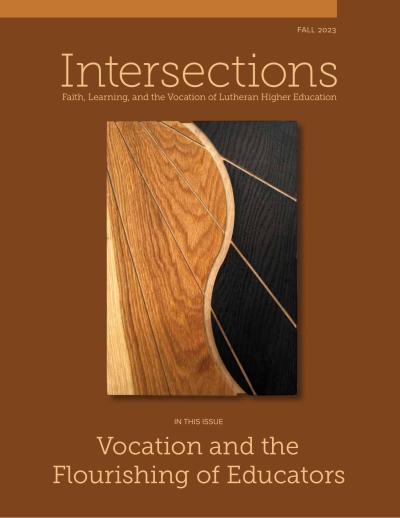 Editorial
From the Editor: So That We, Too, May Flourish
Colleen Windham-Hughes
No. 58 · Fall 2023
Windham-Hughes introduces the 2023 VLHE conference theme of educator flourishing, drawing on Dr. Monica Smith’s plenary challenge — “How can we flourish if only some are centered and others are at the margins?” — and invites readers to ground themselves in Us/We, the cover art by Augustana graduate William Hatchet, and join the conversation.
-
 Article
The Vocation Movement in Lutheran Higher Education
Mark Wilhelm
No. 43 · Spring 2016
Wilhelm offers a brief history of the “vocation movement” in ELCA higher education, arguing that it arose as Lutheran leaders moved beyond institutional markers (percentages of Lutheran students, faculty, and board members) and the collapse of ethnic, separatist Lutheranism to re-ground their schools’ identity in a 500-year-old intellectual tradition that educates the whole person for vocation and the common good — an educational ideal open to persons of any religious or non-religious conviction.
-
 Article
Sojourners in a Pluralistic Land: The Promise and Peril of Christian Higher Education
Randall Balmer
No. 25 · Spring 2007
Balmer, a Barnard scholar of American evangelicalism reared in evangelical parsonages and formed at Trinity College in the Chicago suburbs, defends public education even as he champions Christian higher education as a “halfway house” for students moving from religious subculture into a pluralistic world. Drawing on his own undergraduate experience, his books Mine Eyes Have Seen the Glory and Thy Kingdom Come, and a chastening visit to Patrick Henry College, he names three perils of Christian higher education—the Scylla of secularism (intellectual arrogance allergic to piety), the Charybdis of sectarianism (intellectual dishonesty as exemplified by intelligent design’s special pleading), and insularity—and prescribes mentors, primary sources, internships outside the subculture, and a broader, intergenerational pluralism on campus.
-
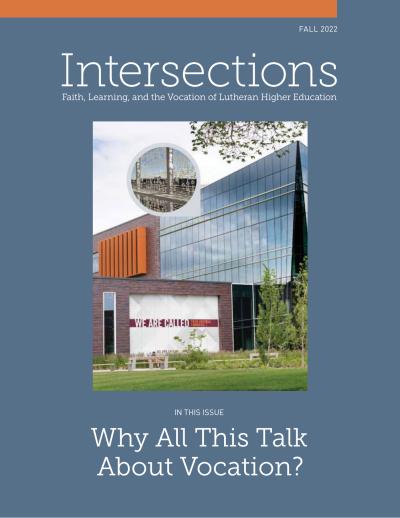 Article
Why All This Talk About Understanding the Mission of NECU Member Institutions as a Vocation?
Mark Wilhelm
No. 56 · Fall 2022
In his valedictory keynote, retiring NECU Executive Director Mark Wilhelm argues that Lutheran higher education is, properly understood, vocation-based education — outlining four core practices recovered over the past fifty years and naming the constructive and corrective work still to be done, including a fuller embrace of DEIJ and of the diverse vocations of NECU’s 27 institutions.
-
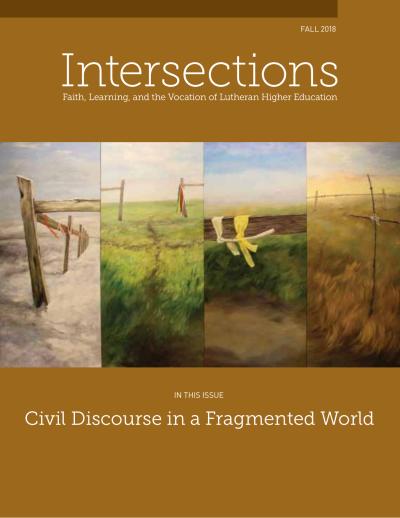 Editorial
From the Publisher
Mark Wilhelm
No. 48 · Fall 2018
Wilhelm frames the issue by reflecting on the Letter of James and the Lutheran tradition of “calling a thing what it is” — arguing that the standards of academic discourse, deeply rooted in Lutheran insistence on frankness and honesty alongside concern for the common good, give NECU institutions a solid platform for sustaining honest but not hateful discourse about divisive issues.
-
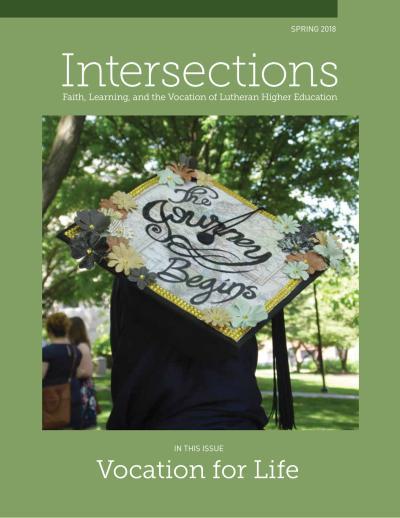 Article
Luther, the Catechisms, and Intellectual Disability
Courtney Wilder
No. 47 · Spring 2018
Wilder confronts Luther’s deeply troubling response to a child with disabilities at Dessau, then mines his Small and Large Catechisms for a Lutheran theology of inclusion — reading the Third Article of the Creed, the petitions of the Lord’s Prayer, and the sacrament of baptism as resources that affirm the full humanity of people with intellectual disabilities as faithful children of God.