Negotiating Legitimate and Conflicting Values
Eboo Patel
Interfaith Youth Core
Katie Bringman Baxter
Interfaith Youth Core
Mark S. Hanson
Augsburg College
Intersections No. 44 · Fall 2016
Katie Baxter
I’m an alumna of a Lutheran college. I graduated from Wittenberg about 15 years ago and being at Augsburg College the last couple of days has given me the opportunity to reflect on my Lutheran education and how it has brought me to the place I am now. I use the liberal arts education I received at Wittenberg every day in my work with Interfaith Youth Core.
And so, I’m thankful for my Lutheran education. I am also thankful for the opportunity to speak with Mark Hanson and Eboo Patel about where interfaith engagement and Lutheran higher education is going. Each has strong convictions about the next stage of interfaith cooperation in civil society and on our campuses.
Eboo Patel is president and founder of Interfaith Youth Core. The reverend Mark Hanson is presiding bishop emeritus of the Evangelical Lutheran Church in America; he now serves on the faculty here at Augsburg College.
As two people who think a lot about interfaith cooperation in multiple safe spaces, and about public interfaith engagement, what are you seeing out there? What situations, settings, and scenarios would you like to call attention to? I’m asking this question now especially as we think about the role of our colleges, and about what we will do when we return from this conference to our individual campuses.
Mark Hanson
Thank you. It’s always curious to be asked to predict the future—to be a prophet. I simply work for a nonprofit organization! I want to get to the specifics of your question with an illustration from the Jimmy Fallon show last night. Barack Obama was the guest; they took a playful riff on the news, and the President was insightful and relaxed, and at one point President Obama said this: “Democracy—for it to work—means learning to compromise even when you are 100 percent certain that you are right. What is at stake is not just proving that you are right, but finding ways to work together to move this country forward.” I think that this is his way of saying that one must serve the common good. He may be channeling Marty Stortz or Eboo Patel! After all, Dr. Stortz is telling us that the politics of the common sees the other as one’s neighbor, and then asks about what it means to be neighbor?” And I heard Eboo Patel saying that interfaith leadership in a religiously diverse democracy calls for leaders to commit to building bridges from the bottom up, precisely because bridges don’t drop from the sky.
“We are building mature leaders for religiously diverse contexts who are not going to be scared by the questions of complexity before us.”
When I talk about the future, it’s not to predict it, but rather to live today as signs of God’s promised future. A question that we don’t engage fully enough across our religious traditions is this: How does your religious tradition imagine the future? How do we live as signs of that future today?
In a polarized culture that is so frightening and mean-spirited, what I witnessed at this conference and see on our campuses is certainly a sign of hope. I think we are building mature leaders for religiously diverse contexts who are not going to be scared by the questions of complexity before us, who will have confidence in their own position. They will also understand what President Obama says: To build a democracy is not to convince others that you have it right but to seek the common good. That’s called engaging in an ethic of proximity. You must come to your neighbor with your values shaped by your deeply held religion and then ask: What does it mean to be neighbor together?
Bethany Lutheran church on Franklin Avenue is not far from where we sit. It was born out of an old controversy at Trinity Lutheran Church. (When Lutherans have controversies, especially among Scandinavians, rather than talk to each other, they go start another church.) But Bethany Church is now in a very diverse community. It hosts a soup kitchen that welcomes the community five days a week. Besides a free meal, it provides free conversation—and it is quite holy. I have had soup next to the homeless person that I see when I get off the freeway ramp, the one holding a sign asking for money. And I’ve had soup with high executives from the Fairview hospital system.
A few years ago, Bethany Lutheran, like many congregations, had to ask who is welcome there, and how they should express that welcome. Communities that have often felt excluded from the church include people who are gay, lesbian, bisexual, and transgender, as we all know. So Bethany chose to be part of a movement within the Lutheran church called “Reconciling in Christ.” They wanted the community to know about this commitment, so they painted the metal strips along the window that faces Franklin Avenue with all the colors of the rainbow. It was a marvelous sign of welcome.
Well, fast-forward a couple of years. Recently, the chair of the Minnesota chapter of the Council on American Islamic relations approached Bethany about moving their headquarters and sharing space with Bethany. But they also admitted that those rainbow colors will provide tension for many Muslims, endangering their own sense of being welcomed. So how does a community wanting to welcome one community that has been excluded now extend a welcome to another community that’s also excluded without excluding the ones who have already been welcomed?
A meeting was called a week ago. It was a living laboratory. Different peoples and traditions, each with deeply held convictions, each of which was 100 percent right, now had to ask of one another: How shall we be neighbors? How shall we be in community together? Out of that conversation came a creative resolution. They decided not to have just one flag, the rainbow flag, but also flags painted for the residents who live in the Cedar Riverside neighborhood so that they all know they are welcome. They will also ask an artist to build a mosaic that includes the rainbow as part of the narrative of Bethany, but that also includes images of people who are newer to the community and out of whose tradition they are currently building community together. I think that’s part of the vocation of Lutheran higher education—to prepare citizens to be faithful stewards of their own traditions but also committed to being neighbors to others. It will take hard work to create an ethic of proximity to our neighbor in order to serve the common good.
Eboo Patel
I almost just want to repeat Bishop Hanson’s story because it’s so very important. Let’s think more about this scenario for a moment. On the one hand, how many people in this room feel wounded and hurt that gays and lesbians continue to be unfairly marginalized in our society? How many believe that their religious institution ought to be proactive in reaching out to the LGBT community to involve those folks? On the other hand, how many people feel wounded and hurt when they see stories of seventh grade Muslim girls getting their head scarves pulled off in junior high after a particularly loud and pompous pump rally the night before? How many people feel that they ought to be proactive in reaching out to the Muslim community and get involved in that? All the same folks are raising their hands. And here’s the rub: What happens when one of those communities says, “I cannot share space or symbols with that other marginalized community”?
Welcome to a religiously-diverse democracy.
Some years back, I would do my best to not think about these examples because they didn’t fit into my paradigm. My paradigm was basically: I’m for all the marginalized and for justice in any form. But gay folks are marginalized and Muslims are marginalized and they have different views on sharing spaces. The more I grow in interfaith leadership, the more that I can recognize that these are precisely the issues for which we should be preparing our students. Other issues—it’s not that they’re not important—but if there is a clear right and a clear wrong, well, then it’s not that hard. It’s just a matter of marshaling forces around the right choice. But when there are legitimate views (which doesn’t mean that they are perfectly right, but they are legitimate), when there are legitimate views and they are in tension, the question to me is not so much: Who is right? But rather: How do we move forward?
“When there are legitimate views and they are in tension, the question to me is not so much: Who is right? But rather: How do we move forward?”
This is a less poetic way of saying what Bishop Hanson said. What I have now is basically a set of files in my brain where I keep track of the dozens of things that happen on an everyday basis where legitimate views conflicts with other legitimate views among people who orient around religion differently.
Just yesterday, I received an email from the associate dean of religious life at Vanderbilt University. She happens to be a Lutheran pastor. She has an increasingly sophisticated understanding of mental health and wellness issues; she has learned with that sophisticated understanding that well-trained dogs can be of a particular comfort to students experiencing mental strain and stress. She really cares about this issue and believes that it is part of her vocation as a chaplain to be proactive in welcoming people who might be experiencing issues related to mental health. She also has an increasingly sophisticated view of Islam and Muslims. And so, she is aware that certain groups within Islam believe that the presence of a dog cancels or interferes with a Muslim’s prayer. She has a conundrum. She wants to get a well-trained dog to help serve within the chaplaincy offices at Vanderbilt, so that they are a place that welcomes people with mental illness, and so—to use Muslim language—they can be a “special mercy.” At the same time, she is aware of being in a position where a number of people cannot come because they believe that the presence of that dog cancels their prayers. The beauty of this particular example is that it is the most everyday of issues.
Or take a different issue: If you are the park district manager in Crown Heights, Brooklyn, and a group of Orthodox Jews comes to you and says “Orthodox Jewish women of a particular school of thought cannot swim with men; will you create special swimming hours to accommodate our particular religion?” What do you do? Is meeting that request a violation of church and state? What about other people who want to swim in those hours? Have you now excluded them?
Or this: If take your “Intro to Religion” class to visit a local mosque and the friendly Muslim imam at the mosque says that women should go in this direction, and men should go in the opposite direction, and anybody who is wearing a skirt or a sleeveless shirt can’t come in, have you just exposed your female students to the worst form of religious misogyny? Or are you exposing them to a different cultural pattern? The instructor has to figure out what to do in that very moment. And it’s not just a decision. He or she also has to figure out how to have a conversation in class about this.
Or this: When Orthodox Jewish men of a particular school board a plane and discover that their seat is next to a woman, they sometimes refuse to sit down. In their Jewish school even inadvertent touch with a woman is a violation of their religious ethic. Is that not okay? Should the flight attendant say, “Hey man, if you don’t want sit in your seat, then get off the plane”? Or can she or he find another, more creative way to move forward?
Or finally: If “fireman friendly” comes to the Boys’ and Girls’ Club two blocks away with a dog and this dog has thrilled kids for thirty years, but today 20 percent of the kids in that Boys’ and Girls’ Club are Somali, do you still bring the dog?
These are the kinds of decisions that interfaith leaders face every day. Increasingly, my mind focuses on case such as these rather than on religious slurs, or other clear cases of right and wrong. In what ways do Lutheran colleges and universities prepare students to be leaders in these situations? These are the kinds of decisions that interfaith leaders face every day.
Katie Baxter
Thank you both for these stories that highlight and complicate interfaith leadership within our civil spaces.
In addition to my part in Interfaith Youth Core, I am the chair of the council at my Lutheran congregation. We are an urban congregation; we are a growing congregation; and we have just sold our building and are exploring shared spaces within our community. So we are about to embark on an 18 month process where we will be engaging the Latino Episcopal Congregation to share space. We’ll also engage a progressive, protestant, nondenominational congregation that does lots of social action in the neighborhood. Finally, we’ll talk with a Jewish congregation that draws people from across Chicago. As a faith leader, what am I to anticipate in the next 18 months? What might come up as we work together and consider whether we can live in community together? What can Lutheran colleges and universities campuses do to prepare students to be leaders in these kinds of scenarios?
“What can Lutheran colleges and universities campuses do to prepare students to be leaders in these kinds of scenarios?”
Mark Hanson
I think we’re ready to publicly declare that, in order to complete an education at one of the 26 ELCA colleges and universities, a student will need to prepare to live in a religiously pluralistic context. We are committed to that outcome.
I’ve been a part of far too many institutional “visioning” committees and planning processes. I’ve realized that almost every planning process has really been about institutional survival and viability; almost never does it put forward a bold vision of what kind of world we want to create, and what contribution our institution can make to that kind of world. I think the work of interfaith engagement on campuses, by contrast, is about the kind of world we really do want to build.
Yesterday four incredible students sat on this stage as a panel. I almost texted Eboo and said, “You know, we really don’t need to do this dialogue tomorrow morning because we have seen the future and they are sitting right here among us.” When I project those four lives into the vocational paths that they have described—a lawyer, a doctor, a bioengineer, and a person in biological sciences—and when I consider that over the next 10 years they will bring deep rootedness in their own tradition, a relational capacity for friendships (including friendships with those who identify as atheists and secularists), I am absolutely convinced that they will bring deep awareness and commitment to building a religiously pluralistic democracy. They are the future that we are committed to building as Lutheran colleges in America.
I think it’s time that we agree that college campuses can be safe places to explore various religious expressions and traditions. Certainly we provide holy spaces or sacred spaces. Are these spaces also respectfully used to honor the traditions of others?
“In what ways can we be together as an academic community but also engage the community beyond the college? How might we do so in service, and justice, and reconciliation?”
How might we teach about religious pluralism in a way that is both curricular and co-curricular? In what ways can we be together as an academic community but also engage the community beyond the college? How might we do so in service, and justice, and reconciliation? Finally, how do we hold each other accountable? Can we build a culture of mutual accountability and together to create a religiously diverse and pluralistic democracy of which we are citizens as individuals but also as representatives of our respective colleges and universities?
Eboo Patel
What would it look like for Lutheran colleges and universities to say publicly that part of the signature of an education at Grandview or Susquehanna or Muhlenberg is that each student becomes an interfaith leader, which means being able to be a proactive, engaged, effective citizen in our in a religiously diverse context? At least as important is this: How do we substantiate that?
In the classroom, or in an interfaith scholars program, or in a chaplaincy program, there are a number of “best practices” for teaching interfaith. First and foremost, we must teach the tensions and complexities, not the easy stuff. In case studies within business school or law school or medical school, it is the hard cases—not the easy ones—that produce genuine reflection and wisdom. People know what to do when a Muslim girl’s headscarf is pulled off by seventh graders. It’s not that those cases shouldn’t be mentioned, but they should not comprise the bulk of a college education. By contrast, the question of what do you do when the Muslim organization that you want to welcome wants to paint over the rainbow flag representing others that have been welcomed—a question such as this one generates genuine tension and invites creative responses.
“We must teach the tensions and complexities, not the easy stuff.”
Second, it does seem to me that the case study format is the best way to teach tensions. By putting students into the role of community leaders, things get real really quickly. What do you say to the Muslim group? What does the subsequent email look like to the LGBT community? What does the next meeting look like? How do you even open up the next meeting? Literally, what is the set of things that you do?
Third, all this connects to an institution’s survival and mission to the extent that these kinds of issues are to be standard operating procedure for the rest of our society. In other words, about 12 versions of the dilemmas represented by these scenarios are happening right now within 5 square miles of here. There is some interesting tension at a healthcare facility around religious diversity. There is some interesting tension happening at a school. There is some interesting tension happening at the Boys’ and Girls’ Club. Your students become nurses, doctors, teachers, counselors, social workers, and community leaders in these environments. How might they get an ethnographic sense of the tensions in these spaces? In other words, in professional environments where people interact, where students get jobs, what are those kinds of tensions?
My colleague Brendan brings up a fascinating issue—namely, that the definition of the end of life for a Buddhist is considerably different than for a “Westerner.” What implications does that have if you work in a hospital and are responsible for declaring a patient dead? What do you do if you’re that nurse? Some version of this is occurring a dozen times over at any given moment. Again, then, what does it look like to get a thick ethnographic sense of these kinds of tensions in professional situations, to keep track of actual cases, and then to build a bridge from your college to the medical center or the local Boys’ and Girls’ Club? How might your school produce nurses, teachers, doctors, and social workers capable of engaging the kinds of tensions and issues that are becoming increasingly common?
Mark Hanson
But I also think we have a lot of work to do to convince many of our colleagues of the importance of interfaith engagement. Many on our campuses assume that interfaith leadership is currently the issue de jure on campuses, and that something else will become more pressing in 3 to 5 years. Not at all. This is about our life in the world. This is not an issue de jure. But if we are to back up that assertion, we need to explain articulately why we are so engaged. Scholars such as Darrell Jodock have been helping us reflect on why Lutherans are inexplicably engaged in higher education. It is all about the freedom that we experience to be neighbor, the freedom to have an insatiable curiosity about life, the freedom to live with complexity and even embrace paradox. If we cannot articulate the deeper footing on which the bridge is being built, then interfaith will be an issue of interest for only a select few.
“Many on our campuses assume that interfaith leadership is currently the issue de jure.”
For me, the weakness of this Vocation of a Lutheran College Conference has been the lack of presence of self-identifying atheists, secularists, and humanists. I, for one, will no longer identify millennial young adults as “nones” because to define someone on the basis of what they lack almost always comes from position of privilege. It does not honor the other. By contrast, to create a context where people can define themselves, and out of that self-definition begin to share their narrative and begin to strive to grow into an ethic of proximity and building community together—well, that’s what we ought to be after.
Katie Baxter
I’d like to spend the remaining time hearing what others in the room want to talk about. So your questions are welcome, as are your affirmations or challenges to anything that you have heard. And I invite you to consider thinking of an example or story to share, particularly cases where legitimate concern meets legitimate concern. What are you preparing your students to do? What are they encountering in the world?
Question #1 from audience: “I’d like to ask Eboo Patel about his term ‘legitimacy.’ I ask because I am wondering whether evoking religious legitimacy threatens to give a free pass to discrimination just because it’s in the name of God.”
Eboo Patel
Actually, this is why I think “legitimate” is a slightly better term than a “right” because the latter often means “I agree with you.” “Legitimacy,” by contrast, doesn’t necessarily connote agreement. I don’t believe a dog cancels my prayers. I don’t believe that touching a woman inadvertently somehow violates sexual ethics for me. But if I respect your identity, I have to have an appreciative understanding of how you come to that view. That’s what diversity is. Diversity is to say: “I don’t superimpose my terms upon you.” Diversity is to recognize that you operate under a different set of terms and I respect how you come to a view based on that set of terms. That doesn’t mean I agree with you—and there are limits! There are legal limits and limits by way of civil discourse.
“If I am to say that I respect your identity, does that mean I only respect it when I like it?”
The greater danger in the rest of higher education is the option of saying, “if you do not share my views—straight down the line—I’m gonna shout you out of this space, your identity damned.” I don’t agree with Muslims who are made uncomfortable by a symbol of gay pride. But they have a legitimate view. I don’t agree with the Orthodox Jewish man on a plane, but if I have sympathy for the Orthodox Jewish women who want to swim in a same-sex environment, based on their understanding of gender and coming out of a Jewish tradition, then why would I not offer that same sympathy to the Jewish man?
If I am to say that I respect your identity, does that mean I only respect it when I like it? Honestly, I think that’s the great danger in progressive higher education right now. When, for example, the African bishop speak of the challenges racism, I will stand up and applaud, but when they follow that with an opposition to same-sex marriage, I don’t really know what to do. And yet, that’s diversity!
Question #2 from audience: “I see what you’re saying, but that problem is not the problem I face most often with my second-year students. The problem I face most often is the question of relativism. The students don’t want to take a side at all; they want to say that everyone has the right to a position, and so we have to show them a place to start so that they can even make some kind of evaluative claims.”
Eboo Patel
Yes, this is why case studies are so important. The New York Times had a story about the pool in Brooklyn that I was using as an example; it’s s real-life scenario. And it is an entirely likely scenario that one of your students will work a job like the park district manager. If one of your students winds up as the manager at a YMCA or of a public pool, he or she will face such issues. The good thing about case studies is that you do not have to convince someone of the relevance. The relevance is right in front of them.
Mark Hanson
Relativists reduce to the lowest common denominator. They are eclectic, and non-evaluative, saying everything is fine. Critical pluralists, on the other hand, presupposes a deep commitment to move to engagement with the other out of one’s own tradition.
I was the parish pastor at a congregation that loved to write resolutions about issues and bring them to church conventions. When we’d have disagreements, some would want to poll private opinions, asking: “Are you for this or against this?” But when you phrase the question that way, one side would eventually win and the other side would lose. A better way forward for us was to assume that there is a continuum of perspectives along a spectrum that we’re trying to reduce to a polarity. So rather than having a resolution, we would get newsprint on the wall, and we would begin to develop the continuum of complex responses to a particular complex issue. And we literally asked people to go to the point on the continuum and stand where they most closely self-identify. And then they could talk to those around them because they found some allies that could strengthen their case. They would move onto the group a little further down the continuum. In this way, they got to build strength and also the capacity to listen to a different perspective. And then they would keep progressing to a perspective that was even more different than their own. Activities such as these call one to deeper listening but also to the possibility of changing one’s mind.
“If it’s dialogical and contextual, then my mind might just be changed!”
The same is true for interfaith dialogue. If it’s dialogical and contextual, then my mind might just be changed! We’re talking today as if all of these perspectives are hardened forever, but that’s not my experience. We may need to call each other to change for the sake of the other and as we examine our impact on civil society.
Question #3 from audience: “The question I want to ask is about framing interfaith education around the term ‘leadership.’ I think this language is compelling, but I wonder—as Lutheran higher education tries to find entry points into this work, does framing that work as ‘interfaith leadership’ limit how people imagine themselves and their roles in this work? Others use language of interfaith ‘competency’ or ‘service.’ Does interfaith leadership indeed provide the broadest possible orientation so that people who are not convinced that this has relevance for their vocations can see the power of embracing interfaith?
Mark Hanson
I think “leadership” has its limits. People may exclude themselves because they do not perceive themselves as leaders. I think “being neighbor” is a much more helpful entry point. And I think “vocation” is a more helpful entry point. What does it mean to be called to a meaningful life, a purposeful life, a life that serves the other and the common good? So, I agree that “leadership” can be too narrow and exclusive for what we are trying to do.
Eboo Patel
Why call this leadership? At the end of the day, we at IFYC want to say, “Here’s our term, here’s our definition, but we will agree to any alternative term that anyone wants to use.” We’ll use inter-religious instead of interfaith; we can use neighbor instead of leader, and so forth. But let me just say why I use the word leader.
Honestly, if I were at Amherst, I might say “neighbor.” People have been whispering in the ears of those kids since they were four years old: “You were born a leader.” But just because you are from Susquehanna or Muhlenberg or Grandview or Augsburg and not Stanford or Harvard, why wouldn’t we want to plant the idea in the heads of graduates that they are leaders? Why wouldn’t we say to them, “You know what, you grew up salt of the earth, but we’re going to call you something that you never thought you could be, and inspire you to be it”? I think that that is a big part of what colleges are about—especially colleges such as yours.
-
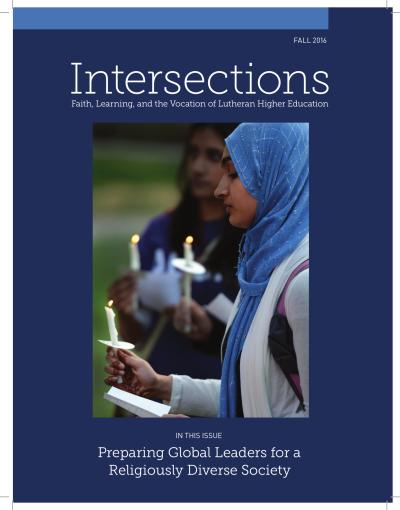 Editorial
From the Publisher and Editor
Jason A. Mahn, Mark Wilhelm
Writing weeks after the 2016 presidential election, Wilhelm and Mahn frame interfaith engagement as the urgent and ongoing work of ELCA colleges and universities, recap NECU’s growing commitments to inter-religious leadership, and introduce essays first delivered at the summer 2016 Vocation of a Lutheran College Conference under the theme “Preparing Global Leaders for a Religiously Diverse Society.”
-
Article
Laboratories for Living in a Diverse World
Elizabeth Eaton
Presiding Bishop Elizabeth Eaton argues that ELCA colleges and universities are called to be laboratories for living in a religiously diverse world. Reflecting on the decline of Christian privilege, the ELCA’s ecumenical and inter-religious work, and her own experience addressing the Islamic Society of North America, she offers three questions about partnerships, formation, and institutions as platforms for new collaborations.
-
Article
Why Interfaith Work is Not a Luxury: Lutherans as Neighboring Neighbors
Martha E. Stortz
Stortz argues that interfaith work is not a luxury but a constitutive commitment of Lutheran higher education — institutions she describes as both “faith-based and interfaith-dependent.” Reading the parable of the Good Samaritan as both an intra-faith and inter-faith encounter, she offers a four-fold matrix of theological reflection, spiritual engagement, social action, and everyday experience as portals into the work of being neighbor.
-
Article
The Promise and Peril of the Interfaith Classroom
Matthew Maruggi
Maruggi draws on his years teaching in the Augsburg religion department to identify three pairs of seeming opposites — dialogue and debate, safety and risk, commonality and particularity — that, held in creative tension, nurture a vibrant interfaith classroom where pluralism is actively engaged rather than merely present.
-
Article
Religious Diversity and the Vocation of a Lutheran College
Darrell Jodock
Jodock argues that a college which takes its Lutheran values seriously is well positioned to foster inter-religious relations along a “third path” that is both religiously rooted and inclusive. He traces the relational and communal character of Lutheran theology, develops a Lutheran understanding of deeper freedom, the theology of limits, and human complexity, and shows how a down-to-earth image of God offers theological resources for overcoming the anxiety and fear that block interfaith engagement.
-
Article
Risky Speech–Gifted Friendships
Sonja Hagander
Augsburg College Pastor Sonja Hagander reflects on pastoral care across faith traditions — from a campus chapel service after the 2008 murder of Muslim student Achmednur Ali, to her decade-long friendship with Jewish colleague Barbara Lehmann — and reads the Gospel of John as a roadmap for interfaith friendships marked by love, free speech, public space, and a willingness to risk being changed.
-
Reflection
Mapping Interfaith Encounters
Callista Isabelle
Muhlenberg College Chaplain Callista Isabelle uses a student-designed subway map of religious and spiritual communities as an image for interfaith engagement — one that invites students to leave their “home” stations, encounter common ground and respectful disagreement, and explore the major intersections where religion meets science, environment, and mental health.
-
Institutional Focus
Interfaith Campus Organizing at California Lutheran University
Allison Bermann, Mehak Sachdev
California Lutheran University students Allison Bermann and Mehak Sachdev describe how interfaith participation at CLU grew from a grassroots movement into a sustained, integrated part of campus identity — with an intern program, Interfaith Allies, co-curricular events from Diwali dinners to Hunger Banquets, and a classroom practice of storytelling that opens the required Introduction to Christianity course to students of every faith and none.
-
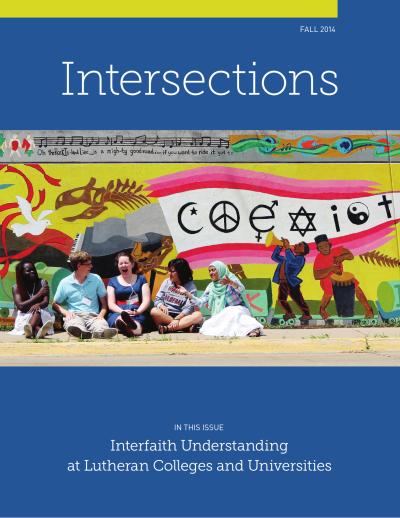 Article
What it Means to Build the Bridge: Identity and Diversity at ELCA Colleges
Eboo Patel
No. 40 · Fall 2014
Through the contrasting stories of two college students — Cassie’s identity relativism and April’s soft fundamentalism — Patel diagnoses Peter Berger’s twin pathologies of modernization and argues that ELCA campuses, anchored in Bonhoeffer and the Lutheran capacity to “have faith without laying claim to certainty,” are uniquely equipped to be places where the light falls: bridges of cooperation that nurture both strong religious identity and benevolence toward others.
-
 Article
Living at the Intersection of Fear and Hope
Mark S. Hanson
No. 32 · Spring 2010
Hanson draws on his January 2009 ELCA/ELCIC visit to Jordan, Israel, and Palestine—a Hebron Quran that did not burn, fifth graders dancing at the Hope School, a conversation with King Abdullah II—to frame the vocation of Lutheran higher education at the intersection of fear and hope. Engaging Brueggemann, Sittler, Buechner, Auden, Strandjord, Douglas John Hall, W. Robert Connor, Lewis Mudge, and Cynthia Moe-Lobeda, he argues that Lutheran colleges are called to critical inquiry that does not collapse into a hermeneutic of suspicion, to a “thinking faith” that resists religious fundamentalism, and to communities of discernment that work for the common good.
-
 Reflection
Colleges Lead Way: Curiosity, Faith, Discernment, Mission are Key
Mark S. Hanson
No. 28 · Fall 2008
Reprinted from The Lutheran (November 2007), Hanson names four marks of the colleges of this church—nurturing unquenchable curiosity, nourishing faith formation and exploration, modeling public moral deliberation, and preparing students for engagement in the world—and gives thanks for the colleges’ vocation to call us to stand outside ourselves and reach out in mission for the sake of the world.
-
 Article
Reflections on Our Shared Commitments
Mark S. Hanson
No. 25 · Spring 2007
Originally delivered to the Lutheran Educational Conference of North America in March 2007, Hanson’s address describes the ELCA as “an ecology of interdependent ecosystems” and locates the church’s relationship to its twenty-eight colleges and universities in a shared mission rather than in older anxieties about church-relatedness. Drawing on Wittenberg’s Lutheran Identity Study, Augustana’s “Five Faith Commitments,” Pamela Jolicoeur’s Concordia address, W. Robert Connor on “big questions,” Joseph Sittler on grace, Walter Brueggemann on fear, Jonathan Strandjord on being “other-wise,” and Cynthia Moe-Lobeda’s Public Church for the Life of the World, he names four marks of shared mission: communities of free inquiry, encouragement of religious expression in a diverse society, education for the common good, and the formation of leaders for church and religious communities worldwide.
-
 Book Review
Reviews
Matthew J. Marohl
No. 26 · Fall 2007
Marohl reviews two 2006 Lutheran University Press volumes from Grand View College (Des Moines, IA). Mark C. Mattes and Ronald R. Darge’s Imaging the Journey … of Contemplation, Meditation, Reflection, and Adventure pairs Mattes’s Lutheran meditations on seven themes (from a spirituality of communication to Alpha and Omega) with Darge’s photographs and Ronald Taylor’s short prayers, with Mattes’s writing on vocation singled out as the volume’s finest. The Grand View College Reader, edited by Mattes, Evan A. Thomas, Kathryn Pohlman Duffy, and Ronald Taylor, surveys the college’s Foundations, Creativity, and Vocation through chapters by Thorvald Hanson, Kenneth Sundet Jones, Kevin Gannon, Ammertte C. Deibert, Steven Snyder, and President Kent Henning, tracing Grand View’s Grundtvigian and Danish Lutheran roots.
-
 Editorial
Guest Editorial: Moral Deliberation in NECU Classrooms
Ernest L. Simmons
No. 51 · Spring 2020
Simmons introduces the guiding question of the NECU working group: could the ELCA’s twelve social statements and thirteen social messages — expressions of Lutheran social teaching originally formulated for congregational use — turn campuses into “academic communities of moral deliberation”?
-
 Editorial
From the Editor: Vocation as Action in the Affirmative
Colleen Windham-Hughes
No. 59 · Spring 2024
Windham-Hughes frames vocation as practicing “at the borders of our incompetence” — every small yes to the callings we experience, every effort made in the direction of life, is action in the affirmative — and previews the issue’s essays on diversity, transformation, AI, championship team culture, and dreaming big within and beyond our limitations.
-
 Editorial
From the Editor
Jason A. Mahn
No. 46 · Fall 2017
Mahn returns to Luther’s opening thesis on whole-life repentance to argue that the deepest critique of the indulgence economy — and of our own American meritocracy — is the very assumption that grace and human striving can be measured, exchanged, and earned.
-
 Editorial
From the Publisher
Mark Wilhelm
No. 39 · Spring 2014
Wilhelm interrogates the widely used phrase “the model is broken,” arguing that it blames the victim, masks the demographic and public-funding pressures actually facing ELCA higher education, and distracts from the work of modifying—rather than discarding—a model of educating the whole person that has successfully adjusted across the centuries.
-
 Article
Polarization, Incivility, and a Need for "Change"
Guy Nave
No. 48 · Fall 2018
Nave argues that when Americans demand “change,” they usually mean that “others” need to see things their way — and that meaningful transformative change requires acknowledging the provisional nature of our perspectives, seeking to understand as much as to be understood, and bursting the ideological echo chambers of social media through projects like Clamoring for Change.