There is no doubt that Lilly Endowment launched a robust movement when, in the early 2000s, it funded eighty-eight colleges and universities across the country to explore how the theological concept of vocation could be infused into the curriculum and co-curriculum of undergraduate education. And then, recognizing how effective this vocation movement had become, the Council of Independent Colleges (CIC) approached Lilly to help create and fund the Network of Vocation in Undergraduate Education (NetVUE), which now includes almost 300 colleges and universities of diverse traditions and missions.
Augsburg University, where I have served as President for sixteen years, was one of the eighty-eight institutions that received the original Lilly grants. It was also a founding member of NetVUE. I have watched with great joy how this community of learning and practice has become a great resource for inspiration and innovation in our common commitment to integrating the concept of vocation into all aspects of our undergraduate programs. At the same time, I have begun to explore how what we have learned about exploring vocation with our undergraduate students has taught us important lessons that can be shared with wider audiences. In that way, I believe that those of us in NetVUE have the opportunity to share the gift of vocation far and wide.
“Exploring vocation with our undergraduate students has taught us important lessons that can be shared with wider audiences.”
In that spirit, I was pleased to serve on a panel at the 2022 NetVUE Conference tasked with sharing ideas and practices about how we might take our lessons about vocation to other important constituencies. Joined by professor emerita Dorothy Bass from Valparaiso University, co-editor with Mark Schwehn of the important compendium, Leading Lives That Matter, and Jodi Porter, who oversees the Lilly-funded Youth Theology Institute program at the Forum for Theological Exploration (FTE), we shared our own experiences with how the concept of vocation can be extended beyond our undergraduate campuses.
There were three main themes in our conversation.
Beyond Undergraduates on Our Campuses
Many NECU and NetVUE institutions have graduate programs, especially in professional disciplines like nursing, education, and social work, where the concept of vocation can play an important role in shaping a professional career and life. At the NetVUE conference, I shared our work at Augsburg in creating an online vocation portfolio (a so-called V-Portfolio) that allows students to share artifacts from their personal academic and professional journeys that help them tell a story about their vocational pursuits. We have used the V-Portfolio with both undergraduates and graduate students, and have found it to be a helpful tool for students as they share a public narrative of the many facets of a vocational journey. In addition to academic work, students share their experiences as parents, citizens, neighbors, and professionals—all of which creates that many-layered story of a life.
The panelists also agreed that the gift of vocation we share with our students is an important aspect of our work with faculty and staff. Many of our institutions have embedded vocation into orientation programs for new faculty and staff, and have designing professional development opportunities that promote vocational growth and discernment. At Augsburg, we also have used the V-Portfolio with faculty and staff who, like our students, want to share a more robust story of their lives—both on and off campus.
Across the Vocational Lifespan
Other important constituencies for our campuses include prospective students and alumni. Jodi Porter shared the mission of the Youth Theology Institutes (YTI), which were originally located on seminary campuses and then expanded to include colleges and universities. YTI is an opportunity for high school students to come to a campus in the summer and spend intense time as part of a learning community that explores a pressing issue in the world through a theological lens.
The opportunity has many important implications for our institutions. The students get the chance to experience life on a campus, to meet fellow travelers, and to learn the skills of theological exploration. These programs also offer current undergraduates the opportunity to serve as peer mentors, expanding their horizon about their own vocational paths. As Porter pointed out, these institutes also serve as an admissions event! At Augsburg, we have consistently seen several of our YTI students matriculate as undergraduates and often end up serving as mentors themselves. Whether the students come to our campuses or not, we know that the YTI experience is an important step for these high school students in their vocational journeys.
Alumni are another important audience for our vocation lessons. At Augsburg, we have organized the Centered Life Series, led by Dr. Jack Fortin, whose book, The Centered Life, has inspired many of us in our own vocational work. Dr. Fortin curates a series of sessions each semester (in person before the pandemic, but even more well-attended online during the pandemic) that address a particular vocational theme. For example, one series focused on the vocation of caregiving for a spouse with memory loss; another series shared the concept of interrogating our institutional saga, the work of appreciation and accountability for what Dietrich Bonhoeffer called our historical legacy. We find that these sessions attract a diverse range of alumni (and other friends) and enable us to show how the concept of vocation is alive and well on our campus.
“One series focused on the vocation of caregiving for a spouse with memory loss; another series shared the concept of interrogating our institutional saga.”
Dorothy Bass shared her work in creating reading circles around the readings found in her compendium, Leading Lives that Matter. For alumni and others, these reading circles provide an opportunity for lifelong learning related to a common text, while also touching on important themes in vocational discernment that have been taught over the ages.
During our discussion at the NetVUE gathering, we were challenged by a relatively young member of the audience to consider how our campus communities can be helpful to recent alumni who are facing the economic disruption of recent years. He mentioned the rise of the so-called “gig economy,” which can make it difficult for young people to find sustainable employment. This is certainly an obstacle to healthy vocational discernment. The panel acknowledged the systemic and systematic challenges—racial, economic, and otherwise—that need to be addressed as we go beyond the boundaries of campus life.
Accompanying our Faith Communities
We then turned our attention to the ways in which our vocation lessons can be shared with faith communities. In some ways this sharing entails coming full circle to the traditions that have given us the gift of vocation. The need to share (back) also recognizes that many of those faith communities have lost their way in supporting the vocational journeys of their members.
“The Riverside Innovation Hub brings scientists, artists, writers, and theologians from the Augsburg faculty into conversation with faith communities.”
I shared the work of the Riverside Innovation Hub, an initiative of Augsburg’s Christensen Center for Vocation, that works alongside local congregations seeking to become public churches. A public church is committed to place-based vocational discernment in the public square for the common good. In other words, the partner churches are pursuing God’s call for them to be in relationship with their local neighborhoods in ways that bring flourishing and life. Originally launched primarily focused on the work of faith communities with young adults ages 22-30, the Riverside Innovation Hub (RIH) now explores how the many resources of a college or university can be brought to bear in helping faith communities be more responsive to the vocational pursuits of its members. For example, RIH leaders found that many young people care deeply about environmental issues and don’t feel that their faith communities offer them resources to pursue those commitments. The RIH brings scientists, artists, writers, and theologians from the Augsburg faculty into conversation with faith communities to help expand their understanding of how they might accompany those young people in their passions for God’s creation.
I would contend that the work of the Christensen Center and its Riverside Innovation Hub is a compelling example of how our colleges and universities can more authentically be in partnership with congregations and other faith communities—and it is all about vocation!
There is much more to explore in these opportunities to share the gift of vocation and the lessons we have learned with our undergraduates with wider audiences. The goal of our panel was to open up a conversation and to do what NetVue does so well, which is to share what works, what doesn’t, and then to let the imagination and courage of those of us dedicated to spreading the good news of vocation take flight.
Works Cited
Augsburg University. Riverside Innovation Hub. Accessed 1 April 2022, www.augsburg.edu/riversidehub/
Fortin, Jack. The Centered Life: Awakened, Called, Set Free, Nurtured. Augsburg Fortress, 2005.
Schwehn, Mark R. and Dorothy C. Bass, eds. Leading Lives That Matter: What We Should Do and Who We Should Be. Second and revised edition. Eerdmans, 2020.
-
 Editorial
From the Publisher
Mark Wilhelm
Wilhelm announces his planned retirement on January 31, 2023, after serving as the founding executive director of the Network of ELCA Colleges and Universities, and gives thanks for the privilege of helping NECU articulate a shared vision for Lutheran higher education in twenty-first-century North America.
-
Editorial
From the Outgoing Editor
Jason A. Mahn
Mahn closes out a decade of editing Intersections, passes the duties to Colleen Windham-Hughes, gives thanks to Mark Wilhelm and Augustana College, and introduces an issue largely drawn from comments by Lutheran faculty, staff, and administrators at the 2022 NetVUE national gathering.
-
Editorial
From the Incoming Editor
Colleen Windham-Hughes
Windham-Hughes introduces herself as incoming editor by reclaiming the root of assess — “to sit by” — and committing to the question “What does this mean?” as she sits with readers in the worth of our work and the universality of vocation.
-
Institutional Focus
Building a Developmental Framework for Vocational Reflection at Thiel College
Brian Riddle, Greg Q. Butcher, Liza Anne Schaef
Riddle, Schaef, and Butcher describe how a NetVUE Program Development Grant enabled Thiel College to build “the Tomcat Way” — a four-year developmental framework with personal, social, academic, and professional domains and four phases (Explore, Envision, Belong and Lead, Launch) — that now guides every aspect of the student experience.
-
Article
Assessing Self-Assessment Instruments at Finlandia University
René Johnson
Johnson surveys three self-assessment instruments presented at the NetVUE conference — PathwayU at Colorado State, the Intercultural Development Inventory at Friends University, and Mark Savickas’s Career Construction Counseling Manual at Union College — and describes Finlandia’s use of the CliftonStrengths© assessment to link students’ personhood to “behaviors that benefit the community.”
-
Institutional Focus
Pivoting to Imaginative Programming in the Midst of the Pandemic at Bethany College
Arminta Fox
Fox recounts how Bethany College’s NetVUE Program Development Grant — originally designed around service-learning trips — was reimagined under COVID-19 into a guest-speaker model that tripled student participation and opened new vocational possibilities through the close, personal stories of alumni, alums-turned-volunteers, and community partners.
-
Institutional Focus
Serving and Building Community at Concordia College
Larry Papenfuss
Papenfuss, director of the Dovre Center for Faith and Learning, frames eight ways Concordia College serves the world by building community — from quality teaching and liberating liberal learning to interfaith cooperation and modeling “diversity with particularity” as a Lutheran “third path” institution.
-
Book Review
Assessing the Value of Liberal Arts: A Review of The Evidence Liberal Arts Needs, by Richard A. Detweiler
Robert D. Haak
Haak reviews Richard A. Detweiler’s The Evidence Liberal Arts Needs, in which the former president of the Great Lakes Colleges Association analyzes 240 college mission statements and interviews more than 1,000 graduates to argue that liberal arts educational experiences have a measurable impact on adult lives of consequence, inquiry, and accomplishment — and invites NECU institutions into a further conversation about how Detweiler’s methodology applies to Lutheran higher education.
-
 Article
What is Required of You?: Higher Education Leadership in a Moral Key
Paul C. Pribbenow
No. 62 · Fall 2025
15 min audio
Drawing on Micah 6:8 and Stephen Carter’s “etiquette of democracy,” Pribbenow describes the three things Augsburg requires of every incoming student — show up, pay attention, and do the work — as a democratic social ethic that prepares students for engaged citizenship in a fractured public life.
-
 Response
Response to Mark Wilhelm: Adopting the Framework of ‘Because’ and ‘Therefore’
Paul C. Pribbenow
No. 56 · Fall 2022
Pribbenow describes how Augsburg University responded to its dramatic demographic transformation (from 18% to nearly 70% BIPOC entering students over sixteen years) by adopting an institutional vocational statement and a simple “because/therefore” framework for translating particular Lutheran theological convictions into institutional programs, policies, and practices.
-
 Article
Through Truth to Freedom—by Way of Reconciliation
Paul C. Pribbenow
No. 52 · Fall 2020
Reflecting on Augsburg’s 150th-anniversary motto “Through truth to freedom,” Pribbenow argues that in a season of three pandemics — pandemic illness, economic collapse, and the racial sin laid bare by the murder of George Floyd — higher education’s most authentic work is to educate for truth and freedom by way of confession and reconciliation.
-
 Article
Say Something Theological: A Meditation on the Vocation of Lutheran Colleges and Universities to Serve the Common Good
Paul C. Pribbenow
No. 42 · Fall 2015
Pribbenow expands Luther’s “priesthood of all believers” into a meditation on doing theology with the Bible in one hand and the New York Times in the other — reading Luke 14 alongside walls, immigration, and hunger in his Minneapolis neighborhood — and argues that the leadership of Lutheran colleges demands a willingness to engage the theological issues at the heart of their public vocation.
-
 Article
Hospitality is Not Enough: Claims of Justice in the Work of Colleges and Universities
Paul C. Pribbenow
No. 35 · Spring 2012
Pribbenow argues that Augsburg’s incarnational motto — “And the Word became flesh” — grounds a calling beyond hospitality to justice. Drawing on Stephen Carter on civility, Letty Russell on just hospitality, Henri Nouwen, Parker Palmer, Michael Sandel, Bonhoeffer, Niebuhr, and Teresa of Avila, he describes four components of Augsburg’s practice: education “off the main road,” co-created common life, abundance over entitlement, and the anchor-institution model in which colleges become economic and civic partners with their neighborhoods.
-
 Article
Dual Citizenship: Reflections on Educating Citizens at Augsburg College
Paul C. Pribbenow
No. 29 · Spring 2009
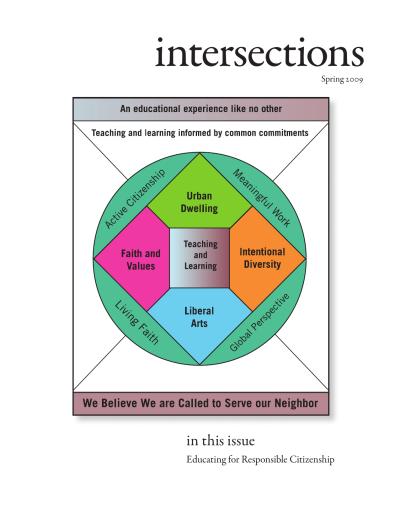
Pribbenow argues that the vocation of Augsburg College is to educate “dual citizens”—those able to live within the messiness of common work rather than resolve every tension once and for all. Drawing on John Courtney Murray on democracy as “the intersection of conspiracies,” Bill Moyers, Jean Bethke Elshtain, Stephen Carter, and the Augsburg vision statement “We believe we are called to serve our neighbor,” he names four common commitments and five principles of civic education that ground Augsburg’s incarnational mission in its city neighborhood.
-
 Article
Professing Religion
John D. Barbour
No. 37 · Spring 2013
Barbour reflects on the vocation of a Professor of Religion at St. Olaf College, asking when and how a teacher should disclose personal faith in the classroom. Drawing on his graduate teachers Anthony C. Yu and Langdon Gilkey, and on Augustine’s Confessions, Dorothy Day, Malcolm X, C. S. Lewis, and Kathleen Norris, he argues that teaching autobiography invites teaching autobiographically—and that professing religion is finally a matter of how one believes, not just what.
-
 Editorial
From the Editor
Tom Christenson
No. 12 · Summer 2001
Christenson introduces three pieces from the summer 2000 Vocation of a Lutheran College Conference at Dana College—noting that Leonard Schulze was asked to keynote before becoming executive director of DHES—and recommends Peter C. Hodgson’s God’s Wisdom: Toward a Theology of Education and Douglas Sloan’s Faith and Knowledge: Mainline Protestantism and American Higher Education for their accounts of how faith and knowledge have been dissociated in modern higher education and what it might take to recover their connection.
-
Editorial
From the Publisher
Mark Wilhelm
No. 35 · Spring 2012
Wilhelm describes the “four-legged stool” supporting ELCA higher education—the annual Vocation of a Lutheran College Conference, the Lutheran Academy of Scholars, the Thrivent Fellows program, and Intersections—and argues that the conversation about Lutheran mission and identity must now be extended beyond college and university personnel to the larger church and community before the gains of a generation are lost.
-
 Article
"Faithful Nones" and the Importance of a Rooted and Open Pedagogy
John Eggen
No. 49 · Spring 2019
Drawing on a student survey from his D.Min. thesis at Midland University, Eggen identifies a distinctive subset of religious “nones” — the “faithful nones” — who reject institutional religion yet retain substantive beliefs and practices, and argues that the non-binary, third-path pedagogy commended by Rooted and Open is uniquely positioned to engage a generation that has disambiguated faith, religion, and spirituality.
-
 Editorial
From the Editor
Tom Christenson
No. 10 · Fall 2000
Christenson recommends the St. Olaf 125th-anniversary volume Called to Serve—edited by Pamela Schwandt with Gary de Krey and L. DeAne Lagerquist—particularly Walter Sundberg’s “What Does It Mean To be Lutheran?” and Darrell Jodock’s “The Lutheran Tradition and the Liberal Arts College.” He notes that the volume’s biographical sketches of Lars Boe, F. Melius Christiansen, Ole Rolvaag, Emil Ellingson, Agnes Larson, John Berntsen, Arne Flaten, and Howard and Edna Hong show, against an outsourcing age, that the life of an institution like St. Olaf is the committed life of the people who work there.
-
Article
Building a Third Space in the Age of AI: A Conversation with Dr. Walter Earl Fluker
Elizabeth Kubek
No. 62 · Fall 2025
11 min audio
Prompted by AI chatbots being marketed to students as a safer alternative to messy human relationships, Kubek interviews Fluker on how Howard Thurman’s vision of common consciousness, somaesthetics, and nature-rooted learning offers educators a “third space” alternative to AI’s hall of mirrors.