Old and New Ideas of the Liberal Arts: A Review of Claiming Our Callings
Intersections No. 41 · Spring 2015
Claiming Our Callings: Toward a New Understanding of Vocation in the Liberal Arts (Oxford University Press, 2014) is a new collection of essays edited by Kaethe Schwehn and L. DeAne Lagerquist of St. Olaf College. The book is a valuable contribution to the national conversation about vocation and liberal education. It will be a particularly useful resource for faculty and administrative leaders working at Lutheran colleges, or at other colleges with dynamic and evolving religious affiliations and openness to faith, as they attempt to explain the complexity and depth of their missions to new faculty and other curious people.
The thirteen essays, all written by men and women teaching or otherwise serving at St. Olaf, illustrate the ways that faculty members of varying generations and disciplines have come to know their callings, and attempt to live them authentically every day, especially in the company of interested students. As professors of English and Education at another Lutheran college, Augustana College (Rock Island), and a married couple with the habit of talking shop at dinnertime, we find ourselves wanting to enter into discussion or even debate with some of these writers. Yet, at bottom, we would be thrilled to see our own college-age kids enrolling in any of these professors’ classes. We wish we could take a few of their classes ourselves. All of the essays in this book, including Schwehn’s Introduction and Lagerquist’s Afterword (which she co-authored with the late James Farrell) are thoughtful, sincere, and learned without being pretentious. All of the essays demonstrate a deep commitment to excellent teaching.
Many of the essays justify the book’s promise to journey “toward a new understanding of vocation” (our emphasis). The idea of vocation or calling is very old. So is Luther’s widening of the idea when he declared that all believers, not just prospective priests and nuns, need to listen for God’s call to their work and other daily joys. What is new for every generation is the creative task of loving the world and healing its wounds, even as that world changes, sometimes (as now) very rapidly. Claiming Our Callings reflects a changing curriculum, showing how consumerism, sustainability ethics, Buddhist meditation techniques, Eastern philosophies of peace and justice, and other non-traditional or non-Western ideas have now become typical and compelling issues in college classrooms. More established ideas get attention too. Donna McMillan (Psychology) reminds us that in discerning our vocations we can be challenged by our own powers of psychological denial. John Barbour (Religion) suggests that professors might help students to reflect on their faith lives by speaking about our own in non-coercive ways. He describes compellingly how this careful balancing act is possible for the willing professor.
Hovering over the book is a real worry: Are the liberal arts losing viability in an economy creating few attractive jobs? Is the never-ending tension on our campuses between idealistic mission and urgent marketing needs tipping the wrong way? Are we beginning to tell our students and their families half-truths about our commitment to their professional skills only, over-selling our assistance in helping them to secure remunerative jobs? These are not entirely new worries. As Schwehn writes in her introduction, even in the nineteenth century, “some Protestant schools maintained a traditional focus on contemplation, character-building, and coherence across disciplines” while “other schools chose to emphasize knowledge over character, specialization over synthesis, and individual advancement over communal service.” This book is mostly about faculty tending the idealistic mission, St. Olaf’s commitment to the phrase, “life is not a livelihood.” Economist Mark Pernecky reminds us that you have to make money before you can give it away, but most of the essayists place more emphasis on students making meaning in all aspects of their lives.
“Most of the essayists hope that we all might turn away from comfortable models of success in the consumer society to models that are more demanding and difficult and even dissenting.”
Most of the essayists hope that we all might turn away from comfortable models of success in the consumer society to models that are more demanding and difficult and even dissenting, and that our careers will be seamlessly connected to our faith (in whatever God or meaning-making system) and other deep commitments.
DeAne Lagerquist (Religion), the book’s co-editor, lays the foundation for the book’s Lutheran and interfaith character. She sees her teaching and understanding of vocation emerging from Luther’s and Bonhoeffer’s theologies, especially their paradoxical claim that we die to ourselves in order to love the neighbor. Her essay might be read annually by leaders on every Lutheran campus, as a reminder of the reasons that we foster theological literacy, “not,” she reminds us, “as an effort to change students’ beliefs, but rather as a long-term goal that entails being articulate about one’s own deepest commitments, being in compassionate conversation with others, and collaborating for the good of the world, even with those whose commitments are different from one’s own.”
Our other favorite essays were those that read more like published memoirs and impersonal histories. We particularly enjoyed reports of actual interactions with students, where teaching ideas and philosophies were tested. Anthropologist Thomas Williamson writes elegantly, his essay describing lively class discussions. He helps his students to learn, through illustrative stories about his friends’ professional and personal journeys, how little the college majors we choose have to do with leading meaningful lives. (We had thought that the “major as destiny” myth was mostly an Augustana problem, and now not only feel better, but have Williamson’s methods to imitate as well.) Biologist Kathleen L. Shea opens with sincere generalities about “ecological science and … sustainable use of our environmental resources,” but then vividly describes the various ways that Oles (readers are obliged to learn the local jargon) change campus ecologies. They learn how to plant and tend thriving trees, lead elementary school groups through the St. Olaf Natural Lands, protect seedling trees from marauding deer, build dikes and dig up drain tile to restore wetlands, and grow and sell produce to the food service provider. Some encounter life-changing realities in Costa Rica, but most learn to love the natural world right on campus.
Historian Jim Farrell’s essay is a fitting memorial to his good work and good life. As his essay reports, he helped students to understand that consuming goods and services is heavy, taxing work. He argues that we may choose this work, or, in the interest of a damaged planet and the unemployed and poorly housed, we may choose to limit consuming in our lives. “You don’t need to be religious to consume less,” Farrell writes, “as the number of ‘downshifters’ in American culture shows, but most of the world’s religions also provide frames in which less consumption involves more meaning.” Through his essay and other effects of his life, Farrell’s good teaching continues.
“As our college leaders struggle with demographic and economic realities, they have to respond to those who exert career-minded pressure, from parents to boards to campus colleagues.”
The Afterword suggests that Claiming Our Callings is “not merely a local [book] about parochial particulars,” but there is a parochial flavor to any book composed exclusively by faculty of one college. The faculty’s pride in their college is often on display, and local traditions and locutions sprinkle the essays. That strikes us as justified—we are notorious for noisily loving our college too—but perhaps it does wrongly hint to readers that the book’s concerns are not widely relevant.
Clearly, Oxford University Press believes that this book has a wide audience, that it is no St. Olaf festschrift. We agree. We see ourselves pulling the book down from the shelf from time to time, to suggest an essay to a new colleague, or to try out a good teaching idea. Since our colleges are often better at acculturating new faculty into momentary campus disputes than to our enduring missions, this book would be excellent reading for new faculty at similar colleges. But really, anyone on a liberal arts campus can benefit from the book. As our college leaders struggle with demographic and economic realities, they have to respond to those who exert career-minded pressure, from parents to boards to campus colleagues. Here is a book that speaks another message we all need to hear, with force and in detail. The essayists in Claiming Our Callings remind us that we learn alongside the students, that we care about the whole lives that they will lead, that we know our world cries out for justice and healthy change. We and our students get to be agents of that change, even as we attempt to live out the old idea of the liberal arts.
-
 Editorial
From the Publisher
Mark Wilhelm
Wilhelm celebrates the leadership of ELCA colleges and universities within American higher education — from presidential service in major higher-education agencies to recognized leadership in global education and interfaith understanding — and lifts up the health of the ELCA network of schools as a church-related community that maintains shared identity while living as good citizens of the larger academy.
-
Editorial
From the Editor
Jason A. Mahn
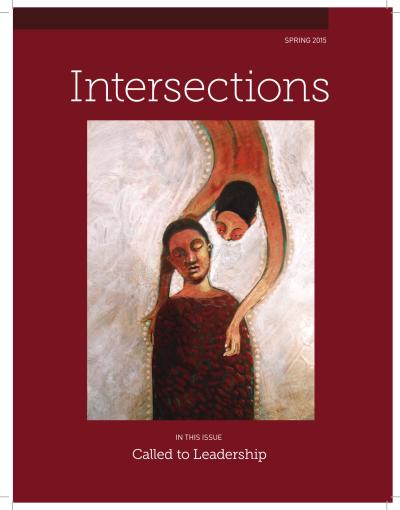
Mahn introduces the “Called to Leadership” issue by worrying that training for leadership has become so ubiquitous in higher education as to be nearly meaningless, and recovers Luther’s sense of leadership as service — a calling to be a “slave” whose learning, power, and wisdom belong to the unlearned, the oppressed, and the foolish — as the shared mission of Lutheran colleges to train servant-leaders.
-
Article
Vocational Leadership
Darrell Jodock
Jodock proposes “vocational leadership” as a name for a distinctive educational value at the heart of a Lutheran college — one that seeks to benefit the neighbor and the community, inspires and invites others to participate in that service, and is institutionally anchored in the Lutheran concept of vocation. He unpacks twelve facets of vocational leadership and ties them to Luther’s own leadership around indulgences, public schooling, and beggary.
-
Article
Sharing Leadership within Colleges and Universities
Leanne Neilson
Building on Jodock’s framework, Neilson applies vocational leadership to the unique work environment of higher education — mission statements, faculty governance, the slow pace of consensus, and the sometimes uneasy relationships between faculty and staff — and asks how leaders, followers, and team players can create an atmosphere of mutual empowerment on Lutheran college campuses.
-
Article
Mentoring in the Academy: Of Gurus, Coaches, and Sponsors
Faith Wambura Ngunjiri
Ngunjiri urges faculty, staff, and administrators in faith-based institutions to assemble a “personal board of directors” of mentors — connectors, sponsors, taskmasters, motivators, dreamers, sages, and proofers — and reflects on how race and gender complicate mentoring in predominantly white, male-led ELCA institutions, where women and minorities must reach out to build the “cloud of witnesses” they need to thrive.
-
Article
The Dangers of "Vocation" for Students Thinking about Career
Carl Hughes
Hughes warns that Lutherans too often use “vocation” as a theologically glorified synonym for a fulfilling career — a misuse that constricts God’s call to our jobs and excludes minimum-wage workers, caregivers, and others from the dignity of calling. Recovering Luther’s expansive understanding, he argues that vocation refers first to people, not professions, and must always be bigger than any one aspect of our lives.
-
Article
Women in Leadership: Obstacles, Opportunities, and Entry Points
Susan Hasseler
Drawing on two focus-group conversations with female faculty and academic administrators at Augustana College (Sioux Falls), Hasseler traces four obstacle/opportunity themes for women in academic leadership — valuing the intellectual work of leadership, religious and cultural interpretations of gender roles, caregiving realities, and embracing a strong voice — and proposes deliberate next steps for cultivating inclusive excellence on ELCA campuses.
-
Article
Superheroes and Origin Stories: Tools to Discover and Claim One's Callings
TJ Warren
Warren argues that the “Hero’s Journey” — Joseph Campbell’s monomyth with its ordinary world, call to adventure, mentors, and return with the elixir — offers a powerful pedagogical tool for helping college students discover their origin stories and claim their callings. Drawing on Superman, Wonder Woman, and Rosa Parks alike, he invites educators to mentor students into becoming the heroes of their own lives.
-
Article
Leading from Within: Peer-Learning Consultations to Explore Our Callings and Campus Capacities for Leadership
Chris Johnson
Johnson reframes vocational leadership as “soul work” that calls for the deep mind as much as the conscious one, and offers two practices — deep listening and a modified Quaker clearness consultation — as ways for campus colleagues to listen one another into existence. Drawing on Sharon Daloz Parks, Marshall Ganz, Parker Palmer, and Mary Rose O’Reilley, he invites readers to map their stories of self, us, and now.
-
 Reflection
Meditation—Band Chapel Service, St. Olaf College
Erik Haaland
No. 7 · Summer 1999
Haaland, a St. Olaf senior, offers a brief Band Chapel meditation that defines art as “the expression of what is deeply human through the manipulation of the physical world” and defends worship—architecture, stained glass, music, eloquence—as an art form requiring our best and most sincere efforts. When the God we worship and the salvation we proclaim do not seem near, artful worship offers not propositions but something real and tangible to hold on to.
-
 Institutional Focus
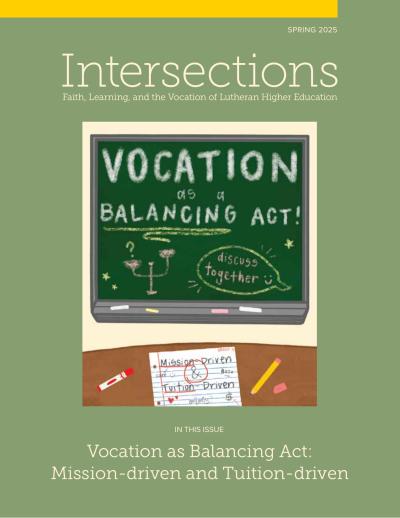
So That All May Belong: Lutheran Roots for Diversity, Equity, Inclusion, and Justice [abridged]
Altheia Richardson, Angie Hambrick, Caryn Riswold, Colleen Windham-Hughes, Deanna Thompson, Marcia Bunge, Robert Clay
No. 61 · Spring 2025
8 min audio
A condensed version of the NECU statement that consolidates Lutheran theological grounding for DEIJ and a single combined call to action for Lutheran colleges and universities — offered as a shareable summary alongside the complete document.
-
 Article
The Search for a Just Peace in a Globalized World
Munib A. Younan
No. 18 · Fall 2003
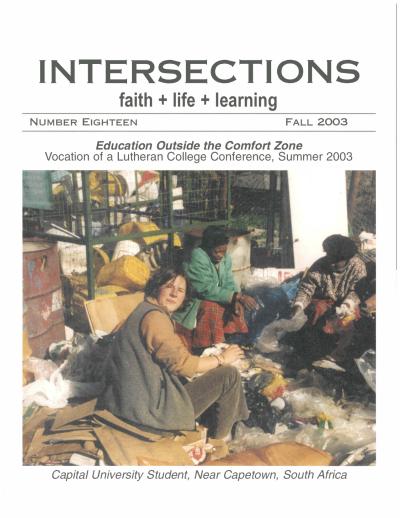
Younan, Lutheran Bishop in Jerusalem, grounds Palestinian Christian identity in Incarnation theology and a Lutheran theology of grace and the cross, then surveys the Evangelical movement’s nineteenth-century legacy in the Middle East—the 1864 Arabic Bible, ELCJ schools, women’s ordination, and the Middle East Council of Churches. Engaging Edward Said’s critique of Samuel Huntington, he calls for international and local mutual-recognition agreements (including the Jerusalem Lutheran-Anglican agreement and a Lutheran-Reformed agreement in the Middle East), four marks of interfaith dialogue, and a sharp distinction between Lutheran “Evangelical” identity and the Dispensationalist evangelistic Right whose Israel-Palestine scenarios he names a heresy. He closes by proposing concrete scholarship, faculty exchange, and sabbatical partnerships between U.S. Lutheran colleges and the ELCJ’s churches, schools, and Dar al-Kalima Lutheran Academy.
-
 Editorial
From the Editor
Tom Christenson
No. 15 · Winter 2002
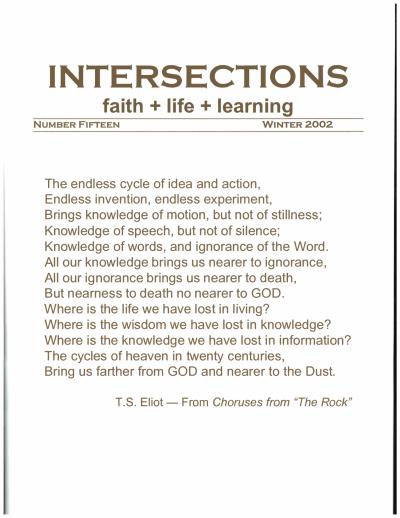
Christenson introduces an issue of varied voices—bishops and university presidents, philosophers and poets, students and their teachers—and defends the T. S. Eliot cover selection (“Where is the wisdom we have lost in knowledge?”) against the charge of being too depressing, arguing with cover artist Ida that Lutherans are realists about human accomplishments and that there is a huge difference between optimism and hope.
-
 Article
Sense of Vocation
Ruth R. Kath
No. 31 · Winter 2010
Kath describes Luther College’s Sense of Vocation program, organized into three components: General Program Initiatives (Vocation Visitors such as Parker Palmer, the Faith and Learning Workshop, self-directed reading grants, publications, and travel funds), the Church Ministry Program (Vocation Fellowships, the DIAKONOS discernment group, seminary visits, alumni discernment retreats, church leader workshops, clergy renewal, and the WIYLDE youth initiative), and the All-Student Vocation Program (Paideia I orientation, Peer Mentors, Capstone curriculum development grants, the Vocation Advising Workshop, and a Vocation Advising Handbook).
-
 Reflection
Colleges Lead Way: Curiosity, Faith, Discernment, Mission are Key
Mark S. Hanson
No. 28 · Fall 2008
Reprinted from The Lutheran (November 2007), Hanson names four marks of the colleges of this church—nurturing unquenchable curiosity, nourishing faith formation and exploration, modeling public moral deliberation, and preparing students for engagement in the world—and gives thanks for the colleges’ vocation to call us to stand outside ourselves and reach out in mission for the sake of the world.