The first month of the 2020-21 academic year was pretty horrible. The 52 year-old husband of a dear friend of mine died from cancer. Two of my cousin’s college-aged children were quarantined (separately, different colleges) with Covid-19. One of the kindest human beings I know was diagnosed with ALS; another friend’s mother received severe burns over a large part of her body in a kitchen fire; another friend’s three-year-old son has had to have two surgeries. The two-year old grandson of my sister’s next door neighbor snuck through a dog door and fell in a swimming pool and drowned. Three (or four, or five, I’ve lost count) hurricanes threatened the Gulf Coast where my daughter lives. And, of course, there are the multiple pandemics of COVID-19, racism/white supremacy, and political dysfunction. We have transitioned from living in a collective state of acute anxiety and trauma to a state of chronic anxiety and trauma. It is simply too much; compassion fatigue is setting in. Everyone I know is functioning in overdrive, trying to work from home, homeschool, plan weddings and funerals and have and care for children, and do all of this without any of the normal social support that we would rely on in a non-pandemic world. Many are no longer trying to keep their heads above water, but are struggling to hold their breath instead.
And yet, we are called to flourish.
Rooted and Open is the NECU (Network of ELCA Colleges and Universities) document that outlines the vision of vocation shared by all of the ELCA colleges and universities. Though we live out this common calling in very particular, contextual ways, we begin from the same foundation. That foundational, shared vocation is as follows: “Called and empowered to serve the neighbor so that all may flourish.” This describes both our vocation and the vocation we are called to inculcate in our students.
Called to Flourish
Several years ago, after extended conversation and a period of silent prayer, my spiritual director said to me, “I have an image of an orchid.” He paused and then went on, “It is growing through broken asphalt. And not just growing but flourishing.” He went on to explain that as this image had come to him he had argued with himself, “That can’t be. Orchids require attention and care. They don’t just grow. They certainly don’t flourish untended.” And yet, he said, the image remained. This image has stuck with me. What does it mean to flourish—especially in less than ideal circumstances?
“What does it mean to flourish—especially in less than ideal circumstances?”
In music, flourishes are extra notes; notes that are not essential or necessary to the musical piece, but that give it a little extra something, something beautiful. This is similarly true of rhetorical flourishes—clever, colorful, sometimes comedic turns of speech that are unnecessary, but improve the affective appeal of a lecture or sermon or conversation. Flourishing, in other words, is more than mere surviving. To flourish is another way of speaking of the scriptural/theological understanding of abundant life.
Flourishing—as my spiritual director noted—requires attention and care. This fall semester, Lenoir-Rhyne University, like many schools, has operated with a modified hybrid model. Every class I teach is divided in half and I get one sixty-minute class period per week of in-person instruction with each half of the class. With such a sharp reduction in instructional time (roughly one-third the time with students we had this time last year), it would be easy to hyper-focus on content in order to “get through” everything it feels like we might need to get through in a semester. Instead, I begin every class with a check-in. We remind one another of our names because, with only one hour a week together, sitting spread out, not doing any in-person small group work, and masked, I do not assume the students have had a chance to get to know one another. And then I ask a question that invites everyone to share how they are coping, and hopefully flourishing, during this strangest and most difficult semester we have ever had or even imagined.
In these conversations we have learned about the death of grandparents, the suicide of a father, and the illness of siblings. We have also learned about life-giving artistic, athletic, and spiritual practices that are nurturing and sustaining each of us, often with invitations to teach each other. (As a result of these conversations, one of my students has taught me to crochet. This has been her life-saving coping mechanism; she crochets constantly, including in class. She came to class early one day to get me started on my own, much simpler, project; she and I now spend an hour a week crocheting and talking together.)
This check-in generally takes anywhere from ten to fifteen minutes, which is a significant percentage of our hour together. But in and through these conversations, each mini-section of each class has developed into its own community. Not long ago, when I came into the classroom one student (one who serves as a pastor already in his congregation) had brought a vial of anointing oil and was showing another student how to give a blessing. Her fiancé is ill and the student-pastor wanted to help and support her. Ten or fifteen minutes a week over the course of the past six weeks has created pockets of communities of care for one another.
Called to Care
We are called to flourish and we are called to care: to care for ourselves, for one another, and for the world. These two things—flourishing and caring—are directly related to one another. Not only is the flourishing of others tied up in my caring, and my flourishing tied up in the caring of others, but my own flourishing is of a piece with my caring for others. Humans are created to live in community, caring for one another.
“Not only is the flourishing of others tied up in my caring, and my flourishing tied up in the caring of others, but my own flourishing is of a piece with my caring for others.”
Care is one of the “Core Values” at Lenoir-Rhyne University. I imagine this is the case for many of our institutions. “Care” is not an abstract idea; it is an active verb that includes self-care, compassion for others, stewardship of resources (personal and communal), and a commitment to the common good. Creating and sustaining an academic and social environment in which habits of care can be developed and nurtured is one of the ways that liberal arts universities live out their promise of educating the whole person and of transforming minds and hearts, which is also language many of us employ in our institutional mission statements.
The vision of care that our institutions embrace cannot be limited to a concern for self. The self, the individual, does matter. And we are called to be good stewards of our selves—body, mind, and spirit. But this care for self has an outward-facing orientation. A liberal arts education rooted in the Lutheran theological tradition focuses us not merely on ourselves, but also on the greater world of which we are a part.
Although Rooted and Open does not speak of care in a time of pandemic, it does remind us that we are called to prepare—and push—students for “meaningful work and active participation in just, loving communities.”
Care is meaningful work. It is a way of participating in the transformation of the world. As Lutheran institutions of higher education we are shaped by Lutheran social ethics even if we are not individually Lutherans (or even Christians). Lutheran social ethics are based on the belief that we are all called to live out our faith (whatever our specific faith commitments may be) through acts of love and service to the neighbor. Such acts create, nurture, and sustain the very communities that in turn create, nurture, and sustain us. Care transforms. It transforms us, our neighbor, and our world.
In addition to being its own meaningful work, care creates meaning. In her new book, Untamed, Glennon Doyle says, “The moral arc of our life bends toward meaning—especially if we bend it that way with all our damn might” (Doyle 34) The work of care is not always easy. It takes time, attention, and energy. But as institutions of higher education our calling to educate is not a call to fill empty heads with important facts. It is to help young adults launch as people who recognize they are capable of changing the world through their own experiences of transformation.
Martin Luther famously said that it is not God who needs our good works, but our neighbor. The Lutheran intellectual tradition is based, in large part, on a theological understanding of freedom; through Christ we are free from any legalistic requirements to earn God’s love. Because there is nothing I have to do or even can do to make God love me more, I am free to extend this same love to my neighbor. It is in this way that God extends care to all of God’s world. We are invited to be the ripples of God’s care and provision in the world.
Called to Community
I have read countless self-care articles since Covid-19 began. Most of them, rightly, include the airline/oxygen mask analogy. I am of no good to others if I do not take care of myself first. And this is, of course, true. The theological and vocational problem with the way this analogy is usually used is that it puts the emphasis in the wrong place. We aren’t called to care for ourselves before caring for others as an act of self-protection. It isn’t: “take care of yourself first and then if you are able help others.” Rather, we are called to care for ourselves so that we can extend care to others. Self-care is not an end unto itself but a means to a greater communal end. It is the act of caring that is primary.
“Even in the midst of social or physical distancing, we are interdependent.”
This past summer Lenoir-Rhyne held an online multi-disciplinary course on Covid-19 that was open to the public as well as to students. At the end of the course, some of my colleagues conducted a survey on behaviors and beliefs around public health and Covid-19. The results of this survey suggested that the more strongly someone believed that wearing a mask helped protect others, the more likely they were to wear a mask. This finding is consistent with other similar research on motivation and altruism. Despite much seeming evidence to the contrary, we are a fairly altruistic species; helping one another is written into our DNA.
We are bound together in community. Even in the midst of social or physical distancing, we are interdependent. My health depends on you and yours on me. The reality of our interdependence highlights our responsibility for one another. In North Carolina, where I live, early on in the pandemic under our stay-at-home order, which effectively shut down everything but essential businesses, including churches, a small group of churches filed a lawsuit arguing that churches should be exempt, on constitutional grounds, from the order. A federal judge sided with the churches. The churches in this case may have been legally correct that they have a constitutional “right” to gather, but there is an even stronger responsibility to act as good stewards of individual and community health.
The ELCA has a rich tradition of writing social statements, which are teaching and policy documents that cover a wide range of social and ethical issues. In 2003 the ELCA approved a statement on health and healthcare, “Caring for Health: Our Shared Endeavor.” This document articulates that Lutheran Christians are compelled by both love and justice and that “Achieving these obligations of love and justice requires sacrifice, goodwill, fairness, and an abiding commitment to place personal and social responsibilities of love and justice above narrower individual, institutional, and political self-interests” (ELCA 20). Our institutional commitments to justice move us beyond care for ourselves and our insistence on our own rights. They lead us to focus on the neighborhood ecology, the common good, of which we are a small part.
To be in community is to be gifted through and through. In his article, “Gift and Calling,” Darrel Jodock stresses the recognition of our own giftedness. All that I am and all that I have is gift. This includes the myriad communities of which I am a part. Referring to our calling to share our gifts with others, “to become absorbed in the needs of others” (Jodock 11), Jodock says, “This notion that gifts come to us from God through others has a corollary—and this is that God’s gifts reach others through us. Not only are others the channels and means whereby we receive gifts, but we are called to be the channels and means whereby gifts reach others. Our giftedness yields a task, a calling” (12).
Martin Luther lived through a global pandemic of the bubonic plague in 1527 in Wittenberg, Germany. During this plague Luther and his wife, Katie, opened up their home to those who were sick and in need of care. Luther argued that it was his duty—and the duty of all—to do all what one could to improve the circumstances of one’s community.
Concluding Reflections
We are called to use our gifts in care for one another, for our communities, and for the world, that all may flourish. Perhaps it is hard to recognize flourishing in this time of pandemic, but it is all around us. As I was working on this article, I posed the question on Facebook, “where have you witnessed flourishing during Covid-19?” I received all manner of answers: more time spent learning skills and hobbies, gardening, deepened relationships, churches learning to create genuine online community, even leaders of non-profits (which I expected to be suffering right now) who see flourishing in the quality and depth of the relationships within their communities. One of my students whose grandfather died early in the semester shared with me how grateful she was to have had the time during the pandemic to eat ice cream with him every night. Every night. It’s an extra “flourish” that she would not have taken the time for in a pre-Covid world. And though her grandfather died, their relationship was given space to flourish in his final months.
“Perhaps it is hard to recognize flourishing in this time of pandemic, but it is all around us.”
Flourishing is more than surviving; it is more than just getting by. But it ends up that what we need to flourish might not be all that complex. We are called to active care of and for ourselves, our communities, and the world. It is hard and meaningful work, but it isn’t complicated.
Works Cited
Doyle, Glennon. Untamed. Dial Press, 2020.
ELCA (Evangelical Lutheran Church in America). “Caring for our Health: Our Shared Endeavor,” 2003. Accessed 1 Nov. 2020, https://download.elca.org/ELCA%20Resource%20Repository/HealthSS.pdf?_ga=2.154648568.1396986931.1604289261-423594126.1604289261
Jodock, Darrell, “Gift and Calling: A Lutheran Perspective on Higher Education.” Intersections 34 (Fall 2011):10-16.
NECU (Network of ELCA Colleges and Universities). “Rooted and Open: The Common Calling of the Network of ELCA Colleges and Universities.” Accessed 1 Nov. 2020, http://download.elca.org/ELCA%20Resource%20Repository/Rooted_and_Open.pdf
-
 Editorial
From the Publisher
Mark Wilhelm
Wilhelm argues that the “hackneyed” expressions of higher education — “you are not just a number,” “the college experience,” “risen to the challenge” — tell the simple truth about NECU institutions even as the Covid-19 pandemic has pushed budgets, employees, and campus life to the breaking point.
-
Editorial
From the Editor
Jason A. Mahn
Mahn narrates a year of crisscrossing pandemics — Covid-19, economic collapse, partisan politics, and the long pandemic of white supremacy revealed anew by the murder of George Floyd — and argues that Lutheran liberal arts schools, by educating for vocation, are uniquely poised to help students respond with character and capable callings.
-
Article
A New Image for an Ancient Call: Lutheran Higher Education Amidst Pandemics Today
Caryn Riswold
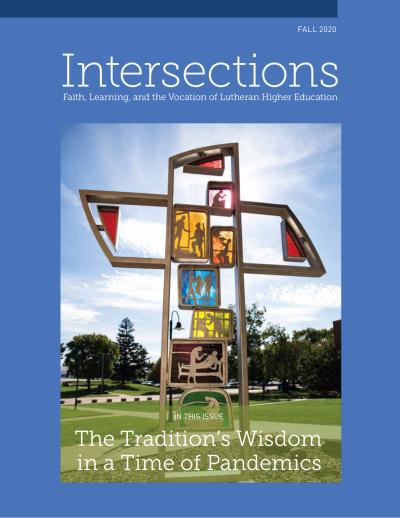
Pairing Wartburg’s Lebenskreuz sculpture with the Matthew 25 acts of mercy and the commitments of Rooted and Open, Riswold reads the calls to feed the hungry, welcome the stranger, and care for the sick as urgent summons for Lutheran higher education in a year of overlapping pandemics — and as a call to dismantle the structures that produced them.
-
Article
Learning from Luther on Covid-19
Carl Hughes
Reading Martin Luther’s 1527 treatise “Whether One May Flee from a Deadly Plague,” Hughes finds practical and spiritual guidance for a pandemic age: serve the neighbor, follow medical experts, honor those whose vocations put them at risk, and trust that even when we fail, God will not abandon the community.
-
Article
Radical Hospitality on Haunted Grounds: Anti-Racism in Lutheran Higher Education
Krista E. Hughes
Writing from Newberry College’s campus on land once home to the Cherokee and within a day’s drive of Mother Emanuel A.M.E., Hughes argues that NECU’s call to “practice radical hospitality” demands that predominately white institutions open themselves to the hauntings of racism — pursuing belonging rather than mere welcome, and risking kenotic transformation of institutional identity itself.
-
Article
Activism, Justice, and the Danger of Silence
Dezi Gillon
In conversation with Jason Mahn, Augustana College alumnux Dezi Gillon traces the call to action they felt as a Black student organizing for Black Lives Matter on a predominately white campus — through seminary, art, spirituality, and restorative justice work — and warns white professors that staying silent “actually speaks volumes.”
-
Article
Leadership in Lutheran Key at a Time of Pandemics
Deanna Thompson
Thompson draws on Luther’s theology of the cross and Shelly Rambo’s theology of trauma to sketch a Lutheran model of leadership for a season of pandemics — one that is attentive to pain, responsive to need, and intentionally nourished by food, friends, and deep conversation.
-
Article
Through Truth to Freedom—by Way of Reconciliation
Paul C. Pribbenow
Reflecting on Augsburg’s 150th-anniversary motto “Through truth to freedom,” Pribbenow argues that in a season of three pandemics — pandemic illness, economic collapse, and the racial sin laid bare by the murder of George Floyd — higher education’s most authentic work is to educate for truth and freedom by way of confession and reconciliation.
-
Article
Finding Purpose in Chaos: Reflection In and Beyond the Public Health Classroom
Lena R. Hann
When the pandemic hit her new public health professionalism course, Hann recalibrated her teaching from the “how” of professional preparation to the “why” of vocational reflection — and recounts how Augustana public health students and alumni found purpose in the chaos through food banks, disaster response, palliative care, and research on health inequities.
-
Reflection
The Long Pilgrimage of 2020-21
Kara Baylor
Drawing on Martha Stortz’s definition of pilgrimage as “intentional dislocation, for the sake of transformation, where the body teaches the soul,” Baylor invites students and educators worn out by the 2020-21 academic year to ask what is essential, to listen to what their bodies are telling their souls, and to be more open to the transformations the dislocation might still yield.
-
Article
Called to the Moment: A New Vocation for Lutheran Colleges
W. Kent Barnds
After a derecho ravaged Iowa in August 2020 and Pastor Katy Warren preached on 1 Peter 4, Barnds watched line workers, neighbors, and Augustana colleagues simply show up where they were needed — and proposes that the true vocation of a Lutheran college may be making the case for “meeting immediate need with a deep willingness” alongside the longer work of vocational discernment.
-
 Institutional Focus
Putting Principles into Practice: An Interview with Kenneth Foster about Concordia's Sustainability Council
Kenneth Foster
No. 36 · Fall 2012
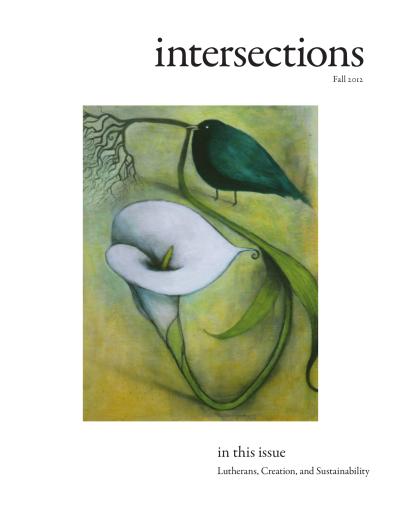
Foster, chair of Concordia College’s President’s Sustainability Council, describes the Council’s formation under President William Craft in 2011 as a re-energization of stalled task-force work, its coordination with grass-roots campus initiatives, and its strategy of moving from principles to practice in stewardship of natural resources at a Lutheran liberal arts college.
-
 Article
A Church, the Human Condition, and the Fissured Face of Peace
D. M. Yeager
No. 22 · Spring 2006
Yeager, a member of the ELCA Task Force for Studies on Sexuality, reflects on lessons for the church’s educational mission in the wake of the 2005 Churchwide Assembly. Drawing on Macquarrie’s The Concept of Peace, Polanyi on the personal coefficient of knowledge, Hannah Arendt’s The Human Condition, and responses to the task force report from Roy Harrisville III and Larry Rasmussen, she proposes “the fissured face of peace”—peace as the absence of hostility rather than disagreement—and maps how Arendt’s five conditions of human existence (life, earth, natality, mortality, worldliness, plurality) might shape Lutheran colleges’ curricula in history, epistemology, and the sociology of knowledge so that graduates can disagree without hostility and embrace the slow work of reformation.
-
 Editorial
From the Publisher
Mark Wilhelm
No. 31 · Winter 2010
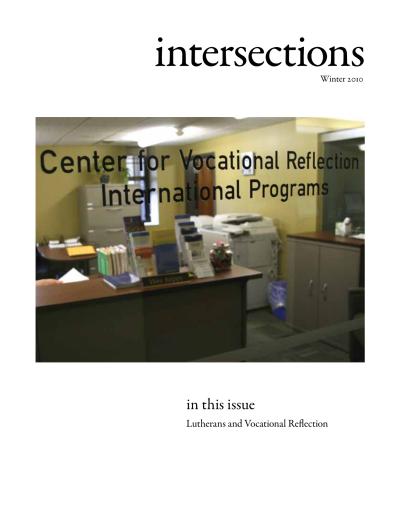
Wilhelm traces his decades-long enthusiasm for the Lutheran doctrine of vocation from his St. Olaf days reading Luther’s Open Letter to the German Nobility, notes Parker Palmer’s lecture-circuit ministry and Mark C. Taylor’s reflections on calling, and argues that ELCA colleges should claim vocation as the defining mark of Lutheran higher education—yet warns that vocation risks becoming “the program du jour” rather than a permanent hallmark.
-
 Book Review
Richard T. Hughes: How Christian Faith Can Sustain the Life of the Mind
Tom Christenson
No. 13 · Winter 2002
Christenson reviews Richard Hughes’s How Christian Faith Can Sustain the Life of the Mind (Eerdmans, 2001), which argues, drawing on Tillich’s notion of “religion breaking through its own particularity,” that faith is a means to the open pursuit of truth rather than its enemy. Christenson reads the argument as a natural fit for a Lutheran tradition of semper reformanda but notes Luther’s own dogmatism toward fellow reformers, and wishes Hughes had drawn a sharper line between an absolute truth that relativizes all human truths and a postmodern abandonment of truth altogether. The book was the most-cited title at the November meeting of North American Lutheran academic officers.
-
 Article
'In, With, and Under:' The Tradition and the Teaching of Christian Ethics
Pamela K. Brubaker
No. 17 · Summer 2003
Brubaker describes how she teaches Introduction to Christian Ethics at California Lutheran University—a religiously diverse classroom where about 30% of students are Lutheran, 30% Roman Catholic, and many are “unchurched”—as a community of moral discourse rooted in the Lutheran dialectic of faith and reason. Drawing on Larry Rasmussen and Bruce Birch, Elizabeth Bettenhausen, Roger Crook, and Robert Benne’s typology of “Hot and Cool Connections” between church and politics, she walks through her course’s units on human sexuality, economic life, and war and peace—including the Bomb Shelter simulation, a mock Disney stockholders meeting on sweatshops, and a Congressional hearing on the School of the Americas—to show how ELCA social statements function as case studies in critical inquiry and education for citizenship.
-
 Editorial
From the Editor
Tom Christenson
No. 10 · Fall 2000
Christenson recommends the St. Olaf 125th-anniversary volume Called to Serve—edited by Pamela Schwandt with Gary de Krey and L. DeAne Lagerquist—particularly Walter Sundberg’s “What Does It Mean To be Lutheran?” and Darrell Jodock’s “The Lutheran Tradition and the Liberal Arts College.” He notes that the volume’s biographical sketches of Lars Boe, F. Melius Christiansen, Ole Rolvaag, Emil Ellingson, Agnes Larson, John Berntsen, Arne Flaten, and Howard and Edna Hong show, against an outsourcing age, that the life of an institution like St. Olaf is the committed life of the people who work there.