This essay takes concepts from the previous article by Darrell Jodock and applies them to the college or university setting. I address the unique aspects of higher education to help understand how to create an environment for vocational leadership, starting at the institutional level, and then drilling down to individual roles.
Jodock referred in his article to what Ronald Heifetz calls “moving to the balcony”—stepping back to view the whole. Practicing vocational leadership in colleges and universities requires that we move to the balcony and focus on the mission and purpose of our institutions.1
Mission and Purpose of Lutheran Colleges and Universities
Mission statements are meant to guide institutions; what is more, vocational leadership should be tied to the mission. The mission statement of ELCA colleges and universities are readily available online. Read through some of these statements—including that of your own college or university—and think about the following questions:
- How do these mission statements articulate the institutions’ Lutheran identity and the concept of vocation?
- The vocation of a Lutheran college or university responds to the needs of its specific community. How do these mission statements articulate service to the neighbor and the community?
- How does your institution live out its mission?
- In your own work, how do you connect to, or support, your institution’s mission statement?
Of course, mission statements are not unique to higher education. All types of organizations have mission statements. To be effective leaders and to encourage vocational leadership within higher education we have to look beyond the mission statement and understand some of the unique aspects of the work environment in higher education.
If you have worked both in higher education and also in an organization outside of higher education, then you are well aware of significant differences between higher education and corporations. Some differences include:
- Differing work environments and expectations of faculty and staff;
- Faculty governance systems;
- The use of committees and consensus-seeking, which slow decision-making processes;
- Close contact—and sometimes uneasy relationships—between faculty and staff.
The issue of faculty and staff relationships warrants further discussion. In his article, Jodock writes that “vocational leadership values a person’s colleagues enough not to manipulate. It works best when it can draw on relationships of trust.” To practice vocational leadership we have to find ways to create safe and trusting environments, which includes the relationships between faculty and staff.
Between Faculty and Staff
There is a tendency among some faculty to be unaware of the way they treat staff. There are situations at my institution where faculty and staff have been placed into a working relationship on a particular project, and the staff members have felt that faculty were disrespectful. Staff members have reported feeling disregarded and ignored, and felt that they were treated as if they are less important than faculty. Sometimes this comes from reactions to faculty being overly critical.
Faculty members are very good at probing, questioning and analyzing. It is natural for some faculty members, when ideas are presented, to immediately criticize and find fault. They question and resist accepting anything at face value. In situations where staff and faculty are placed in the same room to solve an issue or have a discussion, faculty members make good use of their critical minds. That can lead to staff perceiving faculty to be abrasive, rude, and critical. And of course, they are critical because that is what they are trained to be. This cultural difference needs to be understood for faculty and staff to learn to work together. When a faculty member becomes critical of an idea, it is important not to take it personally. Sometimes the feeling of disrespect that staff members report is because of this difference in how staff and faculty approach an issue. Other times it may be due to a true lack of respect that faculty unfortunately can have toward staff, based on differences in power and education.
If you are a faculty member and you don’t think this happens at your institution, then you are challenged to be more mindful, and to make an effort to more closely observe interactions. You might ask some of the staff leaders on your campus about their experiences and observations.
Another issue related to faculty and staff relationships shows a lack of respect in the other direction. It is not uncommon to hear staff members make derogatory comments about faculty related to their schedules. Looking at faculty schedules listed on their office doors might give a wrong impression because the schedules tend to only indicate class times and office hours. What is not listed is the time spent prepping for classes, keeping up with their discipline, grading papers, and serving in various roles on campus. Staying up until midnight grading papers doesn’t show up on the schedule posted on the door. Faculty members do have more flexible work hours, and that can be enviable to staff who have to report in at 8:00 AM every day, twelve months of the year.
To create an environment for vocational leadership, these disrespectful comments and actions between faculty and staff must be addressed and changed. Consider the following questions:
- Are there examples of times when you have observed staff or faculty at your institution being disrespectful of each other?
- How might we create an environment of trust and respect among faculty and staff, or other groups on campus?
Leaders, Followers, and Team Players
Incorporating vocational leadership into our work means that we need to focus on individual roles and recognize the importance of support systems. We all play a variety of roles in our work. Sometimes we’re in a leadership capacity, whether it is a formal leadership role of supervising others or teaching a class. Sometimes it is less formal—it might be leading an activity or project. All of us are also followers. We all have someone to whom we report, and we also take on a follower role in various activities. In any given day, it is possible to go back and forth between leading, following, and being a team player.
If vocational leadership creates an atmosphere that is mutually empowering, then we need to consider how to both support and empower those who lead, and also how to take feedback from those who follow.
Consider the following questions:
- How can you support those who lead? How can you empower those in leadership roles?
- How can those who follow support you? What can you do to encourage their support?
- What will get in the way of this happening?
Imagine what it would be like if everyone at your institution tried to create this environment of mutual support!
Vocational leadership starts with using your mission statement, guiding your institution to “move toward the balcony,” and creating a common understanding of serving the neighbor and the community. It requires that we understand the unique aspects of higher education including relationships between faculty and staff. Finally, it means looking for ways to support those who lead and to encourage feedback from others.
Endnotes
1. Special thanks to Darrell Jodock for preparing the outline that the author used for this presentation at the 2014 Vocation of a Lutheran College Conference.
-
 Editorial
From the Publisher
Mark Wilhelm
Wilhelm celebrates the leadership of ELCA colleges and universities within American higher education — from presidential service in major higher-education agencies to recognized leadership in global education and interfaith understanding — and lifts up the health of the ELCA network of schools as a church-related community that maintains shared identity while living as good citizens of the larger academy.
-
Editorial
From the Editor
Jason A. Mahn
Mahn introduces the “Called to Leadership” issue by worrying that training for leadership has become so ubiquitous in higher education as to be nearly meaningless, and recovers Luther’s sense of leadership as service — a calling to be a “slave” whose learning, power, and wisdom belong to the unlearned, the oppressed, and the foolish — as the shared mission of Lutheran colleges to train servant-leaders.
-
Article
Vocational Leadership
Darrell Jodock
Jodock proposes “vocational leadership” as a name for a distinctive educational value at the heart of a Lutheran college — one that seeks to benefit the neighbor and the community, inspires and invites others to participate in that service, and is institutionally anchored in the Lutheran concept of vocation. He unpacks twelve facets of vocational leadership and ties them to Luther’s own leadership around indulgences, public schooling, and beggary.
-
Article
Mentoring in the Academy: Of Gurus, Coaches, and Sponsors
Faith Wambura Ngunjiri
Ngunjiri urges faculty, staff, and administrators in faith-based institutions to assemble a “personal board of directors” of mentors — connectors, sponsors, taskmasters, motivators, dreamers, sages, and proofers — and reflects on how race and gender complicate mentoring in predominantly white, male-led ELCA institutions, where women and minorities must reach out to build the “cloud of witnesses” they need to thrive.
-
Article
The Dangers of "Vocation" for Students Thinking about Career
Carl Hughes
Hughes warns that Lutherans too often use “vocation” as a theologically glorified synonym for a fulfilling career — a misuse that constricts God’s call to our jobs and excludes minimum-wage workers, caregivers, and others from the dignity of calling. Recovering Luther’s expansive understanding, he argues that vocation refers first to people, not professions, and must always be bigger than any one aspect of our lives.
-
Article
Women in Leadership: Obstacles, Opportunities, and Entry Points
Susan Hasseler
Drawing on two focus-group conversations with female faculty and academic administrators at Augustana College (Sioux Falls), Hasseler traces four obstacle/opportunity themes for women in academic leadership — valuing the intellectual work of leadership, religious and cultural interpretations of gender roles, caregiving realities, and embracing a strong voice — and proposes deliberate next steps for cultivating inclusive excellence on ELCA campuses.
-
Article
Superheroes and Origin Stories: Tools to Discover and Claim One's Callings
TJ Warren
Warren argues that the “Hero’s Journey” — Joseph Campbell’s monomyth with its ordinary world, call to adventure, mentors, and return with the elixir — offers a powerful pedagogical tool for helping college students discover their origin stories and claim their callings. Drawing on Superman, Wonder Woman, and Rosa Parks alike, he invites educators to mentor students into becoming the heroes of their own lives.
-
Article
Leading from Within: Peer-Learning Consultations to Explore Our Callings and Campus Capacities for Leadership
Chris Johnson
Johnson reframes vocational leadership as “soul work” that calls for the deep mind as much as the conscious one, and offers two practices — deep listening and a modified Quaker clearness consultation — as ways for campus colleagues to listen one another into existence. Drawing on Sharon Daloz Parks, Marshall Ganz, Parker Palmer, and Mary Rose O’Reilley, he invites readers to map their stories of self, us, and now.
-
Book Review
Old and New Ideas of the Liberal Arts: A Review of Claiming Our Callings
David Crowe, Katie Hanson
Crowe and Hanson review Claiming Our Callings: Toward a New Understanding of Vocation in the Liberal Arts (Oxford 2014), a collection of thirteen essays by St. Olaf faculty edited by Kaethe Schwehn and L. DeAne Lagerquist. They commend the book’s thoughtful, sincere engagement with consumerism, sustainability, Buddhist meditation, and Lutheran-Bonhoefferian theology — and recommend it for any liberal arts campus pulled between idealistic mission and career-minded pressure.
-
 Editorial
Guest Editor
Madeleine Forell Marshall
No. 25 · Spring 2007
Marshall introduces the four papers in this issue from the 70th annual meeting of the Association of Lutheran College Faculties, held at California Lutheran University in October 2006 on the theme “Identity and Diversity in the Lutheran College.” She notes a geographic pattern—the two East Coast contributors (Balmer and Bailey) defend Christian liberal arts against perceived suspicion, while the two Westerners (Marichal and Brubaker) treat Lutheran identity as advantage and diversity as a Lutheran given—and announces the 2007 ALCF meeting at Newberry College on “Beyond ‘Whatever’: Values Based Learning in Lutheran Higher Education.”
-
 Editorial
From the Publisher
Arne Selbyg
No. 24 · Fall 2006
Selbyg situates this issue in the ongoing ELCA conversation about education that began with the 2005 conference and is feeding into the second draft of the ELCA Social Statement on Education, previews the 2007 conference (“The Vocation of a Lutheran College — Engaging the World”) at Augustana College, Rock Island, and lifts up Luther’s insistence that the church and its members contribute to their wider communities rather than retreat into self-centered enclaves.
-
 Response
Feeling at Home: Dimensions of Faculty Life
Jane Hokanson Hawks
No. 2 · Winter 1997
Hawks of Midland Lutheran College responds to Bouman by reflecting on her path from a Lutheran childhood through the BSN at St. Olaf and thirteen years at four non-church-related institutions to her present home at Midland, where teaching at a Lutheran institution finally feels “right.” Bouman’s framing of the five themes as the Lutheran argument about what it means to be human helped her ad-hoc committee articulate the spiritual role in Midland’s new faculty mentoring program (recently funded by the Lilly Foundation), and grounds her work as a nurse educator confronting the daily humanness of grief, joy, ethical dilemmas, and care across cultural and religious difference.
-
 Article
The Lutheran Calling in Education: Context and Prospect
Paul J. Dovre
No. 23 · Summer 2006
Dovre, President Emeritus of Concordia College and co-chair of the ELCA Task Force on Education, undertakes three tasks: focusing on the current social context (young people’s spiritual lives, the state of mainline denominations, the family map, schools, communities, and higher education); reflecting on why Lutherans care about education (creation in God’s image, vocation, Luther’s legacy, the priesthood of all believers, civic righteousness, and hope); and considering the prospects and possibilities for addressing the calling (biblical, confessional, theological, and pedagogical legacies; the renewal of apostolic ministry, the Christian-college renaissance, K–12 reform, and the congregational education explosion).
-
 Reflection
David Kamins
David Kamins
No. 40 · Fall 2014
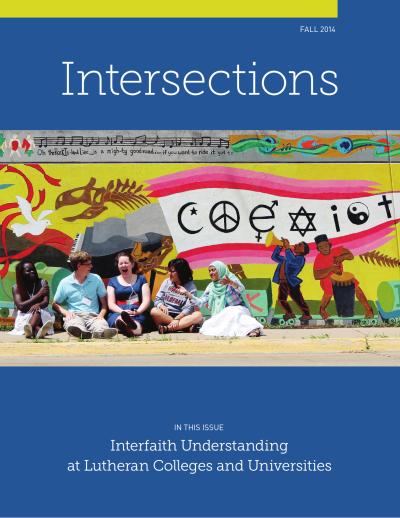
Kamins, a Jewish student at Muhlenberg College, reads Rabbi Joseph Soloveitchik’s The Lonely Man of Faith alongside his own journey at the Interfaith Understanding conference on the eve of Shavuot, finding in the dual figures of Adam I and Adam II a way to remain firmly grounded in his faith community while going out to learn from those around him.
-
 Editorial
From the Publisher
Arne Selbyg
No. 21 · Summer 2005
Selbyg notes that ELCA colleges and universities have remained more loyal to the church than the institutions of many other denominations and announces that with this issue Tom Christenson’s nine-year service as editor of Intersections comes to an end, with Bob Haak of Augustana College in Rock Island assuming the editorship and institutional support shifting from Capital to Augustana.