Beyond Deep Gladness: Coming to Terms with Vocations We Don’t Choose
Intersections No. 58 · Fall 2023
Those of you attending this conference know well that our Lutheran-affiliated colleges and universities encourage students, staff, and faculty to reflect on the topic of vocation in ways that encompass many of the really big questions of life—questions of meaning, purpose, and calling. Many of you also likely know that one of the definitions of vocation that has become ubiquitous at our institutions comes from the writings of theologian, minister, and novelist Frederick Buechner. According to Buechner, the kind of work to which we tend to be called is the kind of work (a) that you need most to do and (b) that the world most needs to have done. So vocation, according to Buechner, is the place where your deep gladness and the world’s deep hunger meet.” Buechner’s definition has become synonymous with the word “vocation” for so many over the past several decades: our vocation is located at the intersection of our deep gladness and the world’s deep hunger. I imagine it has been a sweet spot for many of us—our calling being the place where our passions, our joy, our gifts can be put to work in service of the suffering and needs of the world. And when all of these converge, we flourish.
Lutheran scholars have applauded the ways in which Buechner’s definition of vocation is not just focused on the self. In Lutheran thought, vocation is never just about you—or me. It’s always about who we are—and who we are becoming—in and through our relationships. But scholars have also pointed out that the focus on vocational gladness may sometimes be in tension with the Lutheran vocational commitment to “serve the neighbor in love.” In other words, sometimes we’re called to vocations we’d rather not do. Sometimes being accountable to our students and our colleagues does not result in gladness. Living out our vocations is not just about gladness but can involve challenge, deep sadness, and vocations we didn’t choose. My talk this morning will be focused on a more expansive definition of vocation that includes sadness as well as gladness.
“Living out our vocations is not just about gladness but can involve challenge, deep sadness, and vocations we didn’t choose.”
But isn’t a focus on vocation and sadness kind of a downer for the last keynote of a conference about staff and faculty flourishing? Fair question. Here’s my response: if we don’t make space for the sadness that’s part of our lives and our vocations, it can be difficult if not impossible to get to gladness, to joy, to flourishing. And even more, often it is in sharing one another’s sadness where gladness, joy, and flourishing begin to emerge.
I didn’t encounter Buechner’s definition of vocation until I was a professor of religion in the 1990s, but if I had encountered it as an undergraduate in the 1980s, it likely would have become my mantra. As a student at St. Olaf I enrolled in the Paracollege, a college-within-the-college where students designed their own majors and were asked to explain how becoming generally and liberally educated in this particular way was going to set us up for a meaningful vocations beyond college. After graduation I served for a year with Lutheran Volunteer Corps, running an after-school program in Baltimore where my passion for teaching was put to work in service of students whose lives sometimes made it difficult for them to learn. Doing a Ph.D. in theology led me to a career in teaching and writing, where my deep gladness around being immersed in the really big questions of life with college students felt like a great vocational match.
But in 2008 the world I knew and loved turned upside down. The mysterious breaking of two vertebrae in my back led to a stage IV cancer diagnosis shortly before Christmas. 2009 began with me resigning from virtually every aspect of my full and wonderful life. Once I was weaned off the oxycodone and fentanyl, I had a recurring vision of taking a file folder labeled “cancer diagnosis” and handing it to the receptionist at the oncology clinic where I spent much of my time, telling her firmly but politely that I had tried incurable cancer on for size, but unfortunately, it didn’t fit into the vocational path I was on, so I was returning it. This lousy diagnosis didn’t relate in any way to my deep gladness. Instead of meeting the world’s deep need; my life had become a bucket-full of needs that relied on a small army to help me keep going.
I taught what I thought was going to be my last class ever in spring 2009 and went on sabbatical the following fall. I initially approached sabbatical as a time to try and bring closure to my life before it ended. Instead of dying, however, I went into my first remission. I’m not naturally an anxious person, but life-threatening illness can mess with your equilibrium. As my sabbatical came to an end, I didn’t know if I could handle returning to teaching. What if I sign back up for life only to have to resign from it all again?
Some of you may have read Paul Kalanathi’s heartbreakingly beautiful book, When Breath Becomes Air. He’s the Stanford neurosurgeon who was diagnosed with incurable cancer in his thirties and lived just a few years with the diagnosis. But in that short period of time he, too, went into remission and gained back much of his strength. His oncologist suggested he go back to working as a neurosurgeon. He reminded his doctor he was dying, and her response was this: “True. But you’re not dying today.” Kalanathi observes that of course we’re all dying. But some of us know this more acutely than others. And when that’s the case, it can be really hard to opt back into the life you’ve already had to opt out of once before. But supported by his family, his faith, and his friends and his co-workers, he found strength to put on his scrubs and return to work until the cancer spread once again.
“What does it mean to integrate deep sadness into our lives, even to make it part of our vocation, to figure out ways to go on?”
Even as I find myself in my fourth remission of living with incurable cancer and continue to resonate with Buechner’s vision of vocation as our deep gladness meeting the world’s deep need, my journey with cancer has led me to realize that our conversations about vocation also need to make space for the deep sadnesses that fill our lives. What does it mean to integrate deep sadness into our lives, even to make it part of our vocation, to figure out ways to go on?
One of my vocations is to be an academic, a theologian. In describing the vocation of a theologian, Yale professor Willie James Jennings has said that among other things, “theologians write as fragile bodies even as we write about fragile bodies.” Jennings calls on academics like me to never forget that we are “fully body.” Since my diagnosis I have tried to write and speak in ways that honestly acknowledge bodily pain and suffering, writing and speaking to and on behalf of those who struggle to find words for similar kinds of suffering. Many days I really wish I had a different vocation—that I didn’t see describing the anatomy of life with serious illness as part of what I’m called to do as a theologian in this particular fragile body.
It’s also been hard work putting words to my own journey with advanced-stage cancer. Immediately after the diagnosis, words went away. Arthur Frank, whose work as a sociologist includes investigating the stories we tell one another about illness, says that those of us who are seriously ill “need to become storytellers in order to recover the voices that illness and its treatment often take away.” Frank proposes that rather than imposing a limited set of stories that often get told about illness (that he fought valiantly, that they were always so positive), what is needed is to let our stories breathe, allowing them to take a more capacious form. I think all of us who work on and talk about vocation should take a cue from Arthur Frank and create more spacious definitions of vocation, encourage more discussion, more stories about our deep sadness as well as our deep gladness and how both intersect with the world’s deep need.
My vocational quest to locate words to talk more about the deep sadness with which so many of us live was helped significantly when I was invited by a friend of mine from Boston University, Shelly Rambo, to be part of a project that became Post-Traumatic Public Theology, a collection of essays witnessing to the breadth and depth of traumatic experiences we humans endure, and offering theological reflections on how we as individuals and communities might better support those living with trauma. Rambo’s definition of trauma is “the suffering that remains.” Trauma is most often caused by an event—war, forced migration, natural disaster, sexual assault, racial violence, and “living in a pandemic” that has claimed millions of lives worldwide.
Through my participation in the post-traumatic public theology project, I learned about the ways in which traumatic experiences rob people of language to talk about what they’ve been through and how our bodies respond in divergent ways to traumatic events. We can feel numb, sad, depressed, exhausted. We can be combative and disagreeable, tired and disconnected. People living with trauma often try to hide these emotions, retreating from relationships in attempts to protect themselves. “Trauma affects our brains, but it has a lasting effect on our bodies.”
“How do we deal with the trauma, suffering, and sadness that are part of our lives?”
How do we deal with the trauma, suffering, and sadness that are part of our lives? Many of you (like me) have likely engaged in important therapeutic practices that help address these issues. As a scholar of religion I’m also interested in ways that religion, as its best, can help people address our trauma and sadness. One practice I’ve spent lots of time thinking about recently is the practice of lament. Many of you are familiar with the book of Psalms in the Bible, which is an ancient collection of hymns and prayers. The translation of the Hebrew title of the book of Psalms is “Book of Praises.” Perhaps the most famous of these is Psalm 23, which begins with the words, “The Lord is my shepherd, I shall not want.” A hymn meant to comfort. What’s fascinating, though, is that out of the 150 psalms in the book of praises, 60 of them are what we call “lament psalms.” This means that almost half of the book of praises is full of testimonies of coming undone, of crying out for help, of not knowing how to go on. What would happen if, in addition to Psalm 23, we also paid attention to the one before it, Psalm 22, a hymn that includes the words, “My God, my God, why have you forsaken me?” (I tell my students a more contemporary translation is, “My God, my God, where the hell are you?”). “I cry out but you are silent.” Most lament psalms also contain a word of hope, that God hears the cries of those who are suffering, that God responds with healing. But the strong accent on lament in religious practice offers insight into this profound truth about our lives: that sorrow is a close companion.
One more important point about religious practices of lament—they tend to be public in nature. While it is certainly important to lament in private about our sadness, religious traditions strongly recommend the practice of collective lamentation. Of speaking and hearing the cries of others. Of offering reassurance to the sufferers that they are not suffering alone.
While my initial impetus for expanding talk of vocation to make space for deep sadness emerged from my own experience with illness and working with students with increasing mental and physical health challenges, the past three years of living through a global pandemic has upped the urgency that we make space for deep sadness in our conversations about vocation. Like me, you may still find it difficult to put words to how living through the pandemic’s global upheaval has impacted us. That so many aspects of our lives that bring gladness, joy, and help us flourish were postponed or done virtually. And while our institutions and our lives have opened back up, there’s a persistent uncertainty about what practices may be gone for good and what new ones are taking their place.
“What’s fascinating, though, is that out of the 150 psalms in the book of praises, 60 of them are what we call ‘lament psalms.’ This means that almost half of the book of praises is full of testimonies of coming undone, of crying out for help, of not knowing how to go on.”
Another critical cause of deep sadness I want to lift up today is the intergenerational trauma around systemic racism in the U.S. Three years ago, just a few miles from here, George Floyd was murdered. His killing was neither the first nor the last police killing of a Black person, but teenager Darnella Frazier’s courageous recording of the murder injected the language of (collective, historical) trauma into national conversations about what it means to be a person of color in America.
In her work on trauma and its embodied effects, Lutheran womanist and pastoral care professor Rev. Dr. Beverly Wallace draws on Resmaa Menaken’s powerful book, My Grandmother’s Hands: Racialized Trauma and the Pathway to Mending Our Hearts and Bodies, and his discussion of how bodies have a form of knowledge that is different from our cognitive brains. Dr. Wallace uses the story of Moses and the characters involved in the dramatic attempt to preserve his life as an infant to reflect on the trauma she and other Black Americans experienced during the aftermath of Floyd’s murder. For those of you unfamiliar with the story of Moses birth as told in the Jewish Torah and Christian Old Testament, a brief recap: The Israelites are enslaved in Egypt, and the Egyptians have issued a decree that all baby boys born to Israelite women will be killed. Moses’ mother, Jochebed, gives birth to a son, and the midwives defy the Pharoah’s order and leave Moses in the riverbed for him to be discovered by Pharoah’s daughter.
In her meditation on Moses’ birth in the aftermath of the murder of George Floyd, Wallace writes:
Since we are all children of God, then within our bodies, within our DNA are also the experiences of those who have come before us. Our very bodies house the unhealed dissonance and trauma of our ancestors—intergenerational transmission of trauma, trauma passed on in the expression of our DNA. Might we still be living with the traumatic experience of Jochebed, the mother of the liberator of God’s people? Might we have within us the experiences of Moses and his sister, Miriam? Might we respond as [midwives] Shiphrah and Puah with the resiliency to resist engaging in activities that are harmful to our community?
Wallace’s question of how we respond to traumatic situations is a question about vocation. And she insists that we pay attention to the deep sadness, to the toll that systemic injustice takes on Black bodies and spirits and asks us where we find ourselves in the Moses’ story, in the story of intergenerational trauma.
It’s important that Wallace zeros in on the roles of Shiprah and Puah in the story, the midwives who refused to heed Pharoah’s demands. “When faced with a stress as great as the order to end newborn lives,” Wallace notes, “the midwives chose to fight back by not following this order and doing their part to protect the lives of babies such as Moses.” We see here that protest is also a form of public, collective lament. With this description of the actions of Shiprah and Puah, perhaps we’ve returned to Buechner’s definition of vocation as the place where your deep gladness and the world’s deep need meet. The midwives continued to practice the vocation to which they were called—bringing new life into the world—in ways that resisted the dominant death-dealing forces of their day.
“A key reason for making space for sadness, for lament, is that when we do so, we make more possible space for the gladness, joy, and even flourishing.”
As I mentioned earlier, a key reason for making space for sadness, for lament, is that when we do so, we make more possible space for the gladness, joy, and even flourishing. Some of you may be familiar with Ross Gay, poet and author of—most recently—Inciting Joy. Gay opens the text with a meditation on how his focus on joy is often taken by others as a problematically transgressive act. He recounts how at readings people often challenge him: how can you as a Black male educator, who cares about justice and the state of the planet, write about joy given all the awful? Gay responds to these questions with a question of his own: “What if joy, instead of refuge or relief from heartbreak, is what flows from us when we help each other carry our heartbreaks?”
One last story before I invite you talk at your tables. Some of you likely know that a St. Olaf student was arrested this past spring for terroristic threats after officials found great amounts of ammunition and notebooks describing plans to shoot people on campus. St. Olaf describes itself as an “intensely residential campus,” where almost all of our 3000 students live in on campus housing. The campus is a place where students leave their keys and laptops out on tables, where post office boxes do not have any locks.
The arrest deeply unsettled all of us at St. Olaf, and prompted the administration to declare the following Thursday after the arrest a “day of healing,” where all classes and events were canceled, and opportunities for yoga, conversation, games allowed students, faculty, and staff additional time to pause and process what had happened.
Some of you may also know that an honored tradition at St. Olaf is Friday Flowers, where every Friday a local florist comes to campus to sell flowers—mostly to students but also, sometimes, to faculty and staff. The main reason for the student post office boxes being unlocked is so that students can place a flower in another student’s mailbox for them to pick up later that day.
On the Friday after the day of healing, just over a week after the student’s arrest, a small group of staff worked with the local florist to place a flower is every student’s P.O. box. My colleague and I were walking from our offices to chapel just as classes were getting out and students were flooding into the P.O. box area, and it was a sight I’ll never forget. One of my favorite students (not that we have favorites), saw me before I saw the flowers, and yelled, “Deanna, THE FLOWERS!!!!” Students were gasping, crying, shrieking in disbelief and delight, taking photos.
The rest of the day the campus was alit with a different kind of energy. Everywhere you went, there were students with flowers sticking out of their backpacks. Whenever I’d run into students I couldn’t help but exclaim, The flowers! and the students would grin and respond, Can you believe it? “Joy” isn’t too big a word to describe what those Friday flowers brought to those who encountered them that day.
Back to Ross Gay again on “inciting joy”: What does joy incite?—I should say, I have a hunch, and it’s why I think this discussion of joy is so important. My hunch is that joy is an ember for our precursor to wild and unpredictable and transgressive unbounded solidarity. And that that solidarity might incite further joy. Which might incite further solidarity. And on and on. My hunch is that joy, emerging from our common sorrow—which does not necessarily mean we have the same sorrows, but that we, in common, sorrow—might draw us together. It might depolarize us and de-atomize us enough that we can consider what, in common we love.
Before I turn it over to conversation at your tables, I want to be clear that I’m not suggesting that everyone should be sharing all of their sadness and trauma with others. In the first class I taught after my diagnosis, I had a speech prepared about how I was sick but was looking forward to the course and that we’d all carry on as best we could. But on that first day, unsteady on my feet, I couldn’t talk about my illness at all. That semester the classroom became the one cancer-free space in my life, and what a gift that was. I have also heard from colleagues and friends of color that talking about race-based trauma in predominantly White spaces can at times feel exploitative and unsafe. So it’s tricky and messy, and we want to respect where each person is at when we’re invited to share our sadness.
And finally, a blessing from Kate Bowler:
Blessed are you who don’t have all the right answers.
You who realize that “I don’t know” is the best response and posture for now.
You who lean in, unafraid to learn and change and be wrong along the way.Blessed are you,
stretched and pressed and pulled by the uncertainty,
deciding to not stay the same because we are not who we were.We have been pulled into the unknown without our permission.
But the challenge is the same:
reveal truth in love in the midst of seeming chaos.Blessed are you who realize that community can help see truth more fully even if your chin has to be turned gently toward it.
Being fragile amid a world of hammers takes courage to be wrong,
to learn something new,
to choose humility and kindness over being right.May we be a people who don’t have it all together (and who are done posturing).
Curious, hopeful, courageous.Amen.
Works Cited
Stephanie Arel and Shelly Rambo, eds., Post-Traumatic Public Theology (New York: Palgrave Macmillan, 2016).
Kate Bowler, Blessings, https://katebowler.com/blessings/.
Frederick Buechner, Wishful Thinking: A Seeker’s ABCs (New York: HarperOne, 1993).
Arthur Frank, Wounded Storyteller: Body, Illness, and Ethics (Chicago: University of Chicago Press, 2010).
Ross Gay, Inciting Joy: Essays (Chapel Hill, NC: Algonquin Books, 2022).
Willie James Jennings, “Undone and Redone,” Foreword to Glimpsing Resurrection: Cancer, Trauma, and Ministry, Deanna A. Thompson (Louisville, KY: Westminster John Knox, 2018).
Paul Kalanithi, When Breath Becomes Air (New York: Random House, 2016).
Resmaa Menakim, My Grandmother’s Hands: Racialized Trauma and the Pathway to Mending Our Hearts and Bodies (Central Recovery Press, 2017).
Shelly Rambo, Spirit and Trauma: A Theology of Remaining (Louisville, KY: Westminster John Knox, 2010).
Caelan Soma, “Post-COVID Stress Disorder and Pandemic Trauma and Stress Experience,” Starr Commonwealth Newsletter, February 19, 2021, https://starr.org/2021/post-covid-stress-disorder-and-pandemic-trauma-and-stress-experience/.
Beverly Wallace, “Bible Study: ‘She Had to Keep Him Hidden’ – Experiences of Trauma in the Lineage of Moses,” June 30, 2020, https://connectjournalorg.wordpress.com/2020/06/30/bible-study-she-had-to-keep-him-hidden-experiences-of-trauma-in-the-lineage-of-moses/.
-
 Editorial
From the Editor: So That We, Too, May Flourish
Colleen Windham-Hughes
Windham-Hughes introduces the 2023 VLHE conference theme of educator flourishing, drawing on Dr. Monica Smith’s plenary challenge — “How can we flourish if only some are centered and others are at the margins?” — and invites readers to ground themselves in Us/We, the cover art by Augustana graduate William Hatchet, and join the conversation.
-
Editorial
Maintaining Our Lutheran Identity: A Source of Strength
Lamont Anthony Wells
Wells reflects on the well-being of staff, faculty, and administration in Lutheran higher education across four pillars — rest, creativity and innovation, religious diversity and pluralism, and the preservation of Lutheran identity — and addresses the painful reality of Finlandia University’s closure as a reminder of the network’s shared mission.
-
Article
A Lutheran Call for Educator Flourishing
Krista E. Hughes
Hughes argues that without educator flourishing there is no student flourishing, traces how an exploitative “passion tax” can distort vocation, and offers seven Lutheran “third-way” value pairings — including Metrics/Grace, Efficiency/Kairos, and DEI/Priesthood of All Believers — to reframe institutional success at NECU campuses.
-
Article
Do One Thing: Academic Vocation in the Age of Burnout
Jonathan Malesic
Malesic draws on Oliver Burkeman’s 4,000 Weeks and Søren Kierkegaard’s Purity of Heart is to Will One Thing to argue that academic burnout is fundamentally institutional — a widening gap between mission ideals and working conditions — and urges colleges to resist “projectitis” by focusing on the one thing that matters most.
-
Article
Cultivating Staff Flourishing in Lutheran Higher Education: A Framework for Advocacy and Engagement
Laree Winer
Winer narrates her own “love affair” with Lutheran Higher Education to argue that the heart of the tradition — vocation, de-emphasized hierarchy, and shared humanity — equips NECU institutions to advocate for staff flourishing through data collection, professional development, and ongoing relational commitment.
-
Article
Staff Governance at St. Olaf College, Northfield, MN
Don Ezra Cruz Plemons
Cruz Plemons describes how staff at St. Olaf, in the wake of a decade of difficult events, have built a three-year, glacier-paced effort toward a Staff Governance model — through affinity groups, the Council for Equity and Inclusion, and the Task Force to Confront Structural Racism — that gives staff a voice alongside faculty and students.
-
Article
Vocare: A Spiritual Practice for the Spaces Between
Charlene Rachuy Cox
Cox introduces Vocare, a six-word spiritual practice developed through the Nourishing Vocation Project at St. Olaf, that uses the acronym V-O-C-A-R-E to help individuals and communities honor the spaces “between no longer and not yet” and discern their callings for the common good.
-
Reflection
The Importance of Connection
Alex Piedras
Piedras reflects on the 2023 “So that We, Too, May Flourish” Conference at Augsburg as a refreshing space for a weary DEI advocate — surfacing burnout, the Talking Circle on Indigenous Issues, and Dr. Monica Smith’s Racial Healing Circle as opportunities to recharge the soul and build authentic connections for the long journey.
-
Article
“A Decolonizing Conversation”: Indigenous Engagement at Luther College at the University of Regina
Marc Jerry, Sarah Dymund
Jerry and Dymund describe Luther College at the University of Regina’s response to Canada’s Truth and Reconciliation Commission — Land Acknowledgments, a Starblanket ceremony, the Project of Heart, an Elder in Residence, and the unedited video conversation with Elder Lorna Standingready that anchored their 2023 VLHE keynote.
-
 Institutional Focus
So That All May Belong: Lutheran Roots for Diversity, Equity, Inclusion, and Justice
Altheia Richardson, Angie Hambrick, Caryn Riswold, Colleen Windham-Hughes, Deanna Thompson, Marcia Bunge, Robert Clay
No. 61 · Spring 2025
22 min audio
The full NECU statement grounds DEIJ work in Luther’s 16th-century reforms and Lutheran theological claims about the image of God, equal dignity, and the limits of human knowing — offering definitions, Lutheran roots, and calls to action for diversity, equity, inclusion, and justice, with belonging as the outcome of DEIJ at work.
-
Institutional Focus
Scriptures That Inspire Work for Diversity, Equity, Inclusion, and Justice
Altheia Richardson, Angie Hambrick, Caryn Riswold, Colleen Windham-Hughes, Deanna Thompson, Marcia Bunge, Robert Clay
No. 61 · Spring 2025
9 min audio
A companion list of biblical verses — from Genesis 1:27 and Galatians 3:28 to Micah 6:8 and Luke 4:18-19 — that grounded NECU’s drafting of So That All May Belong, organized by the four DEIJ commitments and offered as an invitation to share other texts that ground and sustain the work.
-
Institutional Focus
So That All May Belong: Lutheran Roots for Diversity, Equity, Inclusion, and Justice [abridged]
Altheia Richardson, Angie Hambrick, Caryn Riswold, Colleen Windham-Hughes, Deanna Thompson, Marcia Bunge, Robert Clay
No. 61 · Spring 2025
8 min audio
A condensed version of the NECU statement that consolidates Lutheran theological grounding for DEIJ and a single combined call to action for Lutheran colleges and universities — offered as a shareable summary alongside the complete document.
-
 Article
Leadership in Lutheran Key at a Time of Pandemics
Deanna Thompson
No. 52 · Fall 2020
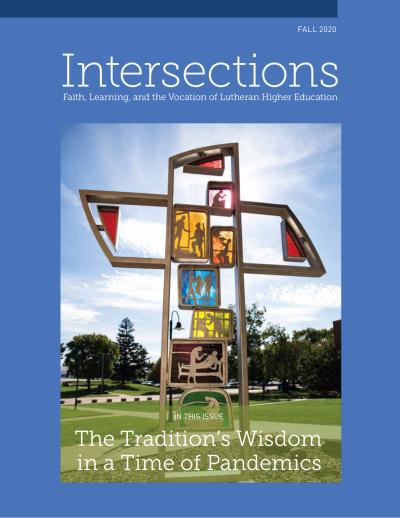
Thompson draws on Luther’s theology of the cross and Shelly Rambo’s theology of trauma to sketch a Lutheran model of leadership for a season of pandemics — one that is attentive to pain, responsive to need, and intentionally nourished by food, friends, and deep conversation.
-
 Editorial
From the Editor
Robert D. Haak
No. 29 · Spring 2009
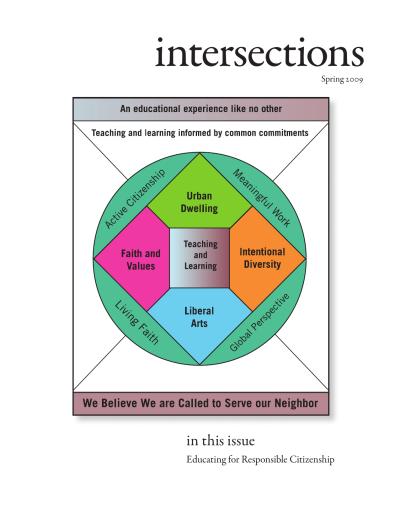
Haak frames the issue’s essays around the question of Lutheran colleges and the role of citizen, noting H. Richard Niebuhr’s typology in Christ and Culture and Luther’s own complex understanding of Christian and state, and offers a fitting farewell to Arne Selbyg with Mike Blair’s tribute song “A Fine Norwegian.”
-
 Editorial
From the Publisher
Arne Selbyg
No. 17 · Summer 2003
Selbyg explains that the four essays in this issue grew out of the first Lutheran Academy of Scholars in Higher Education—a two-week seminar funded by the Lutheran Brotherhood Foundation and the Lilly Endowment, led for its first three years by Dr. Ronald Thiemann of Harvard Divinity School—whose official theme “Finding Our Voice—Christian Faith and Critical Vision” became informally “What’s Faith Got To Do With It?”
-
 Article
Practical Approaches for Lutheran Colleges to Engage Civil Society
Katherine A. Tunheim
No. 35 · Spring 2012
Tunheim distinguishes a college’s mission from its vocation—a calling from the community—and offers four examples of Lutheran colleges “dancing with their neighbors”: Augsburg’s engagement with the Cedar Riverside Neighborhood, her Gustavus students’ work with the St. Peter Soccer Club, St. Olaf football players in the All-Star After-School Program in Northfield, and Concordia students filling sandbags during the 2009 Red River flood. She presses Lutheran educators to ask the troubling questions that prepare students to lead with ethics rather than merely with money.
-
 Article
Martin Luther, Vocation, and Church Colleges: Nurturing Future Leaders for Faith and Community
Richard W. Rouse
No. 14 · Summer 2002
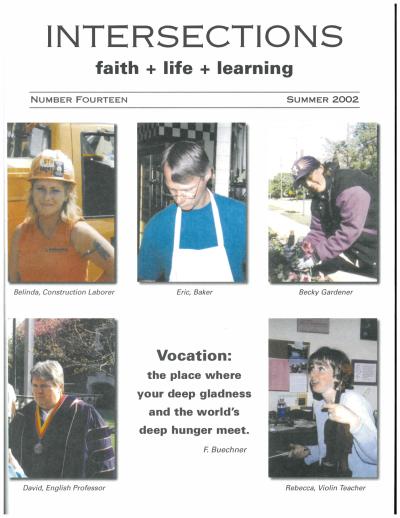
Rouse, citing Arne Selbyg’s statistic that thirteen of sixteen newly elected ELCA bishops graduated from a Lutheran college (and 49 of 65 in the new Conference of Bishops), argues that ELCA colleges are training grounds for future church and community leaders because of Luther’s doctrine of the priesthood of all believers and his distinction between vocation and station—the basis of PLU’s motto “educating for lives of service, inquiry, leadership, and care.” He describes “Paths Unknown: Where is God Leading Me?” a Western Mission Cluster collaboration of California Lutheran, Luther Seminary, Pacific Lutheran Theological Seminary, PLU, and Trinity Lutheran College that used a dedicated web site (godleading.com), a January-February 2001 online virtual forum reaching over 300 participants in 40 states and Canada and Mexico, and one-day interactive video workshops featuring Trump’s play “Holy Odors,” and reports LECNA’s Reclaiming Lutheran Student Project findings on teaching, community, and faith integration at Lutheran schools.
-
 Reflection
I am a Treaty Partner
Kyrie Fairbairn
No. 63 · Spring 2026
7 min audio
A recent California Lutheran graduate reflects on how a course on Indigenous Rights and Practices, and a conversation with a former Chairman of the Lummi Nation, led her to claim a “treaty partner” identity and to challenge readers to learn the treaties that shape the lands they call home.
-
 Article
Point / Counterpoint: What It Means to be a "College of the Church"
Robert Benne, Tom Christenson
No. 28 · Fall 2008
Moderated by Wartburg College pastor Larry Trachte and introduced by Kathryn Kleinhans, this Wartburg campus conversation between Robert Benne (Roanoke College) and Thomas Christenson (Capital University) probes what it means to be a college of the church—Benne emphasizing ethos, vocation, and the Christian intellectual tradition over against secularization and generic education, and Christenson lifting up persistent vocational questions, the gift of difference, and induction into a community of discourse—and finds large common ground around hiring for mission, pedagogy that asks deep questions, and the courage to claim a living religious tradition while inviting everyone to the banquet.