We gather in commitment to address a matter of profound importance—the well-being of the dedicated staff, faculty, and administration within the realm of Lutheran higher education. Our mission extends far beyond the boundaries of traditional academia; it encompasses the nurturing of the human spirit through rest, creativity and innovation, religious diversity and pluralism, and the preservation of our Lutheran identity within the academy.
In our exploration of these critical dimensions, we can draw wisdom and inspiration from the profound insights of the authors in our book So That All May Flourish: The Aim of Lutheran Higher Education. In this resource we have an opportunity to reflect upon the broader context of Lutheran higher education especially among the Network of ELCA colleges and universities (NECU). However, as we embark on this journey, we must first acknowledge the painful reality of Finlandia University’s closure this year, a poignant reminder of the challenges we face in this endeavor together.
Rest: Nurturing the Soul of Educators
In the relentless pursuit of knowledge and wisdom, it is easy to overlook the importance of rest. The trends of teacher burnout in the academic world are deeply troubling, and their toll on our educators is undeniable. Burnout not only erodes the well-being of individuals but also undermines the very quality of education we provide.
As we aspire to a state and season of flourishing in our live we must recognize that all of God’s creation need rest from our mental, emotional, professional, and physical labor. The realities of professional burnout within multiple areas in our academic institutions are key indications of the need to draw from faith traditions and practices that support renewing principles. As a network we have the opportunity to strengthen and encourage each other not to ignore the toll our dedication and commitment to our mission takes on all of us. It is only when our colleagues are well-rested and rejuvenated that they can guide our students towards their full potential. We cannot effectively nurture the minds and souls of our students without first nurturing ourselves.
It is a recognition that transcends time, echoing the sentiments of Martin Luther himself, who said, “I have so much to do that I shall spend the first three hours in prayer.” These words underscore the necessity of spiritual renewal and rest even amidst the busiest of schedules.
Creativity and Innovation: Embracing Change for Growth
Creativity and innovation are the lifeblood of education, and they must be embraced wholeheartedly. In a world marked by rapid change and evolving challenges, our commitment to fostering a culture of creativity and innovation is paramount. Innovation is a key cornerstone of Lutheran higher education. Our institutions have a rich history of adapting to changing times while staying true to our values.
In so many ways, we must see innovation on our campuses and curriculum as essential, not because it can guarantee a successful education environment, but because it refreshes the fact that we all are called to continue to learn and grow. Embracing innovation allows us to remain relevant in an ever-evolving educational landscape, fostering an environment where all can flourish. Stagnation is the enemy of progress, and our role and calling in higher education is not just to impart knowledge but also to inspire growth through innovative thinking.
Religious Diversity and Pluralism: Celebrating Differences
One of the powerful hallmarks NECU institutions and growing value in Lutheran higher education is our commitment to religious diversity and pluralism. Our campuses are enriched by a tapestry of faiths, creating an environment of dialogue, understanding, and mutual respect. This commitment aligns harmoniously with the vision of Dr. Martin Luther King Jr., who famously said, “We may have all come on different ships, but we’re in the same boat now.”
As we navigate the vast seas of diversity, we should echo the sentiments of recently published resource, “So That All May Flourish,” emphasizing that each person’s faith journey is unique and deserving of recognition and respect. This inclusive approach not only enriches our educational experience but also fosters a profound sense of belonging.
Maintaining Our Lutheran Identity: A Source of Strength
Balancing our faith with our academic pursuits can be a delicate task, but it is also a source of strength for our institutions. We must remain steadfast and rooted in preserving our Lutheran identity within the academy. This identity is not a mere adornment but a cornerstone that sets us apart in the world of higher education. Our commitment to Lutheran values, theology, and social statements is what makes our institutions unique. It is a beacon of light for those seeking an education rooted in faith, curiosity, and openness to different ways and possibilities.
Belonging: Inclusive Communities
In our commitment to well-being and flourishing, we must create inclusive communities that foster a deep sense of belonging. NECU is expanding our diversity in strong ways with several schools growing their enrollment within populations of people in the global majority. Supporting affirmative action is not merely a moral imperative but a strategic imperative, harnessing the talents and perspectives of individuals from all walks of life. With this growth we do have some challenges of being prepared to create atmospheres of welcome, hospitality, and inclusive environments. We are seeing this manifested with triggering low retention rates of students, particularly students of color, who bravely enroll at our schools. It is crucial to ensure that every member of our community feels valued, supported, and included.
The Mission of ELCA Colleges and Universities
Our commitment to these principles is not isolated; again, we all are a part of a broader network of ELCA colleges and universities. Together, we share a common mission, a commitment to nurturing well-rounded individuals who are not only academically prepared but also spiritually enriched. Our collective strength lies in our shared values and dedication to excellence in education.
The Painful Reality of Finlandia University
Before I conclude, I must address the somber reality of Finlandia University’s closure this year. It serves as a stark reminder of the challenges we face in the world of higher education. It underscores the importance of our mission, the need for adaptability, and the urgency of nurturing the well-being of our institutions including our staff, faculty, and administration.
In closing, the well-being of our educational network rests upon the pillars of rest, creativity and innovation, religious diversity and pluralism, and the unwavering preservation of our Lutheran identity within the academy. As we continue to navigate the complexities of our roles, let us remember the words of my predecessor, The Rev. Dr. Mark Wilhelm, who said to me as I began this role as executive director, “Lutheran education is a manifestation of the church’s mission in higher education.” It is my hope that our mission is not just to educate but to flourish—to ensure that all may flourish.
Thank you for your dedication to Lutheran higher education, and may we continue to nurture the well-being of our staff, faculty, and administration, fostering environments where all can thrive.
-
 Editorial
From the Editor: So That We, Too, May Flourish
Colleen Windham-Hughes
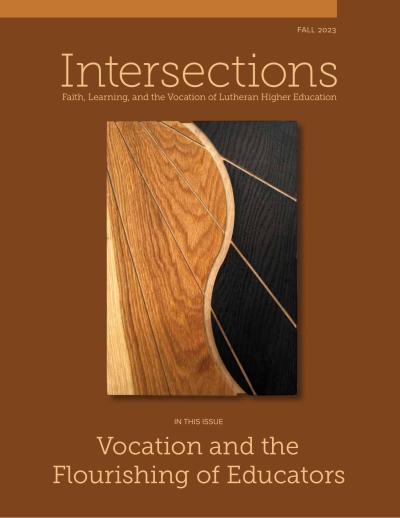
Windham-Hughes introduces the 2023 VLHE conference theme of educator flourishing, drawing on Dr. Monica Smith’s plenary challenge — “How can we flourish if only some are centered and others are at the margins?” — and invites readers to ground themselves in Us/We, the cover art by Augustana graduate William Hatchet, and join the conversation.
-
Article
A Lutheran Call for Educator Flourishing
Krista E. Hughes
Hughes argues that without educator flourishing there is no student flourishing, traces how an exploitative “passion tax” can distort vocation, and offers seven Lutheran “third-way” value pairings — including Metrics/Grace, Efficiency/Kairos, and DEI/Priesthood of All Believers — to reframe institutional success at NECU campuses.
-
Article
Do One Thing: Academic Vocation in the Age of Burnout
Jonathan Malesic
Malesic draws on Oliver Burkeman’s 4,000 Weeks and Søren Kierkegaard’s Purity of Heart is to Will One Thing to argue that academic burnout is fundamentally institutional — a widening gap between mission ideals and working conditions — and urges colleges to resist “projectitis” by focusing on the one thing that matters most.
-
Article
Cultivating Staff Flourishing in Lutheran Higher Education: A Framework for Advocacy and Engagement
Laree Winer
Winer narrates her own “love affair” with Lutheran Higher Education to argue that the heart of the tradition — vocation, de-emphasized hierarchy, and shared humanity — equips NECU institutions to advocate for staff flourishing through data collection, professional development, and ongoing relational commitment.
-
Article
Staff Governance at St. Olaf College, Northfield, MN
Don Ezra Cruz Plemons
Cruz Plemons describes how staff at St. Olaf, in the wake of a decade of difficult events, have built a three-year, glacier-paced effort toward a Staff Governance model — through affinity groups, the Council for Equity and Inclusion, and the Task Force to Confront Structural Racism — that gives staff a voice alongside faculty and students.
-
Article
Vocare: A Spiritual Practice for the Spaces Between
Charlene Rachuy Cox
Cox introduces Vocare, a six-word spiritual practice developed through the Nourishing Vocation Project at St. Olaf, that uses the acronym V-O-C-A-R-E to help individuals and communities honor the spaces “between no longer and not yet” and discern their callings for the common good.
-
Reflection
The Importance of Connection
Alex Piedras
Piedras reflects on the 2023 “So that We, Too, May Flourish” Conference at Augsburg as a refreshing space for a weary DEI advocate — surfacing burnout, the Talking Circle on Indigenous Issues, and Dr. Monica Smith’s Racial Healing Circle as opportunities to recharge the soul and build authentic connections for the long journey.
-
Article
“A Decolonizing Conversation”: Indigenous Engagement at Luther College at the University of Regina
Marc Jerry, Sarah Dymund
Jerry and Dymund describe Luther College at the University of Regina’s response to Canada’s Truth and Reconciliation Commission — Land Acknowledgments, a Starblanket ceremony, the Project of Heart, an Elder in Residence, and the unedited video conversation with Elder Lorna Standingready that anchored their 2023 VLHE keynote.
-
Article
Beyond Deep Gladness: Coming to Terms with Vocations We Don’t Choose
Deanna Thompson
Thompson, living with incurable cancer, expands Frederick Buechner’s definition of vocation to make room for deep sadness — drawing on Arthur Frank, Shelly Rambo, Beverly Wallace, and Ross Gay to argue that practices of lament, including the public lament of Friday Flowers at St. Olaf, open space for gladness, joy, and even flourishing to emerge.
-
 Editorial
From the Publisher & Editor
Colleen Windham-Hughes, Lamont Anthony Wells
No. 63 · Spring 2026
6 min audio
Wells and Windham-Hughes frame vocation as “ground game” — the practical, public living-out of faith through civic engagement — and introduce the issue’s focus on how Lutheran higher education equips students to repair the world.
-
 Editorial
From the Publisher
Lamont Anthony Wells
No. 62 · Fall 2025
5 min audio
Wells frames the issue as a record of the 2025 VLHE Conference at Augsburg under the theme “Ethical Leadership in a Changing World,” arguing that vocation is never solitary but a collective, public witness of ethical formation, theology and care, flourishing and belonging, and leadership rooted in God’s grace.
-
Article
Fostering Moral Imagination and Inclusivity: The Role of Ethical Leadership in ELCA Colleges and Universities Amid Societal Challenges
Lamont Anthony Wells
No. 62 · Fall 2025
12 min audio
Wells argues that “moral imagination” — the capacity to envision ethical alternatives, empathize across difference, and respond creatively to injustice — is the heart of ethical leadership in NECU institutions, and that anchoring leadership in this principle positions Lutheran higher education to cultivate socially responsible citizens.
-
 Editorial
From the Publisher
Lamont Anthony Wells
No. 61 · Spring 2025
5 min audio
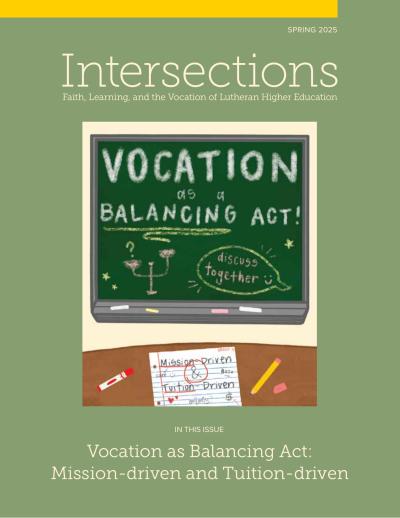
Wells introduces So That All May Belong: Lutheran Roots for Diversity, Equity, Inclusion, and Justice as a theological and institutional articulation of NECU’s commitments, and previews four accompanying essays that frame vocation as a societal responsibility rooted in justice and not solely an individual pursuit.
-
 Editorial
From the Publisher: Reflections on the 2024 Vocational Leaders in Higher Education Conference
Lamont Anthony Wells
No. 60 · Fall 2024
Wells reflects on the 2024 VLHE Conference theme — “Educational Access: Lutheran Roots, Contemporary Practices” — tracing today’s commitment to inclusivity back to Martin Luther’s radical 16th-century insistence that both boys and girls be educated, and previews NECU’s expanded engagement of student leaders alongside faculty and administrators.
-
 Editorial
From the Publisher: Navigating Affirmative Action, DEI Policies, and Lutheran Vocational Identity
Lamont Anthony Wells
No. 59 · Spring 2024
Wells surveys the converging pressures on NECU institutions — the unsettled landscape of affirmative action, political and academic scrutiny of DEI work, and the preservation of distinctively Lutheran vocational identity — and previews how the issue draws on affirmative practices, sociological viewpoints, and theological responses to navigate a path forward.
-
 Editorial
From the Publisher
Arne Selbyg
No. 6 · Winter 1999
Selbyg reports on the work of the Division of Higher Education and Schools to focus what makes Lutheran colleges and universities distinctive, recaps the 1998 Vocation of a Lutheran College conference at Wittenberg, previews the 1999 Susquehanna conference on “Identity and Fragmentation: Can the Lutheran Center hold?” (inspired by Yeats’s vision of the Second Coming), commends Ernest Simmons’s Lutheran Higher Education: An Introduction for Faculty (Augsburg Fortress, 1998), and announces a new NEH/NSF-style initiative called “The Lutheran Academy of Scholars in Higher Education.”
-
 Article
Lutheran Colleges, the Lutheran Tradition, and the Future of Service-Learning
Joseph McDonald
No. 34 · Fall 2011
McDonald, who has used service-learning since the early 1990s and now directs the Values Based Learning Program at Newberry College, traces the service-learning movement from its 1960s socio-political pioneers (Nadinne Cruz, Ira Harkavy) through its institutionalization as classroom pedagogy and citizenship education (Stanton, Giles, and Cruz; Edward Zlotkowski; Jane Addams’s Hull House and John Dewey). He argues that three strengths of the Lutheran tradition—robust reflection as a community of discourse, Christian vocation as service infused in all roles, and the capacity to negotiate tension and paradox—uniquely equip Lutheran colleges to hold the pedagogical and socio-political dimensions of service-learning together, recovering the energy of the pioneers without sacrificing classroom rigor.
-
 Article
Moving Forward by Looking Back: Lutheran Vocation as Foundation for Interfaith Ministry
Kristen Glass Perez
No. 43 · Spring 2016
Recounting how Augustana students mentored her into the role of presider at a campus vigil following the 2012 Sikh Temple of Wisconsin shooting, Glass Perez proposes that interfaith understanding become a mode of praxis for the twenty-first century Lutheran college. Drawing on Engaging Others, Knowing Ourselves and Interfaith Youth Core’s leadership practices, she urges ELCA schools to develop a common language linking interfaith engagement to vocational exploration and to the wider mission of the church.
-
Article
Building a Third Space in the Age of AI: A Conversation with Dr. Walter Earl Fluker
Elizabeth Kubek
No. 62 · Fall 2025
11 min audio
Prompted by AI chatbots being marketed to students as a safer alternative to messy human relationships, Kubek interviews Fluker on how Howard Thurman’s vision of common consciousness, somaesthetics, and nature-rooted learning offers educators a “third space” alternative to AI’s hall of mirrors.
-
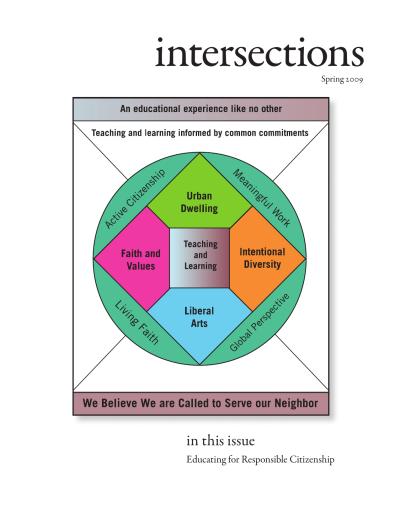 Editorial
From the Editor
Robert D. Haak
No. 29 · Spring 2009
Haak frames the issue’s essays around the question of Lutheran colleges and the role of citizen, noting H. Richard Niebuhr’s typology in Christ and Culture and Luther’s own complex understanding of Christian and state, and offers a fitting farewell to Arne Selbyg with Mike Blair’s tribute song “A Fine Norwegian.”
-
 Article
The New (con)Texts of Jewish-Christian Engagement
Karla R. Suomala
No. 33 · Spring 2011
Suomala surveys four contemporary contexts of Jewish-Christian engagement on American college campuses — campus populations, Jewish studies curricula, the changing nature of Jewish identity among Millennials, and the shift from formal Jewish-Christian dialogue toward broader religious pluralism — and argues that at Lutheran colleges this success story can serve as a model for engaging the other religious neighbors who increasingly form part of our society.