Why do Lutherans so often use the word “vocation” when what we really mean is “career”? As someone who graduated from an ELCA college and now teaches at another, I know that I have been guilty of this sin. Anyone who has hung around Lutherans knows that career and vocation are not supposed to be equivalent; this is why Lutheran liberal arts colleges are said to be the opposite of what are conventionally called “vocational schools.” Nonetheless, especially in the college setting, it is often tempting to conflate the two—to use vocation as a theologically glorified synonym for one’s present or future job. Vocation easily becomes a euphemism that allows us to distance ourselves from the distastefulness of actual remunerated labor. I have come to believe that this misuse of vocation language is extremely dangerous. Misappropriating vocation in this way distorts our tradition’s deepest insights about calling and, just as importantly, about work.
When Lutherans conflate vocation and career, notice that we’re never speaking of just any sort of career. We’re talking about careers that are “fulfilling,” “meaningful,” and “worthwhile”: work that is a “passion.” If we are privileged to have found gainful employment that suits us this way, then vocation language is seductive; if we are dreaming about pursuing such a career in the future, then it can be even more intoxicating. Yet what does this understanding of vocation imply to a student who follows her passion and never finds a full-time job with benefits in her field? Did she misperceive her true vocation? Did she not work hard enough to live out her calling? In my view, the dangers of construing vocation this way are at least as great for those who are able to find meaning and identity in their jobs. Defining vocation as one’s career tips the scale in any reflection on work-life balance. It invites career to consume the totality of our lives—drastically constricting the scope of God’s calling to us.
When Luther wrote about vocation, he did so in order to resist the narrowness of the understanding of vocation that he had inherited. In his late medieval world, only those who pursued “religious life” as monks, nuns, and priests had vocations; everyone else did not. By emphasizing the universality of God’s grace and the priesthood of all believers, Luther argued that all people could be conduits of God’s love, in every arena of their lives. As Martin Marty has provocatively put it, according to Luther’s expansive understanding of vocation, “the mother suckling the baby and washing diapers, the farmer at work, the couple having sex were as likely to be engaged in God-pleasing activities as was any nun engaged in prayer” (104).
In our society today, I don’t think that most of us are tempted to limit vocation to service to the church. But we are constantly tempted to limit our vocation to our jobs. Think how readily we define ourselves and others by our professions. It is our first question at a party: “And what do you do?” He’s an architect. She’s a doctor. I’m a professor. “Oh, you’re just some paper-pusher somewhere? Excuse me, I think I’ll hit up the buffet table.” When we fall into the trap of limiting vocation to career, the result is that we close ourselves to others as they truly are and constrict our sense of ourselves.
There is a Tyson chicken plant across the road from the Lutheran college where I teach. Do the minimum-wage workers there have vocations from God? Vocations as meaningful as those of our college pastor and president? I think the Lutheran answer to these questions is Yes. However, in order to answer the questions this way, I don’t think we should have to pretend that menial labor is generally a source of deep personal fulfillment. Instead, we need to refocus what we mean by vocation so that it refers first and foremost to people rather than professions. People called to be mothers and husbands and mentors and friends. People called to hike and play sports and paint. People called to organize for their rights and those of others. People called to advocate for the humane treatment of animals. People called to vote with certain values in mind. People called to change babies’ diapers. As a theological concept, vocation is both infinitely encompassing and infinitely particular. It affirms each facet of our created selves—including our professional selves. But it is always bigger and more numinous than any one aspect of our lives.
At its core, Luther’s theology of vocation should challenge our society’s paradoxical tendency to both fetishize and denigrate work. It should call into question our implicit assumption that only those fortunate enough to get paid for “doing what they love”—and who thus, as the saying goes, “never work a day in their lives”—are living out callings from God. Vocation should empower us to affirm work as work without suggesting that it is coextensive with God’s calling to any human being.
“Luther’s theology of vocation should challenge our society’s paradoxical tendency to both fetishize and denigrate work.”
So when we mean to speak of career on campus, why not just speak unblushingly of “career”? Our Lutheran tradition enables us to prepare students for professional practicalities without resorting to a loftier euphemism. At the same time, our tradition calls us to see our students as much more than their future professions. It calls us to think of vocational discernment as a never-completed process that implicates entire selves. Most fundamentally, it requires us constantly to question the limits we impose on how God can be present in our lives and in the world.
Works Cited
Marty, Martin. Martin Luther: A Life. New York: Penguin, 2004.
-
 Editorial
From the Publisher
Mark Wilhelm
Wilhelm celebrates the leadership of ELCA colleges and universities within American higher education — from presidential service in major higher-education agencies to recognized leadership in global education and interfaith understanding — and lifts up the health of the ELCA network of schools as a church-related community that maintains shared identity while living as good citizens of the larger academy.
-
Editorial
From the Editor
Jason A. Mahn
Mahn introduces the “Called to Leadership” issue by worrying that training for leadership has become so ubiquitous in higher education as to be nearly meaningless, and recovers Luther’s sense of leadership as service — a calling to be a “slave” whose learning, power, and wisdom belong to the unlearned, the oppressed, and the foolish — as the shared mission of Lutheran colleges to train servant-leaders.
-
Article
Vocational Leadership
Darrell Jodock
Jodock proposes “vocational leadership” as a name for a distinctive educational value at the heart of a Lutheran college — one that seeks to benefit the neighbor and the community, inspires and invites others to participate in that service, and is institutionally anchored in the Lutheran concept of vocation. He unpacks twelve facets of vocational leadership and ties them to Luther’s own leadership around indulgences, public schooling, and beggary.
-
Article
Sharing Leadership within Colleges and Universities
Leanne Neilson
Building on Jodock’s framework, Neilson applies vocational leadership to the unique work environment of higher education — mission statements, faculty governance, the slow pace of consensus, and the sometimes uneasy relationships between faculty and staff — and asks how leaders, followers, and team players can create an atmosphere of mutual empowerment on Lutheran college campuses.
-
Article
Mentoring in the Academy: Of Gurus, Coaches, and Sponsors
Faith Wambura Ngunjiri
Ngunjiri urges faculty, staff, and administrators in faith-based institutions to assemble a “personal board of directors” of mentors — connectors, sponsors, taskmasters, motivators, dreamers, sages, and proofers — and reflects on how race and gender complicate mentoring in predominantly white, male-led ELCA institutions, where women and minorities must reach out to build the “cloud of witnesses” they need to thrive.
-
Article
Women in Leadership: Obstacles, Opportunities, and Entry Points
Susan Hasseler
Drawing on two focus-group conversations with female faculty and academic administrators at Augustana College (Sioux Falls), Hasseler traces four obstacle/opportunity themes for women in academic leadership — valuing the intellectual work of leadership, religious and cultural interpretations of gender roles, caregiving realities, and embracing a strong voice — and proposes deliberate next steps for cultivating inclusive excellence on ELCA campuses.
-
Article
Superheroes and Origin Stories: Tools to Discover and Claim One's Callings
TJ Warren
Warren argues that the “Hero’s Journey” — Joseph Campbell’s monomyth with its ordinary world, call to adventure, mentors, and return with the elixir — offers a powerful pedagogical tool for helping college students discover their origin stories and claim their callings. Drawing on Superman, Wonder Woman, and Rosa Parks alike, he invites educators to mentor students into becoming the heroes of their own lives.
-
Article
Leading from Within: Peer-Learning Consultations to Explore Our Callings and Campus Capacities for Leadership
Chris Johnson
Johnson reframes vocational leadership as “soul work” that calls for the deep mind as much as the conscious one, and offers two practices — deep listening and a modified Quaker clearness consultation — as ways for campus colleagues to listen one another into existence. Drawing on Sharon Daloz Parks, Marshall Ganz, Parker Palmer, and Mary Rose O’Reilley, he invites readers to map their stories of self, us, and now.
-
Book Review
Old and New Ideas of the Liberal Arts: A Review of Claiming Our Callings
David Crowe, Katie Hanson
Crowe and Hanson review Claiming Our Callings: Toward a New Understanding of Vocation in the Liberal Arts (Oxford 2014), a collection of thirteen essays by St. Olaf faculty edited by Kaethe Schwehn and L. DeAne Lagerquist. They commend the book’s thoughtful, sincere engagement with consumerism, sustainability, Buddhist meditation, and Lutheran-Bonhoefferian theology — and recommend it for any liberal arts campus pulled between idealistic mission and career-minded pressure.
-
 Article
Leading Students to Distinguish Between Career and Vocation: Reflections from a Lutheran Law School
Steven C. Bahls
No. 20 · Fall 2004
Bahls, writing as former dean of the Capital University Law School, argues that most law students and many legal educators confuse vocation with career—asking “what kind of lawyer do you want to be?” rather than “who do I want to be?” Drawing on John O. Mudd’s five attributes of a well-prepared lawyer and Susan Daicoff’s empirical research on lawyer dissatisfaction and the “amoral professional role,” he turns to Ernest L. Simmons’s and Darrel Jodock’s articulations of Luther’s understanding of vocation and proposes five steps—reflection, assessment, vision, integrative thinking, and reassessment—along with explicit leadership from law school deans, engagement of career services offices, and leadership within the profession (illustrated by Capital’s joint venture with the Columbus Bar Association).
-
 Article
A Church, the Human Condition, and the Fissured Face of Peace
D. M. Yeager
No. 22 · Spring 2006
Yeager, a member of the ELCA Task Force for Studies on Sexuality, reflects on lessons for the church’s educational mission in the wake of the 2005 Churchwide Assembly. Drawing on Macquarrie’s The Concept of Peace, Polanyi on the personal coefficient of knowledge, Hannah Arendt’s The Human Condition, and responses to the task force report from Roy Harrisville III and Larry Rasmussen, she proposes “the fissured face of peace”—peace as the absence of hostility rather than disagreement—and maps how Arendt’s five conditions of human existence (life, earth, natality, mortality, worldliness, plurality) might shape Lutheran colleges’ curricula in history, epistemology, and the sociology of knowledge so that graduates can disagree without hostility and embrace the slow work of reformation.
-
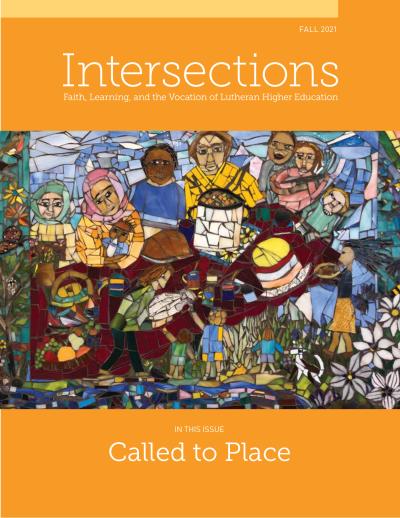 Article
Hospitality to the Wild
Laura M. Hartman
No. 54 · Fall 2021
Drawing on research with a Wild Ones Native Landscaping chapter and Marilyn Matevia’s ethic of “creature comfort,” Hartman argues that Christian hospitality must extend to non-human animals and plants — and asks whether college campuses can foster not just human diversity but biodiversity.
-
 Editorial
From the Publisher
Arne Selbyg
No. 27 · Spring 2008
Selbyg, retiring this summer as Director for ELCA Colleges and Universities, reflects on his decade serving as spokesperson between the church and its twenty-eight colleges and universities, and argues that the link between the colleges and the church has grown stronger over the last ten years — sustained by supportive church leaders like Presiding Bishop Mark Hanson, the annual Vocation of a Lutheran College conference, and a Lutheran theology of higher education whose principles (questioning authority, returning to the sources, including the excluded, serving the neighbor) remain a strong basis for operating colleges and universities in the twenty-first century.
-
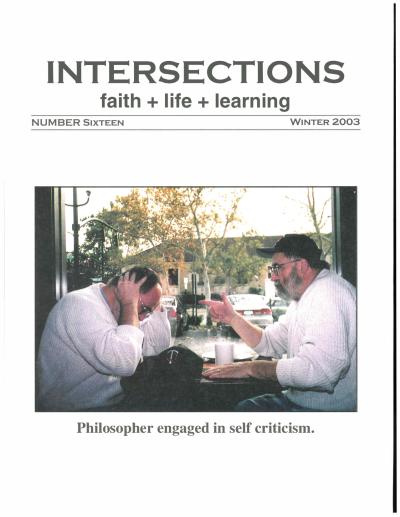 Article
Honoring the Word: Lutherans and Creative Writing
Carol Gilbertson
No. 16 · Winter 2003
Gilbertson argues that “honoring the Word” in Lutheran colleges means cherishing the sacred power of human language as God’s gift across three sites—the chapel talk, the classroom of wonder, and the poem—and illustrates her argument by reading aloud her own poems: “The Refiner’s Fire and Leaping Calves,” “Late June,” “Early June,” “Sweet July,” “Good Friday,” “Pondering These Things,” “The Limbs of Words,” and “Night Rising,” drawing on Darrell Jodock, John Updike, Martha Nussbaum, George Steiner, and T. S. Eliot’s “The Dry Salvages” to claim writing as a Christian vocation that “incarnate[s] the unseen sacred.”
-
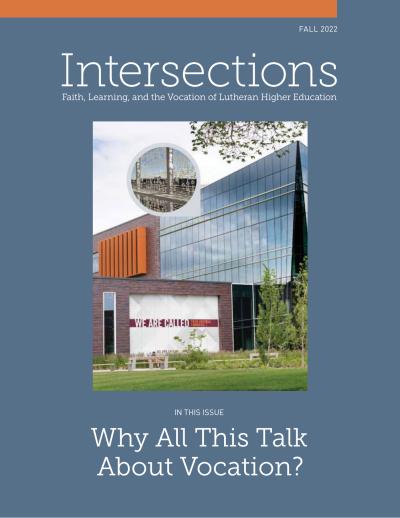 Editorial
From the Editor: Why All This Talk About Vocation?
Colleen Windham-Hughes
No. 56 · Fall 2022
Windham-Hughes introduces the Fall 2022 issue built around Mark Wilhelm’s keynote “Why all this talk about vocation?” and previews five panel responses, two first-time conference reflections, and companion pieces on Womanist theology — framing vocation as a call not to privilege but to constructive and corrective work that undoes unjust systems.