Superheroes and Origin Stories: Tools to Discover and Claim One's Callings
Intersections No. 41 · Spring 2015
Clark Kent: “How can I decide what to do with my life when I don’t even know who I am? I feel like I’m walking in a dream, and nothing’s real, not even me.”
Jonathan Clark: “Then maybe the answer is to wake up. There will come a day Clark, when for the very first time, you won’t have to hold back…a day when you can cut loose…a day when you can finally be who you truly are… you’re unique in all the world. Extraordinary. Not just any man…and more than just a man…a SUPER-man. Live Clark. Follow your passion. Show the whole world what you can do. Fly, Clark… Fly…”
From Superman: Earth One, by J. Michael Straczynski and Shane Davis
Origin stories—the stories of heroes coming to be—are fascinating. This is why we tend to get caught up in them. I can’t tell you the number of times I have read or seen the origin of Superman. I never get sick of it, and apparently, neither do others, as the story gets told over and over again. Origin stories define characters: where they came from, who they were, what they’ve faced, and how they have discovered themselves, their strengths, and their calling. We know many characters within literature and film, but until we know their origin, we do not know their purpose in the world. I am convinced that discovering one’s origin and referring to the stories of our fictional heroes can be powerful tools in helping individuals discover and claim their callings.
Joseph Campbell identified a “monomyth”—a single story—that can be observed within many forms of literature and film. As writers and filmmakers continued studying the pattern, they later referred to it as “The Hero’s Journey.” Although the pattern has been debated and modified throughout the years, many agree that it consists of 12 stages: the ordinary world; the call to adventure; refusal of the call; meeting with the mentor; crossing the threshold; tests, allies, and enemies; approach; the ordeal; the reward; the road back; the resurrection; and the return with the elixir. These stages can serve as a catalyst for helping individuals understand their own origins.
For example, in my own journey (where I’m the hero—which is fantastic, I must say), identifying my ordinary world consisted of being a young Iowa boy who believed he was meant to impact the world in some way, but was also unsure of who he was and how he could contribute. Then, my freshman year of high school, I attended a youth leadership conference called Get a Grip where I met my mentor. By experiencing this leadership organization, I discovered that my way of impacting the world was by encouraging people, making them laugh, and helping them realize their true potential. After a few years of being mentored and continuing to discover myself, I crossed the threshold by attending college.
This is just one way we can take a look at our own origin stories. By walking through “The Hero’s Journey” stages, we can start to pinpoint significant moments in our lives that have shaped us and that demonstrate what we are good at. This method of reflection can lead to other questions, such as: “Does your origin story decide your vocation?” For example, does coming from a family of medical professionals mean you cannot pursue an art degree? The concept itself can at least start the discussion on a level that people understand and relate to.
As I have worked in higher education, I’ve noticed that we tend to make things incredibly complex as we work with students. Although college is a time for rigorous exploration and discovery, we need to find opportunities to meet students at their level and relate what we are trying to teach with their experiences and interests. Once we have their attention, the rigorous exploration and discovery can commence.
When an individual walks into my office, his or her attention is immediately drawn to my Superman and other hero collectibles displayed there. These items generate discussion. Students, faculty, and staff ask, “Why Superman?” My response is always, “Because he humbly seeks to do good in the world using the many talents that he possesses.” And to the general question of, “Why superheroes?”, I say, “Because I believe we are all superheroes in our own way. The hero’s journey lives within all of us.”
Heroes—however we define them—speak to all of us. Whether they are fictional (Superman, Wonder Woman, Harry Potter) or real (Rosa Parks, Ghandi, Mother Theresa), they speak. Why do they speak to all of us? We can relate to their failures, hardships, and struggles. We can also relate to their successes, the moments at which they overcame adversity or some villainous foe. Heroes inspire us to do and be something more—to pursue our calling. We must find ways to help others become the hero in their own lives.
As higher education professionals, we have an opportunity to mentor students along their own journeys—as Professor Charles Xavier does with the X-Men. We get to challenge, support, and encourage students to focus on their strengths and manage their weaknesses so that when their true purpose does call, they can, as Jonathan Kent says, “fly.”
As you work with students, find stories of heroes that speak to you—superheroes, friends, family members, politicians, social justice leaders, and so forth. Use these role models, mentors, and leaders to help others realize who they are and how they can contribute to society. As you provide these examples, help others articulate their origin stories so they might find their purpose in the world and “wake up” to take their call.
Works Cited
Campbell, Joseph. The Hero with a Thousand Faces. Princeton, NJ: Princeton University Press, 1949.
Straczynski, J. Michael (author) and Shane Davis (illustrator). Superman: Earth One, volume 1. New York: DC Comics, 2010.
-
 Editorial
From the Publisher
Mark Wilhelm
Wilhelm celebrates the leadership of ELCA colleges and universities within American higher education — from presidential service in major higher-education agencies to recognized leadership in global education and interfaith understanding — and lifts up the health of the ELCA network of schools as a church-related community that maintains shared identity while living as good citizens of the larger academy.
-
Editorial
From the Editor
Jason A. Mahn
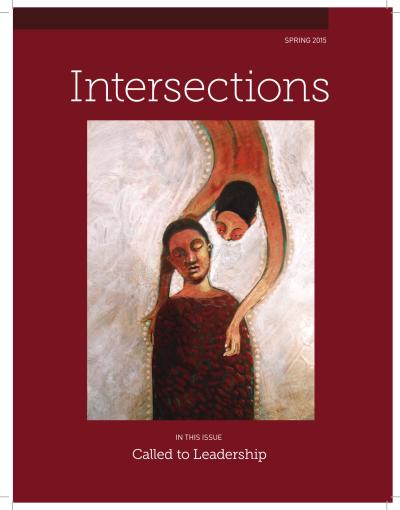
Mahn introduces the “Called to Leadership” issue by worrying that training for leadership has become so ubiquitous in higher education as to be nearly meaningless, and recovers Luther’s sense of leadership as service — a calling to be a “slave” whose learning, power, and wisdom belong to the unlearned, the oppressed, and the foolish — as the shared mission of Lutheran colleges to train servant-leaders.
-
Article
Vocational Leadership
Darrell Jodock
Jodock proposes “vocational leadership” as a name for a distinctive educational value at the heart of a Lutheran college — one that seeks to benefit the neighbor and the community, inspires and invites others to participate in that service, and is institutionally anchored in the Lutheran concept of vocation. He unpacks twelve facets of vocational leadership and ties them to Luther’s own leadership around indulgences, public schooling, and beggary.
-
Article
Sharing Leadership within Colleges and Universities
Leanne Neilson
Building on Jodock’s framework, Neilson applies vocational leadership to the unique work environment of higher education — mission statements, faculty governance, the slow pace of consensus, and the sometimes uneasy relationships between faculty and staff — and asks how leaders, followers, and team players can create an atmosphere of mutual empowerment on Lutheran college campuses.
-
Article
Mentoring in the Academy: Of Gurus, Coaches, and Sponsors
Faith Wambura Ngunjiri
Ngunjiri urges faculty, staff, and administrators in faith-based institutions to assemble a “personal board of directors” of mentors — connectors, sponsors, taskmasters, motivators, dreamers, sages, and proofers — and reflects on how race and gender complicate mentoring in predominantly white, male-led ELCA institutions, where women and minorities must reach out to build the “cloud of witnesses” they need to thrive.
-
Article
The Dangers of "Vocation" for Students Thinking about Career
Carl Hughes
Hughes warns that Lutherans too often use “vocation” as a theologically glorified synonym for a fulfilling career — a misuse that constricts God’s call to our jobs and excludes minimum-wage workers, caregivers, and others from the dignity of calling. Recovering Luther’s expansive understanding, he argues that vocation refers first to people, not professions, and must always be bigger than any one aspect of our lives.
-
Article
Women in Leadership: Obstacles, Opportunities, and Entry Points
Susan Hasseler
Drawing on two focus-group conversations with female faculty and academic administrators at Augustana College (Sioux Falls), Hasseler traces four obstacle/opportunity themes for women in academic leadership — valuing the intellectual work of leadership, religious and cultural interpretations of gender roles, caregiving realities, and embracing a strong voice — and proposes deliberate next steps for cultivating inclusive excellence on ELCA campuses.
-
Article
Leading from Within: Peer-Learning Consultations to Explore Our Callings and Campus Capacities for Leadership
Chris Johnson
Johnson reframes vocational leadership as “soul work” that calls for the deep mind as much as the conscious one, and offers two practices — deep listening and a modified Quaker clearness consultation — as ways for campus colleagues to listen one another into existence. Drawing on Sharon Daloz Parks, Marshall Ganz, Parker Palmer, and Mary Rose O’Reilley, he invites readers to map their stories of self, us, and now.
-
Book Review
Old and New Ideas of the Liberal Arts: A Review of Claiming Our Callings
David Crowe, Katie Hanson
Crowe and Hanson review Claiming Our Callings: Toward a New Understanding of Vocation in the Liberal Arts (Oxford 2014), a collection of thirteen essays by St. Olaf faculty edited by Kaethe Schwehn and L. DeAne Lagerquist. They commend the book’s thoughtful, sincere engagement with consumerism, sustainability, Buddhist meditation, and Lutheran-Bonhoefferian theology — and recommend it for any liberal arts campus pulled between idealistic mission and career-minded pressure.
-
 Article
Rooted and Open as Resource for Expanding Opportunities on Your Own Campus
Katherine A. Tunheim, Marcia Bunge
No. 49 · Spring 2019
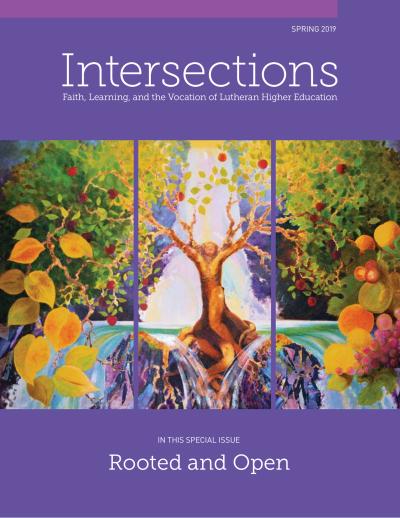
Bunge and Tunheim describe how Gustavus Adolphus College has paired Rooted and Open with its own companion volume Rooted in Heritage, Open to the World — in board workshops, new-faculty orientation, and classroom assignments — and survey several Network-wide opportunities (the Vocation of a Lutheran College Conference, the LECNA Fellows Program, the Association of Lutheran College Faculties, the Tuition Exchange Program, and international partnerships) that give the common calling tangible institutional form.
-
 Article
The Idea of a Christian University
Richard Hughes
No. 11 · Spring 2001
Hughes’s lecture at the inauguration of Andrew K. Benton as the seventh president of Pepperdine argues that a Pepperdine-wide “strategy of community-wide conversation,” carried by the new Pepperdine University Center for Faith and Learning, can sustain the school as a Christian university by leaning into the paradox of Christian particularity rather than around it. Drawing on the incarnation, the Matthew 5 and Luke 14 teachings of Jesus, the Quaker and Cane Ridge (Joseph Thomas) abolition traditions, Galatians 2 and Romans 8, and Luther’s simul Justus et peccator as the gospel that frees the scholar to be wrong, to doubt, and to confess “Lord I believe; help thou mine unbelief,” he mines the Churches of Christ heritage—Alexander Campbell, Barton W. Stone, and John Rogers of Carlisle, Kentucky—as a unity-and-freedom tradition that grounds both diversity and academic freedom.
-
 Article
The "V" Word: Different Dimensions of Vocation in a Religiously Diverse Classroom
Martha E. Stortz
No. 50 · Fall 2019
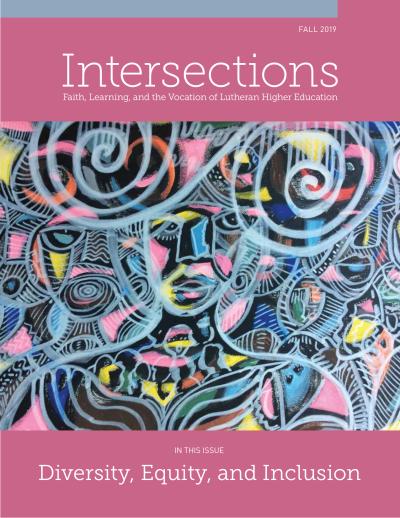
Stortz responds to a sea of blank stares when she used the word “vocation” in a religiously diverse required course by offering five metaphors — place, path, relationships, lens, and story — that point to different dimensions of vocation across the world’s religions and help students articulate their callings on their own terms.
-
 Book Review
In Search of a Calling: The College's Role in Shaping Identity
Karla G. Bohmbach
No. 4 · Winter 1998
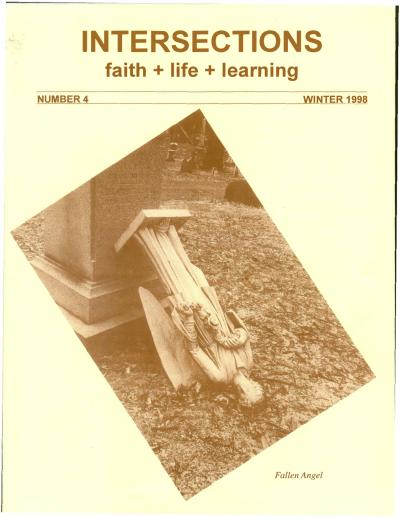
Bohmbach reviews Thomas O. Buford’s In Search of a Calling: The College’s Role in Shaping Identity (Mercer University Press, 1995), which diagnoses a meaning-crisis among college students and traces two historical aspects of “calling”: the biblical, communitarian aspect rooted in the Hebrew Bible and the practical, individualistic aspect rooted in the Renaissance. She praises Buford’s reconstruction of imago dei as imagination rather than copy of God’s rationality, his broad disciplinary range (biblical studies, theology, educational psychology, business management), and his identification of the tension between freedom and limitation as the field of calling. She is sharply critical, however, of his final chapter’s wariness of canon-revisionists and multiculturalists, his caricature of “special-interest groups,” and his presumption of a homogeneous student body—a presumption that, she argues, never matched American college reality and matches it less today.
-
 Article
Freedom of a Christian-College: Looking through the Lens of Vocation
Kathryn L. Johnson
No. 24 · Fall 2006
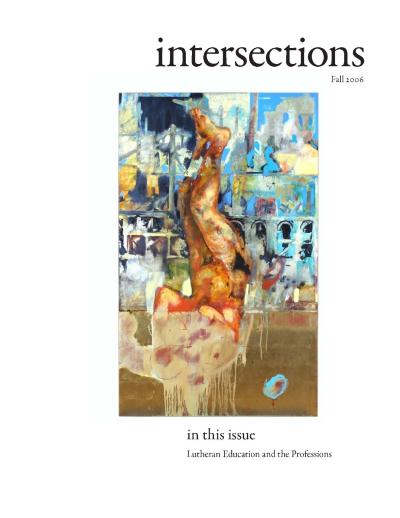
Johnson, Paul Tudor Jones Professor of Church History at Louisville Presbyterian Theological Seminary, re-reads Luther’s 1520 treatise The Freedom of a Christian as a paradigm for the “freedom of a Christian college” amid the pressures of professional preparation. She traces Luther’s paradoxical claim that a Christian is “a perfectly free lord of all, subject to none” and at the same time “a perfectly dutiful servant of all, subject to all,” and argues that the same dialectic frees a Lutheran college to engage the professions without being captured by them.
-
 Article
Diversity, Integrity, and Lutheran Colleges
Florence D. Amamoto
No. 8 · Winter 2000
Amamoto—a sansei Jodo Shin Shu Buddhist who is “an inside outsider” at Gustavus Adolphus—argues that diversity and integrity belong together in Lutheran higher education, perhaps in a way unmatched by other church-related traditions. She affirms the importance of Gustavus’s 60% Lutheran student body and vibrant Christ Chapel under Richard Elvee and Brian Johnson while warning that numbers and chapel are not enough, draws on Tom Christenson, Patricia Gurin, Sylvia Hurtado, Anthony Carnevale, Martha Nussbaum, W. E. B. DuBois (the deaths of Matthew Shepard and Isaiah Shoels), Richard Hughes’s reading of finitum capax infiniti, Richard Solberg, and Mark Schwehn’s mutual hospitality model, and concludes that the real enemy is not diversity but indifference—and that Lutheran finitude grounds a theological commitment to keeping diversity and identity in creative conversation.