How have you experienced mentoring? How have you experienced effective mentoring? What made it effective? And, what challenges have you experienced related to mentoring?
These questions guided table discussions during my facilitation on the topic of mentoring at the 2014 Vocation of a Lutheran College conference. Research has long established that mentoring is an effective approach for enhancing the professional development of individuals in organizations. Participants at the conference shared how mentoring had impacted their careers. During the second part of the workshop, I facilitated discussions on an activity called the Personal Board of Directors, specific to the different kinds of mentors needed for thriving in the academy. Here I articulate the place and purpose of mentoring in the academy, looking at the various roles that different kinds of mentors play. I urge us to get the support we need in order to ably serve in our chosen vocation and adequately meet the demands of the calling we have received.
What is Mentoring?
Mentoring is an efficacious strategy for enhancing the advancement of individuals. It impacts on access to resources, personal growth, and job satisfaction. Both academic and practitioner literature recognizes the viability of mentoring (McCauley; Tolar). Most definitions of mentoring involve a relationship between two people, one of whom is more experienced, and the other less experienced. As McCauley defined it,
A mentoring relationship is an intense, committed relationship in which a senior person (the mentor) stimulates and supports the personal and professional development of a junior person (the protégé). This sort of relationship is generally understood as emerging and developing naturally in the course of organizational life… having a mentor supports career advancement, access to organizational resources and rewards, personal growth, and job satisfaction. (443)
This idea of a hierarchical relationship is perhaps the most studied and discussed form of mentoring. The definition provided here refers to traditional mentoring, which is very well covered in the literature. However, mentoring can take place between people of similar skill or experience level—that is, peer mentoring. In this paper, I discuss both forms of mentoring—the hierarchical/traditional and the horizontal mentoring approaches—because both are needed in order to advance, to experience life or job satisfaction, and to serve effectively in our chosen roles.
Experts recognize that “mentoring is indispensable to learning throughout our careers, not just while we’re wet behind the ears…. Mentoring is how we identify and fill critical gaps we’d struggle to address on our own. A good mentor is part diagnostician, assessing what’s going on with you now, and part guide, connecting you with the advice, people, and resources you need to grow and move ahead” (Erickson 1). Indeed, when I look back at my working life, I can discern the places where the diagnostic eye of a mentor enabled me to make necessary moves that I might otherwise have missed. Good mentors have been instrumental to my journey in academia, playing important guiding and supporting roles.
“When I look back at my working life, I can discern the places where the diagnostic eye of a mentor enabled me to make necessary moves that I might otherwise have missed.”
From an organizational standpoint, investing in mentoring programs enables organizations to attract, develop, and retain quality employees and increase the diversity of their employees; universities do it to retain faculty, staff and students, and to create and maintain a diverse working environment (Tolar 172). Formal mentoring is often set up within the organization, where individuals (both mentors and mentees) are chosen and possibly assigned to each other, for a set period of time, with the hope that those relationships will blossom beyond the set time/formality. Informal mentoring, on the other hand, “is the natural coming together of a mentor and protégé…done in friendship through personal and professional respect from each to the other…a long term relationship” (Buzzanell 33).
Beyond the form of mentoring, we also consider the functions that mentors play: career guidance, social guidance, psychological support, organizational understanding, and spiritual support (Buzzanell). Mentoring takes place through face-to-face dyadic relationships, through online and other computer-mediated means, and in groups or clusters. For instance, at Concordia College, new faculty members undergo two years of group mentoring facilitated by a senior colleague (Associate Dean of the College, Dr. Lisa Sethre-Hofstad), with training and counsel about various issues related to our roles of teaching, research, and service. A second form of group mentoring at Concordia is provided through the Dovre Center for Faith and Learning, focused on understanding Lutheran Higher Education. This group mentoring includes discussions of relevant texts, and talks with the facilitator, Professor Ernest Simmons, as well as other Lutheran Higher Education experts. Both types of group mentoring—the first required and the second voluntary—enable faculty to not only gain a deeper understanding about the culture and norms of the institution, but also to develop community with colleagues from different disciplines and parts of the institution. These types of mentoring experiences are instrumental in helping new faculty members acclimatize and settle into their roles. Most academic institutions have some kind of formal mentoring program for junior and/or new faculty. Whatever form or process, the bottom line is that people share expertise that is helpful in enabling individuals to advance through the organizational hierarchy.
Spiritual mentoring has not been as widely discussed in the literature as other more traditional approaches to mentoring. According to Buzzanell:
Spiritual mentoring refers to a particular way of interacting in mentor-mentee relationships. Spiritual mentoring transcends the usual career, psychosocial support, and role modeling activities to embrace the whole person. Spiritual mentoring might mean that teachers/mentors reframe their jobs so as to assist in cultivating both their own spiritual development and/or that of others. (18)
Buzzanell frames spiritual mentoring as a mutual relationship of spiritual growth and development, where the mentor sometimes guides the process, while other times it is the protégé who directs it. She views it as the coalescing of spirituality, career, and mentoring; it is a co-mentoring relationship irrespective of hierarchy because both parties are mutually edified. I add this discussion of spiritual mentoring because, as people who work in faith-based institutions, we all should be participating in some form of spiritual mentoring, amongst ourselves as faculty, staff, and administrators, as well as with the students whom we serve. According to Buzzanell, “Spirituality offers a process for encouraging inner and good work within the interactions…Spiritual mentoring takes place in overlapping processes: offering opportunities for development, engaging in spontaneous teaching and mentoring, enlarging and enriching resources, and encouraging continuous development” (18, 20). The spiritual values of compassion, humility, simplicity, and altruistic love make spiritual mentoring relationships efficacious and help to contribute to community-building.
The Mentoring Relationship
There are many reasons why mentoring is necessary in the careers and educational journeys of individuals in our institutions. Sometimes an individual seeks a mentor to play a specific role, such as helping to reconfigure her career in a time of transition, providing encouragement during crisis, or maintaining momentum in a long-haul project such as a book or dissertation (Creighton; Gibson). Career transitions can include new jobs, or even getting ready for retirement. Research and experience suggests that mentoring does work, most of the time, when done well. Mentoring can help the protégé to achieve her career goals. But it can also be derailed if something gets in the way of the relationship. There are three parts to that mentoring relationship: the mentor, the protégé, and the context in which it takes place. While we often frame mentoring as beneficial to the protégé, it is also of benefit to the mentor, as it allows her to share her experience, to reflect on what has contributed to her success, and to give towards the advancement of another.
“While we often frame mentoring as beneficial to the protégé, it is also of benefit to the mentor, as it allows her to share her experience, to reflect on what has contributed to her success, and to give towards the advancement of another.”
What does a good mentoring relationship look like? What derails mentoring? Some of the issues that can get in the way of an effective mentoring relationship include lack of time for mentoring, poor planning, lack of chemistry between the mentoring partners, lack of understanding about mentoring for either party, and—for women and minorities—a recognized dearth of mentors (Davis; O’Brien et al.; Tharenou). Research on mentoring suggests five overall themes of negative mentoring experiences: “mismatch within dyad, distancing behavior, manipulative behavior, lack of mentor experience, and general dysfunctionality” (Tolar 174). Have you experienced any of these in your mentoring relationships? I have. In one of my previous jobs, supervisors were assigned as mentors. My assigned mentor and I got along famously outside of work, but she tended to overstep her boundaries in the work setting. What I learned from that relationship was more about what not to do in a mentoring relationship—she was a good friend but a terrible mentor.
So, what are the various relationships that are, together, referred to as mentoring? According to the gurus of mentoring research, “individuals rely upon not just one but multiple individuals for developmental support in their careers” (Higgins and Kram 264). Individuals receive mentoring from many different kinds of people—friends, family, senior colleagues, colleagues at the same level, and community members, who “speak into” the individual’s life at a specific period in time. Some of the people who were important as mentors when I first entered academia as a graduate student are either not in my life anymore, or not playing an active role in providing me with guidance. The kinds of mentors I needed as a graduate student are different from the mentors I need now—some individuals have remained and their roles have evolved, others have dropped off and new ones have joined my personal board of directors. Similarly, there are those that I have mentored in the past who no longer need my support or guidance; as seasons in their lives change, so do the reasons for needing mentoring.
Sylvia Ann Hewlett, Melinda Marshall and Laura Sherbin in their chapter in the HBR Guide to Getting the Mentoring You Need argue that “the relationship between sponsor and protégé works best when it helps both parties” (11). They titled their chapter “The Relationship You Need to Get Right,” foregrounding the fact that mentoring is, indeed, a relationship that has to be managed effectively for it to work. An effective mentor-protégé relationship needs to include responsiveness, effective guidance, and working together to achieve shared goals. Beyond the sponsor-protégé dyad, Higgins and Kram’s developmental network perspective on mentoring suggests that mentoring comes from simultaneous relationships at any given point in one’s life, and it can be personal or career focused (268). Mentors provide developmental assistance—both career and psychosocial support. Career support includes exposure, visibility, sponsorship, advocacy, and protection. Psychosocial support includes friendship, counseling, acceptance, affirmation, and sharing. Some of the mentors that I find most effective in my life not only provide guidance and support for my career, but have also been great sources of psychosocial support during life’s drama, whether that drama was connected to my work or my personal life. Yet there are others whose support is either personal or professional, not both. Clarity on the roles that individual mentors play in my life has been helpful to me, so that I am not expecting psychosocial support from someone whose role is purely career related. Role confusion can cause relationship strain and disappointment.
“Role confusion can cause relationship strain and disappointment.”
Calling Many Mentors
We could talk about mentors, coaches, peers, and sponsors as separate individuals, or as roles that we need in our career progression. Below, I list the types of roles that we need played. As you read through each one, reflect on your own network of mentoring relationships. Do you have people playing these roles? Are you playing any of these roles for others? Where are the gaps? Who can fill those gaps?
The Connector
The best description of a connector is contained in the little book, The Go Giver, by Bob Burg and John David Mann. The authors describe the connector as someone who, having heard about an individual’s need, introduces her to someone who has the resources she needs to meet that need. The metaphor works for mentoring too. A mentor who serves the role of a connector helps to create linkages that are useful for the protégé and may also be useful to the mentor. The connector can be a peer, someone with more experience, or even someone with less experience. Their role is to connect you with other people and sometimes with resources you need to develop and advance. Most times, connectors are people with more resources and experience than the protégé they are supporting.
The Sponsor
Hewlett and colleagues highlight the fact that
the best sponsors…go beyond mentoring. They offer not just guidance but advocacy, not just vision but also the tactical means of realizing it. They place bets on outstanding junior colleagues and call in favors for them. The most successful protégés, for their part, recognize that sponsorship must be earned with performance and loyalty—not just once but continually. (12)
The sponsor puts one’s “reputation on the line for a protégé and [takes] responsibility for his or her promotion. A good sponsor will groom you to audition for a key part… and coach you on your performance” (Hewlett 14). Hewlett and colleagues argue that sponsors make things happen for their protégés by their influence or by their presence. Sponsoring is one of the most important roles in our mentoring network. Without it, it becomes difficult to advance. There has to be someone who can vouch for your abilities, competencies, and potential, someone who can advocate for you. This role cannot be overemphasized. Researchers suggest that without sponsorship, “a person is likely to be overlooked for promotion, regardless of his or her competence and performance” (16).
The Taskmaster/Accountability Partner
This summer, in a bid to ensure we achieved our writing goals, my accountability partner and I checked in with each other every Monday morning to indicate our goals for the week, and every Friday evening to report on our progress. By the end of the summer, we both realized this had helped us keep up with our writing, as we didn’t want to give excuses or explain our failures to each other more than once or twice. We helped each other to stay on track on our writing goals. A good example of a taskmaster is a dissertation chair or coach. I play the role of taskmaster for my dissertation protégés, asking every so often where they are in their dissertation journey, whether they are still writing, what is getting in the way, and encouraging them to stay on task towards completion. In academia, we need accountability partners when we are working on long goals such as dissertations, articles, books, or project reports.
The Motivator
This role involves psychosocial and spiritual support, a shoulder to cry on when you need one. The role is very important to ensure we have emotional support when going through change or struggles. The motivator can also be thought of in spiritual terms—as a prayer warrior, that person you can call anytime of day or night to ask for prayer during a difficult period. When working on a long-term project such as a dissertation, the motivator plays the role of cheering you on when it feels like you are never going to get done. She is the person who will rally you on after you receive that damning feedback that makes it feel like months of work is going down the drain. He is the person you call to complain about the vagaries of the academic life, who listens without judgment then offers to go to the gym or for a run with you to let off steam.
The Dreamer
Many years ago, I got an email from a mentor, who said this: “the world has yet to see what God can do with a woman whose life is fully sold out to him.” I wasn’t doing anything significant at the time, at least not in my own eyes. But this prophetic statement helped me to begin to envision a bigger life role for myself, something beyond mere comfort and paying the bills. This prophecy from a man I deeply respected reminds me that I am not there yet, not done yet—that there are bigger and greater things yet to accomplish, to the glory of God. We all need someone who can dream big dreams when our own vision is short-sighted, someone who can strategize and challenge us to move beyond our comfort zone.
The Sage
This is the guide who gives timely advice. Often times, this is the traditional mentor role that comes to mind when we think about that hierarchical relationship of mentor-protégé. The sage is often wiser (as the name suggests) due to having more experience and can therefore provide directions in how to navigate organizational culture, politics, tenure, promotion, and other elements of academic life.
The Proofer
The proofer’s role is to read, edit, and provide unflinching feedback not only on manuscripts for publication, but also on documents such as reports, important letters, grant applications, and other forms of writing that we do within the academy. The proofer is a very important role, one that, unfortunately, many people do not have, and therefore send out material that really needs that objective set of eyes. Should you really send that angry email? Is that application ready to go? Speaking as an editor and dissertation advisor, it can be quite infuriating to get manuscripts that have not been sufficiently copy-edited, to spend hours trying to make sense of the content in the midst of substantial writing issues. Having a trusted proofer, a friend or colleague who can read the manuscript dispassionately, reduces such occurrences. That person can tell you when you are not making sense, when your ideas are not yet fully formed, when you need to rethink that sentence structure.
Race and Gender in Mentoring Relationships
As mentioned earlier, women and minorities report having a harder time finding mentors in the academy (Tillman; Tharenou). As a woman and a person of color, I know this all too well. So rather than regurgitate what the research clearly says about these challenges, I share what has worked for me.
My personal “board of directors”—those many mentors who play the roles articulated above—includes individuals who are white, black/African, Asian, and Latina. It includes men as well as women, some are close to my age and many who are much older—among them, senior professors, administrators, and even retirees. This rich and diverse group of mentors ensures that every role is served well. I have those who play the role of sponsors, those who provide spiritual and psychosocial support, those who are elders and those who are peers. There are those who, like myself, are immigrants to the United States and know what it feels like to be outsiders within the academy (Hernandez, Ngunjiri, and Chang). There are those who, as peers, proofers, and coauthors, help enhance my productivity in the academy. Some have been great connectors, others wonderful sponsors who help to point me towards doors of opportunities. That is not to say that it has been an easy journey. It has been circuitous, a real labyrinth (Eagly and Carli) that I have learned to navigate slowly but surely. However, it might have been impossible without this “cloud of witnesses,” men and women whom God has used to help me navigate this treacherous terrain. This short account of my personal experience highlights the fact that, for women and minorities, especially in ELCA institutions that tend to be predominantly white, and whose leadership appears to be primarily male, it is up to us (women and minorities) to reach out to all those who have the skill sets and experiences we need as mentors. But it is not only up to us as individuals. Our institutions need to create programs and provide the kind of environment in which these kinds of relationships can be built successfully. The formal mentoring programs are a good start, as is ensuring an open and welcoming culture for diversity of all kinds. The Council for Christian Colleges and Universities has a very effective Leadership Development Institute that caters to women, one that has mixed participants, and one aimed at multiethnic participants and has been quite helpful in preparing a pipeline of women and minorities for leadership roles within their member institutions. ELCA colleges and universities need similar mentoring programs to prepare women and minorities for leadership in our institutions, especially as we think about ways to enhance the diversity of our student bodies.
“It is up to us (women and minorities) to reach out to all those who have the skill sets and experiences we need as mentors.”
Conclusion
So, do you have the mentors you need to successfully navigate the current stage of your career and effectively advance as far as you can? Determine for yourself which roles are necessary in your personal network of relationships, and whether you have people playing those roles. One exercise that is helpful in this regard is to draw a Personal Board of Directors diagram, where you would indicate the individuals playing particular advisory and support roles in your life. You may notice that certain roles are more important at particular points in your career or life. But is there someone you can call upon to play each important role?
Our discussion of mentoring highlights that it is a relationship that requires management, mostly by the person seeking to be mentored. In conclusion, then, consider the following advice:
- Seek the help you need. Be proactive to fill the gaps in your personal board.
- Recall that you need more than one mentor; various individuals should play different roles.
- Attract sponsors, then work to maintain those relationships.
- Recognize that everyone needs mentoring, not just junior faculty and staff. Even those entering retirement may need mentors to help them reconfigure what a fulfilling and significant life looks like beyond the career ladder.
- When all is said and done, pay it forward. Mentor others.
As we work together to prepare our students for ethical and responsible service in the world, we also must be prepared and equipped for our roles. Getting the support and guidance we need as faculty, staff, and administrators enables us to play those roles more effectively. Further, receiving the gift of mentoring then should translate into our paying it forward by mentoring, coaching, and supporting the students we have been called to serve. So let us, individually and collectively, as singular institutions and as a fellowship of faith-based schools, harness the power inherent in mentoring relationships, to the glory of God.
Works Cited
Burg, Bob, and John David Mann. The Go-Giver: A Little Story About a Powerful Business Idea. New York: Portfolio, 2007.
Buzzanell, Patrice M. “Spiritual Mentoring: Embracing the Mentor-Mentee Relational Process.” New Directions for Teaching & Learning 120 (2009): 17-24.
Creighton, Linda, Theodore Creighton, and David Parks. “Mentoring to Degree Completion: Expanding the Horizons of Doctoral Proteges.” Mentoring & Tutoring: Partnership in Learning 18.1 (2010): 39-52.
Davis, Danielle Joy. “Mentorship and the Socialization of Underrepresented Minorities into the Professoriate: Examining Varied Influences.” Mentoring & Tutoring: Partnership in Learning 16.3 (2008): 278-93.
Eagly, Alice Hendrickson, and Linda Lorene Carli. Through the Labyrinth: The Truth About How Women Become Leaders. Boston: Harvard Business School Press, 2007.
Erickson, Tamara. “Introduction: Taking Charge of Your Career.” HBR Guide to Getting the Mentoring You Need. Ed. Harvard Business Review. Boston: Harvard Business School Publishing, 2014. 1-8.
Gibson, Sharon K. “Whose Best Interests Are Served? The Distinction between Mentoring and Support.” Advances in Developing Human Resources 7.4 (2005): 470-88.
Hernandez, Kathy-Ann C., Faith Wambura Ngunjiri, and Heewon Chang. “Exploiting the Margins in Higher Education: A Collaborative Autoethnography of Three Foreign-Born Female Faculty of Color” International Journal of Qualitative Studies in Education (2014): 1-19.
Hewlett, Sylvia Ann, Melinda Marshall, and Laura Sherbin. “The Relationship You Need to Get Right.” HBR Guide to Getting the Mentoring You Need. Boston: Harvard Business School Publishing, 2014. 9-21.
Higgins, Monica C, and Kathy E. Kram. “Reconceptualizing Mentoring at Work: A Developmental Network Perspective.” Academy of Management Review 26.2 (2001): 264-88.
Inzer, Lonnie D. and C. B. Crawford. “A Review of Formal and Informal Mentoring: Processes, Problems and Design.” Journal of Leadership Education 4.1 (2005): 31-50.
McCauley, Cynthia D. “The Mentoring Tool.” Advances in Developing Human Resources 7.4 (2005): 443-45.
O’Brien, Kimberly E., Andrew Biga, Stacey R. Kessler, and Tammy D. Allen. “A Meta-Analytic Investigation of Gender Differences in Mentoring.” Journal of Management 36.2 (2010): 537-54.
Tharenou, Phyllis. “Does Mentor Support Increase Women’s Career Advancement More Than Men’s? The Differential Effects of Career and Psychosocial Support.” Australian Journal of Management 30.1 (2005): 77-109.
Tolar, Mary Hale. “Mentoring Experiences of High-Achieving Women.” Advances in Developing Human Resources 14.2 (2012): 172-87.
-
 Editorial
From the Publisher
Mark Wilhelm
Wilhelm celebrates the leadership of ELCA colleges and universities within American higher education — from presidential service in major higher-education agencies to recognized leadership in global education and interfaith understanding — and lifts up the health of the ELCA network of schools as a church-related community that maintains shared identity while living as good citizens of the larger academy.
-
Editorial
From the Editor
Jason A. Mahn
Mahn introduces the “Called to Leadership” issue by worrying that training for leadership has become so ubiquitous in higher education as to be nearly meaningless, and recovers Luther’s sense of leadership as service — a calling to be a “slave” whose learning, power, and wisdom belong to the unlearned, the oppressed, and the foolish — as the shared mission of Lutheran colleges to train servant-leaders.
-
Article
Vocational Leadership
Darrell Jodock
Jodock proposes “vocational leadership” as a name for a distinctive educational value at the heart of a Lutheran college — one that seeks to benefit the neighbor and the community, inspires and invites others to participate in that service, and is institutionally anchored in the Lutheran concept of vocation. He unpacks twelve facets of vocational leadership and ties them to Luther’s own leadership around indulgences, public schooling, and beggary.
-
Article
Sharing Leadership within Colleges and Universities
Leanne Neilson
Building on Jodock’s framework, Neilson applies vocational leadership to the unique work environment of higher education — mission statements, faculty governance, the slow pace of consensus, and the sometimes uneasy relationships between faculty and staff — and asks how leaders, followers, and team players can create an atmosphere of mutual empowerment on Lutheran college campuses.
-
Article
The Dangers of "Vocation" for Students Thinking about Career
Carl Hughes
Hughes warns that Lutherans too often use “vocation” as a theologically glorified synonym for a fulfilling career — a misuse that constricts God’s call to our jobs and excludes minimum-wage workers, caregivers, and others from the dignity of calling. Recovering Luther’s expansive understanding, he argues that vocation refers first to people, not professions, and must always be bigger than any one aspect of our lives.
-
Article
Women in Leadership: Obstacles, Opportunities, and Entry Points
Susan Hasseler
Drawing on two focus-group conversations with female faculty and academic administrators at Augustana College (Sioux Falls), Hasseler traces four obstacle/opportunity themes for women in academic leadership — valuing the intellectual work of leadership, religious and cultural interpretations of gender roles, caregiving realities, and embracing a strong voice — and proposes deliberate next steps for cultivating inclusive excellence on ELCA campuses.
-
Article
Superheroes and Origin Stories: Tools to Discover and Claim One's Callings
TJ Warren
Warren argues that the “Hero’s Journey” — Joseph Campbell’s monomyth with its ordinary world, call to adventure, mentors, and return with the elixir — offers a powerful pedagogical tool for helping college students discover their origin stories and claim their callings. Drawing on Superman, Wonder Woman, and Rosa Parks alike, he invites educators to mentor students into becoming the heroes of their own lives.
-
Article
Leading from Within: Peer-Learning Consultations to Explore Our Callings and Campus Capacities for Leadership
Chris Johnson
Johnson reframes vocational leadership as “soul work” that calls for the deep mind as much as the conscious one, and offers two practices — deep listening and a modified Quaker clearness consultation — as ways for campus colleagues to listen one another into existence. Drawing on Sharon Daloz Parks, Marshall Ganz, Parker Palmer, and Mary Rose O’Reilley, he invites readers to map their stories of self, us, and now.
-
Book Review
Old and New Ideas of the Liberal Arts: A Review of Claiming Our Callings
David Crowe, Katie Hanson
Crowe and Hanson review Claiming Our Callings: Toward a New Understanding of Vocation in the Liberal Arts (Oxford 2014), a collection of thirteen essays by St. Olaf faculty edited by Kaethe Schwehn and L. DeAne Lagerquist. They commend the book’s thoughtful, sincere engagement with consumerism, sustainability, Buddhist meditation, and Lutheran-Bonhoefferian theology — and recommend it for any liberal arts campus pulled between idealistic mission and career-minded pressure.
-
 Editorial
From the Publisher
Arne Selbyg
No. 22 · Spring 2006
Selbyg notes that both the ELCA and Intersections have undergone major changes this year—the Division for Higher Education and Schools is gone, replaced by the Educational Partnerships and Institutions group within the Vocation and Education unit, and the journal has a new editor (Robert Haak), a new home at Augustana College, a new printer, and a new design. He commends the issue’s focus on human sexuality and points readers to the first draft of Our Calling in Education.
-
 Article
Rich and Poor in an Era of Globalized Religion and Economies: Challenges to Lutheran Colleges
Pamela K. Brubaker
No. 25 · Spring 2007
Brubaker opens with two World Council of Churches communion stories—a generous Aymara potato meal in Bolivia and a gated invitation-only lunch at a prosperous immigrant German Lutheran church in Brazil—to frame the question of which stance Lutheran colleges will adopt toward diversity. Drawing on Richard Hughes and Ernest Simmons on Lutheran “ecumenical confessionalism,” Linell Cady, Ulrich Beck, Held and McGrew, the World Bank’s 2006 Equity and Development report, Mark Juergensmeyer’s Global Religions, Harvey Cox on the Market as God, the WCC’s “economy of life” / AGAPE document, and Larry Rasmussen on universal human rights, she argues that part of the academic work of Lutheran colleges is to educate for critical citizenship by questioning neo-liberal assumptions and equipping students to claim social, economic, cultural, civil, and political rights for the whole human family.
-
 Article
Holy Odors
John P. Trump
No. 14 · Summer 2002
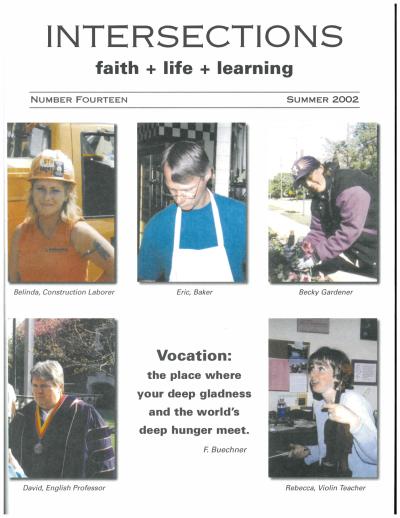
A one-act play by John P. Trump, premiered at Pacific Lutheran University, in which Maggie, a senior studying Reformation history in the library stacks, falls asleep over the Apology of Augsburg and dreams a 16th-century pickled-herring merchant—Herr Leonard Kopp, the man who smuggled Katie von Bora and eight other nuns out of the convent—into existence to argue that her call to archaeology (“digging up old bones”) is as holy as ordained ministry, with Luther’s joke that the church burns incense to insulate priests from the “holy odors” (not holy orders) of everyday life.
-
 Article
The Identity, Mission, Vision, and Goals of a Lutheran College vis a vis Bacon's "Of Studies" and Newman's "The Idea of a University"
Cora Lazor, Mary Theresa Hall
No. 15 · Winter 2002
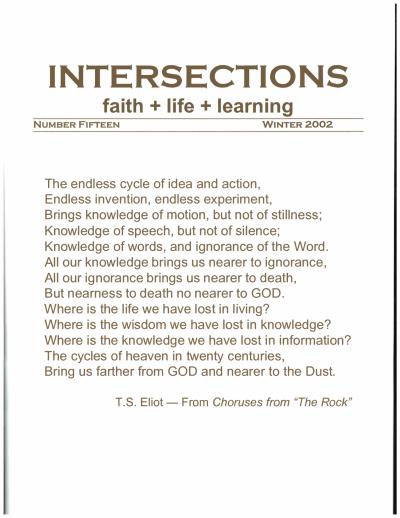
Hall, an Associate Professor of English at Thiel, and Lazor, a Thiel junior and 2002 ELCA Division for Higher Education summer intern, read Thiel College’s Statements of Identity, Mission, Vision, and Goals alongside Sir Francis Bacon’s “Of Studies” (1625) and John Henry Cardinal Newman’s The Idea of a University (engaging Azade Seyhan’s May 2002 PMLA essay along the way). They argue that Bacon’s “Read…to weigh and consider” and Newman’s defense of liberal over technical training underwrite Thiel’s new Writing-Intensive Course requirement, its ten institutional objectives, and its commitment to “service to society” in the Judeo-Christian tradition.
-
 Article
Called to Serve
Robert D. Haak
No. 31 · Winter 2010
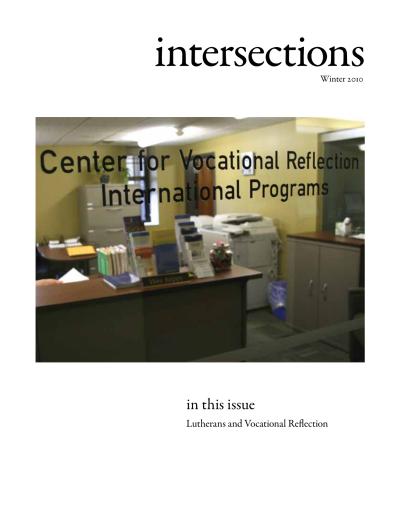
Haak describes Augustana’s Center for Vocational Reflection (CVR) and its threefold framework of skills/gifts/talents, passions/values, and needs of the community. He surveys the CVR’s Working with Faith group, seminary visits, spiritual companioning, Servant Leader Internships, international travel reflection, and the major Senior Inquiry curriculum revision—then reports the lessons learned at Augustana: that multiple exposures matter more than any single program, that the language of vocation works even for non-religious students, that student-initiated ideas (like Erin Blecha’s Athletes Giving Back) often succeed most, and that the CVR will soon merge into a new Community Engagement Center.
-
 Response
Renewing Our Journey: Some Thoughts on Pursuing the Truth
John Rehl
No. 1 · Summer 1996
Rehl, a Capital University graduate pursuing doctorates in theology at Chicago and in economics at Wisconsin, takes up Schwehn’s invitation to think again on the nature of truth. He sets aside truth as information, as object, and as mere words; recasts the church-related college’s task as a renewed emphasis on classroom teaching (Kierkegaard’s teacher as midwife) and on brave, articulate professors. He calls for moral education in courage, discipline, patience, and love, illustrates the costs of the fact-value split with examples from economics, and argues that we honor Lutheran heritage not by preserving it as a museum piece but by testing it—Luther’s theology of the cross over a theology of glory—and by preparing students for a world of Untruth, strengthened (with Julian of Norwich) by the promise that they will not be overwhelmed.