Radical Hospitality on Haunted Grounds: Anti-Racism in Lutheran Higher Education
Intersections No. 52 · Fall 2020
Selma, Charlottesville, and Louisville are all within an easy day’s drive of the Newberry College campus where I work. Only a couple of hours down the road stands Mother Emmanuel A.M.E. Church, where in July 2015 a young white man murdered nine Black worshipers during their evening Bible Study. That same young white man was raised in an ELCA congregation located within commuting distance of our campus.
The founder of our college, the Rev. Dr. John Bachman, was a Lutheran pastor who wrote eloquent theological defenses of slavery and white supremacy and offered the opening prayer of the South Carolina Secession Convention in 1860, four years after the college’s founding.
Our campus sits on land that once was home to the Cherokee people before German and Scots-Irish immigrants moved in and cotton was made king.
We at Newberry live, work, teach, mentor, and coach on haunted grounds in a haunted land.
While bearing a distinct racist and colonial past, the Southeastern United States is, of course, not alone in being haunted land. What does it mean to engage in anti-racist work on haunted ground? This is the question I put before all of us in the Network of ELCA Colleges and Universities (NECU), especially those of us who are white.1 My original assignment for this essay was to reflect upon anti-racism and Lutheran Higher Education (hereafter LHE). Other scholars and practitioners have already begun the crucial work of such reflection in a range of places, including in a recent issue of Intersections (Fall 2019). Likewise, NECU institutions are engaging in the active work of anti-racism on their campuses, strategically revising policies, piloting programs, allocating resources, revisiting history, shifting curricula, and searching souls. These efforts and their fruits are to be celebrated and, where appropriate, duplicated. It is also the case that, like Newberry, all NECU institutions struggle to balance our Lutheran institutional mission “to serve the neighbor that all may flourish” (NECU 3) with the realities of stressed resources, especially during the Covid-19 pandemic.
“What does it mean to engage in anti-racist work on haunted ground?”
Yet more fundamentally, all NECU institutions are historically, predominately, and persistently white. To acknowledge this is more than a statement of fact. We must embrace it as a confession: that we have been and we still are, despite our missional intentions, institutional instruments of white supremacy. Even having written that statement, I find that my stomach clinches and my mouth goes dry every time I read it. If you experience something similar, I encourage you to take a deep breath and to keep reading, for in the words of James Baldwin, we cannot fix what we will not face. If we seek to become robustly anti-racist, we must find ways to dwell in the discomfort and to face the white supremacy that has indelibly shaped our institutions.
Wherever we are located, the question of anti-racism and LHE is haunted. In this piece, I want to reflect on the possibilities of opening ourselves to such hauntings as a means of better attuning ourselves to the transformative work of anti-racism. I specifically want to link the LHE value of radical hospitality to the potentially productive value of allowing ourselves to be haunted. This may strike the reader as an attempt at seasonal playfulness. It is not. Rather, I offer that hauntings can become callings, so that we may imagine and embody more equitable ways of being in the world.
Institutional Anti-Racism: Limits and Possibilities
If the heritage of Lutheran higher education is steeped in whiteness, is anti-racist LHE even possible? I appeal to historian of race Ibram X. Kendi, who suggests that while it is not possible for white people to be non-racist, it is possible for white people to do anti-racist work. If this is true of persons, it can also be true of institutions, including NECU institutions, which fall into the category of “predominately white colleges and universities” (PWCUs). Martin Luther’s notion that Christians are “simultaneously saint and sinner” may help us to understand this paradox through a more dialectical understanding of how we can both perpetuate racism (as persons and organizations trapped in larger inequitable systems) and actively strive toward racial equity and justice.
“If we seek to become robustly anti-racist, we must find ways to dwell in the discomfort and to face the white supremacy that has indelibly shaped our institutions.”
People, of course, make up institutions. This means that individual persons within an institution have their own work to do. It is also the case that racial injustice and oppression persist largely by means of policies and structures that transcend individual persons. In Understanding and Dismantling Racism, antiracism trainer and pastor Joseph Barndt offers a “continuum on becoming an anti-racist multicultural institution.” The continuum ranges from stage 1, the segregated institution (common prior to the 1960s), to stage 6, an “anti-racist, multicultural institution” that is fully committed to “the struggle to dismantle racism in the wider community” and where “clear lines of mutual accountability are built between the institution and racially oppressed people in the larger society” (234-35). Most NECU institutions would fall on the continuum around stages 3 and 4, with a handful of institutions showing some nascent characteristics of stage 5. Barndt describes those stages as follows:
Stage 3: A Multicultural Institution intentionally pursues diversity and inclusion through policies and practices and considers itself non-racist by opening its doors to people of color. But there is also a lack of institutional awareness about persistent patterns of white privilege and little effort to change power structures, decision-making processes, policies, and the culture as a whole.
Stage 4: An Antiracist Institution demonstrates among its constituencies a growing awareness of systemic racism as a barrier to diversity, equity, and inclusion and an increasing commitment to eliminate inherent white privilege. Likewise, a critical mass of leadership and other constituencies claim an anti-racist institutional identity and vision.
Stage 5: A Transforming Institution translates this identity and vision into actual structural changes that guarantee the full participation of persons of color in decision-making and power-sharing at all institutional levels; that foster genuine openness to a wide range of cultural world views; and that establish mutually accountable anti-racist relationships. (234-35)
Regardless of stage, the institutional work of anti-racism is never complete, of course. Rather than viewing this perpetual work as a burden, I encourage us to see it as a promise. This means we can simultaneously and without contradiction continue to confess and repent from the white supremacist heritage of our LHE institutions and celebrate the work of anti-racism on NECU campuses. NECU institutions are doing tremendous work across the United States. We have appointed vice presidents for diversity, equity, and inclusion; targeted strategic plans; supported student vigils, protests, and movements; organized faculty and staff reading groups; planned athletics initiatives; established institutes serving their surrounding communities; won grants that equip congregations to do the work of anti-racism; shifted toward inclusive pedagogy and de-colonial curricula; revised wide-ranging campus policies; introduced new student scholarships focused on social justice; redesigned first-year experience programs centered around intercultural competency—and more. We can and should celebrate the anti-racist work of NECU institutions.
“We can simultaneously and without contradiction continue to confess and repent from the white supremacist heritage of our LHE institutions and celebrate the work of anti-racism on NECU campuses.”
We also are called to confess: This work has only just begun. This work is happening unevenly across the network. This work, done even adequately, requires resources that are scarce in the current climate of higher education and even scarcer in the age of Covid-19. This work pushes against centuries of history. This work may alienate certain donors. This work may or may not be “good business.”
“There is no vaccine or easy cure for white supremacy.”
What might motivate persistence as we strive to meet the ethical imperative of our missions while contending with the forces of history and capitalism? Notice I am not asking what will solve the problem. There is no vaccine or easy cure for white supremacy. My question is modest yet vital: What might motivate us to continue doing the steady, careful work of anti-racism?
Radical Hospitality
There are many possible motivators, and here I suggest just one among others. I call us to consider the LHE value of “radical hospitality.” Rooted and Open articulates a common mission for the colleges and universities of the ELCA. Part of that mission, the document states, is to “practice radical hospitality,” that is, to “welcome all and learn from all” by valuing the unique gifts of each student who steps onto campus. Modeled on God’s hospitality to humanity, “human hospitality to others overcomes the fear of exclusion (‘Do I belong here?’), the feeling of unworthiness (‘Am I good enough?’), and the burden of self-justification (‘I’m the expert—and you’re not!’). Hospitality makes deep learning possible” (7-8).
This is a beautiful vision—and a real challenge to make real for PWCUs. It takes us right to the heart of the question of anti-racism in LHE. The key is the difference between welcome and belonging. Hospitality for many of us brings to mind a host welcoming a guest into one’s home or to one’s table. The hyperbole of the Spanish greeting, Mi casa es su casa, reveals the limits of hospitality. You may welcome me warmly into your home, but you do not literally mean, “Please move in. Feel free to leave your shoes wherever you like, eat everything in the fridge, and stay as long as you want.” We need to distinguish welcome and belonging. Radical hospitality exceeds “welcome.” We are not simply welcoming students to our table. While our students may not stay forever, for many of them campus becomes their home for four or so years. At a certain point, ideally sooner rather than later, they should not expect to be welcomed. They should expect to belong, to be such a part of the community that they become agents of welcome for others.
This includes our Black and Brown students. Dr. Monica Smith, Vice President for Diversity, Equity, and Inclusion at Augustana College (Illinois), puts the notion of radical hospitality to the equity and inclusion test when she says:
Students of color at PWCUs [expect] that the institution will transform to meet their needs so that they can thrive, so that they can embrace the academic experience without the distractions and damage that microaggressions can cause… They hunger for their identities to be affirmed so that they can consider their vocations, rather than merely surviving their college experience. (Smith 8)
That many NECU institutions are not accomplishing this is a reality we must name with courage and humility. In our efforts to provide a quality education, to widen vocational vistas, and to increase the social mobility of our Black and Brown students (all good and worthy things), we still inevitably do harm because white supremacy is woven into our institutional DNA. Too often “success” on our campuses requires Black and Brown students to become “more white”—to suppress modes of relation, language and speech, habits and practices, and self-expressions that bear their unique cultures. This is an acute loss for them but also a loss for the PWCUs they attend. As Smith notes, “diversity will happen…. Inclusion is a choice” (7).
What Smith commends is an institutional culture that, on Barndt’s continuum, is a stage 5 heading toward stage 6. Moreover, what Smith is calling our NECU institutions to is a form of hospitality so radical that we must open ourselves to being fundamentally changed. Are we ready for that? Are we willing? This would be, after all, a hospitality so genuinely radical that it may lead to a complete unraveling of institutional identity, to the point we might even have to ask if anything “Lutheran” would remain.
The theological concept of kenosis may point the way forward. The doctrine of kenosis, based on Philippians 2, refers to Jesus’s “self-emptying” of his own will and divine status in order to become human and an instrument of God’s will. This becomes definitive for Jesus in his life, ministry, and death—namely, his own self-giving for the sake of others’ flourishing. It is precisely in decentering himself that he becomes most characteristically himself. It may be that the most “Lutheran” thing a NECU institution could do is strive to empty itself of its white supremacist ways by centering the perspectives, practices, and agency of our non-white students and constituencies. This is, of course, easier said than done. Consider it we must.
“It may be that the most ‘Lutheran’ thing a NECU institution could do is strive to empty itself of its white supremacist ways by centering the perspectives, practices, and agency of our non-white students and constituencies.”
Anti-racism is active work. It is something we do. But for white people and for persistently white institutions, we must also attend to the transformative receptivity that anti-racism requires. Hospitality is about receiving the other. Radical hospitality is about receiving the other in such a way that we open ourselves to being changed—and indeed being changed in ways we cannot predict or control. Opening ourselves to that which might disturb us is a practice that is at once active and receptive. Which brings me back to hauntings.
Haunted and Called
The specters of both racism and anti-racism are haunting. It is not only the manifestations of systemic racism that can haunt. So can the call to anti-racist work: the magnitude of the call, our sense that we are not up to the task, the dire implications for Black and Brown lives of our falling short. It can be enough to immobilize us. But I offer that the work of anti-racism should haunt us, as individuals and as institutions, and that part of genuinely radical hospitality is opening ourselves to that which haunts or disturbs us. In this sense, that which haunts us may be what ultimately calls us.
Inspired by the work of theorist Gayatri Spivak, theologian Mayra Rivera reflects on a positive sense of haunting, something unusual in the Christian tradition. Rivera observes that the one called the Holy Ghost is also called the Spirit of Truth and the Advocate, implicitly suggesting that in some cases there may be little that distinguishes being haunted from being inspired—or, we might say, called (125). In addition to being called by our missional commitments to equity and justice, we as individuals and institutions may also be called by that which haunts us. Aspirations can be too easily ignored in the day-to-day hustle. That which troubles us, not so much. In Rivera’s words, “May we pray to be haunted” (135). Being haunted can keep us from slipping into either complacency or despair. It can keep us curious and committed. It can also point individuals to their unique piece of anti-racism work.
“Being haunted can keep us from slipping into either complacency or despair. It can keep us curious and committed. It can also point individuals to their unique piece of anti-racism work.”
Just as we may pursue callings, there are many and varied means to pursue hauntings, to go in search of that which might lure us or goad us or shake us toward our most faithful next steps. We can explore history, distant and recent, to better understand the forces that shape our contexts near and far. We can educate ourselves about broader social realities that may seem far from our own lives. Diving deep into a specific issue—for example, mass incarceration, redlining, voter suppression, or disproportionate maternal mortality rates for Black women—makes it more real and more urgent, transforming the “issue” from an abstract idea to a lived reality. We can train our gaze to notice institutional dynamics on our campus that perpetuate inequities and marginalization. We can attune our ears to personal stories, told by our students, colleagues, and neighbors. We can look to the arts: from essays, novels, music, and television to street murals and poetry slams. Any one of these avenues promises to disturb our equilibrium.
All of our NECU institution are marked by the deep histories and current realities of systemic racism. Still, Newberry’s particular story is not St. Olaf’s story or Grand View’s story or California Lutheran’s story. I invite you to ask yourself and to engage in conversation with your campus colleagues: What haunts your institutions, the wider communities in which they are located, and the persons who walk the halls and sidewalks of your campuses? May each NECU campus, in its own unique place, listen for the wisdom in such hauntings—for what they might tell us about how to create genuine communities of belonging, communities of such radical hospitality that “all may flourish” both within and beyond our campus boundaries.
Endnote
1. Throughout this essay, I use the word “we” in potentially slippery and problematic ways. I use it primarily to refer to white people at the predominately white institutions of the ELCA colleges and universities because that is my primary audience for this essay. My intent is not to diminish or exclude the contributions of Black and other POC members of these institutions, but rather to call white people like me to account in the work of anti-racism.
Works Cited
Barndt, Joseph. Understanding and Dismantling Racism: The Twenty-First Century Challenge to White America. Fortress, 2007.
Kendi, Ibram X. How to Be an Antiracist. One World, 2019.
NECU (Network of ELCA Colleges and Universities). “Rooted and Open: The Common Calling of the Network of ELCA Colleges and Universities.” Accessed 1 Nov. 2020, http://download.elca.org/ELCA%20Resource%20Repository/Rooted_and_Open.pdf
Rivera, Mayra. “Ghostly Encounters: Spirit, Memory, and the Holy Ghost.” In Planetary Loves: Spivak, Postcoloniality, and Theology. Eds. Stephen D. Moore and Marya Rivera. Fordham UP, 2011.
Smith, Monica. “Making Diversity Matter: Inclusion is the Key.” Intersections (Fall 2019): 6-11.
-
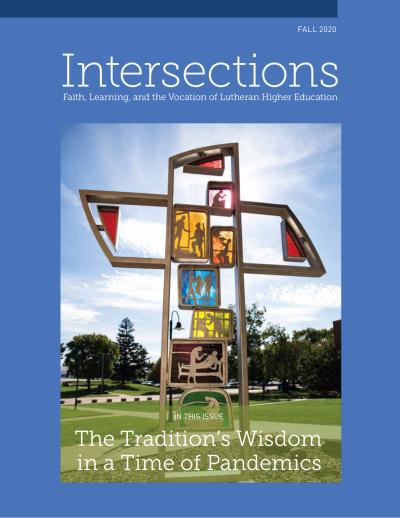 Editorial
From the Publisher
Mark Wilhelm
Wilhelm argues that the “hackneyed” expressions of higher education — “you are not just a number,” “the college experience,” “risen to the challenge” — tell the simple truth about NECU institutions even as the Covid-19 pandemic has pushed budgets, employees, and campus life to the breaking point.
-
Editorial
From the Editor
Jason A. Mahn
Mahn narrates a year of crisscrossing pandemics — Covid-19, economic collapse, partisan politics, and the long pandemic of white supremacy revealed anew by the murder of George Floyd — and argues that Lutheran liberal arts schools, by educating for vocation, are uniquely poised to help students respond with character and capable callings.
-
Article
A New Image for an Ancient Call: Lutheran Higher Education Amidst Pandemics Today
Caryn Riswold
Pairing Wartburg’s Lebenskreuz sculpture with the Matthew 25 acts of mercy and the commitments of Rooted and Open, Riswold reads the calls to feed the hungry, welcome the stranger, and care for the sick as urgent summons for Lutheran higher education in a year of overlapping pandemics — and as a call to dismantle the structures that produced them.
-
Article
Learning from Luther on Covid-19
Carl Hughes
Reading Martin Luther’s 1527 treatise “Whether One May Flee from a Deadly Plague,” Hughes finds practical and spiritual guidance for a pandemic age: serve the neighbor, follow medical experts, honor those whose vocations put them at risk, and trust that even when we fail, God will not abandon the community.
-
Article
Activism, Justice, and the Danger of Silence
Dezi Gillon
In conversation with Jason Mahn, Augustana College alumnux Dezi Gillon traces the call to action they felt as a Black student organizing for Black Lives Matter on a predominately white campus — through seminary, art, spirituality, and restorative justice work — and warns white professors that staying silent “actually speaks volumes.”
-
Article
Leadership in Lutheran Key at a Time of Pandemics
Deanna Thompson
Thompson draws on Luther’s theology of the cross and Shelly Rambo’s theology of trauma to sketch a Lutheran model of leadership for a season of pandemics — one that is attentive to pain, responsive to need, and intentionally nourished by food, friends, and deep conversation.
-
Article
Through Truth to Freedom—by Way of Reconciliation
Paul C. Pribbenow
Reflecting on Augsburg’s 150th-anniversary motto “Through truth to freedom,” Pribbenow argues that in a season of three pandemics — pandemic illness, economic collapse, and the racial sin laid bare by the murder of George Floyd — higher education’s most authentic work is to educate for truth and freedom by way of confession and reconciliation.
-
Article
Finding Purpose in Chaos: Reflection In and Beyond the Public Health Classroom
Lena R. Hann
When the pandemic hit her new public health professionalism course, Hann recalibrated her teaching from the “how” of professional preparation to the “why” of vocational reflection — and recounts how Augustana public health students and alumni found purpose in the chaos through food banks, disaster response, palliative care, and research on health inequities.
-
Reflection
The Long Pilgrimage of 2020-21
Kara Baylor
Drawing on Martha Stortz’s definition of pilgrimage as “intentional dislocation, for the sake of transformation, where the body teaches the soul,” Baylor invites students and educators worn out by the 2020-21 academic year to ask what is essential, to listen to what their bodies are telling their souls, and to be more open to the transformations the dislocation might still yield.
-
Article
Called to Flourish: An Ethic of Care
Mindy Makant
Drawing on Lenoir-Rhyne’s core value of Care, Glennon Doyle’s Untamed, Darrel Jodock’s “Gift and Calling,” and Luther’s plague-era practice of opening his home to the sick, Makant argues that flourishing is interdependent — that self-care is a means to extending care, and that an ethic of care is the meaningful, transformative work to which Lutheran liberal arts education is called.
-
Article
Called to the Moment: A New Vocation for Lutheran Colleges
W. Kent Barnds
After a derecho ravaged Iowa in August 2020 and Pastor Katy Warren preached on 1 Peter 4, Barnds watched line workers, neighbors, and Augustana colleagues simply show up where they were needed — and proposes that the true vocation of a Lutheran college may be making the case for “meeting immediate need with a deep willingness” alongside the longer work of vocational discernment.
-
 Article
A Lutheran Call for Educator Flourishing
Krista E. Hughes
No. 58 · Fall 2023
Hughes argues that without educator flourishing there is no student flourishing, traces how an exploitative “passion tax” can distort vocation, and offers seven Lutheran “third-way” value pairings — including Metrics/Grace, Efficiency/Kairos, and DEI/Priesthood of All Believers — to reframe institutional success at NECU campuses.
-
 Article
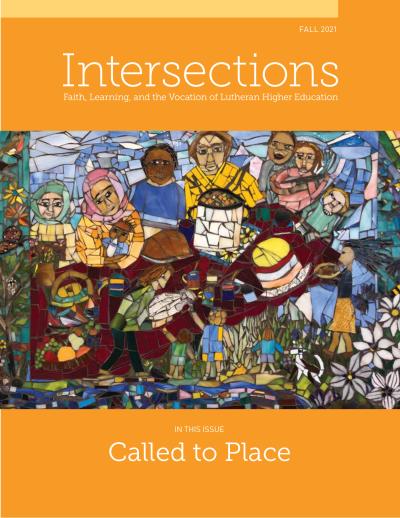
Community-Building On Campus and Beyond
Krista E. Hughes
No. 54 · Fall 2021
Hughes describes Newberry College’s effort to build a “culture of community” that mirrors South Carolina’s demographics while reckoning with the institution’s founding ties to slavery — and names the challenges and promising city-college collaborations that shape this ongoing work.
-
 Editorial
From the Publisher
Mark Wilhelm
No. 29 · Spring 2009
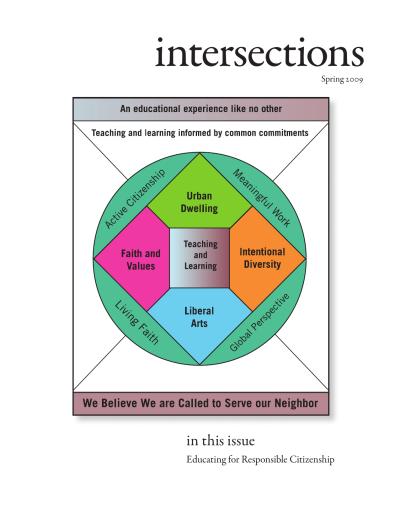
Wilhelm introduces essays from the 2008 Vocation of a Lutheran College Conference held at Luther College under the theme “Educating for Responsible Citizenship,” previewing contributions from Paul Pribbenow on dual citizenship at Augsburg, Wanda Deifelt on Luther College’s engagement with civic vocation, Jose Marichal on the promise and peril of digital citizenship, and Arne Selbyg on his three experiences of being educated for citizenship.
-
 Institutional Focus
Serving and Building Community at Concordia College
Larry Papenfuss
No. 55 · Spring 2022
Papenfuss, director of the Dovre Center for Faith and Learning, frames eight ways Concordia College serves the world by building community — from quality teaching and liberating liberal learning to interfaith cooperation and modeling “diversity with particularity” as a Lutheran “third path” institution.
-
Article
Where Your Feet are Standing: Institutional Engagement and Place
Melissa Maxwell-Doherty
No. 54 · Fall 2021
Maxwell-Doherty draws on Cal Lutheran’s Hispanic-Serving Institution designation and its location on Chumash, Fernandino Tataviam, and Ohlone lands to ask how the university’s mission might shift if it depended on where its students are standing — not just where the institution sits.
-
 Article
Creation, Justice, and Communio: Lutheran Insights Empowering Educational Access
Mary Elise Lowe
No. 60 · Fall 2024
In her VLHE keynote, Lowe names three Lutheran commitments — continuing creation, neighbor justice, and communio — as the “why” that empowers ELCA colleges and universities to pursue equitable access for students often left behind by persistence and graduation gaps.
-
 Reflection
Saving Minds
Lake Lambert
No. 28 · Fall 2008
In a sermon preached in the Castle Church in Wittenberg during Wartburg College’s 2006 faculty and staff development seminar, Lambert names two sins of the mind—coveting and mental sloth (in both its rigid refusal to think and its mindless relativism)—and, drawing on Luther’s Large Catechism and Martin Luther King, Jr.’s “A Tough Mind and a Tender Heart,” calls Christians to receive the wisdom that comes when faith puts knowledge into action, sustained by the hope of the resurrection.
-
 Article
Called to Compassion over the Course of a Life: A Buddhist Perspective
Florence D. Amamoto
No. 47 · Spring 2018
Amamoto, an associate professor at Gustavus Adolphus shaped by Jodo Shin Shu Buddhism, argues that although Buddhism has no “caller” God, it has a strong sense of calling — we are called by the world to respond to the suffering around us with mindfulness, egolessness, and compassion — and that this lifelong journey is enriched by encounter with the Lutheran vocational tradition.