All of us on college and university campuses face incredible challenges brought on by the pandemics of Covid-19 and systemic racism. Many if not most of us are looking for guidance on how to rise to meet these unprecedented moments. There are many places from which to seek guidance, inspiration, and hope—from movement spokespersons to trusted faculty and staff on our campuses.
I’m at St. Olaf College where the college’s mission includes the language of being “nourished by Lutheran tradition.” In addition to numerous contemporary voices of wisdom, I propose that the tradition might also offer insight for the living of these days. Sixteenth-century reformer Martin Luther challenged the religious hierarchies and systems of his day, calling for reforms of structures that harmed those who were often ignored by the powerful. For Luther, the Christian story of God becoming human, suffering, and dying on the cross means that God is not to be found among the powerful, but rather among the suffering. Therefore, Luther believed, being attentive to the pain of those in our midst means attending to the spaces where God is present.
One of Luther’s big ideas is that we cannot earn our own salvation; we can’t justify ourselves or earn our way to heaven. Therefore, our living is in response to the gift of life we are given rather than an attempt at achievement on our part.
Because our living isn’t about proving ourselves to God or to others, Luther understood humanity to be freed up to focus on the needs of our neighbors. Not to the exclusion of our own basic needs, but caring for those in need, he believed, should be our primary orientation.
Drawing on these insights from Luther, I suggest that leadership in a Lutheran key in a time of great hardship includes:
- Being attentive (to the pain)
- Being responsive (to the pain)
- Being nourished (that is, fortified for your role as leader)
Let’s take a closer look at each of these in turn.
Being Attentive (to the Pain)
Martin Luther was a pastor and a monk dedicated to studying, preaching, and teaching. While many religious leaders of his day were focused on building grand cathedrals and amassing wealth for the church, Luther paid attention to those who were being exploited under the current church system. The church was getting rich by charging parishioners to participate in practices such as indulgences and the viewing of relics, practices billed as enhancing one’s status before God. Luther spent his days speaking out about such practices, exposing the economic harm these practices were causing for those who were already struggling.
During this time of the dual pandemics of 2020, we are keenly aware of large-scale suffering all around us. At the time that I write this, there have been over one million cases of Covid-19 diagnosed worldwide and the over 200,000 American deaths caused by the virus. Equally painful, Breonna Taylor, George Floyd, and countless other Black and Brown people have been killed by the police or harmed by other societal structures. We are steeped in anger, grief, and lament.
The language of trauma is becoming more a part of our collective vocabulary as we seek to better understand long-term effects of such suffering. Theologian Shelly Rambo calls trauma “the suffering that remains” (15). When something traumatic happens, we experience a kind of death, the death of bodily safety or integrity, the death of health, the death of a particular way of life. But life continues on and the suffering that accompanies us is the trauma.
“Leadership in a Lutheran key calls on leaders to pay attention to where God is—in and amidst the pain.”
Leadership in this time of pandemics calls us to attend to the suffering and trauma of those around us—to notice it, inquire about it, call attention to it. For Luther, the story of Jesus’s life, which leads to crucifixion, illustrates that God is where the suffering is, that God is present with those who suffer from the virus, from the pandemic of racism, from the trauma of illness and police brutality and more. Leadership in a Lutheran key calls on leaders to pay attention to where God is—in and amidst the pain.
Being Responsive (to the Pain)
Even though Luther was a professor of Old Testament, he didn’t spend his days holed up in a monastery writing big ideas about God and the world. Instead, he spent time on issues calling for his attention. It is important to acknowledge that he didn’t always live up to his own insistence that Christian faith frees Christians up to serve the needs of the neighbor. Still, his vision of Christian life and dogged emphasis on love of neighbor led him to take action in ways that helped support the needs of those around him who were suffering.
Students, faculty, staff, and administrative leaders often have strong visions for what their student organization or team or department might be able to accomplish. Many of us have several big ideas we plan to implement.
And yet, we are more aware this year than most that life doesn’t always go as planned. Leadership in a time of pandemic includes responding to those who are in pain, especially those within our circle of care. Whether it is those in one’s student organization or residence hall, in one’s department, office, or team, being a leader involves working with others to address the needs of those in your community.
Some of the initiatives we’ve been hoping to implement may not happen. Our roles—our vocations—as leaders may entail tasks that we haven’t yet envisioned, but that are called for in this time of pandemics. Given the unprecedented reality of the Covid-19 and systemic racism pandemics, being responsive to the needs of others may be the most important action we take in these exhausting days.
Being Nourished for the Work Ahead
Being an attentive, responsive leader takes time, energy, courage, and stamina. We also must be nourished for this demanding calling.
Looking back at life of Martin Luther, he also took being nourished very seriously. Luther was known for his almost-nightly “table talk” gatherings at his home, where friends, students, and colleagues would gather around the Luthers’ table to eat, drink, and debate issues that mattered in their lives. To live most fully into the leadership roles to which we now are being called, we are in need of multiple forms of nourishment—of good food and drink, of quality time with friends, of time for deep conversations about the issues that matter most to us.
A couple years ago, I invited Lena Gardner, then one of the leaders of Black Lives Matter Minneapolis, to speak to one of my classes. As an activist, she has offered trainings throughout the country on the methods and approaches of Black Lives Matter. She told my students that when she asks these groups what they need the most to continue their work, they often tell her that they need spiritual nourishment. Their spirits need nourishing in order to help sustain them in their role leaders.
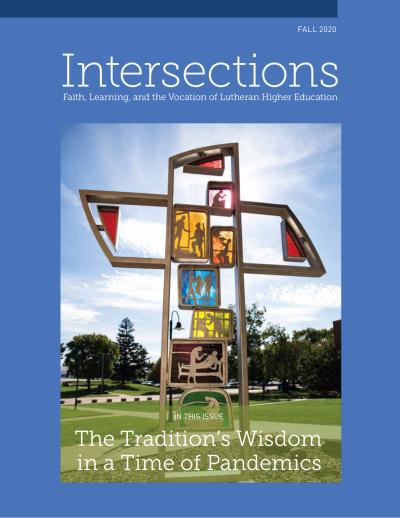
There’s a mosaic that now hangs on a wall in the Lutheran Center at St. Olaf that was created last fall as part of the Center’s launch (see above image). It was created by two Lutheran pastors, Patrick and Luisa Hansel, who served a mostly immigrant church in Minneapolis until their retirement the summer before. Several dozen members of the St. Olaf community participated in putting pieces of the mosaic together. It captures the sense of what it means to be nourished to do the work that matters most in this world. The people in the mosaic come from different religious and cultural backgrounds and gather around a table where they are nourished by food and drink. They are nourished by the rich natural world that surrounds them and by their connections to one another. I think the mosaic provides a vision of what nourishment for the work ahead might look like.
“To live most fully into the leadership roles to which we now are being called, we are in need of multiple forms of nourishment—of good food and drink, of quality time with friends, of time for deep conversations about the issues that matter most to us.”
This is an incredibly challenging time to be a leader. But your campus, your neighborhood, your communities needs you. We’ll be better at being community because of your attentiveness, responsiveness, and the ways you’ll come together with others to nourish and be nourished as you help us move toward better days.
Works Cited
Rambo. Shelly. Spirit and Trauma: A Theology of Remaining. Westminster, 2010.
-
 Editorial
From the Publisher
Mark Wilhelm
Wilhelm argues that the “hackneyed” expressions of higher education — “you are not just a number,” “the college experience,” “risen to the challenge” — tell the simple truth about NECU institutions even as the Covid-19 pandemic has pushed budgets, employees, and campus life to the breaking point.
-
Editorial
From the Editor
Jason A. Mahn
Mahn narrates a year of crisscrossing pandemics — Covid-19, economic collapse, partisan politics, and the long pandemic of white supremacy revealed anew by the murder of George Floyd — and argues that Lutheran liberal arts schools, by educating for vocation, are uniquely poised to help students respond with character and capable callings.
-
Article
A New Image for an Ancient Call: Lutheran Higher Education Amidst Pandemics Today
Caryn Riswold
Pairing Wartburg’s Lebenskreuz sculpture with the Matthew 25 acts of mercy and the commitments of Rooted and Open, Riswold reads the calls to feed the hungry, welcome the stranger, and care for the sick as urgent summons for Lutheran higher education in a year of overlapping pandemics — and as a call to dismantle the structures that produced them.
-
Article
Learning from Luther on Covid-19
Carl Hughes
Reading Martin Luther’s 1527 treatise “Whether One May Flee from a Deadly Plague,” Hughes finds practical and spiritual guidance for a pandemic age: serve the neighbor, follow medical experts, honor those whose vocations put them at risk, and trust that even when we fail, God will not abandon the community.
-
Article
Radical Hospitality on Haunted Grounds: Anti-Racism in Lutheran Higher Education
Krista E. Hughes
Writing from Newberry College’s campus on land once home to the Cherokee and within a day’s drive of Mother Emanuel A.M.E., Hughes argues that NECU’s call to “practice radical hospitality” demands that predominately white institutions open themselves to the hauntings of racism — pursuing belonging rather than mere welcome, and risking kenotic transformation of institutional identity itself.
-
Article
Activism, Justice, and the Danger of Silence
Dezi Gillon
In conversation with Jason Mahn, Augustana College alumnux Dezi Gillon traces the call to action they felt as a Black student organizing for Black Lives Matter on a predominately white campus — through seminary, art, spirituality, and restorative justice work — and warns white professors that staying silent “actually speaks volumes.”
-
Article
Through Truth to Freedom—by Way of Reconciliation
Paul C. Pribbenow
Reflecting on Augsburg’s 150th-anniversary motto “Through truth to freedom,” Pribbenow argues that in a season of three pandemics — pandemic illness, economic collapse, and the racial sin laid bare by the murder of George Floyd — higher education’s most authentic work is to educate for truth and freedom by way of confession and reconciliation.
-
Article
Finding Purpose in Chaos: Reflection In and Beyond the Public Health Classroom
Lena R. Hann
When the pandemic hit her new public health professionalism course, Hann recalibrated her teaching from the “how” of professional preparation to the “why” of vocational reflection — and recounts how Augustana public health students and alumni found purpose in the chaos through food banks, disaster response, palliative care, and research on health inequities.
-
Reflection
The Long Pilgrimage of 2020-21
Kara Baylor
Drawing on Martha Stortz’s definition of pilgrimage as “intentional dislocation, for the sake of transformation, where the body teaches the soul,” Baylor invites students and educators worn out by the 2020-21 academic year to ask what is essential, to listen to what their bodies are telling their souls, and to be more open to the transformations the dislocation might still yield.
-
Article
Called to Flourish: An Ethic of Care
Mindy Makant
Drawing on Lenoir-Rhyne’s core value of Care, Glennon Doyle’s Untamed, Darrel Jodock’s “Gift and Calling,” and Luther’s plague-era practice of opening his home to the sick, Makant argues that flourishing is interdependent — that self-care is a means to extending care, and that an ethic of care is the meaningful, transformative work to which Lutheran liberal arts education is called.
-
Article
Called to the Moment: A New Vocation for Lutheran Colleges
W. Kent Barnds
After a derecho ravaged Iowa in August 2020 and Pastor Katy Warren preached on 1 Peter 4, Barnds watched line workers, neighbors, and Augustana colleagues simply show up where they were needed — and proposes that the true vocation of a Lutheran college may be making the case for “meeting immediate need with a deep willingness” alongside the longer work of vocational discernment.
-
 Institutional Focus
So That All May Belong: Lutheran Roots for Diversity, Equity, Inclusion, and Justice
Altheia Richardson, Angie Hambrick, Caryn Riswold, Colleen Windham-Hughes, Deanna Thompson, Marcia Bunge, Robert Clay
No. 61 · Spring 2025
22 min audio
The full NECU statement grounds DEIJ work in Luther’s 16th-century reforms and Lutheran theological claims about the image of God, equal dignity, and the limits of human knowing — offering definitions, Lutheran roots, and calls to action for diversity, equity, inclusion, and justice, with belonging as the outcome of DEIJ at work.
-
Institutional Focus
Scriptures That Inspire Work for Diversity, Equity, Inclusion, and Justice
Altheia Richardson, Angie Hambrick, Caryn Riswold, Colleen Windham-Hughes, Deanna Thompson, Marcia Bunge, Robert Clay
No. 61 · Spring 2025
9 min audio
A companion list of biblical verses — from Genesis 1:27 and Galatians 3:28 to Micah 6:8 and Luke 4:18-19 — that grounded NECU’s drafting of So That All May Belong, organized by the four DEIJ commitments and offered as an invitation to share other texts that ground and sustain the work.
-
Institutional Focus
So That All May Belong: Lutheran Roots for Diversity, Equity, Inclusion, and Justice [abridged]
Altheia Richardson, Angie Hambrick, Caryn Riswold, Colleen Windham-Hughes, Deanna Thompson, Marcia Bunge, Robert Clay
No. 61 · Spring 2025
8 min audio
A condensed version of the NECU statement that consolidates Lutheran theological grounding for DEIJ and a single combined call to action for Lutheran colleges and universities — offered as a shareable summary alongside the complete document.
-
 Article
Beyond Deep Gladness: Coming to Terms with Vocations We Don’t Choose
Deanna Thompson
No. 58 · Fall 2023
Thompson, living with incurable cancer, expands Frederick Buechner’s definition of vocation to make room for deep sadness — drawing on Arthur Frank, Shelly Rambo, Beverly Wallace, and Ross Gay to argue that practices of lament, including the public lament of Friday Flowers at St. Olaf, open space for gladness, joy, and even flourishing to emerge.
-
 Reflection
Reflections on Lutheran Identity on Reformation Sunday
Thomas W. Martin
No. 19 · Summer 2004
Beginning with an “intellectual vertigo” experienced when his celebrant announced that “today the Church gathers to celebrate the Reformation,” Martin—a biblical scholar who has belonged to four Protestant denominations—asks how Lutherans should tell their own foundational myth. He argues that the Reformation was a mixed bag whose dark side includes a century of religious warfare and the killing of Anabaptists; that Luther himself is too mythic a figure to monopolize; and that distinguishing “constitutive” from “prophetic” reading (after James Sanders) opens the way to a Reformation Sunday told “together with” rather than “over and against” the rest of the Church—one that mixes repentance for the dark with celebration of the glory.
-
 Article
Deep Roots, Big Questions, Bold Goals
Colleen Windham-Hughes
No. 49 · Spring 2019
Adapted from a presentation to the California Lutheran University Board of Regents, Windham-Hughes reads the title Rooted and Open as both reaching back into the Lutheran tradition and opening forward into a shared future, then unpacks the document’s “called and empowered — to serve the neighbor — so that all may flourish” through the lenses of freedom of inquiry as a third path, vocation-centered education, radical hospitality, and civil discourse oriented toward the common good.
-
 Editorial
From the Editor
Robert D. Haak
No. 23 · Summer 2006
Haak previews the issue’s four essays by Marcia Bunge, Paul Dovre, Samuel Torvend, and Cheryl Budlong — each engaging the ELCA Task Force on Education’s study document and first draft of the social statement on Lutheran education — and invites readers to bring their distinctive voices as professional educators at Lutheran institutions into the conversation before the October 15 deadline. He also invites submissions to Intersections and directs readers to LauraOMelia@augustana.edu to be added to the direct mailing list.
-
 Editorial
From the Publisher
Mark Wilhelm
No. 50 · Fall 2019
Wilhelm frames the issue by noting that a federal court’s vindication of Harvard’s race-conscious admissions process is a win for higher education’s commitments to diversity, equity, and inclusion — and argues that for Lutheran higher education, the commitment to diversity is an old and foundational claim, rooted in Christianity’s openness to all and reflected in the four diverse gospels of the New Testament.
-
 Article
Business as Usual? Marketing, God, and the Limits of Christian Callings
Emily Beth Hill
No. 51 · Spring 2020
Hill, a former corporate marketing consultant turned theologian, returns to Luther’s claim that no vocation is more holy than another — and uses Luther’s Large Catechism definition of God to argue that the modern practice of branding intentionally redirects the love and worship of human beings toward capital, raising the question of whether Christian neighbor-love places limits on what professions Christians should pursue.
-
Article
The "V" Word: Different Dimensions of Vocation in a Religiously Diverse Classroom
Martha E. Stortz
No. 50 · Fall 2019
Stortz responds to a sea of blank stares when she used the word “vocation” in a religiously diverse required course by offering five metaphors — place, path, relationships, lens, and story — that point to different dimensions of vocation across the world’s religions and help students articulate their callings on their own terms.