For more than a decade Augsburg College has been thinking deeply about what it means to have a vocation. It began in 1997 with a visioning process initiated by President William Frame. As a result of those discussions it became clear that Augsburg saw itself as a college with a calling. This was followed in 2002 with the receipt of a two million dollar grant from the Lilly Endowment Fund to investigate the theological understanding of vocation on campus. As will be noted below, in the midst of this grant the college enlisted the aid of the Wilder Foundation (the Called for Life study) to help it ascertain whether students, faculty and staff were getting the message. And now Augsburg is poised to move into the next phase of its engagement with the idea of vocation. At the conclusion of the Lilly Endowment grant in 2010 the school has made provision for the establishment of the Augsburg Center for Faith and Learning (ACFL). This Center will carry on much of the work of the Lilly Endowment grant and lay the foundation for new and creative ways to engage a theological understanding of vocation at the college.
This essay will highlight how Augsburg has integrated the idea of vocation into the life of the college in the past ten years. However, we will begin with the Reformation, as this crucial period of the church has provided the theological framework for thinking about vocation at the school. We will then see how some of these ideas were “institutionalized” during the Lilly grant. Finally we will sketch some possibilities for the future, using our work with Wilder and the ACFL as a guide.
Our Lutheran Heritage
It would be a mistake to think that this focus on vocation is something new at Augsburg. If vocation be understood as the attempt to articulate what it means to be loved by God in the daily life of service to the neighbor, then this college has been about the business of vocation from the very beginning. In fact, the school saw itself as part of a rich Christian tradition stretching back to the Bible itself. Time and space prevent us from exploring the manifold resources on vocation that can be found in the Scriptures and the early Christian period. Instead we will pick up the story in the sixteenth century with Martin Luther’s appropriation of this tradition.
Luther’s theology of vocation must be located in the cultural context of the sixteenth century church. At that time there were essentially two classes of Christians—those who supposedly committed themselves to a “holy” life such as that lived by a monk, nun or priest and the vast majority people who continued to live in the “world” and experience its temptations. The former had vocations or “callings.” It was believed they performed a higher duty or service and thus were able to gain merit for themselves and for those left behind in the world. The latter—such as the midwife, farmer or blacksmith—served humanity by sustaining earthly life with their labors but possessed occupations which lacked the inherent sanctity of the clerical or monastic realm. (Tranvik, “Vocation” 4-6)
A theological foundation based on merit made it possible to construct this two-tiered view of the world. The schemes of salvation in the late middle ages varied but all insisted that humans must do something to make themselves right with God. Note that this did not mean that good works alone were sufficient. Grace was also underlined as necessary and important. But the idea was to combine grace and human effort in order to be saved.
As Luther steeped himself in the world of the Bible during his time in the monastery he became convinced that this way of conceiving of one’s relationship to God was false. Relying heavily on the Apostle Paul, he began to believe that one is justified not by works or a combination of faith and works but by faith alone. Luther found great comfort in the God revealed on the cross of Jesus Christ. This was a God who entered deeply into the human condition, even to the point of becoming “sin” (2 Cor. 5:21) and knowing the desolation and darkness of rejection and death. But these hostile forces did not have the final word; the resurrection signaled God’s triumph over the powers of evil. Men and women in a relationship of faith were now liberated to serve their neighbors and care for creation. For Luther, the God revealed on the cross freed humanity from its anxious quest for meaning, purpose and salvation. This God calls people into a relationship of faith and then provides them with callings in the world where they will be instruments of this bold love.
It is a serious misunderstanding of Luther to think that his views on grace and faith were simply abstract matters of theology with little relevance for earthly life. Luther’s rediscovery of a gracious God was not merely an intellectual enterprise. Its reverberations would be felt in homes, villages and cities across Europe. If Luther is right in saying we are saved by grace through faith and not works, then life in the world is experienced in an entirely different way. It is no longer the place where we attempt to placate a demanding God. Or, in a more modern idiom, the world is no longer the realm where we find our core identity in what we do or achieve. Moreover, mindful of the interpretation of the late medieval church, “vocations” are not limited to a special class of Christians who by the supposed holiness of their lives have placed themselves closer to their Creator. Instead, all Christians are called by God and empowered by his undeserved love to serve their neighbors. This point deserves emphasis: all Christians have callings or vocations. (Tranvik, “Vocation,” 6)
It might be useful at this point to provide a brief summary of Luther’s teaching on vocation. It will be evident from the material that follows that these themes inform the programs of Augsburg’s Lilly Endowment grant (Exploring Our Gifts) as well as the proposals for the Augsburg Center for Faith and Learning.
Vocation includes the whole life of a person and is not simply his or her occupation. Because of the conviction that God operates in every sphere of life (and not just in church or work), Christians understand that their callings encompass every area of life (whether one is an employee, student, neighbor, parent, friend, etc.). Vocation involves all of life’s relationships.
The purpose of vocation is to live for the sake of others—for their spiritual, physical, moral and cultural well-being. God upholds his creation and keeps order in human society by means of vocation. Luther describes this activity of God as “masks” which God uses to keep creation in good order. The overall focus of every calling is the need of the neighbor. Luther reportedly once noted that God doesn’t want a cobbler who puts crosses on shoes. Rather, God wants a cobbler who makes good, reliable footwear.
All true vocations rank the same with God. As already noted, there are no “higher” or “lower” callings. In the human realm distinctions will be made and the value of work measured by “human” norms. But in God’s eyes the manager and the maid are both needed to keep human society functioning at an optimal level.
Vocation cannot be boiled down to ethics. This is a tempting but false interpretation of Luther’s insights. Crucial to preserving a healthy understanding of vocation is the knowledge that one’s identity and future are in the hands of a God who is trustworthy. If this essential link with God is obscured or ignored, then the result is an overwhelming temptation to be defined by one’s calling in life. Soon the self is no longer looking beyond its boundaries for ways to be of service but is instead trying to secure its own identity by its activity in the world.
Vocation distinguishes but does not separate the roles of faith and politics in public life. Luther’s teaching on vocation (the complicated legacy of his two kingdoms doctrine hovers over this discussion) makes clear that faith cannot be quiet in matters political. The political sphere is simply another arena where the neighbor is served. But the Lutheran tradition on vocation underlines that there is no specific Christian agenda for the world. It walks a fine line that advocates a passionate engagement in political activity while avoiding the zealotry often linked with positions that claim God for a particular position or point of view.
Exploring Our Gifts: The Lilly Endowment Grant
Augsburg is proud to see itself within a long and deep tradition of reflection on vocation. It is an heir to the teaching of the Reformation. Figures who have been fundamental in shaping the college, such as Georg Sverdrup and Bernhard Christensen, intuitively saw their work and lives through the lens of vocation. (Sverdrup 92) Given this legacy, it is not surprising that Augsburg would apply for a Lilly Endowment grant in 2001.
The immediate background for the request to Lilly was a series of commissions that were established by President William Frame as part of a strategic planning process in 1997. The product of those meetings was a document known as Augsburg 2004, Extending the Vision. At the heart of Augsburg 2004 was the theme of vocation and a determination by the college to equip all students with the ability to live out their lives and careers as callings. Given this sensibility, it was not surprising that a team of Augsburg faculty and staff jumped at the chance to submit an application for one of the Lilly Endowment’s generous grants. Their efforts were rewarded in 2002 when the college was awarded two million dollars for its proposal “Exploring Our Gifts: Connecting Faith, Work and Vocation.”
A unique feature of the proposal was the way it was built from the ground up. Reflecting the college’s historical resistance to hierarchical thinking (the legacy of the Lutheran Free Church), the committee that organized the grant solicited over thirty proposals from all sectors of the Augsburg community. Eventually fifteen different projects were chosen. They were organized under four themes: Vocation as a Life Approach, Vocation as a Curricular Focus, Vocation as Education For Service, and Developing Vocational Awareness in Faculty, Staff and Students. Happily, the college also received a sustainability grant ($500,000) from the Lilly Endowment in 2007, which allowed it to extend Exploring Our Gifts through the 2009-10 academic year. While it would not be useful to detail all the programs in the college’s initiative, some of the more successful features of Exploring Our Gifts are highlighted below.
Vocation as a Life Approach includes monthly chapel services where speakers are invited to talk about their sense of calling. Also under this theme is a retreat where a small group of underclassmen leave campus and spend two days reflecting on their gifts, strengths, and interests. Another part of “Life Approach” emphasis is the use of vocational assessments by the college’s Center for Service, Work and Learning to help students reflect on life’s purpose and meaning.
Vocation as a Curricular Focus makes extensive use of Augsburg’s well known Center for Global Education. Travel, study and service abroad afford excellent opportunities for vocational reflection. Travel seminars to all corners of the globe have a theological understanding of vocation as a central component. Another program in this area is the Lilly Scholars, where ten students who have a desire to explore ministry in the church meet on a monthly basis to discuss how their sense of calling intersects with some of the great theological thinkers in the Christian tradition.
Vocation as Education for Service emphasizes putting a sense of calling into practice. Under this theme, students are given stipends for work in church camps as well as provided internship opportunities at non-profits in the Minneapolis-St. Paul metro area. Also included is the sponsorship of an alternative spring break (service trips to the hurricane-devastated areas around New Orleans) and a Youth Theology Institute where high school youth from around the country come to Augsburg for a week of intensive study around a theological theme.
Developing Vocational Awareness in Faculty, Staff and Students provides a wide variety of opportunities. These include book groups, forums with off-campus speakers, and the sponsorship of Till and Keep, an annual journal that includes essays and art work by the members of the Augsburg community. Given the college’s location in the heart of the city, an annual forum on inter-religious dialogue gives the community a chance to discuss issues of faith and calling with non-Christians, particularly Muslims and Jews. Another successful program in this overall category is the “Lilly Lunch” where a faculty or staff member talks about his or her sense of calling. These events often draw close to one hundred attendees. Finally, a seminar for new faculty orientation means that professors recently hired by Augsburg will meet regularly over a two-year period to discuss the history and mission of the school and be invited to consider their own lives and teaching within the framework of vocation.
One other development in the area of vocation also needs to be mentioned. A theological understanding of vocation brackets the entire Augsburg curriculum. The religion department has played a key leadership role in cultivating a sense of calling at the school. In response to the momentum created by Exploring Our Gifts, it has reorganized its own course offerings to reflect an emphasis on vocation. Students at Augsburg are required to take two classes in religion. The religion department has developed two new entry-level courses entitled “Christian Vocation and the Search for Meaning I” and “Christian Vocation and the Search for Meaning II.” These are novel and creative attempts to re-think how religion is taught at a college of the church. Using the lens of vocation, the biblical and Christian tradition is now transmitted to students with an eye toward nurturing a sense of calling. Academic rigor and critical thinking remain a key part of the process. But now the goal is to have students listen to the tradition in a way that encourages them to reflect on their own sense of meaning and purpose. Moreover, students are challenged to think about what it might mean to take this sense of vocation into their homes, communities and the wider world.
Furthermore, all students at Augsburg are required to take a senior seminar or “Keystone” course in their major. This class includes significant work in their field of study. But it also entails revisiting the whole idea of vocation. Before they leave Augsburg, students are invited once again to think about their lives within the framework of vocation. Moreover, they are encouraged to think about their future in terms of a calling. This includes not only their work life but also the lives they lead in their homes and communities. Overall, in addition to the programs of Exploring our Gifts, this emphasis in the curriculum means that a meaningful encounter with vocation is unavoidable on the Augsburg campus.
In summary, these programs and classes have allowed Augsburg to claim an essential component of its Lutheran heritage and invest it with a vitality that is appropriate for the twenty-first century. The attempt has been to create a “culture of call” where education is no longer seen simply as a means to self-advancement but is rather grounded in a Christian vision where the ultimate goal is love and service in the world. Augsburg’s current president, Paul Pribbenow, has made this the central theme of the school by emphasizing that “we believe we are called to serve our neighbor.” (Pribbenow)
Called for Life: The Wilder Foundation Study
Happily, in the midst of its work with the Lilly Endowment grant, Augsburg received an opportunity to assess how well it was transmitting the concept of vocation to its students. In 2004 a series of discussions took place between Richard Torgerson (president of Luther College), Jack Fortin (director of Luther Seminary’s Centered Life project), and David Tiede (president of Luther Seminary). The result of these conversations was a successful application to the Lilly Endowment asking for funds to support an assessment of vocational discernment in undergraduate schools and college. Augustana College (Rock Island), Luther College and Augsburg College were selected as sites for the assessment. All had received Lilly Endowment grants and had indicated an eagerness to find out how vocation was being integrated into the lives of students. The well-regarded Wilder Foundation of St. Paul, MN, was selected to develop and administer the assessment, which became known as the Called For Life study.
Called For Life came at about the midpoint of Exploring Our Gifts. Augsburg had long been planning to “institutionalize” a sense of calling amongst students, faculty and staff. Among the vehicles to accomplish this was the establishment of the Augsburg Center for Faith and Learning. It was envisioned that the ACFL would assume many of the responsibilities of Exploring Our Gifts. But there was also the recognition that because of budget realities not everything would be retained. Decisions needed to be made about which programs would be funded and what priorities would be emphasized. Called For Life helped Augsburg figure out where its resources would be mostly wisely spent.
Two things from Called For Life deserve special attention. First, the survey makes clear that the Lilly Endowment grants at Augsburg, Augustana and Luther College have been extremely effective in helping students view their lives through the lens of vocation. For example, ninety-one percent of the class of 2007 reported that their understanding of vocation deepened while at college. Moreover, it is also clear that the grants have been effective in helping students think about vocation in relation to service to their community. This is particularly important given the rampant individualism that pervades American culture and higher education. It is also significant since many popular presentations of vocation focus solely on the individual and the importance of finding one’s “bliss.” Finally, when compared with pre-Lilly alumni, Called For Life reports that graduates were twice as likely to develop a sense of vocation while attending college. (Wilder Foundation)
Secondly, the success of the programs helps to validate how Augsburg has sought to integrate vocation into the life of the campus. As stated above, particularly important at Augsburg has been the use of vocation in the curriculum. Called For Life underlines the usefulness of this approach. As Augsburg develops the programs and initiatives of the ACFL, it is clear that the integration of vocation into the curriculum will remain a high priority. However, this does not mean that co-curricular efforts will be ignored at the college. The ACFL recognizes the need to cast a wide net and this will include programs that are not connected to courses per se. But the college now knows that faculty and staff development related to vocation must be a central concern. The values and commitments of an institution are reflected in the classes offered and the people who teach them. Augsburg will continue to seek new and creative ways to cultivate a sense of calling in the instructor, and most importantly, in the learner.
The Next Step: The Augsburg Center For Faith and Learning
In 2008 the college made a large investment in vocation by officially establishing the ACFL and naming Dr. Tom Morgan as its executive director. By the summer of 2010, Augsburg will be in a good position to make the transition from Exploring Our Gifts to the ACFL. In addition to the ACFL itself, Augsburg has been fortunate to have Dr. David Tiede as its first Bernhard Christensen Chair in Religion and Vocation (Christensen was president of Augsburg from 1938-63). Shaped by the example of Dr. Tiede, the person in the role of the chair is to be a “thought leader” at the college on vocation and work closely with the ACFL in order to guide its programs and development.
The ACFL is not modest about its goals. It seeks to establish Augsburg as a leader in the theological exploration of vocation. To this end it envisions programs that develop faculty and staff leadership (which is a key component as outlined above), enliven student engagement, and promote public awareness of the rich heritage (particularly in the Lutheran church) connected with vocation. At the center of this project will be the rich legacy of Dr. Christensen. (Tranvik, “Sinning Boldly”) His teaching has been helpfully distilled by Dr. Phil Quanbeck I and Dr. Phil Quanbeck II, who in consecutive terms have served the college almost sixty years in the religion department. As interpreted by the Quanbecks, the following themes will be at the heart of Augsburg Center for Faith and Learning:
- The Christian faith liberates hearts and minds
- Diversity is a community calling
- Inter-faith friendships enrich learning
- The love of Christ draws us to God
- Our vocations move us into God’s world
In conclusion, we return briefly to the sixteenth century. As we have seen, Martin Luther boldly declared that we are saved by grace through faith alone. It was also his conviction that this radical love from God in Christ freed us from preoccupation with ourselves and turned us outwards in service to the neighbor and the world. The revolution started by Luther invigorated the life of laypeople. It underlined for them that their lives mattered as much as those of the monk, nun or priest. Moreover, it invested their daily activity with a sense of meaning and purpose that it previously lacked. In other words, Luther’s teaching enabled them to enter the rich world of vocation. Augsburg College is proud to be an heir to this tradition. Since its founding in the middle of the nineteenth century it has sought to be a place where a sense of calling comes into central focus. The Lilly Endowment grant provided new energy for this tradition. The establishment of the Augsburg Center for Faith and Learning means that this school is serious about not just keeping this tradition alive, but also making it the center of what it means to a college of the Lutheran church in the twenty-first century.
Works Cited
Pribbenow, Paul C. “Dual Citizenship: Reflections on Educating Citizens at Augsburg College.” Intersections (Spring 2009) 6-11.
Sverdrup, Georg. The Heritage of Faith. Trans. Melvin A. Helland. Minneapolis: Augsburg, 1969.
Tranvik, Mark D. “Vocation at Augsburg College.” Till and Keep (Fall 2003) 1-11.
_____. “Sinning Boldly on Campus: Rethinking the Role of the Christian Faith in the Colleges and Universities of the Mainline Church.” The Cresset (Lent 2009) 28-33.
Wilder Research. “Called for Life. How colleges help students discern their purpose in life and prepare to live it.” Prepared by Greg Owen, Ellen Shelton, and Brian Pittman. St. Paul: Wilder Research, 2009.
-
 Editorial
From the Publisher
Mark Wilhelm
Wilhelm traces his decades-long enthusiasm for the Lutheran doctrine of vocation from his St. Olaf days reading Luther’s Open Letter to the German Nobility, notes Parker Palmer’s lecture-circuit ministry and Mark C. Taylor’s reflections on calling, and argues that ELCA colleges should claim vocation as the defining mark of Lutheran higher education—yet warns that vocation risks becoming “the program du jour” rather than a permanent hallmark.
-
Article
Called for Life — Affirming Vocational Discernment
Richard L. Torgerson
Torgerson introduces the “Called for Life” project, a three-year, $278,437 Lilly Endowment-funded collaboration among Luther, Augsburg, and Augustana that—in partnership with Luther Seminary’s Centered Life initiative and Wilder Research—rigorously assessed the effectiveness of campus vocation programs, examining whether students’ exposure to and understanding of calling had increased, and what program elements were most effective in shaping discernment.
-
Article
Called for Life
Brian Pittman, Ellen Shelton, Greg Owen
Owen, Shelton, and Pittman of Wilder Research present the key findings of the Called for Life study, comparing the class of 2007 “Lilly graduates” from Luther, Augsburg, and Augustana to a pre-Lilly cohort from the class of 2001. They report that Lilly graduates were more than twice as likely to associate vocation with “calling” rather than “just a job,” and they identify four common ingredients of effective programming: relationships with caring adults, experiential learning outside the classroom, vocation-infused courses, and peer relationships within a pervasive campus culture of vocational exploration.
-
Article
Sense of Vocation
Ruth R. Kath
Kath describes Luther College’s Sense of Vocation program, organized into three components: General Program Initiatives (Vocation Visitors such as Parker Palmer, the Faith and Learning Workshop, self-directed reading grants, publications, and travel funds), the Church Ministry Program (Vocation Fellowships, the DIAKONOS discernment group, seminary visits, alumni discernment retreats, church leader workshops, clergy renewal, and the WIYLDE youth initiative), and the All-Student Vocation Program (Paideia I orientation, Peer Mentors, Capstone curriculum development grants, the Vocation Advising Workshop, and a Vocation Advising Handbook).
-
Article
Called to Serve
Robert D. Haak
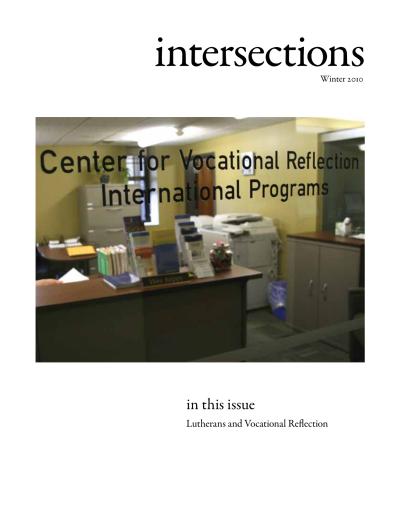
Haak describes Augustana’s Center for Vocational Reflection (CVR) and its threefold framework of skills/gifts/talents, passions/values, and needs of the community. He surveys the CVR’s Working with Faith group, seminary visits, spiritual companioning, Servant Leader Internships, international travel reflection, and the major Senior Inquiry curriculum revision—then reports the lessons learned at Augustana: that multiple exposures matter more than any single program, that the language of vocation works even for non-religious students, that student-initiated ideas (like Erin Blecha’s Athletes Giving Back) often succeed most, and that the CVR will soon merge into a new Community Engagement Center.
-
 Editorial
From the Editor
Jason A. Mahn
No. 43 · Spring 2016
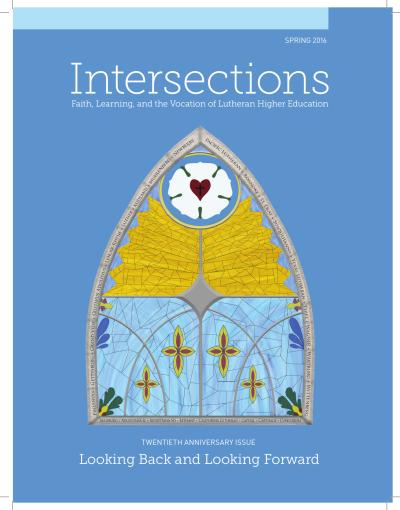
Mahn introduces the twentieth anniversary issue of Intersections, recalling its 1996 birth at Capital University “in the twinkle of an idea” in the mind of founding editor Tom Christenson, and previewing essays by Wilhelm, Amamoto, Kleinhans, Glass Perez, and Simmons that together look back at twenty years of the journal and forward to its work in the decades to come.
-
 Response
Response to Mark Wilhelm: Vocation, Mission and Privilege
Marit Trelstad
No. 56 · Fall 2022
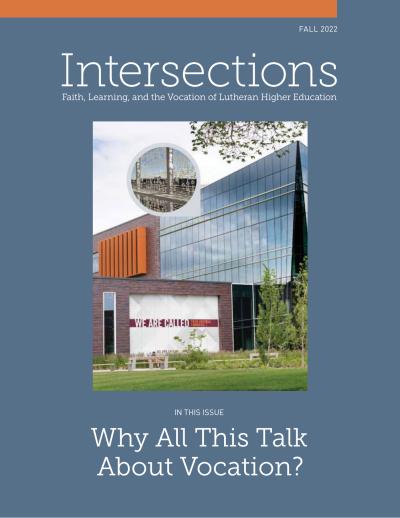
Trelstad affirms Wilhelm’s claim that vocation is the foundational shared mission of Lutheran higher education rather than one program among many, and presses the critique that calls to “vocational reflection” can mask privilege — arguing that an intersectional lens shows vocational discernment is in fact a matter of survival and flourishing for students from marginalized communities.
-
 Reflection
Vocation
Matt Peterson
No. 10 · Fall 2000
In a chapel homily, St. Olaf student Matt Peterson quotes former St. Olaf professor Howard Hong’s 1955 Our Church and the World—“the tragedy is that we seem to have lost the full grasp of the Christian vocation”—to argue that vocation, from the Latin vocare, is centrally a call into daily communion with God and into continually becoming Christian, not the title of a successful career marked by GPA, win-loss records, honorary degrees, or net worth. Drawing on Anthony Bloom on prayer that must be lived, he indicts the dread of Monday, the “come hell or high water” demand for production, and the “faith community” that we take on faith.
-
 Article
Roots and Shoots: Tending to Lutheran Higher Education
Jason A. Mahn
No. 49 · Spring 2019
Mahn revisits why “education-for-vocation” has become a leitmotif for the 27 NECU schools, distinguishes institutional vocation from individuals’ religious identities and educational priorities from their theological grounding, and offers a friendly critique of Jodock’s bridge metaphor: Lutheran colleges grow in two directions like plants — deep roots and wide branches alike require constant tending.
-
 Article
'In, With, and Under:' The Tradition and the Teaching of Christian Ethics
Pamela K. Brubaker
No. 17 · Summer 2003
Brubaker describes how she teaches Introduction to Christian Ethics at California Lutheran University—a religiously diverse classroom where about 30% of students are Lutheran, 30% Roman Catholic, and many are “unchurched”—as a community of moral discourse rooted in the Lutheran dialectic of faith and reason. Drawing on Larry Rasmussen and Bruce Birch, Elizabeth Bettenhausen, Roger Crook, and Robert Benne’s typology of “Hot and Cool Connections” between church and politics, she walks through her course’s units on human sexuality, economic life, and war and peace—including the Bomb Shelter simulation, a mock Disney stockholders meeting on sweatshops, and a Congressional hearing on the School of the Americas—to show how ELCA social statements function as case studies in critical inquiry and education for citizenship.
-
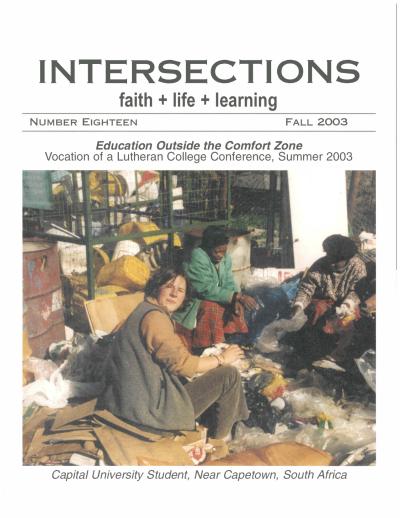 Article
Service Beyond the Comfort Zone
Kathryn Wolford
No. 18 · Fall 2003
Wolford names economic globalization and the growth of civil society as the two issues shaping Lutheran World Relief’s mission, illustrating with the Guatemalan storekeeper undercut by subsidized “gringo” chickens, fair-trade coffee and chocolate campaigns, and Charles Onyango-Obbo’s warning about anti-terrorism laws in fragile African democracies. Drawing on Darrell Jodock, Art Simon, and the Good Samaritan, she frames the global vocation of Lutheran colleges as inviting students past comfort zones of race, class, ethnicity, and ideas through service-learning that links mercy and justice, and closes with a concrete LWR partnership invitation including site visits, internships, fair-trade campus campaigns, and the “A Place for Peace in Colombia” advocacy program.