Finding Purpose in Chaos: Reflection In and Beyond the Public Health Classroom
Intersections No. 52 · Fall 2020
In February 2020, I began teaching a new course designed specifically for undergraduate public health majors: “Professionalism in Public Health Practice.” The course aimed to prepare students for internships, jobs, and graduate programs in our field. The course’s original goal was practice-based: What knowledge and skills do students need to take the next step in their careers? The syllabus was packed with résumé and cover letter workshops, how to read a job posting, and how to network with professionals in the workforce. Recent alumni visited to answer questions about how they studied for the GRE, what internships they completed, and how they decided whether to work right away or go to graduate school first. Students brainstormed ways to market themselves at career fairs and how to sit for interviews. It was an extremely informative but, admittedly, also rather prescriptive, focusing on the how of professional preparation.
“If there was ever a time to be a public health student, this was it.”
Six weeks into the semester, the coronavirus pandemic hit the United States. By March, I sat before a classroom full of public health almost-grads who were asking if they would be sent home in order to keep everyone safe. Some reported up-to-the-minute news regarding the virus’s spread, government responses (or lack thereof), and regional school closures. Others shared concern about family members on the medical front lines who weren’t allowed to leave work after viral exposure. One student worried about where she would live if we went to distance learning because her parents were immunocompromised. The tension in the room was thick, but there was also an edge of hope. If there was ever a time to be a public health student, this was it.
Our college announced an early spring break the next day. Students quickly packed (most of them, only for a few weeks away), and then scattered to their hometowns. We didn’t know what was about to happen, or how long it would last. We didn’t get to say a proper goodbye, or even, “see you on Zoom.” There was no closure, only chaos, soon followed by confusion.
This was my first pandemic as both a public health professional and a faculty member. While students were tasked with adjusting to their new normal of virtual learning, I was confronted with the reality that this professionalism course was simultaneously urgent and already outdated. What changes would I need to make for it to be as meaningful as it was useful?
“In focusing on the how of professional preparation, I hadn’t asked them to pause and direct their attention to why they wanted to pursue public health in the first place.”
Throughout my previous eleven years of teaching, I’d come to realize how prescriptive public health education as a whole can be. Considering the rigorous standards set forth by accrediting bodies and students’ growing demand for pre-professional training (especially in the health sciences), my public health courses had fallen into a rhythm (or rut?)—one that addressed competencies and outcomes that students would need for their post-baccalaureate path. Students were eager to complete their required courses and internships, graduate, and move on to the next adventure. In focusing on the how of professional preparation, I hadn’t asked them to pause and direct their attention to why they wanted to pursue public health in the first place.
Still, our alumni regularly write to me and reflect on how their Augustana experience helped them navigate their vocational path. Many trace that path backwards to identify those “a-ha” moments that changed the trajectory of their lives. It was these alumni who, over the course of more than 25 years, had found their way into public health even before Augustana formalized a public health major and pre-professional workshops. Those students were called to public health through some special experience or moment, a moment of asking why, one that helped a nebulous jumble of ideas and desires solidify into a calling.
Of course, this is one of the ultimate goals of a residential, Lutheran liberal arts college where students live, learn, work, and serve together. These alumni stories, combined with an Education-for-Vocation faculty seminar at Augustana College that NetVUE funded and in which I participated, led me to recalibrate the second half of my professionalism course. I asked students to reflect on their goals in public health: What originally brought them to public health? What were their interests before the pandemic? Where did they feel they were being called now? And why?
One business and public health student, Tracey, was in the middle of an internship with the local American Red Cross when the pandemic hit, and she had to move home to Connecticut. She felt called to continue helping others, and so signed up to work at a nursing home. Knowing that she was putting herself in harm’s way, she said she would rather try to help the vulnerable than sit home and worry.
Hannah, double majoring in political science and public health, shifted her plans of pursuing health policy work in order to join a service organization and help in disaster areas. She immediately deployed from Illinois to California to help provide shelter to people evacuating the wildfires.
Older alumni, too, have reached out to me to reflect on where their public health journeys have led since leaving Augustana and as the pandemic hit. Sara, who studied religion and public health, started working at a regional food bank in Ohio only two weeks before her state lockdown made the demand for their services skyrocket. She shared, “Augustana taught me how intertwined our community and individual health is, and how important it is to ask deeper questions when coordinating an effort. How will this affect someone different from me? In what ways can we honor and respect someone’s humanity even during this time of emergency?”
“In what ways can we honor and respect someone’s humanity even during this time of emergency?”
Alyssa, an alumnus with majors in public health and communication studies, now researches the impact of postpartum depression on Latinx communities for her doctoral program in Seattle. Her team explores how Covid-19 and the increasing impacts of institutional racism may exacerbate this already serious issue for underrepresented mothers.
Darielle, a Masters in Public Health (MPH) candidate in Chicago, described how her time at Augustana prepared her to be flexible, especially during unpredictable situations: “Augie pushed me to persevere, to be resilient and humble...which has helped me remain optimistic during the pandemic and social injustices.” She plans to use this optimism and resilience in her new role researching opioid use disorder and treatment therapies.
Nikki, who pursued her Bachelor in Science of Nursing (BSN) and became a registered nurse, reflects deeply on how her nursing and public health backgrounds blended to make sense of the chaos during the early days of the pandemic:
2020 was “The Year of the Nurse,” celebrating the 200th anniversary of the birth of Florence Nightingale, the founder of modern nursing. At the beginning of the year, nurses hoped for recognition via safer staffing ratios, better pay, and more independence in our practice. Covid-19 shook the entire healthcare system to its core and we are just now beginning to pick up the pieces. It was easy to get lost in the horror of it all; no one had any answers and we were working with limited supplies. [But} our experiences and reliance on one another made us stronger.
Reflecting on her Augustana education, Nikki said the liberal arts helped her understand not only the how of nursing, but also the why:
When I started as a nurse, I always assumed “helping” patients meant improving their health. I have learned, unfortunately, that this is not always possible. Helping patients in palliative or hospice situations can mean helping them accept their illness or death. Some patients are managing their illness fine physically but have a hard time grasping the mental and emotional side of being ill, like being scared and secluded from their family. Talking to these patients, making them laugh, or holding their tablet during a Zoom call is as important as monitoring their oxygen saturation. I’ve come to understand that in order to help someone you have to understand their perception of health. I learned this in medical anthropology, and through my experiences, I was able to apply it in real life.
These alumni stories show us that public health can and should be rooted deeply in the Lutheran approach to the liberal arts, with its institutional commitment to vocational reflection. Combining skills-based public health courses (the “how”) with opportunities for introspection and exploration (the “why”) allows students to examine their role in serving others and make meaning as health practitioners. The liberal arts curriculum provides even more opportunities to connect other areas of study with their public health goals. This is demonstrated in the fact that the alumni I’ve here quoted majored in the diverse fields of business, communication studies, nursing, political science, and religion.
The pandemic is far from over, but hearing testimonies from public health students and alumni who have shifted their plans in order to serve others in new ways has strengthened my resolve to include more deliberate reflection in all of my courses. Augustana’s mission calls us to offer a “challenging education that develops the qualities of mind, spirit, and body necessary for students to discern their life’s calling of leadership and service in a diverse and changing world.” This year has shown us exactly how important it is to find purpose in chaos, and I look forward to seeing our next generation of Augustana public health graduates find their calling in our ever-diverse and changing world.1
Endnote
1. I want to acknowledge and thank the many Augustana College public health alumni who have shared their vocational journeys with me, especially Alyssa Hernandez, MS; Sara Hovren, BA; Tracey Keane, BA; Nikki Montgomery, BA, BSN-RN; Hannah Norris, BA; and Darielle Sherrod, MPH(c).
-
 Editorial
From the Publisher
Mark Wilhelm
Wilhelm argues that the “hackneyed” expressions of higher education — “you are not just a number,” “the college experience,” “risen to the challenge” — tell the simple truth about NECU institutions even as the Covid-19 pandemic has pushed budgets, employees, and campus life to the breaking point.
-
Editorial
From the Editor
Jason A. Mahn
Mahn narrates a year of crisscrossing pandemics — Covid-19, economic collapse, partisan politics, and the long pandemic of white supremacy revealed anew by the murder of George Floyd — and argues that Lutheran liberal arts schools, by educating for vocation, are uniquely poised to help students respond with character and capable callings.
-
Article
A New Image for an Ancient Call: Lutheran Higher Education Amidst Pandemics Today
Caryn Riswold
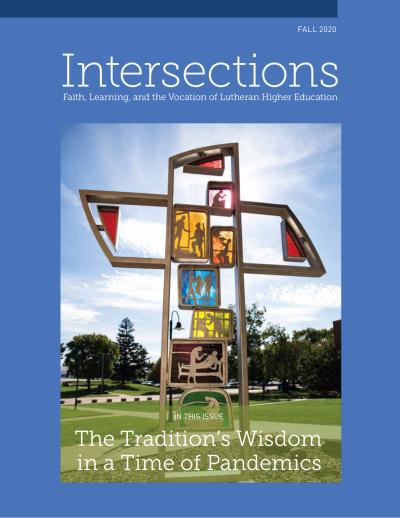
Pairing Wartburg’s Lebenskreuz sculpture with the Matthew 25 acts of mercy and the commitments of Rooted and Open, Riswold reads the calls to feed the hungry, welcome the stranger, and care for the sick as urgent summons for Lutheran higher education in a year of overlapping pandemics — and as a call to dismantle the structures that produced them.
-
Article
Learning from Luther on Covid-19
Carl Hughes
Reading Martin Luther’s 1527 treatise “Whether One May Flee from a Deadly Plague,” Hughes finds practical and spiritual guidance for a pandemic age: serve the neighbor, follow medical experts, honor those whose vocations put them at risk, and trust that even when we fail, God will not abandon the community.
-
Article
Radical Hospitality on Haunted Grounds: Anti-Racism in Lutheran Higher Education
Krista E. Hughes
Writing from Newberry College’s campus on land once home to the Cherokee and within a day’s drive of Mother Emanuel A.M.E., Hughes argues that NECU’s call to “practice radical hospitality” demands that predominately white institutions open themselves to the hauntings of racism — pursuing belonging rather than mere welcome, and risking kenotic transformation of institutional identity itself.
-
Article
Activism, Justice, and the Danger of Silence
Dezi Gillon
In conversation with Jason Mahn, Augustana College alumnux Dezi Gillon traces the call to action they felt as a Black student organizing for Black Lives Matter on a predominately white campus — through seminary, art, spirituality, and restorative justice work — and warns white professors that staying silent “actually speaks volumes.”
-
Article
Leadership in Lutheran Key at a Time of Pandemics
Deanna Thompson
Thompson draws on Luther’s theology of the cross and Shelly Rambo’s theology of trauma to sketch a Lutheran model of leadership for a season of pandemics — one that is attentive to pain, responsive to need, and intentionally nourished by food, friends, and deep conversation.
-
Article
Through Truth to Freedom—by Way of Reconciliation
Paul C. Pribbenow
Reflecting on Augsburg’s 150th-anniversary motto “Through truth to freedom,” Pribbenow argues that in a season of three pandemics — pandemic illness, economic collapse, and the racial sin laid bare by the murder of George Floyd — higher education’s most authentic work is to educate for truth and freedom by way of confession and reconciliation.
-
Reflection
The Long Pilgrimage of 2020-21
Kara Baylor
Drawing on Martha Stortz’s definition of pilgrimage as “intentional dislocation, for the sake of transformation, where the body teaches the soul,” Baylor invites students and educators worn out by the 2020-21 academic year to ask what is essential, to listen to what their bodies are telling their souls, and to be more open to the transformations the dislocation might still yield.
-
Article
Called to Flourish: An Ethic of Care
Mindy Makant
Drawing on Lenoir-Rhyne’s core value of Care, Glennon Doyle’s Untamed, Darrel Jodock’s “Gift and Calling,” and Luther’s plague-era practice of opening his home to the sick, Makant argues that flourishing is interdependent — that self-care is a means to extending care, and that an ethic of care is the meaningful, transformative work to which Lutheran liberal arts education is called.
-
Article
Called to the Moment: A New Vocation for Lutheran Colleges
W. Kent Barnds
After a derecho ravaged Iowa in August 2020 and Pastor Katy Warren preached on 1 Peter 4, Barnds watched line workers, neighbors, and Augustana colleagues simply show up where they were needed — and proposes that the true vocation of a Lutheran college may be making the case for “meeting immediate need with a deep willingness” alongside the longer work of vocational discernment.
-
 Article
Welcome Strangers
Gregg Muilenberg
No. 15 · Winter 2002
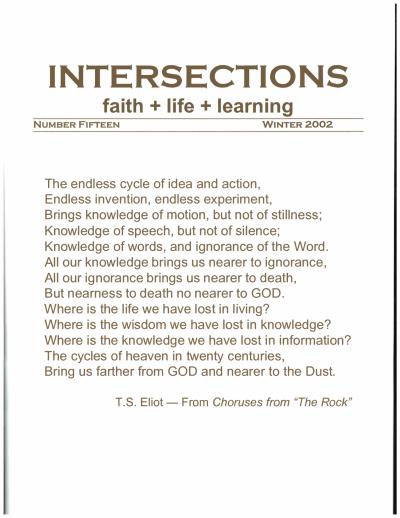
Muilenberg, a non-Lutheran philosopher at Concordia, argues that self-consciously Lutheran colleges cannot make non-Lutheran faculty feel welcome through “institutional fit” rhetoric (he cites Concordia’s own hiring boilerplate) because identity must be sustained and developed, not preserved like a pickle. Drawing on Nikos Kazantzakis’s Report to Greco and the three marks of the “profoundly religious person”—commitment to the truth, to the power of the spirit, and to metousiosis through myth—he proposes that faith and reason are best understood as an unending struggle into which strangers must be invited as valuable and active participants, safeguarded by the strongest possible affirmation of academic freedom (citing Martha Nussbaum on Notre Dame and BYU).
-
 Editorial
From the Editor
Jason A. Mahn
No. 39 · Spring 2014
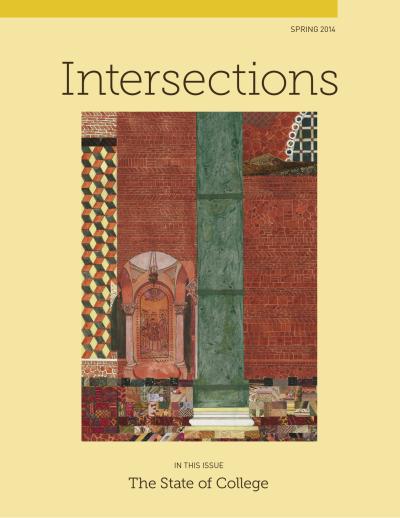
Mahn reports on the working group “People of Wondrous Ability: Introducing Faculty and Staff to Lutheran Higher Education,” shares creative ways campuses are introducing colleagues to the charisms of the Lutheran tradition, and frames the issue as a set of reflective reviews that move from national trends to homegrown conversations about the state of college.
-
 Reflection
John 3:16-17
Richard Priggie
No. 27 · Spring 2008
Preached at the Vocation of the Lutheran College conference in August 2007, Priggie’s sermon on John 3:16-17 reads the Greek word “cosmos” as evidence that “God was into globalism long before we were” and calls Lutheran colleges to embrace Matthew Fox’s “deep ecumenism” — an embrace of and care for all created things. Drawing on J.B. Philipps’s Your God Is Too Small and the movie Pleasantville, he invites his hearers to come to Rock Island in order to leave Rock Island, to be Christian in order to be more than Christian, and to find the places where the roads don’t go in a circle but just keep going.
-
Editorial
From the Publisher
Arne Selbyg
No. 27 · Spring 2008
Selbyg, retiring this summer as Director for ELCA Colleges and Universities, reflects on his decade serving as spokesperson between the church and its twenty-eight colleges and universities, and argues that the link between the colleges and the church has grown stronger over the last ten years — sustained by supportive church leaders like Presiding Bishop Mark Hanson, the annual Vocation of a Lutheran College conference, and a Lutheran theology of higher education whose principles (questioning authority, returning to the sources, including the excluded, serving the neighbor) remain a strong basis for operating colleges and universities in the twenty-first century.
-
 Article
Even Lutheranism Can Be Cool Now: Changes in Religion and American Culture
Mark Wilhelm
No. 28 · Fall 2008
Wilhelm names two major changes in the role of religion in American culture—the rise of a rhetoric of religious individualism, exemplified by “Sheilaism” in Robert Bellah’s Habits of the Heart, and a proliferation of religious options driven by the democratization of authority, the end and beginning of ethnicity, the success of ecumenism, and the information revolution—and draws implications for Lutheran-related higher education, including support for Stephen Prothero’s call for core religious literacy and a confident reclaiming of each college’s religious heritage as a platform for engaging the religious diversity of America.
-
 Article
Why Lutheran Colleges Need to Engage Civil Society
Ann M. Svennungsen
No. 35 · Spring 2012
Svennungsen makes the case that Lutheran colleges must engage the larger civil sphere, drawing on her work with The Presidents’ Pledge Against Global Poverty, Darrell Jodock’s seven fundamental experiences for vocational discernment, David Brooks on civility and modesty, and Michael Sandel’s argument that the affluent are seceding from public life. She urges Lutheran educators to invest in the infrastructure of civic renewal so that service-learning and civic engagement remain central to the Lutheran college curriculum.