Although it is located in a small rural town in the middle of the state, Newberry College in a sense belongs to the entire state of South Carolina, which in turn sits on the unseeded lands of the Kusso, Yemassee, Santee, Cherokee, Saluda, and Catawba. Not only does the college have deep connections to the state’s historic and cultural roots, but also its current student population mirrors the state’s demographics.
Located 154 miles from Charleston, where approximately 40 percent of all enslaved Africans were brought into the United States, Newberry College owes its history to the practice of enslavement. The college’s founder, Rev. Dr. John Bachmann, gave the opening blessing at the South Carolina Secession Convention, and he wrote eloquent theological defenses of the institution of slavery (curiously, even as he affirmed, in contrast to other scientific writer of his day, that whites and blacks were of the same species).
Fast forward to today and to who our students are: Newberry is one of the few schools in the state that nearly perfectly mirrors the demographics of South Carolina— in terms of race, gender, socio-economic status, and urban-versus-rural origins. A predominantly white institution, its proportion of minority students reflects the population of the state. Yet it is less reflective of the city and county of Newberry, where there is a slight majority of Black residents, with white residents close in number and only a tiny percentage of Latinx and Asian residents. Socioeconomically, there is also mirroring, with the City posting a median income is $31,000, while the student population of the college includes 50 percent first-generation students, 40 percent Pell-eligible students, and a little over 30 percent racial minority students (with significant overlap across these categories).
Our ‘culture of community’ has both promise and plenty of room for growth.
Our “culture of community” has both promise and plenty of room for growth. On campus, we are trying to build a culture of true belonging, which is the central theme of the DEI Strategic Plan developed by a Presidential Task Force during the 2020-21 academic year. We conducted a campus-wide campus climate survey (HEDS) and have established a series of listening session opportunities for students to come and speak openly about concerns. Our student orientations and student fairs have had more intentional aims to connect students no only across campus but with the broader community. Finally, in the last couple of years, students have established the Social Justice Club and Spectrum (for LGBTQ+ and allies) with campus-wide impact beyond their small membership sizes.
In and with the city of Newberry, the Muller Center for Exploration and Engagement is heavily involved with civic engagement activities—connecting students, staff, and faculty to opportunities for community-based learning and service opportunities. There’s also a strong connection between the athletics department and the community, and the support travels in both directions. There is tremendous community support for the college’s sports teams. In turn, our athletic teams lead the campus in volunteer work in the community, followed by the campus’s Greek organizations and students in community-engagement courses.
The challenges of building a sense of community on campus and off are plenty, however. First and most central is a basic lack of time and energy. For students, staff, and faculty, schedules are packed with demanding commitments, while community-based education and relationship-building takes time. Even when the desire and will is there, there is scant breathing space.
This draw to broader activist movements frequently orients students away from the local and toward the national and global issues.
Another challenge is the generational characteristics of Gen Z students, where there tends to be less focus on service and more on activism, often based on social media. This draw to broader activist movements frequently orients students away from the local and toward the national and global issues. The way technology can mobilize coalitions across space and time is nothing short of miraculous. The challenge is to not sacrifice local relationships and needs.
Whereas that is a challenge for students, there is a specific one for the personnel of Newberry College—namely, the fact that a large proportion of the upper administration and faculty, along with some staff, do not live in the city of Newberry. The community is small, and there is a widespread impression that there is not enough to do and/or the local public schools are not strong enough. This means, however, that the people who live in Newberry the city and the people who work at Newberry the college do not overlap as significantly as they could, which in turn impedes the development of organic relationships of trust, support, and collaboration.
And yet, there are ample signs of hope. Where city-college relationships are good, they are really strong. The mayor and Newberry City Council regularly recognize the college as the largest provider of volunteers in the city, and annually the city holds a ceremony to honor those graduating seniors who have shown strong service to the city during their time as Newberry College students. In addition, there are alumni and alumnae who have chosen to remain in the community following graduation; several now serve in influential positions in the city—from city administration to churches to the local newspaper.
What is more, civic leaders from the community and the campus are currently involved in two significant projects: Coming Together for Newberry, an alliance of people seeking to practice and advance interracial engagement and understanding in Newberry County, and the Gallman School Project, an initiative to acquire and renovate the historically significant Black high school and establish a community center that will provide a range of services and opportunities for the surrounding community.
Finally, the growing number of international corporations coming to the area promises to turn little Newberry into a global city where the possibilities for collaboration among the town, the college, and the business industry will grow.
There is plenty of room to grow in terms of community-building on campus and beyond. There is also a great deal of promise, rooted primarily in the already rich relationships that are possible only in a small town.
-
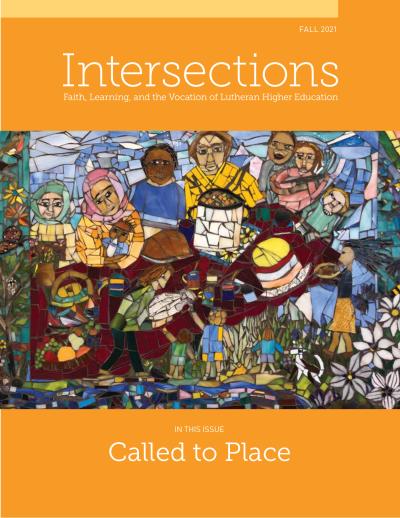 Editorial
From the Editor
Jason A. Mahn
Mahn introduces the “Called to Place” theme of the 2021 VLHE Conference, arguing that Lutheran higher education’s emphasis on vocation must be grounded in particular geographies and embodied communities — for, as Wallace Stegner put it, “If you don’t know where you are, you don’t know who you are.”
-
Article
Where Your Feet are Standing: Institutional Engagement and Place
Melissa Maxwell-Doherty
Maxwell-Doherty draws on Cal Lutheran’s Hispanic-Serving Institution designation and its location on Chumash, Fernandino Tataviam, and Ohlone lands to ask how the university’s mission might shift if it depended on where its students are standing — not just where the institution sits.
-
Article
Just Communities: From Liberal Arts in Prison to Racial Healing over Zoom
Monica Smith
Smith showcases how Augustana College’s commitment to social justice extends into the Quad Cities through two initiatives: the Augustana Prison Education Program at East Moline Correctional Center, and Racial Healing conversations developed through the Truth, Racial Healing and Transformation framework.
-
Reflection
Caught in a Place Between Caesar and God
Darrel D. Colson
Colson reflects on his anguish, as Wartburg’s president, over an Iowa law that prevents him from requiring student COVID-19 vaccinations — reading Luther’s “Whether One May Flee From a Deadly Plague” alongside the conflict between obeying the law and serving neighbor.
-
Article
Hospitality to the Wild
Laura M. Hartman
Drawing on research with a Wild Ones Native Landscaping chapter and Marilyn Matevia’s ethic of “creature comfort,” Hartman argues that Christian hospitality must extend to non-human animals and plants — and asks whether college campuses can foster not just human diversity but biodiversity.
-
Article
Return to Purpose: Learning in an Age of Collapse
Ahmed Afzaal
Afzaal argues that the cascading crises facing higher education are not temporary glitches but symptoms of planetary and civilizational collapse — and that colleges must embrace “double-loop” learning and return to a shared sense of purpose if they are to help humanity descend gradually rather than catastrophically.
-
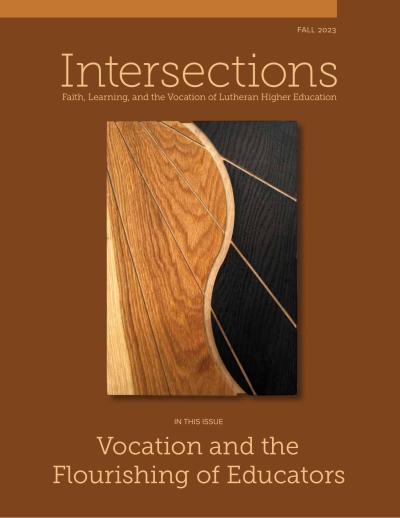 Article
A Lutheran Call for Educator Flourishing
Krista E. Hughes
No. 58 · Fall 2023
Hughes argues that without educator flourishing there is no student flourishing, traces how an exploitative “passion tax” can distort vocation, and offers seven Lutheran “third-way” value pairings — including Metrics/Grace, Efficiency/Kairos, and DEI/Priesthood of All Believers — to reframe institutional success at NECU campuses.
-
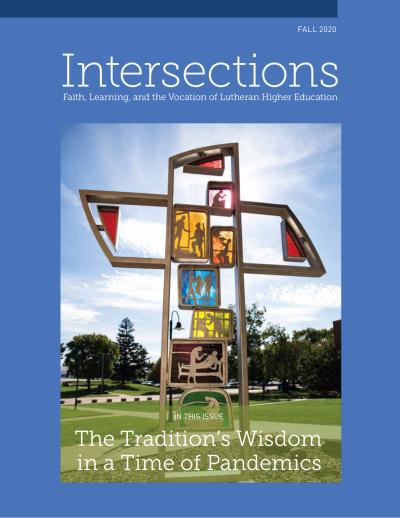 Article
Radical Hospitality on Haunted Grounds: Anti-Racism in Lutheran Higher Education
Krista E. Hughes
No. 52 · Fall 2020
Writing from Newberry College’s campus on land once home to the Cherokee and within a day’s drive of Mother Emanuel A.M.E., Hughes argues that NECU’s call to “practice radical hospitality” demands that predominately white institutions open themselves to the hauntings of racism — pursuing belonging rather than mere welcome, and risking kenotic transformation of institutional identity itself.
-
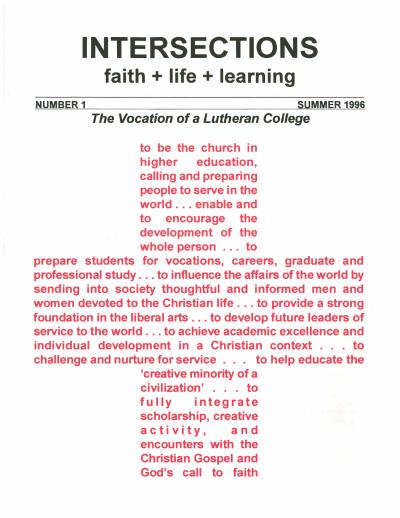 Institutional Focus
Continuing the Dialogue: Augustana College
Sandra C. Looney
No. 1 · Summer 1996
Looney describes Augustana College, Sioux Falls, debating and renaming its values—Christian, Liberal Arts, Community, Excellence, Service—under the leadership of religion professor Dr. Arthur Olsen and the T’N’T (“Through Thick and Thin”) committee, in the wake of ELCA Region III’s “What Does It Mean to be a College of the Church?” conversations. She describes Augustana’s 56% Lutheran student body, daily 10 a.m. chapel, dual Christmas Vespers in Our Savior’s Lutheran Church and St. Joseph’s Cathedral, the Capstone classes on moral and aesthetic issues, and the ongoing work of enlarging Augustana’s conversation to include Native American, Jewish, and Islamic voices.
-
 Editorial
From the Publisher
Mark Wilhelm
No. 55 · Spring 2022
Wilhelm announces his planned retirement on January 31, 2023, after serving as the founding executive director of the Network of ELCA Colleges and Universities, and gives thanks for the privilege of helping NECU articulate a shared vision for Lutheran higher education in twenty-first-century North America.
-
 Editorial
From the Publisher: Introduction and Invitation
Lamont Anthony Wells
No. 57 · Spring 2023
Wells introduces himself as the new Executive Director of NECU, succeeding Rev. Dr. Mark Wilhelm, and frames this Spring issue as a passionate response to the crises facing higher education amid threats to academic freedom and the well-being of educators.
-
 Response
Feeling at Home: Dimensions of Faculty Life
Jane Hokanson Hawks
No. 2 · Winter 1997
Hawks of Midland Lutheran College responds to Bouman by reflecting on her path from a Lutheran childhood through the BSN at St. Olaf and thirteen years at four non-church-related institutions to her present home at Midland, where teaching at a Lutheran institution finally feels “right.” Bouman’s framing of the five themes as the Lutheran argument about what it means to be human helped her ad-hoc committee articulate the spiritual role in Midland’s new faculty mentoring program (recently funded by the Lilly Foundation), and grounds her work as a nurse educator confronting the daily humanness of grief, joy, ethical dilemmas, and care across cultural and religious difference.
-
Response
“You Shall Know the Truth, and the Truth Will Set You Free”: A Scientist’s Response
Ben Huddle
No. 2 · Winter 1997
Huddle of Roanoke College proposes adding a sixth theme to Bouman’s five—the scientific method—as a tool for knowing the Truth not available to Luther but central to twentieth- and twenty-first-century learning. Diagramming the continuous cycle of observations, laws, theories, and predictions, he argues that scientists must be ethical and that scholars in other fields must understand the scientific method (lest environmentalists ignore the Second Law of Thermodynamics). A Lutheran college, he concludes, should treasure both the religious and the scientific tradition: stifling either loses meaning or significance, and the Lutheran tradition is therefore biblical, catholic, evangelical, sacramental, scientific, and world-affirming.
-
 Article
Climate Justice, Environmental Racism, and a Lutheran Moral Vision
Cynthia Moe-Lobeda
No. 36 · Fall 2012
Moe-Lobeda argues that the vocation of a Lutheran college is to prepare students for Thomas Berry’s “great work”: forging a sustainable relationship between the human species and the planet while diminishing the gap between those who have too much and those who have not enough. She develops a three-fold “moral vision” rooted in Luther’s theology of the cross—seeing what is (climate injustice and environmental racism for what they are), seeing more just and sustainable alternatives, and seeing God’s saving presence at work—and offers it as a distinctive Lutheran contribution to the panhuman and interfaith challenge of our day.