In this interview, Intersections editor Jason Mahn talks with Augustana College alumnux, Dezi Gillon, to learn more about the callings to justice-work among students of color, and how he and other white professors can better support them as they live out those callings.
Jason: I remember vividly the die-in that you and others at Augustana organized as part of the emerging Black Lives Matter movement five years ago. Would you please describe some of your other activism in college and how you started to think about protest and activism in relation to who you are, and who and what you feel called to be?
Dezi: My urge to participate in activism at Augustana came from my desire to be heard and to find community. This was after the acquittal of George Zimmerman, Trayvon Martin’s murderer, and my anger and desperation couldn’t be ignored. The moment swept me and others into a whirlwind of organizing and disrupting systems of oppression that affected us and those we loved.
The beginning of the BLM movement was a moment that encapsulated feelings of anger and resentment I had towards white people growing up in Chicago and Evanston. I also grew up with two parents who were very active in their local Black communities. My father was a community organizer and social worker and my mother did outreach work through the church we attended. At the beginning of my junior year, I could feel the support of my family back home and my community at Augustana. I felt as though I needed to do something.
I was fortunate to be surrounded by friends who also felt a call to action. The idea to organize protests at Augustana came after a number of seminars addressing the current events involving the Black Lives Matter movement. I remember walking away from those discussions feeling underwhelmed and frustrated at the lack of attention this matter was getting at our school.
What I loved so much about our community was that it was student led, trauma informed, and centered Black students. Although we reached out to Augustana faculty and staff for advising, we also had the guidance of writers and activists such as Angela Davis, Alicia Garza, bell hooks, James Baldwin, and so many more. We led various demonstrations on campus as well as a die-in. We also worked with the local Black Lives Matter chapter in the Quad Cities where we participated in a few local protests.
Jason: You talk about the “call to action” of you and your friends as emerging from places of disappointment, anger, and resentment. But you also speak of positive influencers and mentors, including your parents’ engagement with Black communities and famous Black writers who inspired you to act. Thinking back on those college years now, did your call to activism feel more like filling a void and emerging out of pain or following those who gave you hope and courage?
Dezi: While there was and is deep pain, for the most part my call to action came from a passionate desire to feel more connected to my community of fellow Black and Brown students. I love us, and I wanted to fight for us—for our love and existence, as well as for our representation at Augustana. I was also very grateful for fellow white students who joined our organizing and care work. I felt inspired by folks in my community and people I was meeting in Chicago and following on social media. There was no time to be silent or to cater to requests to be more gentle with white professors and students. Even though there was pain, we were determined to fight for one another in community.
Jason: Did the calling you felt to fight for and support a community of Black and other students of color carry over into your life and work since graduating from college?
Dezi: Yes! That time in undergrad has had such a significant impact on my life. After finishing my bachelor’s degree I decided to go to Union Theological Seminary in New York City. There I participated in organizing for undocumented folks who were seeking asylum in church and in school as well as accompaniment in court proceedings.
During my time in NYC, I also deepened my exploration into spirituality and Blackness. There was such a diversity of Black experiences in that city. I started becoming closer to my West African roots in my spiritual practices. I started grappling with very complex questions regarding my Christian identity.
While doing social justice education and programming with the Sadie Nash Leadership Project, I also discovered that work with youth and environmental justice were large parts of my vocation. This work and so much more brought me to do the restorative justice work I do now. As I am now settling back into Chicago, I want to continue to learn more about transformative justice and youth work. Using art and transformative practices and following the leadership of youth, I want to invest myself in justice for the communities that I am a part of.
Jason: You mention how art, spirituality, and activism all compose parts of your identity and calling. Can you give us a sense of how those three go together—especially for the younger communities in which you are a part?
Dezi: I actually found these fit together quite easily for me. I have always been an artist. Sometimes I am a very active artist and other times my creativity seems blocked. Creating art and being fascinated by the art around me has informed my calling for justice and my connection to the spirit.
“Tying together art, spirituality, and activism was second nature to me.”
When I moved to NYC and started school at Union Theological Seminar, I had access to so much art and spiritual faith practices. These were woven together so tightly that at times I couldn’t tell them apart. Being around other artists, especially artists whose work tied directly to their spiritual life, helped me unravel the cultural aesthetics of Black Christianity and Black American lived experiences. I became fascinated with the arts and spiritual life.
I began to prioritize art and garden-based learning in my facilitation style as well as in my academic and personal life. Art became a portal into understanding and storytelling and I wanted to incorporate that into the way I taught. I also want folks to think more critically about the land and their relationship to it and to the people in their local community. Tying together art, spirituality, and activism was second nature to me. Any limitations did not come from me, but from the boxes that other people put me in. I wanted to break out of those boxes and into something that documented the lives of my community.
Jason: What advice would you give to Black students studying at predominantly white institutions? How about to white teachers like me who are trying to learn how to better support students as they fight for change in an unjust world?
Dezi: Whew, these are big questions! The advice I would give to current Black students at PWIs is to try to find your people. Find people who support all of you—not just some of you. I am so grateful for the leadership of Black students and the space they take up on college campuses. Don’t let white people and non-black POC put you into boxes that stifle your strengths. And if you feel like you are doing work you should be getting paid for, chances are you are. Know your worth and demand your seat at the table.
“By staying silent you actually speak volumes.”
When I think about the advice I’d give to teachers, I think of the Maya Angelou quote, “I’ve learned that people will forget what you said, people will forget what you did, but people will never forget how you made them feel.” You have the power to shape the way Black folks feel on your campus. I experienced not only the silence of my fellow students, but also of my professors. I remember the silence being frustrating and cruel. At times, the silence was almost louder than words of solidarity. There is no neutral ground. By staying silent you actually speak volumes. You are a resource to students, and should use the power that you have to open doors for students and support students when they need you. Do not become another barrier to voices who are learning to speak out.
-
 Editorial
From the Publisher
Mark Wilhelm
Wilhelm argues that the “hackneyed” expressions of higher education — “you are not just a number,” “the college experience,” “risen to the challenge” — tell the simple truth about NECU institutions even as the Covid-19 pandemic has pushed budgets, employees, and campus life to the breaking point.
-
Editorial
From the Editor
Jason A. Mahn
Mahn narrates a year of crisscrossing pandemics — Covid-19, economic collapse, partisan politics, and the long pandemic of white supremacy revealed anew by the murder of George Floyd — and argues that Lutheran liberal arts schools, by educating for vocation, are uniquely poised to help students respond with character and capable callings.
-
Article
A New Image for an Ancient Call: Lutheran Higher Education Amidst Pandemics Today
Caryn Riswold
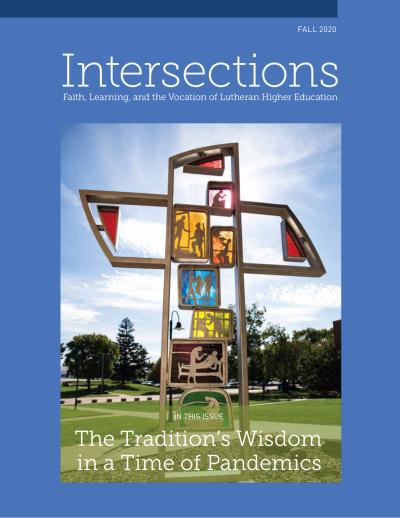
Pairing Wartburg’s Lebenskreuz sculpture with the Matthew 25 acts of mercy and the commitments of Rooted and Open, Riswold reads the calls to feed the hungry, welcome the stranger, and care for the sick as urgent summons for Lutheran higher education in a year of overlapping pandemics — and as a call to dismantle the structures that produced them.
-
Article
Learning from Luther on Covid-19
Carl Hughes
Reading Martin Luther’s 1527 treatise “Whether One May Flee from a Deadly Plague,” Hughes finds practical and spiritual guidance for a pandemic age: serve the neighbor, follow medical experts, honor those whose vocations put them at risk, and trust that even when we fail, God will not abandon the community.
-
Article
Radical Hospitality on Haunted Grounds: Anti-Racism in Lutheran Higher Education
Krista E. Hughes
Writing from Newberry College’s campus on land once home to the Cherokee and within a day’s drive of Mother Emanuel A.M.E., Hughes argues that NECU’s call to “practice radical hospitality” demands that predominately white institutions open themselves to the hauntings of racism — pursuing belonging rather than mere welcome, and risking kenotic transformation of institutional identity itself.
-
Article
Leadership in Lutheran Key at a Time of Pandemics
Deanna Thompson
Thompson draws on Luther’s theology of the cross and Shelly Rambo’s theology of trauma to sketch a Lutheran model of leadership for a season of pandemics — one that is attentive to pain, responsive to need, and intentionally nourished by food, friends, and deep conversation.
-
Article
Through Truth to Freedom—by Way of Reconciliation
Paul C. Pribbenow
Reflecting on Augsburg’s 150th-anniversary motto “Through truth to freedom,” Pribbenow argues that in a season of three pandemics — pandemic illness, economic collapse, and the racial sin laid bare by the murder of George Floyd — higher education’s most authentic work is to educate for truth and freedom by way of confession and reconciliation.
-
Article
Finding Purpose in Chaos: Reflection In and Beyond the Public Health Classroom
Lena R. Hann
When the pandemic hit her new public health professionalism course, Hann recalibrated her teaching from the “how” of professional preparation to the “why” of vocational reflection — and recounts how Augustana public health students and alumni found purpose in the chaos through food banks, disaster response, palliative care, and research on health inequities.
-
Reflection
The Long Pilgrimage of 2020-21
Kara Baylor
Drawing on Martha Stortz’s definition of pilgrimage as “intentional dislocation, for the sake of transformation, where the body teaches the soul,” Baylor invites students and educators worn out by the 2020-21 academic year to ask what is essential, to listen to what their bodies are telling their souls, and to be more open to the transformations the dislocation might still yield.
-
Article
Called to Flourish: An Ethic of Care
Mindy Makant
Drawing on Lenoir-Rhyne’s core value of Care, Glennon Doyle’s Untamed, Darrel Jodock’s “Gift and Calling,” and Luther’s plague-era practice of opening his home to the sick, Makant argues that flourishing is interdependent — that self-care is a means to extending care, and that an ethic of care is the meaningful, transformative work to which Lutheran liberal arts education is called.
-
Article
Called to the Moment: A New Vocation for Lutheran Colleges
W. Kent Barnds
After a derecho ravaged Iowa in August 2020 and Pastor Katy Warren preached on 1 Peter 4, Barnds watched line workers, neighbors, and Augustana colleagues simply show up where they were needed — and proposes that the true vocation of a Lutheran college may be making the case for “meeting immediate need with a deep willingness” alongside the longer work of vocational discernment.
-
 Article
Luther's Theology of Learning: Discovering the Vocation of Today's Small Lutheran Liberal Arts College
Eric Childers
No. 20 · Fall 2004
In an excerpt from his Wake Forest University Divinity School senior thesis, Childers profiles six students hand-picked by presidents and chaplains at Concordia College (Moorhead), Lenoir-Rhyne College, and Muhlenberg College—Nathan Gossai, Amy Nelson, Alison Schmidt, Ryan Sigmon, Julie Christianson, and Jeffrey Slotterback—as a living testament to Luther’s theology of learning. He then draws on Solberg, Mark R. Schwehn (in Paul J. Dovre’s The Future of Religious Colleges), Robert Benne, Ernest Simmons, Mark Noll, Richard Hughes, and James Burtchaell to argue that Lutheran colleges have not yet fully articulated their own theology of education and that their vocation is to embrace, engage, and galvanize a Lutheran tradition of learning rooted in the liberal arts, Scripture, the Confessions, and confident ecumenism.
-
 Response
Response to Mark Wilhelm: DEI, Great; DWS (Dismantling White Supremacy), Even Better
Vic Thasiah
No. 56 · Fall 2022
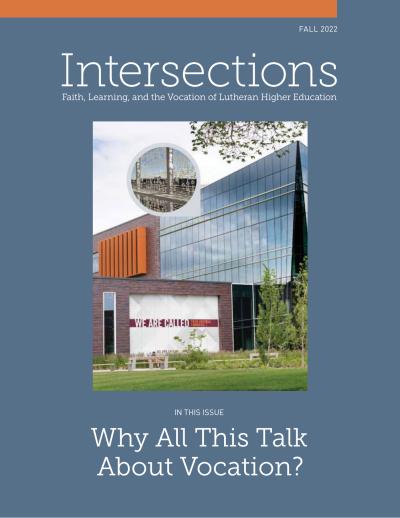
Thasiah argues that if Lutheran colleges and universities want to live out their commitment to the flourishing of all, DEI is good but DWS — dismantling white supremacy — is even better, and offers three Lutheran sensibilities (suspicion of self-righteousness, the decolonial shockwave of the cross, and critical thinking that can still register awe) that can make DWS a core practice of higher education.
-
 Institutional Focus
Health Food in the Inner City: An Interview with Brian Noy about Augsburg's Campus Kitchen
Brian Noy
No. 36 · Fall 2012
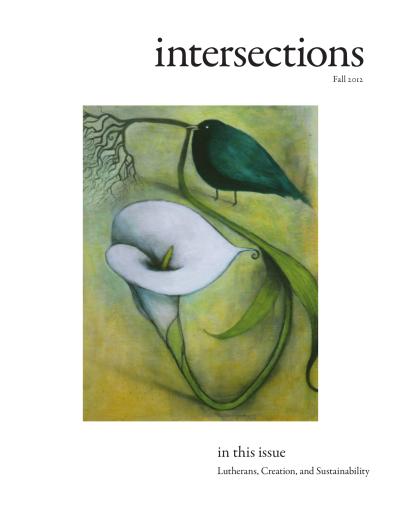
Noy, Director of Campus Kitchen at Augsburg College in Minneapolis, describes the Kitchen’s four-fold program—Food to Share (2,000 meals per month from surplus dining-services food and Campus Cooking Classes), Food to Grow (an 80-plot community garden), Food to Buy (two farmers markets that accept EBT/food stamps), and Food to Know (educational programming)—and the deep history of Augsburg’s service to the immigrant communities of the Cedar Riverside neighborhood, now Somali and Mexican as well as historically Norwegian.
-
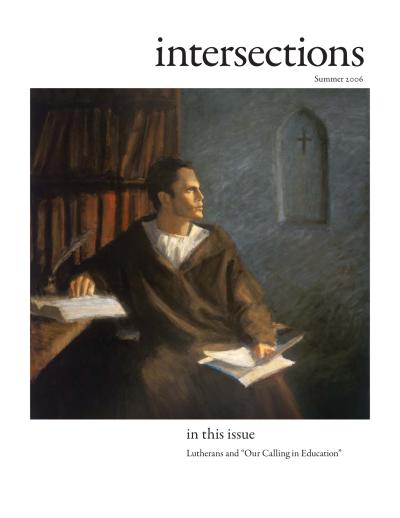 Article
Lutheran Education in the None Zone
Samuel Torvend
No. 23 · Summer 2006
Torvend, Associate Professor of Religion at Pacific Lutheran University, argues that any ELCA social statement on education must speak not only to those raised within the cultural and theological traditions of ELCA Lutheranism but also to the diverse communities of the “none zone” — the Pacific Northwest and other regions where religious affiliation is increasingly unaffiliated. The statement must therefore equip Lutheran colleges, congregations, and schools for engagement with religious pluralism and cultural diversity rather than presuming a Lutheran cultural baseline.
-
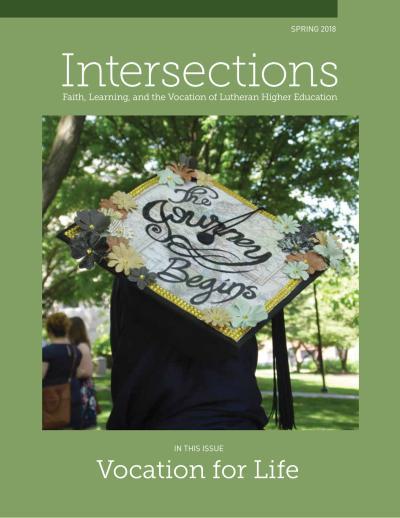 Article
Vocation for Emerging Adulthood: Within and Beyond College
Adam Copeland
No. 47 · Spring 2018
Copeland uses scenes from Master of None, David Brooks’ columns, Meg Jay’s The Defining Decade, and the stories of two ELCA college graduates to argue that emerging adulthood has fundamentally changed — and that Lutheran colleges should call out cultural lies about work, reframe vocation as meaning-making, and help graduates take small, wise steps into their twenties.
-
 Editorial
From the Publisher
Arne Selbyg
No. 24 · Fall 2006
Selbyg situates this issue in the ongoing ELCA conversation about education that began with the 2005 conference and is feeding into the second draft of the ELCA Social Statement on Education, previews the 2007 conference (“The Vocation of a Lutheran College — Engaging the World”) at Augustana College, Rock Island, and lifts up Luther’s insistence that the church and its members contribute to their wider communities rather than retreat into self-centered enclaves.