Educators deserve to flourish as they live out their vocations.
In 2023, educators are not flourishing.
The intersection of this conviction and this reality poses a vital question for the Network of ELCA Colleges & Universities (NECU) as our institutions move into a not-quite-post-pandemic era—within an industry that was facing considerable challenges prior to the arrival of the Covid-19 virus and amidst other ongoing threats of climate change, systemic injustice, and civic strife.
Because of this context, it is all the more important that Lutheran Higher Education (LHE) attend to questions of educator flourishing. Yes, to serve our students well, whether as staff, professors, coaches, or administrators, we must put on our proverbial oxygen masks first. But a LHE framework assumes more than this utilitarian attitude. Educators themselves are the relational and cultural roots of campus communities. If our campuses are to host and promote healthy communities of belonging, thriving educators are vital. There simply is no student flourishing without educator flourishing.
Flourishing may seem to be a high and unrealistic bar given the range of challenges facing NECU institutions. From a Lutheran perspective, it is a call nonetheless. For Lutheran institutions, the physical, psychological, and social health of all members of our campus communities is a missional commitment and central to our common institutional vocations. According to Rooted and Open: The Common Calling of ELCA Colleges & Universities, the diverse institutional members of NECU share a mission to “equip graduates who are: Called and empowered / To serve the neighbor / So that all may flourish” (3). This “all” must include the very educators who are engaged in the work of equipping graduates.
Institutions cannot, of course, safeguard their constituencies against every sling and arrow of life, much less the world’s staggering systemic inequities. From illness and other personal tragedies to poverty and racism, humans suffer. What NECU institutions are institutionally charged with is to cultivate the best conditions possible, given both resources and limitations, for the education of whole persons within a community of respect and care—in the words of Rooted and Open, to nurture campus cultures of “radical hospitality” (7-8).
My reflections in this essay invite educators on NECU campuses to consider ways to create communities and cultures where not only students but also educators might flourish, even amidst the challenges facing higher education today. I reflect on how the Lutheran emphasis on vocation enlivens the educational experience for students and educators alike, but when distorted, can impede educators’ flourishing. I also consider how other Lutheran theological and educational values might mitigate the imbalances caused by some of contemporary higher education’s reigning concepts. A Lutheran “third way” that holds in generative tension the values of its heritage and contemporary higher ed practices can ground transformative education for students while vocationally nurturing educators.
The Vocation of Educators and the “Passion Tax”
A belief in education’s potential to change lives and a love for students drive most people who work in higher education. Even those unfamiliar with Lutheran concepts are apt to say that their work on college campus is more than a career. It is it calling. LHE gives a conceptual frame to this felt sense. “NECU institutions,” explains theologian and Lutheran educator Marcia J. Bunge, “speak about vocation as the many ways in which all are called to use their unique gifts and strengths to love others, seek justice, and contribute to the common good in various spheres of life—whether at home, at work, or in civic life” (13, italics in original).
As Bunge goes on to note, this framework of vocational exploration at its best includes not only students but staff and faculty. This is more than simply a Lutheran conviction. In his study of vocation programming involving interviews and surveys of nearly 800 individual faculty and staff across 26 campuses, sociologist Tim Clydesdale found an outcome he had not been looking for: that robust vocation programs not only benefited students but significantly increased employee satisfaction, morale, and retention and helped educators themselves “hone [their] own sense of [their] ‘vocation,’ ‘calling,’ or ‘purpose’” (132).
The call to higher education carries tremendous rewards. There is nothing quite like witnessing a student make new discoveries, achieve new skills, light up with fresh awareness, and grow into themselves more fully. Like many callings, the vocation to higher education also involves sacrifice, some of it necessary and some of it, if not exactly welcome, then at least expected and accepted.
What happens though when the sacrifices become too great? This is not a new question. Martin Luther’s understanding of vocation has proven to be a double-edged sword: because all work is sacred, people may feel compelled to persist in jobs even as the sacrifices deepen beyond the point of sustainability. Although there may be occasions and circumstances that call for unsustainable sacrifice, this cannot be the only or primary model for vocation.
Where vocation meets the contemporary values of neoliberal capitalism and the rise of “workism” (the premise that our paid work is our primary locus of purpose and meaning), those with a strong sense of calling pay what has been called the “passion tax.”1 This is the price paid—in their psychological or physical health, in insufficient income, in excessive time on the job, in their personal and family relationships—out of a commitment to those they serve. Contrary to the adage, “love what you do, and you’ll never work a day in your life,” it can be the case that one’s sense of purpose becomes so strongly wrapped up in their paid work, they never cease to work. Yet more troublesome is how this passionate sense of calling can be and is manipulated and even abused by organizational leaders. Layer this problematic dynamic with cultural expectations about who primarily should carry such burdens—women, people of color, and most especially women of color—and vocation becomes not a life-giving concept but an exploitative one.2
Values-based higher education, like LHE, is a field rife with people paying a passion tax with their lives, their bodies, and their mental health. In fact, this is often something celebrated and marketed to prospective students and their parents. At my institution, Newberry College, we applaud the “personal attention” given to each student. Such personal attention is truly remarkable and worthy of celebration. It also too frequently leads to exhaustion and burnout.
Especially in the wake of the Covid-19 pandemic and with a rise in mental health challenges among students, the personal attention that they need to thrive has become at times overwhelming. In many cases, basic student survival requires tremendous time, energy, effort, and emotional labor from educators who care. As educators are asked to do more with fewer resources and to wear multiple hats on their campuses, they are also asked—and feel moved to—care for their students with even greater attentiveness. Even for those willing to answer this call, the passion tax has become alarmingly high.
Must educators deplete themselves in order to care for their students and get their jobs done? Is there another way? A Lutheran framework would say, “yes, there is another way.” It would also insist that true vocation is not equivalent to workism, for it encompasses our whole lives. How, then, might we rethink our campus cultures so that all, including educators, may flourish?
An LHE Framing of Institutional Values
Because the passion tax is not only about individual choice but about institutional structures and expectations, NECU schools would do well to tap into Lutheran values to reimagine campus life for students and educators alike. The Lutheran tradition, both theological and educational, is known for its dialectical “third-way” thinking, that is, its method of avoiding reductionist dualisms as a means of capturing life’s complexities and ambiguities. Here I use this Lutheran dialectical approach, placing key Lutheran values in fruitful tension with some of the operative values that guide today’s higher education industry.
“Because the passion tax is not only about individual choice but about institutional structures and expectations, NECU schools would do well to tap into Lutheran values to reimagine campus life for students and educators alike.”
These operative values are not in and of themselves wrong. They have arisen to keep campuses open, developing, and improving for the sake of their students. When such values are out of balance, however, they contribute to burnout and low morale among institutional personnel. Holding these operative industry values in tension with Lutheran theological and educational values is, I offer, a missionally faithful means by which NECU institutions might nurture campus cultures where students, staff, faculty, and administrators can vocationally flourish while being good neighbors to one another and to those beyond their campus borders.
I offer seven pairs of values. There are surely more, and these seven are simply an invitation to hold conversations across NECU campuses about how a specifically Lutheran reframing of higher education values might lead to healthier, more sustainable campus cultures. There is overlap among these values which fall loosely into three themes, namely, how NECU campuses cultivate and assess institutional success, personal achievement, and campus culture.
Metrics | GRACE
Higher education is an increasingly data-driven industry. When carefully collected, framed, and interpreted, data and metrics provide tremendous insight into a range of important factors, from student satisfaction and retention to campus climate and effective pedagogies. Data and metrics used well serve to keep campuses focused and accountable.
Not all things worthy of evaluation can be plugged into an Excel formula or an annual personnel review rubric however. Feverishly chasing numbers can impede effective teaching, positive relationships, and meaningful educational experiences for students and educators alike. Educators, like professionals in other contemporary industries, are regularly asked to do more work with fewer resources—while being reminded that one of the strongest predictors of student retention is having a positive relationship with at least one campus employee.
The Lutheran concept of grace establishes that human dignity and worth are beyond measure and cannot be earned. Beyond a more colloquial sense of giving one another grace in challenging circumstances, what would more grace-forward measures of institutional and professional “success’ look like? How might a rubric of grace reshape institutional expectations of its educators, the rhythms workdays and workweeks, and even policies and procedures?
Growth | GROWTH
In an era of declining enrollments, actual and potential, growth is paramount. When institutions can celebrate large entering classes, promising retention numbers, impressive job placement statistics, and new construction on campus, it is good news all around. These are signs of a secure institutional future.
If the flourishing of all campus constituencies is a missional call for NECU institutions, measures of growth and development beyond the numbers is also vital. How are campuses and their people growing their intercultural competencies and nurturing communities of belonging? How are institutions preparing their students, not only for successful careers but for lives of meaning, purpose, and service? How are campuses contributing to the communities in which they are situated? How are campus personnel at all levels equipped for vocational growth and development?
“How are campuses and their people growing their intercultural competencies and nurturing communities of belonging?”
Campus Role(s) | FREEDOM & CREATIVITY
Indeed, people are drawn to work on college and university campuses because they want to contribute to a meaningful mission and to support those working toward their dreams. They arrive to their campus roles with unique experiences, expertise, and interests, eager to contribute to and benefit from an organization dedicated to human development. Ideally, they grow vocationally within their roles. Along the way, they may also come to wear many hats as student needs expand and resources shrink. Unfortunately, at some point, many educators find that institutional exigencies have overshadowed their own vocational development.
Lutheran theology celebrates freedom and creativity as hallmarks of humanity. How do the official campus roles of educators encourage this freedom and creativity and celebrate the uniqueness of what each person brings? What messages are implicit in campus policies and practices? Where is true creativity and innovation welcome, and where are people expected to “just stick to their jobs”? Which people on campus are viewed as whole, creative persons, and which ones are seen merely as roles?
Student Success | WHOLE-PERSONS
Similarly, even as the goal of campuses is to educate students, retention goals sometimes overshadow student needs. Student success as measured by retention and persistence toward graduation is vital. Empowering students to persist through academic and personal challenges not only gets them closer to an education and a degree, it builds their capacity for resilience and their self-confidence. It also ensures, for those who attend NECU schools at great financial cost, that they are receiving value in exchange for their investment. Educators are thus encouraged to do all they can retain students at their institutions.
But there are circumstances when the success or the health of a student means leaving the institution. The reasons are myriad: financial insecurity, family needs, mental health challenges, and even clearer vocational discernment. A Lutheran approach prioritizes student flourishing over student success. Given that, what are the most humane ways to support students as they juggle competing commitments or face crises? What concrete supports are in place to mitigate the personal challenges that impede academic progress? How do we balance encouragement to persist on their educational journey and honoring when they need to leave? How do such questions impact our transfer policies, not only into our schools but out of them? What are our policies around temporary withdrawal and readmission?
Silos | COMMUNITY
“Silos” are a common complaint in higher education, yet they seem to be a persistent feature. The term speaks to the pervasive lived reality that even on small campuses, many areas do their work in isolation from others. The silo’ing of campus work, whether curricular or co-curricular, can lead at worst to turf wars and battles over scarce resources and at best to miscommunication and duplication of efforts. The reality is that silos are the natural result of people working diligently to do their jobs well. Necessary collaboration may happen, but basic community can suffer. There are simply not enough hours in the day.
Although the term “community of belonging” is a recent one, it well describes a Lutheran understanding of common life together, one in which each person is welcome in all their complex fullness. Pockets of community naturally arise on campuses where there is a shared purpose or project. How is broader community built and encouraged? From physical spaces on campus to daily/weekly calendars to job expectations, what institutional structures encourage or impede community building? What are the key practices of hospitality? Who benefits from those, and who might be excluded? How do people come to feel that they belong?
Efficiency | KAIROS
The challenge of community building is not unrelated to the value of efficiency that has permeated all industries, including higher education. It seems that everything has become urgent. The ideal time to degree is now less than four years. The teaching semester has been shortened. Admissions officers are constantly scrambling. Ever growing to-do lists demand daily efficiency. Efficiency has its rightful place. But it can leave little room for the human connection that presumably is at the heart of what draws educators to this work.
Kairos time, in contrast to chronos (or linear) time, expresses time as a season or a moment in history that carries significance; biblically, it refers to God’s time. Translated for NECU campuses, it offers a counterpoint to efficiency at all costs, namely the costs of reflective deliberation, meaningful personal connection, open and creative exploration, and other key elements of a liberal arts education. How can we balance the need for efficiency with rhythms and spaces shaped by a spirit of kairos rather than the dictates of clock and calendar? How can educators, for the sake of their students and themselves, slow the pace of education and formation?
DEI | PRIESTHOOD of ALL BELIEVERS
This last pair is offered as a positive correlation rather than a dialectic contrast. Diversity, equity, and inclusion (DEI)—along with belonging and justice—are growing priorities on NECU campuses. While DEI is having a cultural moment (evidenced as much by the backlash against it as its advances), such commitments link directly to Lutheran convictions, including the dignity and worth of all people and in turn a vocation to common life, where all may flourish.
The notion that every person is created “in the image of God” is grounds for a commitment to DEI. But I do appreciate the critique offered by DEI strategic and higher education leader Dr. Monica Smith, that while this may be theologically true, we live in a world that frequently denies that wide swaths of people reflect the divine image due to their skin color, ability, first language, gender identity, citizenship status, religion, or more—and thus are not understood to have inherent dignity and worth. While NECU institutions have a mission to counter such denials with unqualified affirmation, the theological notion of the “priesthood of all believers” offers an additional robust value to the mix. The priesthood of all believers describes the church as a community in which all people are invited and expected to engage in ministry and service based upon their own unique gifts. What would happen if each person who walks on our campuses were understood to possess not only a certain universal human worth but also a precious particularity that enriches the community? How can NECU campuses live out the call to genuinely radical hospitality in which all people are welcome in their fullness, their gifts called out, nurtured, celebrated, and amplified?
“All of our flourishing is mutual,” says Robin Wall Kimmerer, environmental biologist and enrolled member of the Citizen Potawatomi Nation (166). If they so choose, NECU institutions have an opportunity, rooted in their Lutheran missions, to meet the demands of this moment in higher education with some transformative countercultural values and practices. Campuses are ecosystems in which there is no genuine thriving of individuals without the thriving of the whole. What steps will we take so that educators, too, may flourish?
Endnotes
1. Derek Thompson coined the term “workism,” convincingly proposing that “work has morphed into a religious identity—promising transcendence and community but failing to deliver” for the college-educated elite.
2. For this general dynamic, see Bryan Dik’s observations in “Understanding Work as a Calling: Contributions for Psychological Science,” Christian Scholar’s Review, Vol. I.II: 4 (41). For how inequities exacerbate exploitation, see Ruchika Tulshyan’s Inclusion on Purpose: An Intersectional Approach to Creating a Culture of Belonging at Work (Cambridge: The MIT Press, 2022).
3. For wisdom on slowing the pace of higher education, see The Slow Professor: Challenging the Culture of Speed in the Academy by Maggie Berg and Barbara K. Seeber (Toronto: University of Toronto Press, 2016).
Works Cited
Bunge, Marcia J. “Vocation and the Dynamics of Discernment.” In So That All May Flourish: The Aims of Lutheran Higher Education. Ed. Marcia J. Bunge, Jason A. Mahn, and Martha E. Stortz. Minneapolis: Fortress Press, 2023).
Clydesdale, Tim. The Purposeful Graduate: Why Colleges Must Talk to Students about Vocation. Chicago: University of Chicago Press, 2015.
Kimmerer, Robyn Wall. Braiding Sweetgrass: Indigenous Wisdom, Scientific Knowledge, and the Teaching of Plants. Minneapolis: Milkweed Editions, 2013.
NECU (Network of ELCA Colleges and Universities). Rooted and Open: The Common Calling of the Network of ELCA Colleges and Universities. (2018)
Thompson, Derek. “Workism Is Making Americans Miserable,” The Atlantic online (24 February 2019).
-
 Editorial
From the Editor: So That We, Too, May Flourish
Colleen Windham-Hughes
Windham-Hughes introduces the 2023 VLHE conference theme of educator flourishing, drawing on Dr. Monica Smith’s plenary challenge — “How can we flourish if only some are centered and others are at the margins?” — and invites readers to ground themselves in Us/We, the cover art by Augustana graduate William Hatchet, and join the conversation.
-
Editorial
Maintaining Our Lutheran Identity: A Source of Strength
Lamont Anthony Wells
Wells reflects on the well-being of staff, faculty, and administration in Lutheran higher education across four pillars — rest, creativity and innovation, religious diversity and pluralism, and the preservation of Lutheran identity — and addresses the painful reality of Finlandia University’s closure as a reminder of the network’s shared mission.
-
Article
Do One Thing: Academic Vocation in the Age of Burnout
Jonathan Malesic
Malesic draws on Oliver Burkeman’s 4,000 Weeks and Søren Kierkegaard’s Purity of Heart is to Will One Thing to argue that academic burnout is fundamentally institutional — a widening gap between mission ideals and working conditions — and urges colleges to resist “projectitis” by focusing on the one thing that matters most.
-
Article
Cultivating Staff Flourishing in Lutheran Higher Education: A Framework for Advocacy and Engagement
Laree Winer
Winer narrates her own “love affair” with Lutheran Higher Education to argue that the heart of the tradition — vocation, de-emphasized hierarchy, and shared humanity — equips NECU institutions to advocate for staff flourishing through data collection, professional development, and ongoing relational commitment.
-
Article
Staff Governance at St. Olaf College, Northfield, MN
Don Ezra Cruz Plemons
Cruz Plemons describes how staff at St. Olaf, in the wake of a decade of difficult events, have built a three-year, glacier-paced effort toward a Staff Governance model — through affinity groups, the Council for Equity and Inclusion, and the Task Force to Confront Structural Racism — that gives staff a voice alongside faculty and students.
-
Article
Vocare: A Spiritual Practice for the Spaces Between
Charlene Rachuy Cox
Cox introduces Vocare, a six-word spiritual practice developed through the Nourishing Vocation Project at St. Olaf, that uses the acronym V-O-C-A-R-E to help individuals and communities honor the spaces “between no longer and not yet” and discern their callings for the common good.
-
Reflection
The Importance of Connection
Alex Piedras
Piedras reflects on the 2023 “So that We, Too, May Flourish” Conference at Augsburg as a refreshing space for a weary DEI advocate — surfacing burnout, the Talking Circle on Indigenous Issues, and Dr. Monica Smith’s Racial Healing Circle as opportunities to recharge the soul and build authentic connections for the long journey.
-
Article
“A Decolonizing Conversation”: Indigenous Engagement at Luther College at the University of Regina
Marc Jerry, Sarah Dymund
Jerry and Dymund describe Luther College at the University of Regina’s response to Canada’s Truth and Reconciliation Commission — Land Acknowledgments, a Starblanket ceremony, the Project of Heart, an Elder in Residence, and the unedited video conversation with Elder Lorna Standingready that anchored their 2023 VLHE keynote.
-
Article
Beyond Deep Gladness: Coming to Terms with Vocations We Don’t Choose
Deanna Thompson
Thompson, living with incurable cancer, expands Frederick Buechner’s definition of vocation to make room for deep sadness — drawing on Arthur Frank, Shelly Rambo, Beverly Wallace, and Ross Gay to argue that practices of lament, including the public lament of Friday Flowers at St. Olaf, open space for gladness, joy, and even flourishing to emerge.
-
 Article
Community-Building On Campus and Beyond
Krista E. Hughes
No. 54 · Fall 2021
Hughes describes Newberry College’s effort to build a “culture of community” that mirrors South Carolina’s demographics while reckoning with the institution’s founding ties to slavery — and names the challenges and promising city-college collaborations that shape this ongoing work.
-
 Article
Radical Hospitality on Haunted Grounds: Anti-Racism in Lutheran Higher Education
Krista E. Hughes
No. 52 · Fall 2020
Writing from Newberry College’s campus on land once home to the Cherokee and within a day’s drive of Mother Emanuel A.M.E., Hughes argues that NECU’s call to “practice radical hospitality” demands that predominately white institutions open themselves to the hauntings of racism — pursuing belonging rather than mere welcome, and risking kenotic transformation of institutional identity itself.
-
 Editorial
From the Publisher
Lamont Anthony Wells
No. 62 · Fall 2025
5 min audio
Wells frames the issue as a record of the 2025 VLHE Conference at Augsburg under the theme “Ethical Leadership in a Changing World,” arguing that vocation is never solitary but a collective, public witness of ethical formation, theology and care, flourishing and belonging, and leadership rooted in God’s grace.
-
 Response
Response to Bishop Olson and President Tipson
Robert Benne
No. 16 · Winter 2003
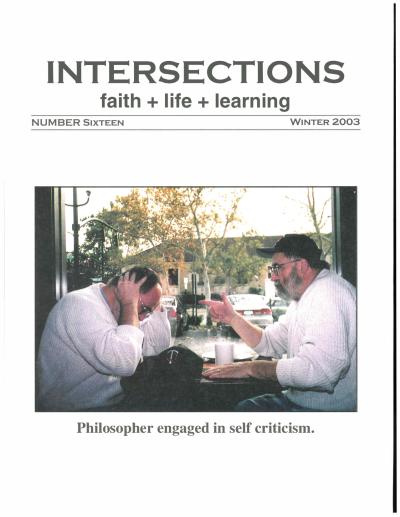
Benne responds to two articles in the Winter 2002 Intersections: former Bishop Stanley Olson’s “The Marks of an ELCA College,” whose narrow reading of the two kingdoms cedes all epistemological claims to secular knowledge, and President Tipson’s engagement with The Future of Religious Colleges, whose “rather unchastened Enlightenment spirit” underestimates how loaded the social sciences and humanities are with their own philosophical and religious assumptions. Drawing on Reinhold Niebuhr, John Milbank, and William Buckley, Benne defends a “critical mass” of pervasively Lutheran colleges and calls on bishops and pastors to take the schools seriously lest they drift from their religious heritage.
-
 Article
A Lutheran Dialectical Model for Higher Education
Ernest L. Simmons
No. 37 · Spring 2013
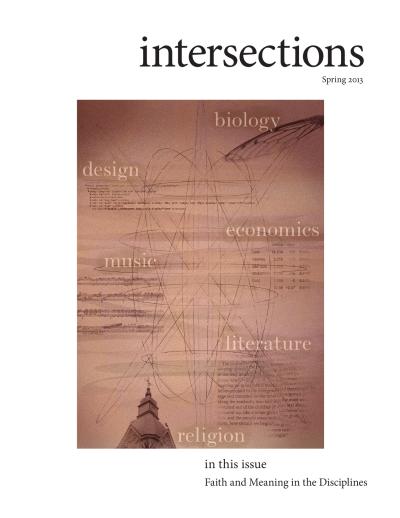
Drawing on “The Freedom of a Christian,” simul justus et peccator, Richard Hughes, Joseph Sittler, Martha Nussbaum, and Tom Christenson, Simmons argues that the Lutheran tradition informs an open, dialectical educational model that holds Christian and academic freedom together. He locates vocation at the intersection of the practical (why are you here?) and the existential (why are you here?) and proposes Lutheran higher education as education for self-transcendence and leadership Soli Deo Gloria.
-
 Editorial
From the Editor
Tom Christenson
No. 21 · Summer 2005
In his valedictory letter as outgoing editor, Christenson recounts the 1994 origins of Intersections, when he took the idea to Naomi Linnell and Jim Unglaube at DHES and persuaded the council of presidents to launch the journal on a shoestring with printing paid by DHES and everything else by Capital University. He summarizes the issue’s contents—papers from the 2004 Vocation of a Lutheran College Conference plus two commissioned pieces from former DHES directors Bob Sorensen and Leonard Schulze—and thanks the student copy editors and Capital’s presidents and provosts who sustained the publication.
-
 Article
Service Beyond the Comfort Zone
Kathryn Wolford
No. 18 · Fall 2003
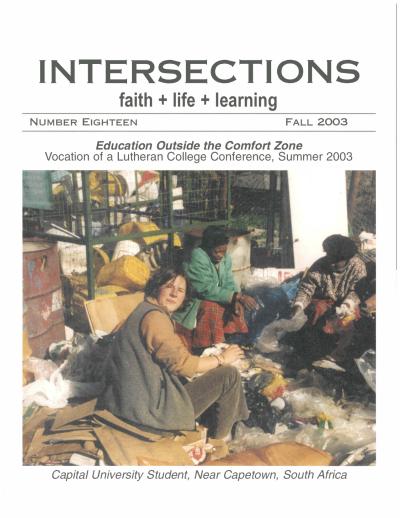
Wolford names economic globalization and the growth of civil society as the two issues shaping Lutheran World Relief’s mission, illustrating with the Guatemalan storekeeper undercut by subsidized “gringo” chickens, fair-trade coffee and chocolate campaigns, and Charles Onyango-Obbo’s warning about anti-terrorism laws in fragile African democracies. Drawing on Darrell Jodock, Art Simon, and the Good Samaritan, she frames the global vocation of Lutheran colleges as inviting students past comfort zones of race, class, ethnicity, and ideas through service-learning that links mercy and justice, and closes with a concrete LWR partnership invitation including site visits, internships, fair-trade campus campaigns, and the “A Place for Peace in Colombia” advocacy program.
-
 Editorial
From the Editor
Tom Christenson
No. 6 · Winter 1999
Christenson explains that three of the five papers from the 1998 Wittenberg Vocation of a Lutheran College conference appear here (with Robert Scholz and Cheryl Ney to follow in the next issue), passes on Andy Sheppard’s “Books for Belarus” appeal from Southwestern College, and reflects on Douglas John Hall’s The End of Christendom and the Future of Christianity—its claim that disengagement from cultural dominance is the prerequisite for faithful re-engagement, and its retrieval of Christ’s metaphors of “a little salt, a little yeast, a little light” as a possible session topic for a future VLC Conference.