Lutherans and Lutheran colleges talk about vocation and calling, often assigning almost mystical or magical qualities to the discernment thereof. When I hear this talk, I sometimes wonder if the discovery involves a voice like the one in Field of Dreams, or perhaps a lightning bolt. I suppose that sometimes it does.
Many are familiar with Frederick Buechner’s oft-cited description of vocation: “The place God calls you to is the place where your deep gladness and the world’s deep hunger meet.” Working at a Lutheran college for the last 15 years, I’ve heard college presidents, faculty, and chaplains quote Buechner or come up with their own way of describing what is supposed to happen to an 18 to 22-year-old in college.
The 26 Lutheran colleges and universities have even united around a common mission related to vocation, as articulated in the statement, Rooted and Open. There, they summarize their collective work as follows:
Together, these educational communities train graduates who are called and empowered to serve the neighbor so that all may flourish. This vocation is shared by diverse institutions. While the history of each institution propels it from behind, a shared calling also draws the institutions forward, pulling them into a future that brings wholeness to the world. The Lutheran theological roots that these schools have inherited deepen their educational purpose, inform their educational commitments and anchor their educational priorities.
There is plenty of Biblical and scholarly work that reinforces this claim to vocation, and I consider it a great privilege to serve a Lutheran college and to raise my children in an ELCA congregation. But I do worry a bit about the often grandiose and erudite descriptions of calling and vocation, especially on college campuses.
I’ve been thinking about this since hearing a delightful sermon by Pastor Katy Warren, associate pastor at St. Paul Lutheran Church in Davenport, Iowa, where I am a member. Pastor Katy had the tough job of preaching a sermon through a mask, during a brief in-person, midday service of communion following the derecho (inland hurricane) that clobbered Iowa in August of 2020.
It had been quite a week—100 mile-per-hour winds, splintered trees, decimated crops, days without electricity and other services. Needless to say, we were not prepared and the damage was awful. I didn’t envy Pastor Katy’s assignment to make sense of it all.
She chose to read from 1 Peter 4: 8-11, which was an effective passage for the moment. Verse 10 stood out to me: “Each of you should use whatever gift you have received to serve others.” Pastor Katy then shared stories of line workers from across the nation rushing to Iowa’s rescue, neighbors with power setting up charging stations for those without, strangers with chainsaws helping those with downed trees, restaurants offering freezer space, and other acts of kindness and generosity.
“Were those line workers, neighbors, restaurant owners, and chainsaw-wielding neighbors thinking about meeting the world’s deep need with their deep gladness?”
Following the service, I found myself thinking about how the message related to my own life and the work of Lutheran colleges. Were those line workers, neighbors, restaurant owners, and chainsaw-wielding neighbors thinking about meeting the world’s deep need with their deep gladness? I suppose it’s possible, but I doubt it.
This spring, summer, and into the fall, I’ve witnessed something similar at Augustana College. So many of my amazing colleagues on campus have helped where and when they have been needed throughout the pandemic. People have stepped in and up to help—the athletic trainer-turned-telecounseling outreach coordinator; the counselor now an expert contract tracer; the Sports Information Director now coordinating campus-wide surveillance testing; the hesitant email user now an expert in meeting virtually with all kinds of stakeholders. Seeing such responsiveness has made me wonder about the emphasis we place on calling. Perhaps there is more room to focus on the immediate needs of those around us, while also encouraging the discovery that accompanies vocational reflection.
I believe we should pair our important message about vocation and calling with the kinds of things we witness in the moment, such as the aftermath of the derecho here in Iowa and the campus’s response to the pandemic and changing needs.
Rather than asking college students to identify and follow their path in life, should we simply make a stronger case for responding to the moment? For just showing up, giving what you have, helping exactly where and when needed, no matter what your background?
“Should we simply make a stronger case for responding to the moment?”
We might call it “meeting immediate need with a deep willingness,” or simply, “called to the moment.” For liberal arts students educated as versatile, critical thinkers, it might be a natural impulse. I, for one, think making that case might be the true vocation of a Lutheran college.
-
 Editorial
From the Publisher
Mark Wilhelm
Wilhelm argues that the “hackneyed” expressions of higher education — “you are not just a number,” “the college experience,” “risen to the challenge” — tell the simple truth about NECU institutions even as the Covid-19 pandemic has pushed budgets, employees, and campus life to the breaking point.
-
Editorial
From the Editor
Jason A. Mahn
Mahn narrates a year of crisscrossing pandemics — Covid-19, economic collapse, partisan politics, and the long pandemic of white supremacy revealed anew by the murder of George Floyd — and argues that Lutheran liberal arts schools, by educating for vocation, are uniquely poised to help students respond with character and capable callings.
-
Article
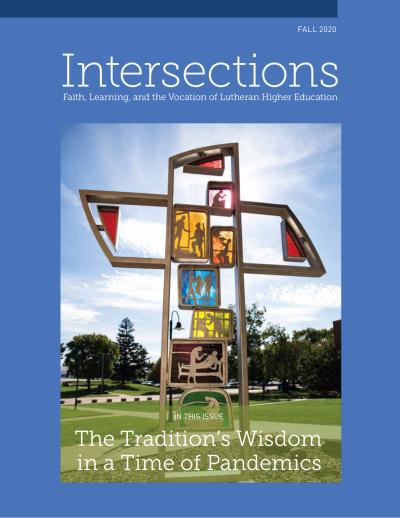
A New Image for an Ancient Call: Lutheran Higher Education Amidst Pandemics Today
Caryn Riswold
Pairing Wartburg’s Lebenskreuz sculpture with the Matthew 25 acts of mercy and the commitments of Rooted and Open, Riswold reads the calls to feed the hungry, welcome the stranger, and care for the sick as urgent summons for Lutheran higher education in a year of overlapping pandemics — and as a call to dismantle the structures that produced them.
-
Article
Learning from Luther on Covid-19
Carl Hughes
Reading Martin Luther’s 1527 treatise “Whether One May Flee from a Deadly Plague,” Hughes finds practical and spiritual guidance for a pandemic age: serve the neighbor, follow medical experts, honor those whose vocations put them at risk, and trust that even when we fail, God will not abandon the community.
-
Article
Radical Hospitality on Haunted Grounds: Anti-Racism in Lutheran Higher Education
Krista E. Hughes
Writing from Newberry College’s campus on land once home to the Cherokee and within a day’s drive of Mother Emanuel A.M.E., Hughes argues that NECU’s call to “practice radical hospitality” demands that predominately white institutions open themselves to the hauntings of racism — pursuing belonging rather than mere welcome, and risking kenotic transformation of institutional identity itself.
-
Article
Activism, Justice, and the Danger of Silence
Dezi Gillon
In conversation with Jason Mahn, Augustana College alumnux Dezi Gillon traces the call to action they felt as a Black student organizing for Black Lives Matter on a predominately white campus — through seminary, art, spirituality, and restorative justice work — and warns white professors that staying silent “actually speaks volumes.”
-
Article
Leadership in Lutheran Key at a Time of Pandemics
Deanna Thompson
Thompson draws on Luther’s theology of the cross and Shelly Rambo’s theology of trauma to sketch a Lutheran model of leadership for a season of pandemics — one that is attentive to pain, responsive to need, and intentionally nourished by food, friends, and deep conversation.
-
Article
Through Truth to Freedom—by Way of Reconciliation
Paul C. Pribbenow
Reflecting on Augsburg’s 150th-anniversary motto “Through truth to freedom,” Pribbenow argues that in a season of three pandemics — pandemic illness, economic collapse, and the racial sin laid bare by the murder of George Floyd — higher education’s most authentic work is to educate for truth and freedom by way of confession and reconciliation.
-
Article
Finding Purpose in Chaos: Reflection In and Beyond the Public Health Classroom
Lena R. Hann
When the pandemic hit her new public health professionalism course, Hann recalibrated her teaching from the “how” of professional preparation to the “why” of vocational reflection — and recounts how Augustana public health students and alumni found purpose in the chaos through food banks, disaster response, palliative care, and research on health inequities.
-
Reflection
The Long Pilgrimage of 2020-21
Kara Baylor
Drawing on Martha Stortz’s definition of pilgrimage as “intentional dislocation, for the sake of transformation, where the body teaches the soul,” Baylor invites students and educators worn out by the 2020-21 academic year to ask what is essential, to listen to what their bodies are telling their souls, and to be more open to the transformations the dislocation might still yield.
-
Article
Called to Flourish: An Ethic of Care
Mindy Makant
Drawing on Lenoir-Rhyne’s core value of Care, Glennon Doyle’s Untamed, Darrel Jodock’s “Gift and Calling,” and Luther’s plague-era practice of opening his home to the sick, Makant argues that flourishing is interdependent — that self-care is a means to extending care, and that an ethic of care is the meaningful, transformative work to which Lutheran liberal arts education is called.
-
 Reflection
Saving Minds
Lake Lambert
No. 28 · Fall 2008
In a sermon preached in the Castle Church in Wittenberg during Wartburg College’s 2006 faculty and staff development seminar, Lambert names two sins of the mind—coveting and mental sloth (in both its rigid refusal to think and its mindless relativism)—and, drawing on Luther’s Large Catechism and Martin Luther King, Jr.’s “A Tough Mind and a Tender Heart,” calls Christians to receive the wisdom that comes when faith puts knowledge into action, sustained by the hope of the resurrection.
-
 Editorial
From the Publisher
Arne Selbyg
No. 15 · Winter 2002
Selbyg announces that the 2001 ELCA Churchwide Assembly has commissioned a new social statement on education, placing it alongside the economy, the environment, abortion, sexuality, health, and peace, and invites Intersections readers to submit input on which topics within the field of education the statement should address.
-
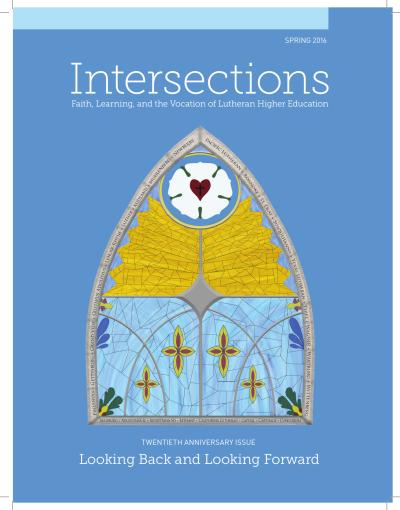 Article
Moving Forward by Looking Back: Lutheran Vocation as Foundation for Interfaith Ministry
Kristen Glass Perez
No. 43 · Spring 2016
Recounting how Augustana students mentored her into the role of presider at a campus vigil following the 2012 Sikh Temple of Wisconsin shooting, Glass Perez proposes that interfaith understanding become a mode of praxis for the twenty-first century Lutheran college. Drawing on Engaging Others, Knowing Ourselves and Interfaith Youth Core’s leadership practices, she urges ELCA schools to develop a common language linking interfaith engagement to vocational exploration and to the wider mission of the church.
-
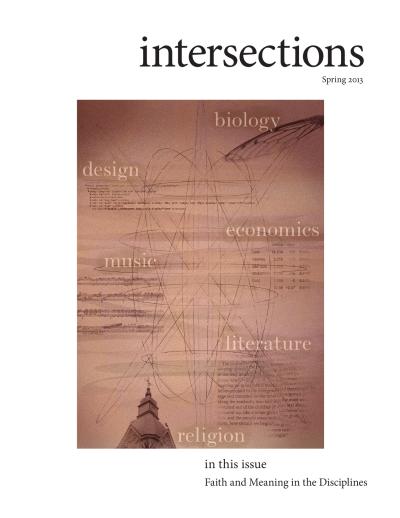 Article
Living Biology
Stephanie Fuhr
No. 37 · Spring 2013
Fuhr recounts how a one-credit Becoming Biologists course at Augustana College was rebuilt around the biological worldview after a student flagged John Janovy Jr.’s argument that values are legitimate tools in biology. Drawing also on Stephen Jay Gould’s The Mismeasure of Man, she argues that visions and values—not skills alone—inspire a life’s work in science and provide the foundation for lifetime engagement in the work of biology.
-
 Editorial
From the Editor
Tom Christenson
No. 19 · Summer 2004
Christenson reflects on the scarcity of time in over-committed academic lives and posts a tongue-in-cheek help-wanted advertisement for his own successor as editor. He introduces the issue’s four authors as “three friends and one new acquaintance” whose work addresses Lutheran higher education, the significance of Paul Ricoeur, the implications of being a reformation community, and the perils of teaching ethics.
-
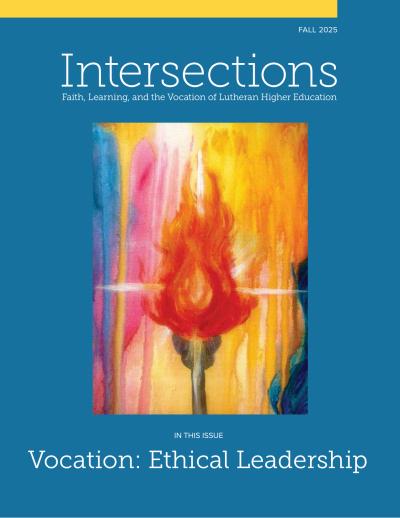 Editorial
From the Publisher
Lamont Anthony Wells
No. 62 · Fall 2025
5 min audio
Wells frames the issue as a record of the 2025 VLHE Conference at Augsburg under the theme “Ethical Leadership in a Changing World,” arguing that vocation is never solitary but a collective, public witness of ethical formation, theology and care, flourishing and belonging, and leadership rooted in God’s grace.