A New Image for an Ancient Call: Lutheran Higher Education Amidst Pandemics Today
Intersections No. 52 · Fall 2020
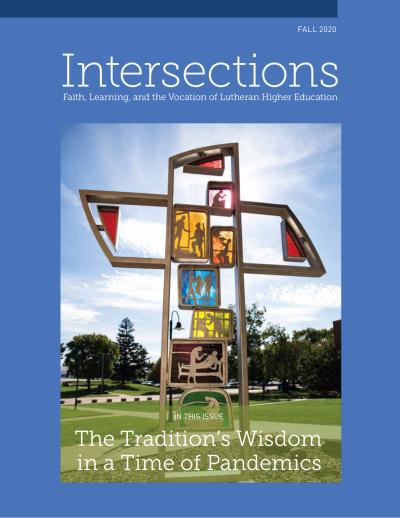
When the Wartburg College community gathered in October 2019 to dedicate the Lebenskreuz sculpture featured on the cover of this issue of Intersections, we could not have known how the academic year would end. We could not have understood how painfully necessary its reminder of Jesus’s call to tend to our neighbors’ needs would become in just one semester’s time.
The design has particular connection to the history of Wartburg College and its institutional vocation. It comes from the Diakoneo in Neuendettelsau, Germany, where Wilhelm Löhe founded a social ministry enterprise in 1854,
as a response to the Industrial Revolution’s legacy of deteriorating social conditions for disadvantaged populations. This move came just two short years after Löhe had directed Georg M. Grossmann to establish a pastoral ministry training school for German immigrants in the United States—a school that would become Wartburg College. (Wartburg College)
The sculpture is a 12-foot tall stainless steel and stained glass version of the smaller wooden crosses crafted in the Diakoneo’s workshops, “where people with disabilities are provided vocational training, job coaches, and work opportunities crafting handmade items, including the Lebenskreuz” (Wartburg College). One of these sits on the altar of the Wartburg College Chapel. The design notably features panels depicting the acts of mercy narrated in Matthew 25:35-40:
“For I was hungry and you gave me food, I was thirsty and you gave me something to drink, I was a stranger and you welcomed me, I was naked and you gave me clothing, I was sick and you took care of me, I was in prison and you visited me.” Then the righteous will answer him, “Lord when was it that we saw you hungry and gave you food, or thirsty and gave you something to drink? And when was it that we saw you a stranger and welcomed you, or naked and gave you clothing? And when was it that we saw you sick or in prison and visited you?” And the king will answer then, “Truly I tell you, just as you did it to one of the least of these who are members of my family, you did it to me.”
We had no way to know in 2019 that this ancient summons to serve the neighbor would take on renewed urgency for our campus communities in the coming year, communities that are, in the word of Rooted and Open, “called and empowered to serve the neighbor so that all may flourish” (NECU). In what follows, I pair the works of mercy with the commitments articulated in Rooted and Open so that each might guide us through tumultuous times.
Called and Empowered: “I was sick and you took care of me.”
The Covid-19 pandemic pushed every community across the globe to focus on care for its sick and dying neighbors. College communities like ours were forced to identify potential sites for quarantining infected students, develop processes to protect vulnerable members of the community, and ultimately create overnight plans to evacuate campuses.
As a new academic year commenced, new plans yet again had to be developed by Campus Health Recovery teams taking into account the needs for rapid testing, contact tracing, quarantines, and return-to-learn plans that include mask mandates and reconfigured classroom spaces. With a text like Matthew 25 before us, and a piece of art visually compelling us, care for the sick and attention to the dying has become a central call of a Lutheran college and its graduates in 2020.
To Serve the Neighbor: “I was hungry and you gave me food”; “I was thirsty and you gave me something to drink.”
The economic shutdown that was a result of the spread of Covid-19 revealed another pandemic, as exhibited in lines at food banks, weekly unemployment claims that shattered record highs in United States economic history, and shuttered businesses and campuses that will never return to our communities. The hungry and thirsty in our communities had fewer places to turn for support; even congressional bailout packages prioritized corporate protections over rent-relief.
Feeding the hungry and giving sustenance to the thirsty means attending to the embodied needs of our neighbor. Students who had to return home often found themselves with unemployed parents and lost jobs for themselves. Even on our campuses, for the students who were unable to leave because they didn’t have a safe home to return to or a country that would allow them to return, food insecurity reached new levels, with drastically reduced dining options and increased reliance on food pantry services. Colleges were called to rethink what it means to feed the hungry and sustain the thirsty in our own residence halls as well as in our communities.
So That All May Flourish: “I was a stranger and you welcomed me.”
The murder of George Floyd in Minneapolis on May 25, 2020, and the public demands for accountability, justice, and transformation of our white supremacist society called every community to examine who is and is not welcomed, who is and is not supported and protected. For predominantly white colleges and universities, which includes many ELCA schools, this included a reckoning with the experiences of students and alumni of color. These students should be emboldened to tell their stories, make their pain public, and demand that the institution adhere to the very values it espouses, yet often fails to enact.
Welcoming the stranger is about listening and seeing across lines of difference, including racial difference. Welcoming requires naming and letting go of fear, finding a space where one can be vulnerable and safe at the same time. To speak of welcoming is also to presume a power dynamic embedded in the roles of host and visitor, one that also demands examination and radical reframing. Matthew 25 is a text that pushes us to do that work of reframing and humbling.
As the public work of racial reckoning continued into the summer, the Department of Homeland Security proposed to change a policy that would have forced deportation of any international student enrolled at a college or university whose education had to move to remote-delivery or online instruction due to the pandemic. This literal rejection of the visitor, the stranger, prompted a wave of resistance, including statements from individual college presidents like this one:
We will move heaven and earth to ensure that you can continue taking courses in a way that satisfies the U.S. government. Not only are you welcome on this campus, you are Wartburg Knights, and, as such, you are as entitled to be in this community, on this campus, as I am. (Colson)
Though this proposed change to student visa regulations was rescinded in response to lawsuits and amicus briefs from leading higher education organizations and institutions, it happened amidst the myriad pandemics to which we are called to respond. Like the other pandemics, it is a product of the structures that continue to disenfranchise members of our campus communities.
Deadly Structures and the Cross of Life
In her analysis of Matthew 25, womanist theologian Mitzi J. Smith notes that
it places more emphasis on acts of social justice (feeding the hungry, visiting the sick and imprisoned) than on actually changing those systems that promote the perpetual existence of poverty, hunger, prison nations and enslavement, and sickness, as opposed to equity, health, wholeness, protections, and freedom for all. (Smith 92)
She argues that “systemic change is necessary to destroy poverty, inequities, and injustice” because “I don’t believe we love a God who encourages the normalization of violence” (92). So yes, these acts of mercy are necessary “to keep people alive and healthy in the meantime,” but let us not lose sight of a larger call—to eradicate the systems and structures that produced such pandemics in the first place.
Lebenskreuz means “cross of life,” a term which itself captures a paradox embedded in Martin Luther’s call for Christians to be theologians of the cross, wherein an instrument of torture and death becomes a source of life and divine accompaniment. “God can be found only in suffering and the cross,” writes Luther. For this reason, a person “deserves to be called a theologian, however, who comprehends the visible and manifest things of God seen through suffering and the cross” (“Heidelberg” 52). God is found in the unexpected places, at the margins of society, in suffering and pain, confounding the best of human wisdom and calling us to serve our neighbors in precisely those places and times.
In Luther’s own 1527 letter, “Whether One May Flee from a Deadly Plague,” he repeatedly refers to Matthew 25 and the acts of mercy that Jesus commands. At one point, he writes, “if it were Christ or his mother who were laid low by illness, everybody would be so solicitous and would gladly become a servant or helper….And yet they don’t hear what Christ himself says, ‘As you did to one of the least, you did to me’ [Matt. 25:40]” (130).
May the presence of this sculpture on our campus, and on this cover, be a public reminder of the calling of Lutheran colleges and universities to welcome the stranger, feed the hungry and thirsty, care for the sick and dying, and tend to the imprisoned. The pandemics we navigate today are not new, and dismantling the structures that produced them requires educated citizens who can advocate for systemic change and do the hard and messy work to transform the social and political conditions that produced them.
So that all may truly flourish.
Works Cited
Colson, Darrel. “Wartburg President Offers Words of Support to International Students.” Accessed 1 November 2020, www.wartburg.edu/2020/07/08/wartburg-president-offers-words-of-support-to-international-students/
Luther, Martin. “The Heidelberg Disputation” (1518). Luther’s Works (American Edition), volume 31. Fortress, 1957.
_______. “Whether One May Flee from a Deadly Plague” (1527). Luther’s Works (American Edition), volume 43. Fortress, 1999.
NECU (Network of ELCA Colleges and Universities). “Rooted and Open: The Common Calling of the Network of ELCA Colleges and Universities.” Accessed 1 Nov. 2020, http://download.elca.org/ELCA%20Resource%20Repository/Rooted_and_Open.pdf
Smith, Mitzi. Womanist Sass and Talk Back: Social (In)Justice, Intersectionality, and Biblical Interpretation. Cascade, 2018.
Wartburg College, “Lebenskreuz Sculpture Details.” Accessed 1 Nov. 2020, https://alumni.wartburg.edu/s/1563/17crowd/interior.aspx?sid=1563&gid=1&pgid=2202&sitebuilder=1&contentbuilder=1
-
 Editorial
From the Publisher
Mark Wilhelm
Wilhelm argues that the “hackneyed” expressions of higher education — “you are not just a number,” “the college experience,” “risen to the challenge” — tell the simple truth about NECU institutions even as the Covid-19 pandemic has pushed budgets, employees, and campus life to the breaking point.
-
Editorial
From the Editor
Jason A. Mahn
Mahn narrates a year of crisscrossing pandemics — Covid-19, economic collapse, partisan politics, and the long pandemic of white supremacy revealed anew by the murder of George Floyd — and argues that Lutheran liberal arts schools, by educating for vocation, are uniquely poised to help students respond with character and capable callings.
-
Article
Learning from Luther on Covid-19
Carl Hughes
Reading Martin Luther’s 1527 treatise “Whether One May Flee from a Deadly Plague,” Hughes finds practical and spiritual guidance for a pandemic age: serve the neighbor, follow medical experts, honor those whose vocations put them at risk, and trust that even when we fail, God will not abandon the community.
-
Article
Radical Hospitality on Haunted Grounds: Anti-Racism in Lutheran Higher Education
Krista E. Hughes
Writing from Newberry College’s campus on land once home to the Cherokee and within a day’s drive of Mother Emanuel A.M.E., Hughes argues that NECU’s call to “practice radical hospitality” demands that predominately white institutions open themselves to the hauntings of racism — pursuing belonging rather than mere welcome, and risking kenotic transformation of institutional identity itself.
-
Article
Activism, Justice, and the Danger of Silence
Dezi Gillon
In conversation with Jason Mahn, Augustana College alumnux Dezi Gillon traces the call to action they felt as a Black student organizing for Black Lives Matter on a predominately white campus — through seminary, art, spirituality, and restorative justice work — and warns white professors that staying silent “actually speaks volumes.”
-
Article
Leadership in Lutheran Key at a Time of Pandemics
Deanna Thompson
Thompson draws on Luther’s theology of the cross and Shelly Rambo’s theology of trauma to sketch a Lutheran model of leadership for a season of pandemics — one that is attentive to pain, responsive to need, and intentionally nourished by food, friends, and deep conversation.
-
Article
Through Truth to Freedom—by Way of Reconciliation
Paul C. Pribbenow
Reflecting on Augsburg’s 150th-anniversary motto “Through truth to freedom,” Pribbenow argues that in a season of three pandemics — pandemic illness, economic collapse, and the racial sin laid bare by the murder of George Floyd — higher education’s most authentic work is to educate for truth and freedom by way of confession and reconciliation.
-
Article
Finding Purpose in Chaos: Reflection In and Beyond the Public Health Classroom
Lena R. Hann
When the pandemic hit her new public health professionalism course, Hann recalibrated her teaching from the “how” of professional preparation to the “why” of vocational reflection — and recounts how Augustana public health students and alumni found purpose in the chaos through food banks, disaster response, palliative care, and research on health inequities.
-
Reflection
The Long Pilgrimage of 2020-21
Kara Baylor
Drawing on Martha Stortz’s definition of pilgrimage as “intentional dislocation, for the sake of transformation, where the body teaches the soul,” Baylor invites students and educators worn out by the 2020-21 academic year to ask what is essential, to listen to what their bodies are telling their souls, and to be more open to the transformations the dislocation might still yield.
-
Article
Called to Flourish: An Ethic of Care
Mindy Makant
Drawing on Lenoir-Rhyne’s core value of Care, Glennon Doyle’s Untamed, Darrel Jodock’s “Gift and Calling,” and Luther’s plague-era practice of opening his home to the sick, Makant argues that flourishing is interdependent — that self-care is a means to extending care, and that an ethic of care is the meaningful, transformative work to which Lutheran liberal arts education is called.
-
Article
Called to the Moment: A New Vocation for Lutheran Colleges
W. Kent Barnds
After a derecho ravaged Iowa in August 2020 and Pastor Katy Warren preached on 1 Peter 4, Barnds watched line workers, neighbors, and Augustana colleagues simply show up where they were needed — and proposes that the true vocation of a Lutheran college may be making the case for “meeting immediate need with a deep willingness” alongside the longer work of vocational discernment.
-
 Institutional Focus
So That All May Belong: Lutheran Roots for Diversity, Equity, Inclusion, and Justice
Altheia Richardson, Angie Hambrick, Caryn Riswold, Colleen Windham-Hughes, Deanna Thompson, Marcia Bunge, Robert Clay
No. 61 · Spring 2025
22 min audio
The full NECU statement grounds DEIJ work in Luther’s 16th-century reforms and Lutheran theological claims about the image of God, equal dignity, and the limits of human knowing — offering definitions, Lutheran roots, and calls to action for diversity, equity, inclusion, and justice, with belonging as the outcome of DEIJ at work.
-
Institutional Focus
Scriptures That Inspire Work for Diversity, Equity, Inclusion, and Justice
Altheia Richardson, Angie Hambrick, Caryn Riswold, Colleen Windham-Hughes, Deanna Thompson, Marcia Bunge, Robert Clay
No. 61 · Spring 2025
9 min audio
A companion list of biblical verses — from Genesis 1:27 and Galatians 3:28 to Micah 6:8 and Luke 4:18-19 — that grounded NECU’s drafting of So That All May Belong, organized by the four DEIJ commitments and offered as an invitation to share other texts that ground and sustain the work.
-
Institutional Focus
So That All May Belong: Lutheran Roots for Diversity, Equity, Inclusion, and Justice [abridged]
Altheia Richardson, Angie Hambrick, Caryn Riswold, Colleen Windham-Hughes, Deanna Thompson, Marcia Bunge, Robert Clay
No. 61 · Spring 2025
8 min audio
A condensed version of the NECU statement that consolidates Lutheran theological grounding for DEIJ and a single combined call to action for Lutheran colleges and universities — offered as a shareable summary alongside the complete document.
-
 Article
Committed to Paradox
Caryn Riswold
No. 60 · Fall 2024
Riswold lifts up paradox — saint and sinner, lord and servant, Rooted and Open — as a distinctive Lutheran root that lets institutions honor the complicated truth of who their students are and embrace the messy, ever-reforming work of access and accessibility as a theology of the cross.
-
 Article
Views on Flourishing After the Age of Roe
Caryn Riswold, Mary J. Streufert
No. 57 · Spring 2023
Riswold and Streufert reflect on the Radcliffe Institute’s January 2023 conference “The Age of Roe” and argue that the ELCA’s 1991 Social Statement on Abortion and its 2019 statement Faith, Sexism, and Justice offer Lutheran higher education a third way to approach reproductive justice grounded in serving the neighbor so that all may flourish.
-
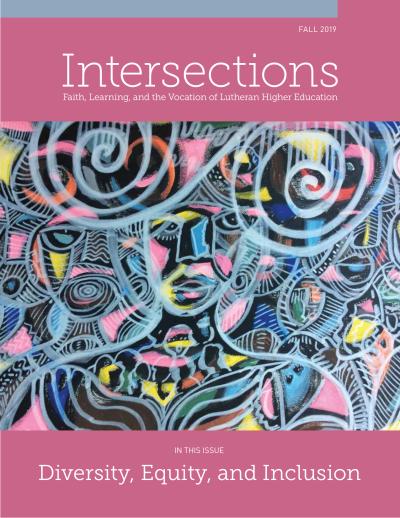 Article
The Vocation of White People in a Racist Society
Caryn Riswold
No. 50 · Fall 2019
Riswold proposes that whiteness is a weakness borne of apathy, atrophy, and ignorance — an atrophied muscle of race-consciousness — and offers concrete practices (reading, adjusting one’s gaze, consuming media differently, drawing on ELCA social statements like the repudiation of the Doctrine of Discovery) for exercising that muscle and naming the vocation of white people in a racist and white supremacist culture.
-
 Article
Sojourners in a Pluralistic Land: The Promise and Peril of Christian Higher Education
Randall Balmer
No. 25 · Spring 2007
Balmer, a Barnard scholar of American evangelicalism reared in evangelical parsonages and formed at Trinity College in the Chicago suburbs, defends public education even as he champions Christian higher education as a “halfway house” for students moving from religious subculture into a pluralistic world. Drawing on his own undergraduate experience, his books Mine Eyes Have Seen the Glory and Thy Kingdom Come, and a chastening visit to Patrick Henry College, he names three perils of Christian higher education—the Scylla of secularism (intellectual arrogance allergic to piety), the Charybdis of sectarianism (intellectual dishonesty as exemplified by intelligent design’s special pleading), and insularity—and prescribes mentors, primary sources, internships outside the subculture, and a broader, intergenerational pluralism on campus.
-
Institutional Focus
So That All May Flourish Study Guide
No. 57 · Spring 2023
A chapter-by-chapter study guide to So That All May Flourish (Fortress Press 2023), a new volume by NECU authors that develops the central tenet of “Rooted and Open” and offers discussion questions for use in orientation programs, classes, workshops, task forces, and professional development settings.
-
 Reflection
Meditation—Band Chapel Service, St. Olaf College
Erik Haaland
No. 7 · Summer 1999
Haaland, a St. Olaf senior, offers a brief Band Chapel meditation that defines art as “the expression of what is deeply human through the manipulation of the physical world” and defends worship—architecture, stained glass, music, eloquence—as an art form requiring our best and most sincere efforts. When the God we worship and the salvation we proclaim do not seem near, artful worship offers not propositions but something real and tangible to hold on to.
-
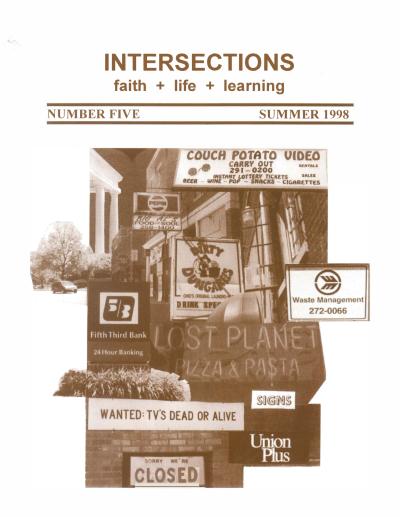 Article
Redemption Through Imperfection
Kyoko Mori
No. 5 · Summer 1998
Mori, drawing on a visit to the Philadelphia Museum of Art with a friend, contrasts Marcel Duchamp’s Étant donnés—a peephole work whose mysterious motion sweeps every viewer into a shared, perpetual performance—with the static, glass-encased Liberty Bell as parody of spiritual experience. She extends the contrast into a meditation on rituals (comfort and consolation) versus art (truth, however painful), and on writing as a redemptive process that moves from orderly first drafts toward chaos and deeper, frightening truth—closing with master potters who skewed each finished vessel slightly so that art and decoration could be told apart. Parts are excerpted from Polite Lies (Holt 1997).
-
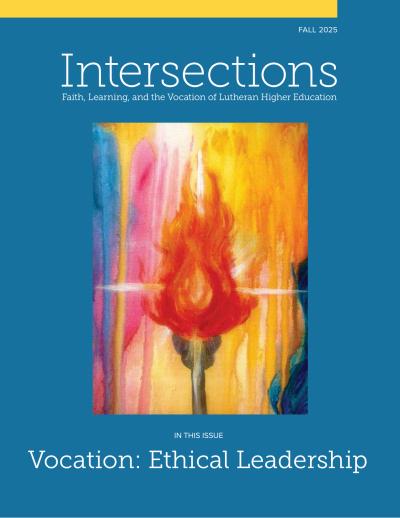 Article
Ethical Leadership: Rooted, Open, Generative, and Mindful
John Arthur Nunes
No. 62 · Fall 2025
25 min audio
As he prepares to teach an Ethical Leadership First Year Seminar at California Lutheran, Nunes organizes his pedagogy around three mutually-reinforcing “turns” — inward, outward, and intellectual — grounded in Luther’s mandatum dei and larvae dei, Bonhoeffer’s estates, and Howard Thurman’s call to hear “the sound of the genuine” in oneself.
-
 Article
Vocare: A Spiritual Practice for the Spaces Between
Charlene Rachuy Cox
No. 58 · Fall 2023
Cox introduces Vocare, a six-word spiritual practice developed through the Nourishing Vocation Project at St. Olaf, that uses the acronym V-O-C-A-R-E to help individuals and communities honor the spaces “between no longer and not yet” and discern their callings for the common good.