A Lecture Celebrating the Inauguration of Andrew K. Benton As the Seventh President of Pepperdine University: Tuesday, September 19, 2000
Shortly before he left office, David Davenport, the sixth president of Pepperdine University, led the entire Pepperdine community in the creation of a mission statement that affirms the following:
Pepperdine is a Christian university committed to the highest standards of academic excellence and Christian values, where students are strengthened for lives of purpose, service, and leadership.
Now, as we celebrate the inauguration of Andrew K. Benton as the seventh president of this institution, we must ask the question, “What does it mean when we say that Pepperdine is a Christian university?” And we must ask as well a second question that follows closely on the heels of the first: “How can we insure that Pepperdine remains a vibrant Christian university for as long as this institution shall survive?”
These are serious questions that we dare not ignore, for there are many powerful critics who argue that the idea of a Christian university is an oxymoron, a virtual contradiction in terms. In their judgment, Christianity is restrictive, dogmatic, and exclusive, while the university, at its best, celebrates openness, diversity, and an unrelenting search for truth. How, then, can one combine the ideals of Christianity with the ideals of the academy and do so successfully?
The truth is, there are many outstanding institutions of higher learning in the United States that at one time embraced a commitment to their Christian moorings, but slowly abandoned that commitment as their academic stature improved. While Harvard, Yale, and Princeton head that list, we could point to scores of other institutions that finally abandoned their experiment in Christian higher education.
Today, there are precious few institutions that have matured into first-rate centers of scholarship and learning while maintaining a strong institutional commitment to the Christian faith. The critics of Pepperdine’s vision, then, could easily point to the impressive list of failures in the field of Christian higher education as proof that Pepperdine will likely fail as well.
It would be all too easy to ignore those critics as false prophets who simply don’t understand what Pepperdine is all about. But we will make a grave mistake if we choose to believe that, somehow, we stand above the powerful forces that hastened the collapse of Christian higher education at so many other worthy institutions. If scores of other institutions have failed to combine the ideals of the Christian faith with the ideals of the academy in a meaningful way, what makes us think that Pepperdine will be an exception to the rule?
In terms of academic quality, Pepperdine already walks in the footprints of many distinguished institutions of higher learning in the United States. Indeed, in September, 2000, U.S. News and World Report ranked Pepperdine among the top fifty centers of learning in the United States. For a university that is slightly more than fifty years old, that is cause for considerable pride.
At the same time, the ranking by U.S. News and World Report is also a cause for sober reflection on how we hope to maintain, and even enhance, the Christian character of this institution in the years to come. We can make good and noble resolutions all we want, but mere talk will not get the job done. What we need is a strategy that grows from the very heart of this community.
A Strategy of Community-Wide Conversation
The word “strategy” is in some ways misleading, for I am not suggesting that there is some “quick fix” or some gimmick that, if properly employed, will keep Pepperdine on course. Instead, the strategy I have in mind is a strategy of continual theological reflection as, together, week after week and year after year, all of us in this community undertake the task of exploring what it might mean for Pepperdine to thrive as a Christian university. This means that we must think long and hard on the question that inevitably stands at the very heart of this institution: “How can we combine the ideals of the Christian faith with the ideals of the academy and do so successfully?” This is the question that must frame our thinking and our conversation, not just today and not just tomorrow, but for as long as this institution shall survive.
If we hope that Pepperdine will succeed in this experiment in Christian higher education, the conversation on this issue must not be confined to a handful of faculty or a core group of administrators who have a particular interest in this issue. Instead, the conversation must reach out and embrace each and every person in our community—every member of the faculty, every person in the administration, every person who serves on the Board of Regents, every student, and every person who works on the staff of this University.
If the Pepperdine community were to undertake this kind of sustained conversation, we just might have a chance to take our place among that handful of universities that have matured into first-rate centers of scholarship and learning while maintaining a strong institutional commitment to the Christian faith.
With this sort of conversation in mind, the Pepperdine administration established in October of 1999 the Pepperdine University Center for Faith and Learning. The administration charged the Center with providing various venues for members of this community to think creatively on the meaning of Christian higher education. How, for example, can Christian faith sustain the life of the mind? What does it mean to engage in scholarship that is both Christian in orientation but also sensitive to issues of diversity? How might we teach from a Christian perspective while, at the very same time, enhancing our students’ abilities to think both critically and comparatively? How can responsible Christian scholars connect their Christian convictions with their teaching and their scholarship in ways that respect the integrity of the academic enterprise, the integrity of their disciplines, the integrity of their students, and the integrity of the Christian faith? Or, to put all these questions in the most succinct possible form, how can we combine the ideals of the Christian faith with the ideals of the academy and do so successfully?
To fulfill its mandate, the Center is hard at work convening seminars and discussion groups where faculty from all five schools that make up this University can reflect on these kinds of questions. In fact, between May of 1999 and September of 2000, a total of 75 Pepperdine faculty participated in these seminars. We now seek to extend the work of the Center by offering seminars where faculty can interact not just with other faculty, but also with students, staff, and members of the administration on precisely these kinds of issues.
In time, and with adequate levels of funding, we hope to offer grants for some of our very finest scholars who have a vision for top-flight, faith-based scholarship. And we hope as well to bring to this campus visiting scholars who model cutting edge academic work that is grounded in a Christian frame of reference.
In my judgment, there is no more important work at Pepperdine University today than the work of the Center for Faith and Learning. I say this because the Center’s work is an investment in the soul of this institution. It is not an investment in brick and mortar, though clearly without brick and mortar we cannot survive. Instead, the work of the Center is an investment in the hearts and minds of the people who make up this university. This is the only sort of investment that can help insure that Pepperdine will move into the future as a Christian university of the very highest order.
I want now to make some suggestions that perhaps will contribute to the quality of the conversation that the Center seeks to facilitate.
Diversity
In the first place, scholars at institutions like Pepperdine commonly commit themselves both to the Christian faith and to the life of the mind, but often struggle to connect these dimensions in a meaningful way. After all, the academy invites openness, diversity, and critical scholarship, while the Christian religion demands a highly particularistic faith commitment. The question we must therefore ask is this: how is it possible to nurture one’s commitment to a highly particularistic religion like Christianity, and nurture at the very same time a commitment to values like diversity and genuine openness to perspectives that differ from one’s own?
The answer to that question has much to do with the paradox of the Christian faith. That paradox begins with the incarnation—the notion that an infinite God appeared in finite human flesh—and then goes on to manifest itself in a myriad of other ways. In the Christian tradition, for example, life always springs from death, the deepest levels of fulfillment always emerge from self-denial, leadership always grows from servanthood, and the ability to affirm diversity always springs from an affirmation of Christian particularity.
How might this paradoxical character of the Christian faith play itself out in the context of the life of the mind? Jesus underscores the particularity of the Christian tradition when He says of Himself, “I am the way, the truth, and the life. No one comes to the Father but by me.”
And yet, this very same Jesus also taught,
You have heard that it was said, “Love your neighbor and hate your enemy.” But I tell you: Love your enemies and pray for those who persecute you, that you may be sons of your Father in heaven. He causes his sun to rise on the evil and the good, and sends rain on the righteous and the unrighteous. If you love those who love you, what reward will you get? Are not even the tax collectors doing that? And if you greet only your brothers, what are you doing more than others? Do not even pagans do that? Be perfect, therefore, as your heavenly Father is perfect. (Matt. 5:43–48)
The truth is, Jesus consistently reached out to the powerful and to the marginalized, to Jews and to Greeks, to men and to women, to slaves and to free Roman citizens, to prostitutes, to tax collectors, and to thieves. Today, His compassionate concern extends to every man and woman in this multicultural world in which we live: Asians and Africans, Hispanics and Native Americans, Buddhists and Hindus, Jews and Christians. When it comes to compassionate concern, Jesus leaves no one out.
This means that if we ask Jesus to define for us the meaning of diversity, we must be prepared for an answer that is absolutely inclusive. In Jesus’ world, all human beings are infinitely valuable. From the rich young ruler to the woman caught in adultery, Jesus took everyone He encountered with complete and radical seriousness.
And so we are left with the question, Can we serve Jesus and celebrate diversity at one and the same time? If we understand anything at all about Jesus, the question answers itself. The truth is, we cannot serve Jesus without serving the diversity of peoples and cultures that abound in our world.
But there is more, for on the question of diversity, Christian faith goes far beyond the intellectual tradition that sustains diversity in the modern, secular academy. That tradition simply holds that “All men are created equal and are endowed by their Creator with certain unalienable rights.” This is a marvelous beginning, but Christian faith moves beyond equality and rights to love, service, and compassion.
Christians are told, for example, to love not only our friends but also our enemies—those whom we are inclined not to like, or those whose folkways or religious traditions may cause us considerable discomfort, or those whom the rest of society tends to leave behind for whatever reason. Thus, Jesus tells us,
When you give a luncheon or dinner, do not invite your friends, your brothers or relatives, or your rich neighbors; if you do, they may invite you back and so you will be repaid. But when you give a banquet, invite the poor, the crippled, the lame, [and] the blind. (Luke 14:12–13)
Over the years this tradition of Christian compassion has played itself out in some important ways. For example, in spite of the fact that America’s most notable revolutionary leaders affirmed the proposition that “all men are created equal,” they failed to see how that proposition might demand liberation of their slaves. In contrast, the Quakers, driven by the biblical tradition of love and compassion for all human beings, had freed their slaves by the time America declared its independence from Great Britain.
In our own tradition of Churches of Christ, this same biblical tradition inspired Barton Stone and his followers who lived in the vicinity of Cane Ridge, Kentucky to free their slaves as well. And they took this action long before most white people in the American South had even considered emancipation of slaves as an option. Thus, Joseph Thomas, a preacher in the Christian movement in the early nineteenth century, reported in 1810–11 that
The christian companies in this settlement and about Cane Ridge have been large; but within a few years, many of them, who held black people as slaves, emancipated them, and have moved to the state of Ohio. I will observe that the christians of these parts abhor the idea of slavery, and some of them have almost tho’t that they who hold to slavery cannot be a christian.
It is undeniably true that many Christians across the centuries have failed to live out the Christian mandate for love and compassion for all human beings. But the fact that so many Christians have failed in this regard in no way invalidates the vision itself. The teachings of our Lord still stand, whether Christians implement those teachings or not.
It must be clear by now that while the modern secular academy values diversity, so does the Christian faith. And yet, the Christian scholar must always bear in mind that when we compare the Christian university with the modern secular academy, the grounds for the commitment to diversity are not the same. The secular academy prizes diversity because it affirms the democratic faith that “all men are created equal.” On the other hand, Christians prize diversity simply because they affirm the life and teachings of Jesus the Christ.
This particularity—this radical commitment to this very particular person called Jesus the Christ—is precisely what scandalizes the critics of Christian higher education. But the critics fail to see that Christians can affirm diversity in radical and far-reaching ways, not in spite of their commitment to the Christian particularity, but precisely because of that commitment.
In spite of all this, many critics of Christian higher education will no doubt suggest that our argument thus far has really begged the fundamental question. It is one thing to extend service and compassion to a diversity of human beings. It is quite another thing to take seriously their ideas, their cultural traditions, even their religious perspectives. This, the critics argue, is the crucial step that many Christian colleges and universities are unwilling to take.
The critics may be correct in their observation regarding some Christian institutions of higher learning. But they are wrong if they think that Christian scholars have no biblical mandate for taking seriously the ideas—even the religious traditions—of the wide variety of people who inhabit this globe.
The plain truth is that Christians are called to take other human beings seriously. In the context of the academy, this means that we must listen carefully to their points of view, always asking what we might learn from those who come from cultural, political, and religious traditions that are different from our own. Listening does not necessarily mean agreement. But listen we must. As Christian scholars, we can do no less.
Academic Freedom
I want now to ask about a second value the academy holds dear, the notion of academic freedom.
Critics sometimes argue that Christian institutions of higher learning can’t extend academic freedom in truly meaningful ways because of their highly particularistic religious commitments. I grant you, there are many Christian colleges and universities that refuse to embrace genuine academic freedom for their faculties. But institutions like these simply don’t reflect the genius of the Christian faith.
I want to suggest that there are no institutions anywhere in the world better prepared to extend academic freedom than Christian institutions of higher learning. I say this because of the nature of the Christian gospel. Let me explain.
The Christian gospel begins with the affirmation that no human being is God. To the contrary, every human being is finite, fundamentally flawed, and inescapably sinful. No one, therefore, can possibly perform enough good works or muster up enough righteousness to earn a seat in the kingdom of God. Instead, justification or forgiveness comes to us only through the grace of God which we receive through faith and not by works. As Paul wrote in Galatians 2:15–16,
We who are Jews by birth and not “Gentile sinners” know that a man is not justified by observing the law, but by faith in Jesus Christ. So we, too, have put our faith in Christ Jesus that we may be justified by faith in Christ and not by observing the law, because by observing the law no one will be justified.
This is the core of the gospel of Jesus Christ.
Martin Luther often used a Latin phrase to capture the genius of the Christian gospel: “simul Justus et peccator” or, in English, “simultaneously justified and a sinner.” I can perhaps best explain the meaning of that phrase by contrasting Luther’s vision with my own childhood misunderstandings.
When I was in the fifth grade, growing up in San Angelo, Texas, I always walked to school and had to cross a very busy street before I reached my final destination. I vividly recall reminding myself on many occasions that if per chance I were struck by a car and killed on the way to school, I must remember to pray God’s forgiveness for all the sins I had committed since my most recent prayers. If I managed to get that petition in before I expired, I had a chance at going to heaven. If not, I knew I would be doomed to eternal damnation.
Many years later, in a class on the book of Romans at Harding College, I learned that the gospel of Jesus Christ completely undermined those childish misunderstandings. My epiphany came when the professor unpacked Paul’s assertion in Romans 8:1: “There is therefore now no [italics mine] condemnation for those who are in Christ Jesus.” No condemnation. What a magnificent concept! This passage means that my salvation does not depend on the frequency of my prayers or the quality of my works, but solely and entirely on the grace of a loving God.
And yet, the fact that we are not condemned does not mean that we are no longer sinners. This is the crucial point that we must grasp and the point that Luther sought to make when he used the phrase, “simul Justus et peccator” or, “simultaneously justified and a sinner.” As a Christian, I am perpetually redeemed. But as a human being, I never cease to be a sinner. Simul Justus et peccator!
Luther found this doctrine enormously liberating because it freed him to take seriously his finitude, his frailties, and his inescapably sinful nature. He never took the gospel as a license to sin. But the gospel did mean that he no longer had to pretend to be a saint. For that reason, he sometimes advised his followers to “sin boldly.”
The implications this notion holds for the life of the mind—and for academic freedom in the context of a Christian university—are staggering. While our finitude means that the Christian scholar may well misunderstand, miscalculate, or draw erroneous conclusions, the Christian paradox, simul Justus et peccator, means that the Christian scholar is freed to do all these things.
Don’t misunderstand. The Christian gospel is not a license for sloppy scholarship. But it does free us to take our finitude seriously, to recognize up front that we will make mistakes and that, indeed, we may well be wrong. This recognition enables the Christian scholar to approach his or her work with humility, to confess mistakes quickly and forthrightly, and to pursue the search for truth with zeal and determination, knowing that complete and final truth lies always beyond our grasp.
Or again, the depth of our humanity has determined that no human being—not even a Christian scholar—can finally escape the most radical doubts and the most radical kinds of questions. But the Christian paradox—simul Justus et peccator—means that the Christian scholar is freed to confront those questions honestly. No longer must we repress those doubts or pretend that we have perfect faith and perfect tranquility. Instead, we are freed to confess with the father of the boy with the evil spirit in Mark 9, “Lord I believe; help thou mine unbelief.”
Put another way, the Christian gospel enables us to be real. I cannot imagine a stronger foundation for responsible academic freedom than this.
Finally, we must be clear on one more crucial point. In the previous section, we saw that for the Christian, an affirmation of diversity finally rests on the foundation of Christian particularity. So it is with academic freedom. The Christian scholar claims academic freedom precisely because that scholar takes seriously the particularity of Jesus the Christ. Here we encounter once again that amazing paradox that is so central to the Christian faith. We are freed to question because we affirm, and we are freed to doubt because we believe. Those who fail to discern the paradox of the Christian gospel will never understand how Christian faith can sustain academic freedom and the life of the mind. But those who have eyes to see will find in the Christian gospel an incredibly powerful support for the kinds of radical questions which every serious scholar must raise.
I hope by now that the kinds of questions the Pepperdine Center for Faith and Learning hopes to foster are apparent. Chief among those questions are these: How can Christian faith sustain a commitment to diversity? And how can Christian faith enhance the quality of academic freedom?
On Taking Seriously Our Relationship to the Churches of Christ
But there is one more question that is vital to the work of Pepperdine, and it is this: how can we put to productive and meaningful use the relationship this University sustains to the Churches of Christ?
We commonly say that apart from our relationship with the Churches of Christ, Pepperdine would cease to be a Christian university altogether. And that is very likely true, for the Church of Christ is our mooring, our anchor, our very tangible connection to the world of Christian tradition and Christian faith.
But is this the only rationale we can offer for maintaining our relation with Churches of Christ? If so, then we have sold this tradition very short indeed.
The far more pressing questions are these. How can the heritage of Churches of Christ sustain us in the work of higher education? Are there resources in the heritage of Churches of Christ to which we can appeal as we seek to enhance diversity and academic freedom? Or again, how can the heritage of Churches of Christ help sustain the life of the mind?
These are questions we must address. For if we ignore these questions, the day may come when faculty at this institution will judge our relationship with Churches of Christ as irrelevant at best and, at worst, as a hindrance to the life of the mind and the work of higher education. If the faculty eventually make that judgment, then we can rest assured that Pepperdine’s relationship with Churches of Christ will have become an empty formality, lacking both substance and content.
So what might we say about this tradition? Does it possess resources that can sustain us in the work of scholarship, teaching, and learning? The answer to that question must be a resounding “yes.”
Before I proceed with this line of thought, I want to acknowledge up front that I am not naive about the history of this tradition. I am painfully aware that there is much in the history of Churches of Christ that works against diversity, that undermines freedom of thought and freedom of expression, and that offers little support for the life of the mind.
But having said that, we must also confess that there is much in this tradition to which we can appeal on behalf of the work in which we are engaged.
First, Churches of Christ emerged in the early nineteenth century as a unity movement. The founders of this tradition—Alexander Campbell and Barton W. Stone—lamented the fact that so many Christian churches on the American frontier viewed other denominations with such hostility. Campbell and Stone, therefore, gave birth to a movement that aimed for unity in diversity. Stone, for example, admonished his followers in 1830,
Be careful not to wound the feelings of the least christian of any name. View all the children of God as your brethren, whatever name they may bear. What if they have received wrong opinions of truth? This is no reason why you should despise or reject them.
This is a powerful model for an institution like Pepperdine that seeks to enhance a diversity of peoples and perspectives.
Second, Churches of Christ emerged in the early nineteenth century as a freedom movement. If they had any hope of uniting Christians while respecting a diversity of perspectives, then Campbell and Stone knew they had to grant to all men and women the freedom and the right to search for truth for themselves. This was no mere strategy, but a conviction that grew from their awareness of their own sinfulness and their own limitations. Stone therefore wrote in 1829,
I have too much evidence of my liability to err to make my present opinions a test by which to judge the hearts of my fellow Christians.
Further, Stone and Campbell knew how easy it is for religious people—indeed, for any people—to succumb to traditions that stifle the mind and cut off fresh and creative thinking. Accordingly, Campbell wrote,
I have endeavored to read the scriptures as though no one had read them before me; and I am as much on my guard against reading them to-day, through the medium of my own views yesterday, or a week ago, as I am against being influenced by any foreign name, authority, or system, whatever.
But perhaps the strongest statement one can find in the annals of Churches of Christ on behalf of intellectual and spiritual freedom is a statement from John Rogers, the preacher for the Church of Christ in Carlisle, Kentucky in the early nineteenth century. In 1830, Rogers penned these simple but powerful words.
The fatal error of all reformers has been that they have too hastily concluded that they knew the whole truth, and have settled back upon the same principles of proscription, intolerance and persecution, against which they so strongly remonstrated. … Having, then, fall in our view, this fatal rock, on which so many reformers have split, may we studiously avoid it. We have no reason to conclude, we know all the truth. … We have nothing to lose in this inquiry after truth. We have no system to bind us to human opinions.
These are not isolated statements that reflect a minority voice in Churches of Christ in the founding years, but statements that have reflected the genius of this tradition for two full centuries. And it is precisely this genius—this “heart of the tradition”—that allows us to build a truly great university on the foundation offered to us by the heritage of the Churches of Christ.
If we hope that the heritage of Churches of Christ can really provide a foundation for the life of the mind, then we must make certain that all the people who work and study at this institution have some familiarity with the meaning of this tradition. This is why the Center for Faith and Learning devotes a segment of each and every seminar to helping faculty, staff, students, and administration to understand more fully how the heritage of Churches of Christ can, indeed, help sustain the life of the mind.
Conclusions
So now, we return to the question with which we began. What does it mean when we affirm Pepperdine’s mission statement that plainly asserts that “Pepperdine is a Christian university”?
It means, first of all, that Pepperdine as an institution takes its stand on the Christian faith. But second, it means that precisely because of its commitment to the Christian faith, Pepperdine seeks to enhance diversity, maintain academic freedom, and nurture the life of the mind. And finally, it means that Pepperdine seeks to strengthen its relationship with Churches of Christ, not only because we know that apart from that relationship, the Christian character of this institution would likely collapse, but also because we know that the Churches of Christ can provide us with invaluable supports for the work in which we are engaged.
We therefore press ahead in our attempt to make of Pepperdine University a truly great center of teaching, learning and scholarship. We are confident that we will succeed in this task, not in spite of our commitment to the Christian faith, but because of that commitment. This is why we confess in our mission statement that “Pepperdine is a Christian university committed to the highest standards of academic excellence and Christian values.” When we make that confession, we affirm once again the paradox of the Christian faith that we are freed to question because we affirm, and we are freed to doubt because we believe.
-
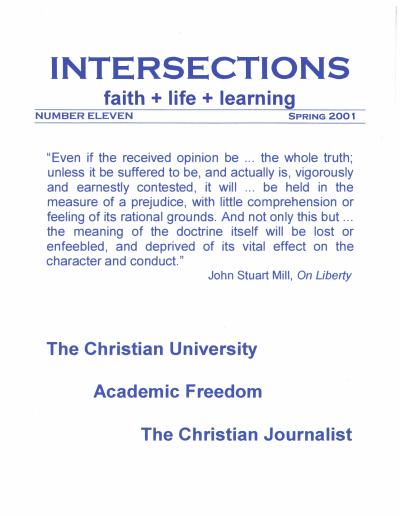 Editorial
From the Publisher
Arne Selbyg
Selbyg admits that promoting Lutheran colleges and universities can feel Sisyphean—clueless faculty or staff, fundraising treadmills, students and parents treated poorly by admissions, pastors with no sense of the colleges’ mission—but reports that alumni satisfaction surveys, ELCA-college faculty seminars, an engaging bishop, Ernie Simmons’s Lutheran Higher Education: An Introduction, and renewed reader interest in Intersections all show the stone is not at the bottom of the hill.
-
Editorial
From the Editor
Tom Christenson
Christenson explains that this issue “borrows everything from other sources”—Richard Hughes’s talk at Pepperdine president Andrew K. Benton’s inauguration, Nicholas Wolterstorff’s and Storm Bailey’s essays from the AAUP’s Academe, and Catherine McMullen’s Concordia talk—and defends the blatant borrowing as appropriate to faculty work, hoping new faculty will find in these pieces a corrective to common misconceptions about faith-related education and academic freedom.
-
Article
Ivory Tower or Holy Mountain? Faith and Academic Freedom
Nicholas Wolterstorff
Wolterstorff defines infringement of academic freedom as impairing a faculty member’s standing on account of the ideological content of her position, argues that academic freedom (like free speech) is “duly qualified” rather than absolute, and offers eight considerations bearing on religiously based institutions: Weber’s differentiation of Wissenschaft, religious pluralism within a liberal polity, the vitality of American civil society, a decentralized educational system, the “holistic” character of much American religion, the post-Kuhnian collapse of classical foundationalism and of the “generically human” academy, the fact that ideas matter, and the personhood violated by infringement (the desecration of an image of God). He concludes that the private sector offers wider academic freedom than the public, that religious qualifications are not inherently inappropriate (any more than St. John’s Great Books commitment), but that religiously based colleges too often apply them unjustly—arbitrarily, secretly, without recourse—and that the AAUP’s best service is model codes of procedure.
-
Article
Uneasy Partners? Religion and Academics
Storm Bailey
Bailey, a philosopher at Luther College, takes up the reflex of describing church-related colleges as “pretty good in spite of the religion” and argues instead that religious commitment serves academic goals on three fronts: service as central academic purpose (Richard Hughes on Mennonite colleges in Models of Christian Higher Education), educational community (Plato’s dialogues, Parker Palmer, and Mark Schwehn’s Exiles from Eden), and integration of knowledge across disciplines against Nelson and Watt’s “entrepreneurial disciplinarity.” He then defends academic freedom on Christian grounds by drawing on Mill’s On Liberty argument from fallibilism, the centrality of epistemic weakness in the Christian tradition, and Wolterstorff’s claim that to infringe academic freedom is to desecrate an image of God—making personal and institutional religious commitment a foundation, not a foe, of the liberal academic ideal.
-
Article
Can a Christian Be a Journalist?
Catherine McMullen
McMullen recounts how Ernie Mancini’s alumni-program invitation forced her to articulate what a print-journalism major at Concordia might be, then surveys the annus horribilus of 1998—Chiquita and the Cincinnati Enquirer, CNN/Time’s retracted Tailwind story, Patricia Smith and Mike Barnicle fired at the Boston Globe, Stephen Glass at The New Republic, and Matt Drudge and the White House scandal—before contrasting Concordia’s liberal-arts approach with Pat Robertson’s Regent University, whose “Christian journalism” produces one-sided vampire-cult stories and graduates who conclude journalism is no place for a Christian. Drawing on Richard Baker’s The Christian as a Journalist, Tom Christenson on the “law of niceness,” Ernie Simmons, Harmon Smith and Louis Hodges on Christian ethics, Robert Benne’s Lutheran four orders and his “Christian cobbler makes good shoes, not poor shoes with little crosses on them,” Mel Mencher, Robert Bugeja, Walter Cronkite, Pete Hamill, Jeremy Iggers, David Remnick, the Northwestern Death Row exoneration of Dennis Williams, Verneal Jimerson, and William Rainge, and Pulitzer citations for Katherine Boo, Eric Newhouse, George Dohrman, and Mark Schoofs, she argues that journalism is a Lutheran vocation and that Christian cobblers—and Christian journalists—make good shoes.

-
 Reflection
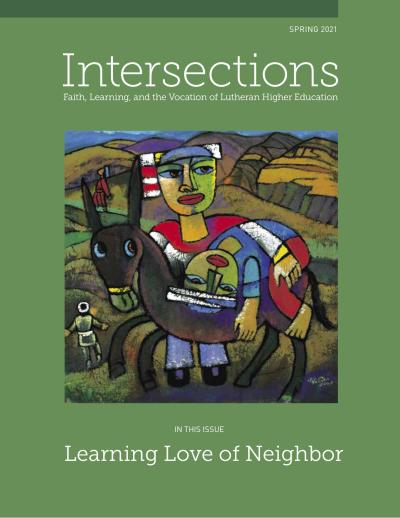
Shelter in Place: Reflections from March 22, 2020
Jason A. Mahn
No. 53 · Spring 2021
On the fourth Sunday of Lent in 2020, Mahn meditates on the etymology of “shelter” (from shield) and on an email from a former student in Boston whose mutual-aid organizing models a Lutheran understanding of vocation: the upending of ego by divine love that frees us, finally, to see and serve the neighbor.
-
 Article
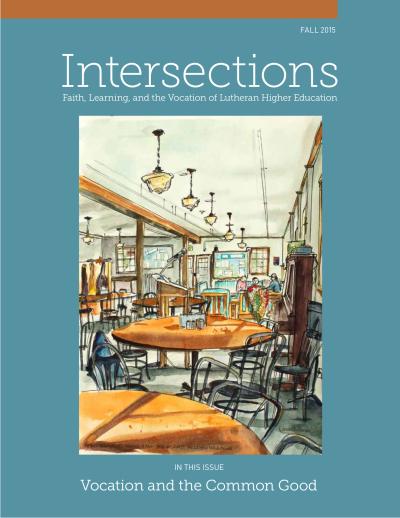
Women Presidents in Higher Education: How They Experience Their Calling
Aimee Goldschmidt, Gary McLean, Katherine A. Tunheim
No. 42 · Fall 2015
Drawing on in-depth interviews with fifteen women college presidents and a transformative-learning-theory framework, Tunheim, McLean, and Goldschmidt trace a three-stage journey — identifying, interpreting, and pursuing the call — and ask what the language of vocation contributes to the preparation and mentoring of women leaders in higher education.
-
 Article
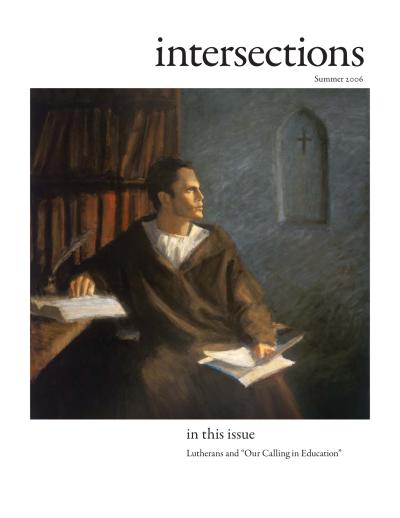
The Lutheran Calling in Education: Context and Prospect
Paul J. Dovre
No. 23 · Summer 2006
Dovre, President Emeritus of Concordia College and co-chair of the ELCA Task Force on Education, undertakes three tasks: focusing on the current social context (young people’s spiritual lives, the state of mainline denominations, the family map, schools, communities, and higher education); reflecting on why Lutherans care about education (creation in God’s image, vocation, Luther’s legacy, the priesthood of all believers, civic righteousness, and hope); and considering the prospects and possibilities for addressing the calling (biblical, confessional, theological, and pedagogical legacies; the renewal of apostolic ministry, the Christian-college renaissance, K–12 reform, and the congregational education explosion).
-
 Article
Money, Sex and Power: An Exploration of Some Controversial Issues in the Public Witness of the Church
Pamela K. Brubaker
No. 21 · Summer 2005
Brubaker explores two controversial issues in the church’s public witness—homosexuality and economic life—and the challenges they present for both church and college. Drawing on Beverly Harrison, Elizabeth Bounds, Ron Thiemann, Linell Cady, Marcia Bunge, Richard Hughes, Darrell Jodock, Ernest Simmons, Karen Bloomquist, Garth Kasimu Baker-Fletcher, and Larry Rasmussen, and on episodes at California Lutheran University around “Harmony Week” and Bishop Paul Egertson’s participation in Anita Hill’s ordination, she argues that colleges related to the ELCA are called to educate for “critical citizenship” by hosting rigorous, bold, and unfettered debate—including debate over the neo-liberal globalism that she names a form of economic fundamentalism.
-
 Reflection
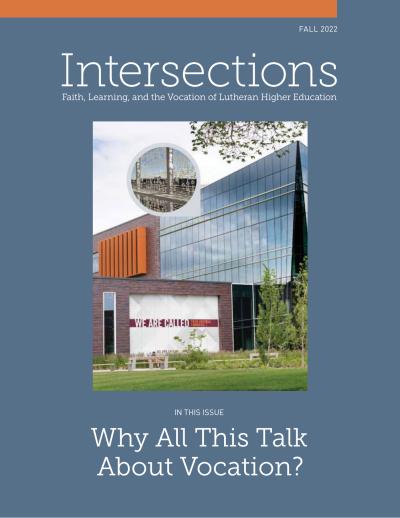
Why All This Talk About Vocation?
Madyson Ray
No. 56 · Fall 2022
Ray, a junior at Midland University and the only student attendee at the 2022 conference, reflects on four workshops — on teaching womanist thought, on supporting student-athletes, on resistance to the word “vocation,” and on vocational reflection — and brings home concrete ideas including a women’s-history scavenger hunt and semester-long vocational reflections.
-
 Reflection
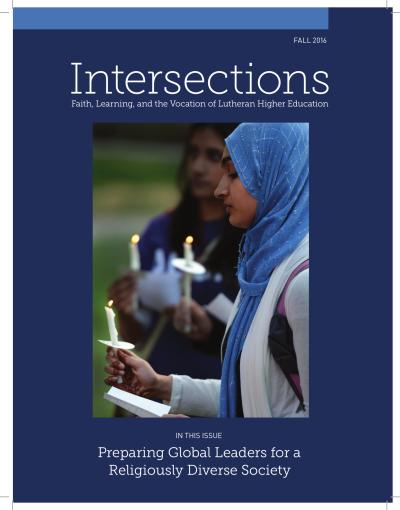
Mapping Interfaith Encounters
Callista Isabelle
No. 44 · Fall 2016
Muhlenberg College Chaplain Callista Isabelle uses a student-designed subway map of religious and spiritual communities as an image for interfaith engagement — one that invites students to leave their “home” stations, encounter common ground and respectful disagreement, and explore the major intersections where religion meets science, environment, and mental health.