INTERSECTIONS remains an important way for the higher education community to engage ideas about and reflections on the characteristics of Lutheran higher education: what is, what was, what should be, what could be, and why. We hope each issue stimulates discussion on the campuses of Lutheran institutions, and that it keeps church leaders informed about the ideas that circulate on campus. It is designed to reach faculty, college administrators and church leaders. If you have ideas for how the journal can be more effective or better reach it’s audience, please send them to the editor, Tom Christenson, or to me.
But as an academic journal INTERSECTIONS can only do a good job with one audience by leaving other audiences untouched. So the Executive Director for the Division for Higher Education and Schools within the Evangelical Lutheran Church in America, Leonard Schulze, challenged his staff to think through all the different target groups we have for our communications, and to develop a comprehensive communications plan. How do we communicate with high school students, with college students, with parents, with pastors, with journalists and media people? The more we do, the more we realize that we should do. It is clear that we have not done a good enough job of communication through the years because there is widespread ignorance about Lutheran colleges and what they stand for. Again, we welcome your input, please send us your ideas.
But before you do that, review what we are doing. Check our website at <www.elcacolleges.org>, it is much improved in the last year, thanks to our webmaster Tom Witt and the Assistant Director for Colleges and Universities, Sue Edison-Swift. Push the button for FREE STUFF to get copies of our brochures. Look at our advertisements in The Lutheran, Lutheran Partners, Seeds for the Parish and the ELCA Yearbook. If you have not already done so, read the book by Professor Ernie Simmons that we had Augsburg-Fortress publish: Lutheran Higher Education — An Introduction. Check the higher education stories in the ELCA video magazine—Mosaic.
You can also help us by telling us what works well. If you notice an ad or a story about Lutheran colleges or universities, tell us where you spotted it, and what made it catch your eyes. And if you hear a presentation that you think deserve a wider audience among one or more of our constituencies bring it to our attention, or have the author submit it to Tom for his consideration.
Arne Selbyg
Director for Colleges and Universities
-
 Editorial
From the Editor
Tom Christenson
Christenson previews a varied issue—Darrell Jodock’s Bernhardson inaugural lecture, Ernie Simmons’ Valparaiso conference talk on student/parent attitudes, two South Africa travel pieces by Brian Wallace and Corin Wesner, and reviews of Richard Hughes’s and Robert Benne’s recent books—and tells the story of “the church lady from hell,” a mid-fifties returning student who condemned everyone in the class with “God and I think…,” to ask what a religious tradition without a sense of humor would look like.
-
Article
The Lutheran Theological Tradition and Recruiting Lutheran Students
Ernest L. Simmons
Simmons opens with an Abraham-and-Isaac “Windows 98” joke to illustrate the dialectic of faith and learning, then argues that in a new market era of limited religious background, intentional mission and marketing go together. Drawing on Levine and Cureton’s When Hope and Fear Collide for the Millennial Generation born in 1982 and Tom Beaudoin’s Virtual Faith for their GenX parents, he reads “Reclaiming Lutheran Students” survey results showing 86% strong community at ELCA colleges versus 54% at flagship publics and 61% alumni mentoring versus 39%. He then develops three areas where the Lutheran tradition uniquely equips its colleges—community, mentoring and vocation, and the integration of faith and values—using Luther’s “two kingdoms” image of the “Left Hand” (reason) and “Right Hand” (faith) of God, with academic freedom as a product of Ahlstrom’s “Critical Current” in the tradition, and closes with three challenges: recruiting and retaining mentoring faculty, educating church leaders, and reaching potential students and parents.
-
Article
Freedom, Humor, and Community: A Lutheran Vision for Higher Education
Darrell Jodock
Jodock’s inaugural lecture for the Bernhardson chair at Gustavus Adolphus develops three interlocking themes drawn from the Lutheran tradition as a deeper grounding for the liberal arts college than contemporary American assumptions. A sense of humor rests on Luther’s discovery that God takes the initiative—Luther could call himself a beggar, joke about the epistle of James, and credit Wittenberg beer for the Reformation—and underwrites the freedom of inquiry that John Updike traces to Grace Lutheran Sunday School in Shillington. Community, grounded in Augsburg Confession VII and Luther’s 1524 letter to the German city councils, makes the college a community of discourse pursuing wisdom rather than “the same old blockheads.” Freedom is both “freedom from” and “freedom for,” illustrated by Nechama Tec’s Polish Holocaust rescuers and by Jodock’s Holocaust-class corporate role-play in which students voted to build a factory in a death camp rather than risk losing their board seats—a vivid case for educating toward “a passion for justice.”
-
Reflection
Truth, Reconciliation, and Redemption in South Africa
Brian Forry Wallace
Wallace, a 24-year veteran political science professor at Capital University, recounts five weeks of post-apartheid peace-building travel-study with students living south of Cape Town—visiting townships, schools, day-care centers, a children’s AIDS hospital, Robben Island, and Nelson Mandela’s cell—and offers vivid sketches of his student companions Amy, Brian, Meghan, Karrie, Patrick, Meredith, Cheryl, Corin, Debbie, April, and Audra. He concludes that these students—atheists and agnostics and Buddhists and Methodists and Baptists, headed for social work, nursing, teaching, ministry, and parenthood—embody vocation by responding to a voice that calls them out of themselves to be present and to heal in this world, and that they are his link to the redemption of a lost and broken soul.
-
Reflection
Sweet on My Lips
Corin Wesner
A passage from Wesner’s travel journal during the same South Africa workshop. Walking into a wood-and-tin shack church where raindrops fall on already-soaked carpet and the service is in Xhosa, she remembers her painted, carpeted home church and her adolescent argument with her mother about wearing a dress to worship, and finds herself engulfed in warmth as the few women sing—welcomed by a stranger’s smile and opened up.
-
Book Review
Richard T. Hughes: How Christian Faith Can Sustain the Life of the Mind
Tom Christenson
Christenson reviews Richard Hughes’s How Christian Faith Can Sustain the Life of the Mind (Eerdmans, 2001), which argues, drawing on Tillich’s notion of “religion breaking through its own particularity,” that faith is a means to the open pursuit of truth rather than its enemy. Christenson reads the argument as a natural fit for a Lutheran tradition of semper reformanda but notes Luther’s own dogmatism toward fellow reformers, and wishes Hughes had drawn a sharper line between an absolute truth that relativizes all human truths and a postmodern abandonment of truth altogether. The book was the most-cited title at the November meeting of North American Lutheran academic officers.
-
Book Review
Robert Benne: Quality With Soul: How Six Premier Colleges and Universities Keep Faith With Their Religious Traditions
Joy Schroeder
Schroeder reviews Robert Benne’s Quality With Soul (Eerdmans, 2001), which assesses the secularization documented by James T. Burtchaell’s The Dying of the Light and names six “bright lights” that resist it: Calvin, Wheaton, Baylor, Notre Dame, Valparaiso, and St. Olaf. Benne argues that piety alone or “generic Christianity” is insufficient—a school’s specific denominational intellectual tradition must permeate mission statements, classroom, and chapel, sustained by a critical mass of identifying faculty (he proposes a 2:1 ratio and at least one-third communicant membership), a first-rate theology department as “trustworthy guardian,” and visionary presidential and board leadership. Schroeder flags the under-representation of student and faculty voices but commends the book as required reading for presidents, board members, and faculty seminars at church-related institutions.
-
 Article
From Alien to Citizen
Arne Selbyg
No. 29 · Spring 2009
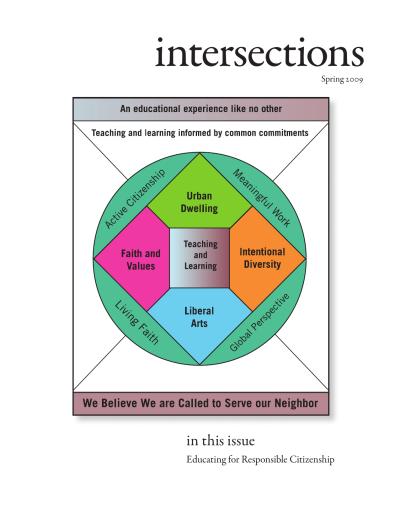
Selbyg reflects on three experiences of being educated for citizenship—growing up in Norway under the legacy of Lutheran pastors and public school teachers who resisted the Nazi occupation, arriving in America as a resident alien, and becoming a naturalized American citizen—and proposes the jazz ensemble as a better metaphor for American society than the melting pot, one in which different citizens learn skills, study other instruments, and dialog with one another in service to the common music.
-
 Editorial
From the Publisher
Arne Selbyg
No. 27 · Spring 2008
Selbyg, retiring this summer as Director for ELCA Colleges and Universities, reflects on his decade serving as spokesperson between the church and its twenty-eight colleges and universities, and argues that the link between the colleges and the church has grown stronger over the last ten years — sustained by supportive church leaders like Presiding Bishop Mark Hanson, the annual Vocation of a Lutheran College conference, and a Lutheran theology of higher education whose principles (questioning authority, returning to the sources, including the excluded, serving the neighbor) remain a strong basis for operating colleges and universities in the twenty-first century.
-
 Editorial
From the Publisher
Arne Selbyg
No. 26 · Fall 2007
Selbyg notes that, while a stated purpose of Intersections over its twelve years and twenty-six issues has been the intersection of faith, learning, and teaching, surprisingly few articles have addressed how Lutheran faculty teach and why — and credits the editor for assembling essays from authors whose teaching has benefited from the ELCA Wittenberg Center, on the eve of the City of Wittenberg’s “Luther Decade” leading up to the 2017 Reformation anniversary.
-
 Editorial
From the Publisher
Arne Selbyg
No. 25 · Spring 2007
Selbyg notes that most papers in this issue grew out of a pan-Lutheran conference organized by the Association of Lutheran College Faculties in fall 2006 rather than the annual Vocation of a Lutheran College conference, and argues that the ELCA’s ecumenical posture—truthful but open to learning from others—is a good foundation for institutions of higher education whose faculty likewise profess while remaining subject to change based on new research and insights.
-
 Editorial
From the Publisher
Arne Selbyg
No. 24 · Fall 2006
Selbyg situates this issue in the ongoing ELCA conversation about education that began with the 2005 conference and is feeding into the second draft of the ELCA Social Statement on Education, previews the 2007 conference (“The Vocation of a Lutheran College — Engaging the World”) at Augustana College, Rock Island, and lifts up Luther’s insistence that the church and its members contribute to their wider communities rather than retreat into self-centered enclaves.
-
 Editorial
From the Publisher
Arne Selbyg
No. 23 · Summer 2006
Selbyg features articles based on presentations at the 2005 Vocation of a Lutheran College conference focused on the upcoming ELCA Social Statement on Education, and urges members of the ELCA higher-education community to download the first draft (“Our Calling in Education”) from the ELCA website and submit feedback to the Task Force on Education before the October 15 deadline. He worries that the sexuality social statement on a 2009 timeline will draw more attention than the education statement, but reminds readers that, for Martin Luther and for those who work in Lutheran higher education, education is as important as sex.
-
 Editorial
From the Publisher
Mark Wilhelm
No. 48 · Fall 2018
Wilhelm frames the issue by reflecting on the Letter of James and the Lutheran tradition of “calling a thing what it is” — arguing that the standards of academic discourse, deeply rooted in Lutheran insistence on frankness and honesty alongside concern for the common good, give NECU institutions a solid platform for sustaining honest but not hateful discourse about divisive issues.
-
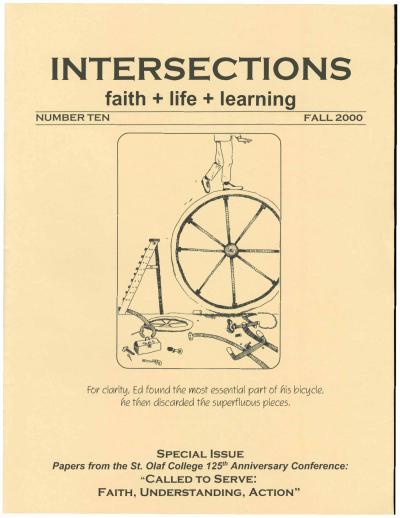 Article
Faith, Understanding, and Action
Paul J. Dovre
No. 10 · Fall 2000
Dovre frames the St. Olaf 125th anniversary—originally read as part of a presentation with the St. Olaf Cantorei and organist Paul Manz—around T.F. Gullixson’s story of an immigrant woman who “turned her face to the west wind” and the 1874 gathering at the Holden parsonage of B.J. Muus, Harold Thorson, O.K. Finseth, K.P. Haugen, and O.O. Osmondson. He weaves Anselm’s “faith seeks understanding,” Harold H. Ditmanson on the universal relevance of Christian faith, and the music of Venatius Honorius Fortunatas, John Rutter, Herbert Brokering, Ralph Vaughan Williams, and John Tavener into a meditation on faith as motive, understanding as modus, and action as consequence, against the “ill winds” of poverty, child homicide, AIDS, and consumer gluttony.
-
 Article
Integrity and Fragmentation: Can the Lutheran Center Hold?
Robert Benne
No. 8 · Winter 2000
Benne answers the conference’s question pessimistically—“the Lutheran center cannot hold in many, if not most of our colleges, because it was never there in an articulated form in the first place”—and distinguishes “Christ of culture” colleges like the Midland Lutheran of his youth (Lutheran by ethno-religious ethos rather than by articulated theology) from James Burtchaell’s “confessional colleges” that operated from a theologically distilled Lutheran humanism. Drawing on Alasdair MacIntyre and Mark Schwehn’s First Things essay on Christian universities, he sketches what a Lutheran center looks like (unity, universality, integrity, a tradition of thought) and how its distortion—reducing the Gospel to justification and ceding everything else to autonomous reason—splits Christ and culture as dangerously as the German church separated Gospel and politics. For colleges that have lost their center, he proposes an “intentional, robust pluralism” that guarantees a Lutheran voice in every department and an “affirmative action for Christians” in hiring.
-
 Editorial
From the Publisher
James M. Unglaube
No. 1 · Summer 1996
Unglaube welcomes readers to the inaugural issue of Intersections, crediting Editor Tom Christenson and Capital University, and announces the new annual Vocation of a Lutheran College Conference whose continuing dialogue the journal exists to enhance. He gives thanks to the Lilly Endowment for a sizable grant supporting the 1996 conference, campus dialogues, and the birth of the publication.
-
 Article
Learning the Language of Inclusive Pedagogy
David Thompson
No. 50 · Fall 2019
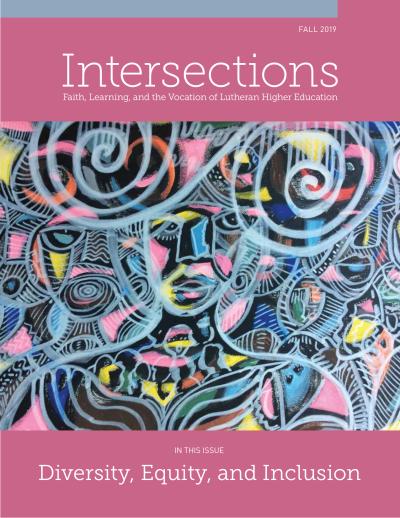
Thompson frames inclusive pedagogy as a foreign language with its own vocabulary, grammar, and cultural values, and reflects on a year of immersing himself in readings, conversations, and workshops — arguing that proficiency grows when instructors study and practice these languages repeatedly and atrophies when ignored.
-
 Article
Say Something Theological: A Meditation on the Vocation of Lutheran Colleges and Universities to Serve the Common Good
Paul C. Pribbenow
No. 42 · Fall 2015
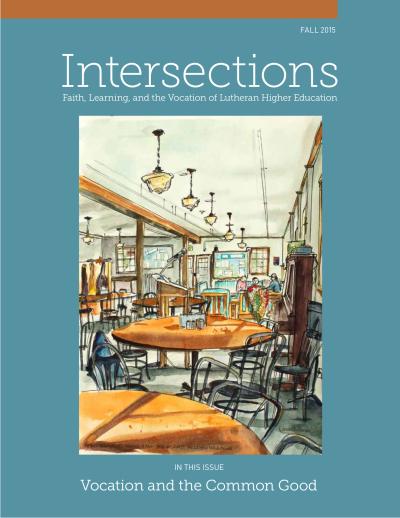
Pribbenow expands Luther’s “priesthood of all believers” into a meditation on doing theology with the Bible in one hand and the New York Times in the other — reading Luke 14 alongside walls, immigration, and hunger in his Minneapolis neighborhood — and argues that the leadership of Lutheran colleges demands a willingness to engage the theological issues at the heart of their public vocation.