From Pietism to Paradox: The Development of a Lutheran Philosophy of Education
Intersections No. 8 · Winter 2000
I became interested in questions related to the identity and educational mission of Lutheran colleges and universities in the mid 1950s while I attended Pacific Lutheran University. I didn’t get much help in my quest from either the institutional ethos or from what I read, however. The institutional ethos was largely composed of the Protestant triumphalism that was booming at the time, an aggressive moralism that was orchestrated by the incumbent president, S. C. Eastvold, and a defensiveness that wanted little or nothing to do with the complicated intellectual and moral questions that were being raised left and right. The institution was a fortress—a “defender of the faith”—in the language of a future Danforth Foundation study. I read Søren Kierkegaard and Reinhold Niebuhr and they helped me personally and politically, but I got no significant help with Athens-Jerusalem questions.
My long discussions with friends and my sometimes smart-alecky, reform-minded columns in the student newspaper, consequently, were never sharply focused, though sharp responses were sometimes evoked. The situation was quite a lot like that described by James Neuchterlein in his 1988 reflection about his collegiate experience at Valparaiso University:
We received educations suitable to our ambitions. The faculty in those years was overworked and underpaid, competent but undistinguished. They were predominantly Lutheran and deeply committed to the idea of Christian higher education, though, with some notable exceptions, that commitment consisted more of tribal loyalty and devotion than of any very clear idea of the difference a Christian education should make. We were without a doubt a Christian community, but what made us, or should make us, a Christian intellectual community remained uncertain.
I liked graduate school very much, but I didn’t have much time for questions about Lutheran college identity. Neither was there encouragement for such questions. Professionalism, specialization, and research talk dominated. What George Marsden calls “methodological secularization” also loomed over the whole enterprise. I didn’t discover the Harold H. Ditmanson, Howard Hong, and Warren Quanbeck edited book The Christian Faith and the Liberal Arts (1960) where contributors tried to discover whether there was a Lutheran philosophy of education until later and then decided it was too narrowly focused on the liberal arts and mirrored too much of the 1950s to be especially relevant. Indeed, the committee which represented the Evangelical Lutheran Church (ELC) colleges that had put the book together concluded it “would not be disposed to claim that what is set forth is distinctively Lutheran position.” The last two paragraphs of Warren Quanbeck’s chapter, “The Theological Basis of Christian Higher Education,” began to spell that out, however, and in my view it was unfortunate that much of the rest of the study did not begin to work out the details of the themes that were introduced there.
When I joined the PLU faculty in 1963 academic life was much more interesting and explosive than it had been a few years earlier. Ecumenical activity, secularism, pluralism, violence, and revolutionary change all had to be addressed. It was hard to find time to deal with institutional identity and purpose in that milieu, as institutions tried to hold on to the important and authentic parts of the past in the midst of the passions and wrenching changes taking place on all sides. We tried, however, and as I taught my courses dealing with the Reformation I discovered that Luther’s dialectical theology had remarkable relevance to educational philosophy and what was going on. It was not as retrograde as I had thought as an undergraduate. It was a wonderful discovery for me. I have been trying to work out the details ever since.
The need for an appropriate theological foundation for higher education—and an overdue move away from moralism or pietism as that foundation—became clearer at PLU in the early 70s. The new university president appointed a “Commission on Academic Excellence” in 1971 to prepare an educational road map to guide the institution into the future. The quite detailed final report appeared in 1973 and was introduced by a paragraph taken from a speech to university donors written a year earlier by university pastor, Gordon Lathrop. The statement was grounded in dialectical or two kingdoms theology and emphasized the necessity of dialogue between Christ and culture at a Lutheran institution. The statement was a revelation to some and helpful for many others, but it was controversial as well. It was opposed by the Humanities Division with the Religion Department taking the lead. Past formulations about the role of chapel, religion classes, and a religious atmosphere, as well as the residue of pietism, still had purchase on many members of the faculty. Lathrop had written:
For the Lutheran University, culture must not be subsumed under faith—that only leads to legalism and to the religious pretense which is the greatest enemy of the Gospel. The Lutheran conception of “civil righteousness” and the “two kingdoms” ought to allow us to rejoice in goodness found in the culture and in the creativity and reflection of men, without christianizing. But neither must the Word of God be subsumed under culture—in the midst of the University and its pluralistic involvements the Word must freely stand forth in its purity, as the Law and Gospel of God…. But then it seems to me that the Lutheran University must be a place dedicated to the full confrontation and dialogue between Christ and culture. It seems to me that the only religious test we ought to ask professors and students to submit to before they come here is whether or not they are actually willing to engage in this dialogue.
From the mid-1970s onward the American Lutheran Church (ALC) also got into this search and held a series of workshops devoted to “The Context and Mission of Lutheran Higher Education.” A more adequate theological and educational foundation for the ALC colleges and universities needed to be found so they could deal more effectively with their increasingly diverse student bodies and constituencies, as well as the changes and problems that had exploded out of the previous decade. The first and most helpful of these workshops was held at Concordia College organized by the college Dean, Paul Dovre, and the newly appointed Director of Institutional Research, Loren Anderson. Many of the institutional representatives present were intent on finding a justification for Lutheran higher education that focused on religious atmosphere or community—expressed in rather saccharin ways I thought—and dialectical theology as articulated by Gordon Lathrop (I had distributed his speech) was looked at with some suspicion. The workshop’s presenters were not interested in simplistic or saccharin formulas, however.
They were an impressive group and included Bill Narum of St. Olaf College (who had been involved in the writing of the Christian Faith and the Liberal Arts volume); Bob Bertram of Seminex; Harris Kaasa of Luther College; and the Yale Professor of American religious history, Sydney Ahlstrom. He lectured nightly, focusing on “What’s Lutheran About Higher Education?,” and drew very important distinctions between the three traditions that flowed out of the post-Reformation educational experience of Lutherans, the scholastic, the pietistic, and the critical. It was quite clear by the end of the week that he thought Lutheran institutions should be guided by the critical tradition. Ahlstrom’s distinctions and descriptions helped place the Lutheran educational enterprise in a much richer and more sophisticated context than earlier studies provided.
I reviewed Harris Kaasa’s paper “Faith and Learning: An Old Question Revisited.” It was a thoughtful and sometimes autobiographical survey of the topic from a Lutheran perspective. It described the influence of pietism on educational views and also described the theological and educational importance of Warren Quanbeck at Luther Seminary:
But I remember what a revelation it was to me when in my senior year at Seminary Warren Quanbeck expounded for us Luther’s doctrine of the two kingdoms. Eureka! Here at last was a conceptual scheme by which I could live by faith and come to terms with “the world,” a scheme by which I could relate faith to secular learning and indeed all human culture in a positive way. I discovered that it was not necessary to fear or shun learning. It was not only unnecessary but downright heretical to abandon the world to the devil. For both kingdoms were God’s kingdoms, though he ruled over each by a different word: over the world by law, and over the true church, the communion of saints, by the gospel and grace. Today, I see no reason to abandon this scheme. It remains for me the scheme which best does justice to both Scripture and my own experience.
By the time the workshop at Concordia concluded Luther’s two kingdoms theology was more firmly in place for a number of the participants, but it had been an emotional battle. ALC workshops and discussions continued at Luther College in 1975 and Luther Seminary in 1978 where Herman Diers of Wartburg College continued the Quanbeck-Lathrop-Kaasa foundational argument with a paper entitled “Implications of Luther’s Dialectical Theology For A College Curriculum.” It was a helpful summary by an important player in Lutheran educational circles.
A climax to the search for identity and purpose that marked the 1970s came in presentations at California Lutheran College in 1979. Papers were read by Richard Solberg on “Images and Expectations of LCA Colleges,” by Edgar Carlson on “The Future of Church-Related Higher Education” and Franklin D. Fry on “The Basis for Partnership Between Church and College.” Fry’s paper was a summary of the LCA’s statement with that same title approved at the biennial convention held in Boston in 1976. He quoted extensively from Luther’s letter to “The Councilmen of All Cities in Germany That They Establish and Maintain Christian Schools” and in the section on the theological base for church-college partnership he said: “It is, essentially an explication of the Lutheran understanding of the two areas of God’s kingship. We discern that he rules over the world through his Law, and he rules over his church through his Gospel…. Therefore, Lutheran theology does not place the college under God’s Gospel, and we do not expect the college to be a conversion center.”
The 1976 LCA statement spelled this out more fully, by addressing the meaning of the word “secular,” and following the logic of the theological reasoning utilized throughout the statement distinguished between “Christian” and “church-related” education:
As we carry out the God-given ministries of our ordinary days, we discern that God had woven into the fabric of all he had created his desire and his design that all people work together to tend his unfolding creation and to care for one another…. As we live and work with others, we discern the outlines of this design. We are set in families; we establish governments; we take our place in the structures of commerce and industry; we form organizations—colleges among them—to promote the public good. The creator does not intend us to make a lonely way through life; he has provided us with companions and colleagues. It is his will that we ally ourselves with all who are moved by reason and conscience to respond, even if unawares to his law written in their hearts, as they seek to advance and improve the human condition. This association is God-given; this cooperation in the secular is God-pleasing. For the term secular means non-redemptive; it does not mean God-forsaken. This means that education in general, and the church-related college in particular, have an integrity and purpose grounded in the Creed’s first Article concerning creation.
A few sentences later the reasons for preferring “church-related” were discussed:
This understanding also makes clear that it is both unbiblical and misleading to speak of ‘Christian’ higher education or a ‘Christian’ college. People needing salvation are baptized into Christ; institutions entrusted with a secular task, do not need to be baptized to be faithful servants of God the creator.
By the end of the 1970s the victory of the two kingdoms or dialectical theology model as a foundation for Lutheran higher education over formulations from the scholastic or pietistic traditions was won. It had taken two difficult decades and perhaps not all were still persuaded. The victory was harder to win in the ALC than in the LCA, perhaps because of the greater proximity to Norwegian Lutheran pietism in the ALC’s mid-western heartland. It is, however, now the view being expressed by the Division for Higher Education and Schools of the Evangelical Lutheran Church in America (ELCA). It has been basic to these “Vocation of a Lutheran College” conferences, and it was clearly and effectively summarized by Richard Hughes at the conference held at Carthage College in 1997. It was also articulated by Ernest Simmons in chapter three of his helpful and timely book, Lutheran Higher Education: An Introduction for Faculty. I hope that book is being widely used.
The importance of all this hit me in a special way half a dozen years ago when I was a member of a committee drafting a mission statement for PLU. We included dialectical theology as a foundation. But the project where foundational thinking really hit home was when I began writing PLU’s centennial history slightly more than a decade ago.
Where should I begin the narrative and what should I include about theology and its intersection with education? I read widely in institutional histories and found that most began just a few years before legal incorporation. I quickly concluded that was not correct for a Lutheran college or university where the question of the Reformation’s impact needed to be addressed and the relationship of Christianity and learning carefully reviewed. That relationship was rehearsed in the early church so I went back to the second century and Tertullian who, as you know, saw the radical distinction between Greco-Roman and Judeo-Christian traditions and asked: “What has Jerusalem to do with Athens, the Church with the Academy, the Christian with the heretic? I have no use for a stoic or a Platonic or a Dialectical Christianity. After Jesus Christ we have no need of speculation, after the Gospel no need of research.” The church turned Tertullian down.
To answer the question of where to begin I should have gone back to the New Testament. The New Testament was written in Greek, not the Hebrew of the Old Testament or the Aramaic that Christ spoke, so when it was to be understood or translated all the nuances of Greek culture had to be dealt with. Jaroslav Pelikan has written that “It remains one of the most momentous linguistic convergances in the entire history of the human mind and spirit that the New Testament happens to have been written in Greek.” If Christianity was to be proclaimed the Greco-Roman intellectual categories and educational structures had to be used. There were no others. The issue was joined. The Christian church committed itself to culture, learning, and education knowing perfectly well that arete, paideia, and sophia were not religious categories.
The church remained tied to education all through the Middle Ages, first in the monastic schools (where for centuries the only formal education took place) and then in a more dynamic way in universities after they emerged in the twelfth century. It was out of a German university in the sixteenth century that Lutheran history and Lutheran higher education were launched.
What was included in the package of materials bequeathed to us by Luther and the Reformation? Is it still relevant?
There are at least five over-arching themes and it seems to me they are still profoundly relevant. First, is the foundational role of dialectical theology to produce the fundamental shape of Lutheran colleges and universities. Second, Christian humanism must continue to play a central (but not exclusive) role in the kind of education provided. Third, Luther’s idea of universal compulsory education while perhaps largely accomplished in the United States and western Europe still has revolutionary implications when extended to the rest of the world. Fourth, education should sensitize people to care for the earth and it should enhance the qualities of citizenship and service. Finally, academic freedom should be present in all the activities of a university. Luther wrote: “No science [including theology] should stand in the way of another science, but each should continue to have its own mode of procedure and its own terms.” The modern understanding of academic freedom has its roots in the Reformation and Luther’s reforming career.
As I reflected on this journey I decided that I’m sorry I’m such a slow learner, but I’m also sorry that I didn’t get better advice along the way and that there weren’t better explanations available that would have helped me orient myself as a college student and as a young faculty member. There are now and I hope they are being utilized. I don’t know how much wisdom I have acquired through this journey, but I have reached several conclusions about Lutheran higher education.
Dialectical—or two kingdoms—theology is an indispensable foundation for the educational activity of Lutheran colleges and universities. The victory of the critical tradition of Lutheran education accompanied as it was by dialectical theology was difficult to win in the decades after World War II. The formulations of Lutheran scholasticism and the often aggressive moralism of the pietistic tradition were hard to dislodge. The victory must be maintained. Christ and culture in paradox—in H. Richard Niebuhr’s phrase—is a better approach to education than that of any other church group I know.
It is also important to describe our institutions as church-related. It is biblically and theologically correct to do so and it helps avoid utopian expectations and theological triumphalism. We must continue to make it clear that Lutheran educational institutions are not Bible colleges of the contemporary American sort dominated by one expression or another of fundamentalism.
The liberal arts—or Christian humanism as our colleague Bob Benne has described it—needs to continue to be basic to our enterprise, but professional studies and competence need to be equal partners in what we do. They need to be just as much a part of the reason-faith dialogue as are the traditional liberal arts. Perhaps the New American College model is one we should all learn from. At any rate, the larger question we need to address is the relationship of Christianity to all learning, not just some.
If dialectical theology is basic to how we understand and organize our educational efforts then we must be dialectical. Dialogue must take place between singularity and diversity, the liberal arts and professional studies, teaching and research, mind, body, and spirit, and most importantly, faith and reason.
If these foundational emphases are in place then I believe Lutheran higher education will have identity, integrity, and health. The various articulations can be quite diverse, however, as you can see from the 28 institutions represented here.
-
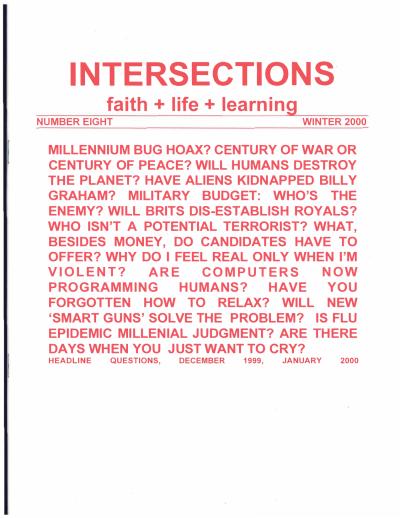 Editorial
From the Publisher
Arne Selbyg
Selbyg reflects on the origins of Intersections—begun out of concern that the philosophy and theology behind Lutheran higher education could be lost to retirements and other preoccupations—and credits Paul Dovre of Concordia and Robert Sorensen of the ELCA Division for Higher Education and Schools as key figures behind the resumption of the debate. He points to three recent books (Ernest Simmons’s Lutheran Higher Education, Paul Contino and David Morgan’s The Lutheran Reader, and Pamela Schwandt’s Called to Serve) and to the new Lutheran Academy for Scholars in Higher Education, and previews the next “Vocation of a Lutheran College” conference at Dana College in August on what differentiates Lutheran colleges within American higher education.
-
Editorial
From the Editor
Tom Christenson
Christenson marks the eighth edition of Intersections, expresses gratitude to the ELCA Division for Higher Education and Schools and especially to the soon-retiring Bob Sorenson for backing the journal, the Vocation of a Lutheran College Conferences, and the Lutheran Academy of Scholars, and introduces an issue that gathers analyses and arguments from both insiders to Lutheran theology and outsiders, from veterans of the institutions and recent arrivals—voices that together remind us that what is and what ought to be need to inform each other.
-
Article
Integrity and Fragmentation: Can the Lutheran Center Hold?
Robert Benne
Benne answers the conference’s question pessimistically—“the Lutheran center cannot hold in many, if not most of our colleges, because it was never there in an articulated form in the first place”—and distinguishes “Christ of culture” colleges like the Midland Lutheran of his youth (Lutheran by ethno-religious ethos rather than by articulated theology) from James Burtchaell’s “confessional colleges” that operated from a theologically distilled Lutheran humanism. Drawing on Alasdair MacIntyre and Mark Schwehn’s First Things essay on Christian universities, he sketches what a Lutheran center looks like (unity, universality, integrity, a tradition of thought) and how its distortion—reducing the Gospel to justification and ceding everything else to autonomous reason—splits Christ and culture as dangerously as the German church separated Gospel and politics. For colleges that have lost their center, he proposes an “intentional, robust pluralism” that guarantees a Lutheran voice in every department and an “affirmative action for Christians” in hiring.
-
Article
Diversity, Integrity, and Lutheran Colleges
Florence D. Amamoto
Amamoto—a sansei Jodo Shin Shu Buddhist who is “an inside outsider” at Gustavus Adolphus—argues that diversity and integrity belong together in Lutheran higher education, perhaps in a way unmatched by other church-related traditions. She affirms the importance of Gustavus’s 60% Lutheran student body and vibrant Christ Chapel under Richard Elvee and Brian Johnson while warning that numbers and chapel are not enough, draws on Tom Christenson, Patricia Gurin, Sylvia Hurtado, Anthony Carnevale, Martha Nussbaum, W. E. B. DuBois (the deaths of Matthew Shepard and Isaiah Shoels), Richard Hughes’s reading of finitum capax infiniti, Richard Solberg, and Mark Schwehn’s mutual hospitality model, and concludes that the real enemy is not diversity but indifference—and that Lutheran finitude grounds a theological commitment to keeping diversity and identity in creative conversation.
-
Poem
Things That Renew Hope
Sig Royspern
Inspired by Andrew Greeley’s Religion as Poetry, which defines religion as hope-renewing experiences and the stories, symbols, rituals, and images that preserve them, Rauspern offers a list-poem of small renewals of hope: lovers kissing in the street, the first snowfall of each year, compost and spring sprouts and Jewish humor, kids’ summer mischief, a mother nursing her baby on the bus, small jazz ensembles, two old men reconciling without remembering why, an unscheduled gift, the blues, a child taking him by the hand, and a gray-haired man who threw his cellular phone in the river.
-
Article
The Diversity Dilemma: Dealing With Difference
Kathy Fritz
Fritz reports from Newberry College—83% Caucasian, 16% African-American, 22% Lutheran, the smallest college in NCAA football—on a 1998–1999 year of crisis in which the Board of Trustees Executive Committee asked the president to resign over financial issues, the president fired three vice presidents, four trustees including the chair and treasurer resigned, and the controversial “veterinary technology” major became a flashpoint between the president’s recruitment-driven vision and the faculty’s commitment to “preparation for LIFE.” Turning to ethnic diversity, she frames three sociological approaches—“feed them all” to reduce conflict, the “3 A’s” (academics, athletics, arts) to create common identity, and Aguirre and Turner’s case for “weak ethnic identification” against the post-Yugoslavia failures of strong pluralism—and grounds the search for institutional unity in St. Paul’s body-of-Christ imagery from 1 Corinthians 12 and Ernest Simmons’s claim that diversity yields “creative adaptations that assist mutual survival.”
-
Reflection
A View From the Other Side
Daisybelle Thomas-Quinney
Thomas-Quinney—an ordained Church of God minister and adjunct in Religion at Thiel College—offers “a view from the other side” as a non-Lutheran African American “outsider and novice”: her bittersweet 1995 arrival at Thiel, her swift discovery (alongside one African American secretary, one Hispanic professor, and thirty-eight African American students recruited largely as athletes) of a “chilly” campus unprepared to nurture the very minority students it had recruited, her examination of Thiel’s 1875 founding and the Augsburg Confession Article IV right-hand/left-hand kingdoms, the parables of mustard seed and yeast from Matthew 13, and Bishop James Crumbly’s 1985 LCA manual Inclusiveness and Diversity: Gifts of God. Drawing on Bruce Reichenbach, Samuel Hazo, and Josephine D. Davis’s Coloring the Halls of Ivy, she concludes that the Lutheran center cannot hold “as is” but has “great possibility” when the mission statement is actually followed.
-
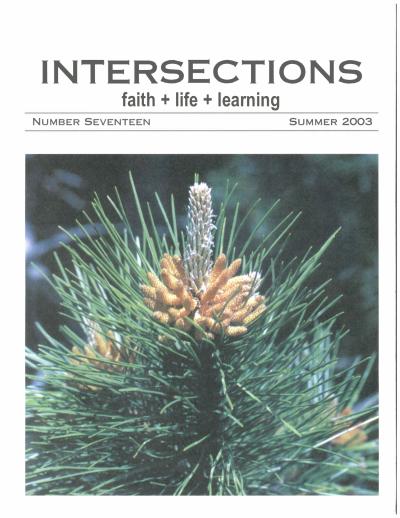 Editorial
From the Publisher
Arne Selbyg
No. 17 · Summer 2003
Selbyg explains that the four essays in this issue grew out of the first Lutheran Academy of Scholars in Higher Education—a two-week seminar funded by the Lutheran Brotherhood Foundation and the Lilly Endowment, led for its first three years by Dr. Ronald Thiemann of Harvard Divinity School—whose official theme “Finding Our Voice—Christian Faith and Critical Vision” became informally “What’s Faith Got To Do With It?”
-
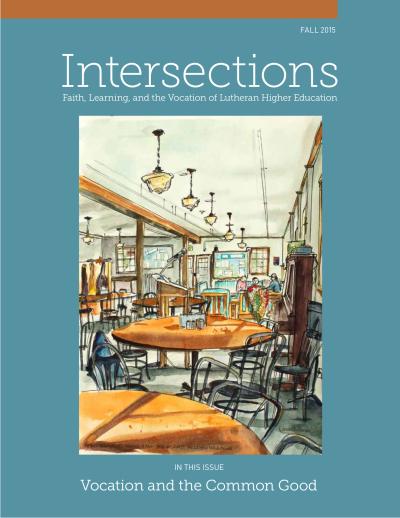 Editorial
From the Editor
Jason A. Mahn
No. 42 · Fall 2015
Mahn introduces the “Vocation and the Common Good” issue by asking what is left of “the commons” in an age of privatized goods and education-as-commodity, and frames church-related colleges — with their stubborn vocabulary of “liberal arts,” “collegiate,” and “calling” — as among the least fully-privatized resources left in American life.
-
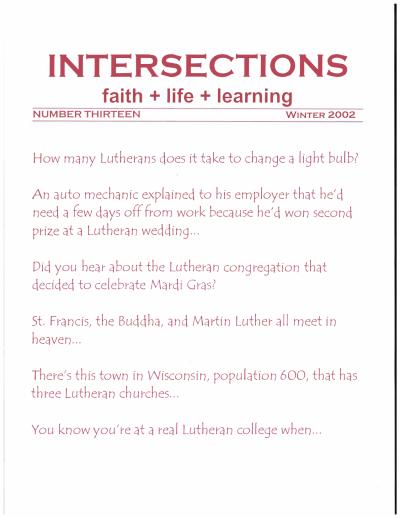 Editorial
From the Publisher
Arne Selbyg
No. 13 · Winter 2002
Selbyg reports that Executive Director Leonard Schulze has challenged the ELCA Division for Higher Education and Schools to develop a comprehensive communications plan reaching high school students, college students, parents, pastors, and journalists, and invites Intersections readers to review the redesigned elcacolleges.org website, the “FREE STUFF” brochures, the journal’s advertisements in The Lutheran and related publications, Ernie Simmons’ new Augsburg-Fortress book Lutheran Higher Education: An Introduction, and the ELCA video magazine Mosaic—and to send in their own ideas.
-
 Editorial
From the Editor
Tom Christenson
No. 10 · Fall 2000
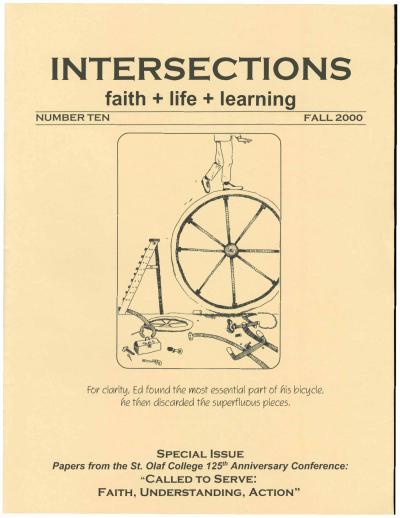
Christenson recommends the St. Olaf 125th-anniversary volume Called to Serve—edited by Pamela Schwandt with Gary de Krey and L. DeAne Lagerquist—particularly Walter Sundberg’s “What Does It Mean To be Lutheran?” and Darrell Jodock’s “The Lutheran Tradition and the Liberal Arts College.” He notes that the volume’s biographical sketches of Lars Boe, F. Melius Christiansen, Ole Rolvaag, Emil Ellingson, Agnes Larson, John Berntsen, Arne Flaten, and Howard and Edna Hong show, against an outsourcing age, that the life of an institution like St. Olaf is the committed life of the people who work there.
-
 Article
Sojourners in a Pluralistic Land: The Promise and Peril of Christian Higher Education
Randall Balmer
No. 25 · Spring 2007
Balmer, a Barnard scholar of American evangelicalism reared in evangelical parsonages and formed at Trinity College in the Chicago suburbs, defends public education even as he champions Christian higher education as a “halfway house” for students moving from religious subculture into a pluralistic world. Drawing on his own undergraduate experience, his books Mine Eyes Have Seen the Glory and Thy Kingdom Come, and a chastening visit to Patrick Henry College, he names three perils of Christian higher education—the Scylla of secularism (intellectual arrogance allergic to piety), the Charybdis of sectarianism (intellectual dishonesty as exemplified by intelligent design’s special pleading), and insularity—and prescribes mentors, primary sources, internships outside the subculture, and a broader, intergenerational pluralism on campus.
-
 Article
Both Priest and Beggar: Luther among the Poor
Martha E. Stortz
No. 46 · Fall 2017
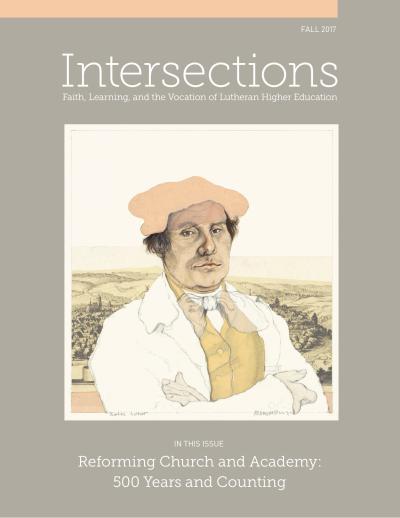
Reading Luther’s deathbed remark “We are all beggars” against his “priesthood of all believers,” Stortz argues that priest and beggar are two sides of a human reality — one that locates civic responsibility for the poor at the heart of the Reformation legacy and that pushes beyond paternalistic service toward the systemic question of justice.