Plague, pestilence, pandemic—these are not new phenomena. As someone who studies the history of theology, I think that one of the blessings of being part of a religious tradition is being able to look back on how people of faith in ages past have grappled with the scourges they faced.
I have been thinking lately of a short treatise that Martin Luther wrote in 1527, titled “Whether One May Flee from a Deadly Plague.” With all his talk of evil “vapors,” “mists,” and “spirits,” Luther definitely sounds like someone from another era. Then again, he also seems to understand the basics of respiratory transmission. Throughout the treatise, he actually shows a surprising degree of understanding of the nature of contagion and what we would today call public health. In fact, I would say that he has a lot of practical and spiritual guidance for our cities and our country as we struggle with the Covid-19 pandemic.
Luther’s response to pandemic centers around the theme of community. He reminds us that, like it or not, “we are bound to each other.” We live next to each other, we eat each other’s food, and we breathe each other’s air. On the one hand, he says, it is community that makes a pandemic possible, just like it makes a mass fire possible. On the other hand, he insists that the very thing that puts us at risk is also the very thing that can save us. If there’s a fire burning in our house, it is our neighbors who will help us put it out. So in a time of plague, God calls neighbors to take care of neighbors and to work together to restore the health of the community.
What does it mean to be part of a community during a time of plague? It starts, as it always does, with looking out for others rather than just ourselves. Like Jesus before him, Luther says that loving God means loving people. As he puts it, “service to God is service to our neighbor.”
For Luther, serving one’s neighbor in a time of plague requires first and foremost following the advice of medical experts. He insists that God has “created medicines” and “provided us with guidance” from doctors. He says that to put everything in God’s hands and then ignore experts’ advice would be like refusing to fetch water when your neighbor’s house is on fire.
“What does it mean to be part of a community during a time of plague?”
In Luther’s time as in our own, doctor’s orders started with vigilance about sanitation. Sure, pray to God for protection, Luther says, but then “fumigate, help purify the air, administer medicine, and take it.” Luther practically issues a lock-down order: “Shun persons and places wherever your neighbor does not need your presence.” He goes so far as to say that negligence in these matters is akin to murder. He has especially harsh words for anyone who has symptoms of the disease and doesn’t take precautions not to infect others.
Within the community, Luther says that some people have special responsibilities. For example, doctors and nurses have a calling from God to care for the sick and the dying. In our time as in Luther’s, following this calling puts their own lives at risk. Luther promises that God is with them in what they do and says that they should be honored in the community for their selflessness.
Similarly, Luther argues that civic officials are called to be competent and responsible leaders in a time of crisis, always looking out, not for their own interests, but for the good of the whole. He insists that they have a particular duty to look out for the poor and the weak. When they flee from these responsibilities, he says, they sin against God.
Like it does for most, the pandemic currently sweeping our country and my city makes me fearful. As someone married to a hospital nurse, I am especially worried for my wife’s safety and that of my family. Still, Luther reminds me that we have faced pandemics like this before. We can get through them, with the help of God, if we work together for the good of all.
“Luther argues that civic officials are called to be competent and responsible leaders in a time of crisis, always looking out, not for their own interests, but for the good of the whole.”
So honor medical professionals and trust their advice. Thank grocery store workers, delivery personnel, and all those who risk their safety for the benefit of others. Remember that whenever we wash our hands, or check in on a neighbor in need, or stay home when we would rather go out, we are truly doing God’s work. Finally, as Luther would certainly remind us, have faith that even when we fail, God will never abandon our community or anyone within it.
-
 Editorial
From the Publisher
Mark Wilhelm
Wilhelm argues that the “hackneyed” expressions of higher education — “you are not just a number,” “the college experience,” “risen to the challenge” — tell the simple truth about NECU institutions even as the Covid-19 pandemic has pushed budgets, employees, and campus life to the breaking point.
-
Editorial
From the Editor
Jason A. Mahn
Mahn narrates a year of crisscrossing pandemics — Covid-19, economic collapse, partisan politics, and the long pandemic of white supremacy revealed anew by the murder of George Floyd — and argues that Lutheran liberal arts schools, by educating for vocation, are uniquely poised to help students respond with character and capable callings.
-
Article
A New Image for an Ancient Call: Lutheran Higher Education Amidst Pandemics Today
Caryn Riswold
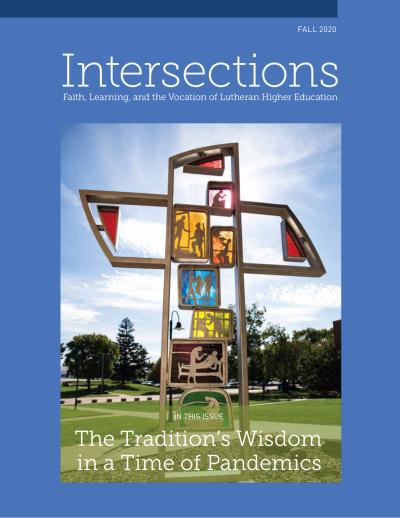
Pairing Wartburg’s Lebenskreuz sculpture with the Matthew 25 acts of mercy and the commitments of Rooted and Open, Riswold reads the calls to feed the hungry, welcome the stranger, and care for the sick as urgent summons for Lutheran higher education in a year of overlapping pandemics — and as a call to dismantle the structures that produced them.
-
Article
Radical Hospitality on Haunted Grounds: Anti-Racism in Lutheran Higher Education
Krista E. Hughes
Writing from Newberry College’s campus on land once home to the Cherokee and within a day’s drive of Mother Emanuel A.M.E., Hughes argues that NECU’s call to “practice radical hospitality” demands that predominately white institutions open themselves to the hauntings of racism — pursuing belonging rather than mere welcome, and risking kenotic transformation of institutional identity itself.
-
Article
Activism, Justice, and the Danger of Silence
Dezi Gillon
In conversation with Jason Mahn, Augustana College alumnux Dezi Gillon traces the call to action they felt as a Black student organizing for Black Lives Matter on a predominately white campus — through seminary, art, spirituality, and restorative justice work — and warns white professors that staying silent “actually speaks volumes.”
-
Article
Leadership in Lutheran Key at a Time of Pandemics
Deanna Thompson
Thompson draws on Luther’s theology of the cross and Shelly Rambo’s theology of trauma to sketch a Lutheran model of leadership for a season of pandemics — one that is attentive to pain, responsive to need, and intentionally nourished by food, friends, and deep conversation.
-
Article
Through Truth to Freedom—by Way of Reconciliation
Paul C. Pribbenow
Reflecting on Augsburg’s 150th-anniversary motto “Through truth to freedom,” Pribbenow argues that in a season of three pandemics — pandemic illness, economic collapse, and the racial sin laid bare by the murder of George Floyd — higher education’s most authentic work is to educate for truth and freedom by way of confession and reconciliation.
-
Article
Finding Purpose in Chaos: Reflection In and Beyond the Public Health Classroom
Lena R. Hann
When the pandemic hit her new public health professionalism course, Hann recalibrated her teaching from the “how” of professional preparation to the “why” of vocational reflection — and recounts how Augustana public health students and alumni found purpose in the chaos through food banks, disaster response, palliative care, and research on health inequities.
-
Reflection
The Long Pilgrimage of 2020-21
Kara Baylor
Drawing on Martha Stortz’s definition of pilgrimage as “intentional dislocation, for the sake of transformation, where the body teaches the soul,” Baylor invites students and educators worn out by the 2020-21 academic year to ask what is essential, to listen to what their bodies are telling their souls, and to be more open to the transformations the dislocation might still yield.
-
Article
Called to Flourish: An Ethic of Care
Mindy Makant
Drawing on Lenoir-Rhyne’s core value of Care, Glennon Doyle’s Untamed, Darrel Jodock’s “Gift and Calling,” and Luther’s plague-era practice of opening his home to the sick, Makant argues that flourishing is interdependent — that self-care is a means to extending care, and that an ethic of care is the meaningful, transformative work to which Lutheran liberal arts education is called.
-
Article
Called to the Moment: A New Vocation for Lutheran Colleges
W. Kent Barnds
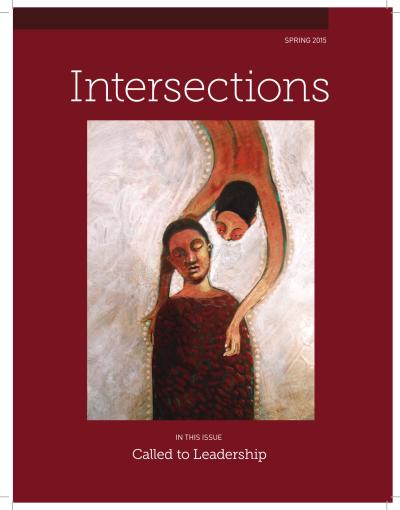
After a derecho ravaged Iowa in August 2020 and Pastor Katy Warren preached on 1 Peter 4, Barnds watched line workers, neighbors, and Augustana colleagues simply show up where they were needed — and proposes that the true vocation of a Lutheran college may be making the case for “meeting immediate need with a deep willingness” alongside the longer work of vocational discernment.
-
 Institutional Focus
Continuing the Dialogue: Augustana College
Sandra C. Looney
No. 1 · Summer 1996
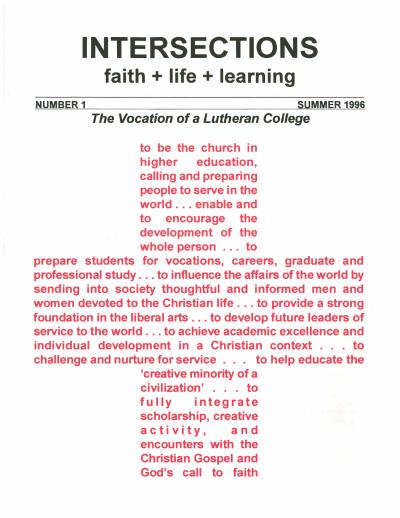
Looney describes Augustana College, Sioux Falls, debating and renaming its values—Christian, Liberal Arts, Community, Excellence, Service—under the leadership of religion professor Dr. Arthur Olsen and the T’N’T (“Through Thick and Thin”) committee, in the wake of ELCA Region III’s “What Does It Mean to be a College of the Church?” conversations. She describes Augustana’s 56% Lutheran student body, daily 10 a.m. chapel, dual Christmas Vespers in Our Savior’s Lutheran Church and St. Joseph’s Cathedral, the Capstone classes on moral and aesthetic issues, and the ongoing work of enlarging Augustana’s conversation to include Native American, Jewish, and Islamic voices.
-
 Article
In the Beginning of the Reformation Was the Word
George Connell
No. 46 · Fall 2017
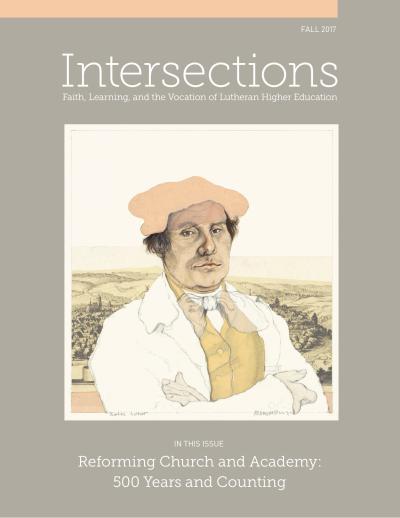
Drawing on a Concordia faculty pilgrimage to German Luther sites, Connell appropriates John’s prologue to frame the Reformation as a movement about words — the printed page, the university classroom, the Marburg confession, the Wartburg translation, Bach’s music, and the dining-room conversations of Table Talk — while soberly noting that words can wound as well as heal.
-
 Article
Money, Sex and Power: An Exploration of Some Controversial Issues in the Public Witness of the Church
Pamela K. Brubaker
No. 21 · Summer 2005
Brubaker explores two controversial issues in the church’s public witness—homosexuality and economic life—and the challenges they present for both church and college. Drawing on Beverly Harrison, Elizabeth Bounds, Ron Thiemann, Linell Cady, Marcia Bunge, Richard Hughes, Darrell Jodock, Ernest Simmons, Karen Bloomquist, Garth Kasimu Baker-Fletcher, and Larry Rasmussen, and on episodes at California Lutheran University around “Harmony Week” and Bishop Paul Egertson’s participation in Anita Hill’s ordination, she argues that colleges related to the ELCA are called to educate for “critical citizenship” by hosting rigorous, bold, and unfettered debate—including debate over the neo-liberal globalism that she names a form of economic fundamentalism.
-
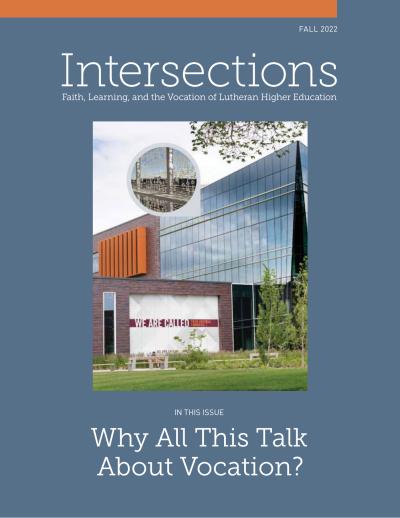 Response
Response to Mark Wilhelm: Vocation—Wide Perspective Questions
Mary-Paula Cancienne
No. 56 · Fall 2022
Cancienne, drawing on Iain McGilchrist, asks whether higher education has prioritized micro lenses at the expense of the macro view, and invites educators to hold the drama of individual vocation stories within a wider plot that includes James Webb Telescope wonder, climate grief, the long shadow of enslavement, and the resilience of native populations.
-
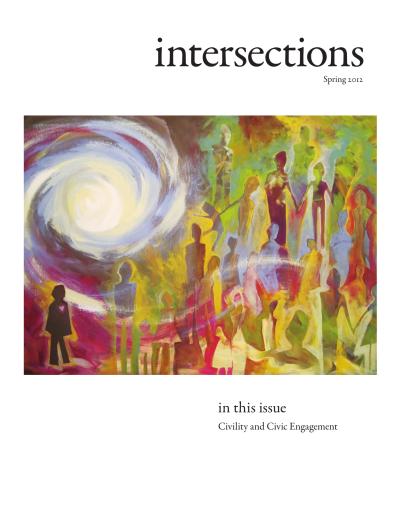 Article
Why Lutheran Colleges Need to Engage Civil Society
Ann M. Svennungsen
No. 35 · Spring 2012
Svennungsen makes the case that Lutheran colleges must engage the larger civil sphere, drawing on her work with The Presidents’ Pledge Against Global Poverty, Darrell Jodock’s seven fundamental experiences for vocational discernment, David Brooks on civility and modesty, and Michael Sandel’s argument that the affluent are seceding from public life. She urges Lutheran educators to invest in the infrastructure of civic renewal so that service-learning and civic engagement remain central to the Lutheran college curriculum.
-
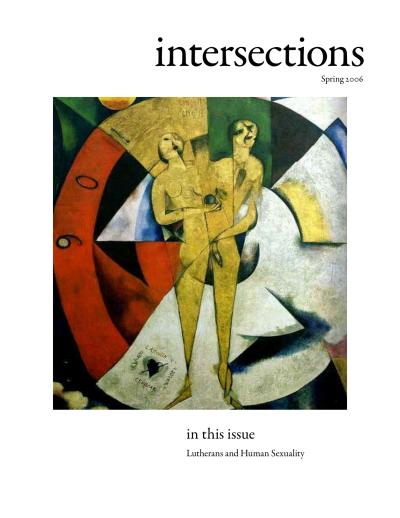 Editorial
From the Editor
Robert D. Haak
No. 22 · Spring 2006
Haak introduces himself as the new editor inheriting the journal from Tom Christenson and frames the issue around the question of what ELCA colleges might contribute to conversations about human sexuality. He summarizes the contributions of Yeager, Benne, Williams, Bussie, and Nack, and shares previously uncollected National Study of Youth and Religion data on the sexual attitudes and behaviors of Lutheran teens—including that 25% of regularly-attending ELCA teens report the church has done nothing to help them with their sexuality.