We’re certainly going through a period that puts the “dismal” in the dismal science otherwise known as economics. The unemployment rate has doubled over the last eighteen months as the economy has lost 6.5 million jobs, with more job losses expected in the near future. Most reasonable economic forecasts predict that the nation’s unemployment rate, presently at 9.6 percent, will reach and even exceed 10 percent before the year’s end. The long-term unemployment rate is now at 5.1 percent, meaning that over half of the people who have lost jobs during this economic downturn have been without a salary for more than fifteen weeks. The downturn has affected not only income, but wealth. Household wealth has decreased by about 50 percent between 2004 and 2009, hitting older households hardest. Families headed by individuals between the ages of 55 and 64 saw the median value of their assets decline from $315,000 in 2004 to just $160,000 in 2009, changing the retirement plans of a generation of baby boomers (Rosnick and Baker 1). While our leaders look for green shoots and lights at the end of tunnels, we are left to console ourselves by finding hope in the fact that the rate of our descent into the economic abyss of unemployment, foreclosure, and bankruptcy seems to be decreasing, even as the descent itself continues.
Some solace, if not genuine hope, is offered by the fact that we’ve been here before. The unemployment rate reached 10.8 percent in November 1982 at the depths of the last big recession. But twelve months later, the unemployment rate had decreased by two percentage points, and by 1987, it had returned to its pre-recession level of 5.9 percent. The central message of Recession 101, a national billboard campaign introduced this June, is that the single most interesting fact about recessions is that they indeed end.
But, to me at least, this recession seems different. Maybe it’s my age. In 1982, I was in the second year of my Ph.D. program. I had very little income as a research assistant, but I also had neither debts nor responsibilities to anyone but myself. Twenty-seven years later, I am ten years from what I thought was to be my retirement age. I have income on which I’ve grown dependent and a job that I would hate to lose. I have a house that has lost twenty percent of its assessed value in the last year, a child starting college, another one starting high school, and a retirement account whose value decreases even as I continue to plough more into it each month. I studied the last recession; I experience this one.
No doubt these altered circumstances explain away much of the difference in the public’s attitude towards this most recent recession. In the years since 1982, a generation of baby boomers like myself have matured, launched careers, and accumulated wealth and houses and children and parents who need extended and expensive care. But I don’t think that a generational life-cycle model alone explains the panic that has gripped the nation since September of 2008 when within a single month Fannie Mae and Freddie Mac collapsed; Merrill Lynch was purchased at fire-sale prices; Lehman Brothers filed for bankruptcy; the president, warning that “our entire economy is in danger,” asked Congress for $700 billion to relieve private financial institutions of their bad debts; and the stock market suffered the largest one-day decline in history. Sure, recessions happen, but this one seems bigger, and scarier, than any that our generation has experienced.
This panic, the one that presidents and billboards alike are trying to address and assuage, this heightened social sensitivity to increases in unemployment and decreases in the value of stocks, is not, I believe, the result of hypersensitivity on the part of baby boomers to the regular peaks and troughs of a business cycle. The panic that accompanies this recession, which was largely absent from the last, results from the fact that many of us are genuinely and profoundly surprised at this recession’s mere existence. We had been told, and we sincerely believed, that this recession was never going to happen. In July, 2004, Washington Post columnist George Will proclaimed that “the economic problem, as understood during two centuries of industrialization, has been solved. We can reliably produce economic growth and have moderated business cycles.” Industry deregulation, globalized markets, tepid governmental regulation of commerce, the environment, and financial institutions, and the inscrutable monetary policy of Alan Greenspan had created a squeeze chute which effectively, we thought, corralled the economy, constraining its movements to a few harmless bucks and kicks. Our panic in the face of this recession is the panic the rodeo crowd experiences when the bull breaks out of its squeeze chute, gores its handlers, and charges the stands.
And it is in this adrenalized response to the charging bull that I find the possibility for hope in this period of economic decline. Having experienced the destructive capacity of this wild bull market, we might be inclined to favor one of the breed’s more docile hybrids.
I do not mean, by choice of metaphor or example, to disparage market systems in which owners of private property are free to exchange their goods and services. But I do hope that my metaphor of a charging bull highlights the danger Paul Tillich found embedded in the bourgeois principle that “the free flow of human productive forces will lead inevitably to a rational formation of society.” (49) Charging bulls are not rational. Furthermore, we neglect our obligation to our neighbors in the rodeo audience if we dismiss their injuries with a crude utilitarianism that compares the costs inflicted by the bull to the benefits he generates for his owners. Markets, as most economists are fond of saying, are amoral, without morals. We fail in our moral duties when we allow these amoral institutions to have the final say in determining our neighbor’s welfare.
A Lutheran understanding of our role as economic agents needs to be grounded in the consideration of the impact of our actions on our neighbors. In contrast to Calvin, who largely supported the economic institutions of the day, Luther railed against a self-interested norm for market behavior. Writing on “Trade and Usury” in 1524, Luther observes that
The merchants have among themselves one common rule, which is their chief maxim and the basis of all their sharp practices. They say: I may sell my goods as dear as I can. This they think their right. Lo, that is giving place to avarice and opening every door and window to hell. What does it mean? Only this: ‘I care nothing about my neighbor; so long as I have my profit and satisfy my greed, what affair is it of mine if it does my neighbor ten injuries at once?’…. On this basis trade can be nothing else than robbing and stealing other people’s property. (“Trade and Usury” 87)
Instead of selling dear, Luther recommends that concerns for the neighbor dominate market transactions, writing that,
your selling ought not to be a work that is entirely within your own power and will, without law or limit, as though you were a god and beholden to no one; but because this selling of yours is a work that you perform toward your neighbor, it must be so governed by law and conscience, that you do it without harm and injury to your neighbor, and that you be much more concerned to do him no injury than to make large profits. (88)
The raging bull of the market is to be constrained by considerations of its impact on others.
Now, in fairness to Luther and to history, I need to point out that the “law and limit” Luther would impose on merchants does not originate with the nation state. Government intervention into the marketplace was, according to Luther, “not to be hoped for,” as “we Germans are too busy with drinking and dancing to give heed to such regulation.” (89). Instead of answering to secular authorities, Luther’s merchant answers to God. The sale of goods is itself a work that is subject to the vocational call that sanctifies all human effort. As such, its practice is bound by concerns for neighbor.
But who is my neighbor? Should I be concerned for my fellow Minnesotans? My fellow Americans? My fellow human beings? And how do I translate my concerns for my neighbor’s welfare into my own market transactions in this global market place? In a consumer society, is consumption itself an act of vocation, and if so, does it matter if I buy free trade coffee or the house brand? And how do these questions relate to the more immediate question of finding hope in a period of economic decline, or the broader question of the vocation of the Lutheran college?
The Lutheran understanding of market transactions as works that we perform toward our neighbor expands the boundaries of economic analysis beyond the consideration of economic efficiency, forcing us to consider explicitly the personal, social, and distributional impacts of markets and market allocations. This means that we need to examine, with some suspicion, the analytical framework common to economics that justifies sweat shop labor, for example, by casting the tradeoff between prostitution and sweatshops as analogous to the choice between pizza and subway sandwiches (Marglin 225). In both cases, the rational utility maximizer simply chooses the option that promises to generate the greatest happiness; economics recognizes no moral difference embodied in either choice. In the words of Larry Summers (2003), “as long as the workers are voluntarily employed, they have chosen to work [in the sweatshop] because they are working to their best alternative.” But a Lutheran understanding of market transactions as works subject to a vocational call demands that we consider our duty to those who labor for us. Through duty to each other, the worker in the shoe factory and the consumer who purchases the pair of athletic shoes are linked in a way that is not reflected in the economic model of individual utility maximizers. A Lutheran understanding of market transactions explicitly acknowledges that linkage, and the responsibilities it imposes.
The Lutheran understanding of vocation as extending into all aspects of our work in this world, including our market transactions, means that we need to be particularly mindful of the biases and distortions introduced into economic analysis by the discipline’s two traditional reference points: the highly stylized, rational, utility-maximizing individual and the nation-state. The individual who serves as the reference point for economic analysis, Homo economicus, is like one of those new Japanese robots in that, while bearing a striking resemblance to humankind, it seems to be missing some critical parts. Homo economicus goes about its days, rationally choosing between pizza and submarine sandwiches, eight hours of prostitution or eight hours in the sweatshop, calculating with amazing precision the total amount of “utils” generated by each activity, and, by applying the appropriate discount rate, is able to attain the maximum amount of happiness by the time its battery loses its charge. This life narrative for Homo economicus reduces our moral obligation to nothing other than assuring that it is given as much choice as possible. As only Homo economicus knows which choices will maximize its happiness, the rest of us would be wrong to force economicus to consume so many calories a day of protein, or so many units of education, or so many square feet of housing, if doing so reduces the amount of income economicus has to spend other goods. Our duties to each other as individuals are simply reduced to the avoidance of activities that restrict others’ choices. Furthermore, since in a market economy, choice is limited by income, society fulfills its obligation to its members by maximizing the income generated within that society. This means that the nation-state dispenses its moral obligations by subjecting its decisions to cost-benefit analysis, which is itself limited to the consideration of only those costs and benefits accruing to the citizens of the nation state.
During the economic expansion that preceded the recent and precipitous market decline, critics of this sort of economic fundamentalism were mostly dismissed as either idealistic or unschooled. As nothing succeeds like success, the economic model credited with providing the roadmap that guided our ever-expanding trajectory was increasingly relied upon. To paraphrase from Karl Polanyi, social values in the United States at the beginning of the twenty-first century were corroded by “a crude utilitarianism combined with an uncritical reliance on the alleged self-healing virtues of unconscious growth” (33). Benefit-cost analysis became the order of the day as federal regulations of all types were forced to prove their merits on the basis of the relative magnitude of their impacts on the economy. Economic values trumped other commitments in the areas of workplace safety, environmental protection, energy policy, and consumer product safety. The crude utilitarianism that forms the basis of benefit-cost analysis was used to justify everything from privatizing social security to refusing to reduce greenhouse gas emissions, to water-boarding. And all of this is the result of an allegedly moral commitment to expand the choices available to a humanoid known as Homo economicus.
“.... encouraging another national conversation concerning our moral obligations to one another.”
Even as the Great Depression created the political environment that replaced laissez-faire with the New Deal, this recent downturn holds the possibility of encouraging another national conversation concerning our moral obligations to one another as fellow citizens, as fellow beings created in God’s image, and fellow souls reconciled to God through Jesus’ death and resurrection. It’s a conversation that I believe our Lutheran colleges are well suited for as intellectual heirs to both the rich understanding of vocation that is one of Lutheranism’s gifts to moral discourse, and the doctrine of the two kingdoms. Together, these two intellectual traditions provide a space for a discussion of our duties to each other which is necessarily constrained and informed by the explicit recognition of our plurality and diversity.
The depth and breadth of this recent economic downturn has exposed some of the folly of trusting in markets and market valuations alone to provide for our physical needs. Government is also necessary. As Luther instructs in his Large Catechism, “although we have received from God all good things in abundance, we cannot retain any of them or enjoy them in security and happiness unless he gives us a stable, peaceful government.” (430).
Our ability to retain and use God’s abundant gifts to us depends on government, not markets. Governments may use markets as tools to accomplish their purposes, but they need to be careful to avoid surrendering their purposes to these tools. The hope to be found in this recent economic decline is that we recognize and reclaim our role as active moral agents called to serve our neighbor in all of our interactions, even—or perhaps particularly—those taking place in the market.
Works Cited
Luther, Martin. “The Large Catechism.” The Book of Concord. Philadelphia: Fortress Press, 1959.
———. “Trade and Usury.” Selected Writings of Martin Luther, Ed. Theodore Tappert. Trans. Charles Jacobs. Revised by Walter Brandt. Philadelphia: Fortress, 1967. 85-150.
Marglin, Stephen. The Dismal Science: How Thinking Like an Economist Undermines Community. Cambridge: Harvard UP, 2008.
Polanyi, Karl. The Great Transformation. New York: Rinehart, 1944.
Rosnick, David and Dean Baker. “The Wealth of the Baby Boom Cohorts After the Collapse of the Housing Bubble.” Center for Economic Policy and Research 29 July 2009. <http://www.cepr.net/documents/publications/baby-boomer-wealth-2009-02.pdf>
Summers, Lawrence. “Morning Prayers Address.” Appleton Chapel, Harvard University (September 15, 2003). <http://www.president.harvard.edu/speeches/summers_2003/prayer.php> Accessed July 2, 2010.
Tillich, Paul. The Socialist Decision. Trans. Franklin Sherman. New York: Harper and Row, 1977.
-
 Editorial
From the Publisher
Mark Wilhelm
Wilhelm invites readers to enjoy or revisit the presentations from the 2009 Vocation of a Lutheran College Conference, then reflects on the Higher Learning Commission’s denial of Dana College’s request to transfer accreditation to a for-profit purchaser—an event that effectively ended Dana’s sale and prompted ELCA colleges and universities to welcome Dana students and faculty—and argues that the irreversible entry of for-profit operators into liberal arts education gives the Lutheran community further reason to continue the conversation about the vocation of a Lutheran college.
-
Article
Living at the Intersection of Fear and Hope
Mark S. Hanson
Hanson draws on his January 2009 ELCA/ELCIC visit to Jordan, Israel, and Palestine—a Hebron Quran that did not burn, fifth graders dancing at the Hope School, a conversation with King Abdullah II—to frame the vocation of Lutheran higher education at the intersection of fear and hope. Engaging Brueggemann, Sittler, Buechner, Auden, Strandjord, Douglas John Hall, W. Robert Connor, Lewis Mudge, and Cynthia Moe-Lobeda, he argues that Lutheran colleges are called to critical inquiry that does not collapse into a hermeneutic of suspicion, to a “thinking faith” that resists religious fundamentalism, and to communities of discernment that work for the common good.
-
Article
Practicing Hope: The Charisms of Lutheran Higher Education
Martha E. Stortz
Stortz names four charisms—theological gifts of identity rather than commodities—that Lutheran higher education brings to a culture of fear: semper reformanda as flexible, responsive institutions; the freedom of a Christian as simul justus et peccator critical inquiry that holds opposites in creative tension; regard for the other as “neighbor” rather than friend or alien; and the priesthood of all believers as a public, civic calling to know the poor. Drawing on Augustine, George Lindbeck, Patricia Killen, James Clifford, Earl Shorris, Carter Lindberg, and Augsburg’s Center for Global Education, she argues that immersion trips, neighbor-regard, and welfare reform witness that the gift Lutherans bring is hope grounded in Christ in you, the hope of glory.
-
Article
Hope in the Face of Ecological Decline
Jason Peters
Peters reads our ecological crisis—a campus “Birth Control Tree,” feminized fish, population, climate, water, and soil—through Alexander Pope, William Blake, Søren Kierkegaard, and C. S. Lewis’s The Abolition of Man, and argues that the modern project of mastering nature has made despair (the unconscious form Kierkegaard named) our condition. He calls for three reorientations: practical (assigning value to domestic arts and place over disciplinary specialization), philosophical (dismantling the Baconian/Machiavellian/Cartesian project of control), and theological (recovering the Church’s rejection of Gnosticism so that grace comes to us by means of nature, not in contempt of it).
-
Article
An Apostolate of Hope
David L. Tiede
Tiede argues that the vocation of a Lutheran college is to be “an apostolate of hope” oriented by three metrics of our time: 12,000 (the Dow), 350 (parts per million of CO2), and $1.25 (the daily income of 1.4 billion people in extreme poverty). Drawing on Darrell Jodock’s “third path” for church-related colleges, Larry Rasmussen’s Batalden lectures, Mark Tranvik, Douglas John Hall, Bill McKibben, Stephen Privett, Peter Singer, and Augsburg’s Center for Global Education, he proposes that justification by faith, critical pluralism, stewardship of God’s earth, and love and justice for our students together prepare wise leaders to renew the future.
-
Article
"Annoying the Student With Her Rights:" Human Life Coram Hominibus; Reflections on Vocation, Hope, and Politics
Caryn Riswold
Riswold takes a student’s course-evaluation complaint that she had been “annoyed with her rights” about voting as the entry point for reflection on fear of change, mistrust of difference, and right-wing extremist violence—Poplawski, Von Brunn, Roeder, and the Sotomayor hearings. Drawing on Gerhard Ebeling’s reading of Luther’s fourfold relationality (coram Deo, mundo, meipso, hominibus), Brian Gerrish, Alister McGrath, Gustaf Wingren, Philip Hefner, Mary Rose O’Reilley, and bell hooks, she argues that the vocation of the Lutheran college is precisely to “annoy students with their rights” by forming them for socially responsible voice grounded in faith active in love.
-
Reflection
The Neglected Miracle of Pentecost
Susan M. O'Shaughnessy
O’Shaughnessy, in a homily delivered at Concordia College in 2008, reads the Pentecost narrative of Acts 2 through Maria Lugones and Elizabeth Spelman’s 1983 critique of white feminism’s cultural imperialism. She argues that the miracle is not the disciples’ speaking but the immigrant Jews’ hearing—and that the writer of Acts withholds the content of what was said precisely to teach disciples that people of privilege know less than the foreigner, the immigrant, the oppressed, the woman, the child, and must learn to listen in new languages before they can speak.
-
 Article
Bringing Core Values to Life through Civic Engagement
Austin Trantham
No. 63 · Spring 2026
5 min audio
Trantham shows how Saint Leo University’s Benedictine Core Values shape his civic engagement work — from advising a “Why Vote?” campaign and Constitution Day panels to engaging students in the Unify Challenge for respectful cross-institutional discourse.
-
 Article
Dual Citizenship: Reflections on Educating Citizens at Augsburg College
Paul C. Pribbenow
No. 29 · Spring 2009
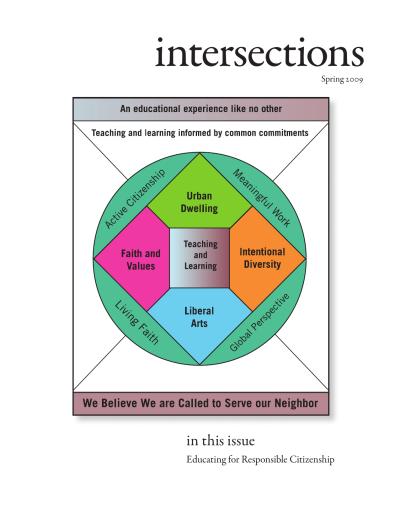
Pribbenow argues that the vocation of Augsburg College is to educate “dual citizens”—those able to live within the messiness of common work rather than resolve every tension once and for all. Drawing on John Courtney Murray on democracy as “the intersection of conspiracies,” Bill Moyers, Jean Bethke Elshtain, Stephen Carter, and the Augsburg vision statement “We believe we are called to serve our neighbor,” he names four common commitments and five principles of civic education that ground Augsburg’s incarnational mission in its city neighborhood.
-
 Article
Luther's Theology of Learning: Discovering the Vocation of Today's Small Lutheran Liberal Arts College
Eric Childers
No. 20 · Fall 2004
In an excerpt from his Wake Forest University Divinity School senior thesis, Childers profiles six students hand-picked by presidents and chaplains at Concordia College (Moorhead), Lenoir-Rhyne College, and Muhlenberg College—Nathan Gossai, Amy Nelson, Alison Schmidt, Ryan Sigmon, Julie Christianson, and Jeffrey Slotterback—as a living testament to Luther’s theology of learning. He then draws on Solberg, Mark R. Schwehn (in Paul J. Dovre’s The Future of Religious Colleges), Robert Benne, Ernest Simmons, Mark Noll, Richard Hughes, and James Burtchaell to argue that Lutheran colleges have not yet fully articulated their own theology of education and that their vocation is to embrace, engage, and galvanize a Lutheran tradition of learning rooted in the liberal arts, Scripture, the Confessions, and confident ecumenism.
-
 Article
Diversity, Integrity, and Lutheran Colleges
Florence D. Amamoto
No. 8 · Winter 2000
Amamoto—a sansei Jodo Shin Shu Buddhist who is “an inside outsider” at Gustavus Adolphus—argues that diversity and integrity belong together in Lutheran higher education, perhaps in a way unmatched by other church-related traditions. She affirms the importance of Gustavus’s 60% Lutheran student body and vibrant Christ Chapel under Richard Elvee and Brian Johnson while warning that numbers and chapel are not enough, draws on Tom Christenson, Patricia Gurin, Sylvia Hurtado, Anthony Carnevale, Martha Nussbaum, W. E. B. DuBois (the deaths of Matthew Shepard and Isaiah Shoels), Richard Hughes’s reading of finitum capax infiniti, Richard Solberg, and Mark Schwehn’s mutual hospitality model, and concludes that the real enemy is not diversity but indifference—and that Lutheran finitude grounds a theological commitment to keeping diversity and identity in creative conversation.
-
 Article
Lutheran Identity and Diversity in Education
Bruce Reichenbach
No. 17 · Summer 2003
Reichenbach applies the theological taxonomy of exclusivism, inclusivism, and pluralism to Lutheran colleges and argues that institutions self-consciously committed to inclusivism must hold a non-negotiable theological core in paradoxical tension with intentional diversity. Drawing on Richard Hughes, Darrell Jodock, Gilbert Meilaender, Robert Benne, and Mark Schwehn, he surveys the theological themes Lutheran writers identify as identity-forming—the four solas, law and Gospel, two kingdoms, vocation, simultaneously saint and sinner, the theology of the cross—and proposes that diversity at an inclusivist Lutheran college is to be employed in service of educating “head, hands, and heart,” maintained through a critical mass of faculty and staff who carry the “DNA of the school.”
-
 Article
The Breadth and the Depth: Dimensions of Christian-Muslim Relations at Educational Institutions of the ELCA
Mark N. Swanson
No. 33 · Spring 2011
Swanson reflects on the spatial metaphors of depth and breadth that shape Lutheran higher education and argues that the study of Islam and real conversation between Christians and Muslims can contribute to both the broadening of horizons and the deepening of faith, drawing on his experience at the Lutheran School of Theology at Chicago and pointing to hospitality as a Christian practice in which depth and breadth come together.