My friend and colleague Mary Elise Lowe dove into the ways that creation, justice, and communio/community are concepts and practices rooted in our institutions’ shared Lutheran identities. When considering the many issues that require our focus on campus, our undocumented students, our neurodiverse neighbors, disability services, gender diversity, food access, and queer justice … we see that one more thing becomes clear: This work is complicated. Committing to access and accessibility around these and other things necessarily means that institutional habits and patterns are disrupted. It can feel messy, uncertain, and challenging. That is, of course, the point.
There is one more distinctive root to Lutheran higher education that meshes with an honest assessment of this complex reality: paradox. Things that seem self-contradictory or run contradictory to expectation, multiple true things that would seem to be in opposition to each other. There are a lot of things about working at a Lutheran college or university that fit this description, including all of these issues around access and accessibility. I invite you to think about how this root of embracing and valuing paradox informs our work in two ways:
It helps us understand who we are … both our individual human nature, as well as the nature of institutions.
It helps us talk about what we do … our actions, transformations, and why change is challenging.
Embracing and living out of the value of paradox can also be one way of practicing humility for anyone who needs to remember to be open to learning, able to navigate transformation, and be okay with a bit of messiness along the way. Living in the muddled middle means the extremes of one position or another, one practice or another, have less value. Life is lived, and education and transformation happen somewhere in the middle.
Who We Are: Human Nature, Human Institutions
First, I want to point out that insights around how things are complicated and paradoxical help us understand who we are: human nature and by extension, human institutions. The Lutheran theological, intellectual, and educational tradition exists in a world where paradox is a fact … it is the nature of reality. Things that seem like they can’t both be true at the same time are. Things whose existence is not at all what conventional wisdom would suggest are real. These are the Both/Ands, the Muddled Middles.
Why we embrace this value has at least something to do with Martin Luther’s work, where we see a tendency to resist the binary, the “either/or”. When it comes to talking about human beings, he centered a claim that each person is both saint and sinner, and he embraced the paradox of freedom wherein a person is both lord of all and servant of all at the same time.
On the paradox of human nature, you already know that no one person is completely good or completely evil … we’re all more complicated than that. Consider how this applies to your work and your institution, and your habits and practices. Any one policy or practice is likely complicated, and not all good and probably not all terrible. For example, think of attendance policies in the classroom, billing deadlines in the business office, and marketing and branding strategies. Valuing paradox means that we can recognize complicated realities in things like these, and then discern together how to amplify what is good and figure out how to mitigate harm.
“Valuing paradox means that we can recognize complicated realities in things like these, and then discern together how to amplify what is good and figure out how to mitigate harm.”
On the paradox of human freedom, Luther argues that because Christians are freed by grace from having to do and say and be the perfect things in order to be saved and to “get right” with God, they are liberated to attend to the needs of their neighbors. For him, this is a theological discussion and he draws on the New Testament writings of Paul, suggesting “that when each person has forgotten himself and emptied himself of God’s gifts, he should conduct himself as if his neighbor’s weakness, sin, and foolishness were his very own.”1 Because of that, he also notes that a Christian should “be guided in all his works by this thought and contemplate this one thing alone, that he may serve and benefit others in all that he does, considering nothing except the need and advantage of his neighbor.”2
These statements capture an essential reorientation of human attention toward the needs of the neighbor. Some like to shorthand this and say, “We are freed to serve.” Though he is clearly focused on what it means to be Christian, I think this re-orientation is helpful for institutions living out of those roots. In fact, I suspect that service and leadership are some sort of central pillars on your campus. Perhaps they’re in your mission statement or define a signature program. Remember, service and leadership are paradoxical insofar as they can be thought of in opposition to one another, and some will view them as contradictory. But on our campuses, something like servant leadership, holding that tension together, is good.
The fact that this paradox is woven into the Lutheran tradition helps us think about human beings as complicated, and human institutions as sometimes or even often contradictory. We can champion things that seem contradictory to some, like service and leadership, faith and learning. We may also recognize the most obvious paradox of being educational institutions that are Rooted AND Open … and Reaching and Gathering and Serving and so many other things.
When it comes to considering the needs and benefits of our students, it also gets complicated. Because it doesn’t mean just giving them what they want, treating them as consumers who need to be satisfied. It requires that we do the work of discerning what sort of education is good for them and for the world, what challenges will benefit them when they are in the world, when their worldview needs a little deconstructing, and when reconstruction needs to happen. And I know that each person working on a college campus will have more than one story of how students are complicated … they are walking paradoxes. They want to craft and sometimes brand their own bespoke lives and they want desperately to be in community. They have so many questions and crave certainty while resisting given answers. They have access to the world of information and connection in their pockets and are by many accounts the most socially isolated generation yet. They know the world itself is a mess and they have no shortage of blame for the ones in power. They feel they have no power while others perceive them as key drivers of culture.
Students are complicated, and our campus communities are complicated. Think about it: our institutions are Lutheran without a critical mass of Lutheran students, or faculty, or staff. A generation past would have bemoaned that paradox. Even beyond religious identity, most of the students in my classroom, and probably most of the people working on each NECU campus, are not the people for whom the modern university was established. Especially Lutheran colleges and universities. Unless you are a straight white cisgendered neurotypical able-bodied Lutheran man, your presence in this work today is a paradox.
I conclude this discussion about the paradox and complications of who we are as people and as institutions with the words from one of our student speakers at commencement this spring:
“Attending an Evangelical Lutheran College as a Muslim, I was apprehensive. Would my faith waver? Spoiler: it didn’t. Thanks to courses like RE 102 and the college’s support for my spiritual journey, my commitment to Islam only grew stronger. … Enrolling in RE 102, Bible in a Diverse World, I encountered peers who embraced their faiths with passion and sincerity while remaining genuinely open to understanding others. This experience illuminated the profound role faith plays in shaping our lives and principles. It inspired me to explore the mosaic of religious beliefs, a journey that, rather unexpectedly, deepened my own commitment to Islam.”3
What We Do: Human Action, Struggle, Change, Transformation
If who we are is complicated, let’s shift to focus on what we are called to do in our work as colleges and universities committed to access and accessibility, and see how this Lutheran root of valuing paradox and tension informs that. Because we didn’t get to this point where a Muslim student leader claims the value of a Lutheran college education easily, quickly, or without dissent. The vision of what it means to be a college or university of the ELCA changed over time, and as a result of discernment, needs, action, pressures, and intentions.
By being grounded in a resistance to binaries and false choices, opening our institutional doors wider, and reaching for each other, Rahima’s and so many other students’ stories are possible. In the end, the series of choices that moved from rootedness to openness and accessibility has empowered more flourishing. This commitment to complicated work, holding things in tension, sheds light on more dimensions of the human experience and makes deeper connections possible. If someone were to insist that Lutheran higher education is still only for that mythically normed young white Lutheran man, look at what would be lost. Look at who would not be here. Think of the conversations that wouldn’t be had.
“They can and should lead to hard conversations, to information that can complicate things and even change your mind, to relationships that contradict what you might have been taught were possible, and to the particular kind of discomfort and challenge that is essential for growth and transformation”
These paradoxical communities are not simple, not always fun, and often challenge us deeply. They can and should lead to hard conversations, to information that can complicate things and even change your mind, to relationships that contradict what you might have been taught were possible, and to the particular kind of discomfort and challenge that is essential for growth and transformation.
Here too we have grounding notes from the Lutheran theological and intellectual tradition: Martin Luther focused a lot of his attention on the cross when talking about how to “do theology.” In the Christian gospels, Mark especially, Jesus’ followers routinely have no idea what he is talking about throughout his public ministry, and they are uncomfortable to the point of desertion. They aren’t there at the end of his life, at the cross. The women are there … but the men? Gone. A surprising fact in a complicated narrative. Luther pointed out that the Christian belief in a God of power and grace who would be most fully present in death and desertion also defies logic and conventional wisdom. That Jesus’ own devoted friends and followers would be absent? This is not what one would expect. That new life comes from brutal death? This is not what one would expect.
For Luther, the moment of Jesus’s tortured and painful death at the hands of the state on the cross is both not how one would expect “the son of God” to live and die, and it is exactly there that God is most fully experienced: in a shocking place of suffering and injustice. It is also that God is there in the suffering precisely for the purpose of overcoming it. He argues that understanding this is a prerequisite for being a theologian because it accepts that the default human situation is pain, not comfort. It assumes struggle and claims God’s presence in the midst. With a deep hope that all of this mess is headed somewhere else. This is Luther’s description of what it means to be a “theologian of the cross.”
Theologians of glory, on the other hand, are the ones who assume they know everything already and are able to get it right—even perfect. On the contrary, with this cross experience, Luther puts it bluntly: “God destroys the wisdom of the wise.”4 Knowing that we don’t really know, seeing that we have not truly seen, listening to voices that we have not heard: these today are expressions of this Lutheran root.
“When we commit to access and accessibility, we live out of a complicated and ever-reforming Lutheran tradition that is rooted in understanding the truth of paradox and struggle, the value of accompaniment and discernment, and the hope of new life.”
It is important that we lean into the hope and ultimately the freedom that this foundation affords us all. When we commit to access and accessibility, we live out of a complicated and ever-reforming Lutheran tradition that is rooted in understanding the truth of paradox and struggle, the value of accompaniment and discernment, and the hope of new life. The work is complicated, and it’s ultimately worth doing, so that we can witness more stories from transformed lives and renewed communities.
Endnotes
1. Martin Luther, “Two Kinds of Righteousness (1519),” in Luther’s Works, ed. Jaroslav Pelikan and Helmut Lehmann (St. Louis: Concordia Publishing House, 1955–1986), 31:302.
2. Martin Luther, “Freedom of a Christian,” 365.
3. Rahima Waheed, “Wartburg is our village.” Online: https://www.wartburg.edu/rahima-wartburg-is-our-village/
4. Luther, “Heidelberg Disputation,” 53.
-
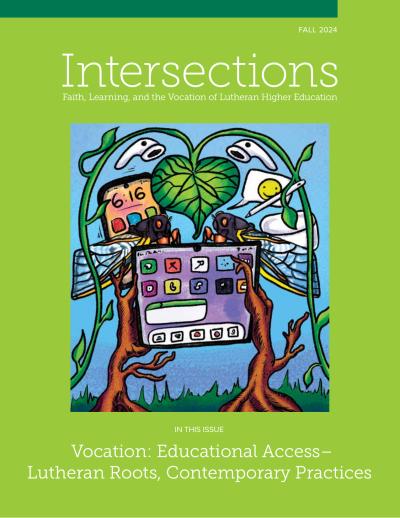 Editorial
From the Editor
Colleen Windham-Hughes
Windham-Hughes welcomes newcomers and seasoned colleagues to the conversation, lifts up Mary Elise Lowe’s three Lutheran “whys” for educational access, and commends Rev. Jen Rude’s “Sacred Pause” practice as a way to humanize one another and make opening access both easier and more joyful.
-
Editorial
From the Publisher: Reflections on the 2024 Vocational Leaders in Higher Education Conference
Lamont Anthony Wells
Wells reflects on the 2024 VLHE Conference theme — “Educational Access: Lutheran Roots, Contemporary Practices” — tracing today’s commitment to inclusivity back to Martin Luther’s radical 16th-century insistence that both boys and girls be educated, and previews NECU’s expanded engagement of student leaders alongside faculty and administrators.
-
Article
Access, Accessibility, & Change: A Call for Trustworthy Leadership in Higher Education
Emma Jones
Jones surveys the converging pressures on higher education — cost, the enrollment cliff, shifting demographics, and declining public confidence — and uses Reichheld and Dunlap’s four factors of trust (transparency, capability, reliability, humanity) to call campus leaders to rebuild trustworthy leadership from the inside out.
-
Article
Creation, Justice, and Communio: Lutheran Insights Empowering Educational Access
Mary Elise Lowe
In her VLHE keynote, Lowe names three Lutheran commitments — continuing creation, neighbor justice, and communio — as the “why” that empowers ELCA colleges and universities to pursue equitable access for students often left behind by persistence and graduation gaps.
-
Article
2024 VHLE Conference: "Rooting Access" Panel Talking Points
Guy Nave
Nave reads “access” across Deuteronomy 23, Ruth, Isaiah 56, Acts 10, and Matthew 15:21-28 as an ongoing biblical conversation that evolves from exclusion to ever-widening welcome — and presses ELCA institutions to shift their focus from “student readiness” to “institutional readiness.”
-
Article
Affirming, Entrusting, and Acting: A Baptismal Grounding of Affirmative Action in Lutheran Higher Education
Peter Carlson Schattauer
Schattauer draws on the Lutheran baptism liturgy — where the gathered assembly publicly affirms what it is for and is entrusted with responsibilities for justice and peace — to argue that NECU institutions create truly inclusive communities by affirming commitments, naming responsibilities, and acting in ways that embody both.
-
Reflection
Reflecting on Belonging
Melissa Woeppel
Woeppel, campus pastor at her own alma mater, wrestles with a Bethany student’s plea — “I want to feel like this is my home, like I belong” — and Mindy Makant’s reminder that we don’t choose the story of the past but do choose how we tell it forward, opening space for students from 35 faith traditions to find Lutheran institutions to be their home.
-
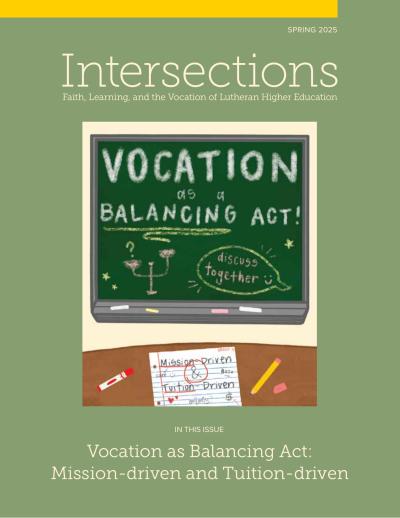 Institutional Focus
So That All May Belong: Lutheran Roots for Diversity, Equity, Inclusion, and Justice
Altheia Richardson, Angie Hambrick, Caryn Riswold, Colleen Windham-Hughes, Deanna Thompson, Marcia Bunge, Robert Clay
No. 61 · Spring 2025
22 min audio
The full NECU statement grounds DEIJ work in Luther’s 16th-century reforms and Lutheran theological claims about the image of God, equal dignity, and the limits of human knowing — offering definitions, Lutheran roots, and calls to action for diversity, equity, inclusion, and justice, with belonging as the outcome of DEIJ at work.
-
Institutional Focus
Scriptures That Inspire Work for Diversity, Equity, Inclusion, and Justice
Altheia Richardson, Angie Hambrick, Caryn Riswold, Colleen Windham-Hughes, Deanna Thompson, Marcia Bunge, Robert Clay
No. 61 · Spring 2025
9 min audio
A companion list of biblical verses — from Genesis 1:27 and Galatians 3:28 to Micah 6:8 and Luke 4:18-19 — that grounded NECU’s drafting of So That All May Belong, organized by the four DEIJ commitments and offered as an invitation to share other texts that ground and sustain the work.
-
Institutional Focus
So That All May Belong: Lutheran Roots for Diversity, Equity, Inclusion, and Justice [abridged]
Altheia Richardson, Angie Hambrick, Caryn Riswold, Colleen Windham-Hughes, Deanna Thompson, Marcia Bunge, Robert Clay
No. 61 · Spring 2025
8 min audio
A condensed version of the NECU statement that consolidates Lutheran theological grounding for DEIJ and a single combined call to action for Lutheran colleges and universities — offered as a shareable summary alongside the complete document.
-
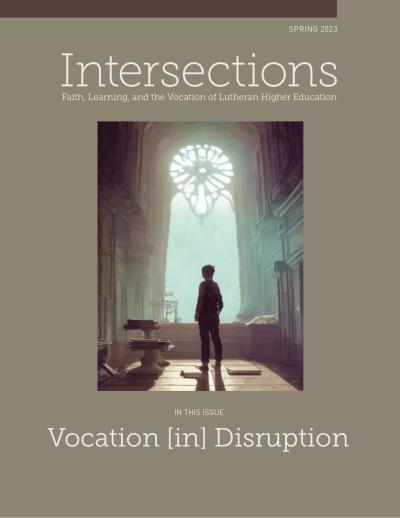 Article
Views on Flourishing After the Age of Roe
Caryn Riswold, Mary J. Streufert
No. 57 · Spring 2023
Riswold and Streufert reflect on the Radcliffe Institute’s January 2023 conference “The Age of Roe” and argue that the ELCA’s 1991 Social Statement on Abortion and its 2019 statement Faith, Sexism, and Justice offer Lutheran higher education a third way to approach reproductive justice grounded in serving the neighbor so that all may flourish.
-
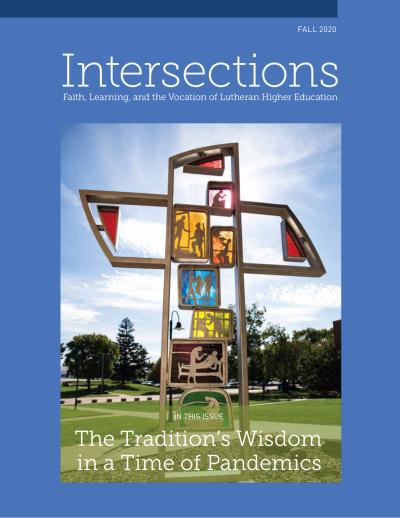 Article
A New Image for an Ancient Call: Lutheran Higher Education Amidst Pandemics Today
Caryn Riswold
No. 52 · Fall 2020
Pairing Wartburg’s Lebenskreuz sculpture with the Matthew 25 acts of mercy and the commitments of Rooted and Open, Riswold reads the calls to feed the hungry, welcome the stranger, and care for the sick as urgent summons for Lutheran higher education in a year of overlapping pandemics — and as a call to dismantle the structures that produced them.
-
 Article
The Vocation of White People in a Racist Society
Caryn Riswold
No. 50 · Fall 2019
Riswold proposes that whiteness is a weakness borne of apathy, atrophy, and ignorance — an atrophied muscle of race-consciousness — and offers concrete practices (reading, adjusting one’s gaze, consuming media differently, drawing on ELCA social statements like the repudiation of the Doctrine of Discovery) for exercising that muscle and naming the vocation of white people in a racist and white supremacist culture.
-
 Article
Liberal Arts and Professional Education: A Call for Philosopher-Servants
Steven C. Bahls
No. 24 · Fall 2006
Bahls, President of Augustana College (Rock Island), calls for a renewed commitment at Lutheran colleges to form “philosopher-servants” — graduates whose grounding in the liberal arts and the liberating gospel equips them for thoughtful service in business, education, nursing, and the other professions. Their impact, he argues, is “a good thing and a fact that we can be proud of as those who labor in Lutheran higher education.”
-
 Editorial
From the Editor
Tom Christenson
No. 4 · Winter 1998
Christenson thanks the departing Jim Unglaube, recommends Ronald A. Wells’s Keeping Faith: Embracing the Tensions in Christian Higher Education (Eerdmans) as both an interesting collection of essays and a model worth imitating at ELCA institutions, previews the issue’s pieces by Richard Hughes, Carl Skrade and Spencer Porter, Gregory Clark, and Karla Bohmbach, and introduces three new features of the journal: “What I Have Learned” (an essay by a senior or emeritus faculty member, inaugurated by Richard Ylvisaker), “Reviews” (initiated by Karla Bohmbach), and a “Bulletin Board” for cross-campus announcements.
-
 Reflection
Dreaming God's Dream: A Sermon on Isaiah 56:1-2, 6-8
Stephan K. Turnbull
No. 34 · Fall 2011
Preached at the 2008 “Savvy with Substance” Convocation of the ELCA at Central Lutheran Church, Minneapolis, this sermon by parish pastor Stephan K. Turnbull (First Lutheran Church, White Bear Lake) sets the small dreams of pastors and academics—balanced budgets, peaceful congregations, coherent midterm papers—over against the prophet’s dream in Isaiah 56 of a God who gathers all nations to a house of prayer for all peoples. Turnbull calls educators, preachers, and church leaders to articulate God’s dream of getting the world back through the dying of Jesus the Messiah and the resurrection’s first fruits of new creation.
-
 Article
Work Works
Julius Crump
No. 56 · Fall 2022
Crump argues that in an era of class-stratified careerism and the “ruins of neoliberalism,” commencement-speech rhetoric about heroic vocation will not resuscitate vocation — instead, professors embodying vulnerability, extemporaneity, and contemporaneity in the classroom can show students that consistent work, embodied as service to others, is itself worthy.
-
 Editorial
From the Editor
Tom Christenson
No. 19 · Summer 2004
Christenson reflects on the scarcity of time in over-committed academic lives and posts a tongue-in-cheek help-wanted advertisement for his own successor as editor. He introduces the issue’s four authors as “three friends and one new acquaintance” whose work addresses Lutheran higher education, the significance of Paul Ricoeur, the implications of being a reformation community, and the perils of teaching ethics.
-
Article
A Response to Paul Santmire
Don Braxton
No. 4 · Winter 1998
Braxton appreciates the dialectical structure of Santmire’s mandates—“skeletons in our closets and riches in our own vaults”—and reads it as a faithful expression of the Lutheran tradition of Paul, Augustine, and Luther. He argues that Santmire is on target in warning against premature flight to non-Christian traditions for environmental wisdom (theoretical sensitivity does not translate into ecological behavior in practice), and that classical Lutheran social ethics has too often been quietistic. But Lutheran ethics at its best is dialectical, not dualistic—recognizing the interpenetration of church and world, Law and Gospel, eschatological Kingdom and present realities, as in Hegel, Ritschl, Bonhoeffer, Reinhold Niebuhr, and Larry Rasmussen. Braxton commends environmental responsibility, social criticism of unsustainable practices, and a liturgical practice of resistance to instrumentalism as appropriate next steps for Lutheran liberal arts colleges, especially Capital University.