Why Did the Chicken Cross the Road? A Homily on Liminality and Vocation
Intersections No. 45 · Spring 2017
Sometimes homilies are like sitcoms. They both start with a funny story, they highlight a problem or dilemma of some sort, and they resolve that same problem neatly and quickly (in 22 minutes—commercials don’t count—on TV and 5 to 10 or maybe 15 minutes from the pulpit). To do so, they use a platitude or passage from scripture that is, ultimately, a word of support for the present and hope for the future.
I have used this formula myself. Many times. The funny story usually is at the expense of the privacy of one of my kids and has, in the past, included tales of throwing up, swearing, and licking the toilet. Today I really wanted to tell you the story about driving home from my night class two weeks ago with a frog in my car, but no matter how hard I tried, I couldn’t find a pertinent or pithy theological point to the story. Maybe some day I will figure out what it means and whether or not it connects thematically to another story of mine from a couple of summers ago about catching a chicken—with the help of my middle son and while wearing a swimsuit (with shorts, I might add)—on a very busy street in Maplewood, Minnesota, and quite literally, pondering the question, “Why did the chicken cross the road?”
But I think the very reason I am not up to that formulaic challenge today is buried in that very familiar and very existential question. The distance between “Why did the chicken cross the road?” and “Who am I?” and “What am I to do with my life?” or “What is my vocation?” is not so great.
Vocation. We talk about that term a lot. We try to make it easy, or, at least, accessible. We talk about a sense of calling and a caller, maybe God, calling. We talk about the self and those skills, strengths, and passions that make us who we are. We talk about the neighbor and the community and the world. We talk about their needs. We believe we are called to serve our neighbor. The intersection of that calling, those passions and needs—that is vocation. But it is not that simple.
“The distance between ‘Why did the chicken cross the road?’ and ‘Who am I?’ and ‘What am I to do with my life?’ or ‘What is my vocation?’ is not so great.”
Some of my students, right now, are reading The Other Wes Moore, by Wes Moore. It is a story about two boys growing up in the same rough neighborhood of Baltimore at the same time, with—coincidentally—the same name. Both smart, driven, charismatic, capable. They did not hear the voice of God; they did not have that sense of calling. They navigated the neighborhood, day to day. The calls they heard were familial—one Wes Moore heard and, ultimately, heeded the voice of his mother. She removed him from the neighborhood, and sent him away to school. The other Wes Moore heard the voice of his brother, emulated his street-savvy business practices, sold drugs, robbed stores. The first Wes Moore went to college, became an officer in the military, got a Rhodes Scholarship. The other Wes Moore shot a police officer and has a life sentence without parole.
Other students of mine are reading Outcasts United, by Warren St. John. It is a story about a town on the outer perimeter of the Atlanta metropolitan area where thousands of refugees from all over the world have been placed. It is a story about a Smith College-educated, Jordian woman, Luma Mufleh, who starts a soccer program for refugee boys. It is a story about long-standing racism and resistance to change. It is a story about adaptation and acceptance. It is a story about conflict and war around the world. It is a story about hope for a better life in a safe place. It is a story about high expectations and accountability. It is a not a religious story, but it is a story of vocation. Luma has a vocation that is tied up with service and education. But I don’t think she would call it that. But it is also a story that highlights “liminality.”
Liminality is a state of being between two worlds, in which a person “becomes ambiguous, neither here nor there, betwixt and between all fixed points of classification,” according to anthropologist Victor Turner (Turner 232). Adolescence itself is a stage of liminality; refugees and immigrant teenagers possess a “double liminal status” and truly struggle with issues of individual identity.
“Adolescence itself is a stage of liminality; refugees and immigrant teenagers possess a ‘double liminal status’ and truly struggle with issues of individual identity.”
This idea of “being between” needs to be part of our conversations about vocation. Starting college is a liminal experience. Literally, the word means threshold. Leaving high school and starting college is exactly like crossing a threshold. How long do students stand with one foot on each side? Increasingly, we have students who have this “double liminal status.” We have Hmong students, Muslim students, Latinx students, particularly those who are immigrants or the children of immigrants, all of whom are continually pulled between cultures, languages, and expectations. Our LGBTQ+ students, maybe coming out for the first time, experience liminality as do our students in Augsburg’s StepUP recovery program. Our non-traditional students find themselves in liminal spaces, too: torn between their identity as student and professional, student and parent; they are balancing work and school while simultaneously caring for children and aging parents. This list is not exhaustive and these experiences are not limited to students. Those of us on the faculty and the staff also can list the ways we find ourselves between, between two worlds, with different pulls and competing priorities.
Are these considerations part of our reflections on vocation? Maybe they have been all along—and I am the one who has missed it or misunderstood. For a long time, I thought Dietrich Bonhoeffer’s reflections on vocation stood as a corrective to some of the seemingly cursory discussions of vocation (particularly conversations that lead people to believe that vocation is some one thing they have to find). Bonhoeffer writes of vocation as responsibility and claims that “vocation is the whole response of the whole person to the whole of reality.” (This is a paraphrase of his work in Discipleship.) I still stand by this idea. I think it functions as a hermeneutic, giving us a way to see vocation related to the whole of our lives, and to think about vocation as the way we live in the world, in relationship with others, how we make decisions and choose our actions and reactions. But I have started to worry that this idea of vocation as responsibility puts those who live in liminal spaces in an even more difficult position. If one is already torn between competing claims on one’s identity, might not the idea that one must respond to those claims with the whole of one’s life simply render decision-making and prioritizing impossible? It stretches them even more tightly and thinly across the divide.
“If one is already torn between competing claims on one’s identity, might not the idea that one must respond to those claims with the whole of one’s life simply render decision-making and prioritizing impossible?”
Perhaps Bonhoeffer himself is the best one to address this concern because he lived the end of his life in prison, on the threshold between two worlds and two ways of understanding himself: as the one others saw, poised and confident, and the one he knew himself to be, unsure and weary. His famous poem, “Who Am I?” gives voice to his own state of liminality. The poem begins by asking
Who am I? They often tell me
I step out from my cell
calm and cheerful and poised,
like a squire from his manor.
Later in the poem Bonhoeffer gives his own assessment:
Am I really what others say of me?
Or am I only what I know of myself?
Restless, yearning, sick, like a caged bird,
Struggling for life breath, as if I were being strangled…
The poem ends with this:
Who am I? They mock me, these lonely questions of mine.
Whoever I am, Thou knowest me; O God, I am thine.
(Letters and Papers 459-60)
Bonhoeffer’s poem does not resolve his internal disruption but points us to the possibility that the surrender to the divine is one way through it. In that way, we can begin to glimpse the liminal as a place of transformation. The African-American slaves, and as slaves, the very embodiment of liminality, chose to enter the liminal space offered by song and prayer to “go down to the river to pray” as a way to transcend their liminal condition.
Honestly, I am still not clear on the relationship between liminality and vocation—how selves torn between identities can listen for the call that requires their authentic self to show up. But maybe there is power in the experience of liminality. And maybe there is choice, like Ruth’s choice, in Ruth 1:15-18, to return to the land of Judah with Naomi. And maybe the real answer to the question, “Why did the chicken cross the road?” is something like “to make a new life on the other side.”
Works Cited
Bonhoeffer, Dietrich. Discipleship. Translated by Barbara Green and Reinhard Krauss. Minneapolis: Fortress, 2003.
———. “Who Am I?,” in Letters and Papers from Prison. Translated by Isabel Best, et. al. Minneapolis: Fortress, 2009.
Moore, Wes. The Other Wes Moore: One Name, Two Fates. New York: Spiegel & Grau, 2011.
St. John, Warren. Outcasts United: A Refugee Soccer Team, An American Town. New York, Spiegel & Grau, 2009.
Turner, Victor. Drama, Fields, and Metaphors: Symbolic Action in Human Society. Ithaca, NY: Cornell University Press, 1974.
-
 Editorial
From the Publisher
Mark Wilhelm
Wilhelm describes how ELCA colleges and universities have shifted the definition of Lutheran higher education away from institutional markers toward alignment with educational values drawn from the Lutheran intellectual tradition — and previews a NECU-convened faculty working group whose recommendations will go to the ELCA college presidents at their June 2017 conference on Lutheran identity.
-
Editorial
From the Editor
Jason A. Mahn
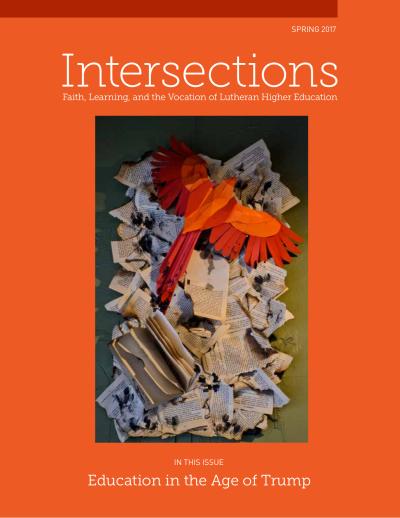
Mahn introduces “Education in the Age of Trump” by recounting a difficult academic year on his own campus — the Augustana “chalking” incident, a Latinx Unidos rally, and post-election conversations with marginalized students and quietly conservative Trump supporters alike — and frames the issue’s essays as careful (re)imaginings of the vocation of Lutheran higher education in an anxious political climate.
-
Article
Higher Education in the Age of Trump
Daniel B. Braaten
Braaten surveys what the Trump administration has and has not done on higher education — from the selection of Betsy DeVos and a rumored Falwell-led task force to the travel ban and expanded deportation priorities — and argues that Lutheran colleges, guided by the ELCA’s social message on immigration, have a special obligation to consider what they will do to protect their most vulnerable students.
-
Article
Resistance in the Age of Trump: An Interview with Ivonne Wallace Fuentes
Jason A. Mahn, M. Ivonne Wallace Fuentes
In conversation with Jason Mahn, Roanoke College historian Ivonne Wallace Fuentes describes how she launched a local chapter of Indivisible after the 2016 election, how the skills of teaching and historical research carry over into grassroots advocacy, and how her sense of vocation (vocare) has become intertwined with the work of advocacy (advocare).
-
Article
Religion in the Age of Trump
Daniel A. Morris
Morris reads the 81% evangelical vote for Donald Trump through two historical theses: that evangelicals’ once-coherent story about Godly participation in political life has fallen apart, and that their long-running tendency to exclude others — once aimed at Black Americans and Catholics — has now turned decisively against Muslims. He argues that scholars of religion and politics have a responsibility to tell these stories well, and that appeals to classroom objectivity can no longer be a luxury.
-
Article
Room at the Table: Reflections on Identity and Inclusion from a Lutheran-Friendly Muslim
Rose Aslan
Aslan reflects on her experience as a Muslim professor of Islamic studies at California Lutheran University — teaching “Introduction to Christianity” from her strengths in the Abrahamic religions, preaching an Eid khutba in a Lutheran chapel, and conversing with the university’s convocators — and proposes “Lutheran-friendly Muslim” as a way of being host and guest at once in a pluralistic Lutheran institution.
-
Article
Jonah: The Anti-Hero of Vocation
Martha E. Stortz
In a chapel talk first given at Augsburg College’s Vocation 2.0 series in September 2016, Stortz reads the prophet Jonah as the great anti-hero of vocation — one who tries to outrun God’s call to the great city of Nineveh — and argues that, in a season of urban violence and divisive election-year rhetoric, the story is less about public calling than about being called by the publics in our midst.
-
Poem
Poetry: After Months of Clouds, the Sun; First Bird
Farah Marklevits
Two poems by Augustana writing instructor Farah Marklevits: “After Months of Clouds, the Sun” calls the reader up from a desk of doom-scrolling addiction and into breeze and light, while “First Bird,” epigraphed by Emily Dickinson, watches a robin flit through mid-January Midwestern loam as a phenological fairy tale of dread and the urge to live.
-
 Response
Response to Robert Benne
Baird Tipson
No. 17 · Summer 2003
Tipson responds to Robert Benne’s comments in the previous issue about his review essay of The Future of Religious Colleges, affirming their fundamental agreement that the Enlightenment epistemology dominant in higher education poses the most serious threat to the vitality of Lutheran colleges. Using the example of lecturing on early Mormon history and the Book of Mormon, he concedes that the methodological “solvent” of Enlightenment historiography acts on Christian as well as Mormon faith claims, and concludes that while H. Richard Niebuhr’s “inner” and “outer” history and Walter Brueggemann’s approach in The Theology of the Old Testament are comforting to believers, they do not offer an epistemology that can stand alongside the Enlightenment model in evaluating truth claims in the academy.
-
 Reflection
Caught in a Place Between Caesar and God
Darrel D. Colson
No. 54 · Fall 2021
Colson reflects on his anguish, as Wartburg’s president, over an Iowa law that prevents him from requiring student COVID-19 vaccinations — reading Luther’s “Whether One May Flee From a Deadly Plague” alongside the conflict between obeying the law and serving neighbor.
-
 Book Review
Unconventional Wisdom and Talking about God: A Review of Beckstrom’s Leading Lutheran Higher Education in a Secular Age
Ann Rosendale
No. 53 · Spring 2021
Rosendale reviews Brian Beckstrom’s Leading Lutheran Higher Education in a Secular Age, recommending its diagnosis of the gap between espoused and perceived Lutheran identity at ELCA schools and its prescription—Trinitarian Missiological Ecclesiology and a campus-wide willingness to talk explicitly about God.
-
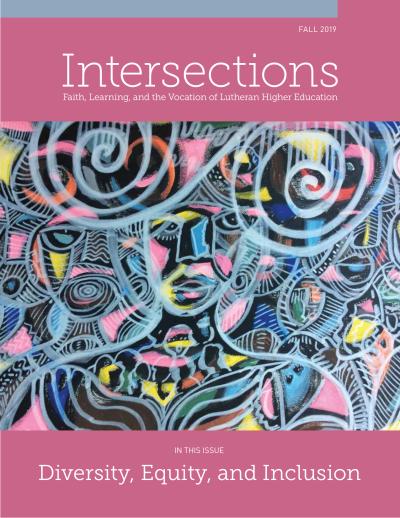 Article
The Perils and Promise of Privilege
Guy Nave
No. 50 · Fall 2019
Nave argues that privilege is always used in one of two ways — to preserve privilege by promoting inequity, or to challenge privilege by promoting diversity, inclusion, and equity — and uses examples from Indianapolis Catholic schools, Martin Luther, and equity-mindedness research to call Lutheran institutions to address the racist practices and policies that reproduce whiteness on their campuses.
-
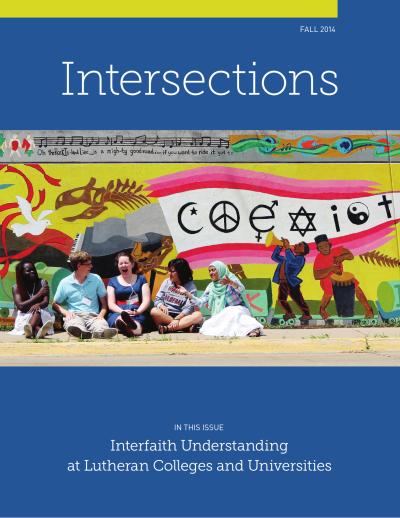 Article
Well, Well…Plumbing Our Depths, Telling Our Stories
Ann Boaden
No. 40 · Fall 2014
Beginning with a college visit that turned into a grieving mother’s confidence about her daughter’s last moments, Boaden uses John 4’s well of living water to argue that an interfaith education worthy of the name requires Lutherans to plumb the depths of their own tradition’s wells — with rituals, stories, and seasons intact — before they can see, respectfully, into the wells from which others drink.
-
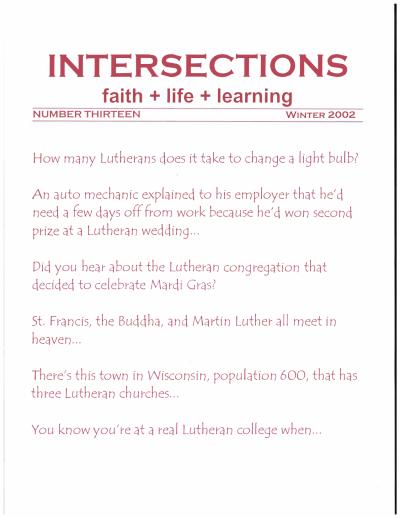 Article
Freedom, Humor, and Community: A Lutheran Vision for Higher Education
Darrell Jodock
No. 13 · Winter 2002
Jodock’s inaugural lecture for the Bernhardson chair at Gustavus Adolphus develops three interlocking themes drawn from the Lutheran tradition as a deeper grounding for the liberal arts college than contemporary American assumptions. A sense of humor rests on Luther’s discovery that God takes the initiative—Luther could call himself a beggar, joke about the epistle of James, and credit Wittenberg beer for the Reformation—and underwrites the freedom of inquiry that John Updike traces to Grace Lutheran Sunday School in Shillington. Community, grounded in Augsburg Confession VII and Luther’s 1524 letter to the German city councils, makes the college a community of discourse pursuing wisdom rather than “the same old blockheads.” Freedom is both “freedom from” and “freedom for,” illustrated by Nechama Tec’s Polish Holocaust rescuers and by Jodock’s Holocaust-class corporate role-play in which students voted to build a factory in a death camp rather than risk losing their board seats—a vivid case for educating toward “a passion for justice.”