What are the new contexts of and issues that characterize Jewish-Christian engagement on campuses? Why do these matter to us? You might say, as I do, “I don’t think we have any Jewish students on campus,” or “Maybe there are just one or two Jewish students.” Does Jewish-Christian engagement matter to Lutherans, to Christians? I think it does. Christians and Jews have been each other’s “Other” for nearly two millennia, and our track record in that relationship, to say the least, is not very good. The United States in the late 20th and early 21st century suggests a new, radically different phase in this relationship, a “golden age” according to one Jewish scholar. That is not to say there aren’t issues, but relatively speaking, Jews and Christians have learned to live together and to thrive.1 This “success story,” if you will, can serve as a model and a deep well of resources in how we engage the other “Others” that are forming significant portions of our society.
I want to look at four different contexts or arenas that highlight the contemporary relationship between Jews and Christians in our culture. We’ll look at campus populations, curricula, identity, and religious pluralism as areas in which Jewish and Christian students (and others) are living and learning together in ways profoundly different than their parents or grandparents did.
Not Your Parents' Jewish-Christian Encounter
In some ways, college campuses themselves are a “new” context of Jewish-Christian engagement, historically speaking. The post-World War I climate was characterized by anti-Jewish policies and practices on campuses throughout the United States. Henry Ford’s publication of the anti-Semitic “Protocols of the Elders of Zion,” a tract depicting Jews as engaged in an international conspiracy for world domination, contributed to an environment in which Jews were looked upon with suspicion (Tenenbaum 17). By 1924 Congress passed legislation curtailing the immigration of “racially inferior” people, including East European Jews, writes Shelly Tenenbaum in the introduction to her article, “The Vicissitudes of Tolerance: Jewish Faculty and Students at Clark University,” in which she traces the status of Jews—students, staff and faculty—on United States campuses throughout the 20th century.
Tenenbaum goes on to describe how many East Coast college presidents implemented exclusionary measures out of fear that increasing numbers of Jewish students would overwhelm their schools and threaten their institutions’ reputations. President A. Lawrence Lowell of Harvard, for example, advocated a quota system when the proportion of Jewish students at his school tripled from 7% in 1900 to 21.5% in 1922 (17). Similarly, Yale’s President James Rowland Angell supported a measure to limit the number of Jewish students when they grew from 2% in 1901–1902 to more than 13 percent of the class in 1925 (18). Once one school introduced quotas, a chain reaction emerged since “no one wanted to become a dumping ground for unwanted Jews” (18, quoting Oren 40). Some schools used character tests while others developed other exclusionary tactics such as requiring students to send a photo along with information about religion and race to identify and reject Jewish applicants. According to Tenenbaum, the schools that implemented the quotas were successful in reducing the numbers of Jewish students significantly in a relatively short period of time.
This discriminatory trend started to change after World War II due to a number of different factors, including, according to one historian, a new spirit of inclusion connected to the post war ethos (Tenenbaum citing Synnott 201). Perhaps more practically, student enrollment on United States campuses doubled between 1938–1948, creating the need for more faculty in nearly every area of study. Universities could no longer afford to discriminate against Jews—they desperately needed trained faculty, including Jews (Tenenbaum 21). With all of this, the system of quotas for students also began to fall. In addition, “the dismantling of the Jim Crow laws of legal segregation in the 50s and 60s further supported these trends so that by the time of the passage of the Civil Rights Act of 1964 … anti-Semitic quotas had all but disappeared in the [academic world]” (Rathner and Goldstein).
Today there are about 250,000 Jewish undergraduates on American college campuses, according to the 2000–2001 National Jewish Population Survey (Fishkoff). While the Jewish population represents about 2% of the national population, Jewish students make up about 5% of the population on United States campuses. While there are a number of schools, both public and private, that boast high numbers of Jewish students, such as Brandeis, NYU, and Columbia, Jewish students attend a wide variety of schools throughout the country. According to Jeff Rubin, a spokesman for Hillel International, the past decade has seen a rise in the number of Jewish students applying to private schools “that haven’t historically been magnets” (Passman).
In a recent article that explores the college choices of Jewish students in the Jewish Exponent, Rubin pointed to Muhlenberg College as one of the schools with a growing Jewish population. Patti Mittleman, the Hillel director and Muhlenberg’s Jewish chaplain, came to the college in 1988, when her husband was appointed the first professor in the schools new Jewish studies program. At that time, she said, “There were no Jews—or very few Jews” (Passman). Today, there are about 750 Jewish students at Muhlenberg, or about 35% of their students. In 2009, Muhlenberg was fifth in the Reform Judaism Magazine rankings of schools with the highest percentages of Jewish students, up from tenth place in 2007. What attracts Jewish students to a place like Muhlenberg? Initially unsure about the school because it was historically a Lutheran institution, Muhlenberg senior Susan Medalie said that she “was hooked” when she visited the campus and found out how many Jewish students there were (Passman). The Jewish community is not limited to the campus; the Lehigh Valley boasts a vibrant, active Jewish community as well. Mittleman also suggests that Muhlenberg is particularly attractive to families who have spent lots of time and money sending their kids to Jewish day schools or private schools and are looking for a smaller school with low student-teacher ratios.
Muhlenberg’s Jewish population has grown so much over the past decade that Hillel recently began an expansion project, increasing the size of the current house, which opened in 2001, from 7,000 to 20,000 square feet. Friday night Shabbat dinners regularly draw as many as 300 students, with about 50 students attending liberal and traditional services. In addition to Hillel, Muhlenberg also has a Jewish studies minor, and hosts the Institute of Jewish-Christian Understanding. This coming fall, upon completion of renovations to the campus dining facility, students will have the option of glatt-kosher dining in the student cafeteria. Mittleman estimates that about one-third of the Jewish students keep kosher.
Muhlenberg is not the only ELCA college with a Hillel center. Students at Gettysburg College, Wagner College, Augustana College (Rock Island), and Susquehanna College also have Hillel programs or houses on their campuses. Wagner Hillel which began in 2003 now has over 100 Jewish students who regularly participate in activities. A number of other colleges with smaller Jewish populations offer support and programming through their campus ministry offices. Wittenberg University, and St. Olaf, for example, have Jewish student clubs or groups. These schools are more the exception than the rule, however. Most of the ELCA colleges and universities have very few, if any, Jewish students. Luther, for example, hasn’t had more than a handful of self-identified Jewish students on campus at any given time during the nine years that I have been on faculty.
Judaism on the Books
While there are Jewish students on an increasingly diverse number of campuses throughout the country, the overall Jewish population is still small. What is of interest in this regard is the explosion of Jewish studies programs as well as course offerings in Jewish thought, life, culture, social science, history, and religion at American colleges and universities. The growth of Jewish studies in the United States dates back to the 1970s, a time in which groups including women, ethnic minorities, and gays and lesbians demanded programming and curricular changes to reflect their presence on campuses and in society, as well as their contributions to history (Hsu). While it is hard to come by current data on the numbers of Jewish Studies programs in the United States, the Association for Jewish Studies reports that when it was established in 1969 as a society for “individuals whose full-time vocation is teaching, research, or related endeavors in academic Jewish Studies,” it had 35 members (“Association for Jewish Studies”). Today the AJS has more than 1,500 members from a variety of fields across the United States and Canada.
Interestingly, much of the growth in this area has been driven by the interest of non-Jewish students. Professors who teach Jewish studies courses report that many, and sometimes most, of the students in their classes are not Jewish. “What was once considered a course of study almost exclusively for Jews has, in the last 40 years,” reports Sean Roach in a piece on the expansion of Jewish studies, “evolved into a diverse and multi-faceted educational discipline” (Roach). There are at least two consequences of the tremendous growth that Jewish studies has witnessed: (1) More and more Jewish students are learning about their religious and cultural heritage in an academic setting rather than through more traditional venues such as the home, synagogue, or Jewish religious education programming; and (2) More and more Christians (and others) are being exposed to Jewish life, thought, culture, and religion than ever before since much of the growth in these courses has been driven by non-Jewish student enrollment. “My classes,” notes Umansky of Fairfield University, “are really a mixture of students…but most of them are Christian. We close our classes at 30 and I [had] four Jewish students this year. That is the most I’ve ever had. Sometimes I have none, or just one” (Roach).
This growth in Jewish studies course offerings has impacted Lutheran higher education as well. In a survey of the most recent course catalogs at the 26 ELCA colleges and universities, 17 offer at least one stand alone course in Judaism—a course focusing on some aspect of contemporary Jewish life, thought, culture, or practice. Muhelenberg offers a Jewish studies minor, and Gettysburg College and Wittenberg University each offer at least four stand alone courses in Judaism. Another three ELCA colleges integrate Judaism into a Western traditions or monotheism course, and six have no offerings in which Judaism figures significantly. These statistics do not include courses in Bible or Christian Theology or History, even though these subjects may touch on aspects of Jewish thought or religion. Many of these courses have found their way into course catalogs at these institutions in the last 20–30 years, roughly coinciding with the beginning of the Jewish studies movement in the 1970s.
Much like the national picture of Jewish studies, most of the students who take courses in Judaism at ELCA colleges and universities are not Jewish. At Luther College, I offer an “Introduction to Judaism” course every year, and it always has at least 25 students, in part because students can fulfill their second religion course requirement by enrolling in it. Even so, it has been and continues to be a very popular religion course. Over the 9 years that I’ve taught the course, I have had about 3 Jewish students, and another 3–4 Christian students who were considering conversion to Judaism. The motivations of my students for taking the course are diverse. Many say they want to study Judaism as a way to learn more about the roots of their Christian faith traditions. Some have had Jewish friends or family members, while others register for the course because they don’t know anything about Judaism and are curious.
Some of the challenges that I face include introducing students to Judaism in the nearly complete absence of Jews, either at Luther or in the local community. A caveat to this is that there is a significant Chasidic Jewish community down the road in Postville, IA, but this is not a Jewish population that is necessarily open or accessible to us due to the traditional nature of their observance. In addition, many of my students have never met a Jewish person or have had any exposure to Judaism. In doing adult forums on Jewish-Christian engagement at local churches over the past decade, I have found that many of those who are over 65 years of age remember having at least one Jewish family in their small town, and talk about attending school with or befriending a Jewish person of their own age. This is almost never the case for students who arrive at Luther from these same small towns today, and reflects the movement of Jews out of rural areas into more urban settings with larger Jewish populations.
Another issue that I wonder about for my institution as well as other Lutheran or Christian-affiliated schools that offer one or two courses that focus on Judaism is the function of these courses in the larger religion and liberal arts curriculum. My concern is that these courses can, for Christians, serve a utilitarian function in ways that study of other religious traditions cannot. What I mean to say is that part of the reason for the appearance of Jewish studies courses at Lutheran colleges (among others) is that as interest in historical Jesus studies grew, and it became acceptable, even popular, to consider the Jewishness of Jesus, it became acceptable, and even popular to include a course in Judaism in departments of religion. Courses in Judaism came to serve, perhaps not intentionally, as courses in which Christian students could learn more about the Jewish roots of their faith. This may not be a bad thing, but Judaism-as-background rather than Judaism for its own sake and for the sake of its adherents can send the wrong message to our students. Students can easily miss the idea that Judaism is not Christianity, and that Judaism is a living, breathing tradition on its own.
Jewish Students Today are Being Jewish Differently
Substantial numbers of young Jewish adults are being Jewish in ways that are quite different from their predecessors. In the many studies and analyses of Jewish young people that are flowing out of the American Jewish community in their efforts to understand and reach out to 21st century Jews, the Jewish Millennial on campus, especially the non-Orthodox Millennial, might have the following profile. She is a student who is not particularly interested in Jewish institutions or denominational labels, although she might identify more with Reform Judaism, if pressed. In fact, this student probably sees Judaism as a cultural rather than religious identity (Birkner, “Generation Y”). According to Cindy Greenberg, director of NYU’s Edgar M. Bronfman Center for Jewish Student Life, “Many of these students feel passionate about being Jewish but aren’t necessarily religious,” rather they see their Jewishness as grounds for service, and “[Jewish-led social action] allows them to express themselves Jewishly…” (“Generation Y”). Students “want to participate in social action projects that don’t speak only to the Jewish community but to the community at large, and projects that the whole campus population, not just Jewish students, can take part in it,” said Danny Greene, a recent graduate of Stanford where he was a Jewish student leader (“Generation Y”).
With these sensibilities, today’s Jewish student is likely to be more comfortable with non-Jews and much less likely to have mostly Jewish friends than are Jews over 40 years old. College-age Millennials also tend to have non-Jewish boyfriends and girlfriends, marking a dramatic change from past generations. She is more comfortable sharing Jewish events such as holidays and life cycle rituals and space with non-Jews than her parents or grandparents. In addition she is far less likely than her parents to define her Jewish identity in reaction to anti-Semitism or by the Holocaust. Interestingly, she is also far more likely to acknowledge her Jewishness (Birkner, “Trends 101”). “It’s much more common to see college students wearing yarmulkes, and outwardly displaying other Jewish symbols,” says Jewish-American historian Jonathan Sarna. “Like other cultural groups, there’s been a coming out” (“Trends 101”). This openness may be due to the fact that for one of the first times in history, this young Jewish person can now decide for herself how she wants to practice her Jewish identity and traditions or even if she wants to be Jewish at all. This ‘dim-sum’ Jewishness, as former Heeb Magazine editor Jenn Bleyer has called it, signals a radical discontinuity between traditional and contemporary ways of being Jewish (Shmookler).
Finally, this student is increasingly likely to have one Jewish and one non-Jewish parent—already in 2001, 52% of young Jews between the ages of 18–24 came from intermarried families (Beck). The young adult who grows up in an interfaith family is even less connected to the religious and ethnic dimensions of her Jewish identity than her counterparts with two Jewish parents. She does, however, view her “Jewishness” positively and enjoys activities she considers Jewish, especially holidays (Beck). According to Lynn Davidman of Brown University, “Up until very recently Jews did not really intermarry, except in tiny numbers, so I think we’re at an unprecedented time in Jewish history. People who are born of one Jewish parent are one example of an increasing phenomenon in United States society, which is that people are born with more than one kind of identity” (Lukas).
Over the past few years, some Jewish children from intermarried families have begun to refer to themselves as “Half-Jews,” a term that is not without controversy in the Jewish community. While the Jewish religious denominations have varying views of what makes someone Jewish—the Conservative and Orthodox streams count as Jews only those with Jewish mothers, whereas the Reform and Reconstructionist movements sanction Jewish lineage from either side—the denominations are united in their opposition to the notion of one being “half-Jewish.” But “many children of intermarriage say they simply cannot turn their backs on the non-Jewish half of their identity. Their rabbis may say they are Jewish, but in their hearts they are also whatever grandma and grandpa are,” reports Leah Blankenship in The Wisconsin Jewish Chronicle: “This openness to multiple identities is particularly true among college students, according to Daniel Klein and Freke Vuijst, who interviewed hundreds of students for The Half-Jewish Book published in 2000. Klein says that those who consider themselves to be half-Jewish ‘feel they are a combination, they are an amalgam, they are bicultural’” (Blankenship). Rabbi Alan Flam, former director of Brown’s Hillel thinks that “this is a radically new question for the Jewish community. Students are talking less about theology and more about culture. They are saying, ‘Wait, I have a dual identity,’ similar to students who may have one parent who is Asian and one who is black. They are saying, ‘I want to figure out a way to affirm both identities in my life’” (Lukas).
There is a web-based organization called the Half-Jewish Network which provides information, resources, and online forum on issues that affect people that describe themselves as half-Jewish. In a recent post, a young woman provides an eloquent response to the question, “What do you answer when asked ‘Are you Jewish?’”
I ponder this question a lot—the short answer is that it depends on the context. My father is Jewish, Jewish-identified, etc., and I spent a lot of time growing up with my (father’s) Jewish family. I was basically “born-again” as a Christian when I was young, due to the influence of my mother’s Pentecostal, and have no interest in converting to Judaism.
It’s probably accurate to say I “look Jewish”—at least more Jewish than not (I get a lot of questions about my “exotic” ethnicity), but on the other hand, my last name (which is both my parents’ names, hyphenated) is kinda ambiguous. In other words, it’s not Goldstein.
There is too much baggage around Jewish identity to simply say I am “Jewish” when I am not generally recognized as such by Jews. (Although in social practice, I am kinda casually semi-accepted.) Plus, I can never answer all the questions folks who haven’t been exposed to Jews want to ask me about “my people.”
At the same time, I don’t like saying “Well, my father is,” or “half my family is,” because in so many other contexts that sounds like one is trying to distance oneself from Jewishness, which I emphatically do not desire to do.
“I am of Jewish descent” sounds similarly cold and distancing, if closer to accurate. I am proud to be of Jewish descent, but I almost, at times, don’t feel like I “deserve” to be proud. On the other hand, I am probably most vocal when people break out the anti-Semitism. I am under no illusions that the Nazis and others did/do not make a distinction when it comes to me, my family, et al. On the third hand—ha!—I am probably less sensitive to less-overt anti-Semitism both because I am less Jewish-identified than some folks and because I grew up in a very liberal area that was about 20% Jewish, so, at least when I was a child, it was easy to pretend/imagine that anti-Semitism was largely a non-issue except for “extreme” things that “happened elsewhere” or “in the past.”
I don’t know. It’s one of those crazy things where the greater society defines you one way, and the group itself may see you as something completely different. I mean, a dark-haired, “Semitic-looking” “Sheva Rabinowitz” could be a non-Jew, and a blonde, blue-eyed “Bridget Olafssen” could be a Jew—and they’re probably cousins. (“Half-Jewish Network”)
Religious Pluralism
Formal Jewish-Christian dialogue, as an endeavor and an arena, now can look back at significant achievements since WWII, especially in the United States. Much of the energy and initiative for this dialogue has derived from clergy, academics, and officials within religious institutions who have engaged in a serious re-evaluation of the Jewish-Christian relationship from the early centuries of Christianity to the present. In the course of this process, a host of new resources have been produced, including new theological and biblical resources used to train clergy and for use by clergy, i.e. commentaries and homiletical resources, curricular resources for use in Sunday schools and confirmation programs, liturgical formations for use in worship, the development of guidelines for interaction with and speaking about Jews and Judaism, and finally, statements by ecclesial bodies and other independent organizations dedicated to deepening the Jewish-Christian relationship that acknowledge the tragedies of the past, and set forth a new vision of the future. While there is still strong interest in some sectors regarding the Jewish-Christian dialogue, much of that initial energy and participation has waned in the last decade or so, and since the college campus was never the primary venue for this dialogue, a new generation of participants hasn’t been cultivated. This does not mean, however, that students are not interested in interfaith issues.
Right now, college and university campuses are witnessing a growing interest in engaging religious pluralism in ways that are in fact new and promising. Especially since 9/11, religious conversation and recognition of religious plurality as a legitimate type of diversity are now generating significant interest and involvement on campuses, both private and public. In this developing scenario, the dynamics of interfaith engagement are shifting away from some of the more traditional texts and issues that characterized the stand-alone relationships, i.e. Jewish-Christian and others, to a more action- or service-oriented engagement in which students of all faith traditions (or none at all) are coming together to work toward common goals. The process in some ways reverses that of the stand-alone dialogue in which participants claim one particular tradition, i.e., Lutheran Christian or Reform Jew, are knowledgeable about their tradition, and have a specific interest or objective in engaging the other. Today, on campuses, students who want to be involved interreligiously are coming together without the assumption of any previous knowledge about their own tradition or the tradition of the “other,” and in the course of working toward a community objective they learn more about themselves and the traditions of others.
In the opening pages of his recent book, Acts of Faith: The Story of an American Muslim, the Struggle for the Soul of a Generation, Interfaith Youth Core (IFYC) founder Eboo Patel contrasts this view of pluralism with what he sees as older models of interfaith engagement that don’t seem to reflect today’s realities and needs. “Interfaith cooperation,” he writes, “is too often a conference of senior religious leaders talking.” He then continues:
No doubt these leaders play a crucial role in religious bridge building. They have broken important theological ground, articulated frameworks for religious understanding, and sent the signal that cooperation with the religious Other is not only possible but necessary. Yet few in my generation have been involved. (xvii)
In this statement Patel voices appreciation for older models of cooperation that include dialogue, but suggests that these models have had their day, and that the challenges that younger generations face are different, more pressing, and perhaps more complicated. “I went to my first interfaith conference when I was twenty-one,” notes Patel, “and discovered that I was the youngest person there by some thirty years.” The pattern didn’t change, regardless of which conference he attended, and he came to the realization that “the faces of religious fanatics were young; the faces of interfaith cooperation were old” and that “something had to change” (xviii). As Patel tells the story of how he came to the mission of IFYC, he focuses on developing the framework in which the world is divided between religious pluralists and totalitarians, between being able to make a life together and violence.
The Interfaith Youth Core, an organization that is becoming increasingly popular on campuses around the United States, both captures the changing realities of interfaith engagement, and outlines a vision for students living in a pluralistic world in their definition of religious pluralism as “a state in which we respect one anothers’ religious identity, develop mutually enriching relationships with each other and work together to make this world a better place.” While Patel’s definition of religious pluralism is only one among many that are in circulation, and he focuses more on youth, as well as the service component in his vision of pluralism, his definition is in large part derived from that of Diana Eck at the Harvard Pluralism Project whose definition of pluralism comprises the gold-standard of the newly emerging field. At the core of her definition, Eck states that pluralism is “the energetic engagement with diversity, the active seeking of understanding across lines of difference, the encounter of [religious] commitments,” and that it “is based on dialogue” (Eck). While she uses the word dialogue, she doesn’t refer to its historical expression in the forms such as Jewish-Christian dialogue, but rather in the nature of dialogue as a give-and-take interaction between participants.
Conclusion
So often, engaging students across religious boundaries can result in uplifting the lowest common denominator, clichés such as, “We all believe basically the same thing anyway,” or “Our differences are unimportant, what matters are our similarities.” At Lutheran colleges, we have the opportunity to be more deliberate, to go deeper and to really grapple with difference, where the uniqueness and power of each tradition can often be located. In the process of engaging students across in a variety of faith traditions, however, it is important to remember that each tradition has a particular history of its own, and that issues of identity and interfaith engagement pose unique challenges and opportunities to students who come from these traditions. The case of Jewish students on predominantly Christian campuses is a case in point.
End Notes
1. It is important to note that anti-Semitism has not disappeared on United States campuses, although it is generally not as systematic or blatant as it was in the past. Many scholars have actually noted an uptick in anti-Semitic incidents in the first decade of the 21st century and have expressed concern that these incidents are not being taken as seriously as they should be. Cf. Rathner and Goldstein.
Works Cited
Association for Jewish Studies, website.
Beck, Pearl, Ron Miller, and Jacob B. Ukeles. Young Jewish Adults in the United States Today. American Jewish Committee (AJC), Sept. 2006.
Birkner, Gabrielle. “Generation Y Values Impact Jewish Students on Campus,” New York Community Media Alliance, 10 Nov. 2005.
____. “Trends 101: The New Jewish Life on Campus.” Reform Judaism Magazine Online, Fall 2006.
Blankenship, Leah. “‘Half-Jewish’? Children of Intermarriage Grapple with Their Identities.” The Wisconsin Jewish Chronicle, 7 Sept. 2007.
Eck, Diana. The Pluralism Project at Harvard University.
Fishkoff, Sue. “What Do Students Want? On College Campuses Across U.S. Jewish Freshmen Seek Community.” Jewish Telegraphic Agency, 10 Nov. 2005.
“Half-Jewish Network Message Board.” Post by Michelle, 20 June 2009.
Hsu, Charlotte. “Defining Role of Jewish Studies Scholar.” UB Reporter, 8 July 2010.
Lukas, Michael. “Divisible Jewishness.” New Voices: National Jewish Student Magazine, 17 Apr. 2002.
Oren, Dan A. Joining the Club: A History of Jews and Yale. New Haven: Yale UP, 1985.
Passman, Aaron. “Students Get Comfy With Heritage at School.” Jewish Exponent, May 6, 2010.
Patel, Eboo. Acts of Faith: The Story of an American Muslim, the Struggle for the Soul of a Generation. Boston: Beacon, 2007.
Rathner, Janet Lubman and Alison Goldstein. “Campus Anti-Semitism: The Issues Have Changed, the Problem Has Not.” In an interview with S. Tenenbaum, B’nai B’rith Magazine, Summer 2008.
Roach, Sean. “Jewish Studies: Not Just for Jews Anymore.” Jew-ish.com Seattle, 8 Jan. 2008.
Shmookler, Max. “Jews Front and Center? Scrambling for Jewish Identity in the Mainstream.” New Voices: National Jewish Student Magazine, 14 Dec. 2005.
Synnott, Marcia Graham. The Half-Opened Door: Discrimination and Admissions at Harvard, Yale, and Princeton, 1900–1970. Westport, CT: Greenwood, 1979.
Tenenbaum, Shelly. “The Vicissitudes of Tolerance: Jewish Faculty and Students at Clark University.”
-
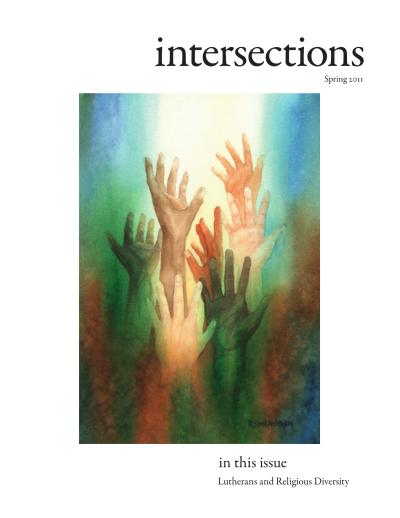 Editorial
From the Publisher
Mark Wilhelm
Wilhelm notes that while the ELCA’s vocation in higher education remains vibrant, the landscape of churchwide leadership has shifted dramatically with the dissolution of the Vocation and Education unit, and expresses appreciation for the faculty and staff at ELCA colleges and universities who have stepped up to sustain the network during this time of transition.
-
Editorial
From the Editor
Robert D. Haak
Haak frames the issue by asking how Lutheran colleges and universities understand the changing landscape of religious identification on their campuses, and argues that Lutheran theological commitments — including the work of the Spirit and the Incarnation — call institutions to create places where the voice of “the other” is heard and valued.
-
Article
Vocation of the Lutheran College and Religious Diversity
Darrell Jodock
Jodock describes a “third path” for Lutheran colleges that is both rooted in the Lutheran tradition and inclusive of religious diversity — an alternative to sectarian and non-sectarian default models — and identifies six interlocking features of the Lutheran tradition (giftedness, an engaged God, wisdom, caution about claims to know, community, and an emphasis on service and community leadership) that shape how such a college engages interreligious dialogue and civil discourse.
-
Article
The State of Civil Discourse on Campus and in Society
Terence S. Morrow
Morrow examines the troubled state of civil discourse in the United States and on college campuses, drawing on three deep traditions — the liberal arts, Lutheranism, and the Anglo-American legal tradition — to argue that Lutheran colleges can serve students and society by acknowledging the tensions inherent in civil discourse and helping students navigate them, and surveys promising campus programs at St. Thomas, Tufts, Loyola, and Harvard.
-
Article
The Breadth and the Depth: Dimensions of Christian-Muslim Relations at Educational Institutions of the ELCA
Mark N. Swanson
Swanson reflects on the spatial metaphors of depth and breadth that shape Lutheran higher education and argues that the study of Islam and real conversation between Christians and Muslims can contribute to both the broadening of horizons and the deepening of faith, drawing on his experience at the Lutheran School of Theology at Chicago and pointing to hospitality as a Christian practice in which depth and breadth come together.
-
Article
Reconciled Diversity: Reflections on our Calling to Embrace our Religious Neighbors
Jacqueline Bussie
Bussie offers three concrete recommendations for cultivating reconciled religious diversity on Lutheran campuses — Lutheran listening and the telling of stories, engendering encounters with religious neighbors through curriculum and bridge-building events, and choosing empathy and collaboration over evangelism and creed — arguing that what students fear most in encounters with the religious “other” is the loss of their own identity and distinctiveness, and that we can show them how loyalty to one’s own tradition and reverence for different traditions can coexist.
-
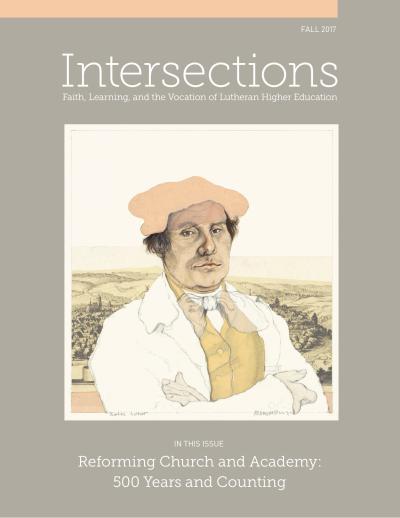 Article
Celebrating the Reformation: The Lutheran Foundation of a Called Life
Mark D. Tranvik
No. 46 · Fall 2017
Tranvik traces vocation from the monastic impulse through Luther’s rejection of the monk’s vow as the only true calling, and translates the “called life” for twenty-first-century Lutheran colleges — institutions that see students as made in the image of God, enlist the whole community in discernment, and make room for faith and its convictions.
-
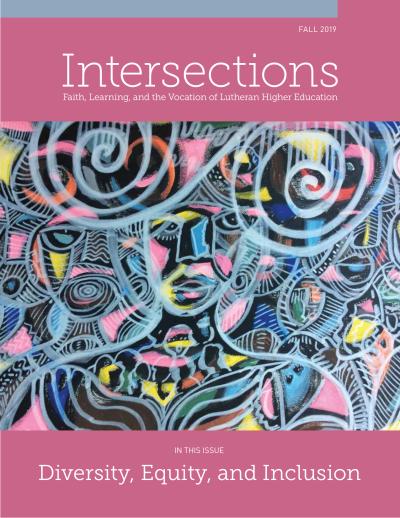 Reflection
Seeing in a New Way: A Meditation
Kara Baylor
No. 50 · Fall 2019
Baylor, the only Black campus pastor in the NECU, weaves Psalm 25, the parable of the Good Samaritan as re-read through Lenny Duncan, and the “crimson thread of divine justice” from Allen Dwight Callahan into a meditation that closes with the invitation she offered at the 2019 conference — to tie a crimson thread around the wrist as a symbol of collective commitment to moving beyond privilege toward inclusion and equity.
-
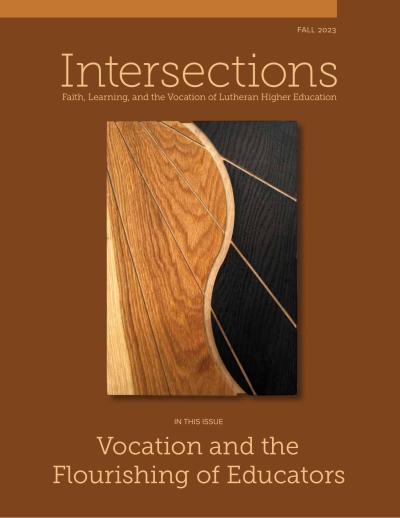 Article
Staff Governance at St. Olaf College, Northfield, MN
Don Ezra Cruz Plemons
No. 58 · Fall 2023
Cruz Plemons describes how staff at St. Olaf, in the wake of a decade of difficult events, have built a three-year, glacier-paced effort toward a Staff Governance model — through affinity groups, the Council for Equity and Inclusion, and the Task Force to Confront Structural Racism — that gives staff a voice alongside faculty and students.
-
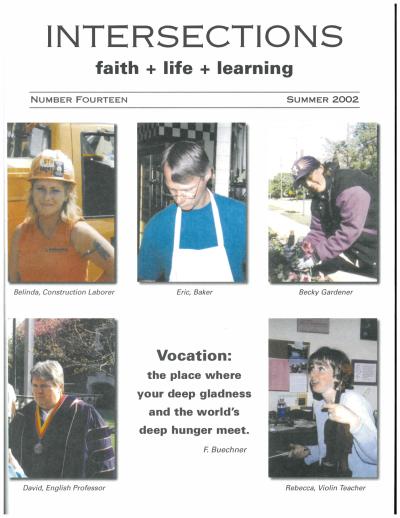 Reflection
Discerning Vocation: Personal Recollections
Tom Christenson
No. 14 · Summer 2002
Christenson recalls growing up two blocks from Concordia College, Moorhead, where his father—known to students as “Doc”—was the steam engineer, and afternoon wanderings past walrus-moustached biologists, Harpo-Marx-haired theologians, and a math professor who wrote proofs with one hand and erased them with the other. He came to see the campus as “an asylum for child-like minds building towers of intellectual blocks and then knocking them down,” and traces his philosophical bent back to a high school physics teacher who, asked why Bernoulli’s principle was true, finally growled, “Christenson, you’re nothing but a damn philosopher.”
-
 Article
The Vocation Movement in Lutheran Higher Education
Mark Wilhelm
No. 43 · Spring 2016
Wilhelm offers a brief history of the “vocation movement” in ELCA higher education, arguing that it arose as Lutheran leaders moved beyond institutional markers (percentages of Lutheran students, faculty, and board members) and the collapse of ethnic, separatist Lutheranism to re-ground their schools’ identity in a 500-year-old intellectual tradition that educates the whole person for vocation and the common good — an educational ideal open to persons of any religious or non-religious conviction.
-
 Editorial
From the Publisher
Mark Wilhelm
No. 30 · Fall 2009
Wilhelm reports on the difficult financial season facing the ELCA churchwide organization — a ten-percent budget reduction announced in November and significant cuts to unrestricted grants for colleges and universities — while affirming that the ELCA’s commitment to the mission of its schools remains strong, including its commitment to engaging the “other,” the theme of this issue.