So That All May Belong: Lutheran Roots for Diversity, Equity, Inclusion, and Justice [abridged]
Altheia Richardson
Network of ELCA Colleges and Universities
Angie Hambrick
Pacific Lutheran University
Caryn Riswold
Wartburg College
Colleen Windham-Hughes
California Lutheran University
Deanna Thompson
St. Olaf College
Marcia Bunge
Gustavus Adolphus College
Robert Clay
Luther College
Intersections No. 61 · Spring 2025
NOTE: This is an abridged version of the complete document, which also appears in this issue.
Institutions that make up the Network of the ELCA Colleges and Universities (NECU) share a common calling of “equipping graduates who are called and empowered to serve the neighbor so that all may flourish.”1 Although their mission statements vary, these institutions are committed to providing students of all backgrounds an excellent education and preparing them to use their unique strengths to contribute to the flourishing of people and our planet.
These commitments are rooted in educational reforms and a specific notion of calling or vocation promoted by Martin Luther in the 16th century. At a time when education was limited to the wealthy or monks, nuns, and priests, Lutheran reformers claimed that all are called to use their unique gifts and strengths to love others, seek justice, and contribute to the common good. This concept of vocation informs NECU’s commitment not only to provide education for students of all backgrounds, but also to promote diversity, equity, inclusion, and justice (DEIJ).2 Doing so fosters belonging, honors the contributions of the diverse members of our campus communities, and aligns with the mission of NECU institutions.
Furthermore, as we actively strive to cultivate campus communities where all feel a sense of belonging and DEIJ thrives, NECU institutions are called to reject unjust or harmful institutional legacies and practices and to address them. This call to acknowledge and redress harm is in line with the Lutheran spirit of reform and its commitment to justice.
Lutheran Roots
Lutheran theology affirms the dignity and worth of all persons and claims all are called to use their unique gifts and strengths to love and serve others. Lutheran tradition is therefore always reforming institutions and values various roles and responsibilities that contribute to the common good. Building on their gifts, all people are free to pursue questions; seek truth, justice, and beauty; and share what they discover with others.
Although human beings can know much about God and the world, the universe is complex, and human understanding is always limited. Recognizing creation’s diversity and the limits of human knowledge, Lutheran theology embraces diversity and emphasizes the significance of wonder, academic freedom, intellectual humility, life-long learning, and building a world in which all people and our planet flourish.
In line with its affirmation of God’s good creation, the dignity of all persons, and its robust concept of vocation, Lutheran theology emphasizes the development of the whole person (mind, body, spirit), love of neighbor, and social and environmental justice. Relationships and institutions, though fallible, are necessary for promoting the well-being of individuals, families, communities, and the planet.
Shaped by these notions, Lutheran higher education embraces diversity as a core value that enriches both the academic environment and the broader community. This commitment to diversity is not limited to demographic representation; it is about cultivating an environment where all voices are heard, respected, and valued. By engaging with diverse perspectives, Lutheran higher education helps individuals better understand the complex and dynamic world we live in and equips them with the skills to navigate and positively impact that world.
We call on our Lutheran colleges and universities to:
Focus on recruitment and retention: Work to recruit and retain people from diverse communities (students, faculty, staff and administration).
Appreciate cultural wealth: Recognize and appreciate the richness that comes from diverse backgrounds, experiences, and identities and engage with people whose identities and experiences differ from our own.
Engage in self-reflection and challenge bias: Consider how our own identities, actions, assumptions, and biases may impact others and work to build greater awareness and understanding.
Provide targeted support: Recognize that different individuals and communities may need different forms of support to fully participate and succeed. Advocate for resources, support, and opportunities that are tailored to meet these specific needs.
Foster accountability: Create mechanisms that hold our institutions and ourselves accountable for promoting equity. This includes regularly assessing the impact of policies and practices on marginalized groups and making adjustments when necessary.
Create inclusive spaces: Work to ensure that everyone in the community feels welcomed and valued, regardless of their background or identity. This means being mindful of how spaces, both physical and social, can include or exclude certain groups.
Dismantle systemic and physical barriers: Identify and remedy institutional practices, policies, and structures that may unintentionally perpetuate inequality or exclusion, particularly for marginalized groups.
Uplift marginalized voices: Actively listen to and amplify the perspectives of individuals and groups who have historically been excluded or oppressed. Recognize their experiences and contributions as essential to creating a more just community.
Build solidarity: Stand alongside those who are fighting for social and environmental justice, and use our voices, influence, and resources to support efforts that dismantle inequities and create pathways for all people to thrive.
Engage in service and advocacy: Support initiatives both on and off campus that work toward justice, from service to the neighbor to advocating for equitable policies.
NECU institutions are called to offer a unique environment where students, faculty, and staff are not only included, but also celebrated, supported, and given the opportunity to thrive within a community grounded in faith and justice. This distinctive approach sets Lutheran institutions apart from other colleges and universities. These institutions can continue to differentiate themselves by offering an educational experience where belonging is not just a byproduct of DEIJ initiatives, but an integral part of the mission.
Endnotes
1. Rooted And Open: The Common Calling of the Network of ELCA Colleges and Universities.
2. See National Association of Diversity Officers in Higher Education (NADOHE).
-
 Editorial
From the Publisher
Lamont Anthony Wells
5 min audio
Wells introduces So That All May Belong: Lutheran Roots for Diversity, Equity, Inclusion, and Justice as a theological and institutional articulation of NECU’s commitments, and previews four accompanying essays that frame vocation as a societal responsibility rooted in justice and not solely an individual pursuit.
-
Editorial
From the Editor
Colleen Windham-Hughes
5 min audio
Windham-Hughes uses Fred Rogers’ neighborhood as a living embodiment of a Lutheran understanding of vocation — seeing dignity in each person, offering one’s gifts generously, and trusting that the well-being of the neighborhood is intrinsically connected to the well-being of every neighbor.
-
Institutional Focus
So That All May Belong: Lutheran Roots for Diversity, Equity, Inclusion, and Justice
Altheia Richardson, Angie Hambrick, Caryn Riswold, Colleen Windham-Hughes, Deanna Thompson, Marcia Bunge, Robert Clay
22 min audio
The full NECU statement grounds DEIJ work in Luther’s 16th-century reforms and Lutheran theological claims about the image of God, equal dignity, and the limits of human knowing — offering definitions, Lutheran roots, and calls to action for diversity, equity, inclusion, and justice, with belonging as the outcome of DEIJ at work.
-
Institutional Focus
Scriptures That Inspire Work for Diversity, Equity, Inclusion, and Justice
Altheia Richardson, Angie Hambrick, Caryn Riswold, Colleen Windham-Hughes, Deanna Thompson, Marcia Bunge, Robert Clay
9 min audio
A companion list of biblical verses — from Genesis 1:27 and Galatians 3:28 to Micah 6:8 and Luke 4:18-19 — that grounded NECU’s drafting of So That All May Belong, organized by the four DEIJ commitments and offered as an invitation to share other texts that ground and sustain the work.
-
Article
Vocation at Full Stretch: Reflections on Follow Your Bliss and Other Lies about Calling and its Use among College Students
Jason A. Mahn
43 min audio
Mahn engages Bonnie Miller-McLemore’s Follow Your Bliss and Other Lies about Calling as required reading in a sophomore religion course, showing how her categories of missed, blocked, conflicted, fractured, unexpected, and relinquished callings empower young adults to perceive embodied, unplanned, and often painful dimensions of life as essential parts of vocation — and help close the gap between mission-driven and tuition-driven realities.
-
Article
How Mister Rogers’ Neighborhood Reminds Us About Work
Than Oo
5 min audio
Drawing on a Season 15 arc of Mister Rogers’ Neighborhood in which residents redirect pool funds to fix a plumbing problem, Oo finds in Fred Rogers’ vocation-honoring storytelling a reminder that limited resources are an invitation to creativity, perseverance, and optimism in higher education.
-
Reflection
Ecotones of Faith
Tracy Paschke-Johannes
7 min audio
Paschke-Johannes draws on the ecological metaphor of the ecotone — the life-teeming transitional space between two ecosystems — to claim that we are not called to minister in the world of the past or one fifty years hence, but to nurture the kairos moments God is creating in the freshwater-to-saltwater present.
-
Article
Finding the Miracle in the Intersection of Mission and Limitations: Lessons from Latin America
Kat Peters
14 min audio
Peters draws on her time interning with Lutheran World Relief and leading a study abroad program in Central America — including a Costa Rican women’s farm cooperative whose ecotourism project was “unprofitable” but life-giving — to argue that the intersection of God’s preference for struggle and God’s desire for abundant life is itself the miracle higher education can claim amid scarcity.
-
 Editorial
From the Publisher & Editor
Colleen Windham-Hughes, Lamont Anthony Wells
No. 63 · Spring 2026
6 min audio
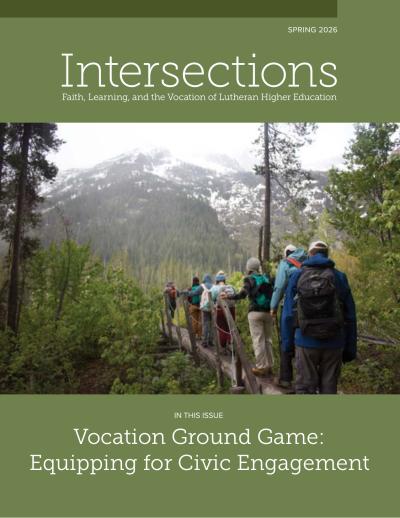
Wells and Windham-Hughes frame vocation as “ground game” — the practical, public living-out of faith through civic engagement — and introduce the issue’s focus on how Lutheran higher education equips students to repair the world.
-
 Editorial
From the Editor
Colleen Windham-Hughes
No. 62 · Fall 2025
5 min audio
Windham-Hughes plays on the shared Latin root of “education” and “seduction” (ducere, to lead) to warn against the No-saying seductions of giving up or condemnation, and to call educators to the riskier Yes of showing up to build third-space communities of truth-telling and hope.
-
 Article
Committed to Paradox
Caryn Riswold
No. 60 · Fall 2024
Riswold lifts up paradox — saint and sinner, lord and servant, Rooted and Open — as a distinctive Lutheran root that lets institutions honor the complicated truth of who their students are and embrace the messy, ever-reforming work of access and accessibility as a theology of the cross.
-
Editorial
From the Editor
Colleen Windham-Hughes
No. 60 · Fall 2024
Windham-Hughes welcomes newcomers and seasoned colleagues to the conversation, lifts up Mary Elise Lowe’s three Lutheran “whys” for educational access, and commends Rev. Jen Rude’s “Sacred Pause” practice as a way to humanize one another and make opening access both easier and more joyful.
-
 Editorial
From the Editor: Vocation as Action in the Affirmative
Colleen Windham-Hughes
No. 59 · Spring 2024
Windham-Hughes frames vocation as practicing “at the borders of our incompetence” — every small yes to the callings we experience, every effort made in the direction of life, is action in the affirmative — and previews the issue’s essays on diversity, transformation, AI, championship team culture, and dreaming big within and beyond our limitations.
-
Article
Team Culture is Key to Success: Learning from Student-Athletes
Colleen Windham-Hughes
No. 59 · Spring 2024
On a December weekend in “Championship City” Salem, Virginia, both California Lutheran’s Women’s Soccer Team and St. Olaf College’s Men’s Soccer Team won NCAA Division III national titles. Windham-Hughes talks with coaches, faculty mentors, and student-athletes about how off-the-field team culture — built on trust, relationships, and shared why — translates onto the pitch and into liberal arts and sciences education.
-
 Editorial
From the Publisher
Mark Wilhelm
No. 36 · Fall 2012
Wilhelm argues that the rhetoric framing ELCA higher education as a binary between “secular” and “religious” is “hokum”: there is a third way of doing higher education from a Christian perspective that is religious in motivation and practice but on the ground looks secular. After more than half a century of debates, he calls on ELCA presidents to “do something” in 2013 to move forward in shared mission and vocation.
-
 Article
Welfare of the City and Why Lutherans Care about Education
L. DeAne Lagerquist
No. 38 · Fall 2013
Lagerquist takes readers on a historical tour from sixteenth-century Saxony through the founding decades of Lutheran higher education in the United States to the present day, recovering Luther’s “gift economy” alongside Lewis Hyde and Oswald Bayer as a counter to the market logic that increasingly governs American higher education. She offers four propositions on vocation and commodification and proposes that Lutheran institutional vocation is to accept and pass along the gifts that come to our schools for the well-being of students, neighbors, and the world.
-
 Book Review
Post-Secular Religion on Campus: Conversing with Jacobsen and Jacobsen
L. DeAne Lagerquist
No. 39 · Spring 2014
Lagerquist guides readers through Douglas and Rhonda Hustedt Jacobsen’s No Longer Invisible: Religion in University Education and its companion volumes, unpacking the authors’ three-act story of campus religion (Protestant, Privatized, Pluriform), their three-by-two framework of historic/public/personal religion in belief and behavior, and the six questions they pose for campus conversations. She lifts up interfaith etiquette and vocation as especially fruitful zones for Lutheran campuses.
-
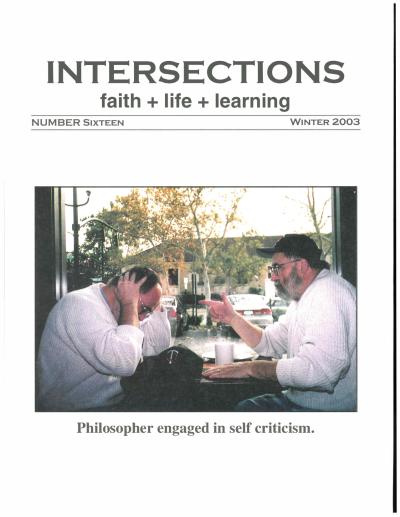 Article
The Impropriety of Jesus' Teaching: The Woman at the Well and The Vagina Monologues
Susan M. O'Shaughnessy
No. 16 · Winter 2003
O’Shaughnessy Poppe dedicates her message to those who worked to put on Eve Ensler’s The Vagina Monologues against administrative resistance and reads the Samaritan woman at Jacob’s well alongside the testimony of a Bosnian rape survivor whose story Ensler asked to tell, arguing that the “impropriety” of Jesus—his scandalous recognition of those silenced by sexism, racism, war, custom, and the church—is the model for the mission of a college of the church to defend academic freedom and to break the chains of oppression by inflicting discomfort on the proper and pure.
-
 Article
'In, With, and Under:' The Tradition and the Teaching of Christian Ethics
Pamela K. Brubaker
No. 17 · Summer 2003
Brubaker describes how she teaches Introduction to Christian Ethics at California Lutheran University—a religiously diverse classroom where about 30% of students are Lutheran, 30% Roman Catholic, and many are “unchurched”—as a community of moral discourse rooted in the Lutheran dialectic of faith and reason. Drawing on Larry Rasmussen and Bruce Birch, Elizabeth Bettenhausen, Roger Crook, and Robert Benne’s typology of “Hot and Cool Connections” between church and politics, she walks through her course’s units on human sexuality, economic life, and war and peace—including the Bomb Shelter simulation, a mock Disney stockholders meeting on sweatshops, and a Congressional hearing on the School of the Americas—to show how ELCA social statements function as case studies in critical inquiry and education for citizenship.
-
 Article
A Lutheran Learning Paradigm
Paul J. Dovre
No. 34 · Fall 2011
Drawing on Hughes and Adrian’s Models of Christian Higher Education and on Ernest Simmons, Darrell Jodock, Tom Christenson, Robert Benne, and Richard Hughes, Dovre sketches a Lutheran learning paradigm shaped by four deep narratives—the biblical, the confessional, the theological, and the vocational—and traces their implications for curriculum (the study of scripture, theology, and vocation), for the religion faculty’s college-wide responsibility, and for pedagogy (moral deliberation, dialectic, paradox, the engagement of faith and the secular disciplines).