In Fall of 2015, a student entered my office suite and offhandedly declared, “I am always so hungry at this school.” With those words, something fundamentally changed in my life and work in ELCA higher education. As I began to build a relationship with that student, I embarked on a new and more nuanced understanding about students and economic hardship at our NECU institutions. I also entered into a new lived experience about my role as a college chaplain at Augustana College and then Muhlenberg College, as well as about the calling of our collective colleges to meet the needs of the students whom we serve.
The student did not intend to enter the chaplain’s office to talk about food insecurity. She came into the integrated and holistic student advising, career, and vocation center to talk about the things we hope our students talk about—academic and co-curricular interests and how those might intersect and be lived out on campus and in the community. I quickly realized that we cannot have conversations about meaning and purpose, academic aptitude, and career ambition until students’ basic needs are met.
In going deeper with the work, I found that the story of that initial student was replicated over and over in other students. It wasn’t that students didn’t have food all the time—it was that there weren’t always transparent mechanisms in place to ensure student success and access to a wide array of things including food, personal hygiene items, clothing, and school supplies which includes textbooks and required online portals. Often, students and families were stretched to the very limit to provide the minimum amount of money needed to enroll and register for classes. When a disruptive event happened (for example, an unexpected family emergency or broken laptop or field trip fee), students were often unable to make up the cost, even if it was minimal.
Responding to Food Insecurity
Food insecurity is defined by “not having reliable access to a sufficient quantity of affordable, nutritious food.” According to the United States Government Accountability Office (GAO), and a study by Durbin, “The Challenge of Food Insecurity for College Students”:
- 30 percent of college students are food insecure;
- 22 percent of college students have the lowest level of food insecurity; and
- 13 percent of students at community colleges are homeless.
A common question I have heard over and over in five years of working on these particular issues is: “Doesn’t everyone have a meal plan?” The simple answer is “no,” and the more complicated answer is that not all meal plans are created equally. So even if a majority of students do have a meal plan, there are varying levels of meal plans and meal plan availability. For example, few campuses maintain a dining service that is open during breaks or the summer. This has a great impact on students who may not be able to leave campus or have another primary residence outside of campus. At each of the two NECU institutions where I have served as a college chaplain, I have worked with cohorts of students who, outside of college-owned housing, identify as homeless. This does not include international students, many of whom remain on campus for the entirety of their time as a student. Additionally, across all college campuses, there are increasing numbers of transfer, commuter, and off-campus students who are less likely to have meal plans (Swipe Out Hunger).
“These types of small loans can make a huge difference in the lives of college students.”
At both Augustana and Muhlenberg, we began to address these complicated needs by instituting new programs, including on-campus pantries, food recovery efforts, and expanded emergency loans and grants. At Muhlenberg College, we also convened a comprehensive working group to look more strategically at student economic hardship on campus. As a result, we launched a set of new initiatives (Muhlenberg) including emergency grants in two categories: grants for basic needs (food, clothing, shelter), and experiential learning grants. The former fund basic needs, food, housing, or other unexpected hardship outside of cost of attendance. The latter enable students to engage in the fullness of curricular and co-curricular life at the college. Examples include a fee associated with a student club or organization or a field trip for a class. Students are eligible to apply two times or up to $500 per year through a centralized application process. They receive a response within 24 hours of the request.
Often, these types of small loans can make a huge difference in the lives of college students. In 2018, with support from the Bill and Melinda Gates Foundation, the National Association of Student Personnel Administrators (NASPA) launched a new website “to support institutions that desire to or currently offer emergency financial resources to students in need.” The website builds upon the 2016 report from NASPA (Kruger); according to their research:
- Emergency loans or grants can have a huge impact on student success.
- 41 percent of emergency loans or grants come from foundations and individual donors.
- 78 percent of private institutions say lack of financial resources is the greatest barrier to serving a greater number of students who need emergency loans or grants.
- 72 percent of the loan or grant need is less than $1,000 per student. (Kruger)
Testimonies by Students and Educators
At Muhlenberg, we also took a deeper dive into our own student data around these issues. In the 2019-2020 academic year, we participated in the HOPE Survey, the largest national survey addressing basic needs insecurity for college students.1 In its third round of administration, the focus has been on enrolling more private, liberal arts colleges to provide more specified data to these campuses. In Spring of 2018, we also conducted a “Hidden Costs Survey” with students, faculty, and staff. Students were asked, “To what extent have these additional costs impacted your ability to engage in College life?”
One student responded, “I have two jobs to help with expenses. I want to pull my weight. But when the college provided that $50, it went a long way both in terms of food and helping me be able to concentrate to do well in class.” Another wrote, “There were so many unexpected costs like food at break periods, having plates, utensils, dish soap, etc. Also, if you didn’t have a fan right away it was sweltering. I could not afford one.”
Faculty and staff were asked, “What have you or your department done to assist student with financial hardship?” One faculty member responded, “I’ve purchased/donated books and other school supplies for students, and I’ve used my account to print course materials for students that needed to be able to write on physical copies, but who couldn’t afford to print. I’ve also brought in food for students who were hungry, and/or fed them at my home.” Over and over again, the responses showed us the way to begin to address some of the need. Not all the need, but some of it.
In his book, The Privileged Poor: How America’s Elite Colleges are Failing Disadvantaged Students, Anthony Jack, of the Harvard Graduate School of Education, refers to some students as “doubly disadvantaged.” These are students who are strong academically, but come from low income backgrounds. They are less exposed to the norms and unspoken expectations of campus life, particularly at elite institutions. Jack describes his own experience at Amherst College. He wondered if he was the only student like himself. This experience, along with figuring out the process of navigating campus culture, became the focus of Jack’s research and scholarship as a sociologist.
“I am grateful for all of the students who are on our campuses and willing to share their experience and, in doing so, bring our institutions to the front lines of this work.”
Muhlenberg College hosted Anthony Jack in Fall of 2019 for a series of on-campus engagements including a meal with students, a faculty and staff enrichment session, a public lecture, and a meeting with senior leadership including the president. Of all of these different opportunities for campus engagement, I was most struck by the student comments during his public lecture. It was the first time that I have been at an event where there were lines of students at the microphones waiting to respond and to ask questions. In many cases, students thanked him for sharing his own story, remarking that it was the first time they heard their own story reflected publicly.
My own reflection on the event was to recall my interaction five years ago with that first student who was bold enough to share her story in a public space, to declare that she was hungry. In many ways, the telling of these stories about food and economic insecurities parallels the #metoo movement. I am grateful for all of the students who are on our campuses and willing to share their experience and, in doing so, bring our institutions to the front lines of this work.
Lessons Being Learned
My experience as a chaplain working directly with these efforts at two colleges in different parts of the country has taught me many lessons. Here are five:
1. This is daily work. There needs to be more than a one-time effort. Like many aspects of life, the issues are intersectional. There are many different reasons a student might face an economic hardship. Often, the reasons overlap, and thus, our responses must also overlap.
2. There are skeptics. Both in the on-campus and broader college communities, I have found that many people have a disbelief that “our” students are mirroring the national trends around student hunger and economic insecurity. This is simply not the case. Another common misconception is that students might “abuse” the resources. In five years of this work, I can confidently say that I have never had a student receive support from the pantry or the emergency grant program who wasn’t truly in need of extra support. I will also note that the students in need have been from a wide variety of backgrounds and identities.
3. It does not always require a huge or new budget line. At both colleges, we were able to reallocate existing funds in order to launch the majority of the programs. At Muhlenberg, the resources are now housed in a central place, giving us the ability to track and assess the need and demand.
4. The chaplaincy has a unique but not solo role to play. On both campuses, my work on these issues has been deeply collaborative with a wide array of partners including faculty, trustees, presidents, student affairs staff, alumni and alumni affairs staff, admissions and enrollment staff, and students themselves. As with other work on campuses, support staff including administrative assistants has been at a forefront of the work. They literally open the pantries for students or alert other staff members that a student may have an emergency need. Without the coordinated work of all of these partners, we could not accomplish this work.
5. Student learning is an outcome. At each college, student workers, student organizations, and students working on academic research were involved with the initiatives. The pantries essentially require intern-level research, planning, and reflection in order to launch. I can cite several examples where student workers have been deeply impacted by their work in these initiatives; they ended up pursuing graduate school and professional opportunities to further work on issues related to food and housing insecurity.
“It is within our common calling as NECU institutions to help ensure that many barriers to success are removed so that students can navigate the college experience with grace and dignity.”
Final Thoughts
I do not want to idealize or glamorize the support we are able to provide. It is not realistic to expect that we can meet all student financial hardship needs. It is also not realistic to expect that for the students with the highest need, their need will disappear when they leave our campuses. I do believe, however, that it is within our common calling as NECU institutions to help ensure that many barriers to success are removed so that students can navigate the college experience with grace and dignity and that they complete their degrees. With these kinds of programs, we are not celebrating economic hardship. We are celebrating our community’s ability to meet the very real needs of our students. I have come to believe that this might be the defining calling of a NECU college or university.
Endnote
1. Results from the survey will be available later in the Spring of 2020.
Works Cited
Dubick, James, Brandon Mathews, and Clare Cady. The Challenge of Food Insecurity for College Students, October 2016. Accessed 1 March, 2020, http://studentsagainsthunger.org/wp-content/uploads/2016/10/Hunger_On_Campus.pdf
GAO (U.S. Government Accountability Office). “Food Insecurity: Better Information Could Help Eligible College Students Access Federal Food Assistance Benefits,” Dec. 21, 2018. Accessed 1 March 2020, https://www.gao.gov/products/GAO-19-95?mobile_opt_out=1
Jack, Anthony Abraham. The Privileged Poor: How America’s Elite Colleges are Failing Disadvantaged Students. Harvard UP, 2019.
Kruger, Kevin, Amelia Parnell, and Alexis Wesaw. “Landscape Analysis of Emergency Aid Programs.” National Association of Student Personnel Administrators (NASPA), 2016. Accessed 1 March 2020, https://www.naspa.org/files/dmfile/Emergency_Aid_Report.pdf
Muhlenberg College. “Financial Hardships.” Accessed 1 March 2020, https://www.muhlenberg.edu/financialhardship/
Swipe Out Hunger. “About Us.” Accessed 1 March 2020, https://www.swipehunger.org/aboutus/
-
 Editorial
From the Publisher
Mark Wilhelm
Wilhelm frames the issue by tracing how Lutheran educational ideals — once a primary source of contemporary higher education — were masked in the United States, and introduces a NECU initiative that uses the case of business ethics to explore Lutheran social teaching as an academic resource.
-
Editorial
Guest Editorial: Moral Deliberation in NECU Classrooms
Ernest L. Simmons
Simmons introduces the guiding question of the NECU working group: could the ELCA’s twelve social statements and thirteen social messages — expressions of Lutheran social teaching originally formulated for congregational use — turn campuses into “academic communities of moral deliberation”?
-
Article
The Responsible Professional: Vocation and Economic Life
Martha E. Stortz, Tom Morgan
Stortz and Morgan argue that the “value-added” of Lutheran higher education is a responsibility ethic — one that frames the professional as a first responder “called and empowered to serve the neighbor so that all may flourish” — and unpack the four criteria of the 1999 ELCA social statement Sufficient, Sustainable Livelihood for All as a framework for economic deliberation.
-
Institutional Focus
A List of ELCA Social Teaching and Policy Documents
A reference list, as of September 2019, of the ELCA’s twelve social statements, fourteen social messages, and over 150 social policy resolutions — with Spanish translations where available.
-
Article
ELCA Social Teaching for the Classroom?
Roger A. Willer
Willer argues that the body of ELCA social teaching, taken as a whole, constitutes an actual social ethic — relatively comprehensive, responsibly consistent, and remarkably cogent — whose mode of responsibility ethics commends it as a classroom resource for any discipline that wrestles with moral questions.
-
Article
The Challenge of Inclusion in the Ethics Classroom
Faith Wambura Ngunjiri
Ngunjiri, the only Black woman tenured faculty member at Concordia College, reflects on her students’ resistant and resonant responses to MLK Day programming on “Not Racist: A White Moderate Myth” — and on what it takes to make the ethics classroom a place where students can “BREW”: Becoming Responsibly Engaged in the World.
-
Article
Business as Usual? Marketing, God, and the Limits of Christian Callings
Emily Beth Hill
Hill, a former corporate marketing consultant turned theologian, returns to Luther’s claim that no vocation is more holy than another — and uses Luther’s Large Catechism definition of God to argue that the modern practice of branding intentionally redirects the love and worship of human beings toward capital, raising the question of whether Christian neighbor-love places limits on what professions Christians should pursue.
-
Article
Gen Z is Made for Lutheran Higher Education
W. Kent Barnds
Barnds argues that Generation Z’s defining traits — socially responsible, purpose-driven, cost-conscious, culturally open, and tech-expectant — align almost perfectly with the missions of NECU institutions, and offers concrete suggestions (from replacing “vocation” with “purpose” to embracing Gen X parents as co-pilots) for Lutheran colleges seeking to attract and serve this generation.
-
 Article
Moving Forward by Looking Back: Lutheran Vocation as Foundation for Interfaith Ministry
Kristen Glass Perez
No. 43 · Spring 2016
Recounting how Augustana students mentored her into the role of presider at a campus vigil following the 2012 Sikh Temple of Wisconsin shooting, Glass Perez proposes that interfaith understanding become a mode of praxis for the twenty-first century Lutheran college. Drawing on Engaging Others, Knowing Ourselves and Interfaith Youth Core’s leadership practices, she urges ELCA schools to develop a common language linking interfaith engagement to vocational exploration and to the wider mission of the church.
-
 Editorial
Guest Editorial
Kristen Glass Perez, Richard Priggie
No. 40 · Fall 2014
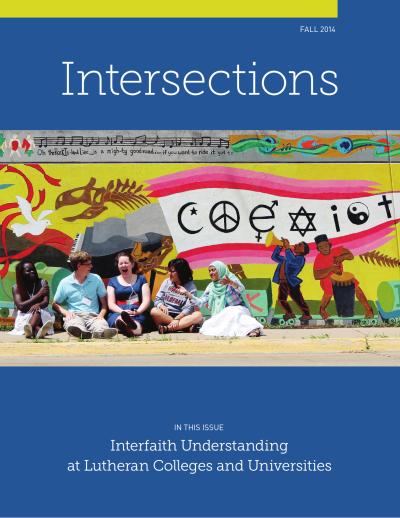
Glass Perez and Priggie introduce the issue by recounting the campus conversations and the June 2014 Interfaith Understanding Conference at Augustana College that gave rise to it, framing the central question, “What does it mean to be Interfaith at a Lutheran College?,” as a living example of the praxis of being a Lutheran college in the twenty-first century.
-
 Institutional Focus
Diversity and Dialogue: Gustavus Adolphus College
Florence D. Amamoto
No. 1 · Summer 1996
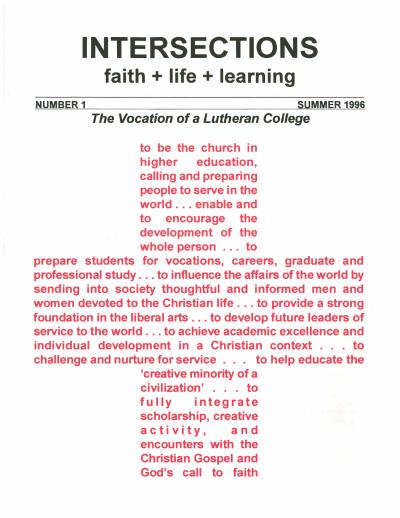
Amamoto, a third-generation Japanese-American Buddhist who teaches American literature at Gustavus Adolphus and regularly attends daily chapel, writes as an “inside outsider.” Engaging Schwehn’s closing call to refurbish the Lutheran college, she argues that church-related colleges are vitally important to society, that “refurbishing” must take up diversity, and describes how Lutheranism is manifest at Gustavus: Christ Chapel as the highest point on campus, the ecumenical chapel program led for thirty years by Chaplain Richard Elvee, the Nobel Conferences that pair scientists with philosophers and theologians, the First-term Seminar and Tuesday Conversations, the India study-abroad program organized by Deane Curtin, and the Sponberg Chair in Ethics. She names the pressures of money, secularization, and the publications-driven push for “excellence” that threaten this creative tension.
-
 Article
Lutheran Colleges, the Lutheran Tradition, and the Future of Service-Learning
Joseph McDonald
No. 34 · Fall 2011
McDonald, who has used service-learning since the early 1990s and now directs the Values Based Learning Program at Newberry College, traces the service-learning movement from its 1960s socio-political pioneers (Nadinne Cruz, Ira Harkavy) through its institutionalization as classroom pedagogy and citizenship education (Stanton, Giles, and Cruz; Edward Zlotkowski; Jane Addams’s Hull House and John Dewey). He argues that three strengths of the Lutheran tradition—robust reflection as a community of discourse, Christian vocation as service infused in all roles, and the capacity to negotiate tension and paradox—uniquely equip Lutheran colleges to hold the pedagogical and socio-political dimensions of service-learning together, recovering the energy of the pioneers without sacrificing classroom rigor.
-
 Article
Negotiating Legitimate and Conflicting Values
Eboo Patel, Katie Bringman Baxter, Mark S. Hanson
No. 44 · Fall 2016
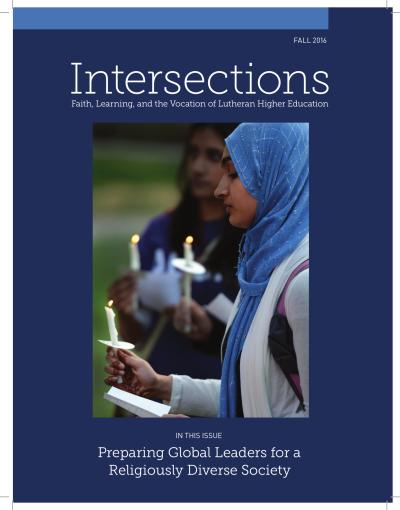
In a closing-day conversation at the 2016 Vocation of a Lutheran College Conference, Mark Hanson and Eboo Patel — moderated by Katie Bringman Baxter of Interfaith Youth Core — share case studies in which legitimate religious values come into tension with one another, and make the case that Lutheran colleges should teach interfaith leadership through the hard cases rather than the easy ones.
-
 Reflection
Truth, Reconciliation, and Redemption in South Africa
Brian Forry Wallace
No. 13 · Winter 2002
Wallace, a 24-year veteran political science professor at Capital University, recounts five weeks of post-apartheid peace-building travel-study with students living south of Cape Town—visiting townships, schools, day-care centers, a children’s AIDS hospital, Robben Island, and Nelson Mandela’s cell—and offers vivid sketches of his student companions Amy, Brian, Meghan, Karrie, Patrick, Meredith, Cheryl, Corin, Debbie, April, and Audra. He concludes that these students—atheists and agnostics and Buddhists and Methodists and Baptists, headed for social work, nursing, teaching, ministry, and parenthood—embody vocation by responding to a voice that calls them out of themselves to be present and to heal in this world, and that they are his link to the redemption of a lost and broken soul.
-
 Article
Practicing Hope: The Charisms of Lutheran Higher Education
Martha E. Stortz
No. 32 · Spring 2010
Stortz names four charisms—theological gifts of identity rather than commodities—that Lutheran higher education brings to a culture of fear: semper reformanda as flexible, responsive institutions; the freedom of a Christian as simul justus et peccator critical inquiry that holds opposites in creative tension; regard for the other as “neighbor” rather than friend or alien; and the priesthood of all believers as a public, civic calling to know the poor. Drawing on Augustine, George Lindbeck, Patricia Killen, James Clifford, Earl Shorris, Carter Lindberg, and Augsburg’s Center for Global Education, she argues that immersion trips, neighbor-regard, and welfare reform witness that the gift Lutherans bring is hope grounded in Christ in you, the hope of glory.
-
 Response
Response to Mark Wilhelm: DEI, Great; DWS (Dismantling White Supremacy), Even Better
Vic Thasiah
No. 56 · Fall 2022
Thasiah argues that if Lutheran colleges and universities want to live out their commitment to the flourishing of all, DEI is good but DWS — dismantling white supremacy — is even better, and offers three Lutheran sensibilities (suspicion of self-righteousness, the decolonial shockwave of the cross, and critical thinking that can still register awe) that can make DWS a core practice of higher education.