Called to Compassion over the Course of a Life: A Buddhist Perspective
Intersections No. 47 · Spring 2018
If you had asked me before I came to Gustavus Adolphus College, I’m not sure I would have said that Buddhism had a notion of vocation, especially if vocation is defined in the traditional Christian sense of answering God’s call, given that Buddhism is non-theistic. However, Gustavus has allowed me to explore my religion more deeply, and has thus led me to a different conclusion. What follows is a short introduction to Buddhism and some reflections on how vocation might be defined within Buddhism.
Buddhism 101
Buddhism grew out of the teachings of Siddhartha Gautama, or the historical Buddha, who was born in fourth century BCE in what is now Nepal, and lived and preached in what is now northern India. Siddhartha was the son of the leader of the Sakya clan. Legend has it that his father was told by a seer that his son would be either a great ruler or a great spiritual figure. You don’t have to guess which his father preferred, and he raised his son in luxury and shielded him from the outside world. However, as a young man, Siddhartha, on various walks though his town, saw an old man, a sick man, and a dying man. Leaving his wife and son, he sought spiritual enlightenment with a group of ascetics. After seven years, he realized this life of extreme physical deprivation had not gotten him closer to understanding the suffering he had seen, so he gave up the ascetic life. But he continued to meditate, which ultimately led him to the understanding he had long sought. He started preaching the Four Noble Truths and the Eightfold Path, which lays out his understanding of the causes of human suffering and the way to end it. The Four Noble Truths are: life is suffering; suffering is caused by ignorance and desire; there is a way to end this suffering; the way is the Eightfold Path. The Eightfold Path consists of right view, resolve, speech, conduct, livelihood, effort, mindfulness, and concentration. One could argue that a Buddhist is “called” to pursue enlightenment, which is defined as wisdom and compassion.
Enlightenment, in fact, was precisely the goal of early followers of the Buddha, who formed monastic communities and tried to emulate his life. Later, schools developed that put more emphasis on what they saw as the spirit of the Buddha’s teachings and emphasized compassion. The ideal compassionate one is a Bodhisattva, a person who has attained enlightenment but stays involved with the world to help others.
My form of Buddhism, Jodo Shin Shu Buddhism, was founded by a Japanese monk (or ex-monk) Shinran Shonin in the thirteenth century. Theologically, Shinran’s beliefs were similar to those of Martin Luther. Shinran believed that he could not reach moral perfection through his own efforts—this was his break with monastic Buddhism. He emphasized instead that we were surrounded by the love and compassion of the universe, personified by Amida Buddha, a non-incarnate Buddha who had vowed to save all sentient beings. This was Buddhism for the masses, the 90 percent of the population who were uneducated and poor. Jodo Shin Shu Buddhism remains the main form of Buddhism practiced in Japan today. It was also the Buddhism of the Japanese immigrants to the United States in the early twentieth century. Included here were my grandparents, whose American-born children helped found the Buddhist temple that I grew up in.
Buddhism does not depend on a particular practice. For instance, my form of Buddhism does not have a sitting meditation practice like Zen. In fact, the Sunday services I attended as a child were modeled on Protestant services by the Buddhist Churches of America, which saw the temples as being places to pass on Japanese religious and cultural traditions, but also to help immigrants assimilate into American society. In my form of Buddhism, the emphasis is on living a life of faith and gratitude—themes shared with the Christian tradition, of course. And yet, until I came to Gustavus, I hadn’t thought of my tradition in terms of vocation.
Buddhism and Vocation
As noted above, the Buddha’s teaching grew out of his desire to understand and end human suffering. However, Buddha as a title means “the awakened one” or “the enlightened One.” The historical Buddha was a man who came to a profound understanding of reality, and passed that understanding on to others. What he realized was that our suffering came from our ignorance, from not seeing reality (for instance, that life is change), as well as from our desires and ego. He also taught that everyone has the capability to become a Buddha. While he taught his followers his insights to help them on their path to enlightenment, he also told them not to take anything on another’s authority—even his—but rather to test what he taught against their own experiences and understanding. In that way, I think Buddhists are called to a life-long search for knowledge and a deeper understanding of life and the world.
In turn, such a deeper understanding of the world and of the human condition, true enlightenment, inevitably leads us to compassion because we see all the suffering around us. I would argue that, although Buddhism does not have an idea of a “caller” God, there is an idea of calling and a caller in Buddhism—we are called to respond to the needs we see around us; we are called by the world. In my form of Buddhism, as in many of the Mahayana schools, there is an emphasis on compassion and selfless giving. It emphasizes that we are constantly surrounded by the love and compassion that exists in the universe. We are called to live a life of gratitude in recognition of this, and to be the conduit of that love and compassion to the world.
“I would argue that, although Buddhism does not have an idea of a ‘caller’ God, there is an idea of calling and a caller in Buddhism—we are called to respond to the needs we see around us; we are called by the world.”
In order to be that conduit for compassion, however, we need more than knowledge. Buddhism teaches we need mindfulness and egolessness. Mindfulness may be obvious; we need to be alert and alive to the moment and to the needs in that particular situation. A good teacher is always alert to capitalize on “the teachable moment,” and her instruction will depend on what any particular student needs in that specific moment. One of the Buddha’s insights was that we are profoundly interdependent—that I am who I am and indeed can live only because my life is intertwined with everything else. My life depends not just on my parents who brought me into the world, but also on everything from the people who grow my food to the very air I breathe. Increased global ties and environmental degradation only make being mindful of this insight more important. Valuing mindfulness reminds us that it is important to challenge our students to see as deeply as they can into the interconnections and complexities of the world, so they can see their stake in the world and respond to the call as skillfully as possible.
I think that the Buddhist emphasis on egolessness and the rejection of desire are difficult for Americans, given their emphasis on individualism, self, drive, and success. Part of the problem, I think, is a misunderstanding of what these Buddhist concepts mean. We Americans tend to associate ego with the self and desire with ambition, progress, and success. If we get rid of desire and ego, students often think, wouldn’t we become passive? Then where would we be? We need ambition and desire, they argue. And wouldn’t being egoless and rejecting desire leave us with no personality, a passive blob?
Buddhism, in fact, argues just the opposite. To help students understand that egolessness can make us more ourselves, I usually ask my students: “When are you more yourself—when you are at a party with a group of strangers or when you are with your best friends?” The reason you are more yourself with your friends is because you are not concerned about how you appear, are not seeking to protect your ego, your sense of self. Ridding ourselves of this ego-concern frees us, allowing us to be more of ourselves, to be more creative and open, to be more vulnerable, and to take more risks. But it also allows us to respond more helpfully to the situations around us. Science has shown that we cannot really multi-task. The less we are taken up with thinking about ourselves, the more internal space we have to hear and see others and their needs more clearly.
Furthermore, in Buddhism, eliminating desire does not mean not caring or not acting. As I noted earlier, we are called to respond to the needs we see around us, to incarnate love in the world. The Buddha knew that no matter how helpful we want to be or how wisely we act, we will not always get what we want. Many of today’s pressing problems, such as climate change and inequality, are massive and full of enormous obstacles. It will take people with persistence and resilience, people who act out of vision, faith, and conviction to bend the arc of history. Overcoming desire in the Buddhist sense does not mean not caring, but rather letting go of seeing particular outcomes within a particular timeframe so that one can go on with the fight. The Dalai Lama’s continuing resistance to China is one example. Closer to home I am reminded of a story a white activist friend told me about what a black activist once said to her: “You know, the problem with you white people is that you give up too fast when you don’t get the result you want. We know this is going to take a long time.”
“Many of today’s pressing problems, such as climate change and inequality, are massive and full of enormous obstacles. It will take people with persistence and resilience, people who act out of vision, faith, and conviction to bend the arc of history.”
Ultimately, I think Buddhism calls me to become as knowledgeable about life and the world as I can be, but also to become as aware, compassionate, and selfless as I can be. I think I know more now than I did when I was 20 or 40. I hope I am a better conduit for the compassion of the universe—not only wiser but also less concerned about myself, more open, more able to hear and see the needs of others more clearly. Like many things that are simple to say, this is hard to do. It is a life-long journey.
Concluding Reflections
My experiences at Gustavus underscore how encountering religious differences can help us think more deeply about our own religious teachings, faith, and values. Teaching at a Lutheran college prompted me to get more interested in exploring my own religion. It also prompted me to think about vocation—both personal and institutional. My participation in Vocation of a Lutheran College conferences, in national conversations about the vocation of church-related colleges, and in the development of Gustavus’s proposal for the Lilly Foundation’s Program for the Theological Exploration of Vocation (PTEV) grant, also allowed me to deepen my knowledge of Lutheran ideas of vocation. This, in turn, prompted me to develop the ideas about Buddhism and vocation I’ve shared here. I also think that my presence and those from other religious traditions (such as the chair of the committee for our PTEV proposal, who was Jewish) has forced Lutherans at Gustavus to think more deeply about Lutheran ideas of vocation. Because of our religious diversity—but also Lutheranism’s valuing of dialogue—our PTEV committee was able to hammer out language and programs that would be welcoming for students of all religious affiliations—and none.
“Teaching at a Lutheran college prompted me to get more interested in exploring my own religion. It also prompted me to think about vocation—both personal and institutional.”
The vocation of any college is to provide an excellent education for students and to provide them with tools they need to live healthy and productive lives. Church-related colleges also aspire to produce students who will live lives of leadership and service. This emphasis on values and service is some of the “value added” elements offered by our small, liberal arts, Lutheran schools. We need to be more vocal about the way our values grow out of our Lutheran heritage. And yet, our understanding of that heritage and its application in today’s world is enriched by having it in conversation with other religious traditions just as our students’ education is enriched by real conversations and interactions with people different from them. The country and our colleges are becoming more diverse, and the world is becoming more interconnected—and, unfortunately, more polarized. We owe it to our students to prepare them for this world. We owe it to the world to prepare leaders who have cultural competence; a vision for a better, more equal and peaceful world; and the skills to be the bridge-builders our world so desperately needs.
-
 Editorial
From the Publisher
Mark Wilhelm
Wilhelm celebrates that NECU schools continue to educate for vocation but warns that the culture of Lutheran higher education is at risk — sustained largely by informal cadres of individuals — and introduces NECU’s Rooted and Open statement as a first institutional step toward reclaiming the 500-year-old Lutheran intellectual and educational tradition.
-
Editorial
Guest Editorial
Lynn Hunnicutt
Hunnicutt traces the etymology of vocation through its cognates — evoke, provoke, convocation — to argue that vocation presumes a relationship between caller and called, that callings are often grounded in ordinary words and humble lives, and that recognizing vocation as plural and lifelong relieves colleges of the pressure to help students find a single calling while on campus.
-
Article
One Life, Many Callings: Vocation Across the Lifespan
Katherine Turpin
Turpin, drawing on the collaborative research behind Calling All Years Good, traces how vocational discernment shifts through adolescence, younger adulthood, middle adulthood, late adulthood, and older adulthood — arguing that focusing vocation on entry into the workforce limits the capacity of intergenerational college communities to wrestle with calling throughout life.
-
Article
Vocation for Emerging Adulthood: Within and Beyond College
Adam Copeland
Copeland uses scenes from Master of None, David Brooks’ columns, Meg Jay’s The Defining Decade, and the stories of two ELCA college graduates to argue that emerging adulthood has fundamentally changed — and that Lutheran colleges should call out cultural lies about work, reframe vocation as meaning-making, and help graduates take small, wise steps into their twenties.
-
Article
Vocation and Dharma throughout Life's Stages: A Hindu Perspective
Vidya Thirumurthy
Thirumurthy traces her own attempt as a Hindu faculty member at Pacific Lutheran University to grasp the Lutheran concept of vocation, finding in the Bhagavad Gita’s teaching on dharma — duty fulfilled without expectation of reward — an equivalent that, like vocation, varies across the four stages of life and calls individuals to transform others through selfless service.
-
Book Review
Vocation on Campus: Reading Mark Tranvik's Martin Luther and the Called Life at Pacific Lutheran University
Alex Lund, Michael Halvorson
Halvorson and Lund — faculty member and student — review Mark Tranvik’s Martin Luther and the Called Life alongside PLU’s Wild Hope Center for Vocation, weighing the book’s warning against “vocation lite” against the challenge of speaking of God’s call to students in the Pacific Northwest’s “None Zone,” where most students have little exposure to Lutheranism.
-
Article
Luther, the Catechisms, and Intellectual Disability
Courtney Wilder
Wilder confronts Luther’s deeply troubling response to a child with disabilities at Dessau, then mines his Small and Large Catechisms for a Lutheran theology of inclusion — reading the Third Article of the Creed, the petitions of the Lord’s Prayer, and the sacrament of baptism as resources that affirm the full humanity of people with intellectual disabilities as faithful children of God.
-
Article
Lutheran Higher Education in the Land of Anxiety
Jon Micheels Leiseth
Leiseth, returning to Concordia from work with the ELCA’s Young Adults in Global Mission in Southern Africa, draws on Bessel van der Kolk and Babette Rothschild to argue that pervasive student anxiety functions as low-grade trauma that hijacks the storytelling at the heart of vocational discernment — and explores embodied, breath-based practices that might help students reclaim their stories.
-
 Article
Diversity and Dialogue: Twenty Years and Counting
Florence D. Amamoto
No. 43 · Spring 2016
Twenty years after her essay “Diversity and Dialogue” in the first issue of Intersections, Amamoto returns to Gustavus Adolphus College to reflect on what has changed and what has not: rising numbers of students of color and international students, faculty turnover and increased publication pressures, the disappearance of the Center for Vocational Reflection, and the renewed importance of articulating Gustavus’s Swedish Lutheran heritage and inclusive sense of community in a tuition-dependent, cost-cutting environment.
-
 Article
Diversity, Integrity, and Lutheran Colleges
Florence D. Amamoto
No. 8 · Winter 2000
Amamoto—a sansei Jodo Shin Shu Buddhist who is “an inside outsider” at Gustavus Adolphus—argues that diversity and integrity belong together in Lutheran higher education, perhaps in a way unmatched by other church-related traditions. She affirms the importance of Gustavus’s 60% Lutheran student body and vibrant Christ Chapel under Richard Elvee and Brian Johnson while warning that numbers and chapel are not enough, draws on Tom Christenson, Patricia Gurin, Sylvia Hurtado, Anthony Carnevale, Martha Nussbaum, W. E. B. DuBois (the deaths of Matthew Shepard and Isaiah Shoels), Richard Hughes’s reading of finitum capax infiniti, Richard Solberg, and Mark Schwehn’s mutual hospitality model, and concludes that the real enemy is not diversity but indifference—and that Lutheran finitude grounds a theological commitment to keeping diversity and identity in creative conversation.
-
 Institutional Focus
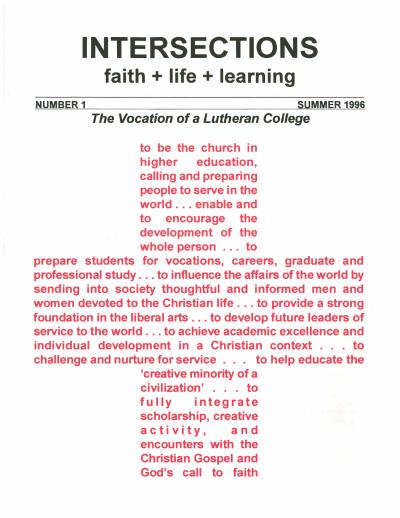
Diversity and Dialogue: Gustavus Adolphus College
Florence D. Amamoto
No. 1 · Summer 1996
Amamoto, a third-generation Japanese-American Buddhist who teaches American literature at Gustavus Adolphus and regularly attends daily chapel, writes as an “inside outsider.” Engaging Schwehn’s closing call to refurbish the Lutheran college, she argues that church-related colleges are vitally important to society, that “refurbishing” must take up diversity, and describes how Lutheranism is manifest at Gustavus: Christ Chapel as the highest point on campus, the ecumenical chapel program led for thirty years by Chaplain Richard Elvee, the Nobel Conferences that pair scientists with philosophers and theologians, the First-term Seminar and Tuesday Conversations, the India study-abroad program organized by Deane Curtin, and the Sponberg Chair in Ethics. She names the pressures of money, secularization, and the publications-driven push for “excellence” that threaten this creative tension.
-
 Article
The Skeptical Theologian's Dictionary
Carl Skrade, Spencer Porter
No. 4 · Winter 1998
Porter and Skrade offer selections from a mock-lexicon of theological terms: answer, church, faith, God, grace, hope, justification, love, prayer, sin, soul, and theology, among others. Each entry begins with a standard definition and then unsettles it—answer reminds the reader that in theology and poetry the questions matter more than their answers; church alternates between “the mystical Body of Christ” and ordinary human gatherings whose machinery often obscures the gospel; God is the One whose name we are told not to take in vain and yet whose name we keep using; prayer is communion with God yet often degenerates into a list of demands. The form’s irony exposes the gap between the language of theology and its lived realities—a sober, witty corrective for Lutheran classrooms and chapels alike.
-
 Article
Impelled to Pluralism: Thoughts About Teaching in a Lutheran University
Jim Huffman
No. 17 · Summer 2003
Huffman traces his personal journey through three stages of faith—the “comfortable Christ” of his Midwestern Christian childhood, Clark Pinnock’s “faith principle” of accessible salvation, and finally Christ as the “humble teacher”—to a pluralism that rejects religious triumphalism without abandoning Christian commitment. Drawing on Diana Eck, Wesley Ariarajah, John Cobb, the Catholic novelist Endo Shusaku, and the histories of Confucian China and imperial Japan, he then describes how this commitment shapes his teaching of East Asian religion and nationalism at Wittenberg University: insisting on respectful language, working sympathetically through doctrines like Buddhist non-attachment, and helping students see the pernicious effects of triumphalism in both religious and political life.
-
 Article
Professing Religion
John D. Barbour
No. 37 · Spring 2013
Barbour reflects on the vocation of a Professor of Religion at St. Olaf College, asking when and how a teacher should disclose personal faith in the classroom. Drawing on his graduate teachers Anthony C. Yu and Langdon Gilkey, and on Augustine’s Confessions, Dorothy Day, Malcolm X, C. S. Lewis, and Kathleen Norris, he argues that teaching autobiography invites teaching autobiographically—and that professing religion is finally a matter of how one believes, not just what.
-
 Reflection
Seeing in a New Way: A Meditation
Kara Baylor
No. 50 · Fall 2019
Baylor, the only Black campus pastor in the NECU, weaves Psalm 25, the parable of the Good Samaritan as re-read through Lenny Duncan, and the “crimson thread of divine justice” from Allen Dwight Callahan into a meditation that closes with the invitation she offered at the 2019 conference — to tie a crimson thread around the wrist as a symbol of collective commitment to moving beyond privilege toward inclusion and equity.
-
Article
The "V" Word: Different Dimensions of Vocation in a Religiously Diverse Classroom
Martha E. Stortz
No. 50 · Fall 2019
Stortz responds to a sea of blank stares when she used the word “vocation” in a religiously diverse required course by offering five metaphors — place, path, relationships, lens, and story — that point to different dimensions of vocation across the world’s religions and help students articulate their callings on their own terms.
-
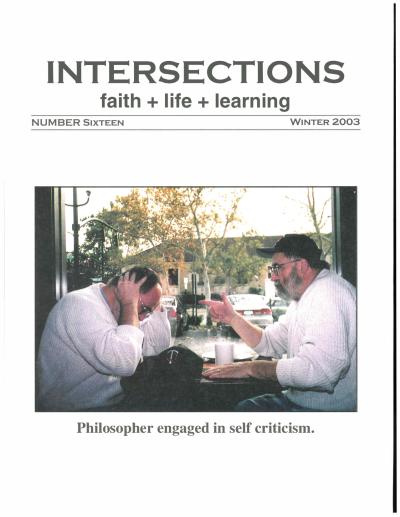 Article
Writing Toward the Night Complete: Teaching and Working at the Public, Secular Institution
Bruce Allen Heggen
No. 16 · Winter 2003
Heggen, Lutheran Campus Ministry pastor and adjunct English professor at the University of Delaware, builds on a freshman’s essay closing line—“All in all our night was complete”—to argue that even in the secular public university one can “teach hope” as a critical principle by drawing on Douglas John Hall’s Heideggerian distinction between calculative and meditative thought, the Frankfurt School’s instrumental versus substantialist reason, Luther’s theology of the cross, Parker Palmer’s “obedience to truth,” bell hooks, Lionel Basney, Shelley Shaver, and Donald Sheehan’s Frost Place “principle of compassion.” The classroom and Lutheran campus ministry together can become “communities of memory and hope” that, like the artist student’s Fourth of July, hold together danger, people getting together, explosions, and lots of fun.