If you have a weakness, it is important to recognize it and strengthen it. This applies to our physical bodies. For example, I have a weaker right knee joint so I need to strengthen the muscles and tendons supporting it so I can safely ride a dozen miles on my bike. This can apply to our intellectual lives as well. I have a weak knowledge of modern German history so I need to read and learn so that I can more effectively teach students during my travel course in Germany.
This weakness analogy applies to white people talking about race and racism. Robin DiAngelo points out on the first page of her book, White Fragility, that white people “are insulated from racial stress.” She goes on to note that we are “socialized into a deeply internalized sense of superiority” and that “we become highly fragile in conversations about race” (1-2). Fragility results from weakness, and so I propose that we begin thinking of whiteness as a weakness borne of apathy, atrophy, and ignorance.
The Weaknesses of Whiteness
This is not weakness in the sense of lack of power, strength, and ability in the public world and its interlocking systems and structures. Exactly the opposite is true: The entire body of literature on white privilege explains how whiteness confers advantage and benefits upon those who possess it, whether they know it or not, and definitely without their having earned them.
This is a particular kind of weakness akin to an atrophied muscle or a weak joint. It is the result of not working it out. It is a weakness resulting from social structures designed to our advantage. Think of the morbidly obese human characters in the animated movie WALL-E, who never have to walk or move their bodies because everything is designed to support them, move them, feed them, entertain them. They end up unable to stand on their own legs because they never had to develop the muscles to do just that.
White people can continue to choose not to exercise the muscle of race-consciousness.
Whiteness is a weakness borne of apathy about race, racism, equity, and inclusion. White people can continue to choose not to exercise the muscle of race-consciousness. It’s easier, more comfortable, and less tiring to pretend we don’t have that muscle and we don’t need it. This weakness manifests itself in many forms, ranging from the kind of defensive denial that educators for diversity and inclusion regularly encounter, to the kind of aggressive violence seen in white supremacist rallies.
It also manifests itself as a form of bullying. DiAngelo describes an unspoken assertion this way: “I am going to make it so miserable for you to confront me [about racism] that you will simply back off, give up, and never raise the issue again” (112). This is one among many reasons that white people are too-seldom called on their racist assumptions, actions, and words. Have you ever attempted to tell another person that something they said was racist? How did that go? Often, most of us end up preserving what DiAngelo calls “white solidarity” which is “the unspoken agreement among whites to protect white advantage and not cause another white person to feel racial discomfort by confronting them when they say or do something racially problematic” (57). This happens daily at the family table, at the department meeting, in the hallway, at the grocery store, in the parking lot, and in every other place that we are together.
Like physical weaknesses, whiteness is a weakness that ends up making us a certain kind of vulnerable. If socialization is doing its job, white privilege becomes buried deep within the subconscious, and so aggressions often stem from a deeply internalized knowledge of this weakness. Think about how some bullies aggress against others often because they are deeply wounded and unable to acknowledge or name that pain. Or they know that they are weak, and therefore are deeply afraid of others knowing it. Some weaknesses are thereby expressed through violence against others in word and/or deed. The thing a bully says or does to another is sometimes best seen and understood as revealing something about himself. This is known as projection.
DiAngelo gives many examples of the ways that “white fragility distorts reality.” She points out “how fragile and ill-equipped most white people are to confront racial tensions, and their subsequent projection of this tension onto people of color” (110). Consider three of the more harmful racist stereotypes as projections of white weakness onto nonwhite persons:
- Nonwhite people are lazy. (Actually, to not have to exercise the muscle of race-consciousness reveals white people to be extraordinarily lazy.)
- Nonwhite people are violent and/or criminals. (Actually, white people perpetrate extensive violence, interpersonal and structural, and regularly get away with criminal activity shielded by their whiteness.)
- Nonwhite people don’t belong “here” and should be sent back to where they came from. (Actually, white people in this country are the ones who don’t belong, the ones whose ancestors colonized by stealing land and life from indigenous peoples.)
For these and so many other reasons, I’d like to suggest that the vocation of white people is to acknowledge the atrophied muscle of race-consciousness and begin exercising it immediately.
The vocation of white people is to acknowledge the atrophied muscle of race-consciousness and begin exercising it immediately.
DiAngelo’s final piece of advice for those who see their weakness and hear the call to strengthen that muscle is “Take the initiative and find out on your own” (144).
Developing Race-Consciousness
How do we do this? What classes and machines exist at the Gym of Justice-work? Will anyone else be there or are we always working out on our own?
First, read. As an educator, I admit that my own first response to uncovering a weakness related in part to ignorance is to find (or assign!) a book. Happily, there are generations of people of color who have shared their stories, their experience, their angers, and their joys in texts that are autobiographical, poetic, descriptive, educational, and complex in all the necessary ways. Read Jarena Lee, Audre Lorde, W.E.B. DuBois, Malcolm X, Brittney Cooper, and Lenny Duncan. There is simply no excuse for any white person not to read the reams of books, blogs, essays, poetry, research, and other words written by people of color. Zora Neale Hurston didn’t write in order to be forgotten, and Colson Whitehead’s insights into history emerge in this moment ready for you to learn from them. Michelle Alexander has defined the contemporary discussion about mass incarceration in The New Jim Crow and you do yourself a service to work through it.
Notice your internal bias when it pops up in those spaces and places—because it will.
Second, adjust your gaze. Travel to places and through neighborhoods that don’t look like your own. Assess your social media connections: Who looks like you and who doesn’t? Send your kid to a school or buy a house in a place or attend worship in a space that encourages and facilitates relationships across lines of racial difference. Sit next to someone who doesn’t look like you in the next meeting or conference session. Make small talk, because no big-talk comes before small talk. Look people in the eye. Notice your internal bias when it pops up in those spaces and places—because it will. Slow down and assess what your (real?) concern is.
Third, consume info-tainment differently. The entire structure of a capitalist media culture embedded in white supremacy, including its programming and publishing, is designed to enable our white weakness. Seek out movies and entertainment and news sources that center persons and communities that are not white. Ava Duvernay is doing amazing work today on television, streaming, and in theaters. How much of it have you seen? TheRoot.com has been publishing online for years. Have you read it lately? And if you haven’t engaged The 1619 Project yet, I implore you to begin now. There are journalists and activists and writers and speakers using many forms of media to their and our advantage, readily willing and able to be viewed, read, and heard by more people every day.
Finally, look to your own discipline, tradition, institution, or religious heritage for work that has been done already, and keep doing it. We know from working out and physical activity that once we stop strengthening our race-consciousness muscles they resume their atrophied state. Even as I was sitting in one place for a short time writing this piece, I got up for a glass of water and my leg muscles had stiffened just that little bit that comes with the middle decades of embodied existence. Movement is life, and stillness perpetuates weakness.
Resources in the Lutheran Tradition
Here are some concrete examples that I pulled together after the Vocation of a Lutheran College conference in 2019, thinking particularly about Lutheran colleges and universities looking to address their weaknesses in the work of equity and inclusion.1 What resources do these institutions have to call upon?
I could point to some theological concepts that root Lutheran identity like paradox (we are all saint and sinner, Christians are freed to serve the neighbor), or to the recent statement about the common calling of our institutions (NECU), but more to the point of this year’s conference topic, I want to call on some specific practical resources available through the denomination itself.
First, as companion note to Dr. Guy Nave’s plenary-opening “land acknowledgement” statement, we can refer to the “Repudiation of the Doctrine of Discovery” affirmed by the ELCA in 2016. This document is “a statement of repentance and reconciliation to native nations in this country for damage done in the name of Christianity.” It “repudiate[s] explicitly and clearly the European-derived doctrine of discovery as an example of the ‘improper mixing of the power of the church and the power of the sword.’” It goes on to direct various ministries of the Church to develop resources and strategies to live anew and alongside of the indigenous peoples who were the first inhabitants of this land. Though colleges and universities are not named, what strategies might your campus employ to repent its participation in such colonial activity?
What strategies might your campus employ to repent its participation in such colonial activity?
Second, as theological and ecclesial guidance for a foregrounding of racial justice in these particular conversations, we can refer to the social statement, “Freed in Christ: Race, Ethnicity, and Culture.” This statement was approved by the ELCA at its Churchwide Assembly in 1993, and begins with an effective definition as well as its theological implications:
Racism—a mix of power, privilege, and prejudice—is sin, a violation of God’s intention for humanity. The resulting racial, ethnic, or cultural barriers deny the truth that all people are God’s creatures and, therefore, persons of dignity. Racism fractures and fragments both church and society. When we speak of racism as though it were a matter of personal attitudes only, we underestimate it.
Dr. Nave, Dr. Monica Smith, and nearly every other speaker and writer on racial justice reiterates this last point because too many people still fail to understand it. Racism is structural, systemic, and institutionalized. Being allegedly “good people” is not enough; in fact, such assertions are part of the problem. In what ways can and must our colleges and universities adjust policies, procedures, and practices in order to move toward inclusive excellence and racial justice?
In what ways can and must our colleges and universities adjust policies, procedures, and practices in order to move toward inclusive excellence and racial justice?
Third, as companion resource to Dr. Smith’s discussion of the various intersectional social classifications that comprise each of our identities, we can look to the newly adopted social statement, “Faith, Sexism, and Justice: A Lutheran Call to Action,” which was approved by the ELCA’s Churchwide Assembly in August, 2019. In this piece there is a call toward new commitments that address the problem as stated in some detail: “Patriarchy and sexism reflect a lack of trust in God and result in harm and broken relationships. Just as this church has identified racism as sin, this church identifies patriarchy and sexism as sin.” Again when it comes to our campus communities, where is gender justice seen and not seen in our patterns and practices?
Finally, when it comes to religious diversity which intersects with racial justice in some very particular ways, the ELCA’s “Declaration of Inter-Religious Commitment” relates directly to the robust initiatives around interfaith engagement on our campuses, This policy statement was also approved at the 2019 Churchwide Assembly. In this resource, the church commits to engaging with our neighbors who are not Lutheran and not Christian. They engage not for the sake of evangelizing them but for the sake of serving and defending them. Anti-semitism and Islamophobia are outgrowths of white supremacy, and each is near the surface of the following statement:
Being a neighbor can be risky. When power is abused, and fear grips a community or a nation, standing up for those who are being targeted or excluded takes courage. We are called to exhibit this courage and take this risk.
Our colleges and universities share in this call to take a risk. On campuses where interfaith engagement is beginning to flourish, where must we still attend to the well-being and even safety of our racially and religiously minoritized students and community members?
I offer up these examples as a model for how tending to an institutional vocation includes drawing upon resources from its denominational and formational bodies. They are things that Lutheran colleges and universities already have to help us tone the weak muscle that whiteness is in a racist and white supremacist culture.
Now, stand up, wake up those muscles (gently at first), read something other than these words, and get to work.
Endnotes
1. A version of what follows was originally published at VocationMatters.org, the blog of the Scholarly Resources Project of the Network for Vocation in Undergraduate Education. See: vocationmatters.org/2019/07/23/equity-mindedness-and-the-vocation-of-lutheran-colleges/
Works Cited
DiAngelo, Robin. White Fragility: Why It’s So Hard for White People to Talk About Racism. Beacon, 2018.
ELCA (Evangelical Lutheran Church in America). “Faith, Sexism, and Justice: A Lutheran Call to Action.” Accessed 1 Oct. 2019, https://www.elca.org/womenandjustice
———. “Freed in Christ: Race, Ethnicity, and Culture.” Accessed 1 Oct. 2019, http://download.elca.org/ELCA%20Resource%20Repository/race_ethnicity_culture_statement.pdf
———. “Repudiation of the Doctrine of Discovery.” Accessed 1 Oct. 2019, http://download.elca.org/ELCA%20Resource%20Repository/RepudiationDoctrineOfDiscoverySPR2016.pdf
NECU (Network of ELCA Colleges and Universities). “Rooted and Open: The Common Calling of the Network of ELCA Colleges and Universities. Accessed 1 Oct. 2019, http://download.elca.org/ELCA%20Resource%20Repository/Rooted_and_Open.pdf
-
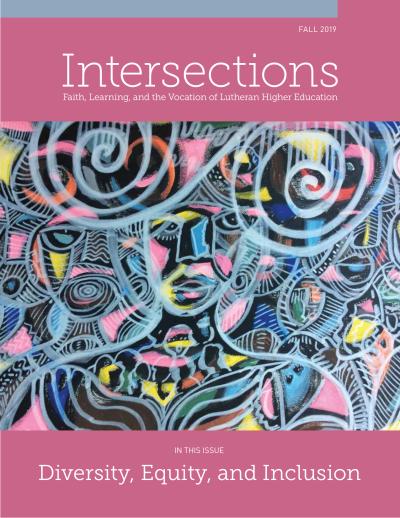 Editorial
From the Publisher
Mark Wilhelm
Wilhelm frames the issue by noting that a federal court’s vindication of Harvard’s race-conscious admissions process is a win for higher education’s commitments to diversity, equity, and inclusion — and argues that for Lutheran higher education, the commitment to diversity is an old and foundational claim, rooted in Christianity’s openness to all and reflected in the four diverse gospels of the New Testament.
-
Editorial
From the Editor
Jason A. Mahn
Mahn opens with Lenny Duncan’s observation that the ELCA is 96 percent white — the whitest denomination in the U.S. — and asks how teachers and administrators at historically, predominantly, and persistently white institutions can turn from white privilege and white supremacy toward spaces where people of color thrive and white people are re-formed into antiracist allies.
-
Article
Making Diversity Matter: Inclusion is the Key
Monica Smith
Smith, Augustana’s inaugural Vice President for Diversity, Equity and Inclusion, frames the work of a Chief Diversity Officer as that of a disrupter and argues that while diversity in higher education is already happening, inclusion is a choice — one requiring a fundamental institutional transformation that diversifies faculty and staff, infuses diversity into the curriculum, invests in professional development, and draws on senior leadership to dismantle barriers.
-
Article
The Perils and Promise of Privilege
Guy Nave
Nave argues that privilege is always used in one of two ways — to preserve privilege by promoting inequity, or to challenge privilege by promoting diversity, inclusion, and equity — and uses examples from Indianapolis Catholic schools, Martin Luther, and equity-mindedness research to call Lutheran institutions to address the racist practices and policies that reproduce whiteness on their campuses.
-
Article
Learning the Language of Inclusive Pedagogy
David Thompson
Thompson frames inclusive pedagogy as a foreign language with its own vocabulary, grammar, and cultural values, and reflects on a year of immersing himself in readings, conversations, and workshops — arguing that proficiency grows when instructors study and practice these languages repeatedly and atrophies when ignored.
-
Article
The "V" Word: Different Dimensions of Vocation in a Religiously Diverse Classroom
Martha E. Stortz
Stortz responds to a sea of blank stares when she used the word “vocation” in a religiously diverse required course by offering five metaphors — place, path, relationships, lens, and story — that point to different dimensions of vocation across the world’s religions and help students articulate their callings on their own terms.
-
Book Review
The American Myth of White Supremacy: A Review of Myths America Lives By
Susan VanZanten
VanZanten reviews Richard T. Hughes’s Myths America Lives By: White Supremacy and the Stories that Give Us Meaning, which argues that the United States grounds its identity in five myths — Chosen Nation, Nature’s Nation, Christian Nation, Millennial Nation, and Innocent Nation — all informed by the primal myth of white supremacy, and considers what Lutheran theological values can offer for resisting that myth.
-
Reflection
Seeing in a New Way: A Meditation
Kara Baylor
Baylor, the only Black campus pastor in the NECU, weaves Psalm 25, the parable of the Good Samaritan as re-read through Lenny Duncan, and the “crimson thread of divine justice” from Allen Dwight Callahan into a meditation that closes with the invitation she offered at the 2019 conference — to tie a crimson thread around the wrist as a symbol of collective commitment to moving beyond privilege toward inclusion and equity.
-
Article
Conciliatory and Queer: The Radical Love of Lutheran Higher Education
Kiki Kosnick, Sharon Varallo
Kosnick and Varallo reflect in conversation on how Augustana’s Five Faith Commitments and its conciliatory ecumenical roots in the Augsburg Confession have given them — a non-binary queer first-generation faculty member and a twenty-one-year veteran — the “street cred” to act on radical love, build bridges to imprisoned and non-binary communities, and discover that Augustana is welcoming not despite the fact that it is Lutheran, but because of it.
-
 Institutional Focus
So That All May Belong: Lutheran Roots for Diversity, Equity, Inclusion, and Justice
Altheia Richardson, Angie Hambrick, Caryn Riswold, Colleen Windham-Hughes, Deanna Thompson, Marcia Bunge, Robert Clay
No. 61 · Spring 2025
22 min audio
The full NECU statement grounds DEIJ work in Luther’s 16th-century reforms and Lutheran theological claims about the image of God, equal dignity, and the limits of human knowing — offering definitions, Lutheran roots, and calls to action for diversity, equity, inclusion, and justice, with belonging as the outcome of DEIJ at work.
-
Institutional Focus
Scriptures That Inspire Work for Diversity, Equity, Inclusion, and Justice
Altheia Richardson, Angie Hambrick, Caryn Riswold, Colleen Windham-Hughes, Deanna Thompson, Marcia Bunge, Robert Clay
No. 61 · Spring 2025
9 min audio
A companion list of biblical verses — from Genesis 1:27 and Galatians 3:28 to Micah 6:8 and Luke 4:18-19 — that grounded NECU’s drafting of So That All May Belong, organized by the four DEIJ commitments and offered as an invitation to share other texts that ground and sustain the work.
-
Institutional Focus
So That All May Belong: Lutheran Roots for Diversity, Equity, Inclusion, and Justice [abridged]
Altheia Richardson, Angie Hambrick, Caryn Riswold, Colleen Windham-Hughes, Deanna Thompson, Marcia Bunge, Robert Clay
No. 61 · Spring 2025
8 min audio
A condensed version of the NECU statement that consolidates Lutheran theological grounding for DEIJ and a single combined call to action for Lutheran colleges and universities — offered as a shareable summary alongside the complete document.
-
 Article
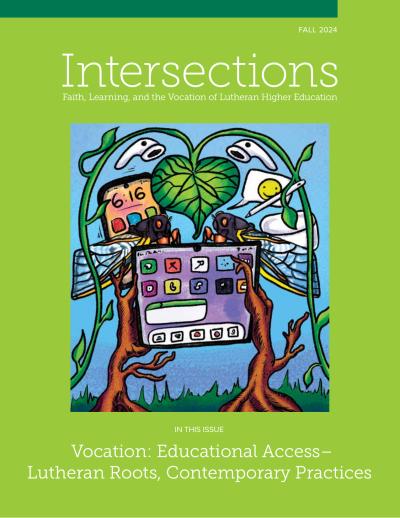
Committed to Paradox
Caryn Riswold
No. 60 · Fall 2024
Riswold lifts up paradox — saint and sinner, lord and servant, Rooted and Open — as a distinctive Lutheran root that lets institutions honor the complicated truth of who their students are and embrace the messy, ever-reforming work of access and accessibility as a theology of the cross.
-
 Article
Views on Flourishing After the Age of Roe
Caryn Riswold, Mary J. Streufert
No. 57 · Spring 2023
Riswold and Streufert reflect on the Radcliffe Institute’s January 2023 conference “The Age of Roe” and argue that the ELCA’s 1991 Social Statement on Abortion and its 2019 statement Faith, Sexism, and Justice offer Lutheran higher education a third way to approach reproductive justice grounded in serving the neighbor so that all may flourish.
-
 Article
A New Image for an Ancient Call: Lutheran Higher Education Amidst Pandemics Today
Caryn Riswold
No. 52 · Fall 2020
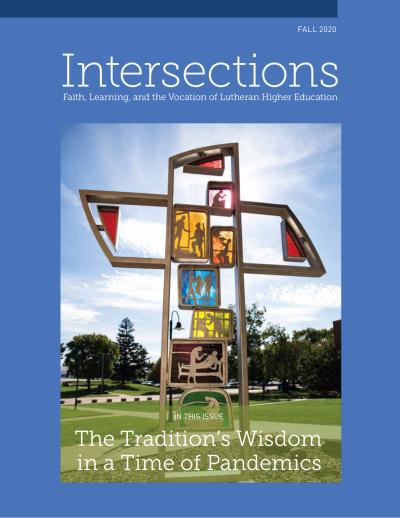
Pairing Wartburg’s Lebenskreuz sculpture with the Matthew 25 acts of mercy and the commitments of Rooted and Open, Riswold reads the calls to feed the hungry, welcome the stranger, and care for the sick as urgent summons for Lutheran higher education in a year of overlapping pandemics — and as a call to dismantle the structures that produced them.
-
 Article
The Promise and Peril of the Interfaith Classroom
Matthew Maruggi
No. 44 · Fall 2016
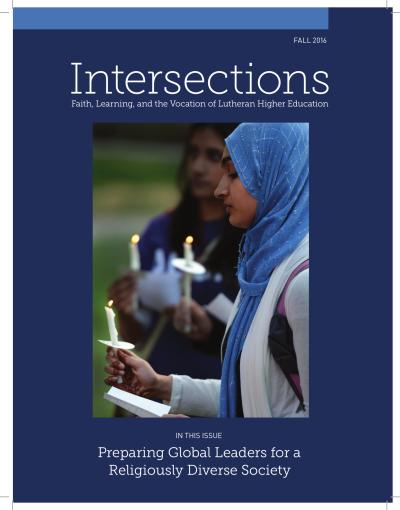
Maruggi draws on his years teaching in the Augsburg religion department to identify three pairs of seeming opposites — dialogue and debate, safety and risk, commonality and particularity — that, held in creative tension, nurture a vibrant interfaith classroom where pluralism is actively engaged rather than merely present.
-
 Response
"Whose Future?" or "Social Justice and the Lutheran Academy?"
Marsha Heck
No. 1 · Summer 1996
Heck argues that the future of Lutheran higher education lies less in defining Lutheran distinctiveness than in moral action grounded in face-to-face relationships with others. Drawing on David Lotz’s two-kingdoms theology of citizenship, Ernest Simmons’s relational reading of Luther, Arthur Preisinger’s indictment of the German Lutheran misreading of two kingdoms during the Third Reich, Starla Stensaas of Dana College, and Paulo Freire’s dialectic of empowerment, she calls Lutheran colleges to integrate moral reflection with moral action—to move students’ muscles against what is not true as well as to feel truths in their bones.
-
Reflection
Mapping Interfaith Encounters
Callista Isabelle
No. 44 · Fall 2016
Muhlenberg College Chaplain Callista Isabelle uses a student-designed subway map of religious and spiritual communities as an image for interfaith engagement — one that invites students to leave their “home” stations, encounter common ground and respectful disagreement, and explore the major intersections where religion meets science, environment, and mental health.
-
 Article
Roots and Shoots: Tending to Lutheran Higher Education
Jason A. Mahn
No. 49 · Spring 2019
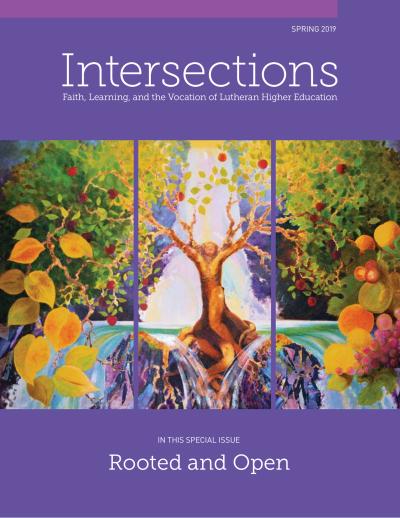
Mahn revisits why “education-for-vocation” has become a leitmotif for the 27 NECU schools, distinguishes institutional vocation from individuals’ religious identities and educational priorities from their theological grounding, and offers a friendly critique of Jodock’s bridge metaphor: Lutheran colleges grow in two directions like plants — deep roots and wide branches alike require constant tending.
-
 Article
The Musician's Vocation
Jeffrey Bell-Hanson
No. 48 · Fall 2018
Bell-Hanson argues that musicians, who exercise profound influence over the emotional flavor of a moment, are called not merely to technical proficiency but to a sense of vocation: understanding their art well enough to use it responsibly, to intend truthfulness rather than manipulation, and to articulate its significance in dialog with other disciplines.
-
 Reflection
Danya Tazyeen
Danya Tazyeen
No. 40 · Fall 2014
Tazyeen, a Pakistani-American Muslim student at Augustana College, reads Qur’an 49:13 — that God made us into peoples and tribes “that you may know one another” — as a charge to break down fear with open dialogue and to see one another as flawed and relatable fellow human beings.