“Go in peace. Serve the Lord.” At the end of each worship service, these words challenge us to live the liturgy in all we do. The dismissal of the people of God to “Go in peace” and “Serve the Lord” is the transition from the liturgy of the Word and Sacrament to the liturgy of ministry in the world. For the baptized children of God the liturgy never ceases!
Foster McCurley, in his soon to be published book, Go in Peace; Serve the Lord: The Social Ministry of the Church, states that “as proclaimer and as sign, the church participates in the world, both by what it says and what it does.” Recognizing that all humanity is crated in the image of God and that it is for all humanity that Christ died, all people and all the needs of people belong to the ministry of the church.
He goes on to say that “the purpose of the church’s social ministry is to serve God’s humanity, to minister to the needs of the most vulnerable, and to indicate by service its commitment to the integrity of every human being. No matter what the faith of the needy person, even if no faith at all, that person possesses a God-given dignity that no one can deny or diminish. The person to be served is not an object of the church’s efforts to increase its membership but a subject with all the dignity that people made in the image God conveys.”
Whether expressions of the church find the motive for social ministry in identification with the vulnerable of the land, in the identification of Jesus Christ with the poor, in the response of the people of God to God’s saving action, in the command to love God by the loving neighbor, or in the continuation of Jesus’ own ministry, the message is clear: the people of God live not for themselves but for others. In such sacrificial love God is glorified and the Lord is served.
In Teaching a Stone to Talk, Annie Dillard said that Christians often treat their faith life and worship as if they are tourists “having coffee and donuts on Deck C. Presumably someone is minding the ship, correcting the course, avoiding icebergs, watching the radar screen …” She asserted that the wind is picking up and we are not sufficiently aware of the conditions. The image of passengers on Deck C having coffee and donuts also fits for some social ministry organizations, and, I would suspect, colleges, and maybe even some church body leaders in places like Chicago and St. Louis. It is urgent that we have “all hands on deck” in the church—Now!
The winds on deck are absolutely changing! Leaders of social ministry organizations are faced with a variety of dilemmas in regard to the decisions we must make to be both effective and faithful.
The gap between the rich and the poor is growing at an astronomical rate during the most significant time of prosperity in the history of this nation and the world. The Caucasian majority will become the Caucasian minority in the U.S. by 2050, with Hispanics and Latinos reaching over fifty percent of the U.S. population.
Both of the factors—the rich getting richer while the poor are getting poorer and the predicted Hispanic majority—are occurring at a time when we baby boomers are aging and a larger portion of the U.S. population is moving to over the age of 65. The face of our country is changing!
And to challenge our future in Social Ministry organizations even more, capitalism and the search for new profit fields have led the for-profit sector into the arena of human services. Today you find Lockheed Martin and technology companies responding competitively to RFP’s social welfare programs! The face of who is delivering human care is changing!
Dual career families are approaching seventy-five percent of the population. Over fifty percent of the workforce are women and sixty percent of the new entrants into the workforce are women. Nearly thirty-three percent of American workers—34 million people, are now contingency workers, including temps, part-timers, consultants, freelancers, and self-employed workers. Almost nine percent of the adult working population—close to 10 million Americans—are now in the process of starting their own companies.
What do these statistics and numbers mean to agencies and institutions of the church? How can we use them to lead the church we so dearly love into the next century? I believe we need to read this environment carefully. Andrew Grove, chairman of Intel Corporation and author of the best-selling book, Only the Paranoid Survive, suggests we answer three simple questions:
Has the organization that you most worry about or compete with shifted? Grove suggests that you try the “silver bullet” test. If you had one bullet, what would you shoot with it? If you change the director of the gun, that is one of the signals that you may be dealing with something more than an ordinary shift in the competitive landscape (family service to for-profits).
Is your key complementer—an organization whose work you rely on to make your services more available—changing? A shift in direction by a partner or market ally can be as decisive as a move by a competitor.
Do the people you have worked with for 20 years seem to be talking gibberish? Are they suddenly talking about people, services, or organizations that no one had heard of a year ago? If so, it’s time to pay attention to what’s going on.
The power of our church today comes through the many acts of mercy, hospitality, service, and education that we offer. To serve and to thrive … most of our colleges and SMOs are pretty good on the “serve” part; we meet people’s needs day in and day out. Even if needs or resources change, we usually meet, and sometimes even exceed, expectations.
When it comes to thriving, however, it is a different story. How many of us can say our organizations really thrive? Most folks I know in SMOs feel that every day is a battle. It feels like our nose is barely above water, and that the sea is not calm. For many not-for-profit SMOs, survival, rather than thriving, is our major accomplishment.
And the challenges seems to be growing: more competition shifts, less willingness to pay for overhead, and pressure for “more for less.” We are challenged to “make the seas safe for travel.”
Through all this, we must remember that God’s power is in the acts of mercy that we perform each day. God is found in the ordinary—earthen pots and clay vessels. We are ordinary people doing extraordinary acts in an extraordinary time in history! David Tiede, president of Luther Seminary, asked at a Connecting Institutions Conference in St. Paul, Minnesota earlier this year, “How can our earthen vessel bear the treasures entrusted to us on our watch?” Who will we employ to be on watch? It takes serious decisions and a great deal of time for planning and training of leadership is necessary if social ministry is to be effective, high quality, and sustainable.
Throughout the history of the Lutheran church, social ministry organizations have acted out our understanding of the Gospel through social service programs, often speaking for the voiceless and the disenfranchised. Social ministry organizations and institutions of higher learning are the embodiment of the church in the nation and the world. We are “where rubber hits the road.” The art or dance or jazz (whatever you want to call it) of our leading agencies and institutions of higher education is complex—culturally, economically, and theologically. In the Rogers and Hammerstein musical, “The King and I”, the song asks, “Shall we dance?” But I believe the question is more rightly for us—“Will we dance?”
I do not believe that it is any longer correct or astute to continue asking, “What can or will the church, or the Synod, or the congregation, do for us?” I believe that the question now is more one of, “What will we do for the church? What is our calling as Social Ministry Organizations and colleges in the church?” What role will we step to the dance floor and perform? Will we lead or will we follow? Can we find a way to follow and be faithful to our Lutheran tradition and theology and lead to the newness of the 21st century creation and situation?
My god friend’s father, Dr. Arthur Becker, said a long time ago, “The church’s responsibility is to assure people that God has not abandoned them … that the promise of God’s grace in Christ is still in place. If the Word and the Sacrament ministry of congregations is the ‘mouth’ of the body of Christ, ten Social Ministry Organizations (and I would add colleges) are the ‘hands’ of the body of Christ. The work of agencies and institutions of the church must always be measured to the extent to which people are assured that they will not be abandoned.” We are not, in Social Ministry Organizations and colleges, an add-on, an appendage to, or a nice little extra. We are the church in the world.
I agree with Bob Bacher, executive for Administration in the Office of the Bishop of the ELCA, who say that “we should never speak of the church and its institutions. These very words imply a conceptual and operational separation of the two and control of one by the other.” I maintain, as do many others, that if Lutheran SMO’s and colleges did not exist, we would have to invent them to be church and do mission.
In its “Statement of the Purpose,” The Evangelical Lutheran Church in America offers the ways in which the ELCA will participate in “God’s mission.” Among the statements used on how the ELCA will respond to “participate in God’s mission” are the words (and I quote from the ELCA constitution), “To fulfill theses purposes, this church shall: a) Receive, establish, and support those congregations, ministries, organizations, insitutions, and agencies necessary to carry on God’s mission through this church” (ELCA Constitution, Chapter 4.02).
“Can it be stated any more clearly than that?” asks Ken Senft, director of The Mission Institute. “The ELCA is saying that important and included ‘to participate in God’s mission’ are the organizations, institutions, and agencies necessary to carry on God’s mission through this church. The ELCA is claiming a relationship with organizations, institutions, and agencies for mission—as it participates in God’s mission to the world. This claim means that in our understanding of this church, all the parts of this church are included in order for each part to receive from and for each part to give to the whole of this church. All parts of this church contribute to the strength of the whole church. All Parts of this church receive strength from the whole church. All parts of the church, those centered in Word and Sacrament in the gathered congregation, and those parts of the church scattered in the world through institutions (SMOs, colleges and universities, seminaries) are all together in God’s mission in the world.”
Social ministry organizations are also affiliated with the ELCA and/or recognized by the LCMS. The first principle in these recognition/affiliation documents pledges social ministry organizations to adopt “a mission statement which declares the organization’s purpose, directs its ministry of responding to human needs as an expression of the Gospel, and affirms the integral nature of its mission with the whole mission of the church.”
The connection between church and institution requires a will on the part of the church to see the opportunities for mission through institutions—institutions over which they do not have significant, if any, governance control and institutions over which they do not have significant financial dependence upon for church budget support.
The connection between institution and church requires a will on the part of the institution to have a substantive relationship with the church in which shared vision, community, and participation in mission are the anticipated results from shared roots.
I think being a leader in SMOs and colleges today requires courage, commitment, and strong will. It requires “all hands being on deck.” It requires us to be vigilant and ready to act. Our church needs leadership from the front. I believe it was Timothy Lull or David Tiede that said not long ago, “Be real and Be ready!” Our church was not planted in this land only for the comfort of the faithful. Is it then, or could it be, that our calling as agencies and institutions of the church, is to put a burr under the saddle, to lead from the front, and to act with courage and boldness in a time when people are searching for strong leadership and direct statements that address their time, their place, their situation?
In the 1970’s I am told at least two college presidents, and I know a number of Lutheran SMO presidents declared that their institutions really no longer needed the church. Several SMOs wanted to remove Lutheran from their name because they saw it as a hindrance to raising money and attracting clients. They were looking to the business community for their support and their referrals, not the church. Interesting to me is my belief that it is, in fact, our very connection and rootedness in the church that makes us interesting and desirable by business. We have values that attract these businesses. We have something that those not affiliated with a church body do not have.
Because we are not in social ministry and education to make profit, we are able to speak more boldly. Because we have stakeholders, not stockholders, we can advocate for justice without fear of investor mutiny. Oh, there are ramifications. Stakeholders can leave too, but for most of them, they want a church-affiliated voice saying what they fear to speak. I frequently tell donors, “LFS is not in a popularity contest. In fact, we frequently serve those least popular in society, It is a lesson from Christ—He served the least loved—the leper, the prostitute, the Pharisee. And he did it without an intake interview to see if they were Lutheran or had enough income to enter the synagogue!”
Bob Bacher says we are standing at a threshold in agencies and institutions of the church. “A threshold,” he says, “calls attention to an interruption, a meeting of old and new. The advantage of seeing our time now as a threshold is twofold. First, it makes it harder to assume that business as usual will do and avoids the neglect of the past in some headlong plunge into an imagined ‘brave new world.’ In counseling programs at Lutheran Family Services we will tell clients not to ‘get stuck in their past.’ A road sign in Canada says, ‘Be careful which rut you fall into. You may be driving it for the next 25 miles.’ We must heed the signs.”
Mission is both here and there. Given the nature of modern society, the mission frontier is right here at the door of our congregations, colleges, or SMOs, but it is also far away, given that the whole world is the subject of God’s love. I frequently tell congregations in Nebraska that sometimes we in the church do mission work halfway around the world, and sometimes we do it in our own backyards. I can walk outside my office door in downtown Omaha and find a homeless man on a cold winter night sleeping in the alley behind a dumpster or I can look out my office window on a sunny summer noon hour and see prostitutes work the business crowd.
Do we as leaders in colleges and SMOs have the courage to really lead? To hold on to rooted theology and yet be pulled by the situation that the church finds itself in society? For example, do we really have the courage to lead this church from inclusiveness “numbers counting” into real cultural pluralism and diversity? Do we have the courage to admit that eight students from Africa do not make a multiculturally diverse student body or a social service agency staff?
Do we have the courage to study the demographic trends and change our college curriculum to make Spanish a requirement for all students, whether they are majoring in accounting or sociology or journalism? Is Intro to Art or Physical Therapy or Logic any more important in the year 2000 than Conversational Spanish? Do we have the courage to teach the church that starting a mission congregation in a Hispanic section of town using all the Caucasian, Northern European liturgy and cultural norms of worship may not be effective, genuine outreach or care of neighbor?
Do we have the courage in social ministry to enter the arena of counseling over the internet wires? Do we have the courage in our colleges and seminaries to stop training students for church and a world that doesn’t exist any of professors and counselors once knew it? Do we have the courage in our social ministry organizations to cut back on services to Caucasian clients in order to increase services to Hispanic, Sudanese, and African American clients? Do we really believe we are a church in a mission field or is that just something Loren Mead writes about?
Justo Gonzales, a pastor and scholar. In his book, Manana: The Bible through Hispanic Eyes, Gonzales reflects on Paul’s use of manna in the wilderness story in which Paul appeals to the Corinthian congregation to share and send money for the poor in Jerusalem. “Perhaps,” Gonzalez writes, “one of the reasons we tend to remember the miracle of production, and not the miracle of distribution, is that as individuals or as a society, we can boast of imitating God being productive, but we cannot boast about the manner in which our resources are distributed.” In other words, we can produce, but we do not share (or distribute) our resources so easily.
Are we in agencies and colleges really courageous enough to invite church leaders to tell us what they really need from us? Are we really courageous enough to tell church leaders what the new mission field is really like? We need people in our SMOs that are trained to work in a mission field where skin is not all white and all language is not English, where most people, including our staff, are not Lutheran, and where more words are spoken over the internet than over the telephone. Technology is bringing the outside world into our social ministry organizations.
Let’s say you are going to a party, so you pull out a couple of dollars and buy a little greeting card that plays “Happy Birthday” when it is opened. After the party, someone casually tosses the card into the trash, throwing away more computer power than existed in the entire world before 1950! We cannot any longer settle in!
Our partnerships are changing. How we do our work is changing. At LFS of Nebraska we are partnering with the Methodists in the North Omaha community. We are beginning to partner with Church World Service in Refugee Resettlement. Twenty years ago we did refugee resettlement alone. Today we are doing it ecumenically. We are working with the Catholics, Baptists, and Congregationalists in neighborhood development. When most of the people in the world were Caucasian, and when the mainline churches had growing memberships, we lay leaders and clergy alike, settled into our padded pews and sermon files. The more things changed, the more they stayed the same.
Some of my colleagues in social ministry believe that social ministry organizations are in a growing position of weakness in the church because we are losing funding from the church at all levels. You, in colleges, know that all too well. Maybe, just maybe, in our weakness is our strength for this next century! Maybe out of our lesser dependence on financial support from the church, we will be free and courageous enough to assume leadership from the front in our church.
I heard the story once of a refugee, now a pastor in Wisconsin, who said, “How can my people engage successfully in society but remain true to cherished traditions?” For us here today, her question could be paraphrased to this, “How can we in institutions works successfully in society and remain faithful to our calling?”
Maybe what the church needs from us in colleges and social ministry organizations is a brave new voice, not fearful of reelection or declining membership numbers. What is our calling in the church in the 21st century? Maybe, just maybe, we are the bearers of hope! In our agencies and institutions we may have enough distance from the bureaucracy of the church to step boldly into action. Do we have the courage?
It was the very proclamation of “feed the hungry, clothe the naked, care for the children” that led our church—Danes, Norwegians, Swedes, and Germans—into social ministry and higher education, into caring for our neighbor. I do not question why we do it. Our Gospel call to care for our neighbor remains the same. In 2000 I question the how, the where, and the to whom we deliver the education and the social services. To stay viable and competitive, I suggest a broadening of the focus of neighbor from the primarily white orphan or white college student to a more intentionally inclusive, culturally diverse group.
In the 1980’s social ministry organizations were encouraged to diversify our programs and funding bases so that we were not so dependent on one funding source. Today, we are talking about focusing on what we do best and dropping the rest. Can we act on mission fields that exist in our own backyards? Could colleges and SMOs pool our resources and provide scholarships to children in foster care—children on the edge, not benefitting form the millions made in the market this year? Could we provide social service and education scholarships in large numbers to the Sudanese refugees in our backyards? Could we look at more two-year degrees? Could we develop youth and family ministry programs that educate lay persons to minister in our congregations and communities? Could we develop more dual-degree training between ordained ministry, religion, and social work? Could we, together, step to the plate, admit the problems of alcohol on our campuses, and address the problem?
Since knowledge doubles in our world every two years, can we step boldly into education and change what is required to be learned in four years? Can we prepare our students and social workers for a world where English is the second language? Could we spend more of our resources to speak about “vocation and calling” to high school students?
Could colleges and social ministry organizations work more together in speaking about vocation in the church? Social ministry organizations need accountants, public relations directors, human resource managers, foster care workers, and administrative assistants, counselors, and network administrators. Together, could we help students see that for Christians, occupation is seen through the eyes of God-given vocation, that work is not the venue for personal aggrandizement, but for witness to Christ in the service of neighbor? This understanding gives all who work in social ministry organizations a sense of purpose beyond the paycheck. Could we not help our students understand that calling and vocation extend beyond the call to ordained ministry? Social ministry organizations need your brightest and best students, who have a sense of vocation and calling, to use their occupational skills and their faith-based understanding of care for neighbor, in order to keep the church in society, caring for the voiceless and abused, the abandoned and forgotten.
In Nebraska this past legislative session, twelve of the largest not for profit private providers banded together, mobilized our boards and staff, and almost single-handedly moved the legislature to raise reimbursement rates for providers. We had not had rate increases in six years. Let me be clear. I do not mean that we care more about Nebraska’s children and families than employees of the state. However, we were not “chained by their bureaucracy” and we could be a powerful voice of advocacy and justice for both our agencies and for clients. Can we not do the same in church? Can we not, in this mission field time in the church, when mainline denominations are “struggling to maintain” their church headquarters and staff, be the voice of the church, crying out in the wilderness, calling all hands on deck, to “Go in Peace; Serve the Lord.”
-
 Editorial
From the Publisher
Arne Selbyg
Selbyg reports that the Lutheran Brotherhood Foundation and the Lilly Endowment have funded the Lutheran Academy of Scholars, which since 1999 has gathered ten to twelve Lutheran scholars at Harvard for two-week summer seminars under Ronald Thiemann (themes: “Finding Our Voice—Christian Faith and Critical Vision” in 1999–2000 and “The Lutheran Public Intellectual: Faith, Reason and the Arts” in 2001), and announces that the academy will move to Berkeley in 2002 under Ted Peters to take up the intersection of faith and science.
-
Editorial
From the Editor
Tom Christenson
Christenson introduces three pieces from the summer 2000 Vocation of a Lutheran College Conference at Dana College—noting that Leonard Schulze was asked to keynote before becoming executive director of DHES—and recommends Peter C. Hodgson’s God’s Wisdom: Toward a Theology of Education and Douglas Sloan’s Faith and Knowledge: Mainline Protestantism and American Higher Education for their accounts of how faith and knowledge have been dissociated in modern higher education and what it might take to recover their connection.
-
Article
Teaching as a Form of Servant Leadership
Leonard G. Schulze
Schulze defines teaching as a paradoxical “servant leadership” rooted in the etymology of educare, e-ducere, Erziehung, and Bildung, surveys representative models of the teacher (Plato’s cave, the Theatetus midwife, Socrates of the Apology, and Freire’s Pedagogy of the Oppressed), and proposes a four-fold taxonomy of learning—information, critical thinking, praxis, and teleology—each requiring its own form of teacherly leadership. He closes with ten Wittenberg-style theses for teachers at Lutheran colleges, including that the Gospel liberates us from using knowledge as power, that disputatio is an expression of faith, and that we are called to lead students from the tyrannies of ignorance, rote knowledge, incompetence, and anomy to the freedoms of awareness, critical understanding, skillful action, and purposive lives in community.
-
Article
The Vocation of a Lutheran College
L. DeAne Lagerquist
Lagerquist places the twenty-eight ELCA-affiliated colleges in the context of American higher education from Harvard (1636) through the “old time college,” the post-Civil-War research university, and the postwar expansion—drawing on Christopher Lucas, Philip Schaff’s Neo-Lutheran/moderate/Old Lutheran categorization, Sydney Ahlstrom’s scholastic/pietistic/critical currents, Luther’s appeal to the German nobility, Lewis Hyde’s gift economy, and Alasdair MacIntyre’s After Virtue. She proposes five characteristic practices (the school as learning community, study of Bible and Christian tradition, participation in the arts as makers and audience, application of learning in service, and on-campus Christian worship) grounded in Lutheran teaching about grace, image-and-fall, gratitude, and revelation through created “masks,” and four virtues these practices engender in graduates—loving gratitude, faithful wisdom, bold freedom, and hopeful humility.
-
Article
A River Runs Through It: CLU as a Church-Related University
A. Joseph Everson
Everson borrows Norman Maclean’s A River Runs Through It and the small creek that flows through California Lutheran University’s Kingsman Park as images for the quiet stream of Christian tradition on campus, describes the dialectic of faith and reason (with a “Lord of Life” student congregation, two required religion courses, and a voluntary Wednesday chapel) as the “theology of paradox” that runs from Luther’s simul justus et peccator through Richard Solberg and Richard Hughes, and names six commitments that constitute the CLU ethos—academic freedom (Jeremiah 29:7 and John 8:32), vocation, service (Amos and Habitat for Humanity), grace and graciousness (Portia’s “quality of mercy” speech from The Merchant of Venice), diversity, and reverence (Proverbs 9 as awe and wonder).
-
 Article
Cultivating Transformative Responsible Dialogue: Community of Moral Deliberation and Lutheran Higher Education
Per Anderson
No. 35 · Spring 2012
Anderson proposes that ELCA colleges and universities embrace a project of “transformative responsible dialogue” that advances the ELCA’s commitment to be a “community of moral deliberation” and answers the LIFT Report’s call for a culture of faithful discernment. Drawing on Michael Meyer’s “liberal civility,” Martha Nussbaum, Hans Jonas’s responsibility ethic, Patrick Keifert’s ecclesiology of strangers, and Kathryn Tanner on culture, he argues that liberal education at our schools can form students whose dialogue knits together civility, responsibility, and Christian openness to the other.
-
 Article
Ethical Leadership for a Changing World: A Shared Calling from Cradle to Career
Cory Newman, Janelle Rozek Hooper
No. 62 · Fall 2025
5 min audio
Hooper and Newman recount how an ELCA Barna survey on early childhood education sparked the realization at VLHE 2025 that ELCA colleges and the 1,200 Lutheran schools and early learning centers share identical challenges — and an untapped potential to form ethical leaders across the full educational continuum from cradle to career.
-
 Editorial
From the Editor
Jason A. Mahn
No. 37 · Spring 2013
Mahn introduces the issue’s six essays as parallel attempts—from poetry, economics, choral music, biology, religion, and Lutheran higher education—to resist our culture’s fact-value split, and uses Augustana’s Fritiof Fryxell, a 1922 biology and English graduate who began teaching just as the Scopes Trial ignited, to illustrate how church-related colleges have long held faith and disciplinary inquiry together.
-
 Article
The Dangers of "Vocation" for Students Thinking about Career
Carl Hughes
No. 41 · Spring 2015
Hughes warns that Lutherans too often use “vocation” as a theologically glorified synonym for a fulfilling career — a misuse that constricts God’s call to our jobs and excludes minimum-wage workers, caregivers, and others from the dignity of calling. Recovering Luther’s expansive understanding, he argues that vocation refers first to people, not professions, and must always be bigger than any one aspect of our lives.
-
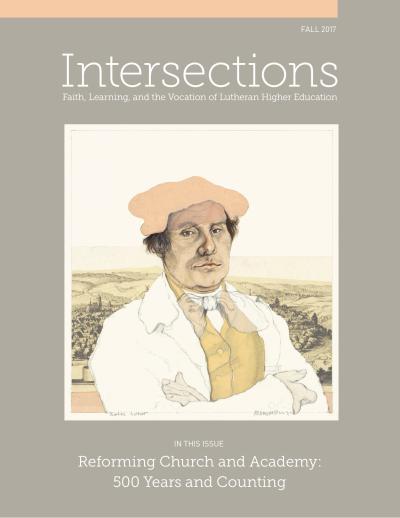 Article
Both Priest and Beggar: Luther among the Poor
Martha E. Stortz
No. 46 · Fall 2017
Reading Luther’s deathbed remark “We are all beggars” against his “priesthood of all believers,” Stortz argues that priest and beggar are two sides of a human reality — one that locates civic responsibility for the poor at the heart of the Reformation legacy and that pushes beyond paternalistic service toward the systemic question of justice.
-
 Editorial
From the Editor
Robert D. Haak
No. 27 · Spring 2008
Haak frames the issue around the question of why Lutherans engage the world rather than retreat from it, locating the answer in the doctrines of creation and incarnation, and introduces essays by Erwin on globalism, Carlsen on local community engagement, Marty on multiple callings, and Mattes on the Grundtvigian heritage at Grand View. He also bids farewell to publisher Arne Selbyg, noting the fittingness of the Adinkra (“farewell”) cloth on the cover of this final issue under Selbyg’s leadership.