Writing Toward the Night Complete: Teaching and Working at the Public, Secular Institution
Intersections No. 16 · Winter 2003
Classroom and Campus Ministry as Communities of Memory and Hope
1. Finding Community
The office of Lutheran Campus Ministry at the University of Delaware is directly across the street from Russell Hall, a freshman honors dorm. On the day all 3,500 plus first year students at Delaware move into their dorm rooms, I like to spend time in my office, watching parents and students in a mad tangle, unloading cars, vans and even rented trucks, locating dorm rooms, carrying clothing, computers and televisions into small spaces they will begin to share with one or two strangers. At noon, the street is barely negotiable. By 6 PM the street is nearly empty, except for debris of moving. Good-byes have been said; parents have begun making the trek home. Some farewells have been teary; some not. New students are on their own in a way most have never been before. Fast-forward four months: by December, some “frosh” have learned to get themselves up for an 8 AM class - some have missed many classes. Some who were excited to be at University have been homesick in a way they could not have imagined. Some are pleased at the progress they have made in their classes. Some have failed to be admitted into select and competitive programs. All say in December that they had had no idea how hard they would have to study. But the very first few days leading up to this play themselves out in similar ways on all college and university campuses, public and private: the night before classes begin, new students wander around looking as bewildered and disoriented as Hereford calves fresh out of a Colorado branding chute. I remember the student at MIT, a young woman from Maryland, who finally made it to the Wednesday evening Lutheran-Episcopal Eucharist at the Saarinen chapel there: how she held her green Lutheran Book of Worship very, very close for a while. Finally, in all that newness, something familiar.
I teach as supplemental faculty for the English Department of the University of Delaware. Among my courses is English 110, “Critical Reading and Writing.” The goal is for students from a variety of educational backgrounds to learn the basic skills for research, and to write competently in the conventions of academic discourse. We begin the semester with a “diagnostic” exercise. I think of the student who struggled for an hour to get three or four nearly coherent sentences out. It occurs to me that we may have a problem here. We do. He is the student most likely to miss the 8:00 AM class. When he comes, he usually rushes into the basement level classroom seven or seventeen minutes late, always in stocking feet with roller blades in hand. I wait for the day when he comes careening in without having bothered to remove roller blades before a crash landing in his desk. It never happens. I’m not sure whether I’m relieved or disappointed, but I decide against suggesting the possibility to him. When we talk about his writing, he makes it a point to show me photos of his art projects. He’s an art major; he’s pretty good.
Generally my worst fears for him as a writer were realized. Steven King (yes, that Steven King) has said that few of us will become Hemingways or Eudora Weltys; but there are also only a very few who cannot improve their writing.1 This kid threatens to be the exception to prove the rule. I had decided that the last assignment of the semester should describe an event in which the students realized that they were part of family or community: I stole the title of their assignment from Harold Ditmanson, once of St. Olaf: “Hours of Authority.” One student wrote of his Bar Mitzvah; another, about a family Christmas that might have been a scene from a Russell Banks novel. My artist student wrote about a memorable Fourth of July: there were fireworks; a neighbour’s car caught fire; he and his friends were questioned by police. But he concludes, “All in all our night was complete: danger, people getting together, explosions, and lots of fun.” His competence in research was still marginal; but because of the freedom of that sentence I wanted to believe that he had come far enough as a writer to pass the course. Maybe I envied him his ability to say so clearly what it is that grounds us in community: danger; people getting together; explosions; and lots of fun.
I allow students to write regularly of their own experience because I am convinced that all of our writing is somehow autobiography. We write best when we write about what moves us, what interests us, what touches us - what heals us: “In your wound is your brilliance,” writes poet Robert Bly.2 Most students come to their discipline for one of two reasons: the prospect of a good income, or because they love the subject. A student loves her dog and her horse and chooses Delaware for the pre-veterinary medicine program in the College of Agriculture. Among her professors one will stand out for his enthusiasm in an anatomy classroom: he’s the one who has made a career of wandering town collecting cat cadavers in order to make fresh tissue slides, the one who would find a particularly interesting specimen and then, like a kid showing off his favourite Christmas present, call students to share the discovery. It is difficult to help a student maintain enthusiasm for a subject when he or she becomes aware of the rigour of the discipline. Yet we know that the rigour must be maintained, because it is that hard work that brings the student out of his or her own limited neighbourhood through the confusion of freshman orientation and the first semester and into the wider community of the discipline and of the world.
The rigour of the discipline also brings a student closer to God, though a student may not know that. In a fit of high self-esteem a few years ago I bought a poster with Einstein’s picture on it, and his words, “I want to know God’s thoughts; the rest are details.” I believe that there is no better way to know what Dorothy Sayers called “the mind of the maker” than through attention to the details of the made. Which is to say, we are drawn to what we love, and it is through love of the created that we are drawn to love of the Creator.
2. Thinking Hope
“Critical Reading and Writing” has other goals and objectives than to help the student articulate that love of the created thing that draws one into vocation. The goals of the course are simple (though not easy): the student is to learn to read with pencil in hand, growing familiar with an author and with the author’s point of view, eventually the better able to provide a summary and critique of the author, and able to place the author in conversation with other authors, and to do so in writing, and to develop one’s own argument according to rudimentary logic. The student who learns to do this well passes the course and may do so with an “A.”
There is however another aspect of critical thinking that is more difficult to teach. It can not be taught in one class only, but must be learned over a long period of time. A freshman woman wrote in an early assignment that she had been horrified to learn from other freshmen of high schools so violent that students have to pass through metal detectors before entering the building. In her paper she said that she was glad to find out about this because she planned to teach some day, and she hoped to avoid teaching in this kind of environment. I am saddened but not surprised at her response. I want this person to learn that the problem is not addressed by her engineering her life in such a way that she steers clear of such a school; it is addressed when she recognizes that such schools can and must be changed, however slowly, with however much difficulty, whatever the social forces that resist such change, and that she can and in some way must have a part in that change. Her hope for her future has got to be based on something other than the avoidance of a teaching position she judges to be bad; and it is her teacher’s responsibility to teach hope as a critical principle and to foster it in pedagogical practice.
2.1. Thinking Hope: Calculative and Meditative Thought
To teach hope in a concrete way it helps to understand something about different ways of thinking. Douglas John Hall, for instance, draws on Martin Heidegger’s distinction between “Meditative Thought” and “Calculative Thought.”3 “Calculative thought” is characterized by “planning and investigating;” it “computes, …ever new, ever more promising and at the same time economical possibilities. Calculative thinking races from one prospect to the next. Calculative thinking never stops, never collects itself.”4 Meditative thought, on the other hand, considers “the meaning in everything that is.” Meditative thought may appear to be removed from reality, if the nature of reality is determined by “calculative thought” only; it is not concerned with carrying out “current business,” or with “the practical.” It is, on the other hand, “associative,” even poetic, in that it can make “poetic leaps of relationship” not so discernable to one schooled in “calculative thought” alone.5 And it cannot be evaluated on “scantron” forms.
To help freshmen in a class at a secular public university devoted to critical reading and writing begin to recognize the possibility that there are two ways of thinking, I draw on, for instance, a poem by Richard Wilbur: “Advice to a Prophet”:
When you come, as soon you must, to the streets of our city,
Mad-eyed from stating the obvious,
Not proclaiming our fall but begging us
In God’s name to have self-pity,Spare us all word of the weapons, their force and range,
The long numbers that rocket the mind;
Our slow, unreckoning hearts will be left behind,
Unable to fear what is too strange.Nor shall you scare us with talk of the death of the race.
How should we dream of this place without us?—
The sun mere fire, the leaves untroubled about us,
A stone look on the stone’s face?6
Wilber is telling us what cannot be accomplished by calculative thought, the attempt at persuasion by data and naked fact alone; data and naked fact alone do not touch the human spirit. We require something else: and the remainder of the poem lifts up the meditative quality of metaphoric, associative recognition of a deeper dimension of creaturely existence faced with the possibility of the obliteration of sentient life on the planet earth:
Speak of the world’s own change. Though we cannot conceive
Of an undreamt thing, we know to our cost
How the dreamt cloud crumbles, the vines are blackened by frost,
How the view alters. We could believe,If you told us so, that the white-tailed deer will slip
Into perfect shade, grown perfectly shy,
The lark avoid the reaches of our eye,
The jack-pine lose its knuckled gripOn the cold ledge, and every torrent burn
As Xanthus once, its gliding trout
Stunned in a twinkling. What should we be without
The dolphin’s arc, the dove’s return,These things in which we have seen our selves and spoken? …
Even freshmen, however irreligious, however committed to the values of the marketplace, can be drawn through the power of metaphor to appreciate the poet’s criticism of the language and methods of calculative thought, and to make sense of what the poet names later as “the red rose of our love” and “the clean horse of our courage.”
2.2. Thinking Hope: “Instrumental” vs. “Substantialist/Objective” Reason.
The theorists of the Frankfurt School, sometimes known as the “Institute for Social Research,” offer a second illustration of the varying modes of thought that we learn to recognize and work between in order to teach hope. Developing their fundamental ideas in the early years following the first world war, and continuing their most creative work among the expatriate German communities in New York and California from the mid-1930s through the early 1950s, they spoke of the distinction between “Instrumental Reason” and “Substantialist/Objective Reason.” Gary Simpson defines Instrumental Reason succinctly as “the concept of reason… whereby reason becomes powerful as an instrument or tool for pursuing efficient means toward a given end but impotent for evaluating the desirability or value of the given end or goal”.7 Substantialist/objective reason is “the conception of reason that postulates and seeks to examine an objective, total order within human reality and functions to provide a rationale for the patterns of social existence.”8 Unlike Heidegger, and those who use his distinction between meditative and calculative thinking, the theorists of the Frankfurt School do not privilege one mode of thinking over another. Heidegger’s preference for “meditative thought” is limited in that it tends to express nostalgia for a pre-enlightenment way of seeing the world, a way to which we cannot return. Nonetheless, the advances of the enlightenment may not be claimed uncritically. Thus, both instrumental reason and substantialist/objective reason have their place, and each may be used in critical evaluation of the other. Instrumental reason, for instance, advances technology; substantialist/objective reason asks about the use and liability of technology. Walter Benjamin, Theodore Adorno, Max Horkheimer and the other social thinkers of the Frankfurt School were influenced by Marx’s “dialectical materialism” and critique of capitalism. But they refused to recognize Marxism as an absolute and timeless revelation: rather, they borrowed its dialectical methodology to criticize any closed philosophical system. They did not reject the enlightenment but were sceptical of the positivism and progressivism of the heirs of the enlightenment - their nominalism, empiricism, and high estimation of scientific evidence. Critical theory is not “doctrine,” but method.9
It is a primary feature of critical theory to be “ecological,” in the sense that Joseph Sittler spoke forty years ago of “The Ecology of Faith”: that is, the “critical theorists” recognized that any system under scrutiny is not external to the observer, but rather the observer is a part of the observed; to recognize a need for change is to recognize also that the consequence of any change is to change ourselves.10 In that one is neither identified with the system under review nor detached from it, but is a part of it, theirs is an argument against totalitarian systems, an argument against what Max Weber called the “fully administered society.” Or, as Walter Benjamin put it, it is a commitment to the concern that the murderer never triumph over the innocent victim (a thought echoed by Elie Wiesel when he says, “we have poetry in order that the dead may vote”) - or, as Matthew Lamb put it in his collection of essays concerning the significance of critical social theory for Christian ethics, it helps the Christian express “solidarity with victims.”11
2.3. Thinking Hope: The Cultural Roots of Critical Thought.
The concepts of “critical theory” as concepts are notoriously difficult to teach and put abstractly into practice; my freshman who hopes to avoid teaching in a desperately tough inner city school is not likely to respond to them early in her undergraduate career. But there is a moral rigour and a theological subtlety in the thought of Adorno, Benjamin and Horkheimer that Martin Jay suggests originates in the “values espoused” in the even secular Jewish homes in which they were raised.12 Douglas John Hall writes that Christian theology includes a self-critical stance not unique to the theological discipline, but “is part and parcel of the cultural matrix that is the foundation of the prophetic and wisdom tradition of the Hellenic world. The university is a child of that cultural spirit that lives between belief and the ongoing critique of what is believed.”13 Thus, even in a secular classroom an aware teacher can foster critical thinking in the undergraduate by pointing out, for instance, the inherent self-criticism found within the sources of the western artistic and cultural imagination.
Another class that I teach in the English department at the University of Delaware is “Biblical and Classical Literature.” It is a course required of both English and Art History majors and recommended for religious studies minors, intended to compensate for the illiteracy of most Americans concerning the sources of the western artistic and intellectual imagination: the biblical literatures written in Hebrew and Greek, and the classical literatures written in Greek and Latin. Ideally this would be at least a two-semester course leading to the convergence of these two great streams in Augustine and Dante. But even a semester is enough to get an overview of the great sweep of biblical narrative and a taste of the pagan myths of cultural origins; and to begin to see how the narratives and myths develop and reinterpret themselves in light of the demands of new contexts: how, for instance, generations after Moses prophecy arises in a new way as the critical conscience of divinely ordained kings, and how women of courage subvert the dominant paradigm of patriarchal oppression; and, at the other end of the Mediterranean, how the playwright Aeschylus rewrites Greek theology to offer the community a new way of resolving tragedy and treachery; how a Socrates could offer a city weary of empty religious practice the critique of careful thought. How the greatest and earliest of our literatures arise out of the shadow of the destruction of great cities: after the events of last September 11 it is particularly poignant to remember that the epic and dramatic poetry and the philosophy of Greece is commentary on the Trojan war; that the canon of Hebrew scripture was formed in response to the fall of Jerusalem; that Augustine wrote The City of God with the sacking of Rome echoing in his mind. The ancient literatures teach that barbarity still lurks at the edge of the civilized clearing, that the ancient commitment to hospitality still stands, that those who practice hospitality are still vulnerable to those who would violate the counsel that every stranger is Zeus in disguise. One does not necessarily have to profess Christian faith to teach undergraduates in a secular classroom the primary tenet of “critical theory,” that every “absolute” is subject to revision: so Jesus says, “You have heard it said; but I say unto you.” It may belong to the realm of Christian confession, and thus to the specialized work of campus ministry, to move from this to the claim that, in the words of Walter Brueggeman, “something is ‘on the move’ in the darkness that even the lord of the darkness does not discern;”14 and yet the most irreligious of students can be helped to recognize that that is also the subtext of so popular a literary and cinematic text as The Lord of the Rings. Might this help an undergraduate education major look at violent schools differently, and hope - and work for - other possibilities?
2.4. Critical Theology: The “Theology of the Cross” in the University Classroom.
Not every student studies “Biblical and Classical Literature,” though it is a surprisingly popular elective. But the point is that a secular learning community enables the teaching of hope through the critical and self-critical exploration of any of the multicultural sources of the modern world. Within this curriculum the equally critical and self-critical study of confessional theology also has its place, as Douglas John Hall has said clearly:
While Christian theology must not be presumptuous about its place in the contemporary university, and while its first responsibility must be the service of the community of belief, both university and church benefit from this pursuit of this discipline within the secular academy. The university benefits because apart from an holistic grasp of Christian belief Western civilization (including the university itself) cannot be profoundly understood, critiqued and (in its better expressions) preserved; the church benefits because without the critical dialogue of the academy belief too easily degenerates into credulity, sentimentality or ideology.15
A Protestant, Hall draws on Martin Luther’s “Theology of the Cross” as a primary touchstone for his own theological reflection. He writes that a theology of the cross always argues against propositional certainty in theology, reminding Christians that doubt is an intrinsic dimension of the faith which is, nonetheless, always faith seeking understanding, and always in relationship with the Man of Nazareth who made himself vulnerable in “obedience unto death, even the death on the cross.” Such a theology is “a discipline highly practiced in the art of self-criticism.”16 Hall has long insisted that that “meditative core” of Christian faith puts Christian faith in opposition to the Christendom which has become the officially or unofficially established religion of Europe and North America since Constantine appropriated the cross and said “In this sign I conquer.” The political edge of Luther’s “Theology of the Cross,” Hall argues, is its critique of what he names America’s culture of “official optimism” - an optimism called increasingly into question by global political, economical, and environmental developments, and which in turn relies increasingly on military strategies for defence and on a shallow, one-dimensional religious justification of those military strategies.17 Hall finds that Christian theology as a “Theology of the Cross” has a place in the academy first, because it has its roots in the critical proclamation of the Hebrew prophets and the critical reflection of Hellenistic philosophy; and secondly because the subject and object of the theology of the cross is not abstract “divinity” but the God of Abraham and Moses, who is always for the world in its wholeness, understood as the beloved artefact of God’s creation and the beloved object of God’s redemption.18 Thus, while many university scholars and the theologian at work in the university may justifiably critique certain of each others’ assumptions and ways of thinking about the world, they still share at their best a common concern for “the fate of the earth,” (Jonathan Schell) and for human futures, and a common commitment to service grounded in wisdom and instructed by love.
Hall acknowledges that to teach as a confessional Christian theologian in a secular university is to invite an inevitable tension:
Those involved in the teaching of Christian theology in such a context are conscious of their responsibilities to two communities of discourse whose methods and priorities are not made easily compatible - the university, which by its nature as a community of open-ended inquiry must maintain a certain scepticism in relation to all systems of meaning, and especially those that seem to posit finality; and the church, which at its best is also sceptical of such systems but cultivates its peculiar openness to mystery through commitment to a specific spiritual-intellectual tradition - a commitment that our immediate predecessors in this discipline named “the scandal of particularity.”19
Thus he insists that when that tension makes of Christian theology the object of religious Wissenschaft it is no longer a Christian theology which assumes a commitment to a certain “scandalous particularity;” in the words of David Miller of Syracuse University, it “loses traction.” If one yields to the temptation to resolve the tension easily “either one accentuates one’s commitment to the academy in such a way as to minimize one’s responsibility to the community of faith; or one emphasizes one’s belonging to the community of faith so as to avoid existential entanglement with the claims of the university.”20 Hall laments that when scholars have accepted positions in departments of religion without assuming the burden of answerability to religious communities
… the result is that the churches have been deprived of this scholarship, and (more regrettable still) have therefore been all the more vulnerable to simpler and frequently simplistic versions of the faith, which have gained a stronger hearing in our society through the mass media.21
On the other hand, more simplistic versions of the faith are not corrected when the scholar submits to a “kind of loyalty to the religious community that sits lightly to the requirements of reason and the academy.”22 But the tension entered consciously can produce positive gains: when theology as self-consciously Christian theology is astutely aware of and committed to the world and committed as well to the service of memory against cultural amnesia, the Christian scholar can engage in what Hall calls a “dialectic of proximity and distance” that may be “against the world for the world” (as George Lindbeck, Richard John Neuhaus, and a number of others entitled a book published at least thirty years ago), and may also be “against the church for the church and for the gospel.” Understood dialectically, and critically and self-critically, a world-oriented Christian “Theology of the Cross” supports all members of the learning community in their integration of faith and intellect - and it supports members of the learning community in resisting abstraction for the sake of “meaning” in consideration of the concrete and the particular. As Luther said, “the ‘Theology of the Cross’ calls a thing what it is.”23 It is utterly honest. But because its realism is understood theologically as the way God works in the world, it is also utterly hopeful.
3. Teaching Hope.
To teach to a college student a reason for hope and a sense of responsibility to community requires more than attention to course content and to ways of thinking. Teaching hope and responsibility are also matters of pedagogy. Pedagogy, though, is a matter around which I find much sadness and cynicism. In a posthumously published essay Lionel Basney of the English department at Calvin College lamented the nature of teaching in higher education at the end of the twentieth century: “to be a teacher now means being a committee person, or academic politician, a conference goer, an administrator, a grant winner, a counsellor.”24 Basney discusses his attitudes towards attendance (he never kept attendance records) and towards the books he has read - “most of my books are nothing like Walden, of course, and I regret having bought them. They were expensive, profitless, and distracting.”25 Student dress suggests to him that, however much a student may deny it, “the market in clothes (as in food and ideas) furnishes us all virtually identically… how intense a denial of human particularity this entails.”26 Reflecting on the use of time in class he considers that “a large body of systematic knowledge is [probably not] of much use to a teacher of undergraduates. Which means that a large part of our formal professional training is beside the point.”27 Now Basney, a self-consciously Christian professor teaching at a private institution committed to a particular tradition of Protestant Christianity, is not dismissing academic rigour or attention to a robust cultural intellectual heritage. He is concerned rather that too much attention to “scholarly esoterica” and academic commodification too often interferes with what is not beside the point: the fact that in the classroom, “people are present:”28 a young man with roller blades; a young woman passionate about her horse; a young woman concerned about teaching in schools with metal detectors at the door.
Teaching in a markedly different context, Shelley Shaver is another who recognizes the presence of people in the classroom. She teaches remedial writing at a California community college. Many of her students, she writes,
are the first in their families to attend higher education. Their ages range from 18-year-olds who are here because they don’t know what else to do after graduating (sometimes barely) form high school, all the way up to middle-aged re-entry students who want to advance at work or who suddenly need new employment skills after a divorce or an injury on the job. Almost all of my students work, many at minimum wage jobs, and all feel somewhat guilty for putting in hours at school that they could spend at work to help their families. Few of their friends from high school have any idea of the hard work at home that college requires. Some come from Southeast Asian countries and are trying to lead double lives that satisfy both their traditional parents and the society that surrounds them. I suppose my image of the typical community college student is someone in the mid-twenties age range who made C’s in high school, graduated and worked for a few years at a fast food or sales job, and then realized that without further education, this was the end of the road.29
She describes students “with the ambition to succeed in the world, but with no earthly idea of how to do it.”30 Her task is to give students not simply what she is convinced they “ought to know” about writing - many of them, like my poor artist on roller blades, improve only minimally, however they struggle - but she tries also to foster disciplines necessary to effective job performance: punctuality, honouring commitments, meeting deadlines, cultivating attitudes other than an in-your face hostility learned when one has “never had a conversation where one person questions and talks and the other questions and comments back.”31 Shaver quotes Will Rogers: “people learn in two ways: … One is reading. The other is association with smarter people.”32 This, however, demands from the teacher not only “knowledge,” but a sense of vocation as recognizing that a student is more than what he or she at first seems to be:
Since many did poorly in high school, to a large extent their future success depends on their being able to construct a new identity in the community college… The major obligation of my job is to refuse to accept the negative identities they press me to buy into. I have constantly to let my students see that I perceive other personas for them, more creative, more promising.33
In his own way, in a very different kind of institution with a different “market,” Lionel Basney echoes this:
What’s going [in the classroom] is partly waiting. You talk with and to students, waiting for the moment of intellectual shock, or fear, or (more rarely) love, that means something has found its way in, or been allowed in, though the significance of this is the student’s to state and may not be evident for years.34
A friend says that too much teaching is nothing but the transmission of data from the professor’s notes to the students’ notebooks without going through the minds of either. Parker Palmer offers an alternative understanding of teaching such as is illustrated by the experiences described by Lionel Basney and Shelley Shaver in classrooms “with people present.” “To teach,” Palmer says, “is to create a space in which obedience to truth is practiced.”35 To summarize Palmer’s theory of education fully is to recapitulate the discussion of different modes of thinking suggested by Douglas Hall’s summary of Martin Heidegger, by the theorists of the Frankfurt school, and by the critical realism of Luther’s “theology of the cross.” It is also to move critical method and intellectual content into the experience of relationship in classroom community. Teaching that is merely the transmission of data is not a communication of truth but an obstacle to truth because it teaches “an objectivism that persists in making ‘things’ of us all. This objectivism is quickly translated into political and social programs of division, manipulation and oppression.”36 According to Palmer, a teacher who counters these tendencies with “obedience to truth”
is a mediator between the knower and the known, between the learner and the subject to be learned. A teacher, not some theory, is the living link in the epistemological chain. The way a teacher plays the mediator role conveys both an epistemology and an ethic to the student, both an approach to knowing and an approach to living. I may teach the rhetoric of freedom, but if I teach it ex cathedra, asking my students to rely solely on the authority of ‘the facts’ and demanding that they imitate authority on their papers and exams, I am teaching a slave ethic.37
Or to use an example from the discipline of Christian theology: “grace” taught with a pedagogy of shame communicates only a dogmatic formula to be memorized, not a sense of life to be lived in a community of freedom and hope; whereas enthusiastic instruction in the anatomy of a cat taught in a way that recognizes the dignity of a student in fact and in potential both liberates the student and invites her into community, even though the name of Jesus may never enter into the conversation.
This does not necessarily make of the classroom a “safe place.” In Teaching to Transgress, Bell Hooks writes that the classroom is not and cannot be a safe place, not because we are vulnerable to shame, embarrassment, and exposure, but because effective teaching forces us to see the world differently than we have - or want to.38 Few of us ever really seek growth willingly, Joseph Sittler once told us; “we are pushed, pulled, thrust, dumped into growth.” My students from above the Mason-Dixon line are always distressed when I speak of the American Civil War as “the war of northern aggression” - as I too was once distressed to hear this. But, writes Palmer, the teacher who attempts not to transmit data but to communicate hope knows that “hope includes to recognize one’s own sense of vulnerability and authenticity,” and teaching becomes an act of prayer in the sense of prayer as “the practice of relatedness.”39 As a teacher and teacher of teachers informed by Christian spirituality, Palmer claims that
truth is not a concept that “works” but an incarnation that lives. The “word” our knowledge seeks is not a verbal construct but a reality in history and the flesh. Christian tradition understands truth to be embodied in personal terms, the terms of one who said, “I am the way, the truth, and the life.” Where conventional education deals with abstract and impersonal facts and theories, an education shaped by Christian spirituality draws us toward incarnate and personal truth. In this education we come to know the world not simply as an objectified system of empirical objects in logical connection with each other, but as an organic body of personal relations and responses, a living and enduring community of creativity and compassion. Education of this sort means more than teaching the facts and learning the reasons so we can manipulate life toward our ends. It means being drawn into personal responsiveness and accountability to each other and the world of which we are a part.40
All the educators I’ve been discussing agree that such teaching is not therapy; that when a classroom conversation becomes “therapeutic” it is too often a manipulative exploitation of an inappropriate vulnerability. Nonetheless, Lionel Basney observes that there is in such a classroom a “wounding” - an intellectual and spiritual wounding, a violation, as Sittler said, of “intellectual innocence.”41 Nonetheless, with careful attention that wound will be kept open because - I repeat Robert Bly - “in one’s wound is one’s brilliance.” Thus in such a classroom, whether in the college of the church or the secular university supported by the state, two disciplines come necessarily into play for the one who stands in front of the room and is paid to be “teacher”: the discipline of humility and the discipline of compassion; and both serve to invite the student more fully into a community of what Palmer calls “truthful knowing.” He writes,
In truthful knowing we neither infuse the world with our subjectivity (as in premodern knowing) nor hold it at arms length, manipulating it to suit our needs (as in the modern style). In truthful knowing the knower becomes co-participant in a community of faithful relationships with other persons and creatures and things, with whatever our knowledge makes known. We find truth by pledging [commitment to what is known], and knowing becomes a reunion of separated beings whose primary bond is not of logic but love.42
Humility is demanded of one who teaches toward hope as an element of truthful knowing because such truth is not a contained body of knowledge of which we stand outside and can master, but a matrix of ever-expanding relationships of which we are a part; humility is also required of one who teaches toward hope because we are a part of that community of inquiry that consists of the class who has met for this hour on this day, and while we know that we have much to offer this group, we discover sometimes to our joy and sometimes to our embarrassment that we also have much to learn from them: and it is that that makes of the classroom a community of people getting together on the edge of something perhaps dangerous and volatile, but also exciting and even fun.
A second essential discipline is that of compassion. For a number of years now I have at the beginning of August made a pilgrimage to Franconia, New Hampshire, to participate in the “Festival of Poetry” held on the farm on which Robert Frost lived following his return from England to the United States at the onset of the first world war. The director of the festival, Donald Sheehan, is simply one of the finest teachers I have ever experienced in action. His attitude toward teaching is summarized well when he writes that the festival seeks
to articulate and practice a single principle as the key to each conference’s success: the principle of compassion. For the most part, artists of all kinds are helplessly intelligent but only deliberately compassionate. The first morning of the Festival, participants are told that in workshops (indeed, in all their interactions) if they have to make a flash choice between sympathy and intelligence, choose sympathy: for sympathy - and here is the whole point - will increase the depth of intelligence. Love keeps seeing more; contempt is very soon blind. In this way, the Festival seeks to manifest the meaning of every fruitful relationship between artists. To the extent that each participant’s primary aim is to make better not his or her own art but the art of at least one other person, one’s own art grows stronger.43
I believe that teachers and students in the university classroom are also “helplessly intelligent but only deliberately compassionate.” The effective teacher fosters compassion, that of the teacher’s for the students, that of the students for each other, and that of all for the subject under consideration. In such an atmosphere the classroom may become not just a threatening place of anxious competition, but a community of mutual vulnerability, cooperative critical inquiry, and authentic hope. When it works well, it resembles a jazz trio or a string quartet, playing under the leadership of one, but with the full responsive participation of all. Or that’s how I imagine it. And I want to believe that it is in such an atmosphere that one student can write freely about a miserable family Christmas, and another about the Fourth of July.
4. The Ministry of Hope.
This may seem impossibly idealistic. It is. I am fortunate to be teaching for a very healthy department in a state university that, while it is not ideal, is nonetheless a very good place. I am also a pastor of the Evangelical Lutheran Church, called to serve in a ministry of word and sacrament to the faculty, staff and students at this state university.
To develop campus ministry as a community of hope in this place is not simply to maintain “the consolation and conversation of the saints” as a place of uncritical piety, or of solace for those wounded, whether by the class which demands more than the student can produce, or by the professor whose challenges to the assumptions of faith are, as sometimes happens, barbed beyond propriety. It is however a place to learn of the community of faith through attention to the community’s writings and to its history; it is a place in which to address hard questions that the university raises of faith; it is also a place to develop a community of ever-widening circles, that includes the earth and all creatures that dwell therein. What Parker Palmer says of the reality that should ideally be taught in the classroom, must be acknowledged in the community of Christian belief:
The structure of reality is not exhausted by the principles of empiricism and rationality. Reality’s ultimate structure is that of an organism, an interrelated, mutually responsive community of being. Relationships - not facts and reasons - are the key to reality; as we enter into those relationships, knowledge of reality is unlocked. Human beings are not the only participants in that community; but we alone are capable of participating in self-aware and articulate ways. As our capacity for conscious and reflective relationship increases, so does our knowledge. The deepest calling in our quest for knowledge is not to observe and analyze and alter things. Instead it is personal participation in the organic community of human and non-human being, participation in the network and accountability called truth.44
This may not happen in a classroom. But it can happen in campus ministry; and when I see students practice compassion for each other, when I see faculty involved in campus ministry tutoring and mentoring students in their discipline, when I see students practicing care for the whole of the earth and its creatures I know that it is happening. It, too, has its danger and potential for explosion; but it brings people together - and sometimes it is a lot of fun.
Endnotes
1 Steven King, On Writing: A Memoir of the Craft (New York: Scribners, 2000), p. 142.
2 Robert Bly, Iron John: A Book about Men (Reading, MA: Addison and Wesley Publishing House Inc., 1990), p. 41.
3 Douglas John Hall, Thinking the Faith: Christian Theology in a North American Context (Minneapolis: Fortress Press, 1989), p. 396.
4 Ibid., p. 395.
5 Ibid.
6 Richard Wilbur, “Advice to a Prophet,” in New and Selected Poems (San Diego: Harcourt, Brace, Jovanovich, Publishers, 1988), p. 182.
7 Gary Simpson, Critical Social Theory: Prophetic Reason, Civil Society, and Christian Imagination (Minneapolis: Fortress Press, 2002), p. 170.
8 Ibid., p. 172.
9 So Gregory Baum, at the American Academy of Religion, in a panel discussion devoted to appreciation of his work, Toronto, Canada, November 25, 2002.
10 Joseph Sittler, The Ecology of Faith (Philadelphia: Muhlenberg Press, 1961).
11 Matthew Lamb, Solidarity with Victims: Toward a Theology of Social Transformation (New York: Crossroad, 1982).
12 Martin Jay, The Dialectical Imagination: A History of the Frankfurt School and the Institute of Social Research, 1923-1950 (Boston and Toronto: Little, Brown and Company, 1973), p. 35.
13 Hall, “The Modest Science: Christian Theology, the University, and the Church” (ARC: The Journal of the Faculty of Religious Studies, McGill University Vol. 24, 1996), p. 29.
14 Walter Brueggeman, The Prophetic Imagination (Philadelphia: Fortress Press, 1978), p. 23.
15 Hall, “The Modest Science,” p. 7.
16 Ibid., p. 25.
17 Hall, Lighten Our Darkness: Toward an Indigenous Theology of the Cross (Philadelphia: The Westminster Press, 1976), pp. 39-59.
18 Hall, “The Modest Science,” p. 25.
19 Ibid., p. 35.
20 Ibid., p. 36.
21 Ibid., p. 36f.
22 Ibid., p. 37.
23 Luther, “The Heidelberg Disputation,” Thesis 21. In Timothy Lull, Martin Luther’s Basic Theological Writings (Minneapolis: Fortress Press, 1989), p. 31.
24 Lionel Basney, “Teacher: Eleven Notes” (The American Scholar Vol. 71, No. 1, Winter 2002), p. 75.
25 Ibid., p. 78.
26 Ibid., p. 79.
27 Ibid. p. 80.
28 Ibid.
29 Shelley Shaver, “What They Need” (Southwest Review Vol. 86, Nos. 1&2, 2001), p. 194.
30 Ibid.
31 Ibid., p. 200.
32 Ibid.
33 Ibid.
34 Basney, op. cit., p. 80.
35 Parker Palmer, To Know As We Are Known: Education as Spiritual Journey (San Francisco: HarperCollins, 1983, 1993), p. 68.
36 Ibid., p. 51.
37 Ibid., p. 59.
38 bell hooks, Teaching to Transgress: Education as the Practice of Freedom (New York: Routledge, 1994), p. 9.
39 Palmer, op. cit., p. 124.
40 Ibid., p. 14.
41 Sittler, “The Wood’s In Trouble” (Discourse: A Review of the Liberal Arts Vol. 1, no. 3, July 1958), p. 149.
42 Palmer, op. cit., p. 32.
43 Donald Sheehan, personal correspondence, July 2002.
44 Palmer, op. cit., p. 53.
-
 Editorial
From the Publisher
Arne Selbyg
Selbyg reports that “vocation” is surely among the top three words in Intersections’s history and congratulates nine ELCA institutions—Augsburg, Augustana (Rock Island), Concordia (Moorhead), Gustavus Adolphus, Luther, Pacific Lutheran, St. Olaf, Valparaiso, and Wartburg—on receiving roughly two-million-dollar Lilly Endowment grants for the “Programs for the Theological Exploration of Vocation,” while reminding readers that for Lutherans the priesthood of all believers means callings to be accountants, nurses, police officers, and home makers count as fully as callings into ministry.
-
Editorial
From the Editor
Tom Christenson
Christenson previews this issue’s papers from the Vocation of a Lutheran College Conference—Curt Thompson on “the Lutheran knot,” Carol Gilbertson on the creative dimensions of language, Bruce Heggen on theological vocabulary in the state university, Susan Poppe on the boundaries of campus freedom, and Sig Royspern’s oracular gems—welcomes Robert Benne’s response to the previous issue as a sign that Intersections is becoming a locus of continuing conversation, and confesses his reluctant consent to appear on the cover.
-
Article
Do You Teach in a Different Manner at a Lutheran College? Unraveling the Lutheran Knot and Highlighting the Glory in the Theology of the Cross
Curtis L. Thompson
Thompson argues that being Lutheran means having a “knot in the stomach”—a dialectical “Yes and No” tension between law and gospel, two kingdoms, Word and world—and that this knot is held together by Luther’s theology of the cross supplemented by an under-appreciated theology of glory in which God shines through human beings and creation. He then traces how the Lutheran knot shapes his teaching at Thiel College in the Religion department, the first-year team-taught “History of Western Humanities,” the second-year “Science and Our Global Heritage,” and his work as Co-Director of Thiel’s Global Institute, concluding that only such “dialectical doublespeak” leaves him with the “at-once dreaded and delightful dis-ease of the Lutheran knot.”
-
Article
Honoring the Word: Lutherans and Creative Writing
Carol Gilbertson
Gilbertson argues that “honoring the Word” in Lutheran colleges means cherishing the sacred power of human language as God’s gift across three sites—the chapel talk, the classroom of wonder, and the poem—and illustrates her argument by reading aloud her own poems: “The Refiner’s Fire and Leaping Calves,” “Late June,” “Early June,” “Sweet July,” “Good Friday,” “Pondering These Things,” “The Limbs of Words,” and “Night Rising,” drawing on Darrell Jodock, John Updike, Martha Nussbaum, George Steiner, and T. S. Eliot’s “The Dry Salvages” to claim writing as a Christian vocation that “incarnate[s] the unseen sacred.”
-
Article
The Impropriety of Jesus' Teaching: The Woman at the Well and The Vagina Monologues
Susan M. O'Shaughnessy
O’Shaughnessy Poppe dedicates her message to those who worked to put on Eve Ensler’s The Vagina Monologues against administrative resistance and reads the Samaritan woman at Jacob’s well alongside the testimony of a Bosnian rape survivor whose story Ensler asked to tell, arguing that the “impropriety” of Jesus—his scandalous recognition of those silenced by sexism, racism, war, custom, and the church—is the model for the mission of a college of the church to defend academic freedom and to break the chains of oppression by inflicting discomfort on the proper and pure.
-
Poem
A Rainfall of Questions Collected in the Form of a Poem
Sig Royspern
Royspern offers fourteen oracular questions on aging, addiction to possessions, water striders, magnolias, slippery fish, moths and the moon, priests and leaf-rakers, weeds and flowers, the price of education, abandoned groceries, spiritual pilgrimage, melons and oats, similes, and the impossibility of finding a store that sells a spring wind.
-
Response
Response to Bishop Olson and President Tipson
Robert Benne
Benne responds to two articles in the Winter 2002 Intersections: former Bishop Stanley Olson’s “The Marks of an ELCA College,” whose narrow reading of the two kingdoms cedes all epistemological claims to secular knowledge, and President Tipson’s engagement with The Future of Religious Colleges, whose “rather unchastened Enlightenment spirit” underestimates how loaded the social sciences and humanities are with their own philosophical and religious assumptions. Drawing on Reinhold Niebuhr, John Milbank, and William Buckley, Benne defends a “critical mass” of pervasively Lutheran colleges and calls on bishops and pastors to take the schools seriously lest they drift from their religious heritage.
-
 Article
Vocation and Dharma throughout Life's Stages: A Hindu Perspective
Vidya Thirumurthy
No. 47 · Spring 2018
Thirumurthy traces her own attempt as a Hindu faculty member at Pacific Lutheran University to grasp the Lutheran concept of vocation, finding in the Bhagavad Gita’s teaching on dharma — duty fulfilled without expectation of reward — an equivalent that, like vocation, varies across the four stages of life and calls individuals to transform others through selfless service.
-
Article
One Life, Many Callings: Vocation Across the Lifespan
Katherine Turpin
No. 47 · Spring 2018
Turpin, drawing on the collaborative research behind Calling All Years Good, traces how vocational discernment shifts through adolescence, younger adulthood, middle adulthood, late adulthood, and older adulthood — arguing that focusing vocation on entry into the workforce limits the capacity of intergenerational college communities to wrestle with calling throughout life.
-
 Article
The Challenge of Inclusion in the Ethics Classroom
Faith Wambura Ngunjiri
No. 51 · Spring 2020
Ngunjiri, the only Black woman tenured faculty member at Concordia College, reflects on her students’ resistant and resonant responses to MLK Day programming on “Not Racist: A White Moderate Myth” — and on what it takes to make the ethics classroom a place where students can “BREW”: Becoming Responsibly Engaged in the World.
-
 Institutional Focus
Sharing the Gift of Vocation at (and beyond) Augsburg University
Paul C. Pribbenow
No. 55 · Spring 2022
Pribbenow, drawing on a 2022 NetVUE panel with Dorothy Bass and Jodi Porter, considers how the gift of vocation forged with undergraduates can be extended — beyond undergraduate campuses to graduate students, faculty, and staff; across the vocational lifespan from high schoolers to alumni navigating the “gig economy”; and into accompaniment of faith communities through Augsburg’s Riverside Innovation Hub.
-
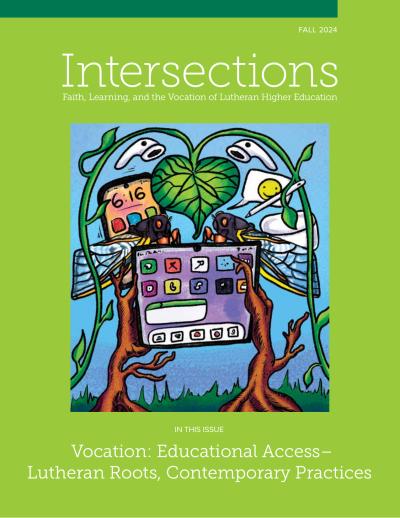 Article
Access, Accessibility, & Change: A Call for Trustworthy Leadership in Higher Education
Emma Jones
No. 60 · Fall 2024
Jones surveys the converging pressures on higher education — cost, the enrollment cliff, shifting demographics, and declining public confidence — and uses Reichheld and Dunlap’s four factors of trust (transparency, capability, reliability, humanity) to call campus leaders to rebuild trustworthy leadership from the inside out.
-
 Article
Engaging the Local Community: Why Bother?
Mary S. Carlsen
No. 27 · Spring 2008
Carlsen traces the often adversarial history of town-gown relations from the medieval universities through the Battle of St. Scholastica Day to the “ivory tower” pattern of American higher education, then argues that Lutheran colleges should engage their local communities for practical, educational, ecological, moral, and theological reasons. Drawing on her work in social work education at St. Olaf and on Ira Harkavy, Ernest Boyer, and the ELCA’s “Our Calling in Education,” she offers a recipe for engagement that is Passionate, Ethical (Needed, Welcomed, Mutual, Long-term, Attentive to diversity, Strengths-based, Respectful), and Reflective.