In 2004, Augustana College in Rock Island joined with the other recipients of Lilly Endowment grants, including nine Lutheran institutions, to explore the question of what difference the concepts and language of “vocation” could make in the lives of our students and the self-understanding of our campuses. The other two schools featured in this issue, Luther College in Decorah and Augsburg College in Minneapolis, and Augustana also received sustaining grants that allowed us to follow up the work of the initial grant period. The three schools have come together with the help of the Wilder Institute to study what we have done well (and not so well) and to make available to others what we have learned in our journey. Each of the programs is different, and each successful. We offer the descriptions and “learnings” in this issue to others who might want to follow our path.
What have we done?
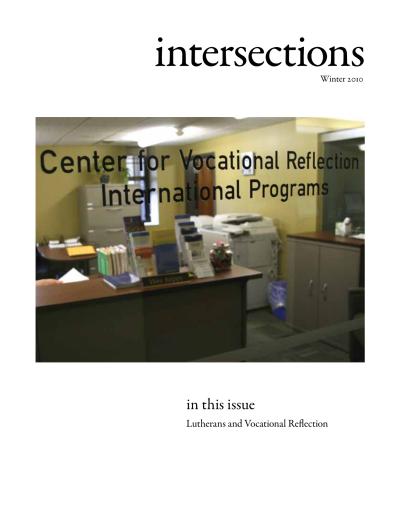
At Augustana, the decision was made to establish a center with a physical location for this effort, the Center for Vocational Reflection. This CVR was staffed with a director, a program associate, and a program coordinator who handled the secretarial aspects of our work. Later, a second program associate was added to the staff.
The focus of the work of the CVR is illustrated by a diagram with three overlapping circles labeled “Skills, Gifts, and Talents,” “Passions and Values,” and “Needs of the Community.”
We asked, over and over again, three sets of questions: What are your skills, gifts and talents? What are your passions and values? What are the needs of your community? Our belief and experience is that when and where these questions are addressed and where the answers overlap, that convergence becomes for that student their “definition” of vocation.
Mark Tranvik, in his article in this issue, has outlined the particular nuance and history of the concept of vocation that informs a Lutheran understanding. This same understanding has shaped our use of the term. We have also been conscious that many of our students do not identify themselves closely with the Lutheran, or any other, religious tradition. We worked to find language and concepts that would allow and invite specifically religious conversation with students for whom this was part of their self-understanding, but also was helpful and inviting to those who saw themselves as “spiritual, but not religious” or even those who did not consider themselves religious in any sense. What we found, along with the other “Lilly schools,” is that the language and concepts of vocation are productive in a very wide range of settings. As Lutherans, this doesn’t surprise us. We expect that our understanding of principles is relevant even beyond those who call themselves Lutherans!
The center of our work has been conversations in a wide range of settings with students (and truth be told, with a lot of faculty, staff and members of the community also). Much of the programming that we have done is designed to create contacts and settings that allow and encourage conversations around the questions raised above.
This is particularly true with programs designed to reach out to students who are considering these issues directly and explicitly. Sometimes this involves students who are trying to discern a calling to work in the church professionally. We have met on a regular basis with such students in a group called Working with Faith. While conversations in the group often surround aspects of the ordained ministry, it also recognizes that there are a wide range of professionals serving the church today. We have had programs on camp ministries and youth ministry and music ministry—any area that members of the group would like to explore as they try to find their path. A significant element of this discernment has been the CVR’s support of visits to seminaries for those who believe this might be their way. We have taken trips twice a year to a range of seminaries, from east to west coast and many places in between. These usually entail visits to Lutheran seminaries, but are not exclusive to them. We work with all students of all denominations (or no denomination) to help them find the “right fit” for their work and study. We have helped students to move from Augustana to study at most of the Lutheran seminaries but also such places as North Park Seminary in Chicago, Trinity Seminary in Deerfield, Ashland Seminary in Kentucky, Yale Divinity School and others.
We have also been supportive of those students and employees who are seeking spiritual discernment in their lives while at the college. We fund one-on-one meetings with certified spiritual directors. We also have invited together a successful group called Spiritual Companioning that meets to share with each other their spiritual journey. With the help of a faculty member trained in spiritual reflection, this small group meets on a regular basis over lunch to discuss where they are and to practice their spirituality.
While meetings with the staff of the CVR are a very important part of the work we do at Augustana, we also know that we will not be able to have conversations with every member of our community if we limit our contact to those who seek out the CVR.
Work with internships illustrates this point. The CVR at Augustana offers a number of internships. Probably the most important program that we run is the Servant Leader Internships. This program uses Lilly Endowment funds supplemented by funds from the local Amy Helpenstell Foundation to allow students to “try out” the careers to which they feel they are being led. These funds allow students to work in religious and not-for-profit settings that often are not able to pay stipends for this work. The funds allow students to participate during the school year or during the summer, time when they might otherwise need to hold jobs to earn money for their education. Many of these internships are with local agencies, from the Girl Scouts, to art museums, to the botanical center and many others. We also have been able to provide an intern that works with Luther Place in Washington, DC and other placements throughout the country. Interns have worked all across the globe, from Switzerland to Africa to Latin America. In all cases, the goal of the internships is to help the students come to understand their own vocation in the context of their studies, their lives and the lives of their community. Each student reflects on these questions while in the internship and also on their return to campus. While these internships are easy to define as “successful” if a student finds just the right fit between their calling and the career they are trying out, we also consider it a successful internship if a student finds through the experience that the career they thought was a fit was not. A young woman who believed working with troubled teens was her life-work found out that it wasn’t…and also found a better fit in another aspect of the mental health system. This was surely a success for us… and her!
We have also worked very closely with the Office of Internship Services and the internship director for business internships. They have seen the value of these conversations with their interns also. Now, all interns in any program at the college are asked to write a reflective paper on their internship in order to successfully complete that experience. Very often these reflections are discussed at “reflection dinners” that bring together interns (and sometimes donors and supervisors) to share their experiences upon their return to campus. Reflection on vocation is simply part of the way we do internships, whether directly connected to the CVR or not.
The importance of reflection during and after student’s experience of international travel is well documented. With the establishment of an Office of International and Off-Campus Programs at Augustana has come the ability to ensure that international experiences of all types are followed with programs to encourage the students to process these experiences when they return to campus. This usually entails essays and dinners in which the questions of vocation and needs of the community are central. We have begun to document the effects of these programs through the administration of the Global Perspectives Inventory [https://gpi.central.edu/]. This instrument is able to determine the level of awareness and engagement with cultures outside the student’s normal experience. Again, this reflection has become simply part of the way we now do international travel at Augustana.
Probably the most significant internalization of vocational reflection into the Augustana culture has come in conjunction with a major curriculum revision, Senior Inquiry. This program expects all students to engage in a capstone research experience as part of their major. The centerpiece of this capstone project, no matter which department, is the expectation of reflection on that experience.
“The expectation for student Senior Inquiry projects is that they will meet the following outcomes:
- Substantial in meaning and impact
- Communicative of the discoveries made through the project
- Reflective of one or more of the following:
- the nature of knowledge and inquiry
- self-awareness and connection with others
- the relationship of individuals to a community”
Nearly all Augustana students participate in this program. This brings vocational reflection into the very heart of what we do at Augustana. The effect of Senior Inquiry has been particularly important. Faculty soon realized that we could not expect students to engage well in such reflection if they were not asked to similarly reflect earlier in their program. Nearly all majors now ask students to begin asking and answering these questions when they enter the major and throughout their program. We now see these same questions becoming the focus of our first-year general education program and in other general education courses.
This description indicates that vocational reflection has become part of the educational enterprise at Augustana. The CVR supports it in the ways we have discussed and many others. One count numbered the CVR-related programs at over twenty. Not all of these programs are directly curricular. We have supported campus-wide conversations over two years on The Values of Augustana. We have hosted a large number of speakers who model to students that the path to successful vocation is rarely in a straight (or obvious) line. We have led countless small group discussions of Parker Palmer’s Let Your Life Speak. We have celebrated a move to new quarters with a “CVR-nival” that introduced us to many new students during the beginning of the school year. And we have worked with individual students who come to us saying “Can you help me figure it out?”.
A major part of our outreach to the students and community are programs of students associated with and supported by the CVR. Each year we bring together five to seven students who come to us with ideas that they believe will be effective in bringing the vocational conversation to their peers. We meet with these students regularly. We provide them with the support (financial, intellectual and spiritual) that they feel they need in order to implement their ideas. Often these programs have turned out to be the most successful programs that we have run. An example of one of these is Athletes Giving Back, initiated and brought to maturity by a student, Erin Blecha. Erin’s story is included in this issue. Other programs have established afternoon mentoring programs for grade school age youth at a Lutheran congregation near campus. Another has brought together Augustana students with local high school students in their setting. Another has worked with alumni and fraternities to create mentoring pairs to talk about vocation and life after Augustana.
What have we learned?
There can be no doubt that the funding available because of the Lilly Endowment grant has been extremely helpful in establishing the culture of vocational reflection at Augustana. As important, however, is the energy of faculty, administration and students surrounding these ideas. Many of these programs are associated with work we are already doing at our institutions. It is not a matter of “adding vocation” to the work we are doing but rather recognizing the vocational aspects of much of the work we are already doing, and have been doing for many years even before the impetus of the Lilly funding.
In the end, it is the power of the ideas that will make the biggest difference on the campus. The Lutheran concept of vocation is a powerful idea. That each student’s life and work is important not only to them but to the communities to which they belong is a message that is as relevant and important today as it was in Luther’s time and before. What the Lilly funding did was allow us to focus on these concepts in new ways and to try out for our institutions new ways of entering these conversations. Our experience at Augustana and among the “Lilly schools” is that paying attention to these questions is the necessary crucial first step. This step is more important than any individual program that we have developed to carry this process forward. No one program, no one structure, no one “silver bullet” will lead to success. In fact, one of the most important “learnings” of the experience we have had is that the effect of these ideas on students comes from multiple encounters with the concepts over the full time at our institutions. One time programs, standing alone, will likely not be effective. Multiple exposures, in multiple places (curricular, co-curricular, extra-curricular) are what it takes for these ideas to become part of who our students are and become.
An important “learning” at Augustana has been that this language works for all students, not just those who are predisposed toward religious language. Many of our students do recognize the importance of religion in their lives. With them we are more than happy (and able) to use the full range of religious language to talk to them about these deeply important issues. Other students are less comfortable or even hostile to religious language.1 Even these students are able and willing to talk about their own skills, gifts, and talents, about their own values and passions, and about how they will respond to the needs of the community. This language is rich enough that it provides entrée into the conversation from many angles. For us, language that is inviting and multivalent has proven to be important and useful.
Another (surprising?) thing that we learned was that our most successful programs where often the ones suggested by students and faculty. Even times when the idea seemed unlikely to succeed, the success rate of ideas generated outside the CVR was great. We came to learn that the power of the idea of vocation was such that we could trust the idea, and those who became committed to it.
As at the other Lilly schools, a key ingredient in the success of the program is the support of key constituents. Probably this list will vary from campus to campus. At Augustana we had strong and early buy-in from all levels, from the president and dean of the faculty to faculty and staff. This was particularly important as the elements of vocational reflection worked their way into the curriculum of the college.
An element of the programming at Augustana (that is also reflected in materials from the other schools) grows out of a recognition that it is not only individuals who have vocations. Institutions also have (or should have) responses to the central questions we are asking. The CVR has become one of the instigators of identity questions on campus. This happens in a variety of forums. We sponsor a weekly gathering called Coffee and Conversation that brings together faculty, staff and administration to a unscripted coffee-hour. Conversations range from the silly to the sublime, but always work to build community across divisions that form in any institution. The CVR also has sponsored conversations between the faculty and the president, especially in the time of the recent economic disruptions. We also sponsored a two year series on The Values of Augustana. The purpose of this series was to give members of the community a chance to state their understanding of our institutional values, and have these remarks be the launching pad for conversations among all present of what are and should be institutional values and identity. These talks were published in a form that is used to continue the conversation with those coming into the community—faculty, staff, or administration.
What do we hope?
Where do we go from here? In just the same way that no one of us could have predicted at the beginning of this journey that we would end up where we are, no one can say precisely where we are headed. One thing is certain: as long as the programs of vocational reflection are alive and well on our campuses, they will continue to evolve along with the students and the institutions. We do not expect that five years from now, we will look the same.
We hope that some of the things that we have learned might be helpful to others who share these values. We think that this is particularly relevant to those colleges and universities that look to the Lutheran tradition for their own vocation. We hope that the results of the study of the Wilder Foundation described in this issue will encourage others to try to implement these ideas on their campuses. And we all offer our support and experience to extend these programs.
At Augustana, the CVR will be changing once again to a new conception. Next fall the CVR will become part of a new entity—The Community Engagement Center. This will bring us into closer connection to offices on campus with which we have already worked closely—those interested in career development, internships, off-campus programs, entrepreneurial development, volunteers and service-learning. This new configuration will enable us to move even more easily beyond the campus to the communities in which we find ourselves—both local and global. When we were just starting a tiny program on campus, Kristen Glass (who now directs the Young Adult Ministry program for the ELCA) declared with exuberance, “Vocation cannot be contained!” These words continue to be prophetic!
Endnote
- The complexity of student’s relationship with religion and spirituality is explored in Smith and Snell, Souls in Transition.
Works Cited
Palmer, Parker. Let Your Life Speak. Jossey-Bass, 2000.
Smith, Christian, and Patricia Snell. Souls in Transition: The Religious & Spiritual Lives of Emerging Adults. New York: Oxford UP, 2009.
-
 Editorial
From the Publisher
Mark Wilhelm
Wilhelm traces his decades-long enthusiasm for the Lutheran doctrine of vocation from his St. Olaf days reading Luther’s Open Letter to the German Nobility, notes Parker Palmer’s lecture-circuit ministry and Mark C. Taylor’s reflections on calling, and argues that ELCA colleges should claim vocation as the defining mark of Lutheran higher education—yet warns that vocation risks becoming “the program du jour” rather than a permanent hallmark.
-
Article
Called for Life — Affirming Vocational Discernment
Richard L. Torgerson
Torgerson introduces the “Called for Life” project, a three-year, $278,437 Lilly Endowment-funded collaboration among Luther, Augsburg, and Augustana that—in partnership with Luther Seminary’s Centered Life initiative and Wilder Research—rigorously assessed the effectiveness of campus vocation programs, examining whether students’ exposure to and understanding of calling had increased, and what program elements were most effective in shaping discernment.
-
Article
Called for Life
Brian Pittman, Ellen Shelton, Greg Owen
Owen, Shelton, and Pittman of Wilder Research present the key findings of the Called for Life study, comparing the class of 2007 “Lilly graduates” from Luther, Augsburg, and Augustana to a pre-Lilly cohort from the class of 2001. They report that Lilly graduates were more than twice as likely to associate vocation with “calling” rather than “just a job,” and they identify four common ingredients of effective programming: relationships with caring adults, experiential learning outside the classroom, vocation-infused courses, and peer relationships within a pervasive campus culture of vocational exploration.
-
Article
A College with a Calling: Vocation at Augsburg
Mark D. Tranvik
Tranvik narrates Augsburg’s decade of deep engagement with vocation—from President William Frame’s 1997 visioning process and the 2002 two-million-dollar Lilly grant for Exploring Our Gifts, through five Lutheran theological principles (vocation includes the whole life, lives for the sake of others, ranks all callings equal, cannot be reduced to ethics, and engages public life), to the Wilder Foundation’s Called for Life assessment and the 2008 founding of the Augsburg Center for Faith and Learning under Dr. Tom Morgan and the Bernhard Christensen Chair held by Dr. David Tiede.
-
Article
Sense of Vocation
Ruth R. Kath
Kath describes Luther College’s Sense of Vocation program, organized into three components: General Program Initiatives (Vocation Visitors such as Parker Palmer, the Faith and Learning Workshop, self-directed reading grants, publications, and travel funds), the Church Ministry Program (Vocation Fellowships, the DIAKONOS discernment group, seminary visits, alumni discernment retreats, church leader workshops, clergy renewal, and the WIYLDE youth initiative), and the All-Student Vocation Program (Paideia I orientation, Peer Mentors, Capstone curriculum development grants, the Vocation Advising Workshop, and a Vocation Advising Handbook).
-
 Book Review
Assessing the Value of Liberal Arts: A Review of The Evidence Liberal Arts Needs, by Richard A. Detweiler
Robert D. Haak
No. 55 · Spring 2022
Haak reviews Richard A. Detweiler’s The Evidence Liberal Arts Needs, in which the former president of the Great Lakes Colleges Association analyzes 240 college mission statements and interviews more than 1,000 graduates to argue that liberal arts educational experiences have a measurable impact on adult lives of consequence, inquiry, and accomplishment — and invites NECU institutions into a further conversation about how Detweiler’s methodology applies to Lutheran higher education.
-
 Article
The Vocation of Intersections on its Twentieth Birthday
Jason A. Mahn, Robert D. Haak, Tom Christenson
No. 43 · Spring 2016
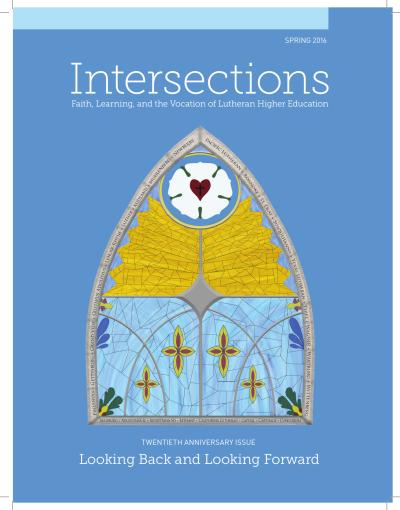
The three editors of Intersections — Bob Haak, Jason Mahn, and Tom Christenson (in spirit, following his death in 2013) — trace the twenty-year vocation of the journal itself: its 1996 birth at Capital University; its coming-of-age years of debate over institutional markers, two-kingdoms theology, and Lutheran identity; the ascendancy of “education for vocation” as the central marker of Lutheran higher education; and its ongoing identity in relation to a changing ELCA and to the broader cultural conversation about purpose, wholeness, and the vocation of higher education.
-
 Editorial
From the Outgoing and Incoming Editors
Jason A. Mahn, Robert D. Haak
No. 34 · Fall 2011
Outgoing editor Robert D. Haak reflects on a six-year run inheriting Intersections from founder Tom Christenson, the “powerful voices” that have driven the conversation (Dovre, Jodock, Christenson, Simmons, Morgan, Olsen, Wilhelm) and the newer ones now entering (Mahn, Bussie); incoming editor Jason A. Mahn, picked up from the airport in Bob’s pickup truck five years ago, names central issues that “Lutherans on Faith and Learning” engages and previews essays by Dovre, Jodock, McDonald, Hill, Turnbull, and Jodock again.
-
 Editorial
From the Editor
Robert D. Haak
No. 33 · Spring 2011
Haak frames the issue by asking how Lutheran colleges and universities understand the changing landscape of religious identification on their campuses, and argues that Lutheran theological commitments — including the work of the Spirit and the Incarnation — call institutions to create places where the voice of “the other” is heard and valued.
-
 Editorial
From the Editor
Robert D. Haak
No. 30 · Fall 2009
Haak frames the issue around the question of Lutheran college identity as formed in distinction from some “other,” introducing essays by Witherup on the Joint Declaration, Reuther on Holden Village, Afzaal on Christian-Muslim dialogue, Dovre on the history of Midwestern Lutheran colleges, Radecke on service-learning, and Ratke on Wilhelm Löhe — each making the claim that the “other” is an essential partner in conversation who helps us know who we are and shape who we will become.
-
 Editorial
From the Editor
Robert D. Haak
No. 29 · Spring 2009
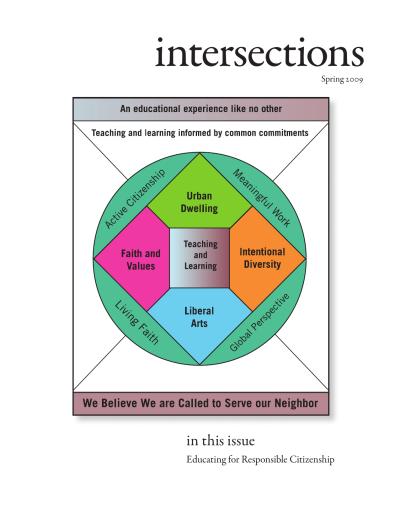
Haak frames the issue’s essays around the question of Lutheran colleges and the role of citizen, noting H. Richard Niebuhr’s typology in Christ and Culture and Luther’s own complex understanding of Christian and state, and offers a fitting farewell to Arne Selbyg with Mike Blair’s tribute song “A Fine Norwegian.”
-
 Editorial
From the Publisher
Arne Selbyg
No. 21 · Summer 2005
Selbyg notes that ELCA colleges and universities have remained more loyal to the church than the institutions of many other denominations and announces that with this issue Tom Christenson’s nine-year service as editor of Intersections comes to an end, with Bob Haak of Augustana College in Rock Island assuming the editorship and institutional support shifting from Capital to Augustana.
-
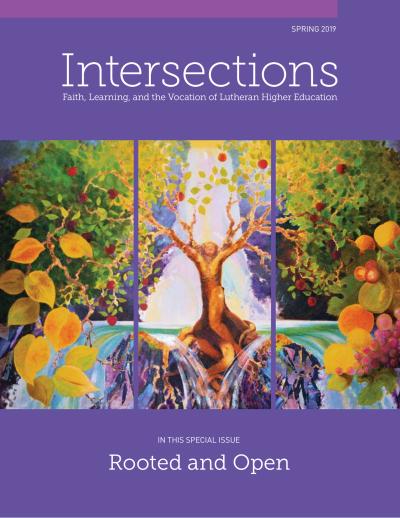 Article
Roots and Shoots: Tending to Lutheran Higher Education
Jason A. Mahn
No. 49 · Spring 2019
Mahn revisits why “education-for-vocation” has become a leitmotif for the 27 NECU schools, distinguishes institutional vocation from individuals’ religious identities and educational priorities from their theological grounding, and offers a friendly critique of Jodock’s bridge metaphor: Lutheran colleges grow in two directions like plants — deep roots and wide branches alike require constant tending.
-
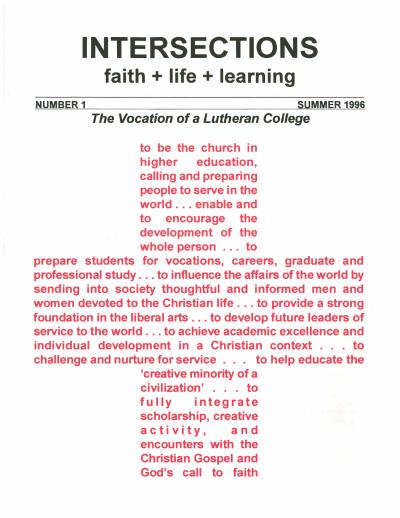 Response
Knowing and a Tradition to be Known
Kurt Keljo
No. 1 · Summer 1996
Keljo, University Pastor at Capital, embraces Schwehn’s vocational call but challenges his epistemological framing. We are called to bear witness to the Truth more than to pursue it; truth and power need not be dissociated when power is understood cruciform-ly as love and service; alongside objectivity, a case can be made from the tradition for connected knowing (image of God, idolatry, repentance, Incarnation). Christians offer not a particular epistemology but a foundation for epistemology—a tradition to be known. He closes with James Fowler’s four marks of the “public church”: particularly Christian, prepared for pluralism, balancing intimacy with public engagement, and unafraid of ideological pluralism in confident, nondefensive civility.
-
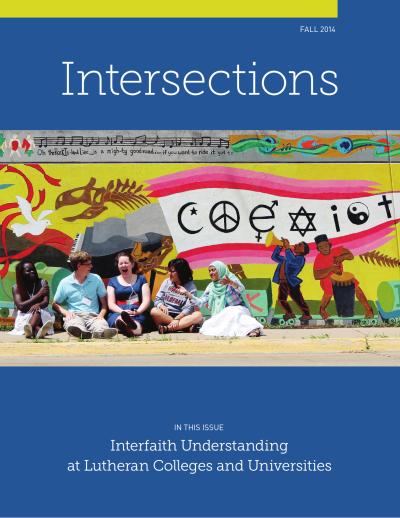 Article
What it Means to Build the Bridge: Identity and Diversity at ELCA Colleges
Eboo Patel
No. 40 · Fall 2014
Through the contrasting stories of two college students — Cassie’s identity relativism and April’s soft fundamentalism — Patel diagnoses Peter Berger’s twin pathologies of modernization and argues that ELCA campuses, anchored in Bonhoeffer and the Lutheran capacity to “have faith without laying claim to certainty,” are uniquely equipped to be places where the light falls: bridges of cooperation that nurture both strong religious identity and benevolence toward others.
-
Editorial
From the Outgoing and Incoming Editors
Jason A. Mahn, Robert D. Haak
No. 34 · Fall 2011
Outgoing editor Robert D. Haak reflects on a six-year run inheriting Intersections from founder Tom Christenson, the “powerful voices” that have driven the conversation (Dovre, Jodock, Christenson, Simmons, Morgan, Olsen, Wilhelm) and the newer ones now entering (Mahn, Bussie); incoming editor Jason A. Mahn, picked up from the airport in Bob’s pickup truck five years ago, names central issues that “Lutherans on Faith and Learning” engages and previews essays by Dovre, Jodock, McDonald, Hill, Turnbull, and Jodock again.
-
 Article
Making Diversity Matter: Inclusion is the Key
Monica Smith
No. 50 · Fall 2019
Smith, Augustana’s inaugural Vice President for Diversity, Equity and Inclusion, frames the work of a Chief Diversity Officer as that of a disrupter and argues that while diversity in higher education is already happening, inclusion is a choice — one requiring a fundamental institutional transformation that diversifies faculty and staff, infuses diversity into the curriculum, invests in professional development, and draws on senior leadership to dismantle barriers.