“I don’t want to be deceived,” he said. “I am looking to Reason to keep me from illusion.” Jerry was one of my brightest philosophy majors. His father was a pastor. Under the influence of higher criticism of the Bible and Nietzsche, however, the effect of countless sermons and his religious upbringing had diminished. Jerry was convinced that his father was deceived and that Jerry himself had been brought up in a faith that was little more than wishful thinking. “Reason” was going to protect him from illusions that might try to trap him later in life.
Any criticism of the Enlightenment and contemporary Christian higher education must consider the relation between (1) postmodernism, (2) the ethic of love and peace espoused by the Christian Church, and (3) the meeting of (1) and (2) in the church-related college. I believe that we must think about how to construct a university where the rhetorical power of this dichotomy between rhetoric and dialectics no longer holds the minds of students like Jerry. We must both break down the dichotomy and learn to value the power of words.
The dichotomy is common and ancient: truth opposes illusion, reason opposes power, philosophy opposes rhetoric, and real argument opposes merely verbal links in discourse. Almost every philosopher since Plato, who sets out the dichotomy in the Apology, dwells on these oppositions. Interestingly, even those who chasten and restrict reason do not hesitate to make the opposition and condemn rhetoric. Alasdair MacIntyre offers up a familiar and representative lamentation: “In the forums of popular life rhetorical effectiveness in persuasion and manipulation prevails against rational argument.”1
Accordingly, I will begin with an account of MacIntyre’s proposal, in his book Three Rival Versions of Moral Enquiry, for a postliberal university. MacIntyre’s postliberal university institutionalizes the conflict of wills that postmodernism claims is everywhere. I will then turn to John Milbank’s criticism of MacIntyre’s position. According to Milbank, MacIntyre’s position is neither Christian nor postmodern. I will sketch a part of Milbank’s criticism of MacIntyre in order to show some problems with taking the postliberal university as a model for a church-related college. Finally, I will offer a modest proposal for the form of discourse that should prevail in a church-related college.
The concepts of “power” and “violence” provide the basis for the opposition. According to philosophy, rhetoric values effectiveness and power, regardless of the rational merits of the case. Violence destroys or tears apart integrity—the integrity of the will, of the mind, of the body. Rhetorical power becomes violent when it does not respect the rationality and will of the hearer, when it aims to impose the will of the speaker on the hearer.
While traditional philosophers want to avoid violence, postmodern philosophers think that violence is unavoidable, but that some forms of violence are better than others. That is, philosophers like Nietzsche and Deleuze maintain the dichotomy, but they defend the sophists. Everything is the will to power. Dialectical argument merely disguises the will that seeks to dominate other wills. It is not on that account less a will.
I. The Postliberal University
In his Three Rival Versions of Moral Enquiry, Alasdair MacIntyre distinguishes three types of universities. The preliberal university of 18th and 19th century Scotland and the United States could assume a fairly homogeneous and well-educated public. Aided by religious tests to exclude and promote faculty, it was able to advance considerably. The preliberal university produced a constrained agreement. The liberal university claims to open its doors to all. By doing away with religious tests, it would promote progress and agreement in all areas of knowledge. The liberal university, then, claims to produce an unconstrained agreement. In fact, however, we can now see that the liberal university does impose constraints. Further, these constraints have cost the liberal university the resources to understand and to justify its own existence.
If we cannot return to the constrained agreement of the preliberal university, nor to the feigned unconstrained agreement of the liberal university, where shall we go? MacIntyre suggests that we should develop a university system that will be a “place of constrained disagreement, or imposed participation in conflict, in which a central responsibility of higher education would be to initiate students into conflict.”2 What would this look like? MacIntyre continues,
Surely a set of rival universities would result, each modeled on, but improving upon, its own best predecessor… And thus the wider society would be confronted with the claims of rival universities, each advancing its own enquiries in its own terms and each securing the type of agreement necessary to ensure the progress and flourishing of its enquiries by its own set of exclusions and prohibitions… But then also required would be a set of institutionalized forums in which the debate between rival types of enquiry was afforded rhetorical expression.3
MacIntyre’s postliberal university has two tiers, both of which emphasize constraint and conflict. First, the university must establish its own identity. This university will look much like the preliberal university that embodies a constrained agreement. That is to say, arguments alone are not enough to establish agreement; there must be some authority to enforce agreement. For the Thomist university, this authority will be the church, and ultimately the Pope.4
This is not a simple sectarianism, however. MacIntyre’s sketch of the university is an attempt to institutionally embody a tradition and to allow for dialogue between other institutionalized versions of moral enquiry. If this were sectarian, they would never come into contact with each other. So, second, the universities in the system need to engage in open hostilities on a level fighting field. In spite of the claim, in Three Rival Versions, that this conflict will have a rhetorical expression, Whose Justice? Which Rationality? clearly indicates that these conflicts are mediated dialectically. Moral enquiry progresses, according to MacIntyre, through open argument both within a tradition and across traditions. The best tradition will be able to solve the problems of other traditions and be able to account for the failure of the inferior tradition. Let us then define the postliberal university as a place of dialectically mediated conflict and constrained agreement. Such is the postmodern opportunity for the university according to MacIntyre.
A. Counter Ontologies
An ontology of violence posits a primordial conflict that politics, morality, and dialectics each attempt to overcome or limit with another act of violence. Milbank finds an “ontology of violence” in the philosophy and institutions of the ancients, the moderns, and the postmoderns. Since the ancients and the postmoderns are committed to an ontology of violence, MacIntyre’s choice between Aristotle and Nietzsche does not present us with true alternatives.
In contrast with the history of philosophy, Milbank finds an “ontology of peace” expressed in Augustine’s The City of God. Peace is a harmonious agreement based in charity. Christianity posits an ontology of peace because God is the most basic reality, and the God of Christians is a God who is love in trinity and who created the universe out of generosity and love. Milbank argues that only Christianity provides an ontological option to violence. The church is that society which promotes and incarnates the charity made possible through the life, death, and resurrection of Jesus.
B. Counter Universities
While Milbank does not consider the implications of his criticism for a university or for a church-related college, one might easily generate a series of questions that extend the criticism to MacIntyre’s proposal for the postliberal university. Is a “place of constrained disagreement, imposed participation in conflict” compatible with a society founded on an ontology of peace? Can a higher education that is Christian both attend to its identity within the Christian tradition and engage in open hostilities as instituted in the postliberal university? Can a postliberal university exist in the City of God?
II. The City of God
MacIntyre has come under attack by John Milbank in his Theology and Social Theory.5 According to Milbank, MacIntyre’s move to dialectics in Whose Justice? Which Rationality?6 shows that he is too much the philosopher and not sufficiently Christian or postmodern. Dialectics is itself a form of the will to power. Insofar as MacIntyre does not realize this, he has not yet crossed the bridge of postmodernity. Insofar as he still appeals to dialectics, he remains within an ontology of violence and has not yet taken up the cross of Christian peace.
I am interested in the second criticism for the purposes of this essay. That is, I want to ask if violence and conflict are necessary and constitutive parts of the life of the mind. If dialectics is itself the embodiment of conflict, how might we begin to think differently? In what follows, I will first draw the distinction between the ontology of violence and the ontology of peace. I will then contrast MacIntyre’s Thomist postliberal university with the church-related college.
If MacIntyre’s post-liberal university and the church-related college are rooted in mutually exclusive categories, then the postliberal university would amount to an institutionalized hostility to Christian identity. To take MacIntyre’s postliberal university as the model for the church-related college would be to forfeit the college’s identity in the mission of the church. I will argue that MacIntyre’s postliberal university is modeled on an ontology of violence insofar as it defines itself by dialectical argument. The church-related college articulates an ontology of peace insofar as it embodies a history of faith and persuasion.
1. The Thomist University
Consider first the Thomist postliberal university. Thomism, for MacIntyre, is part of the history of philosophy or intellectual history.7 He reads Thomas, in the end, as a philosopher rather than as a theologian whose work reflects the faith and practice of the church. Thomism is a set of beliefs, an intellectual position, an extended dialectical argument, that is, a tradition.
A Thomism instituted in a postliberal university requires conflict. This conflict is mediated dialectically. Otherwise said, dialectic is the intellectual management of conflict. The Platonic dialogues, Aristotle’s method, and Thomas’s method show dialectics as the attempt to bring many competing voices into a unified harmony.8 This unified harmony is the Idea of the Good and of peace.9
Postmodernism asks whether dialectics can bring about such harmony. Socrates and Plato face this question when they confront the Sophists, and Aristotle confronts it as well, since “good” can be said in many ways. Plato, Aristotle, and many Thomisms were not entirely successful in achieving a harmony through dialectical means. Neither did the preliberal or liberal university succeed. While MacIntyre appeals to dialectics, agreement within the postliberal Thomist university is itself guaranteed by a decree of the Pope. If dialectics cannot establish harmony, “then only a merely ‘effective’ peace is possible, a ‘secular’ peace of temporarily suspended violence or regulated competition.”10 That is, the conflict is only resolved by one party imposing their will on another.
2. The Church-Related College
Contrast the Thomist university with the nature of the church-related college. The church-related college differs from non-affiliated colleges in that it serves the mission of the church in some way. The church is the community of those people whose lives have been claimed by the God who is love and peace. The preeminence of the peace of the Lord, however, is not established or shown dialectically, by managing conflict through argument. Rather, it is established by God in Jesus, and it is shown in the life and preaching of the church. Phillips Brooks says,
However, the Gospel may be capable of statement in dogmatic form, its truest element we know is not in dogma but in personal life. Christianity is Christ; and we can easily understand how a truth which is of such a peculiar character that a person can stand forth and say of it, “I am the Truth,” must always be best conveyed through, must indeed be almost incapable of being perfectly conveyed except through, personality. And so some formal preaching must be essential to the prevalence and spread of the knowledge of Christ among men.11
Note two interrelated points. First, while dogmas are important and necessary, the church is not founded on dogma or a set of articles. Second, and this is crucial, this first point does not mean that we stop preaching. Jesus preached: Peter and Paul preached. In preaching, the church takes its native form. As a form of discourse, preaching’s primary goal is not to establish any given set of ideas. The truth of the gospel is the person of Jesus, and this truth is communicated through the personality of the preacher as he or she preaches. Preaching articulates a counter-logos which is neither dialectical nor sophistical rhetoric. It is more original than either. The Christian logos gives “pride of place to opinion (doxa), testimony (marturia) and persuasion (pistis).”12 The God of peace is revealed through the power of the Word.
Both of these points help to clarify the difference between the Thomist university and the church-related college. The church-related college is not founded on any one doctrine or school of thought, and its goal is not to produce more and better scholars. Perhaps Thomism is a tradition of moral enquiry: Christianity is not. While Christianity has much to say about the things that concerned philosophers, it is not on that account oriented and guided by philosophy. Christianity is not one more competing vision of the good life. It is not graspable through dialectics; it is not itself promulgated through dialectics. It is a mode of discourse aiming to reveal the God of peace with whom the apostles were acquainted. “Perhaps,” Milbank says, “we have to take more seriously the Biblical narratives… which presumably tell how things happened in the very idiom adopted by their users for the making-of-things-to-happen.”13
Further, this “idiom,” this preaching that humans can now be reconciled to God and to each other, contains an acid that cannot be neutralized by philosophical systems or arguments, and this too can be seen in the preaching of the apostles. John Howard Yoder observes that the apostles did not request “free speech and room for one more stand in the Athenian marketplace of ideas for a new variant of already widely respected diaspora Judaism.” Rather,
A handful of messianic Jews, moving beyond the defenses of their somewhat separate society to attack the intellectual bastions of majority culture, refused to contextualize their message by clothing it in the categories the world held ready. Instead, they seized the categories, hammered them into other shapes, and turned the cosmology on its head… The development of a high Christology is the natural cultural ricochet of a missionary ecclesiology when it collides as it must with whatever cosmology explains and governs the world.14
In the arena of ideas, Christians do not fight fairly. Which is to say that they don’t fight. They do not pit Christian ideas against non-Christian ideas. Rather, they introduce the person of Christ who is irreducible to any and all ideas. Christianity will always oppose the absoluteness and adequacy of every system or idea, while refusing itself to be reduced to a system or an idea. Philosophy will always find Christianity an unassimilatable phenomenon. Like the Son of Man, Christianity is nomadic. It is the reef upon which the ships of idolatrous philosophies are wrecked. The effect of this preaching, Yoder insists, is an intellectual pluralism and relativism, for
pluralism/relativism is a confusing world, but it is not an alien one. It is the child of the Hebrew and Christian intervention in cultural history. It is the spinoff from missionary mobility, from the love of the enemy, from the relativizing of political sovereignty, from a dialogical vision of the church, from a charismatic vision of the many members of the body, from the disavowal of empire and theocracy. It lays before us the challenge of convincing interlocutors who are not our dependents, of affirming a particular witness to be good news without being interested in showing that other people are bad.15
The Christian witness, like the Word about which it testifies, is active and affirming. Conflict with and reaction to “other views” does not constitute the first move or have priority.16 The first move in the Christian witness is not our move at all. Rather, God comes and reveals himself to us as love. Our response to God’s love constitutes the second move. The second move is not exclusively or primarily a matter of intellectual assent but an obedience expressed in love for one’s neighbor. This is the essentially active and affirming nature of the Word and of the preaching of Christian witness. Only such a Word and such a witness can embody an affirmation of power that is non-violent.
This non-violent affirmation precedes the violence of both rhetoric and dialectics, as well as the violence embodied in the dichotomy between rhetoric and dialectics. That is, the Christian witness refuses to impose its will on others, either dialectically or rhetorically (I Cor. 1:17, 2:13), for this is the way God treats us.17 This feature of the Christian witness prevents the church-related college from taking the postliberal university as an acceptable model.
MacIntyre himself catches sight of part of the problem when he ceases to play the role of the philosopher. He claims “this divorce between rhetorical effectiveness and rational argumentation is deeply at odds with the thirteenth-century Dominican ideal, especially as articulated by Aquinas, in which the homily was to be the end-product of an education in philosophy and theology.”18 The divorce also runs counter to the self-understanding and goals of many of those who founded our church-related colleges, not for training scholars capable of engaging successfully in dialectical warfare, but for preparing those capable of being witnesses (µαρτυρες) of Jesus.
The affirmative message of Christian preaching does respond to “other views,” but only as a third moment in the Christian witness. These other positions are not merely “unjustified,” or “an expression of (bad) power,” but “idolatrous.” The category of idolatry indicates that the problem is not so much intellectual confusion or dullness, but our disordered loves. These disordered loves can keep us from confronting God as a person, rather than as an idea, and they bar us from full participation in the City of God. Preaching introduces disordered lovers to the God who is love. The church-related college, taking its guide from the preaching of the church, seeks to educate our desires and set them in order.
III. Conclusion
Jerry, the student to whom I referred above, understood Christianity as a set of beliefs that have an absolute status. He thought that he had lost his faith when he exchanged one set of absolute ideas for another set of equally absolute ideas. The first set of ideas had been instilled in his mind rhetorically; the second set imparted dialectically. He thought that “Reason” stood outside of all power and could save him from “illusion.”
Neither the liberal nor the postliberal university have the resources to respond to Jerry’s loss of faith, for they are rooted in a dialectically managed conflict of ideas. That is, postmodernism shows us that dialectics, rhetoric, and the opposition between them all assume a form of violence. By institutionalizing these forms of discourse, both the liberal and postliberal universities ultimately underwrite an unavoidable violence.
The God worshiped by Christians is a God of love and peace. Thus, the church-related college must institutionally embody an ontology of non-violence both in what it says and in its mode of speaking. The message proclaimed by Christians, therefore, takes the form of preaching. Preaching calls for a transformation of the entire person. The truths of Christianity are not known cheaply or without personal risk. The church-related college, if it is to train preachers, must educate not the minds of students to be scholars, but the loves and desires of persons to be a preacher.
The Christian witness will not always convince modernist students like Jerry. It will not overwhelm the postmodernists. This is the risk it takes in affirming non-violence. In a postmodern era, it is this affirmation that provides the church-related college with its most valuable resource.
-
 Editorial
The Vocation of a Lutheran College: Some Transitional Thoughts
James M. Unglaube
Unglaube offers final reflections on thirty years in Lutheran higher education as he leaves the ELCA Division for Higher Education and Schools to join Carthage College, his alma mater. He recalls colleague Richard Solberg’s influence, the closing of Upsala College in 1995, the Higher Education and Namibia program shared with Naomi Linnell, the growth of endowments from $70 million to $1 billion in 25 years, and the Vocation of a Lutheran College project he credits Paul Dovre with inspiring. He likens the twenty-eight ELCA colleges to flowers on a rose bush—same Lutheran tradition, each blossom different—requiring constant nurture if the partnership between church and college is to thrive.
-
Editorial
From the Editor
Tom Christenson
Christenson thanks the departing Jim Unglaube, recommends Ronald A. Wells’s Keeping Faith: Embracing the Tensions in Christian Higher Education (Eerdmans) as both an interesting collection of essays and a model worth imitating at ELCA institutions, previews the issue’s pieces by Richard Hughes, Carl Skrade and Spencer Porter, Gregory Clark, and Karla Bohmbach, and introduces three new features of the journal: “What I Have Learned” (an essay by a senior or emeritus faculty member, inaugurated by Richard Ylvisaker), “Reviews” (initiated by Karla Bohmbach), and a “Bulletin Board” for cross-campus announcements.
-
Article
Our Place in Church-Related Higher Education in the United States
Richard Hughes
Adapting his 1997 Vocation of a Lutheran College Conference address, Hughes asks how the Lutheran heritage can sustain the life of the mind in church-related higher education. He compares Reformed, Mennonite, and Catholic traditions in turn—the Reformed integration of faith and learning around a Christian worldview, the Mennonite priority of discipleship over cognition, and the Catholic sacramental affirmation of the secular as bridge—before arguing that the Lutheran heritage’s particular gifts (justification by grace, theology of the cross, two kingdoms, paradoxical sensibility, vocation, and openness to ambiguity) uniquely support rigorous inquiry, genuine pluralistic conversation, and critical analysis. Drawing on Arthur Holmes, John Howard Yoder, Mark Schwehn, Alasdair MacIntyre, and Lutheran writers including Bob Benne and Tom Christenson, Hughes contends that Lutheran finitude grounds an unusually open and self-critical academic posture.
-
Article
The Skeptical Theologian's Dictionary
Carl Skrade, Spencer Porter
Porter and Skrade offer selections from a mock-lexicon of theological terms: answer, church, faith, God, grace, hope, justification, love, prayer, sin, soul, and theology, among others. Each entry begins with a standard definition and then unsettles it—answer reminds the reader that in theology and poetry the questions matter more than their answers; church alternates between “the mystical Body of Christ” and ordinary human gatherings whose machinery often obscures the gospel; God is the One whose name we are told not to take in vain and yet whose name we keep using; prayer is communion with God yet often degenerates into a list of demands. The form’s irony exposes the gap between the language of theology and its lived realities—a sober, witty corrective for Lutheran classrooms and chapels alike.
-
Article
A God of Peace and Love? Reflections From a Biblical Scholar
Karla G. Bohmbach
Bohmbach responds to Gregory Clark’s call to proclaim Jesus on Lutheran campuses with biblical-scholar reservations. Israel’s sacred texts also include the herem ban, the conquest narratives, and a God who fights for Israel; the Christian canon includes the apocalyptic violence of Revelation. To proclaim Jesus is therefore to proclaim a particular and contested figure within a tradition that has its own internal violence—not a generic God of peace and love. Bohmbach asks what it would mean for staff, administrators, and teachers on a college campus to take seriously the Jesus who made himself vulnerable to the violence of his world, even to the point of suffering for it, and whether Lutheran colleges are prepared for such a vocation.
-
Article
What I Have Learned: Maybe Plato Was Right
Richard Ylvisaker
Inaugurating the new “What I Have Learned” column, Ylvisaker reflects on a career of teaching philosophy at Luther College and offers four hard-won “preliminary examples” in which Plato turned out to be more right than fashionable criticism allowed: (1) communities are not necessarily better off by becoming more diverse—diversity needs a unity of purpose if it is to enrich rather than fragment; (2) politics, to be more than a struggle for power by competing interests, must rest on a moral basis that transcends those interests; (3) the much-derided body-soul dualism contains a measure of truth about the cognitive and moral limitations of embodied life; and, deepest of all, (4) reason itself depends on a community of discourse in which doctrinaire pronouncement gives way to disciplined inquiry. Athens and Jerusalem, he concludes, should meet at the college of the church.
-
Article
A Response to Paul Santmire: The Lutheran Liberal Arts College and Care for the Earth
Arthur A. Preisinger
Preisinger commends much of Paul Santmire’s earlier essay—the critique of the “back-to-nature” cult, the call for a holistic environmental ethos, the suggestion of a cosmic liturgical praxis—but takes issue with Santmire’s reading of classical Lutheran social ethics. He argues that the two kingdoms doctrine was not a systematic Lutheran treatise (the term itself became common only in the 1930s), that the doctrine’s misuse by some twentieth-century German theologians does not condemn its proper use, and that the South African Council of Churches actually deployed the doctrine (correctly interpreted) against apartheid. Drawing on Karl Hertz, Ulrich Duchrow, Tom Strieter, and F. Edward Cranz, Preisinger defends the doctrine as complementary duality—left hand and right hand of God, governances to be distinguished but never separated—and concludes with Bill Lazareth that the skeletons in the Lutheran closet are not Luther but departures from Luther.
-
Article
A Response to Paul Santmire
Don Braxton
Braxton appreciates the dialectical structure of Santmire’s mandates—“skeletons in our closets and riches in our own vaults”—and reads it as a faithful expression of the Lutheran tradition of Paul, Augustine, and Luther. He argues that Santmire is on target in warning against premature flight to non-Christian traditions for environmental wisdom (theoretical sensitivity does not translate into ecological behavior in practice), and that classical Lutheran social ethics has too often been quietistic. But Lutheran ethics at its best is dialectical, not dualistic—recognizing the interpenetration of church and world, Law and Gospel, eschatological Kingdom and present realities, as in Hegel, Ritschl, Bonhoeffer, Reinhold Niebuhr, and Larry Rasmussen. Braxton commends environmental responsibility, social criticism of unsustainable practices, and a liturgical practice of resistance to instrumentalism as appropriate next steps for Lutheran liberal arts colleges, especially Capital University.
-
Book Review
In Search of a Calling: The College's Role in Shaping Identity
Karla G. Bohmbach
Bohmbach reviews Thomas O. Buford’s In Search of a Calling: The College’s Role in Shaping Identity (Mercer University Press, 1995), which diagnoses a meaning-crisis among college students and traces two historical aspects of “calling”: the biblical, communitarian aspect rooted in the Hebrew Bible and the practical, individualistic aspect rooted in the Renaissance. She praises Buford’s reconstruction of imago dei as imagination rather than copy of God’s rationality, his broad disciplinary range (biblical studies, theology, educational psychology, business management), and his identification of the tension between freedom and limitation as the field of calling. She is sharply critical, however, of his final chapter’s wariness of canon-revisionists and multiculturalists, his caricature of “special-interest groups,” and his presumption of a homogeneous student body—a presumption that, she argues, never matched American college reality and matches it less today.
-
 Response
Feeling at Home: Dimensions of Faculty Life
Jane Hokanson Hawks
No. 2 · Winter 1997
Hawks of Midland Lutheran College responds to Bouman by reflecting on her path from a Lutheran childhood through the BSN at St. Olaf and thirteen years at four non-church-related institutions to her present home at Midland, where teaching at a Lutheran institution finally feels “right.” Bouman’s framing of the five themes as the Lutheran argument about what it means to be human helped her ad-hoc committee articulate the spiritual role in Midland’s new faculty mentoring program (recently funded by the Lilly Foundation), and grounds her work as a nurse educator confronting the daily humanness of grief, joy, ethical dilemmas, and care across cultural and religious difference.
-
 Article
Lutheran Higher Education and the Public Intellectual
Ernest L. Simmons
No. 26 · Fall 2007
Simmons argues that college faculty and administrators are, like it or not, public intellectuals, and that Lutheran higher education’s dialectical understanding of Christ and culture is well suited to support four functions of the public intellectual: articulating constructive critique of received social explanation (especially the “collage identity” described by Renate Schacht); presenting a transcendent theological perspective through the theology of the cross that takes seriously God’s hiddeness, the presence of ambiguity, and the reality of suffering; pursuing the common good amid the demise of the “commons” through H. Richard Niebuhr’s “Christ and Culture in Paradox”; and educating for citizenship through Christian vocation by connecting the practical and existential dimensions of the question “Why are you here?”
-
 Reflection
Keeping Close from a Distance: Pandemic Reflections of a Library Coordinator
Carla Flengeris
No. 53 · Spring 2021
Flengeris reflects on a year of running Luther College’s library at the University of Regina from her basement and mourns the loss of the hourly walks through the stacks—the “roving reference” that, she realizes, were never disruptions to her work but were the work itself.
-
 Article
Lutheran Identity, Academic Integrity, and Religious Diversity
Storm Bailey
No. 25 · Spring 2007
Bailey argues that one might rightly say of a college “that’s a pretty good school because it’s religious,” defending the proposition under three headings: academic and curricular virtues, free inquiry, and religious diversity. Drawing on Mark Schwehn’s Exiles from Eden, Richard Hughes on the Lutheran tradition’s “most potent theological resources” for the life of the mind, Parker Palmer, Lendol Calder, Mill’s On Liberty, Newman’s Idea of a University, and the AAUP’s 1940 Statement, he proposes a “critical mass” alternative in which the Lutheran commitment to truth-seeking and self-critique itself requires—rather than tolerates—a religiously diverse faculty whose opposing voices are needed for the mission to flourish.
-
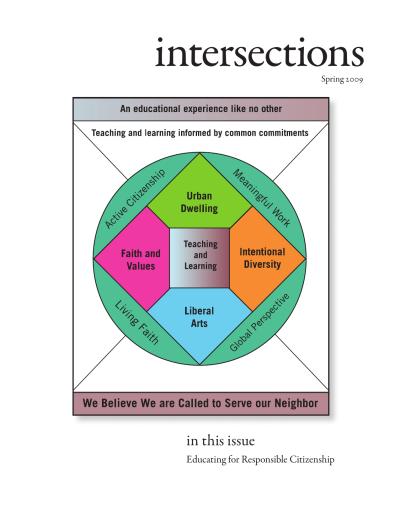 Article
From Alien to Citizen
Arne Selbyg
No. 29 · Spring 2009
Selbyg reflects on three experiences of being educated for citizenship—growing up in Norway under the legacy of Lutheran pastors and public school teachers who resisted the Nazi occupation, arriving in America as a resident alien, and becoming a naturalized American citizen—and proposes the jazz ensemble as a better metaphor for American society than the melting pot, one in which different citizens learn skills, study other instruments, and dialog with one another in service to the common music.
-
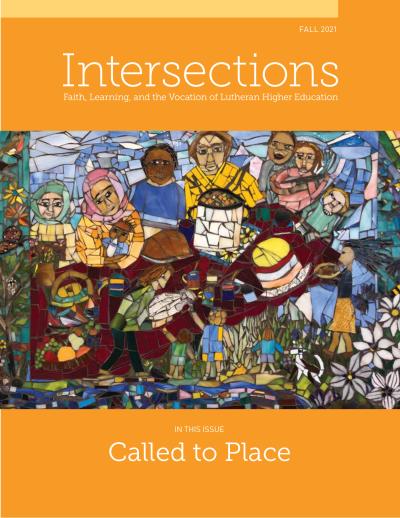 Editorial
From the Editor
Jason A. Mahn
No. 54 · Fall 2021
Mahn introduces the “Called to Place” theme of the 2021 VLHE Conference, arguing that Lutheran higher education’s emphasis on vocation must be grounded in particular geographies and embodied communities — for, as Wallace Stegner put it, “If you don’t know where you are, you don’t know who you are.”