A Chapel Talk at Gustavus Adolphus College
September 11, 1997
(Joshua 6:1–21) Now Jericho was shut up inside and out because of the Israelites; no one came out and no one went in. {2} The LORD said to Joshua, “See, I have handed Jericho over to you, along with its king and soldiers. {3} You shall march around the city, all the warriors circling the city once. Thus you shall do for six days, {4} with seven priests bearing seven trumpets of rams’ horns before the ark. On the seventh day you shall march around the city seven times, the priests blowing the trumpets. {5} When they make a long blast with the ram’s horn, as soon as you hear the sound of the trumpet, then all the people shall shout with a great shout; and the wall of the city will fall down flat, and all the people shall charge straight ahead.” {6} So Joshua son of Nun summoned the priests and said to them, “Take up the ark of the covenant, and have seven priests carry seven trumpets of rams’ horns in front of the ark of the LORD.” {7} To the people he said, “Go forward and march around the city; have the armed men pass on before the ark of the LORD.” {8} As Joshua had commanded the people, the seven priests carrying the seven trumpets of rams’ horns before the LORD went forward, blowing the trumpets, with the ark of the covenant of the LORD following them. {9} And the armed men went before the priests who blew the trumpets; the rear guard came after the ark, while the trumpets blew continually. {10} To the people Joshua gave this command: “You shall not shout or let your voice be heard, nor shall you utter a word, until the day I tell you to shout. Then you shall shout.” {11} So the ark of the LORD went around the city, circling it once; and they came into the camp, and spent the night in the camp. {12} Then Joshua rose early in the morning, and the priests took up the ark of the LORD. {13} The seven priests carrying the seven trumpets of rams’ horns before the ark of the LORD passed on, blowing the trumpets continually. The armed men went before them, and the rear guard came after the ark of the LORD, while the trumpets blew continually. {14} On the second day they marched around the city once and then returned to the camp. They did this for six days. {15} On the seventh day they rose early, at dawn, and marched around the city in the same manner seven times. It was only on that day that they marched around the city seven times. {16} And at the seventh time, when the priests had blown the trumpets, Joshua said to the people, “Shout! For the LORD has given you the city. {17} The city and all that is in it shall be devoted to the LORD for destruction. Only Rahab the prostitute and all who are with her in her house shall live because she hid the messengers we sent. {18} As for you, keep away from the things devoted to destruction, so as not to covet and take any of the devoted things and make the camp of Israel an object for destruction, bringing trouble upon it. {19} But all silver and gold, and vessels of bronze and iron, are sacred to the LORD; they shall go into the treasury of the LORD.” {20} So the people shouted, and the trumpets were blown. As soon as the people heard the sound of the trumpets, they raised a great shout, and the wall fell down flat; so the people charged straight ahead into the city and captured it. {21} Then they devoted to destruction by the edge of the sword all in the city, both men and women, young and old, oxen, sheep, and donkeys.
Some years, I have selected a topic for my autumn chapel homily and then chosen the Biblical verse accordingly—years when I have spoken on travel to Israel, learning Japanese, and the splendor of the season of summer.
This year, I decided to accept Chaplain Elvee’s assignment. Encountering him on campus a few weeks ago, I asked him why he’d chosen this passage about soldiers engaging in battle as a text for the Dean upon the occasion of the opening of school. He laughed his easy laugh and mumbled something about the Dean blowing the horn.
No offense to you musicians, but I’d been ruminating on the walls, not the horns, as I read and reread the passage. I thought first of one of my favorite Robert Frost poems, “Mending Walls.” You remember this poem—the narrator’s neighbor believes that “Good fences make good neighbors” and the narrator questions:
“Before I built a wall I’d ask to know
What I was walling in or walling out,
And to whom I was like to give offense.
Something there is that doesn’t love a wall,
That wants it down.”
I thought, too, of the Holocaust, an area of study in which I both teach and do research. There were the walls around ghettos in which Jews were confined. One book, which presents an autobiographical account of involvement in the Jewish resistance movement at the Warsaw ghetto is entitled On Both Sides of the Wall. It is written by Vladka Meed, a woman I had the privilege to study with in 1994. Another book about the period, simply entitled Walls, is an account by a righteous gentile, Margaret Zassenhaus, whom I knew while living in Maryland, who outwitted the Gestapo on many occasions. Both of these women would be inclined, I believe, to agree with Robert Frost: “something there is that doesn’t love a wall.”
Of course, in reading the passage about Jericho, I also thought of Berlin and its Wall, a wall inside instead of surrounding the city. The Berlin Wall was a real barrier that constituted part of the metaphorical Iron Curtain, such a central feature of the mental landscape of my childhood. The Berlin Wall came down in a triumphant moment in 1989 and is now more or less eradicated, creating all kinds of challenges for that city. Something there was that didn’t love that wall either.
I’d been wondering where to take the homily from there when, during the new faculty orientation last week, a second year faculty member gave new faculty some advice which helped me. In providing tips on how to survive the first year at Gustavus, he urged his colleagues to go to chapel. He confessed that he’d gone out of curiosity rather than a particular religious conviction and he’d been surprised at how much he learned from and about this community by listening to homilies.
And that reminded me of something I have long reflected upon: the ways in which homilies at Gustavus are often acts of self-disclosure. Faculty, students, and staff members speak autobiographically, establishing a level of intimacy in this discourse different from any other discourse on campus. I have come to believe that this is one of the well-springs of community on our campus. This discourse is, perforce, different from those in classrooms, committee meetings, the Canteen, dorm rooms, and different, too, from electronic communications and scholarly presentations.
The discourse is also intertextual. It is not uncommon, as the year unwinds, for one homilist to refer back to what previous homilists have said. In that way, we establish connections with one another that are very powerful and very personal. We demonstrate that we listen, we reflect, we react to what our colleagues say from this pulpit. In such intertextuality, we acknowledge influence and caring and memory, three of the mainstays of working and living together.
Now, I grant you that this homily is becoming more about literary criticism and that literary criticism is becoming more autobiographical. When I embarked on the writing of my dissertation in 1976, I was forbidden to include the word “I” anywhere in the 100+ page text except under the acknowledgments section. This taboo has gradually changed from observation in the first person being ventured tentatively by literary scholars to such personal observations being validated and then being valorized. I wonder if homilies at Gustavus have taken a similar course? Or if they have always tended to be an opportunity for members of this community to speak from the heart, from personal experience, from personal beliefs. Maybe someone with a longer history here than I will respond to this query in a future homily.
Having gone this far, I might as well admit that this is becoming what the lit crit bunch would call a metahomily, that is, a homily about homilies. So I’ll go a step further, and quote from Chaplain Elvee’s invitation—or some might say—admonition—to the community about chapel. Faculty received this in our mailboxes last week.
He says, “[Chapel] is a time for the College to meet together as a community, to celebrate the simple fact that we have collegial concerns for the higher life. The chapel mediates between classroom, athletic field and the larger society. In it we do a bit of intellectual and cultural celebrating. We also express our common (and sometimes not so common) moral, aesthetic and religious concerns…” He gives us quite broad permission here to do as we will.
So, since I’ve claimed that homilies are often autobiographical and intertextual, here goes. One of my experiences in giving these homilies has been empowerment. It’s not something named in Elvee’s description, but I don’t think he’d say it’s excluded either. As many of you know, I was raised in the Roman Catholic tradition. At that time, girls could not become altar boys, nor were women EVER allowed to speak from the pulpit. The first homily I gave at Gustavus in 1992 was an amazing experience. Although I’d given literally hundreds of lectures from podiums in big lecture halls, from behind tables in storefront libraries in small towns in Vermont, in smoky conference rooms, etc etc., I had never been invited to speak aloud in a church. It makes me feel very differently about spirituality to have had the experience of hearing women’s voices here.
Intertextuality. Have you noticed that I complained about my verse assignment at the beginning of the homily and that President Steuer did so yesterday? Yes, this is one of those homily tropes, almost a staple. We get to chide Elvee in public!
Getting back to Joshua and his walls… what does all this about discourses and intertextuality and autobiography and metahomilies and tropes have to do with Joshua fit the battle of Jericho? I like to think of the Chapel discourse as a superb opportunity to help us understand one another, to break down the walls of misunderstandings and stereotypes that differences sometimes build. There is an ecumenism here which I believe is one reason our chapel tradition has stayed alive, while so many others have withered. We genuinely talk with one another in this place. When one speaks personally, intimately, from the heart, it is not possible for the audience to deny that person his or her experience. Instead, we are invited to enter it, to see from a new angle.
Oh, all right. Maybe I am blowing that horn after all. Elvee is probably chortling by now. It is a call to all of you to be here, and be part of this conversation.
“There where it is we do not need the wall:
He is all pine and I am apple orchard.
My apple trees will never get across
And eat the cones under his pines, I tell him
He only says, ‘Good fences make good neighbors.’”
By the end of the poem, the narrator has not seduced his neighbor to rethink this adage. I hope the year ahead will be an opportunity for you to rethink assumptions, pieties, stereotypes, and that you’ll do some of that rethinking right here. LET’S MAKE THOSE WALLS COME TUMBLING DOWN.
Author’s Note
Given the F3 tornado which hit our campus full force on March 29, this final sentence now seems eerily prescient. Many walls indeed came tumbling down, as well as roofs, 80% of our windows and 90% of our trees. But the Chapel walls, I am happy to report, stood firm, and the graceful Chapel spire that was lost will be replaced this summer. Most amazing was the survival of the eternal flame in the red glass lantern suspended from the Chapel ceiling. When it was discovered still burning, by Associate Chaplain Brian Johnson, after the 230 mph winds had torn through the campus, it became a symbol of hope for us all.
-
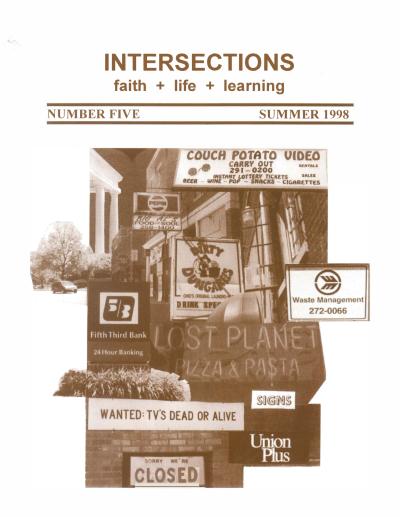 Editorial
From the Publisher
W. Robert Sorensen
Sorenson frames Intersections and the Vocation of a Lutheran College Conference as vehicles for widening the scope of inquiry that the separation of mind from spirit has curtailed, citing Ernest Boyer on probing “the deep places of the mind and the deep longings of the human spirit.” He previews an announcement at the 1998 conference of the Conrad Bergendoff Series—named for the late scholar and former Augustana College president—whose first volume, by Ernest Simmons of Concordia College, will support an Academy of Scholars in Lutheran Higher Education.
-
Editorial
From the Editor
Tom Christenson
Christenson introduces the issue as an illustration of the diversity of interests Intersections aims for, surveys the contents (Lagerquist on method, Mori on art and ritual, Baer on falling walls, Bergendoff as memorial, Funk and Powell in dialogue), urges readers to send in “your good stuff,” asks for distribution feedback, and closes with a sabbatical-year reading list—Kieran Egan, Robert Coles, Daniel Kemmis, David W. Gill, Sallie McFague, Roger Scruton, E.M. Adams, Freeman Dyson, Colamosca and Wolman, Gribbin and Goodwin, van Wyk, Wislawa Szymborska, and Flannery O’Connor.
-
Article
You Don't Seem Angry: Methodological Confessions Of A Lutheran Lay-Woman
L. DeAne Lagerquist
Lagerquist, opening from a colleague’s 1981 observation about her M.A. thesis on four female abolitionists, traces her path from feminist historian and battered women’s shelter advocate through the University of Chicago’s obsession with method to a more self-conscious account of her own. The method grows out of four Lutheran themes—original sin (caution and humility), the eighth commandment against bearing false witness (generosity and forgiveness), the neighbor as “little Christ” (cooperative interpretation), and vocation (interpretation as calling, located alongside feeding the hungry and visiting the lonely)—and shapes her ongoing work on a history of Lutherans in the United States with a plot about learning to live with diversity.
-
Article
Redemption Through Imperfection
Kyoko Mori
Mori, drawing on a visit to the Philadelphia Museum of Art with a friend, contrasts Marcel Duchamp’s Étant donnés—a peephole work whose mysterious motion sweeps every viewer into a shared, perpetual performance—with the static, glass-encased Liberty Bell as parody of spiritual experience. She extends the contrast into a meditation on rituals (comfort and consolation) versus art (truth, however painful), and on writing as a redemptive process that moves from orderly first drafts toward chaos and deeper, frightening truth—closing with master potters who skewed each finished vessel slightly so that art and decoration could be told apart. Parts are excerpted from Polite Lies (Holt 1997).
-
Reflection
A Community That Connects
Conrad Bergendoff
Excerpts from Conrad Bergendoff’s 1990 address at the opening of Augustana’s new library, prepared by David Crowe and published here as a memorial after Bergendoff’s death in December 1997. Bergendoff—Augustana class of 1915, president 1936–1962—recounts eighty years of Augustana memories, insists that “size is pretty much within you, not outside of you,” traces the institution’s bonds to Uppsala from 1860 (and the 1910 visit of the Rector Magnificat), and celebrates Augustana’s graduates “in practically every part of the world” as evidence that a small school can have a universal output.
-
Article
The Quest Of The Historical Jesus: Problem & Promise
Robert W. Funk
Funk, founder of the Jesus Seminar, frames the quest as the search for reliable data amid twenty-two ancient gospels and as a confrontation among three “parties”—the Jesus Party, the Apostolic Party, and the Bible Party. He surveys the Seminar’s 1985–1998 work (The Five Gospels, The Acts of Jesus, the color-coded reports), defends the synoptics over John, the priority of Mark, the Sayings Gospel Q and the Gospel of Thomas, and argues that a recovered Jesus—a teacher of a trust ethic, celebration, a kingdom without social barriers, a society without brokers, without cult rituals—may serve as catalyst for a sweeping third-millennium reformation that purges the “clogged arteries” of institutional Christianity.
-
Response
Beyond Data: The Poetry of Faith — A Response to Robert W. Funk
Mark Allan Powell
Powell, professor of New Testament at Trinity Lutheran Seminary, responds to Funk not as a New Testament scholar (Meier, Raymond Brown, and others can rehearse those debates) but as a Christian and a pastor. He challenges Funk’s closing implication that the institutional church’s “only function” is to protect Christian privilege (citing the ELCA’s 28 colleges, 1378 early childhood centers, AIDS hospices, and more), questions the suspicion of “derivative” faith, and proposes that piety is to theology what poetry is to prose—arguing, against Funk and with Marcus Borg, for a wholistic faith that holds history and myth, data and devotion, head and heart together.
-
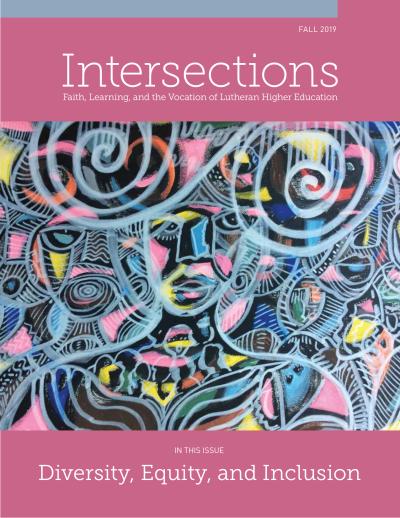 Reflection
Seeing in a New Way: A Meditation
Kara Baylor
No. 50 · Fall 2019
Baylor, the only Black campus pastor in the NECU, weaves Psalm 25, the parable of the Good Samaritan as re-read through Lenny Duncan, and the “crimson thread of divine justice” from Allen Dwight Callahan into a meditation that closes with the invitation she offered at the 2019 conference — to tie a crimson thread around the wrist as a symbol of collective commitment to moving beyond privilege toward inclusion and equity.
-
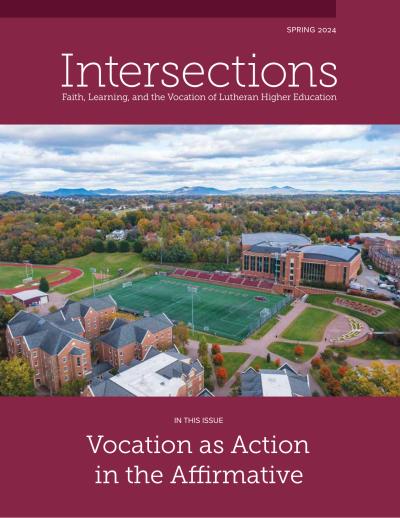 Article
Forming the Division for Access, Equity & Belonging at Susquehanna University
Amy Davis, Dena Salerno, María L. O. Muñoz, Nina Mandel, Scott Kershner
No. 59 · Spring 2024
Five Susquehanna University colleagues trace the institution’s 166-year arc from a Missionary Institute founded to remove barriers to education through the formation of a new Division for Access, Equity & Belonging in 2023, arguing that access rooted in Lutheran origins must continue to drive policy revision, infrastructure, and belonging for minoritized communities today.
-
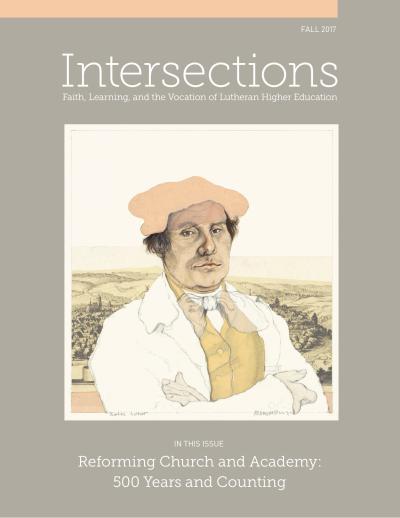 Article
Reforming Our Visions of City Nature
Lea F. Schweitz
No. 46 · Fall 2017
Through a Chicago story of Canada geese at North Pond, Schweitz takes up two Reformation-era ways of reading the “Book of Nature” — Konrad Rosbach’s moral readings and Philip Melanchthon’s scientific ones — and proposes a third: Luther’s sacramental principle that the finite is capable of the infinite, worn as “reading glasses” for an urban planet.
-
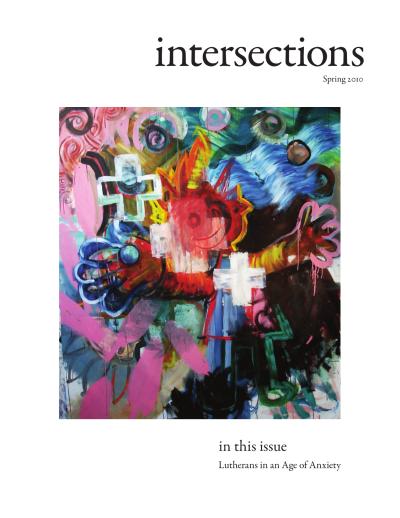 Reflection
The Neglected Miracle of Pentecost
Susan M. O'Shaughnessy
No. 32 · Spring 2010
O’Shaughnessy, in a homily delivered at Concordia College in 2008, reads the Pentecost narrative of Acts 2 through Maria Lugones and Elizabeth Spelman’s 1983 critique of white feminism’s cultural imperialism. She argues that the miracle is not the disciples’ speaking but the immigrant Jews’ hearing—and that the writer of Acts withholds the content of what was said precisely to teach disciples that people of privilege know less than the foreigner, the immigrant, the oppressed, the woman, the child, and must learn to listen in new languages before they can speak.
-
 Article
Impelled to Pluralism: Thoughts About Teaching in a Lutheran University
Jim Huffman
No. 17 · Summer 2003
Huffman traces his personal journey through three stages of faith—the “comfortable Christ” of his Midwestern Christian childhood, Clark Pinnock’s “faith principle” of accessible salvation, and finally Christ as the “humble teacher”—to a pluralism that rejects religious triumphalism without abandoning Christian commitment. Drawing on Diana Eck, Wesley Ariarajah, John Cobb, the Catholic novelist Endo Shusaku, and the histories of Confucian China and imperial Japan, he then describes how this commitment shapes his teaching of East Asian religion and nationalism at Wittenberg University: insisting on respectful language, working sympathetically through doctrines like Buddhist non-attachment, and helping students see the pernicious effects of triumphalism in both religious and political life.
-
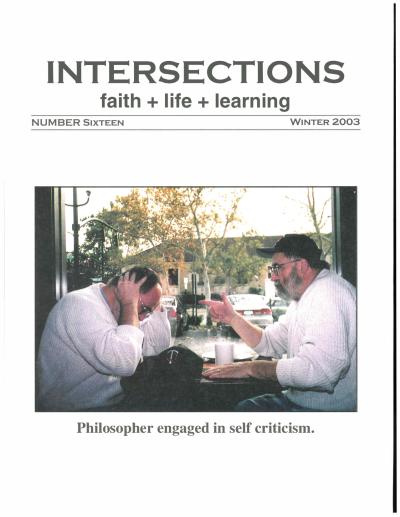 Article
Honoring the Word: Lutherans and Creative Writing
Carol Gilbertson
No. 16 · Winter 2003
Gilbertson argues that “honoring the Word” in Lutheran colleges means cherishing the sacred power of human language as God’s gift across three sites—the chapel talk, the classroom of wonder, and the poem—and illustrates her argument by reading aloud her own poems: “The Refiner’s Fire and Leaping Calves,” “Late June,” “Early June,” “Sweet July,” “Good Friday,” “Pondering These Things,” “The Limbs of Words,” and “Night Rising,” drawing on Darrell Jodock, John Updike, Martha Nussbaum, George Steiner, and T. S. Eliot’s “The Dry Salvages” to claim writing as a Christian vocation that “incarnate[s] the unseen sacred.”