This presentation comes from the perspective of a non-Lutheran, and an outsider and novice to the Lutheran community. So it will be colored with my “otherness.”
Before 1995, I had heard of the Lutheran Church and its traditional theology, but was not sure what its center or “heart” was. What was and is the Lutheran center raised two distinct questions: (1) Is the contemporary Lutheran center different, or is it the same as at inception? (2) If it is the same, why does the theme imply fragmentation?
After many interviews, reading, and writing this paper, there are still many questions in my mind about what the Lutheran center is supposed to be. It has not been clearly articulated in theory or demonstrated in practice at the church-related school where I am currently employed.
What is the center or “heart” of Thiel College? This is a question that our community is still trying to answer. How do we really promote the “heart” of what we do? We are a long way from consensus. Once we learn how to live out our mission statement in visible ways, the center of the Lutheran tradition can be celebrated by all those who work, learn, and grow in our institutions. It is declared in St. Matthew 6:21: “For where your treasure is, there will your heart (center) be also.”
In this presentation, I will talk about the difficulty experienced trying to understand what the Lutheran center is, and thus its integrity and fragmentation. I will share some personal experiences, the historical perspective of Thiel College, theological foundations of the Lutheran tradition, and conclude with some commentary on inclusiveness and diversity. The reality of my presence here today is connected to a long line of predecessors on whose backs I stand, for they bridged this gap for me. The rich oral history—one of storytelling. I am a storyteller.
Now, I believe what will be helpful to begin my presentation is to briefly share with you my story of how I came to be a part of this rich Lutheran tradition: After graduating from a Presbyterian seminary in 1994, as an ordained minister of the Church of God, I found myself in the marketplace seeking employment. I responded to a job announcement for the position of Adjunct Professor in the Department of Religion at Thiel College in Greenville, Pennsylvania. It was the spring semester in 1995. I was hired. In retrospect, I can truly say that those early days at Thiel College were some of the most bittersweet days of my teaching career. Those days were characterized as bittersweet because I worked alone, isolated from the community. The library staff graciously offered me a quiet place to hang my hat and coat. Among the books in the library archives, I sat down to contemplate about my new job, the students, and this community. What was God saying to me in this “chilly” environment?
In the 1960s, I attended a small church-related college, as a first generation student. That was the era of mandatory chapel attendance, a strong moral and ethical ethos and constant God-talk around the campus.
In my naivete, I looked for some of the same characteristics at Thiel College. That kind of philosophy was not a priority at Thiel. Even with the best efforts, the campus pastor found it difficult to arouse an interest in faculty or students for attendance at regular Sunday worship or the special holiday worship services. This was a church-related school? What specifically distinguished Thiel College from a non-Christian college? I wanted to know.
In the midst of that isolation, there was tremendous opportunity for ministry. That made it sweet!
Upon arriving, I was introduced to my department colleagues. There were no efforts made to introduce me to others in the community. There was no discussion about the Lutheran legacy during my brief orientation. This is not offered as a criticism, but highlights the nature of the adjunct status at most educational institutions. I didn’t have any sense of what the rest of the community was like. I was greeted by some with a polite “hello;” by others with a stare. I was the new novelty on campus. My job was to teach a required course in Judeo-Christian Scriptures for that semester.
I had read the college catalog and the mission statement. What I saw in my new surroundings was not congruent with the mission statement.
With the exception of one African American female secretary and one Hispanic professor, there were no other persons of color on the faculty, staff, or administration at Thiel College in 1995.
On the first day of class, just as I was taking my coat off, I heard an unusual bustling sound in the hallway. Out of curiosity, I moved closer to the door to see what was going on. A group of about 15 African American students rushed into the room and surrounded me. The group’s spokesperson explained their presence and excitement: “We came here to welcome you. Now, we have somebody here to help us.” This unexpected welcome raised several critical questions in my mind. What did these students mean “Somebody here to help us?” It didn’t take long for me to find out. Several of the students began to relate problems about the college and told me they were transferring because of the hostile environment. There were few accommodations for these minority students, both at the college or in the surrounding town. The bottom line: the students were depressed, isolated, and left to fend for themselves the best way they could. How could an institution, in the 20th century, recruit these minority students without any representation in administration, faculty or staff?
After several weeks, I conferred with the registrar and learned that there was an enrollment of 38 African American students, most of them males who were involved in the school’s athletic program. Further investigation into their academic standing and conversations with these students revealed that most of them were unprepared for the rigors of college. There were many warning signs that pointed to their failure.
- A hostile environment that had not prepared itself to receive, accept, or nurture these minority students after recruiting them.
- These minority students were recruited for their athletic ability, without serious consideration of their academic deficits.
- The absence of a diverse faculty and administration who could understand the cultural differences these minority students now faced.
“Education is sometimes narrowly conceived to apply to the education of the mind. Thus, colleges and universities typically and appropriately emphasize classroom experiences, teaching, texts, courses, libraries, and the like. Though this constitutes one facet of education, emphasis on this dimension of the education process to the neglect of other factors, can lead a college to cultivate intellectual giants and moral and social dwarfs. Much more goes on at college than the education of mind. Indeed, were students’ education measured in increments of time, the business of formal education would not predominate. Learning occurs in the dorm, in the athletic center or on the field, in the music and drama presentations, in the work experience in the community,” according to Dr. Reichenbach in his article, “Mission and Hiring Policies in the Christian College” (p. 13 Intersections/Summer 1997).
In his scholarly article, “The Wisdom of the True University,” Dr. Samuel Hazo made this suggestion: “What students ought to come to a university (college) to experience are what permits them to do better than what they consider their best, which is all that excellence means” (p. 30).
The Rich Historical Roots of Thiel College
To understand the Lutheran center, the history of this institution had to be examined. From the famous movie “The Sound of Music” comes the wisdom: “Let’s start at the very beginning.”
As an employee of Thiel College, I had not given one serious consideration to the historical specifics of the College. However, in preparation for this presentation, it became necessary for me to do some historical research. Thiel College is one of the 28 ELCA colleges and universities in North America. Thiel College was founded in Greenville, Pennsylvania by a German pioneer who came to the western part of the state in the 19th Century. From its inception, Thiel College has been church-related, with a Bible-based curriculum, which sought to develop the Christian life of the rapidly changing Lutheran population. It has always been a co-educational college; four women were among the first eight graduates in 1875. However, in its evolution the vision of the Lutheran tradition was not nurtured or clearly articulated, a problem that still plagues the college.
Throughout its history, Thiel College has worked to preserve its liberal arts tradition, based on the whole person through extra-curricular programs. Early academic preparation required freshmen students to have a thorough preparation in English, mathematics, German, Latin, and Greek. The College concentrated on classical subjects and later included Bible study, history, and moral philosophy. Seniors added Hebrew and French. By 1880, a Master of Arts and Doctor of Philosophy degrees were offered (Thiel College Profiles ’96, p. 2).
Thiel College has always received strong support from the Lutheran Synod as a church-related, liberal arts college.
A Church-Related College
Thiel College is a church-related college, not a Christian college. What does this really mean? I was hard pressed to find information on the Lutheran tradition or specifics in the college’s mission statement. After interviewing the campus pastor, religion department chairperson, and the director of church relations, I learned that in the Lutheran related colleges and universities, the college president, the campus pastor, and some of the trustees and faculty must come from the Lutheran faith tradition. There are not required church-related activities for students. Instead of requiring its students to attend church services, the Lutheran tradition is open to biblical interpretation and exploration of the history of Scriptures. As such, one must examine how faith and learning takes place at the college. I have difficulty understanding how a college could be related to a Christian tradition without being Christian? A lack of clarity of these differences by students, some faculty and especially the non-Lutheran constituency, has directly impacted and will continue to fragmentize the Lutheran center.
Looking for the Lutheran center is a bit like the parable Jesus told in St. Matthew 13:31–33: “The kingdom of heaven is like a mustard seed, which a man took and planted in his field. Though it is the smallest of all your seeds, yet when it grows, it is the largest of garden plants and becomes a tree, so that the birds of the air come and perch in its branches.” He told them still another parable: “The kingdom of heaven is like yeast that a woman took and mixed in a large amount of flour until it worked all through the dough” (New International Version).
In my quest to understand the difference between a Lutheran church-related college and Christian colleges, I explored the theological constructs of “Two Kingdoms” and observed specific details about the educational life of the institution.
The “Right Hand Kingdom” in Lutheran traditional thinking asserts that their faith is visible in confessions, such as the Augsburg Confession. Article 4 of the Confession reminds the Lutheran that he/she is made right with the Creator through justification by faith, not by good works. It is God’s action in Christ, reconciling the world to Himself, on the cross, and through the forgiveness of sin. We cannot earn God’s grace; it is a gift, freely given. That is confessional faith and the theological understanding of the “Right Hand Kingdom.”
The “Left Hand Kingdom,” in Lutheran traditional theology is personal involvement in the structure and order of society as active participants in politics, family, church, and school. In the “Left Hand Kingdom,” education is the work of God. The integrity of the educational institution is revealed through its openness to the issues of life. The curriculum is composed of courses that support theological reflections, exposure to other faith traditions, western culture, and global heritage.
Dr. Samuel Hazo supports this “Right Hand Kingdom” perspective by stating, “Finally, a true university should maintain and preserve a hierarchy of studies. In the church-related universities (colleges) this means a respect for theology as the queen of all studies” (p. 31). Dr. Hazo cautioned church-related institutions to guard against becoming like corporations. In striving to become like a corporation, a university or a college will turn to cost effective courses which become considered as a product. When this transition occurs, we no longer educate—but that has been known, though, and taught in this culture. We simply prepare students for serving in the system. The survival of the academy must not be relegated to cost effective curriculum.
I believe the mission statement can serve as the agent that helps us locate and identify areas of wholeness and areas of fragmentation. Colleges and universities must be willing to acknowledge, name, and critically examine all the areas of student life, personnel, curriculum, resources and vision that are detached from the mission statement. Here is a case in point, as my story continues:
Thiel College’s mission is to develop through exemplary education all aspects of the human character—the intellectual, the personal, the moral, and the religious—so that lives inspired by the truth and freedom may be committed to service in the world.
Where was this “exemplary education” in regards to those students, minority and others, in the athletic program with learning deficits?
My initial observation suggested that these ill-prepared athletic recruits would have difficulty competing at the same intellectual levels as many of their peers, some of whom were members of academic honor societies and had established themselves as leaders. How could those participating in the athletic program give the required attention and yet keep up with the expected academic rigors of the College? What was the rationale for recruiting this caliber of student? Was it to develop a winning sports team at the cost of academic bankruptcy? Many of the students were barely able to read. This deficit should not have been overlooked when reviewing high school performance records. Was this exemplary education or a “set up” where these students would eventually fail? The mission statement should guide every facet of what we do, how we do our work, and with whom we do our work.
I refer to the explicit claim of Dr. Bruce R. Reichenbach in his article regarding Mission and Hiring Practices in Christian Colleges: “In effect, in defining the purpose of the college as educating the whole person, focus must be placed on every dimension of student life. Hence, the entire college community should be knowledgeably committed to the college’s mission as the college attempts in its diverse educational role to assist students in their education” (p. 13). Thiel College was very fragmented in its diversity of “exemplary education” to the total person, in the case of the minority athletic recruits. This very recruiting process created a major retention issue for the College. These students could not compete at the required academic level because of poor preparation. Many were later dismissed or placed on academic probation; others transferred because of what they felt was a lack of support from the faculty and administration.
The faculty was not diverse. The “chilly” environment did not leave these students with alternatives when experiencing difficulty with college life. In her book, Coloring the Halls of Ivy, Dr. Josephine D. Davis asserts that “Minority administrators play monumental roles in making ‘chilly’ campus climates more welcoming to students of color. This fact, however, is hardly known and rarely celebrated” (p. 4). I would like to add that the majority student population also benefits as well from the presence of minority faculty, staff, and administrators.
To illustrate this point, listen to Tom’s story. The first semester, my second day on the job, one of the students enrolled in the course I was teaching, came and stood face to face with me. He stared at me from head to feet, then with a disdainful look said, “So, you are the new professor, huh?” “Yes, I am,” was my polite response. “Well, I’m not staying. Please sign my registration card so I can withdraw from this class.” I granted his request, and as he walked down the hallway it became clear where I had seen and experienced this kind of arrogance before. It was my native Alabama, a segregated state, where racial hatred runs deep like rivers.
During Tom’s next three years on campus, I had several opportunities to assist him with problems as well as affirm his progress. In the spring of his senior year at Thiel College, he enrolled in my class, “The African American Worship Experience.” Early in the class, each student was asked about their expectations from the course. Tom stated, “I want to learn as much as I can about African Americans because you are so nice.” As you can see from Tom’s story, students from the majority population are helped as well as the minorities from faculty of color.
In his discussion on implementing the college’s mission, Dr. Reichenbach stated, “If this assessment of education is correct, then the college’s mission should inform all aspects of the college’s educational endeavors. Its implementation should occur at all levels of college life, to create a particular kind of community. The same holds true for the Christian dimension of church-related colleges’ mission statements” (p. 13).
The defining purpose of our institutions should be to educate the whole person, thus encompassing every dimension of a student’s life. I believe Tom learned a lot about acceptance, respect, and tolerance from me prior to his enrollment in my class during his last semester at Thiel College.
Inclusiveness and Diversity in the Lutheran Tradition
Given the mission of the Lutheran church-related college and the reality of how it is implemented suggests a major weakness in the Lutheran tradition with regards to inclusiveness and diversity. While cleaning out my desk drawer at Thiel College, I came across a manual for colleges written by the Lutheran Churches of America in 1985. In the book Inclusiveness and Diversity: Gifts of God there is a section about commitments of diversity and inclusiveness with simple goals and strategies which apply to colleges and universities. Part of the notion of diversity and inclusiveness was from the traditional mission statement which implied acceptance, respect, tolerance, and yes, hospitality as part of the Lutheran witness to and in the world. In his instructions on inclusiveness, the presiding Bishop James R. Crumbly advises: “We strive to be a more inclusive community because we believe it is to be God’s will and command. To be faithful in carrying out God’s mission in a pluralistic society such as ours, we should increasingly reflect in our membership people of all races” (p. 1).
“The colleges and universities related to the Lutheran Church in America, as one expression of the missions of that church, are committed to becoming inclusive communities. Each community needs to be diligent in making this call to inclusiveness and the celebration of diversity of its own” (p. 6). The integrity of the Lutheran church and related colleges and universities must work to apply the wisdom of that document.
National polls reveal strong public support for diversity in higher education, according to Diversity Digest, Fall 1998. Across all demographic groups, American voters support diversity causes and programs and can observe the educational benefits of a diverse campus and classrooms. An added benefit of diverse education is that it allows the learning of critical skills, including: communicating with those from differing backgrounds, teamwork, and problem solving.
To help chart a new course in inclusiveness and diversity on our campuses, researchers have recommended a comprehensive organizational change—in both attitude and structure. To achieve campus cultures that are truly inclusive, institutions must emphasize cooperation, collaboration, community, and establish institutional rewards for contributing to collaboration and community-building activities.
Restructuring of college campuses, for full inclusiveness, required making a real commitment to implementing cultural diversity. This commitment will mean changing the ways in which administrative and faculty searches are conducted; seeking innovative ways in which newly hired, minority faculty will be integrated into the existing system; establishing a network of advising personnel; providing an effective distribution of resources for minority students.
In conclusion, the theme for this 1999 conference “Integrity and Fragmentation: Can the Lutheran Center Hold” is pregnant with possibilities and fraught with problems. If we define integrity as wholeness and fragmentation as detachment from the whole, I submit that the Lutheran center cannot hold as is, but has great possibility when its mission statement is followed.
The alternative to defragmentizing the Lutheran center as stated by Dr. Josephine D. Davis will happen when “Coloring the Halls of Ivy” includes the courage to lead! When our identity and mission is clear, it will be easier to restore integrity, to reach out in hospitality to friends and strangers alike. This is a view from the other side.
-
 Editorial
From the Publisher
Arne Selbyg
Selbyg reflects on the origins of Intersections—begun out of concern that the philosophy and theology behind Lutheran higher education could be lost to retirements and other preoccupations—and credits Paul Dovre of Concordia and Robert Sorensen of the ELCA Division for Higher Education and Schools as key figures behind the resumption of the debate. He points to three recent books (Ernest Simmons’s Lutheran Higher Education, Paul Contino and David Morgan’s The Lutheran Reader, and Pamela Schwandt’s Called to Serve) and to the new Lutheran Academy for Scholars in Higher Education, and previews the next “Vocation of a Lutheran College” conference at Dana College in August on what differentiates Lutheran colleges within American higher education.
-
Editorial
From the Editor
Tom Christenson
Christenson marks the eighth edition of Intersections, expresses gratitude to the ELCA Division for Higher Education and Schools and especially to the soon-retiring Bob Sorenson for backing the journal, the Vocation of a Lutheran College Conferences, and the Lutheran Academy of Scholars, and introduces an issue that gathers analyses and arguments from both insiders to Lutheran theology and outsiders, from veterans of the institutions and recent arrivals—voices that together remind us that what is and what ought to be need to inform each other.
-
Article
Integrity and Fragmentation: Can the Lutheran Center Hold?
Robert Benne
Benne answers the conference’s question pessimistically—“the Lutheran center cannot hold in many, if not most of our colleges, because it was never there in an articulated form in the first place”—and distinguishes “Christ of culture” colleges like the Midland Lutheran of his youth (Lutheran by ethno-religious ethos rather than by articulated theology) from James Burtchaell’s “confessional colleges” that operated from a theologically distilled Lutheran humanism. Drawing on Alasdair MacIntyre and Mark Schwehn’s First Things essay on Christian universities, he sketches what a Lutheran center looks like (unity, universality, integrity, a tradition of thought) and how its distortion—reducing the Gospel to justification and ceding everything else to autonomous reason—splits Christ and culture as dangerously as the German church separated Gospel and politics. For colleges that have lost their center, he proposes an “intentional, robust pluralism” that guarantees a Lutheran voice in every department and an “affirmative action for Christians” in hiring.
-
Article
From Pietism to Paradox: The Development of a Lutheran Philosophy of Education
Philip Nordquist
Nordquist traces a four-decade personal and institutional journey from the “Protestant triumphalism” and aggressive moralism of S. C. Eastvold’s 1950s Pacific Lutheran through the 1960 Ditmanson–Hong–Quanbeck volume The Christian Faith and the Liberal Arts, Gordon Lathrop’s 1972 PLU donor address grounding the university in two-kingdoms theology, the ALC’s 1975 Concordia workshop with Bill Narum, Bob Bertram, Harris Kaasa, and Sydney Ahlstrom’s case for the “critical” tradition over the scholastic and pietistic, the 1976 LCA statement distinguishing “Christian” from “church-related” education, and Richard Hughes’s 1997 Carthage address. He concludes that dialectical (two kingdoms) theology, Christian humanism alongside professional studies (the New American College model), Luther’s commitment to universal compulsory education, environmental and civic responsibility, and academic freedom together constitute the bequest of the Reformation—“Christ and culture in paradox” remains the best approach to education he knows.
-
Article
Diversity, Integrity, and Lutheran Colleges
Florence D. Amamoto
Amamoto—a sansei Jodo Shin Shu Buddhist who is “an inside outsider” at Gustavus Adolphus—argues that diversity and integrity belong together in Lutheran higher education, perhaps in a way unmatched by other church-related traditions. She affirms the importance of Gustavus’s 60% Lutheran student body and vibrant Christ Chapel under Richard Elvee and Brian Johnson while warning that numbers and chapel are not enough, draws on Tom Christenson, Patricia Gurin, Sylvia Hurtado, Anthony Carnevale, Martha Nussbaum, W. E. B. DuBois (the deaths of Matthew Shepard and Isaiah Shoels), Richard Hughes’s reading of finitum capax infiniti, Richard Solberg, and Mark Schwehn’s mutual hospitality model, and concludes that the real enemy is not diversity but indifference—and that Lutheran finitude grounds a theological commitment to keeping diversity and identity in creative conversation.
-
Poem
Things That Renew Hope
Sig Royspern
Inspired by Andrew Greeley’s Religion as Poetry, which defines religion as hope-renewing experiences and the stories, symbols, rituals, and images that preserve them, Rauspern offers a list-poem of small renewals of hope: lovers kissing in the street, the first snowfall of each year, compost and spring sprouts and Jewish humor, kids’ summer mischief, a mother nursing her baby on the bus, small jazz ensembles, two old men reconciling without remembering why, an unscheduled gift, the blues, a child taking him by the hand, and a gray-haired man who threw his cellular phone in the river.
-
Article
The Diversity Dilemma: Dealing With Difference
Kathy Fritz
Fritz reports from Newberry College—83% Caucasian, 16% African-American, 22% Lutheran, the smallest college in NCAA football—on a 1998–1999 year of crisis in which the Board of Trustees Executive Committee asked the president to resign over financial issues, the president fired three vice presidents, four trustees including the chair and treasurer resigned, and the controversial “veterinary technology” major became a flashpoint between the president’s recruitment-driven vision and the faculty’s commitment to “preparation for LIFE.” Turning to ethnic diversity, she frames three sociological approaches—“feed them all” to reduce conflict, the “3 A’s” (academics, athletics, arts) to create common identity, and Aguirre and Turner’s case for “weak ethnic identification” against the post-Yugoslavia failures of strong pluralism—and grounds the search for institutional unity in St. Paul’s body-of-Christ imagery from 1 Corinthians 12 and Ernest Simmons’s claim that diversity yields “creative adaptations that assist mutual survival.”
-
 Article
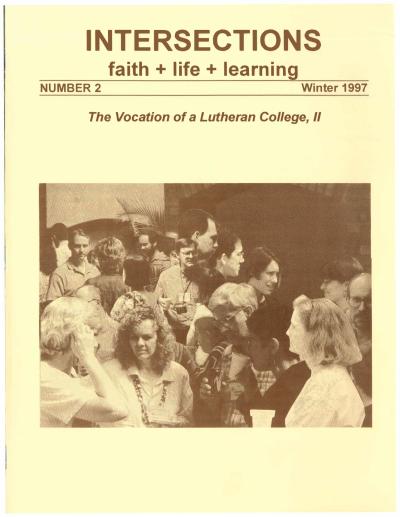
Lutheran Tradition: Five Continuing Themes
Walter R. Bouman
No. 2 · Winter 1997
Bouman of Trinity Lutheran Seminary identifies five themes central to the Lutheran theological tradition (understood through Alasdair MacIntyre’s account of tradition as “an historically extended, socially embodied argument”): biblical (a non-oppressive authority for the Bible rooted in the gospel rather than in scholastic inerrancy, against the backdrop of Luther’s 1517 challenge to Tetzel and the post-Enlightenment marginalization of theology); catholic (continuity with the Book of Concord and the three ancient creeds, with Luther’s “Christology from below” recovering a Jewish rather than Hellenistic understanding of God, revived by Tillich, Pannenberg, Forde, and Jenson); evangelical (justification by faith as the answer to mortality’s radical question); sacramental (Word, Eucharist, and Baptism as Christ’s presence from the future of God’s consummated Reign); and world-affirming (creation as gift, vocation as God’s work in every calling, and stewardship of the ecological crisis).
-
 Editorial
From the Publisher
Arne Selbyg
No. 6 · Winter 1999
Selbyg reports on the work of the Division of Higher Education and Schools to focus what makes Lutheran colleges and universities distinctive, recaps the 1998 Vocation of a Lutheran College conference at Wittenberg, previews the 1999 Susquehanna conference on “Identity and Fragmentation: Can the Lutheran Center hold?” (inspired by Yeats’s vision of the Second Coming), commends Ernest Simmons’s Lutheran Higher Education: An Introduction for Faculty (Augsburg Fortress, 1998), and announces a new NEH/NSF-style initiative called “The Lutheran Academy of Scholars in Higher Education.”
-
 Book Review
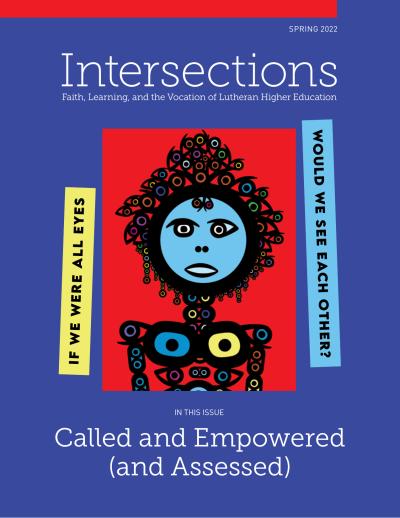
Assessing the Value of Liberal Arts: A Review of The Evidence Liberal Arts Needs, by Richard A. Detweiler
Robert D. Haak
No. 55 · Spring 2022
Haak reviews Richard A. Detweiler’s The Evidence Liberal Arts Needs, in which the former president of the Great Lakes Colleges Association analyzes 240 college mission statements and interviews more than 1,000 graduates to argue that liberal arts educational experiences have a measurable impact on adult lives of consequence, inquiry, and accomplishment — and invites NECU institutions into a further conversation about how Detweiler’s methodology applies to Lutheran higher education.
-
 Article
2024 VHLE Conference: "Rooting Access" Panel Talking Points
Guy Nave
No. 60 · Fall 2024
Nave reads “access” across Deuteronomy 23, Ruth, Isaiah 56, Acts 10, and Matthew 15:21-28 as an ongoing biblical conversation that evolves from exclusion to ever-widening welcome — and presses ELCA institutions to shift their focus from “student readiness” to “institutional readiness.”
-
 Article
Point / Counterpoint: What It Means to be a "College of the Church"
Robert Benne, Tom Christenson
No. 28 · Fall 2008
Moderated by Wartburg College pastor Larry Trachte and introduced by Kathryn Kleinhans, this Wartburg campus conversation between Robert Benne (Roanoke College) and Thomas Christenson (Capital University) probes what it means to be a college of the church—Benne emphasizing ethos, vocation, and the Christian intellectual tradition over against secularization and generic education, and Christenson lifting up persistent vocational questions, the gift of difference, and induction into a community of discourse—and finds large common ground around hiring for mission, pedagogy that asks deep questions, and the courage to claim a living religious tradition while inviting everyone to the banquet.
-
 Article
The University in the City of God: Beyond Dialectics and Rhetoric
Gregory A. Clark
No. 4 · Winter 1998
Clark, drawing on Alasdair MacIntyre’s Three Rival Versions of Moral Enquiry, distinguishes the preliberal, liberal, and postliberal university and argues that the liberal university’s pretense of dialectical neutrality has masked a particular rhetoric of its own. Following John Milbank’s Theology and Social Theory, he holds that every philosophy and institution is finally a rhetoric and that the church’s task is not to win on the secular university’s terms but to proclaim and embody an alternative city. The Christian college, then, should give up the apologetic pose of meeting secular reason halfway and instead practice the rhetoric of the gospel: a proclamation of Jesus, an enactment of Christian friendship and peace, and a willingness to be vulnerable to the violence of the world as Jesus was vulnerable to his own. Clark commends this stance to colleges related to the church.