"Our Calling in Education": Working Together to Generate a Strong Social Statement on Public Schools, Lutheran Schools and Colleges, and the Faith Formation of Children and Young People
Intersections No. 23 · Summer 2006
The ELCA is preparing a social statement on education that will be considered by the Churchwide Assembly in 2007. Since the following talk was given in 2005, the first draft of this social statement has been published. However, the ELCA Task Force on Education is still in the process of revising the draft and formulating the actual social statement, and members of the Task Force welcome and encourage responses to the draft. This talk outlines many of the concerns about education that are addressed in the statement. The essay provides a springboard for your own thinking about education, vocation, church-related colleges and for your own response to the social statement, which you can submit to the Task Force via the internet to Ronald.Duty@elca.org. The website is www.elca.org/socialstatements/education. —MJB
AS YOU KNOW, the ELCA is preparing a social statement on education that will be considered by the Churchwide Assembly in 2007. “Our Calling in Education: A Lutheran Study” was written by the ELCA Task Force on Education as a way to prompt churchwide discussion on education and to help develop a final social statement for the church.1 The actual social statement will be much shorter than this study guide, and it is hoped that it will help set policies on education for the church and guide its advocacy in the area of education.
A “Study Guide” or “Booklet” is an odd literary creation. First of all, it is written with the help of sixteen people. If you have ever edited or co-authored a volume, then you know yourself that such a writing process is a wild endeavor. Secondly, a study guide is a unique literary genre: it is a mix of theological essay, teaching document, information pamphlet, and questionnaire. In academic circles, some might therefore view it as a “nightmare.” My own colleagues at Valparaiso University who have read the study guide appreciate its theological perspectives on education, and they are delighted that the church will address the issue of education in a social statement. However, they find the study guide itself lacks urgency, and some fear it cannot generate the kind of churchwide discussion on education needed to produce an effective social statement.
Our primary task today as a group is not to defend the strengths and weaknesses of the study guide or to revise it into some second edition bestseller. Rather, our common task is to use it as a springboard for a serious discussion about the most urgent issues in the church regarding education and how the church might address them in a social statement. I hope we can all agree that we do face serious challenges related to education and that the church at this time does need a strong and useful social statement on education. As educators, we have a wonderful opportunity to shape this social statement, to voice our concerns and commitments, and to help guide the church. Thus, I am hoping that these remarks will prompt you to share your ideas so that members of the Task Force can incorporate them into the actual social statement. Right now and throughout the process of refining a social statement on education, the ELCA is seeking your informed response to the basic question: What should this statement include? More precisely: What theological insights would best help guide the church in its reflection on education? What specific issues, questions, and challenges regarding education are most central to us and our communities? What kinds of specific policies and practices would strengthen the church in the area of education?
I would like to address these questions by making two claims that shape the two central parts of my remarks. First, the study booklet rightly builds its theological vision of education upon a Lutheran understanding of vocation. Education and vocation are deeply interwoven, and the social statement, like the study guide, should be based on and include a strong theological statement about vocation.
Second, although the study guide addresses a wide range of issues facing people of all ages, from early childhood education to life-long learning, if the social statement itself aims to capture the attention of members of the church, let alone to have an impact, then it must narrow its focus and address urgent questions in three specific areas of education that greatly affect the lives of children and youth today—public schools, Lutheran schools and colleges, and the faith formation of children and young people. These three issues should be addressed in a large social statement with three parts or even in three separate social statements. Thus, the second part of my paper lists the most urgent questions and challenges that I have heard expressed by colleagues and members of the church about these three areas.
Although people of all ages certainly face difficulties in the area of education broadly understood to include both academic training and faith formation, the ELCA’s social statement should focus primarily on children and young people. They face tremendous challenges today in many areas related to education, and the church should address their challenges more intentionally and effectively and be a stronger advocate for them. For example, poor children are not prepared for school in the first place and then must also attend dangerous or inadequate schools. They also often lack the kind of health care or nutrition needed to thrive in school. Even children in affluent neighborhoods suffer neglect and abuse and struggle with drug and alcohol abuse, suicide and depression, and lack of sexual boundaries.2 Scholars also wonder about the effects of technology, the media, and market pressures on rich and poor children alike. Although opinions vary on the extent of these problems or how to solve them, voices across progressive and conservative lines recognize that such challenges are real and should be addressed. Parents, religious communities, and the state are searching for creative and effective approaches to these problems. Although the ELCA, like most denominations, has spoken out and written about a number of social issues, such as abortion and sexuality, it has yet to produce a public document directly about concerns facing children and young people themselves, and the statement on education provides an opportunity to do so.
Build the Statement on a Robust Lutheran Understanding of Vocation
Like the study guide itself, a final social statement on education must be built on a strong Lutheran understanding of calling or vocation. The Lutheran church has a rich legacy of thinking about and supporting education in both church and society, and this legacy is built on a vital view of vocation. A strong concept of vocation, when incorporated into a final social statement, will do much to guide the church’s reflection and advocacy in all areas of education, whether public schools, church related schools and colleges, or the faith formation of children and young people.
Although a Lutheran concept of vocation can richly inform our thinking about many areas of education in both church and society, unfortunately, in contemporary culture and even within Lutheran institutions, the notion of “vocation” is often misused and misunderstood, and this is why it should be clearly introduced and articulated in a final social statement for the Church. Through my own work on our campus for a national initiative on “The Theological Exploration of Vocation,” funded by the Lilly Endowment, we have found that there are four common misconceptions of vocation among students, faculty, and members of the church as a whole. Some people equate vocation with one’s occupation, career, or paid profession. Others, perhaps especially young people, understand vocation as “finding one’s inner joy” or a sense of self-fulfillment. Some Catholics, but also Lutherans and other Protestants, often think of vocation or calling as entering the priesthood or ordained ministry. Finally, still others, even those who are committed Christians or work at Lutheran institutions, have no notion at all that vocation is a theological concept related to their faith tradition, and they simply equate vocation with “vocational programs” or “vo-tech.”
Last year, at a national meeting of representatives from several Lutheran institutions that received Lilly grants, we also found that even Lutherans who are highly informed about a theology of vocation and engaged in programs with young people can unintentionally introduce them to narrow understandings of it. For example, on the one hand, we found that Lutheran colleges sometimes speak of vocation too generically in terms of “gifts and talents” for the common good and neglect other dimensions of a Lutheran understanding of vocation, such as baptism or unity in Christ. Here, vocation can start looking too much like leadership development or citizenship alone. On the other hand, Lutheran seminaries sometimes speak about vocation too narrowly in terms of baptism and neglect what Luther said about creation, the common good, or the two kingdoms. Here, vocation is sometimes equated with ordained ministry.
In contrast to these weak notions of vocation, a robust Lutheran theology of vocation, as the study guide articulates, deeply integrates faith and learning and empowers discipleship and service. Martin Luther emphasized that all believers are called to love God and to love and serve the neighbor, especially those in need.3 They are called to express their faith in works of love and service within the church and the broader culture.4 Although Luther claimed all believers share this common Christian calling, he also emphasized that they honorably carry it out in a wide variety of specific “vocations”—in specific “stations” or “places of responsibility” in which they serve the well-being of others, whether at home, at work, at church, or in civic life.
Furthermore, for Luther, all work that benefits the community holds equal religious value. As he states in his “To the Christian Nobility”:
There is no true, basic difference between laymen and priests, princes and bishops, between religious and secular, except for the sake of office and work, but not for the sake of status. They are all of the spiritual estate; all are truly priests, bishops, and popes. But they do not all have the same work to do…Further, everyone must benefit and serve every other by means of his own work or office so that in this way many kinds of work may be done for the bodily and spiritual welfare of the community, just as all the members of the body serve one another. (LW 44:129—30)
For Luther, everyone therefore has a calling: everyone has these “roles” or “offices”—whether given or chosen, for “all significant social relationships are places into which God calls us to serve God and the neighbor” (Schuurmann xi). Thus, even children and students have a calling here and now. They already have certain responsibilities that benefit the family and the community. Luther also recognizes that each individual serves others in multiple ways in various spheres of life: the home, professional life, the church, and the community.
Thus, from a Lutheran perspective, vocation is therefore not primarily about paid work, personal bliss, or ordained ministry but rather about how we are living out the totality of our lives, serving others, and participating in God’s love and care of the world. A Lutheran view of vocation honors activities and responsibilities outside the priesthood or monastic life; it honors not only paid work but also our duties as parents, spouses, sons and daughters, students, aunts and uncles, and friends; and furthermore, it honors our role as citizens and the need to contribute to the common good. It emphasizes that all of our varied and specific callings are vehicles of the general Christian calling to love and serve others.
This robust theology of vocation is closely intertwined with Luther’s views of education: not only his support of schooling and a solid liberal arts education for all children but also his emphasis on religious education and the faith formation of children and young people. Luther supported formal education and schools because he was convinced that well-educated citizens would serve both church and society. For him, government supported schools were necessary so that everyone could not only read and interpret scripture but also gain the skills and knowledge necessary to be good citizens. Excellent schools help develop the gifts of young people so that they can live out their particular vocations and take up particular roles or offices that serve others and contribute to the common good. As he stated in a letter titled “To the Councilmen of All Cities in Germany That They Establish and Maintain Christian Schools” written in 1524 to political leaders, well-educated citizens are “a city’s best and greatest welfare, safety, and strength” (LW 45:356).
Thus, Luther and his colleague Philipp Melanchthon were strong public advocates for universal schooling, the liberal arts, and educational reform. At a time when formal education was viewed as unnecessary for most children and educational opportunities were limited primarily to the nobility, to boys, or to those entering monasteries, Luther and Melanchthon recommended that all children, including girls and the poor, be given a basic education. Furthermore, Luther and Melanchthon recommended a broad liberal arts program for schools and universities that reflected the humanist reforms of the day.5 Through their initiatives, Luther and Melanchthon prompted several reforms that influenced German schools and universities at that time and still today, including public education for all children. Many Lutherans after the Reformation, such as August Herman Francke in the 18th century, have also been leaders in educational policy and reform (Bunge).
Luther’s view of vocation also informed his emphasis on faith formation of children and young people both at church and in the home. He believed that those who are baptized should understand their faith and live it out in daily life. Although he believed that pastors and congregations should certainly help children and young people learn about their faith, he stressed that children must also be taught the faith at home by their parents.
Thus, Luther’s own view of vocation included serious reflection on the central tasks and responsibilities of parenting. Although Luther knew that parenting can be a difficult task and is often considered an insignificant and even distasteful job, he believed parenting is a serious and divine calling that is “adorned with divine approval as with the costliest gold and jewels” (LW 45:39).6 Luther further underscored the importance of parenting by claiming:
Most certainly father and mother are apostles, bishops, and priests to their children, for it is they who make them acquainted with the gospel. In short, there is no greater or nobler authority on earth than that of parents over their children, for this authority is both spiritual and temporal. (LW 45:46)
According to Luther, as priests and bishops to their children, parents have a twofold task: to nurture the faith of their children and to help them develop their gifts to serve others.7 He also helped parents in this task by preaching about parenting and by writing “The Small Catechism,” which was intended for use in the home.8
Even though there is more to say about Luther’s view of vocation, a Lutheran understanding of vocation provides a solid theological foundation for a Lutheran social statement on education in church and society. On the one hand, the concept of vocation deeply integrates faith and learning and provides theological grounding for strong educational opportunities for all so that everyone can use their gifts to serve the neighbor and contribute to the common good. On the other hand, the concept of vocation also informs the need for faith formation of children and young people at church and in the home. Overall, the concept invites us to reflect on a number of issues related to both academic training and faith formation, such as: our service to the needs of the neighbor; our unique gifts and talents; how to strengthen and to develop them; our multiple duties in various spheres of life; the relation between faith and learning; our relationship to God; and God’s love for and care of the world.
Three Urgent Areas of Concern
Given this Lutheran understanding of vocation, given the long history of Lutheran engagement in education, and given the many challenges that children and youth are facing in both church and society, the social statement should address three specific areas of education that greatly affect the lives of children and young people today (or the church could even offer three separate social statements on these issues).
Public Schools
Based on its understanding of vocation and its strong history of support for the liberal arts and universal education, the ELCA should address issues regarding the public schools. The social statement should clearly state the church’s commitment to strong public education based on the Lutheran notion that the common good of society requires educated citizens, that all children should receive a good education, and that the education of young people is a shared responsibility. Here are six of the most burning questions that we have heard raised in Lutheran colleges and in the wider church that that should be addressed in a social statement on public schools, and you can add your own in the discussion:
1) How can the church help address the glaring inequities (along racial, ethnic, and economic lines) in our present system of public schools? How can the church ensure all children have equitable access to excellent schools and to strong educational programs that will help them to be responsible and productive citizens?
2) What role, if any, should public schools play in the character formation of children? Are there shared moral beliefs and values that public schools should teach? Can public schools even teach moral values and beliefs adequately if they are not taught within a larger religious framework?
3) Given the fact of religious pluralism and the legal right of public schools to teach about religion, should not the church encourage public schools to teach religion as an academic subject? If so, then how would it be taught? What would the curriculum include?
4) Should public schools sponsor or incorporate any religious practices, events, or symbols into their buildings, curriculum, or extra-curricular activities, such as posting the Ten Commandments or saying morning prayers?
5) Should the church support vouchers and school choice? How should the church balance its support of both public and parochial schools?
6) How can the church help lift up the importance of teaching and ensure that teachers are paid fairly?
Lutheran Schools and Colleges
The church also needs a strong social statement on Lutheran schools and colleges. The statement must start by informing members of the church about the nature and number of these institutions. Many members of the church do not even know that there are almost 2,000 ELCA preschools, 174 parochial schools, and 28 colleges and universities (Task Force on Education 2004: 44, 64). Like public schools and universities, these institutions seek to offer an excellent liberal arts education and to prepare young people for their particular vocations as family members, workers, and citizens. However, unlike secular institutions, Lutheran schools and colleges also have a “special responsibility and opportunity to engage faith and learning.” They can provide “an excellent setting for the claims of faith to interact with secular learning in the many fields that make up a liberal education” (Task Force on Education 2004: 65). Unlike some Christian traditions, the Lutheran tradition encourages Christians to make use of the best of secular learning, and it emphasizes an open quest for truth in which faith and learning are not at odds but in vital dialogue with one another. This view of faith and learning is the basis for the Lutheran commitment to intellectual inquiry and academic freedom.
When students are given the opportunity to engage faith and learning, the benefits for both church and society are significant. Some of these benefits were recently confirmed in a national study on Lutheran college graduates. The study found that compared to Lutheran students at flagship public universities, Lutheran students at Lutheran colleges are far more likely to find opportunities to develop spiritually, to discuss faith and values in the classroom, to integrate faith into other aspects of their lives, to participate in service projects, and to engage in church activities (Task Force on Education 2004:67).
Despite such benefits and the rich theological heritage of Lutheran schools and colleges, these institutions face tremendous challenges. For example, only five percent of Lutheran high school graduates even attend Lutheran colleges. Some of the schools and colleges have closed or face serious financial troubles. Furthermore, some ELCA schools and colleges have lost or are losing their Lutheran identity. Many of their students do not know they are attending a Lutheran institution, and they are given few opportunities to engage faith and learning. Although Lutherans have inherited a rich theological understanding of vocation, and although it can be a tremendous resource for people today, we must humbly admit that Lutheran schools and colleges have not consistently helped people explore this understanding of vocation. My own institution, for example, was founded on a rich vision of vocation. When we at Valparaiso University applied for the Lilly grant, we proudly thought that we Lutherans already know all about vocation; we have the market on this concept; and we will be the leaders of this initiative. Yet we were soon humbled when we discovered that most students and even many faculty on our own campus had not explored, let alone appropriated, a deep theological understanding of vocation.
Thus, some of the most urgent questions regarding church-related schools and colleges are the following:
1) How could the church better inform its members about the mission and strengths of Lutheran schools and colleges?
2) How can the ELCA’s churchwide office, synods, local congregations, and individual members better support Lutheran schools and colleges?
3) Even as they serve a diverse student body, how can Lutheran schools and colleges maintain their Lutheran identity? Should they ensure that a certain percentage of students, faculty, and administrators are Lutherans? If so, what percentage? What other ways can they maintain their Lutheran character and mission in academic courses and extra-curricular activities?
4) How can Lutheran schools and colleges more intentionally introduce their students, regardless of their religious backgrounds, to the intellectual heritage of the Christian tradition?
5) How can they more intentionally introduce students, regardless of their religious backgrounds, to the wisdom embedded in a Lutheran understanding of vocation? How can they expose all students to a Lutheran view of vocation as they think about their future work and life-commitments?
6) How can the everyday institutional practices and policies of Lutheran schools and colleges better reflect their mission and a Lutheran understanding of vocation? Do these institutions strive to carry out just practices and policies (especially in the areas of responsibilities to families, such as offering flexible working hours or day care; just treatment of employees, especially those with the lowest paid positions, typically adjunct faculty, housekeeping staff, and dining staff; and environmental responsibility on campus)?
Since I have worked with the Lilly Endowment’s project on vocation both nationally and at Valparaiso University, I would like to say a little more about the 5th and 6th questions and offer you a few resources. You can also find more resources on the project’s website or by contacting any of the eighty-eight college and universities that are carrying out Lilly-funded vocation programs (see http://www.ptev.org/schools.aspx?iid=4).
As I have worked with the Lilly initiative on vocation nationally and on our campus, ten general kinds of activities or “best practices” have proven to be especially effective in helping students, faculty, and administrators to nurture faith and to reflect on vocation. All of them are valuable ways of creating a space for nurturing faith, reflecting on vocation, and discerning a sense of calling. If one looks back at the history of Christianity, then one recognizes that these kinds of activities or practices have commonly been used throughout various faith traditions for moral and spiritual formation. Recent sociological and psychological studies also confirm the value of these kinds of activities for moral and spiritual development.9 There are, of course, many more than I mention now, but these ten have been the most significant on our campus and on other campuses around the country.
1) Exposure to Role Models
2) Naming the Gifts and Talents of Others
3) Narratives of Lives of Faith and Service
4) Prayer and Spiritual Fellowship
5) Leadership in Worship
6) Music and the Arts
7) Service Projects
8) Cross-cultural Experiences
9) Church Camps and Wilderness Experiences
10) Biblical Study and the Study of other Texts
Most church-related colleges and universities that are participating in Lilly’s national project on vocation do include several of these activities because students have different interests and backgrounds, and therefore the “doorways” through which they can best enter reflection on vocation vary. These ten activities or practices also reflect the varied answers one finds in the Christian tradition for answering the question: How do I discern my particular calling? For some, a sense of calling arises primarily out of meditation, prayer, and contemplation. For others, a sense of calling arises more in response to learning about and then actively addressing the particular needs of individuals or communities. Yet for still others, discerning a sense of calling is more a process of carrying out responsibilities in the roles in which they already find themselves and recognizing these roles as part of God’s care of the world. In general, a sense of calling does not come as a voice in the night to isolated individuals but rather through relationships to others and through activities and practices.10
Although these ten kinds of activities can be carried out with little or no money, they do require intentionally creating spaces and opportunities for people to engage in them, and they can be carried out effectively when individuals and institutions work cooperatively to share their assets and ideas. Among Lutherans, there are many new collaborative efforts and initiatives that are creatively changing the “ecology” of the church to invite more reflection on vocation and to deepen our shared discourse about it. We see collaborative efforts and events, for example, among ELCA colleges (through the annual Vocation of Lutheran Colleges conferences or the vocation grants); among colleges and seminaries that received Lilly grants for work with high school and college youth; among individuals who participate in programs such as Lutheran Summer Music, the Lutheran Academy of Scholars, or the Rhodes Consultation; and among colleges, seminaries, campus ministries, church camps, parachurch organizations, and synodical and national church offices through efforts such as the “Making Connections” grants or the Western Mission Network Consultation. Although we sometimes see our church as fractured, from a national perspective, such cooperation and networking is unusual among most Protestant denominations. Although Lutherans hesitate to be proud, we can feel genuinely proud and excited about the ways such cooperative efforts are currently renewing the life of the church.
Faith Formation of Children and Young People
Finally, the ELCA must also pay more attention to the spiritual formation of children and young people and the roles and responsibilities of both parents and the church in this task. This is a burning issue for many parents and members of the church, and a section of the social statement on education or even a third separate statement must address it. Unlike some issues related to public schools, this is also an issue that the church could effectively and directly address without depending on political policy decisions.
Although the Church certainly cares about children and young people and offers a number of programs to serve them, parents and other caring adults need to do more to nurture the faith of children and young people. Just one of many signs of the weakness of faith formation in the church as a whole is that children and young people, even those who attend church regularly, know little about their faith traditions and have difficulty perceiving or articulating the relation between faith and their daily lives. Based on the findings of the National Study on Youth and Religion, Christian Smith, author of Soul Searching: The Religious and Spiritual Lives of American Teenagers, claims, for example, that a large number of teenagers are “remarkably inarticulate and befuddled about religion” (27, 32, 260). Even though a vast number of them identify themselves as Christians and are affiliated with a Christian denomination, they have “a difficult to impossible time explaining what they believe, what it means, and what the implications of their beliefs are for their lives… Religion seems very much a part of the lives of many U. S. teenagers, but for most of them it is in ways that seem quite unfocused, implicit, in the background, just part of the furniture” (262, see also 218). The study also shows that Mainline Protestants “were among the least religiously articulate of all teens.” Smith cites this response of a seventeen year-old Lutheran: “Uh, well, I don’t know, um, well, I don’t really know. Being a Lutheran, confirmation was a big thing but I didn’t really know what it was and I still don’t. I really don’t know what being a Lutheran means” (131-32). Researchers conclude that what they call a vague “Moralistic Therapeutic Deism” appears to be displacing the substantive traditional faith commitments of most historical U. S. religious traditions (262).
I also know from my own experience as a college professor, and perhaps your experience is similar, that although most of my students are bright and articulate, and although ninety-five percent of them come from Lutheran or Catholic backgrounds, have attended church, and are confessing Christians, they know very little about the Bible and their own faith traditions, and they have difficulty speaking about relationships between their beliefs and their everyday lives and concerns.
If a vast majority of children and young people are going to church and confessing to be Christians, then what are the grounds for this situation? There are certainly many causes, and I’ll mention just three that the church could address. First, although there are certainly examples of sound religious education programs, many congregations offer weak religious education programs and fail to emphasize the importance of parents in faith development. The curricula of many programs are theologically weak and uninteresting to children, and they assume children themselves have no questions, ideas, or spiritual experiences. Programs for children and youth are often underfunded, and leaders for them are difficult to recruit and retain. Furthermore, there is little coordinated effort between the church and the home in terms of a child’s spiritual formation. Many parents don’t even know what their children are learning in Sunday school, and parents are also not given the sense that they are primarily responsible for the faith formation for children.
As a result, we find, in the second place, that many children and young people are not speaking to their parents or other caring adults about their beliefs and values, and they are not carrying out central religious practices that nurture faith with their parents in their homes. I am taken aback, for example, when many of my students tell me that they have rarely, if ever, spoken to their parents about any issues of faith, when they know so little about their parents’ beliefs, and when they are highly misinformed about their church’s positions on issues such as creationism or sexuality. Many students also tell me that although they went regularly to church with their parents, they did not pray at home with them. Their experience has been confirmed by several recent studies of the Search Institute and Youth and Family Institute. For example, according to one study of 8,000 adolescents whose parents were members of congregations in eleven different Protestant and Catholic denominations, only ten percent of these families discussed faith with any degree of regularity, and in forty-three percent of the families, faith was never discussed (Strommen and Hardel 14). Many people apparently consider religion to be a private issue—so private that you don’t even pray or share religious thoughts and questions with members of your family.
In general, when we also consider that in our current consumer culture young people and now even very young children are the targets of intense and highly sophisticated marketing campaigns, vying for their money and brand loyalty and shaping their values and assumptions, the question we must ask is not “Will our children have faith?” but rather “What kind of faith will they have?” Our children and young people are and will be shaped by messages around them, and parents and churches must be more intentional about the messages they want to their children to receive. When I learned that children under eighteen in the United States watch an average of twenty-seven hours of television a week (not including time spent playing video and computer games), I wonder how even the best Christian education programs, held perhaps one or two hours a week, can possibly compete with television and help young people critically appropriate the faith, especially if their parents are not intentionally taking time to complement these church programs with religious practices in the home and with regular family discussions about religious questions and beliefs. This is especially important when common sense and recent studies show that, for better or worse, the most important influence on the moral and spiritual lives of children and adolescents continues to be parents.11
A third reason perhaps that faith formation is not the priority it should be and that children and young people know little about their faith traditions and are not carrying out religious practices at home is that the ELCA, like many other denominations, has not offered serious theological reflection on either children or parenting. Although children and parenting are central to Luther’s understanding of vocation and faith formation, Lutheran theologians and ethicists have generally neglected these themes. Certainly, they have devoted significant attention to many issues related to children and parenting, such as abortion, human sexuality, gender relations, contraception, marriage, reproductive technology, and the family. Yet even most studies on marriage and the family have neglected to include serious reflection on fundamental subjects regarding children themselves, such as the nature and status of children; parental obligations to them; the role of church and state in protecting children; the role of children in religious communities; the moral and spiritual formation of children; the role of children in the faith maturation of adults; adoption; or children’s rights.12 Like contemporary theologians and ethicists in other traditions, Lutherans have tended to consider such issues as “beneath” the work of serious scholars and theologians and as a fitting area of inquiry only for pastoral counselors and religious educators. Thus, theological discourse in the Lutheran tradition, as well as other Christian traditions, has been dominated by simplistic and ambivalent views of children and teenagers that diminish their complexity and integrity, fostering narrow understandings of parenting and other adult-child relationships.
Given these and other concerns, here are some of the most burning questions related to faith formation at home and in the church that the ELCA social statement on education must address:
1) How can the church best strengthen its religious education and faith formation programs?
2) How can the church create a stronger partnership between the home and the congregation and better support parents in their task of parenting and shaping the moral and spiritual lives of their children?
3) How can both parents and church leaders more intentionally introduce children and young people to the “best practices” outlined above for helping them nurture faith and discern their callings?
4) How can the church better support the efforts of para-church organizations that are already doing so much for children and young people, such as through national youth events, mission trips, campus ministry, Bible camps, or retreat centers?
5) How can the church strengthen its theological and ethical reflection on children and parenting and lift them up as serious and legitimate areas of concern for the church as a whole?
Conclusion
I have offered just a few burning questions in the areas of public schooling, Lutheran schools and colleges, and the faith formation of children and young people. Certainly, however the last draft of the social statement is written, it must narrow its focus and address some of the most urgent questions being raised by members of the church about children and young people. It cannot be a generic statement that covers all areas of education most broadly understood. However, if the statement does embrace children and youth, addresses urgent questions, and is built on the vibrant theology of vocation that is embedded in the Lutheran tradition, then it is bound to have an impact and to serve and to renew both church and society.
Endnotes
1. Task Force on Education 2004. Additional copies of this resource can either be ordered by calling Augsburg Fortress (1-800-328-4648) or downloaded from the ELCA website (www.elca.org/socialstatements).
2. For more information about the situation of children see the following web-sites: United States Census Bureau (census.gov); The Children’s Defense Fund (childrensdefense.org); The United Nations Children’s Fund (unicef.org); and The National Center for Children in Poverty (nccp.org).
3. This sense of calling is built on Jesus’ command to his followers to “love the Lord your God with all your heart, and with all your soul, and with all your mind, and with all your strength” and to “love your neighbor as yourself.” Mark 12:28-24; Matt. 22:34-40; Luke 10:25-28.
4. As Luther wrote, “Faith is truly active through love, that is, it finds expression in works of the freest service, cheerfully and lovingly done” (Luther 1989:617).
5. Their program embraced “language, reading, and writing; the capacity for critical thinking; history and philosophy; scientific and mathematical skills; familiarity and training in the arts, music, and poetry; as well as instruction in Bible and theology” (Task Force on Education 2004:14).
6. In an often quoted passage, Luther says, “Now you tell me, when a father goes ahead and washes diapers or performs some other mean task for his child, and someone ridicules him as an effeminate fool—though that father is acting in the spirit just described and in Christian faith—my dear fellow you tell me, which of the two is most keenly ridiculing the other? God, with all his angels and creatures, is smiling—not because that father is washing diapers, but because he is doing so in Christian faith” (LW 45:40).
7. For a full discussion of Luther’s views on parenting, see Strohl, Lazareth, and Strauss.
8. The German Lutheran Pietist, August Hermann Francke, also spoke meaningfully about the sacred task of parenting. He claimed that the primary goal of parents is to help children live out their vocation. They are to help children grow in faith, empowering them to use their gifts and talents to love and serve God and the neighbor and to contribute to the common good (Bunge).
9. See, for example, studies by the Search Institute (http://www.search-institute.org/) and the Youth and Family Institute (http://www.youthandfamilyinstitute.org/).
10. As Gustaf Wingren says, “In reality we are always bound up with relations to other people; and these relations with our neighbors actually affect our vocation” (72).
11. Smith 261. This is a point also made consistently in the work of Strommen and Hardel.
12. As Todd Whitmore has argued, “For the most part, church teaching simply admonishes the parents to educate their children in the faith and for children to obey their parents” (161-85).
Works Cited
Bunge, Marcia. “Education and the Child in Eighteenth-Century German Pietism: Perspectives from the Work of A. H. Francke.” The Child in Christian Thought. Grand Rapids: Eerdmans, 2001. 247-78.
Lazareth, William. Luther on the Christian Home: An Application of the Social Ethics of the Reformation. Philadelphia: Muhlenberg, 1969.
Luther, Martin, “The Freedom of a Christian,” in Martin Luther’s Basic Theological Writings. Ed. Timothy Lull. Minneapolis: Fortress, 1989.
Luther, Martin, Luther’s Works. Ed. Jaroslav Pelikan and Helmut Lehmann. 55 vols. St. Louis: Concordia; Philadelphia: Fortress, 1955-1976. [=LW]
Schuurman, Douglas. Vocation: Discerning Our Callings in Life. Grand Rapids: Eerdmans, 2004.
Smith, Christian and Melinda Lundquist Denton. Soul Searching: The Religions and Spiritual Lives of American Teenagers. Oxford: Oxford UP, 2005.
Strauss, Gerald. Luther’s House of Learning: Indoctrination of the Young in the German Reformation. Baltimore: Johns Hopkins UP, 1978.
Strohl, Jane E. “The Child in Luther’s Theology: ‘For What Purpose Do We Older Folks Exist, Other Than to Care for…the Young’.” The Child in Christian Thought. Ed. Marcia Bunge. Grand Rapids: Eerdmans, 2001. 134-59.
Strommen, Merton P. and Richard Hardel. Passing on the Faith: A Radical New Model for Youth and Family Ministry. Winona, MN: St. Mary’s, 2000.
Task Force on Education, Evangelical Lutheran Church in America. “Our Calling in Education: A Lutheran Study.” 2004. http://www.elca.org/socialstatements/education/involved/study.pdf
Task Force on Education. Evangelical Lutheran Church in America. “Our Calling in Education: A First Draft of a Social Statement.” 2006. http://www.elca.org/socialstatements/education/CallingInEd.pdf
Whitmore, Todd David and Tobias Winright. “Children: An Undeveloped Theme in Catholic Teaching.” The Challenge of Global Stewardship: Roman Catholic Responses. Ed. Maura A. Ryan and Todd David Whitmore. Notre Dame: U of Notre Dame P, 1997.
Wingren, Gustaf. Luther on Vocation. Trans. Carl Rasmussen. Philadelphia: Muhlenberg, 1957.
-
 Editorial
From the Publisher
Arne Selbyg
Selbyg features articles based on presentations at the 2005 Vocation of a Lutheran College conference focused on the upcoming ELCA Social Statement on Education, and urges members of the ELCA higher-education community to download the first draft (“Our Calling in Education”) from the ELCA website and submit feedback to the Task Force on Education before the October 15 deadline. He worries that the sexuality social statement on a 2009 timeline will draw more attention than the education statement, but reminds readers that, for Martin Luther and for those who work in Lutheran higher education, education is as important as sex.
-
Editorial
From the Editor
Robert D. Haak
Haak previews the issue’s four essays by Marcia Bunge, Paul Dovre, Samuel Torvend, and Cheryl Budlong — each engaging the ELCA Task Force on Education’s study document and first draft of the social statement on Lutheran education — and invites readers to bring their distinctive voices as professional educators at Lutheran institutions into the conversation before the October 15 deadline. He also invites submissions to Intersections and directs readers to LauraOMelia@augustana.edu to be added to the direct mailing list.
-
Article
The Lutheran Calling in Education: Context and Prospect
Paul J. Dovre
Dovre, President Emeritus of Concordia College and co-chair of the ELCA Task Force on Education, undertakes three tasks: focusing on the current social context (young people’s spiritual lives, the state of mainline denominations, the family map, schools, communities, and higher education); reflecting on why Lutherans care about education (creation in God’s image, vocation, Luther’s legacy, the priesthood of all believers, civic righteousness, and hope); and considering the prospects and possibilities for addressing the calling (biblical, confessional, theological, and pedagogical legacies; the renewal of apostolic ministry, the Christian-college renaissance, K–12 reform, and the congregational education explosion).
-
Article
Lutheran Education in the None Zone
Samuel Torvend
Torvend, Associate Professor of Religion at Pacific Lutheran University, argues that any ELCA social statement on education must speak not only to those raised within the cultural and theological traditions of ELCA Lutheranism but also to the diverse communities of the “none zone” — the Pacific Northwest and other regions where religious affiliation is increasingly unaffiliated. The statement must therefore equip Lutheran colleges, congregations, and schools for engagement with religious pluralism and cultural diversity rather than presuming a Lutheran cultural baseline.
-
Article
"Our Calling in Education": An Educator's Perspective
Cheryl Budlong
Budlong, Professor of Education at Wartburg College, asks educators to reexamine their ‘mental models’ of what education itself means in light of the rapidly expanding literature on how young people learn. Drawing on Malcolm Gladwell, Eric Jensen, Ruby Payne, Judith Harris, Robert Slavin, and the AACTE’s Leading a Profession retrospective on the AACTE agenda 1980–2005, she calls on Lutheran educators to articulate vocation intentionally in their classrooms and to ground curricular and pedagogical reform in Wartburg’s focus on Discovering our Calling.
-
 Institutional Focus
So That All May Belong: Lutheran Roots for Diversity, Equity, Inclusion, and Justice
Altheia Richardson, Angie Hambrick, Caryn Riswold, Colleen Windham-Hughes, Deanna Thompson, Marcia Bunge, Robert Clay
No. 61 · Spring 2025
22 min audio
The full NECU statement grounds DEIJ work in Luther’s 16th-century reforms and Lutheran theological claims about the image of God, equal dignity, and the limits of human knowing — offering definitions, Lutheran roots, and calls to action for diversity, equity, inclusion, and justice, with belonging as the outcome of DEIJ at work.
-
Institutional Focus
Scriptures That Inspire Work for Diversity, Equity, Inclusion, and Justice
Altheia Richardson, Angie Hambrick, Caryn Riswold, Colleen Windham-Hughes, Deanna Thompson, Marcia Bunge, Robert Clay
No. 61 · Spring 2025
9 min audio
A companion list of biblical verses — from Genesis 1:27 and Galatians 3:28 to Micah 6:8 and Luke 4:18-19 — that grounded NECU’s drafting of So That All May Belong, organized by the four DEIJ commitments and offered as an invitation to share other texts that ground and sustain the work.
-
Institutional Focus
So That All May Belong: Lutheran Roots for Diversity, Equity, Inclusion, and Justice [abridged]
Altheia Richardson, Angie Hambrick, Caryn Riswold, Colleen Windham-Hughes, Deanna Thompson, Marcia Bunge, Robert Clay
No. 61 · Spring 2025
8 min audio
A condensed version of the NECU statement that consolidates Lutheran theological grounding for DEIJ and a single combined call to action for Lutheran colleges and universities — offered as a shareable summary alongside the complete document.
-
 Article
Rooted and Open as Resource for Expanding Opportunities on Your Own Campus
Katherine A. Tunheim, Marcia Bunge
No. 49 · Spring 2019
Bunge and Tunheim describe how Gustavus Adolphus College has paired Rooted and Open with its own companion volume Rooted in Heritage, Open to the World — in board workshops, new-faculty orientation, and classroom assignments — and survey several Network-wide opportunities (the Vocation of a Lutheran College Conference, the LECNA Fellows Program, the Association of Lutheran College Faculties, the Tuition Exchange Program, and international partnerships) that give the common calling tangible institutional form.
-
 Article
Renewing a Sense of Vocation at Lutheran Colleges and Universities: Insights from a Project at Valparaiso University
Marcia Bunge
No. 14 · Summer 2002
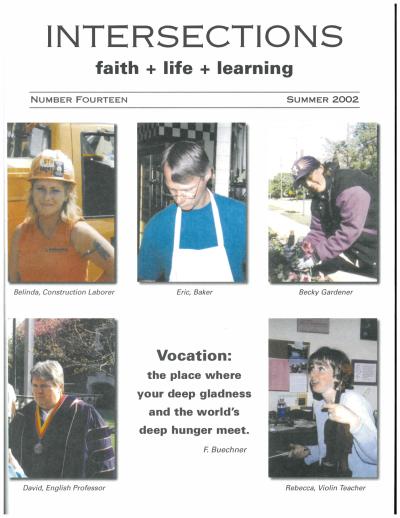
Bunge, director of the process for writing Valparaiso’s nearly two-million-dollar Lilly grant on the Theological Exploration of Vocation, argues that contemporary culture’s reduction of vocation to either paid work or self-fulfillment requires Lutheran institutions to renew attention to a rich theological concept rooted in Luther’s expansion of vocation beyond the priesthood. She outlines eight low-cost “doorways”—caring adults, prayer, worship leadership, music and the arts, service, cross-cultural experience, church camps and wilderness, study and reflection—and describes Valparaiso’s two-program structure: a Campus-Wide Program weaving vocation into Freshman Core Courses and chapel life, and a Church Vocations Program for students considering full-time ministry. She closes with four troubling questions for any institution carrying out such a grant: what faith traditions can learn from one another, how to involve parents, whether faculty and staff have space to reflect on their own vocations, and whether daily institutional practices—family policies, treatment of low-paid staff, environmental responsibility, obligations to the wider community—actually reflect a commitment to love of neighbor.
-
 Article
Reclaiming Grundtvig at Grand View College
Mark C. Mattes
No. 27 · Spring 2008
Mattes traces the Grundtvigian heritage of Grand View College — the only North American institution founded by Grundtvigian Danes — from its origins in the 1880s split between Pietist Inner Mission and Grundtvigian Danish Lutherans through its golden years of folk dancing, gymnastics, and the weekly lecture, to the demographic and curricular changes of the 1950s through 1990s. He describes recent tangible initiatives, including the Grand View College Reader, Imaging the Journey, and the 2007 Strategic Planning Commission’s “Faith Foundations” statement, that seek to recover the “Human first, then Christian” mantra of Grand View’s ancestors for a generation of students whose “ship” has had not only its planks but its very model replaced.
-
 Editorial
From the Publisher
Arne Selbyg
No. 16 · Winter 2003
Selbyg reports that “vocation” is surely among the top three words in Intersections’s history and congratulates nine ELCA institutions—Augsburg, Augustana (Rock Island), Concordia (Moorhead), Gustavus Adolphus, Luther, Pacific Lutheran, St. Olaf, Valparaiso, and Wartburg—on receiving roughly two-million-dollar Lilly Endowment grants for the “Programs for the Theological Exploration of Vocation,” while reminding readers that for Lutherans the priesthood of all believers means callings to be accountants, nurses, police officers, and home makers count as fully as callings into ministry.
-
 Article
Hospitality to the Wild
Laura M. Hartman
No. 54 · Fall 2021
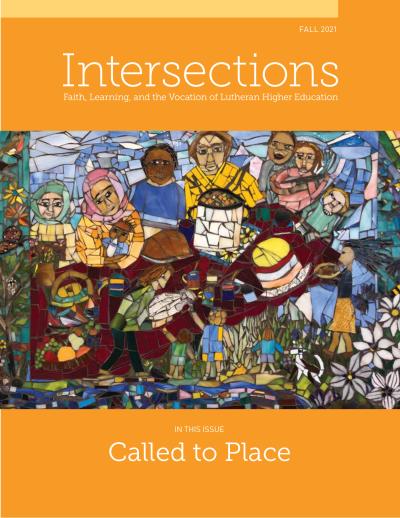
Drawing on research with a Wild Ones Native Landscaping chapter and Marilyn Matevia’s ethic of “creature comfort,” Hartman argues that Christian hospitality must extend to non-human animals and plants — and asks whether college campuses can foster not just human diversity but biodiversity.
-
 Response
Response to Mark Wilhelm: Vocation, Mission and Privilege
Marit Trelstad
No. 56 · Fall 2022
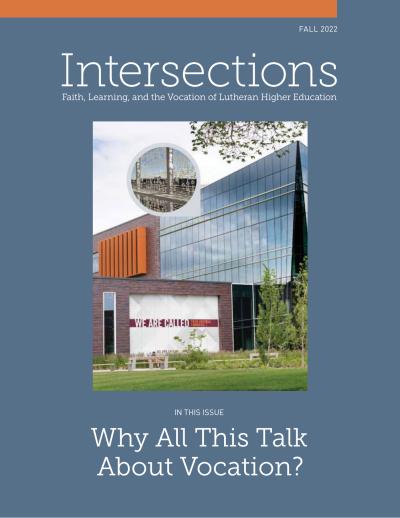
Trelstad affirms Wilhelm’s claim that vocation is the foundational shared mission of Lutheran higher education rather than one program among many, and presses the critique that calls to “vocational reflection” can mask privilege — arguing that an intersectional lens shows vocational discernment is in fact a matter of survival and flourishing for students from marginalized communities.
-
 Institutional Focus
Diversity and Dialogue: Gustavus Adolphus College
Florence D. Amamoto
No. 1 · Summer 1996
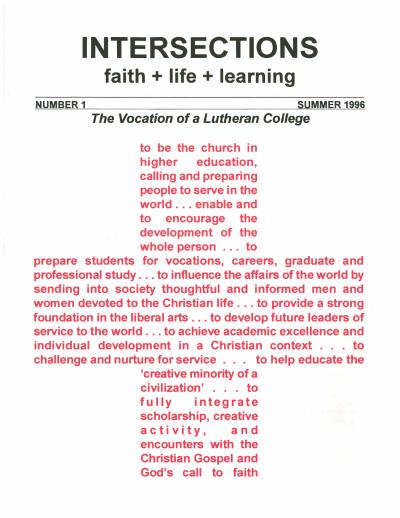
Amamoto, a third-generation Japanese-American Buddhist who teaches American literature at Gustavus Adolphus and regularly attends daily chapel, writes as an “inside outsider.” Engaging Schwehn’s closing call to refurbish the Lutheran college, she argues that church-related colleges are vitally important to society, that “refurbishing” must take up diversity, and describes how Lutheranism is manifest at Gustavus: Christ Chapel as the highest point on campus, the ecumenical chapel program led for thirty years by Chaplain Richard Elvee, the Nobel Conferences that pair scientists with philosophers and theologians, the First-term Seminar and Tuesday Conversations, the India study-abroad program organized by Deane Curtin, and the Sponberg Chair in Ethics. She names the pressures of money, secularization, and the publications-driven push for “excellence” that threaten this creative tension.
-
 Editorial
From the Publisher
James M. Unglaube
No. 2 · Winter 1997
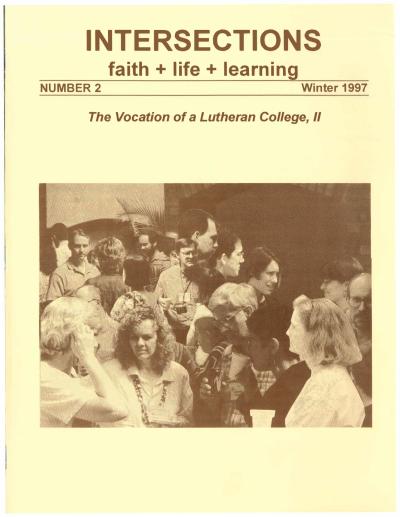
Unglaube reports on the second annual Vocation of a Lutheran College conference of August 1996, where Walter Bouman of Trinity Lutheran Seminary addressed “What is Lutheran; What is the Lutheran Tradition” (biblical, catholic, evangelical, sacramental, world-affirming—the world “received, enjoyed, served as God’s Gift”). He previews presentations by Wendy McCredie of Texas Lutheran and Baird Tipson of Wittenberg on how the Lutheran tradition is embodied in its colleges, and Bob Vogel’s challenge in “Coherence—And Now what?” that the tradition comes to life in how faculty give expression to their beliefs and values in the classroom and with colleagues.