Background
As I set out to prepare these comments, I was struck (and a bit mortified) by the realization that 28 summers have passed since I attended my first conference that focused on the mission and identity of Lutheran colleges. The year was 1975, the location was Concordia College in Moorhead, and the participants included two faculty members from each of the eleven American Lutheran Church colleges. An additional group of us from Concordia attended as listeners and observers.
At the time of that conference I was a third-year faculty member and novice administrator, and the experience made a lasting impression. That impression began with the participants, for this 1975 gathering was one of the early conferences on Lutheran identity, and it drew together legendary faculty leaders such as Dittmanson from St. Olaf, Diers from Wartburg, Storvick from Concordia, Hull-Mohr from Luther, and Nordquist from Pacific Lutheran. In the years that followed, these faculty members would serve as leaders of the “Lutheran” conversation both on their respective campuses and across the broader Lutheran community. This current series of “vocation” conferences may be understood, at least in part, as a natural heir of their legacy and their impact and as a continuing conversation on mission and identity that now dates to three decades and more.
My second lasting memory of that 1975 conference is the keynote lectures that were delivered by Professor Robert Bertram, then a member of the Seminex faculty. His lectures focused on the question “What does it mean to be a Lutheran college?” I remember clearly how, after three excellent presentations that built the context and background, I arrived for his final lecture awaiting a clear and definitive answer to this “Lutheran” issue. So I was both surprised, and initially disappointed, when Bertram concluded that “What it means to be a Lutheran college is that we are free to ask the question, ‘What does it mean to be a Lutheran college?’”
Four lectures later, and that was it! And “it” didn’t seem like much at the time. But as the years have rolled past, Bertram’s conclusion has stuck with me for it captures so very well our Lutheran understanding of and appreciation for the dialectic, complexity and uncertainty, and for the life of faith as purposeful journey and unfolding mystery. It has also stuck with me because I believe it is absolutely and profoundly true. We must keep searching and probing and asking. So in that spirit the discussion and conversation continues; it is indeed important work, and it is the latest version of this important and essential conversation that brings us together today at Carthage College, 28 years later.
Perspective
Cynthia Moe-Lobeda of Seattle University, in her recent book entitled Public Church: For the Life of the World, eloquently describes the Evangelical Lutheran Church in America’s “public” commitment. She writes: “In baptismal vows and prayers, teachings, constitution, liturgy, order of ordination, and confessional documents, the…ELCA professes to be a public church and a church constituted by God for a public vocation” (pg. xii).
In his recent pastoral letter on the public church, Presiding Bishop Mark Hansen quotes the 1991 ELCA Social Statement entitled “The Church in Society: A Lutheran Perspective.” That statement reads:
The ELCA is called to be a part of the Ecumenical Church of Jesus Christ in the context in which God has placed it—a diverse, divided, and threatened global society on a beautiful, fragile planet…this church is committed to defend human dignity, to stand with poor and powerless people, to advocate justice, to work for peace, and to care for the earth….” (p. 2)
Moe-Lobeda asks the great Lutheran question, “What then, does this mean for us—the ELCA—and our role in public life today?” The answer, she observes, “is both breathtakingly simple and confoundingly complex, as is the life of faith itself” (pgs. xii, xiii).
So your conference topic this year that addresses the vocation of a Lutheran college in terms of “the colleges and the public witness of the church” is certainly a natural. What does this mean? The answer is both simple and complex.
In these comments, I will contend that we can best serve the public witness for the church by mining fully our Lutheran tradition and heritage in search of educational excellence, mission fulfillment, and program distinction. Implicit in this argument, of course, is that our ultimate public witness for and with the church is carried out through the lives of our graduates, individuals who are well prepared to lead and called vocationally to serve the world on God’s behalf.
I offer these comments from the perspective of a Lutheran layperson and college leader, a practitioner, if you will. I am not a theologian, and, on the subject of the church and its public witness, I am certainly not a scholar. So the foundation for the ideas and reflections that follow is my experience, sixteen years at Concordia College in Moorhead and twelve at Pacific Lutheran University (PLU). These two venues are at once remarkably similar and dramatically different and, thus, I believe, useful in unwrapping and reflecting upon the vocation and witness of our colleges and universities.
Prairie and Pacific: A Comparison
Concordia-Moorhead and PLU share a common Norwegian Lutheran heritage. They were incorporated as high school level academies just one year apart (1891/1890), and, at least initially, both expressed their vocational calling in a frontier society in nearly identical terms. But the developmental path of these two schools would differ from the beginning, due in significant measure to location and constituency.
Historically, Concordia, as is the case for most of our Midwestern schools (and several further east as well), enjoyed the support of a significant Lutheran constituency and, while experiencing its own share of crisis moments, moved from academy in 1891 to an accredited four-year college by the mid-20s. Overall, the growth and development of the college over 113 years has been continuous and incremental, characterized by stability and steady progress, constantly in missional expression and with a very close church relationship.
PLU, by contrast, was one of six Lutheran schools, each founded by a small group of Lutherans in the Northwest in the late 19th century. The incorporating constituency of PLU included only five congregations and 250 members. Financial crises dominated PLU’s early history and delayed development, four-year college degrees were not awarded until 1940 (fifty years later), and survival was an issue until the end of World War II. It was finally the G.I. Bill that launched PLU as a post-war college and, by 1960, as a comprehensive university.
Today, Concordia College has matured in remarkable ways and continues to serve the Lutheran heartland. It is a region where, relatively, the church is still a prominent community center, socialization still drives membership, religious education is common, denominational loyalties are strong, cultural values are widely held, and diversity is limited. At one point, by my informal count, Fargo-Moorhead, a community of 150,000, included 12 ELCA congregations, several with a membership of 2000 or more. Given Concordia’s primary service region, it is not surprising that it is by nearly all traditional measures arguably the most Lutheran of our 28 schools.
Pacific Lutheran University lives and serves in the Northwest, a region of our country that Patricia Killen of our religion faculty and Mark Silk, her co-editor, in their recent Lilly Foundation funded volume, Religion and Public Life in the Pacific Northwest, has labeled the ‘none’ zone, so named because when asked about their religious identification, more people answer ‘none’ in the Pacific Northwest than in any other region. There is no dominant denomination, and only 2% of the population is Lutheran. Each year, in the Gallup Poll, Washington and Oregon, PLU’s two primary constituent states, vie for first and second place as the “least churched” states of our country. By way of contrast with the plains, it may be said that, in the Pacific Northwest, the church is rarely the community center, membership is elective, religious education limited, denominational loyalty is low, and diversity in values and background is significant and increasing.
And this is not a new or recent circumstance. In this book Killen and Silk describe a 1914 symposium on regional issues at which Professor E. J. Klemme of the Washington State Normal School in Ellensburg lamented, “In the east they were faithful church members; now they are not even church [at]tenders.” “The ascent of the great divide seemed too steep for church letters. The air of the Northwest seemed too rare for prayer. We have hurried forth to conquer the wilderness, but we have been conquered by it” (Killen, p. 9). Thus, Killen and Silk note, successful religious efforts in the Pacific Northwest “must be ecumenical, inter-faith, and coached in language that resonates with those beyond church, synagogue, temple, or mosque. Demographics do not allow any other option.”
Yet, PLU always has been and is today deadly serious about living out our Lutheran heritage, or, as we often say, taking our middle name seriously. Our long-range plan, PLU 2010, describes our core identity and self-understanding as “a Lutheran university in the Pacific Northwest.”
As noted above, I offer these sketches of Concordia College in the upper plains and Pacific Lutheran University in the Pacific Northwest because I have been privileged to experience both. And, after spending the first 47 years of my life and my early career years in the Lutheran heartland, my PLU years have been a time of great personal growth and challenge. I have struggled with this question, “Can one be a faithfully Lutheran University (or, a faithful Lutheran ‘witness’) in a world that is largely non-Lutheran, non-denominational, and overwhelmingly unchurched?”
Twelve years later, I am convinced that the answer is “yes.” And that is very good news. But the content of the answer is different in the Pacific Northwest, and that is why I believe the comparison with the heartland helps one to think about the evolving nature of the vocation to which we are being called as Lutheran colleges and universities. Colleges and universities seeking to be public witness for the church in a rapidly changing world and in a new time, a time when the religious character of the Northwest is less and less unique and more and more the norm and the context for all of us.
What then, given our changing vineyard of service are the callings that define our vocation and shape our public witness? I offer a list of five, I’m sure that you might think of others.
Callings
1. We are called to build an academic program that reflects both our best educational philosophy AND our Lutheran theological tradition.
Historically, our colleges and universities have hinged “Lutheraness” on church ownership and/or participation in governance, the number and proportion of Lutherans on our campus, community or lifestyle expectations (no dancing), commitment to faith development for our students, as well as matters of spiritual, marketing, and financial support from the church. Each of these “Lutheran” identifiers, whether treated simply or in combination, is appropriate and helpful in describing our uniqueness over the years. In different ways, these markers still characterize many of our schools, perhaps, to some degree, all of us.
The changing times in which we live and the changing world we serve is rendering these traditional markers obsolete so we must go further. For me, our future focus must begin with the educational program, for that is the very core of our vocation, the ministry of teaching and learning. So, every time I interview faculty or staff candidates, I include the following explanation:
If you come to PLU, I believe you will find that to be an educator in a Lutheran University is a very consonant and happy way of life. This is true because PLU is an excellent university with a superb faculty and wonderful students. In addition, we are also a Lutheran place and Martin Luther, the founder of our faith was a Lutheran. So it is that our Lutheran theological heritage compliments, reinforces and enriches the best educational instincts of the academy.
For example, Martin Luther laid the foundation for academic excellence and academic freedom. Indeed, you will find here an academic community that understands excellence and intellectual freedom not just as rights and opportunities, but also as mandates and possibilities. And with these mandates we are in effect called to explore the most difficult, vexing and controversial questions. As my predecessor, Robert Mortvedt, president of PLU in the 1960’s was fond of saying, “We do not fear the truth because we believe that all truth is God’s truth.”
But beyond that—our Lutheraness calls us to explore deeply. To get way beyond questions of fact, to explore fundamental principles and values, to seek out the difficult ethical challenges and to explore the great moral dilemmas. In this way, our Lutheran heritage contributes an energy and richness to one’s intellectual journey.
And, one last point, Luther’s two kingdom theology and his emphasis on the faith/reason dialogue, underscores, I believe, our calling to honor and explore alternative ways of encountering reality. This is important because in nearly every academic area our inquiry has carried us beyond the limits of the scientific method and our inclination to understand too simply and with too much certainty.
Well, much more could be said, and I fear in many of my interviews it is, but the point, I hope, is clear: truth seeking, the basic process of intellectual inquiry in pursuit of understanding and insight, is, for a Lutheran University, driven by both our commitment to good education and our rich theological foundation. It is a great gift that has the capacity to mark and distinguish a “Lutheran” education in any age or any locale.
2. We are called to the task of building vibrant campus communities of faith and learning.
One of the primary and historic markers of Lutheran higher education has been the claim to educate the whole person, “mind, body and spirit.” Taken seriously, it is a seminal and powerful notion that sets us apart even as it speaks to the world’s greatest need. It is a vision that we continue to take seriously, and so we build elaborate fitness centers (for the body), and we work to build and maintain strong communities of faith and learning. I believe we are doing very well with the “learning” dimension. But our success in creating vibrant, active and necessarily ecumenical practicing faith communities on our campus is very limited.
It is not an easy matter, for when it comes to campus ministry, worship life, and religious programming, the struggle to balance denominational heritage practice, and calling with ecumenical need and opportunity is difficult. The result in many cases is a program that appeals primarily to Lutheran students and/or those from related mainline protestant denominations. The ultimate results are lonely and frustrated campus pastors, chapels that are mostly empty, and, for most of our students, a disconnect from many of our efforts to foster a major educational outcome as Lutheran schools—spiritual encounter, reflection, growth, and development.
I do not claim to have an answer to this challenge (for there is no simple answer), but here is one idea: At PLU, we have been sponsoring a series of programs called “faith and reason” dialogues. These public conversations focus on high interest, current issues (such as “patriotism in an age of terrorism” or “gay marriage”) and bring together a small group of diverse faculty for public roundtable conversations. Students listen, and then join the dialogue as the program moves along. While it is only one step, these programs have been a huge success in drawing diverse students into an animated conversation that seeks to illustrate by practice the dialogue of reason and faith, the role of both mind and spirit, learning and faith, in encountering reality, and addressing some of the most challenging issues of our day. But if your campus is similar to PLU, there is much more that needs to be done.
3. We are called to embrace inclusiveness and ecumenical outreach.
The world that all of us are called to serve is increasingly diverse in nearly every way; denominations are less important, and religious identification and practice less common. Lutherans continue to decline in total and proportion of the U.S. population. Not surprisingly, the number and percentage of Lutheran students on our campus continues to decline; our faculty and staff are increasingly diverse.
Despite these realities, critical mass theory is alive and well, among both Lutheran leaders and the broader public. Indeed, one prominent sponsor of Lutheran Higher Education within the last decade set out to allocate financial support based on the percentage of Lutherans on our various campuses. And, please do not misunderstand, serving Lutherans is a good thing, and all of us will continue to seek and embrace Lutheran faculty, staff, and students; our vocational calling, our public witness if you will, should, is, and will be—and must be—much more expansive in its vision and reach. The fact that some 70% of our students today are non-Lutheran is one of the strongest expressions of our public witness as colleges and universities and the most powerful outreach efforts of our church. Our capacity as Lutheran colleges and universities to a reach non-Lutheran world is a gift. Let us claim it and move forward!
4. We are called to develop a global vision and commitment.
Lutherans have traditionally thought and acted globally. For better or worse, missionary slide shows have been a staple part of many a Lutheran child’s first exposure to global education! Acts 1:8 describes our calling to be God’s witnesses both at home and “…to the ends of the earth…”
Reflecting this traditional calling and urging, many of our Lutheran colleges and universities have already developed distinguished global educational programs. I believe we are called to continue and expand these efforts, to make global education a distinctive hallmark of Lutheran higher education. Three percent of American undergraduates currently study abroad; we simply must do better if we are to avoid the incredible insensitivity and abysmal ignorance that today jeopardizes the legitimacy of our own world citizenship and the well-being of the global community.
5. We are called to develop our campuses as centers for vocational exploration and discovery.
Martin Luther’s concept of the priesthood of all believers was central to the reformation. What an idea—all work, every profession, not just church leadership, is honorable and God-pleasing when done in His name and on behalf of others. I am not sure one can imagine a simpler, more powerful, or more compelling justification for the Lutheran Church’s involvement and investment in higher education.
The vocation of a Lutheran College is the theme for this conference. The vocation or sense of purpose and calling, of every student and every graduate at our respective schools, is our responsibility. Yet, we have been, and continue to be, remarkably casual and unintentional with the issue. We do not have a clear plan for confronting students with “vocational” questions or supporting their search for insights and answers. The current round of Lilly Foundation grants are a huge step in addressing this issue. At PLU, for example, the grant has already led to a major reorganization of student development services, a first-year student retreat focused on vocational discernment, and a continuing program of faculty and staff seminars, so that we are better equipped to support our students in their quest and exploration.
The vocation issue cuts even more broadly when it comes to marketing our institutions to non-Lutherans and to those outside of a formal faith background. For in its most generic form, vocation is about living life with a sense of purpose—and that, I believe, is a universal human urge and need. So I find that prospective students and their families are very interested in these issues, regardless of their religious or faith background.
Well, there’s much more that could be said, but I believe these are five callings taken seriously distinguish us as colleges and universities seeking to be faithfully Lutheran and to live out our mission, with great importance and effectiveness, in a world that more and more looks like the “none” zone. Together these callings have the capacity to shape our public witness on behalf of the Church as places of exceptional intellectual depth and richness, spiritual growth, ecumenical service, global vision, and vocational discovery. Beyond that, these callings inform us as we work to educate a new generation of able and committed “public” servants.
Before I close, however, this exciting vision must be qualified by the sobering reality of the growing distance between our schools and the church.
A Relationship in Peril
The history of church/higher education relationships in the United States is not encouraging. Most such relationships have dissolved, or they have been dramatically marginalized. In that regard, our Lutheran experience of a continuing strong, informing, and trust-filled relationship between church and college is almost unique and, in relative terms, it is still mainly a good news story. Our theological tradition has helped immensely; strong leadership has been a major factor as well.
But change is all about us, and, particularly since the formation of the ELCA, the Church, preoccupied by other issues, challenged organizationally and financially, has been in retreat from this relationship. Colleges, it is reasoned, have great resources and can take care of themselves. So while the church has backed away, the colleges, for the most part, have not (and that, too, is a uniquely Lutheran story). Today we gather to discuss our vocation and public witness as Lutheran colleges and universities at a time when the church is seeking to reorganize in a manner that will diminish the voice of education and takes another major step toward the elimination of financial support.
For many of us, our Lutheraness is not a matter of church-wide support or money; it is, at the heart, a matter of mission and calling, of institutional identity, of educational distinction. So the relationship is both natural and essential! But in the long run, it also must be mutual and reciprocal if it is to endure the tests of distraction and competing interests, of institutional quest for survival and progress, and future leadership change. My personal belief is that the die is cast on this issue, the direction of the ELCA at the synod and national level is clear. So what are we to do as colleges and universities, for the issue belongs to us!
At PLU we are, in effect, shifting from a program of Church relations to an emphasis of Congregational relations. This fall, we are launching a new program of “partnership” congregations in an effort to establish direct and supportive links with vibrant interested congregations, many which are growing, all who care deeply about Lutheran higher education. These congregations, we believe have the capacity to be valuable colleagues in student recruitment and financial support, as well as institutional grounding, self-understanding, and identity with the church. As both synods and national church withdraw, we look to these congregations as our natural Lutheran partners and foundations for the future.
We are also establishing a new Center of Religion, Culture and Society in the Western United States. This will be a research center that employs our primary resource, the intellectual capital of our faculty. The goal is to work with ministry practitioners in doing applied research that will illuminate religious life and inform ministry practice toward greater effectiveness in the “none” zone. Efforts such as the Center also have the capacity to build a new model for future church relationships.
If we continue in present directions, I believe that the future of our identity as Lutheran colleges and universities is at significant risk. So, perhaps, as we work together in this conference, we might articulate a sixth calling: to formulate a new compact of relationship between our schools and the ELCA. The task belongs to us, for, as Robert Bertram concluded 29 years ago, we are free [still free] to ask the question, “What does it mean to be a Lutheran college?”
-
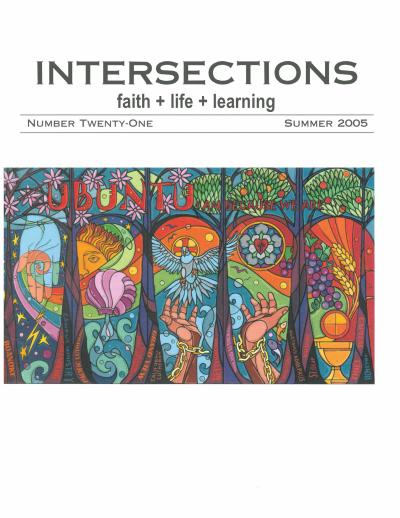 Editorial
From the Publisher
Arne Selbyg
Selbyg notes that ELCA colleges and universities have remained more loyal to the church than the institutions of many other denominations and announces that with this issue Tom Christenson’s nine-year service as editor of Intersections comes to an end, with Bob Haak of Augustana College in Rock Island assuming the editorship and institutional support shifting from Capital to Augustana.
-
Editorial
From the Editor
Tom Christenson
In his valedictory letter as outgoing editor, Christenson recounts the 1994 origins of Intersections, when he took the idea to Naomi Linnell and Jim Unglaube at DHES and persuaded the council of presidents to launch the journal on a shoestring with printing paid by DHES and everything else by Capital University. He summarizes the issue’s contents—papers from the 2004 Vocation of a Lutheran College Conference plus two commissioned pieces from former DHES directors Bob Sorensen and Leonard Schulze—and thanks the student copy editors and Capital’s presidents and provosts who sustained the publication.
-
Article
Changes
W. Robert Sorensen
Writing as former executive director of the Division for Higher Education and Schools, Sorensen places the DHES within the threefold movement of Luther’s Reformation—university, church, and individual piety—and recounts how the Division cohered its work with colleges, universities, campus ministries, and schools around Joseph Sittler’s definition of education as “movement into a larger world.” Drawing on Huston Smith’s “primordial tradition,” the Namibian student program, work in India and Palestine, and the Bergendoff series of publications, he raises a twofold concern about the proposed merger of DHES into a Division for Vocation and Education: whether the new structure will signal the core significance of education in the heritage and life of the church, and whether it can carry forward the effectiveness and scope of DHES’ work.
-
Article
The Church in Education? Education in the Church? Ten Theses on Why These Questions Matter
Leonard G. Schulze
Writing in the months before the August 2005 Churchwide Assembly that will decommission DHES, Schulze frames his vision for the division as ten Lutheran-style theses, each followed by Luther’s catechetical question “What does this mean?” He argues that critical thinking and moral deliberation are in the Lutheran gene pool; that Luther’s devotion to learning was an expression of Christian vocation; that the rise of the research university and the binary public meaning of “evangelical” have marginalized church-related colleges; that DHES has been wrongly perceived as marginal; and that the reformed concept of vocation must drive the soon-to-be-created program unit for Vocation and Education. An appendix reproduces the 2005 DHES strategic planning overview.
-
Reflection
Finding Words That Matter (Proverbs 1:20-21; 4:10-13)
Harvard Stevens Jr.
In a brief homiletic reflection on Proverbs, Stevens addresses Lutheran educators as “merchants of wisdom” competing with a crowded contemporary marketplace of internet, cable TV, and rap music alongside “Hedonism 101,” “Advanced Voyeurism,” and “Pure Escapism.” Recounting an evening with a Carthage student poetry club, he shares the poem wisdom whispered to him there and offers thanks for the high calling to teach “words that matter.”
-
Poem
Sprigs of Mint
Caitlin McHugh
McHugh meditates on three light green mint stalks dying in a plastic cup of water in her window frame’s shadow, drawing a parallel between the neglected mint, the “tainted papers” of her unread journals, and the time that both holds her back and drives her forward.
-
Article
Money, Sex and Power: An Exploration of Some Controversial Issues in the Public Witness of the Church
Pamela K. Brubaker
Brubaker explores two controversial issues in the church’s public witness—homosexuality and economic life—and the challenges they present for both church and college. Drawing on Beverly Harrison, Elizabeth Bounds, Ron Thiemann, Linell Cady, Marcia Bunge, Richard Hughes, Darrell Jodock, Ernest Simmons, Karen Bloomquist, Garth Kasimu Baker-Fletcher, and Larry Rasmussen, and on episodes at California Lutheran University around “Harmony Week” and Bishop Paul Egertson’s participation in Anita Hill’s ordination, she argues that colleges related to the ELCA are called to educate for “critical citizenship” by hosting rigorous, bold, and unfettered debate—including debate over the neo-liberal globalism that she names a form of economic fundamentalism.
-
Article
Education as a Christian (Lutheran) Calling
Tom Christenson
Christenson opens with an imaginative reconstruction of early Christian communities as radically egalitarian, pacifist, communitarian gatherings within the Roman Empire and argues that such communities are natural homes for the educational vocation. Naming two temptations for contemporary Christian higher education—the parochial Bible school and “Generic U”—he uses his friend Sig Rauspern’s tree metaphor to insist that a university is Christian in its trunk and roots rather than in grafted-on branches. Drawing on Wendell Berry, Jacob Bronowski, Walter Wink, Douglas John Hall, and his own Gift and Task of Lutheran Higher Education, he names faithful criticism, engaged suspiciousness, simul justus et peccator, and a fallible, love-related Lutheran epistemology as the particular gifts Lutherans bring to the Christian educational calling.
-
 Article
The Duty to Teach and Restore Bodily Autonomy: Reflections from the Classroom
Cynthia Richards
No. 57 · Spring 2023
Richards reflects on a Narrative Medicine course she taught at Wittenberg University in the wake of the Dobbs decision, in which students examined cultural “first recognitions” of the reproductive body and discovered that almost none had ever had a way of talking openly about their reproductive selves — an alienation she calls educators to address.
-
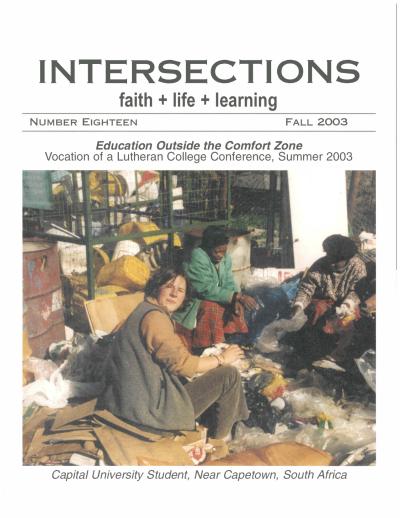 Article
Service Beyond the Comfort Zone
Kathryn Wolford
No. 18 · Fall 2003
Wolford names economic globalization and the growth of civil society as the two issues shaping Lutheran World Relief’s mission, illustrating with the Guatemalan storekeeper undercut by subsidized “gringo” chickens, fair-trade coffee and chocolate campaigns, and Charles Onyango-Obbo’s warning about anti-terrorism laws in fragile African democracies. Drawing on Darrell Jodock, Art Simon, and the Good Samaritan, she frames the global vocation of Lutheran colleges as inviting students past comfort zones of race, class, ethnicity, and ideas through service-learning that links mercy and justice, and closes with a concrete LWR partnership invitation including site visits, internships, fair-trade campus campaigns, and the “A Place for Peace in Colombia” advocacy program.
-
 Editorial
From the Publisher
Mark Wilhelm
No. 51 · Spring 2020
Wilhelm frames the issue by tracing how Lutheran educational ideals — once a primary source of contemporary higher education — were masked in the United States, and introduces a NECU initiative that uses the case of business ethics to explore Lutheran social teaching as an academic resource.
-
 Article
Luther's Theology of Learning: Discovering the Vocation of Today's Small Lutheran Liberal Arts College
Eric Childers
No. 20 · Fall 2004
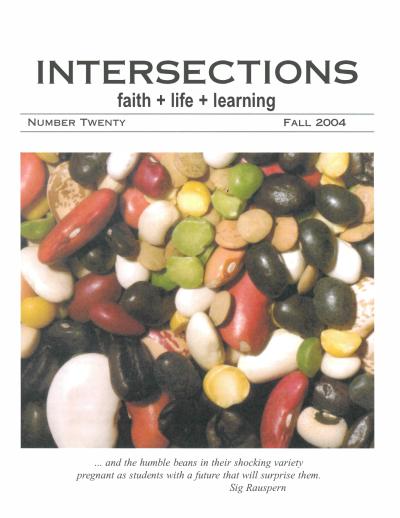
In an excerpt from his Wake Forest University Divinity School senior thesis, Childers profiles six students hand-picked by presidents and chaplains at Concordia College (Moorhead), Lenoir-Rhyne College, and Muhlenberg College—Nathan Gossai, Amy Nelson, Alison Schmidt, Ryan Sigmon, Julie Christianson, and Jeffrey Slotterback—as a living testament to Luther’s theology of learning. He then draws on Solberg, Mark R. Schwehn (in Paul J. Dovre’s The Future of Religious Colleges), Robert Benne, Ernest Simmons, Mark Noll, Richard Hughes, and James Burtchaell to argue that Lutheran colleges have not yet fully articulated their own theology of education and that their vocation is to embrace, engage, and galvanize a Lutheran tradition of learning rooted in the liberal arts, Scripture, the Confessions, and confident ecumenism.
-
 Article
Luther, the Catechisms, and Intellectual Disability
Courtney Wilder
No. 47 · Spring 2018
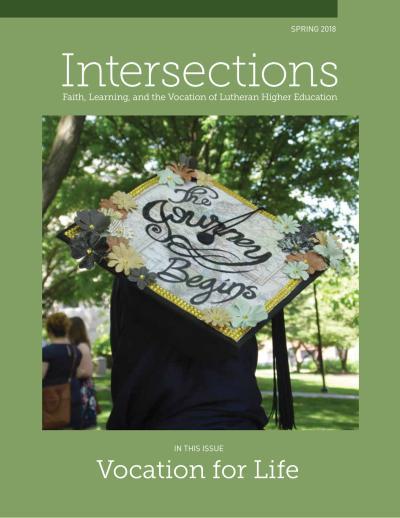
Wilder confronts Luther’s deeply troubling response to a child with disabilities at Dessau, then mines his Small and Large Catechisms for a Lutheran theology of inclusion — reading the Third Article of the Creed, the petitions of the Lord’s Prayer, and the sacrament of baptism as resources that affirm the full humanity of people with intellectual disabilities as faithful children of God.
-
 Reflection
Confessions of a Collaborator
Chuck Huff
No. 3 · Summer 1997
Huff of St. Olaf offers a tongue-in-cheek public confession of his lifelong sin of collaboration—from elementary-school reports on dinosaurs and Cliff notes on Faulkner, through high-school algebra and college group projects, to borrowed syllabi, group work imposed on resentful students, tutorials, independent studies on every form of self-reliance, and circulated drafts. Even this confession was collaborated on, and (he confesses) he enjoyed it.