Money, Sex and Power: An Exploration of Some Controversial Issues in the Public Witness of the Church
Intersections No. 21 · Summer 2005
As a professor and practitioner of Christian ethics, I am well aware of the controversial character of some issues in the public witness of the church, particularly those having to do with sex and money. Beverly W. Harrison claims that “all basic theological and moral questions are about power-in-relationship” (55). Thus we cannot talk about the public witness of the church without also talking about power.
I will first discuss some issues around the public witness of the church and then turn to the vocation of Lutheran colleges. I will explore two controversial issues in the church’s public witness—homosexuality and economic life—and the challenges they present for church and college.
Part One: Public Witness of the Church
When I speak of the public witness of the church, I am thinking primarily of the prophetic voice of the Evangelical Lutheran Church in America (ELCA) and the ecumenical movement on social issues and public policy. This is sometimes called the social witness of the church, to contrast it with a more evangelical witness aimed toward personal conversion. Issues of power permeate this witness: Who has authority to speak for the church? Who decides what will be said? How does the church use its voice and power within the public arena? As you may know, these issues are fiercely contested.
There are those both within and without the churches who object to the church speaking on matters of public policy. Some within the church do not see matters of politics and economics as part of the “core vision” of Christianity. I understand this to be the position of our colleague Robert Benne. Writing in the volume The Promise of Lutheran Ethics, he contends that only in special times on special issues (which he does not specify) should the church stand for or against particular public policy issues; I see this as a conservative objection to a broad public witness of the church—the “core vision” of the church is to be preserved.
A more liberal objection is rooted in the Enlightenment understanding of public and private. In this view, religion, like the family, became a domain excluded from the purview of the public. As Elizabeth Bounds points out, this mutes the voice of religion within the public arena and circumvents attention to power relations within the church. She concludes that mainstream Christian ethics “has used the privatization of religion as a shield against the possibility of publicly contested morality,” assuming “the capacity . . . to separate reality neatly—(a privatized) faith from social life, politics, and consequently, from issues of power” (16). There are, though, increasing numbers of liberal and conservative Christians who enter the public arena to contest social and ethical issues.
This political activism, particularly of religious conservatives, has led some to claim that legally religious people should not speak on public matters. They appeal to the two religion clauses of the U.S. Constitution’s First Amendment, the second of which became interpreted as “the separation of church and state,” to support this position. In other words, they interpret the establishment clause in a way that privatizes religion. This interpretation is not persuasive to me. Although I do not personally agree with many of the religious right’s positions or tactics, I believe that the religious liberty clause, as well as other First Amendment rights like freedom of speech, permit religious believers to participate in public debate.
However, there are valid concerns about the public role of religion. The imposition of particular religious beliefs on the body politic is, in my judgment, a violation of religious liberty. The question about how the church uses its power is pertinent at this point. Does it attempt to impose its beliefs or to persuade people of the rightness of its positions?1 On the one hand, religious liberty gives religious people the right to speak; but on the other hand, it protects us from an imposition of religious beliefs.
In Religion in Public Life, Ron Thiemann articulates a credible place for religious traditions in public discourse.
Insofar as democratic societies are historical, they will remain fallible in their grasp and exemplification of democratic ideals. From time to time these societies need to be called to account by reference to a higher standard of justice than that to which they ordinarily give allegiance. Religious traditions are often the source for those standards, and religious discourse will often be the vehicle for both critique and renewal (88).
He concludes that when religious traditions are used in this way, “they become part of the proper public discourse of democratic societies.”2 Bishop Hanson’s statement against a preemptive war with Iraq is an excellent example of this.
In her discussion of Religion, Theology, and American Public Life, Linell Cady contends that for theologians “to achieve a public form of argumentation,” they must respect the Enlightenment distinction between open inquiry and dogmatic citation and work to combat the authoritarian traces that linger on in contemporary theology.”3 She also insists that “the impossible pretensions to neutrality and universality that underlie the Enlightenment understanding of public, and the public exercise of reason” (64) must be unmasked.
Cady thus shares the communitarian and postmodern critique of certain forms of liberalism. However, both she and Thiemann are working to reform liberalism. They do not take the communitarian turn some other theologians advocate. Elizabeth Bounds cautions against the appeal of communitarian thinkers like Richard Neuhaus and Stanley Hauerwas, who “in their criticism of liberalism, throw out valuable parts of the liberal Protestant heritage: commitments to public participation, justice, and critical reflection on inherited traditions” (118).
Bounds calls for “new forms of Christian citizenship, emphasizing our responsibilities to the entire community, nation, and world, and the necessity of acting humbly as one among many to bring about such changes in this world community” (119). Cady suggests that “commitment to a global community” requires an identity for both individuals and societies that reflects “a dual allegiance to both a particular history within which identity and meaning have been rooted and the global order which remains to be fully actualized” (160). This turn to notions of citizenship can also be a turn to the vocation of the colleges.4
Part Two: Vocation of the Colleges
I believe that a primary purpose of liberal arts colleges is to educate for citizenship in a democratic society, what I call “critical citizenship.” Church-related colleges, I believe, share in this responsibility. In addition to the scholarly disciplines, they bring the resources of Christian faith to this task. Marcia Bunge points out that there is a synergy between the emphasis church-related colleges place on questions of religion and ethics and the current concern within the discipline of religious studies (see Plaskow, 534) to connect the knowledge and insight from religious traditions “to the real problems of society” (3).
In his study of models of church-related colleges, Richard Hughes states that in a Lutheran approach, “the task of the Christian scholar . . . is not to impose on the world—or on the material that he or she studies—a distinctly ‘Christian worldview,’ as in the Reformed model. ‘Rather, the Christian scholar’s task is to study the world as it is and then to bring that world into dialogue with the Christian vision of redemption and grace.’” Hughes believes that “this theological vision is the great strength of Lutheran higher education for it enables Lutherans to take religious and cultural pluralism with a seriousness that often escapes other Christian traditions” (6-7).5
Some ground the Lutheran approach to higher education in the dialectic between faith and reason characteristic of the Lutheran tradition (Brubaker). Others ground the Lutheran approach in what is called the “two kingdoms” or “two governances” doctrine (Solberg, in Hughes, 76). Note that in speaking of governance we are again speaking about power, particularly power-in-relationship.
Darrell Jodock contends that this teaching grounds the characteristic of serving the community and educating its leaders. This characteristic is not distinctive to a college related to the Lutheran tradition, but its grounding is (15). The first governance is rooted in the gospel—God’s mercy and forgiveness—and the goal is personal reconciliation. The second is exercised through social structures “to bring order and justice to the world.” College education is focused primarily on this second form of governance. According to Jodock, “Its purpose is to enable young men and women to discern what makes for justice and what preserves and enhances human dignity” (18).
In his introduction to Lutheran higher education, Ernie Simmons claims that “Lutheran identity is forged … in the dialectical tension” of what he calls “ecumenical confessionalism.” The ecumenical side can discourage “denominational ideology” by keeping the community mindful of the presence and value of other theological and denominational perspectives, “thus affirming diversity on our campuses.” The confessionalism side maintains the value of affiliation “by affirming that in the intellectual arena it is preferable to be self-conscious about one’s commitments, not assume such discussion is value-free.” He insists that “confessionalism as a dynamic theological expression does not seek imposed doctrinal uniformity but rather a lively and healthy confessional dialogue between traditions” (23).
I would contend that the public witness of the churches is also shaped in dialogue between religious traditions as well as social and natural sciences. This is the case, for instance, in the development of the social statements of the ELCA. Committees that draft these statements for the consideration of the churchwide assembly include academics whose expertise is in the area under study—the environment, economic life, the death penalty, for instance—as well as theologians and ethicists. Although these statements are primarily for use in the public witness of the church, I think that they can be a useful resource in education for critical citizenship (Brubaker). It is important to remember, though, that the colleges have distinct roles and responsibilities. What then, should be the relationship between the public witness of the church and the colleges? I think that an exploration of some specific issues can help clarify this.
Part Three: Sexuality Debates
A particularly difficult issue in relation to the public witness of the church—and the vocation of the colleges—is the issue of homosexuality. The ELCA, like most other mainline Protestant denominations, is deeply divided on this issue. Much is at stake for both sides—the authority and interpretation of scripture, the “core” or “heart” of Christian faith. The debate reveals the tension between the generally conservative role of religion in society and the continually reforming character professed by Protestantism.
This issue is one where money, sex, and power sometimes come together in unsettling ways. For instance, some members of the church constituency may threaten to withhold donations if certain topics are discussed on campus. Or the administration may reconsider whether the Gay Men’s Chorus should hold their concert in the Campus Chapel, the usual venue for concerts, for fear of donor backlash.
I want to speak about some situations that have arisen at California Lutheran University (CLU), as illustrative of the difficulties. (You may want to discuss what’s happening on your campus in small groups.) This spring we had some sharply worded letters to our student newspaper asking how a “Christian” college could permit a “Harmony Week” sponsored by the campus Gay-Straight Alliance. Although uncomfortable, this challenge from some conservative students has been useful in helping us think about what it means to be a university “rooted in the Lutheran tradition of Christian faith,” as our mission statement declares. Since its founding in 1959, CLU has come to understand that “The Lutheran tradition cherishes education, faith and freedom of inquiry and encourages the noblest expression of Christian values. The University welcomes students of all beliefs and provides them the opportunity to explore religious issues as part of their formal education and to do so in the spirit of openness, reason and tolerance” (Wold and Swanson, in Hughes, 121). In this matter, I think it can reasonably be claimed that by hosting Harmony Week, the college is acting in a matter consistent with the public witness of the ELCA of non-discrimination against gays and lesbians and the expectation of colleges just articulated.
A few years ago, though, there was an episode in which the college seemed to some to be acting against the public witness—or at least the policies—of the church. This incident was prompted by the participation of Bishop Paul Egertson in the ordination of Anita Hill. As some of you may know, ELCA policy—like that of most other mainline Protestant denominations—limits ordination to celibate gays or lesbians. Hill, a self-identified lesbian, is in a long-term, committed relationship. After trying to change denominational policy, her congregation in St. Paul, Minnesota voted unanimously to ordain her.
The ordination service received heavy media coverage. Newspapers in Los Angeles gave front-page coverage to Egertson’s participation in the service and eventual resignation as bishop because of it, noting that he would return to his teaching position at CLU. President Luedtke wrote an eloquent opinion piece, published in the Los Angeles Times, responding to those who asked why the college would permit him to teach. Luedtke described the beginnings of the Lutheran denomination “in the fearless intellectual and spiritual discourse of the German university.” He declared that “church-related colleges and universities are not the church” but that “they provide extraordinary forums for nailing theses to the wall and using both faith and reason to interpret not only written texts but also the physical and human world that is revealed to us daily in all its beauty and complexity.” He identified four expectations of church-related colleges and universities, including “that the theological and social positions of the parent church be made known to members of the community…[and that] within these contexts, the most rigorous, bold and unfettered debate be encouraged in all matters of faith and reason” (Luedtke).
I endorse this view of the relationship between the colleges and the public witness of the church.
There are other issues related to sexuality, such as the availability of condoms on campus or co-habitation in dorm rooms, which are perhaps more difficult for colleges related to the ELCA than those related to more fundamentalist traditions. The challenge is to determine what policies and practices take account of the realities of campus life and “enable young men and women to discern what makes for justice and what preserves and enhances human dignity?” in the words of Jodock.
Part Four: Economic Globalization
One might conclude from the focus on issues of sexuality in the churches that this is the primary focus of scripture, the primary source for Lutheran (and most Christian traditions’) theology and ethics. However, economics—wealth and poverty—receives much more consideration in scripture. The privatizing of religion discussed earlier is one reason for this discrepancy. Ethicist Garth Kasimu Baker-Fletcher draws on the work of Pierre Bordieu to point out that although different values may be held in what may be called the micro-habitus of family, “the macro-habitus of consumptive, competitive, materialist hedonism has severely restricted the moral vision of all Western nations and peoples and constricted our capacity to grapple effectively with global problems of hunger, poverty, and environmental destruction” (59). In other words, our “culture” shapes the lens through which we read scripture.
Some think that churches do not have the expertise to speak on political and economic issues. Others think that these issues are not issues of faith, but extensions, at best, distractions, at worse. Karen Bloomquist, Lutheran theologian and ethicist currently working with Lutheran World Federation, writes that an issue of faith is clearly at stake…“given the all-pervasive neo-liberal logic”—which prioritizes economic growth and profit—“that undergirds and directs economic globalization as a totalizing system…” (494).
Some mainline Protestant churches, among others, have begun to address these economic issues. For instance, one of the ELCA social statements is on economic life. It articulates a principle and vision of “sufficient, sustainable livelihood for all.” The Lutheran World Federation is engaging economic globalization as a communion and ecumenically with the World Alliance of Reformed Churches and the World Council of Churches, among others. These different traditions approach this issue from particular theological perspectives, but have discovered common principles: “What we share in common is the quest for greater solidarity, love, compassion, and justice in the face of enormous power inequities” (Communique).
An example of ecumenical public witness growing out of this joint work is a letter The World Council of Churches, the Lutheran World Federation, the World Alliance of Reformed Churches, and the Council of European Churches sent to the World Trade Organization and the Ministers of Trade from its member countries when they met in Cancun last fall for “the development round.” This letter is an example of raising standards of justice grounded in religious traditions, upheld by Thiemann as appropriate. It begins by pointing out that “the ecumenical community’s understanding of ‘trade and development’ is rooted in spiritual, moral and ethical perspectives.” It then asks questions to evaluate WTO agreements: “Are they just and fair—especially to the vulnerable and impoverished? For these, we believe, God has expressed a preferential option. Do the agreements support right relationships between North and South, between producers and consumers, and between the powerful and the powerless? Are they friendly to God’s creation? Do they enhance and not diminish the planet’s capacity to sustain and nurture present as well as future generations of humankind and all other life forms? Do they affirm human dignity and care for life in all its richness and diversity?” A statement of principle follows: “international trade agreements should first and foremost respect, value and uphold the sacred nature of all life,” followed by a critique of “the economic agendas of some governments, especially Northern governments, [that] seem to be largely driven by corporate interests at the expense of economic justice.”
Not surprisingly, this analysis is controversial—particularly for many Christians in the global north who may work in transnational corporations or benefit in other ways from the current workings of the global economy. Karen Bloomquist suggests that if the global economy is a matter of faith, it presents an enormous challenge to churches. That is “to nurture people in the Christian faith in comprehensive ways that empower them to resist the logic and assumptions [economic growth and profit] underlying economic globalization” (494).
In what ways is this also a challenge to our colleges? Like sexuality, this is an issue subject to “rigorous, bold unfettered debate” (Luedtke). We also need “to make known” the ELCA and LWF positions on economic life. I think that perhaps more is asked if we are to be accountable to our responsibility to educate for critical citizenship, or to use Jodock’s words again, “enable young men and women to discern what makes for justice and what preserves and enhances human dignity.” Given the hegemony of the neo-liberal model, it is crucial that students are encouraged to question its underlying assumptions—for instance, that the market should be the primary arbiter of value.
A few programs at CLU seem to me to be possible models; there may be others at your colleges. Our School of Business is striving to be a “business school with a conscience.” One of its programs is a Center for Leadership and Values. A recent speaker in the Center’s lecture series, jointly sponsored by the Religion and Political Science departments, was a union organizer from Mexico. She raised important concerns about worker justice in transnational corporations.
Some students, though, begrudge any questioning of “business as usual.” A few openly confess that they only came to college because this is the route to an upper-middle class lifestyle. I see this response as a materialist challenge to the vocation of the colleges. It could also be described as a form of economic fundamentalism. Like religious fundamentalism, it resists the spirit of critical inquiry at the heart of liberal arts education.
Conclusion
Both religious and economic fundamentalism present serious challenges to education for critical citizenship. We tend, I think, to be more aware of the harm of the intolerance inherent in religious fundamentalism. However, neo-liberalism—a form of economic fundamentalism, challenges the basis of the public witness of the church—love of neighbor. F.A. Hayek, the “father of neo-liberalism,” rejects the Christian ethic of neighbor-love as “unfit and unworkable in modern societies, for such an ethic is only a tribal, anti-commercial, and anti-capitalist ethic that poses a grave threat to civilization.”6
In contrast to this interpretation, Lutheran theologian and ethicist Larry Rasmussen contends that the church’s universal vision and conviction is of “the necessary, full inclusion of the excluded, on egalitarian terms.” Universalism and egalitarianism are both “assertions of faith itself, whether or not they also have secular grounds.” These assertions are “the converging Christian ground for one of the lasting moral achievements of modernity itself—universal human rights” (148-9).
As a practicing Christian ethicist, I affirm Rasmussen’s interpretation. As a professor of Christian ethics, I encourage critical inquiry into and unfettered debate about this ethic, these two interpretations—and others. Along with Thiemann, I want these arguments—religious, moral, and political—to be governed by public accessibility, moral integrity, but most of all, mutual respect (140).
Works Cited
Baker-Fletcher, Garth Kasimu. Dirty Hands: Christian Ethics in a Morally Ambiguous World. Fortress Press, 2000.
Benne, Robert. “The Church and Politics: Hot and Cool Connections.” Moral Issues and Christian Response. Ed. Patricia Beattie Jung and Shannon Jung. 7th ed. Thomson Wadsworth, 2003. 17-23.
Benne, Robert. “Lutheran Ethics.” The Promise of Lutheran Ethics. Ed. Karen Bloomquist and John Stumme. Fortress Press, 1998.
Bloomquist, Karen. “Engaging Economic Globalization as Churches.” The Ecumenical Review. 53.4 (2001): 493-500.
Bounds, Elizabeth M. Coming Together/Coming Apart: Religion, Community and Modernity. Routledge, 1997.
Bunge, Marcia. “Introduction to Valparaiso University in the Context of Lutheran Higher Education.” The Lutheran Reader. Ed. Paul Contino and David Morgan. Valparaiso University, 1999.
Brint, Michael. “The Politics of Identity and The Culture of Global Technology.” Culture, Politics and Nationalism in the Age of Globalization. Ed. Reneo Lukic and Michael Brint. Ashgate, 2001. 3-28.
Brubaker, Pamela, “‘In, With and Under:’ The Tradition and the Teaching of Christian Ethics.” Intersections. 17 (2003): 3-7.
Cady, Linell E. Religion, Theology, and American Public Life. SUNY Press, 1993.
Chang, Yoon-Jae. “Economic Globalization, Neoliberalism, and F.A. Hayek: Does History Redeem Itself?” International Conference on Globalization, July 27-August 2, 2003, Payap University, Chiang Mai, Thailand. <http://isrc.payap.ac.th/doc_conference2003.html>.
Communique of the LWF, WARC, and WCC Consultation on Ecclesiology and Economic Globalization. “Ecclesial Entry Points for Addressing Economic Globalization.” Dec. 11-14, 2002. Cartigny, Switzerland.
Evangelical Lutheran Church in America. “Current Policy on Sexuality.” <www.elca.org/faithfuljourney/policy.html>.
Harrison, Beverly W. “The Fate of the Middle ‘Class’ in Late Capitalism.” God and Capitalism: A Prophetic Critique of Market Economy. Ed. J. Mark Thomas and Visick. Madison, Wisconsin: A-R Editions, 1991.
Hughes, Richard and William Adrian, eds. Models for Christian Higher Education: Strategies for Success in the Twenty-first Century. Wm. B. Eerdmans Publishing Company, 1997.
Jodock, Darrell. “The Lutheran Tradition and the Liberal Arts College.” Called to Serve: St. Olaf and the Vocation of a Church College. Ed. Pamela Schwandt. St. Olaf College, 1999.
Luedtke, Luther S. “Religious Colleges Aren’t the Church.” Los Angeles Times. 14 June 2001.
Plaskow, Judith. “The Academy as Real Life: New Participants and Paradigms in the Study of Religion.” 1998 AAR Presidential Address. Journal of the American Academy of Religion. Sept. 1999: 521-538.
Rasmussen, Larry L. Moral Fragments & Moral Community: A Proposal for Church in Society. Fortress Press, 1993.
Simmons, Ernest. Lutheran Higher Education: An Introduction for Faculty. Augsburg Fortress Press, 1998.
Thiemann, Ronald F. Religion in Public Life: A Dilemma for Democracy. (A Twentieth Century Fund Book). Washington, DC: Georgetown University Press, 1996.
World Council of Churches. Statement from ecumenical organisations addressed to the World Trade Organization (WTO) and Ministers of Trade gathered in Cancun, Mexico for the 5th Ministerial Conference of the WTO from Sept. 10-14, 2003.
Notes
1 Benne has a very useful discussion of these questions in his article entitled “The Church and Politics: Hot and Cool Connections.”
2 Thiemann makes the case that “Arguments that arise from religious beliefs or religiously based moral premises can meet the criteria of plausibility that should govern all public speech and action in a liberal democracy” (140).
3 Cady helpfully articulates the relation of public theology and religious traditions: “public theology draws upon the resources of a particular religious tradition to establish a deeper sense of a common public life that demands commitment and nurturing in order to enhance human life and flourishing for both the self and the wider society. Through this task, which it executes in the spirit of open inquiry, it contributes to the ideological and practical reconfiguration of the public realm, thereby witnessing to the understanding that ‘faith in God cannot become incarnate except in a universal community in which all walls of partition have been broken down’” (169). This understanding is particularly useful, in my judgment, in that it expresses a confessional form of witness which is not hegemonic in its intention.
4 Thiemann’s notion of “pluralist citizen” (113) is useful. See also Michael Brint’s insightful discussion of cosmopolitan, culturalist/communitarian, and post-modern individualist perspectives on identity and culture.
5 In my judgment, this is the Lutheran vision at its best. However, actually sharing power with faculty from diverse backgrounds can be a more difficult challenge than embracing pluralism.
6 I am drawing on the work of Yoon-Jae Chang, whose Union Theological Seminary dissertation, God and political economy: A critical appraisal of the late twentieth-century theological responses to capitalism, socialism, and ecology (2003), included a section on Hayek. I am quoting from Chang’s paper, which elaborates on Hayek’s views, and is listed above.
-
 Editorial
From the Publisher
Arne Selbyg
Selbyg notes that ELCA colleges and universities have remained more loyal to the church than the institutions of many other denominations and announces that with this issue Tom Christenson’s nine-year service as editor of Intersections comes to an end, with Bob Haak of Augustana College in Rock Island assuming the editorship and institutional support shifting from Capital to Augustana.
-
Editorial
From the Editor
Tom Christenson
In his valedictory letter as outgoing editor, Christenson recounts the 1994 origins of Intersections, when he took the idea to Naomi Linnell and Jim Unglaube at DHES and persuaded the council of presidents to launch the journal on a shoestring with printing paid by DHES and everything else by Capital University. He summarizes the issue’s contents—papers from the 2004 Vocation of a Lutheran College Conference plus two commissioned pieces from former DHES directors Bob Sorensen and Leonard Schulze—and thanks the student copy editors and Capital’s presidents and provosts who sustained the publication.
-
Article
Changes
W. Robert Sorensen
Writing as former executive director of the Division for Higher Education and Schools, Sorensen places the DHES within the threefold movement of Luther’s Reformation—university, church, and individual piety—and recounts how the Division cohered its work with colleges, universities, campus ministries, and schools around Joseph Sittler’s definition of education as “movement into a larger world.” Drawing on Huston Smith’s “primordial tradition,” the Namibian student program, work in India and Palestine, and the Bergendoff series of publications, he raises a twofold concern about the proposed merger of DHES into a Division for Vocation and Education: whether the new structure will signal the core significance of education in the heritage and life of the church, and whether it can carry forward the effectiveness and scope of DHES’ work.
-
Article
The Church in Education? Education in the Church? Ten Theses on Why These Questions Matter
Leonard G. Schulze
Writing in the months before the August 2005 Churchwide Assembly that will decommission DHES, Schulze frames his vision for the division as ten Lutheran-style theses, each followed by Luther’s catechetical question “What does this mean?” He argues that critical thinking and moral deliberation are in the Lutheran gene pool; that Luther’s devotion to learning was an expression of Christian vocation; that the rise of the research university and the binary public meaning of “evangelical” have marginalized church-related colleges; that DHES has been wrongly perceived as marginal; and that the reformed concept of vocation must drive the soon-to-be-created program unit for Vocation and Education. An appendix reproduces the 2005 DHES strategic planning overview.
-
Article
Private University, Public Witness: Life in the "None Zone"
Loren J. Anderson
Drawing on sixteen years at Concordia College in Moorhead and twelve at Pacific Lutheran University, Anderson contrasts the Lutheran heartland with the Pacific Northwest’s “None Zone”—Patricia Killen and Mark Silk’s name for the country’s least churched region—and argues that a faithful Lutheran witness is possible in this changing context. He proposes five callings for the colleges—an academic program shaped by both educational philosophy and Lutheran theology, vibrant campus communities of faith and learning, inclusiveness and ecumenical outreach, global vision, and vocational exploration—and closes by sketching PLU’s shift toward “partnership” congregations and a new Center of Religion, Culture and Society in the Western United States.
-
Reflection
Finding Words That Matter (Proverbs 1:20-21; 4:10-13)
Harvard Stevens Jr.
In a brief homiletic reflection on Proverbs, Stevens addresses Lutheran educators as “merchants of wisdom” competing with a crowded contemporary marketplace of internet, cable TV, and rap music alongside “Hedonism 101,” “Advanced Voyeurism,” and “Pure Escapism.” Recounting an evening with a Carthage student poetry club, he shares the poem wisdom whispered to him there and offers thanks for the high calling to teach “words that matter.”
-
Poem
Sprigs of Mint
Caitlin McHugh
McHugh meditates on three light green mint stalks dying in a plastic cup of water in her window frame’s shadow, drawing a parallel between the neglected mint, the “tainted papers” of her unread journals, and the time that both holds her back and drives her forward.
-
Article
Education as a Christian (Lutheran) Calling
Tom Christenson
Christenson opens with an imaginative reconstruction of early Christian communities as radically egalitarian, pacifist, communitarian gatherings within the Roman Empire and argues that such communities are natural homes for the educational vocation. Naming two temptations for contemporary Christian higher education—the parochial Bible school and “Generic U”—he uses his friend Sig Rauspern’s tree metaphor to insist that a university is Christian in its trunk and roots rather than in grafted-on branches. Drawing on Wendell Berry, Jacob Bronowski, Walter Wink, Douglas John Hall, and his own Gift and Task of Lutheran Higher Education, he names faithful criticism, engaged suspiciousness, simul justus et peccator, and a fallible, love-related Lutheran epistemology as the particular gifts Lutherans bring to the Christian educational calling.
-
 Article
Rich and Poor in an Era of Globalized Religion and Economies: Challenges to Lutheran Colleges
Pamela K. Brubaker
No. 25 · Spring 2007
Brubaker opens with two World Council of Churches communion stories—a generous Aymara potato meal in Bolivia and a gated invitation-only lunch at a prosperous immigrant German Lutheran church in Brazil—to frame the question of which stance Lutheran colleges will adopt toward diversity. Drawing on Richard Hughes and Ernest Simmons on Lutheran “ecumenical confessionalism,” Linell Cady, Ulrich Beck, Held and McGrew, the World Bank’s 2006 Equity and Development report, Mark Juergensmeyer’s Global Religions, Harvey Cox on the Market as God, the WCC’s “economy of life” / AGAPE document, and Larry Rasmussen on universal human rights, she argues that part of the academic work of Lutheran colleges is to educate for critical citizenship by questioning neo-liberal assumptions and equipping students to claim social, economic, cultural, civil, and political rights for the whole human family.
-
 Article
'In, With, and Under:' The Tradition and the Teaching of Christian Ethics
Pamela K. Brubaker
No. 17 · Summer 2003
Brubaker describes how she teaches Introduction to Christian Ethics at California Lutheran University—a religiously diverse classroom where about 30% of students are Lutheran, 30% Roman Catholic, and many are “unchurched”—as a community of moral discourse rooted in the Lutheran dialectic of faith and reason. Drawing on Larry Rasmussen and Bruce Birch, Elizabeth Bettenhausen, Roger Crook, and Robert Benne’s typology of “Hot and Cool Connections” between church and politics, she walks through her course’s units on human sexuality, economic life, and war and peace—including the Bomb Shelter simulation, a mock Disney stockholders meeting on sweatshops, and a Congressional hearing on the School of the Americas—to show how ELCA social statements function as case studies in critical inquiry and education for citizenship.
-
 Article
Jonah: The Anti-Hero of Vocation
Martha E. Stortz
No. 45 · Spring 2017
In a chapel talk first given at Augsburg College’s Vocation 2.0 series in September 2016, Stortz reads the prophet Jonah as the great anti-hero of vocation — one who tries to outrun God’s call to the great city of Nineveh — and argues that, in a season of urban violence and divisive election-year rhetoric, the story is less about public calling than about being called by the publics in our midst.
-
 Article
Dual Citizenship in Athens and Jerusalem: Ricoeur's Hermeneutics and the Promise of Lutheran Higher Education
Mark C. Mattes
No. 19 · Summer 2004
Mattes proposes a Lutheran model of Christian higher education that develops conversation between faith and learning while preserving the integrity of each, in contrast to Reformed, Roman Catholic, and Mennonite/free-church alternatives. Drawing extensively on Paul Ricoeur’s hermeneutics of suspicion and retrieval, his account of myth and symbol, and his understanding of truth as manifestation rather than mere correspondence, Mattes argues that issues of faith can be genuinely public; that the four phenomenological contours of dialogue—risk, listening, mutuality, and open-endedness—mark authentic Lutheran pedagogy; and that Lutheran education is best served when it charts a path between accommodationist and sectarian responses to the liberal-rationalist tradition.
-
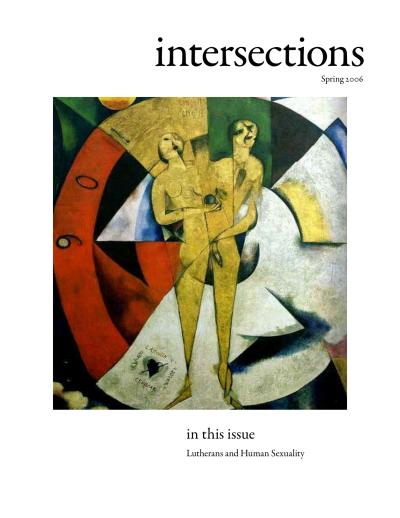 Editorial
From the Publisher
Arne Selbyg
No. 22 · Spring 2006
Selbyg notes that both the ELCA and Intersections have undergone major changes this year—the Division for Higher Education and Schools is gone, replaced by the Educational Partnerships and Institutions group within the Vocation and Education unit, and the journal has a new editor (Robert Haak), a new home at Augustana College, a new printer, and a new design. He commends the issue’s focus on human sexuality and points readers to the first draft of Our Calling in Education.
-
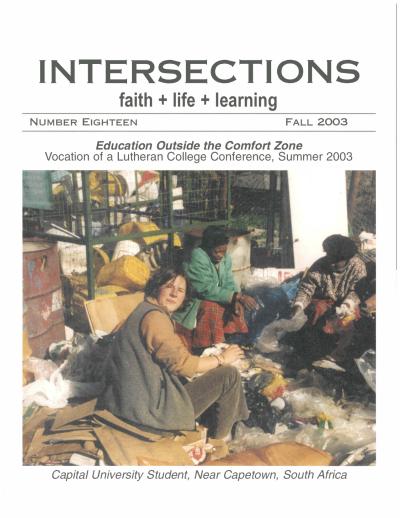 Article
The Search for a Just Peace in a Globalized World
Munib A. Younan
No. 18 · Fall 2003
Younan, Lutheran Bishop in Jerusalem, grounds Palestinian Christian identity in Incarnation theology and a Lutheran theology of grace and the cross, then surveys the Evangelical movement’s nineteenth-century legacy in the Middle East—the 1864 Arabic Bible, ELCJ schools, women’s ordination, and the Middle East Council of Churches. Engaging Edward Said’s critique of Samuel Huntington, he calls for international and local mutual-recognition agreements (including the Jerusalem Lutheran-Anglican agreement and a Lutheran-Reformed agreement in the Middle East), four marks of interfaith dialogue, and a sharp distinction between Lutheran “Evangelical” identity and the Dispensationalist evangelistic Right whose Israel-Palestine scenarios he names a heresy. He closes by proposing concrete scholarship, faculty exchange, and sabbatical partnerships between U.S. Lutheran colleges and the ELCJ’s churches, schools, and Dar al-Kalima Lutheran Academy.
-
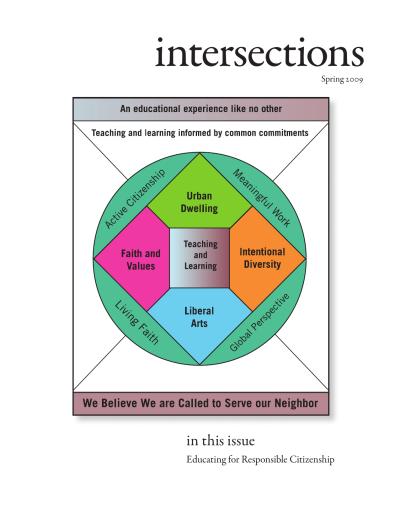 Article
Students in the Cloud: Creating Digital Citizens
Jose Marichal
No. 29 · Spring 2009
Marichal weighs the utopian and dystopian views of the “networked information economy,” drawing on Yochai Benkler, Manuel Castells, Henry Jenkins, Cass Sunstein, Robert Putnam, Nicholas Carr, and Andrew Keen to chart the promise and peril of life “in the cloud,” and proposes Aristotle’s intellectual virtue of phronesis—developed through Hubert Dreyfus’s five stages of skill acquisition—as the goal of digital citizenship for college faculty and their students.
-
Editorial
From the Editor
Tom Christenson
No. 17 · Summer 2003
Christenson introduces the four essays by participants in the first Lutheran Academy of Scholars as fruit of the “genuine conversation” that emerges when specialists set aside their lecturers’ podiums to speak as human beings, and welcomes the issue’s additional “Intersections first”—a response to a response to a review—continuing the conversation between Baird Tipson and Robert Benne about the paradigm of Lutheran higher education.