Structure is important. I realize those words land with a bureaucratic “clank” on many ears, but the obvious fact is no community—including a church or a college—can be without it. It is certainly true that where there is no vision, people perish. It is also equally true that without adequate structure, no community can flourish. How an organization is structured tells us a great deal about what it values and how it functions.
Therefore, when an organization restructures, it is worth our attention. The Evangelical Lutheran Church in America (ELCA) is in the midst of such a process and will recommend a new structure for the Division for Higher Education and Schools (DHES). I have been asked to comment about what the Division was like at the beginning and what the recommended change might mean for the church and for the colleges and universities that carry the church’s name.
Colleges and universities have always been a vital part of the Lutheran community. From the beginning of Luther’s reform, three movements can be identified. The first was a movement of reform in the University itself. Note this is not saying it was a 16th century Reformation that occurred in the new and modest setting of Wittenberg University, but rather a renewal of universities. They gained greater intellectual freedom from Luther’s reform, without which, in turn, that reform could not have moved forward. The second movement changed the life and structure of the church, an attempt to renew the church so that it more clearly reflected the centrality of the Gospel which Luther’s scholarship had uncovered. What distinguished Luther’s Reformation from earlier reforms was that those efforts focused essentially on reforming the life of the church. Luther first centered on the thought and theology of the church, a rediscovery of the radical grace of the Gospel and then, from that understanding, sought to shape in new ways the life and structure of the church. And finally, as time went on, there developed a third movement, Pietism, that wished to deepen the spiritual life of the individual.
To change the imagery a bit and place the Lutheran Reformation upon the stage, we can view it in three interrelated scenes: first the University; then the Church; and finally the individual’s spiritual life. When Lutheranism came to this country, the same three emphases came with it. But interestingly, in exactly the opposite order.1
This heritage helps us understand why education has played such a significant role in the life of the Lutheran Church. When the Evangelical Lutheran Church in America was formed, it gave expression to this reality in several ways. One of the most important was through its churchwide structure, which has the primary task of helping the church carry out its national and international work. Only six Divisions were used to focus these efforts, and one of the six was the Division for Higher Education and Schools, named originally, more simply but less accurately, the Division for Education. Some readers will know the Division has three departments with directors and small staffs for Colleges and Universities, 28 across the country; Campus Ministry, some 200 ministries primarily at state institutions, but also including such campuses as Harvard, Yale and Stanford; and Schools, over 2000 early childhood centers, elementary and secondary schools.
Thus the world’s second largest Lutheran church, as it began, gave high visibility to the place of education in the life of this church. It was structured so that educational issues would always be in the mix of churchwide discussions and planning, and that the church would always have a voice in the many areas of college and university life engaged by the Division. It also meant the ELCA could enter, through the Division, into international areas of educational concerns, about which I will say more later. The Division, therefore, signaled a central place for higher education and schools in the heritage and life of this church and was an important symbol of that reality. This is a fact, I would argue, as important as the Division’s work.
But what would hold the work of a Division together that went, as Bishop Steve Bowman once aptly said, from ABC’s to PhD’s? The cohesiveness began with a definition from the late Joseph Sittler. He spoke of education as movement into a larger world. It was a definition well made for the Division, applicable to an early childhood center or to a college. This is what learning is and does for those fortunate enough to participate in it. And, when done well, it takes place at all ages, within every discipline, and continues for a lifetime.
Within the Division we also understood this larger world to be comprised of two levels of reality, the realm of nature engaged through our senses and the realm of the Spirit, within and around the natural, that can and does break into our experience. Those familiar with the work of Houston Smith will recognize this view of the world with two dimensions of reality as that which he calls the “primordial tradition,” a universal view found within every culture throughout time.2 In the Christian tradition out of which our colleges have come, it resonates with what Jesus called the Kingdom of God. The vast majority of people, according to Smith, experience reality in this two dimensional way. Readers of this essay will also recognize it as a view essentially rejected by the Enlightenment, which gradually narrowed its understanding and investigation primarily to the natural order. Much of great value has been accomplished because of it. This narrower view of reality is also found in most of higher education today, but its inadequacy is increasingly called into question, especially in theoretical physics, although the critique is by no means confined to that discipline. The Division sided with the critics.
So the Division, with its work in colleges, universities, campus ministries, elementary and secondary schools and early childhood centers cohered around an understanding of education as movement into a larger world. From this center, the Division carried out its work by developing various programs that sought to advance three main goals.
To name one of the goals, we wanted to help strengthen educational excellence in our colleges and universities. We used the academy’s definition of excellence in terms of faculty degrees from quality institutions, publications, and especially competence as classroom teachers; A second goal for our programs was to assist the colleges and universities in bringing the Christian theological heritage into academic settings. I sometimes liked to say to the more secular faculty or administrators on our campuses that the colleges of which they were a part would not exist if it were not for the life, death and resurrection of Jesus. Jaws dropped. I meant nothing esoteric by such a statement but simply the fact that without the reality it pointed to, there would be no Christian church, nor that part of it called Lutheran and therefore no people who founded the institutions we now have. But not only heritage gave reason for our colleges and universities to explore theological issues. Such reflection in classrooms and experiences of worship in chapels deepen the learning life of the campus. And thirdly, we wanted the work we did to enhance community on our campuses, glaringly lacking in far too much of higher education today.
The Division therefore centered its work on tasks that would enhance excellence, deepen theological reflection in academic settings, and enrich our schools as communities of faith and learning. I am convinced such efforts strengthen our campuses as places able to “probe both the deep places of the human mind and the deep longings of the human spirit,” to quote a phrase from a speech the late Ernest Boyer once used to praise the colleges and universities of the ELCA. It is unfortunately clear such places are not easily found in higher education today. We worked to help our colleges and universities provide this rare and rich experience to those who were a part of them. If this were done, then the more traditional task of an educational structure in a churchwide office, to help educate the next generation of leaders for church and society, would be enhanced. And students would be moved into a larger world.
This was the center of the Division’s efforts. We wanted it reflected in our work with boards, administrators, faculty, and students. It also stands behind the effort to promote an understanding of vocation in our schools, the faculty conferences on the Vocation of a Lutheran College, the Lutheran Academy of Scholars, the publication of this journal, and the establishment of the Conrad Bergendoff Series of publications on faith and learning in higher education, which to this point includes two books: Ernest L. Simmons, Lutheran Higher Education: An Introduction for Faculty (Minneapolis: Augsburg Fortress, 1993); and Tom Christenson, The Gift and Task of Lutheran Higher Education (Minneapolis: Augsburg Fortress, 2004).
As I indicated earlier, there was also a strong international dimension to DHES. A part of it can be seen in the program to educate in our colleges and universities one hundred Namibian students, an effort well-known and respected. It produced a cadre of young leaders to help their nation break free from the shackles of Apartheid. There is ongoing work, centered in New Delhi, with colleges in India and other areas of the Near East. And there is the present effort of the Division’s department for schools to strengthen elementary schools in the Evangelical Lutheran Church of Palestine. We also helped establish and lead conferences in developing countries, using international settings such as Bethlehem University and Jerusalem, at which educational leaders from developing nations participated with educational leaders from the Vatican and other church bodies. All of this, and much more, was done with competent staff and board members, many of whom I had the pleasure of working with for thirteen years. I think it is a fair evaluation to say the work was done effectively for both the colleges and the church.
And now we are in a process to transition the Division for Higher Education and Schools into the much larger and more broadly focused Division for Vocation and Education. It will be a Division that merges much of the work of the Division for Ministry with that of DHES. Since I am no longer connected to the Division for Higher Education and Schools and have not been since my retirement in 2000, I am less aware of the significance of this proposal than others. I understand that after some initial mistakes the process has moved forward more effectively and will likely be adopted. The work of the Division with colleges and universities, campus ministries, and schools will be brought together with the ELCA’s eight seminaries, various forms of youth ministry, as well as with other areas of ministry. Those who support the transition think it could create a web of connections that might be helpful to the colleges and universities—perhaps, for example, in the area of recruiting.
My concern is twofold: will the new structure signal to both those within and outside the ELCA the core significance of education in the heritage and life of this church; and, secondly, can it carry forward the effectiveness and scope of DHES’ work with the colleges and universities (as well as with campus ministries and schools)? I am more hopeful about the second concern—the ongoing work. I am less certain about the first. In the twentieth century, the relationship between churches and their colleges has frequently collapsed, a story familiar to all of us. The ELCA has been regarded by many in higher education and in other church bodies as a church where the relationship is healthy. This has been the result of a great deal of concern and effort in a network of relationships involving many people, and a very important core of those relationships has been maintained and developed through DHES. Will the new structure be able to give these relationships the same attention, or will they become obscured because of the larger focus of the new Division for Vocation and Education? I know the leadership of the ELCA and the college and university presidents do not wish this into the amazing and changing vitality of the educational environment where exciting and important ideas are flying around. You are a significant sign of this church’s heritage and involvement in this creative process. Whoever you may be, God bless you, the Division you will lead, the colleges and universities, and the church from which they came.
Endnotes
1 The distinguished Yale historian, Professor Emeritus Jaroslav Pelikan, has used similar terminology in speaking of the Reformation, citing first a university phase, then a period of orthodoxy, and finally Pietism. Pelikan’s views are noted in a speech by Donald Hetzler delivered to a Campus Ministry gathering in May of 2003.
2 Huston Smith, Forgotten Truth: The Primordial Tradition, Philadelphia: Fortress Press, 1976.
-
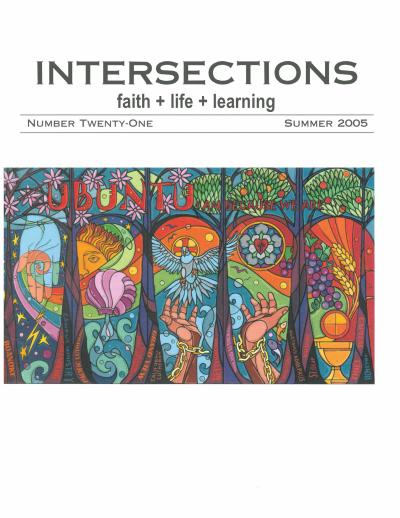 Editorial
From the Publisher
Arne Selbyg
Selbyg notes that ELCA colleges and universities have remained more loyal to the church than the institutions of many other denominations and announces that with this issue Tom Christenson’s nine-year service as editor of Intersections comes to an end, with Bob Haak of Augustana College in Rock Island assuming the editorship and institutional support shifting from Capital to Augustana.
-
Editorial
From the Editor
Tom Christenson
In his valedictory letter as outgoing editor, Christenson recounts the 1994 origins of Intersections, when he took the idea to Naomi Linnell and Jim Unglaube at DHES and persuaded the council of presidents to launch the journal on a shoestring with printing paid by DHES and everything else by Capital University. He summarizes the issue’s contents—papers from the 2004 Vocation of a Lutheran College Conference plus two commissioned pieces from former DHES directors Bob Sorensen and Leonard Schulze—and thanks the student copy editors and Capital’s presidents and provosts who sustained the publication.
-
Article
The Church in Education? Education in the Church? Ten Theses on Why These Questions Matter
Leonard G. Schulze
Writing in the months before the August 2005 Churchwide Assembly that will decommission DHES, Schulze frames his vision for the division as ten Lutheran-style theses, each followed by Luther’s catechetical question “What does this mean?” He argues that critical thinking and moral deliberation are in the Lutheran gene pool; that Luther’s devotion to learning was an expression of Christian vocation; that the rise of the research university and the binary public meaning of “evangelical” have marginalized church-related colleges; that DHES has been wrongly perceived as marginal; and that the reformed concept of vocation must drive the soon-to-be-created program unit for Vocation and Education. An appendix reproduces the 2005 DHES strategic planning overview.
-
Article
Private University, Public Witness: Life in the "None Zone"
Loren J. Anderson
Drawing on sixteen years at Concordia College in Moorhead and twelve at Pacific Lutheran University, Anderson contrasts the Lutheran heartland with the Pacific Northwest’s “None Zone”—Patricia Killen and Mark Silk’s name for the country’s least churched region—and argues that a faithful Lutheran witness is possible in this changing context. He proposes five callings for the colleges—an academic program shaped by both educational philosophy and Lutheran theology, vibrant campus communities of faith and learning, inclusiveness and ecumenical outreach, global vision, and vocational exploration—and closes by sketching PLU’s shift toward “partnership” congregations and a new Center of Religion, Culture and Society in the Western United States.
-
Reflection
Finding Words That Matter (Proverbs 1:20-21; 4:10-13)
Harvard Stevens Jr.
In a brief homiletic reflection on Proverbs, Stevens addresses Lutheran educators as “merchants of wisdom” competing with a crowded contemporary marketplace of internet, cable TV, and rap music alongside “Hedonism 101,” “Advanced Voyeurism,” and “Pure Escapism.” Recounting an evening with a Carthage student poetry club, he shares the poem wisdom whispered to him there and offers thanks for the high calling to teach “words that matter.”
-
Poem
Sprigs of Mint
Caitlin McHugh
McHugh meditates on three light green mint stalks dying in a plastic cup of water in her window frame’s shadow, drawing a parallel between the neglected mint, the “tainted papers” of her unread journals, and the time that both holds her back and drives her forward.
-
Article
Money, Sex and Power: An Exploration of Some Controversial Issues in the Public Witness of the Church
Pamela K. Brubaker
Brubaker explores two controversial issues in the church’s public witness—homosexuality and economic life—and the challenges they present for both church and college. Drawing on Beverly Harrison, Elizabeth Bounds, Ron Thiemann, Linell Cady, Marcia Bunge, Richard Hughes, Darrell Jodock, Ernest Simmons, Karen Bloomquist, Garth Kasimu Baker-Fletcher, and Larry Rasmussen, and on episodes at California Lutheran University around “Harmony Week” and Bishop Paul Egertson’s participation in Anita Hill’s ordination, she argues that colleges related to the ELCA are called to educate for “critical citizenship” by hosting rigorous, bold, and unfettered debate—including debate over the neo-liberal globalism that she names a form of economic fundamentalism.
-
Article
Education as a Christian (Lutheran) Calling
Tom Christenson
Christenson opens with an imaginative reconstruction of early Christian communities as radically egalitarian, pacifist, communitarian gatherings within the Roman Empire and argues that such communities are natural homes for the educational vocation. Naming two temptations for contemporary Christian higher education—the parochial Bible school and “Generic U”—he uses his friend Sig Rauspern’s tree metaphor to insist that a university is Christian in its trunk and roots rather than in grafted-on branches. Drawing on Wendell Berry, Jacob Bronowski, Walter Wink, Douglas John Hall, and his own Gift and Task of Lutheran Higher Education, he names faithful criticism, engaged suspiciousness, simul justus et peccator, and a fallible, love-related Lutheran epistemology as the particular gifts Lutherans bring to the Christian educational calling.
-
 Response
Response to Mark Wilhelm: Vocation—Wide Perspective Questions
Mary-Paula Cancienne
No. 56 · Fall 2022
Cancienne, drawing on Iain McGilchrist, asks whether higher education has prioritized micro lenses at the expense of the macro view, and invites educators to hold the drama of individual vocation stories within a wider plot that includes James Webb Telescope wonder, climate grief, the long shadow of enslavement, and the resilience of native populations.
-
 Article
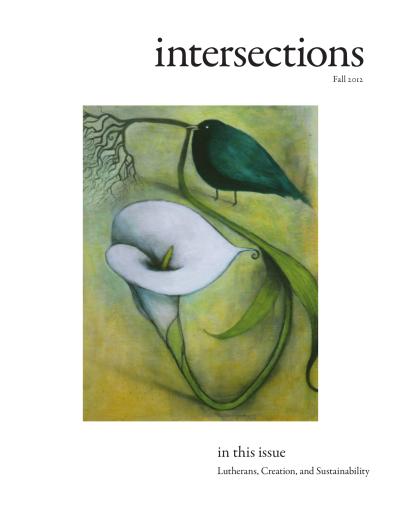
A Traveler's Manifesto for Navigating the Creation
Ann Pederson
No. 36 · Fall 2012
Pederson asks who we are, where we are, and how then we shall live within the Epic of Evolution and the doctrines of creation, incarnation, and imago dei. Drawing on John 3:16 (“For God so loved the cosmos…”), Luther on God’s presence “in the veins of a leaf,” Augustine’s City of God, Phil Hefner’s “created co-creator,” Joseph Sittler’s “Called to Unity,” and Norman Maclean’s Young Men and Fire, she argues for a cosmic reading of incarnation in which all of creation—not only the human—bears the image of God.
-
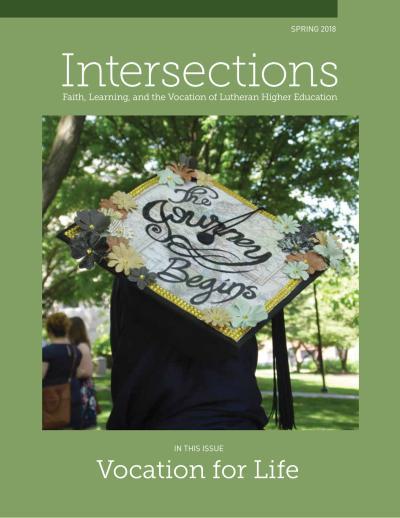 Article
One Life, Many Callings: Vocation Across the Lifespan
Katherine Turpin
No. 47 · Spring 2018
Turpin, drawing on the collaborative research behind Calling All Years Good, traces how vocational discernment shifts through adolescence, younger adulthood, middle adulthood, late adulthood, and older adulthood — arguing that focusing vocation on entry into the workforce limits the capacity of intergenerational college communities to wrestle with calling throughout life.
-
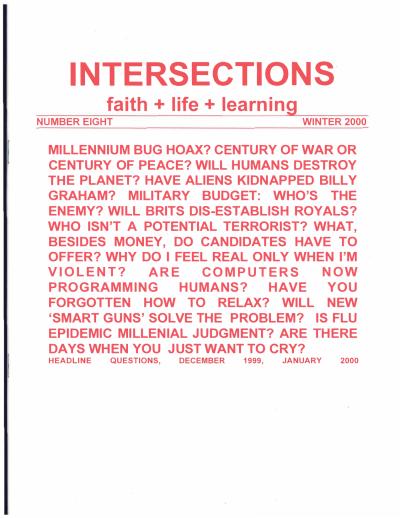 Editorial
From the Publisher
Arne Selbyg
No. 8 · Winter 2000
Selbyg reflects on the origins of Intersections—begun out of concern that the philosophy and theology behind Lutheran higher education could be lost to retirements and other preoccupations—and credits Paul Dovre of Concordia and Robert Sorensen of the ELCA Division for Higher Education and Schools as key figures behind the resumption of the debate. He points to three recent books (Ernest Simmons’s Lutheran Higher Education, Paul Contino and David Morgan’s The Lutheran Reader, and Pamela Schwandt’s Called to Serve) and to the new Lutheran Academy for Scholars in Higher Education, and previews the next “Vocation of a Lutheran College” conference at Dana College in August on what differentiates Lutheran colleges within American higher education.
-
 Response
Finding the Words: The Trouble of Being California Lutheran University
Pamela M. Jolicouer
No. 6 · Winter 1999
Jolicoeur, provost and vice president for academic affairs at California Lutheran, recounts the marketing problem of a university whose middle name is Lutheran in a Southern California religious landscape where the operative modifier is “Christian” (Pepperdine, Azusa Pacific) and tests Christenson’s three themes against her own “alumni magazine test”—the Jesuit standard set by Santa Clara. She concludes that freedom, gift, and vocation, though not uniquely Lutheran, are the words she can actually use: with prospective faculty, with the constituent church bodies who pressed for “Christian” in the new CLU mission statement (compromise: “rooted in the Lutheran tradition of Christian faith…”), and with the “C student” alumna headed for a Ph.D. in psychology whose consciousness of her own gifts had evaporated.
-
 Article
Serving Two Masters: Teaching and Writing Between Academy and Church
John Reumann
No. 9 · Summer 2000
Reumann reflects on more than fifty years navigating between academy and church—the Society of Biblical Literature and Exegesis (whose Doktorvater Morton Enslin was unceremoniously dumped at Toronto by “young Turks” Robert Funk and others, while Harry Orlinsky saved the day at the centennial), the 1978–1987 New American Bible Revised New Testament committee with its bishops, the U.S. Lutheran–Roman Catholic dialogue volume on “Righteousness,” and the 1999 Joint Declaration on Justification—and uses his Anchor Bible and Augsburg commentaries on Philippians, Colossians, and Romans to illustrate Krister Stendahl’s judgment that one can no longer master all the literature: epistolary research, rhetorical and discourse analysis, social-world readings, feminist scholarship on Euodia and Syntyche, the koinonia and friendship debates (Sampley, Fitzgerald, Witherington), and the house-church recovery of Filson. The academy is antepenultimate, the church penultimate, God ultimate—professors as “believers, testifiers, witnesses” serving pro bono, pro ecclesia, and pro Deo.